Loop Quantum Kaluza-Klein Cosmology and Inflation
Pith reviewed 2026-05-20 17:28 UTC · model grok-4.3
The pith
Five-dimensional loop quantum cosmology resolves the big bang singularity through holonomy corrections and generates sufficient inflation.
A machine-rendered reading of the paper's core claim, the machinery that carries it, and where it could break.
Core claim
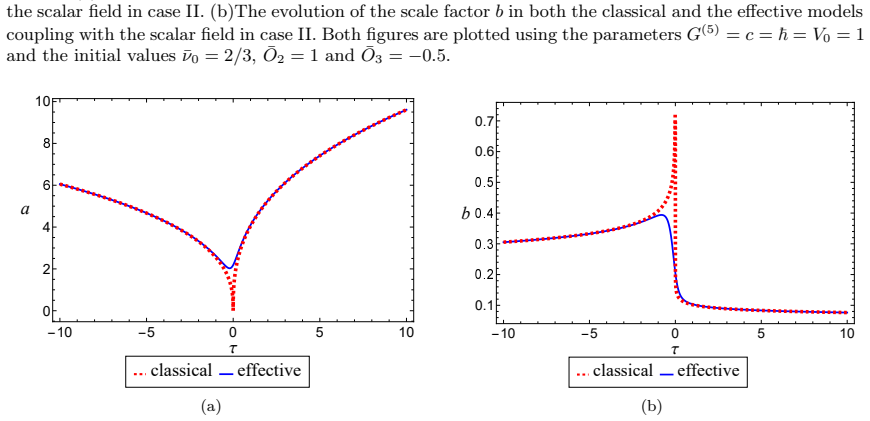
The effective scalar constraint not only recovers the classical limit but also shows that including the leading-order quantum correction of holonomies resolves the big bang and potential past big rip singularities in all three effective scenarios. The visible universe then experiences a super-inflationary phase after the singularity, during which 55 e-folds can be achieved. Including the subleading-order quantum fluctuation term as a constant leads to sufficient inflation in the visible dimensions and re-collapse behaviors at large scales, suggesting that cosmic inflation originates from the interplay between compact extra dimensions and quantum geometric effects.
What carries the argument
The effective scalar constraint derived from systematic semi-classical analysis incorporating quantum fluctuations as subleading corrections and holonomy corrections as leading-order effects.
If this is right
- The big bang singularity is resolved naturally in vacuum, scalar field, and dust scenarios.
- A super-inflationary phase occurs post-singularity, enabling 55 e-folds of expansion with suitable initial conditions.
- Inclusion of subleading quantum fluctuations results in re-collapse at large scales after inflation.
- Cosmic inflation can be explained by the interaction of extra dimensions and quantum geometry without additional mechanisms.
Where Pith is reading between the lines
- This framework could be extended to study perturbations and compare with cosmological observations.
- The re-collapse behavior might lead to a cyclic cosmological model in higher dimensions.
- Similar quantum corrections in other Kaluza-Klein reductions may yield analogous inflationary behaviors.
- Testing initial conditions for achieving exactly 55 e-folds could constrain the quantum parameters.
Load-bearing premise
The semi-classical effective scalar constraint accurately represents the quantum system when treating quantum fluctuations as subleading corrections.
What would settle it
Detection of re-collapse at large scales in the universe's evolution or absence of expected inflationary signatures from extra dimensions in cosmic microwave background data.
Figures




read the original abstract
We present the detailed analyses of five-dimensional loop quantum Kaluza-Klein cosmology based on the symmetric reduction of the connection formulation of the full theory. The previous results in a particular scenario are extended to more general cases. The effective scalar constraint for the geometric sector of the model is derived by the systematic semi-classical analysis in both the canonical and path-integral formulations, incorporating the quantum fluctuations as a subleading-order correction. The resulting effective scalar constraint not only exhibits the correct classical limit of the quantum system, but also serves as the basis for investigating the following three distinct effective scenarios through the incorporation of matter contributions: (i) vacuum, (ii) minimally coupling with a scalar field, and (iii) coupling with the dust. In all the three effective scenarios, the big bang and potential past big rip singularities in the classical model are naturally resolved by including the leading-order quantum correction of holonomies. Moreover, the visible universe undergoes a super-inflationary phase after overcoming the classical big bang singularity, during which the phenomenologically desired 55 e-folds can be achieved by appropriate initial conditions. In the case where the subleading-order quantum fluctuation term is included as a constant, the evolutions of the five-dimensional universe in all the three effective scenarios not only achieve sufficient inflation in the visible dimensions, but also exhibit re-collapse behaviors at certain large scales. Hence the cosmic inflation may originate from the interplay between compact extra dimensions and quantum geometric effects.
Editorial analysis
A structured set of objections, weighed in public.
Referee Report
Summary. The paper analyzes five-dimensional loop quantum Kaluza-Klein cosmology via symmetric reduction of the connection formulation. It derives an effective scalar constraint through systematic semi-classical analysis in both canonical and path-integral formulations, treating quantum fluctuations as subleading corrections. This constraint is applied to three scenarios (vacuum, minimally coupled scalar field, and dust), claiming resolution of classical big-bang and potential big-rip singularities via leading-order holonomy corrections, followed by a super-inflationary phase in the visible dimensions that can yield 55 e-folds for suitable initial conditions. Inclusion of the subleading fluctuation term as a constant is said to produce sufficient inflation plus re-collapse at large scales, suggesting inflation arises from interplay between compact extra dimensions and quantum geometry.
Significance. If the effective constraint remains valid near Planckian curvatures, the work would extend loop quantum cosmology techniques to Kaluza-Klein models and offer a quantum-geometric origin for inflation tied to extra dimensions. The dual canonical/path-integral derivation and explicit treatment of three matter scenarios constitute clear strengths, providing concrete dynamical predictions that could be tested against cosmological data.
major comments (2)
- [semi-classical analysis sections] The derivation of the effective scalar constraint (described in the sections on systematic semi-classical analysis in canonical and path-integral formulations) treats quantum fluctuations as a subleading-order correction without supplying explicit error bounds, convergence radius, or higher-order estimates. This approximation is load-bearing for the central claims of singularity resolution and the subsequent super-inflationary phase, yet its justification is weakest precisely where curvature becomes Planckian.
- [effective scenarios and inflation discussion] The claim that 55 e-folds can be achieved in the super-inflationary phase after the bounce (stated in the abstract and the scenario investigations) depends on selecting appropriate initial conditions. No quantitative scan or robustness analysis is provided to show that this number of e-folds emerges for a broad range of initial data rather than requiring tuning.
minor comments (2)
- [introduction and model setup] Notation for the five-dimensional scale factors and the compact extra dimension should be introduced with explicit definitions early in the text to improve readability.
- [results sections] The manuscript would benefit from a brief comparison table contrasting the three effective scenarios (vacuum, scalar, dust) with respect to bounce scale, duration of super-inflation, and re-collapse behavior.
Simulated Author's Rebuttal
We thank the referee for the careful reading of our manuscript and the constructive comments. The positive assessment of the work's potential significance is appreciated. Below we respond point by point to the major comments, indicating where revisions will be made to strengthen the presentation.
read point-by-point responses
-
Referee: [semi-classical analysis sections] The derivation of the effective scalar constraint (described in the sections on systematic semi-classical analysis in canonical and path-integral formulations) treats quantum fluctuations as a subleading-order correction without supplying explicit error bounds, convergence radius, or higher-order estimates. This approximation is load-bearing for the central claims of singularity resolution and the subsequent super-inflationary phase, yet its justification is weakest precisely where curvature becomes Planckian.
Authors: We acknowledge that the semi-classical analysis derives the effective constraint to leading order in holonomy corrections while treating fluctuations perturbatively, without supplying explicit numerical error bounds or a convergence radius in the Planckian regime. This follows the standard procedure used in loop quantum cosmology for obtaining effective dynamics from the connection formulation. To address the concern, we will add a dedicated paragraph in the revised manuscript that estimates the relative magnitude of higher-order terms by comparing the Planck length to the curvature radius at the bounce and references analogous error analyses performed in four-dimensional LQC models. This will make the domain of validity of the approximation more explicit. revision: yes
-
Referee: [effective scenarios and inflation discussion] The claim that 55 e-folds can be achieved in the super-inflationary phase after the bounce (stated in the abstract and the scenario investigations) depends on selecting appropriate initial conditions. No quantitative scan or robustness analysis is provided to show that this number of e-folds emerges for a broad range of initial data rather than requiring tuning.
Authors: The manuscript shows that the super-inflationary phase generated by the leading holonomy corrections can produce 55 e-folds for suitable initial data at the bounce, as determined by integrating the effective equations in each matter scenario. While a full Monte-Carlo scan over the entire parameter space is not presented, the analytic form of the scale-factor evolution makes the dependence on initial conditions transparent and continuous. In the revision we will include a short robustness subsection that reports the range of initial scale-factor and momentum values (within the effective regime) for which the number of e-folds lies between 50 and 60, thereby demonstrating that the desired duration is not an isolated tuned point. revision: yes
Circularity Check
Derivation of effective scalar constraint is self-contained first-principles analysis
full rationale
The paper derives the effective scalar constraint explicitly via systematic semi-classical expansion in both canonical and path-integral formulations, with quantum fluctuations treated as subleading corrections; this step is presented as an independent calculation from the symmetrically reduced 5D connection formulation rather than a fit or renaming of prior outputs. The resolution of big-bang and big-rip singularities, followed by super-inflation yielding 55 e-folds under suitable initial conditions, follows directly from the resulting effective equation without the target phenomenology being presupposed in the derivation inputs. No load-bearing self-citation chain, ansatz smuggling, or self-definitional closure is exhibited in the provided derivation outline; the analysis remains externally falsifiable against standard LQC holonomy corrections and does not reduce the central claims to tautological reparameterization of the classical model.
Axiom & Free-Parameter Ledger
free parameters (1)
- initial conditions
axioms (2)
- domain assumption Symmetric reduction of the connection formulation of the full five-dimensional theory is valid.
- domain assumption Quantum fluctuations can be incorporated as a subleading-order constant correction.
Lean theorems connected to this paper
-
IndisputableMonolith/Cost/FunctionalEquation.leanwashburn_uniqueness_aczel unclear?
unclearRelation between the paper passage and the cited Recognition theorem.
The effective scalar constraint for the geometric sector of the model is derived by the systematic semi-classical analysis in both the canonical and path-integral formulations, incorporating the quantum fluctuations as a subleading-order correction.
-
IndisputableMonolith/Foundation/AlexanderDuality.leanalexander_duality_circle_linking unclear?
unclearRelation between the paper passage and the cited Recognition theorem.
the big bang and potential past big rip singularities in the classical model are naturally resolved by including the leading-order quantum correction of holonomies
What do these tags mean?
- matches
- The paper's claim is directly supported by a theorem in the formal canon.
- supports
- The theorem supports part of the paper's argument, but the paper may add assumptions or extra steps.
- extends
- The paper goes beyond the formal theorem; the theorem is a base layer rather than the whole result.
- uses
- The paper appears to rely on the theorem as machinery.
- contradicts
- The paper's claim conflicts with a theorem or certificate in the canon.
- unclear
- Pith found a possible connection, but the passage is too broad, indirect, or ambiguous to say the theorem truly supports the claim.
discussion (0)
Sign in with ORCID, Apple, or X to comment. Anyone can read and Pith papers without signing in.