Multicomponent Grain Boundary Segregation Dilute-Limit Model and Its Effect on Nanocrystalline Stability
Pith reviewed 2026-06-25 23:16 UTC · model grok-4.3
The pith
A spectral model for arbitrary solutes shows multicomponent segregation expands the range of nanocrystalline alloys stable against grain growth and phase separation.
A machine-rendered reading of the paper's core claim, the machinery that carries it, and where it could break.
Core claim
We derive a spectral segregation model for an arbitrary number of solutes in the dilute limit (neglecting solute-solute interactions) and demonstrate that multicomponent segregation substantially expands the range of nanocrystalline alloys thermodynamically stable against both grain growth and phase separation.
What carries the argument
The spectral segregation model for multicomponent systems in the dilute limit, which computes stabilization energies across any number of solutes without pairwise interactions.
If this is right
- Stabilization calculations become possible for alloys containing any number of solute species rather than only pairs.
- The predicted thermodynamic stability window against grain growth and phase separation grows larger as more solutes are added.
- A broader set of alloy compositions can maintain nanocrystalline grain sizes without coarsening or decomposing.
- Binary-only models systematically underestimate the range of viable nanocrystalline materials.
Where Pith is reading between the lines
- Design of practical multicomponent nanocrystalline alloys for elevated temperatures could draw directly on the expanded stability maps.
- Experiments could test the model by preparing ternary or quaternary nanocrystalline samples and checking whether grain growth is suppressed at the compositions the model flags as stable.
- The dilute-limit framework might be extended to include weak solute interactions as a next step when concentrations increase.
Load-bearing premise
Solute-solute interactions remain negligible at the concentrations considered.
What would settle it
A measured segregation profile or observed grain-size stability limit in a multicomponent nanocrystalline alloy that deviates from the model's prediction while concentrations are still low enough for the dilute approximation to hold.
Figures
read the original abstract
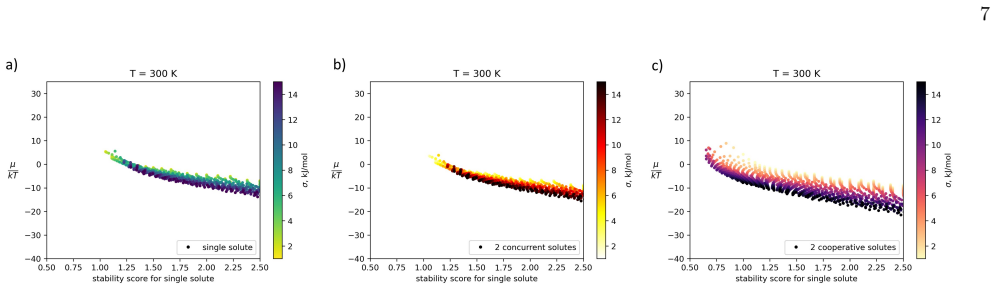
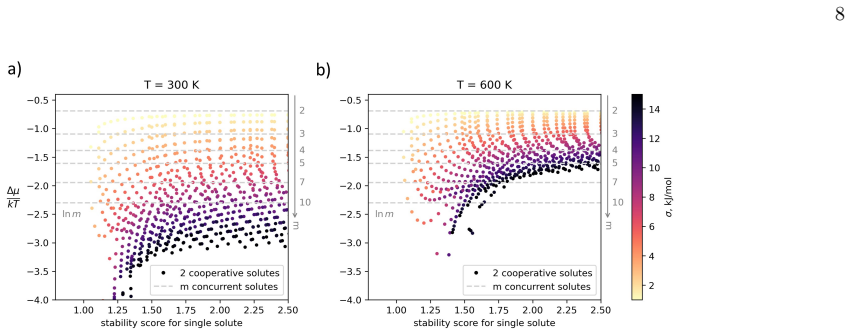
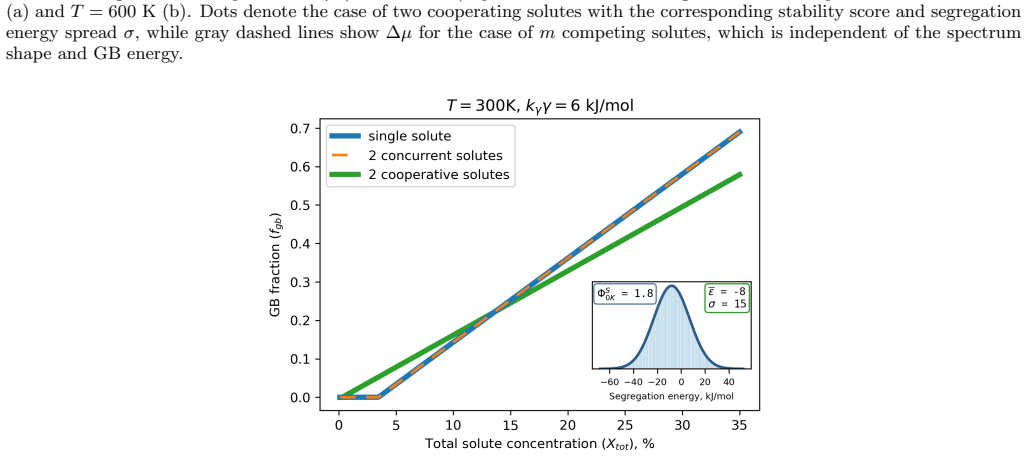
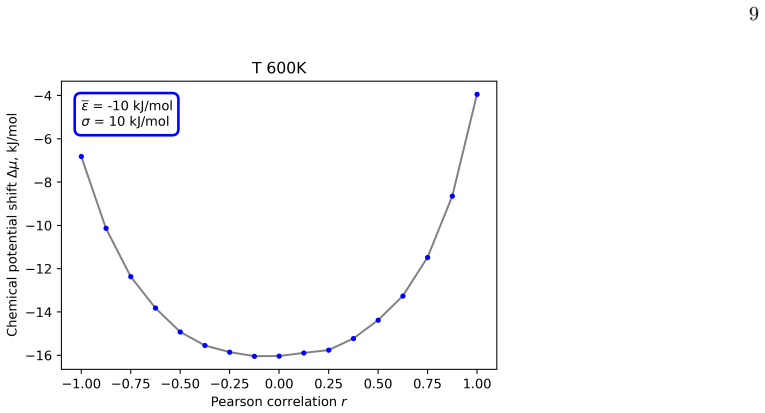
Grain boundary segregation of solutes is a powerful tool for stabilizing nanocrystalline materials. However, previous studies developed an approach to calculate stabilization only in binary systems. In this work, we derive a spectral segregation model for an arbitrary number of solutes in the dilute limit (neglecting solute--solute interactions) and demonstrate that multicomponent segregation substantially expands the range of nanocrystalline alloys thermodynamically stable against both grain growth and phase separation.
Editorial analysis
A structured set of objections, weighed in public.
Referee Report
Summary. The manuscript derives a spectral segregation model for grain boundary segregation energies of an arbitrary number of solutes under the explicit dilute-limit assumption (neglecting solute-solute interactions). It inserts these energies into the standard nanocrystalline free-energy functional to obtain a stability criterion against grain growth and phase separation, showing that the multicomponent case expands the stable region via additive independent linear terms.
Significance. If the derivation holds, the work supplies a straightforward generalization of prior binary models to N-component systems within the dilute limit. The additive structure of the free-energy terms provides a transparent route to stability maps for multicomponent nanocrystalline alloys, which could aid alloy design. The paper explicitly acknowledges the dilute-limit scope and demonstrates internal algebraic consistency without circularity or hidden fitted parameters.
minor comments (3)
- [§2] §2 (model derivation): the transition from the single-solute spectral energies to the multicomponent free-energy expression is presented as a direct sum; an explicit equation showing the N-solute extension of the binary functional would improve traceability.
- [Figure 3] Figure 3 (stability maps): the plotted boundaries for ternary and quaternary cases are shown without error bands or sensitivity analysis to the input segregation energies; adding this would clarify robustness of the claimed expansion.
- [§4] §4 (discussion): the statement that the model 'substantially expands' the stable range is supported by example calculations, but a general inequality proving the expansion for any set of positive segregation energies would strengthen the central claim.
Simulated Author's Rebuttal
We thank the referee for their positive assessment of the manuscript and for recommending minor revision. The review correctly identifies the core contribution as a dilute-limit generalization of prior binary models to arbitrary numbers of solutes, with additive terms in the stability criterion. No major comments were raised, so we have no specific points to address point-by-point.
Circularity Check
No significant circularity; multicomponent extension is additive and self-contained
full rationale
The derivation starts from the explicit dilute-limit assumption (no solute-solute interactions) and extends the binary segregation model to N solutes by treating each solute's segregation energy as an independent linear term. These energies are inserted into the standard nanocrystalline free-energy functional to obtain stability criteria against grain growth and phase separation. The claimed expansion of the thermodynamically stable region follows directly from this additive structure. No step reduces a prediction to a fitted input by construction, invokes a self-citation as the sole justification for a uniqueness claim, or renames a known result; the algebra is internally consistent within the stated scope and the dilute-limit restriction is acknowledged.
Axiom & Free-Parameter Ledger
axioms (1)
- domain assumption Dilute limit where solute-solute interactions can be neglected for arbitrary number of solutes
Reference graph
Works this paper leans on
-
[1]
Gleiter, Nanocrystalline materials, Progress in Materials Science33, 223 (1989)
H. Gleiter, Nanocrystalline materials, Progress in Materials Science33, 223 (1989)
1989
-
[2]
Petrov, P
I. Petrov, P. B. Barna, L. Hultman, and J. E. Greene, Microstructural evolution during film growth, Journal of Vacuum Science & Technology A21, S117 (2003)
2003
-
[3]
H. R. Peng, M. M. Gong, Y. Z. Chen, and F. Liu, Thermal stability of nanocrystalline materials: thermodynamics and kinetics, International Materials Reviews62, 303 (2017)
2017
-
[4]
Chookajorn, H
T. Chookajorn, H. A. Murdoch, and C. A. Schuh, Design of stable nanocrystalline alloys, Science337, 951 (2012)
2012
-
[5]
Antonaia, M
A. Antonaia, M. L. Addonizio, S. Esposito, M. Ferrara, A. Castaldo, A. Guglielmo, and A. D’Angelo, Adhesion and structural stability enhancement for ag layers deposited on steel in selective solar coatings technology, Surface and Coatings Technology255, 96 (2014)
2014
-
[6]
Gledhill, Steyer, Weiss, and Hildebrandt, HiPIMS and DC magnetron sputter-coated silver films for high-temperature durable reflectors, Coatings9, 593 (2019)
2019
-
[7]
Risse, A
S. Risse, A. Gebhardt, C. Damm, T. Peschel, W. St¨ ockl, T. Feigl, S. Kirschstein, R. Eberhardt, N. Kaiser, and A. T¨ unnermann, Novel TMA telescope based on ultra precise metal mirrors, inAstronomical Telescopes and Instru- mentation, edited by J. M. Oschmann, Jr., M. W. M. de Graauw, and H. A. MacEwen (2008) p. 701016
2008
-
[8]
D. A. Sheikh, S. J. Connell, and R. S. Dummer, Durable silver coating for kepler space telescope primary mirror, inSpace Telescopes and Instrumentation 2008: Optical, Infrared, and Millimeter, Vol. 7010 (2008) p. 70104E
2008
-
[9]
D. S. Samsonov, I. Tereschenko, E. E. Mukhin, A. Gubal, Y. Kapustin, V. Filimonov, N. A. Babinov, A. M. Dmitriev, A. Nikolaev, I. Komarevtsev, A. Koval, A. E. Litvinov, G. Marchii, A. Razdobarin, L. Snigirev, S. Tolstyakov, G. Marinin, D. Terentev, A. E. Gorodetsky, R. K. Zalavutdinov, A. V. Markin, V. Bukhovets, I. Arkhipushkin, A. Borisov, V. I. Khripun...
-
[10]
Jacquet, R
P. Jacquet, R. Podor, J. Ravaux, J. Teisseire, I. Gozhyk, J. Jupille, and R. Lazzari, Grain growth: The key to understand solid-state dewetting of silver thin films, Scripta Materialia115, 128 (2016)
2016
-
[11]
Chason and P
E. Chason and P. R. Guduru, Tutorial: Understanding residual stress in polycrystalline thin films through real-time measurements and physical models, Journal of Applied Physics119, 191101 (2016)
2016
-
[12]
I. B. Tereshchenko, G. V. Marchiy, D. S. Samsonov, E. E. Mukhin, Y. V. Kapustin, V. D. Kalganov, A. R. Gubal, and I. M. Komarevtcev, Highly reflective silver mirror under annealing and hydrothermal exposure, Technical Physics Letters 51, 22 (2025)
2025
-
[13]
Weissm¨ uller, Alloy effects in nanostructures, Nanostructured Materials Proceedings of the First International Conference on Nanostructured Materials,3, 261 (1993)
J. Weissm¨ uller, Alloy effects in nanostructures, Nanostructured Materials Proceedings of the First International Conference on Nanostructured Materials,3, 261 (1993)
1993
-
[14]
J. R. Trelewicz and C. A. Schuh, Grain boundary segregation and thermodynamically stable binary nanocrystalline alloys, Physical Review B79, 094112 (2009)
2009
-
[15]
T. P. Matson, N. Tuchinda, and C. A. Schuh, Overview: The spectral model of grain boundary segregation, Acta Materialia 313, 122109 (2026)
2026
-
[16]
Wagih, Y
M. Wagih, Y. Naunheim, T. Lei, and C. A. Schuh, Designing for cooperative grain boundary segregation in multicomponent alloys, Proceedings of the National Academy of Sciences122, e2511930122 (2025)
2025
-
[17]
Guttmann, Equilibrium segregation in a ternary solution: A model for temper embrittlement, Surface Science53, 213 (1975)
M. Guttmann, Equilibrium segregation in a ternary solution: A model for temper embrittlement, Surface Science53, 213 (1975)
1975
-
[18]
M. Guttmann, Thermochemical interactions versus site competition in grain boundary segregation and embrittlement in multicomponent systems, Journal de Physique IV (Proceedings)05, C7 (1995)
1995
-
[19]
Marchiy, D
G. Marchiy, D. Samsonov, and E. Mukhin, Spectral model for grain boundary segregation in systems with strong solute- solute interactions, Acta Materialia294, 121044 (2025)
2025
-
[20]
Hildebrandt and D
D. Hildebrandt and D. Glasser, Predicting phase and chemical equilibrium using the convex hull of the gibbs free energy, The Chemical Engineering Journal and the Biochemical Engineering Journal54, 187 (1994)
1994
-
[21]
Wagih and C
M. Wagih and C. A. Schuh, Thermodynamics and design of nanocrystalline alloys using grain boundary segregation spectra, Acta Materialia217, 117177 (2021)
2021
-
[22]
D. E. Laughlin and W. A. Soffa, The third law of thermodynamics: Phase equilibria and phase diagrams at low tempera- tures, Acta Materialia145, 49 (2018)
2018
-
[23]
P. P. Fedorov, Third law of thermodynamics as applied to phase diagrams, Russian Journal of Inorganic Chemistry55, 1722 (2010)
2010
-
[24]
Porter, K
D. Porter, K. Easterling, and M. Sherif,Phase Transformations in Metals and Alloys(CRC Press, 2021)
2021
-
[25]
K. Xu, H. Bu, S. Pan, E. Lindgren, Y. Wu, Y. Wang, J. Liu, K. Song, B. Xu, Y. Li, T. Hainer, L. Svensson, J. Wiktor, R. Zhao, H. Huang, C. Qian, S. Zhang, Z. Zeng, B. Zhang, B. Tang, Y. Xiao, Z. Yan, J. Shi, Z. Liang, J. Wang, T. Liang, S. Cao, Y. Wang, P. Ying, N. Xu, C. Chen, Y. Zhang, Z. Chen, X. Wu, W. Jiang, E. Berger, Y. Li, S. Chen, A. J. Gabourie,...
2025
-
[26]
T. Liang, K. Xu, E. Lindgren, Z. Chen, R. Zhao, J. Liu, E. Berger, B. Tang, B. Zhang, Y. Wang, K. Song, P. Ying, N. Xu, H. Dong, S. Chen, P. Erhart, Z. Fan, T. Ala-Nissila, and J. Xu, Nep89: Universal neuroevolution potential for inorganic and organic materials across 89 elements (2025), arXiv:2504.21286 [cond-mat.mtrl-sci]
arXiv 2025
-
[27]
A. Stukowski, Visualization and analysis of atomistic simulation data with OVITO-the open visualization tool, Modelling and Simulation in Materials Science and Engineering18, 10.1088/0965-0393/18/1/015012 (2010)
-
[28]
Pedregosa, G
F. Pedregosa, G. Varoquaux, A. Gramfort, V. Michel, B. Thirion, O. Grisel, M. Blondel, P. Prettenhofer, R. Weiss, 19 V. Dubourg,et al., Scikit-learn: Machine learning in python, The Journal of Machine Learning Research12, 2825 (2011)
2011
-
[29]
Hirel, Atomsk: A tool for manipulating and converting atomic data files, Computer Physics Communications197, 212 (2015)
P. Hirel, Atomsk: A tool for manipulating and converting atomic data files, Computer Physics Communications197, 212 (2015)
2015
-
[30]
Bitzek, P
E. Bitzek, P. Koskinen, F. G¨ ahler, M. Moseler, and P. Gumbsch, Structural relaxation made simple, Phys. Rev. Lett.97, 170201 (2006)
2006
-
[31]
H. J. Berendsen, J. v. Postma, W. F. Van Gunsteren, A. DiNola, and J. R. Haak, Molecular dynamics with coupling to an external bath, The Journal of Chemical Physics81, 3684 (1984)
1984
-
[32]
Wagih, P
M. Wagih, P. M. Larsen, and C. A. Schuh, Learning grain boundary segregation energy spectra in polycrystals, Nature Communications11, 6376 (2020)
2020
-
[33]
A. P. Bart´ ok, R. Kondor, and G. Cs´ anyi, On representing chemical environments, Physical Review B87, 184115 (2013)
2013
-
[34]
Himanen, M
L. Himanen, M. O. J¨ ager, E. V. Morooka, F. Federici Canova, Y. S. Ranawat, D. Z. Gao, P. Rinke, and A. S. Foster, Dscribe: Library of descriptors for machine learning in materials science, Computer Physics Communications247, 106949 (2020)
2020
-
[35]
M. K. Horton, P. Huck, R. X. Yang, J. M. Munro, S. Dwaraknath, A. M. Ganose, R. S. Kingsbury, M. Wen, J. X. Shen, T. S. Mathis, A. D. Kaplan, K. Berket, J. Riebesell, J. George, A. S. Rosen, E. W. C. Spotte-Smith, M. J. McDermott, O. A. Cohen, A. Dunn, M. C. Kuner, G.-M. Rignanese, G. Petretto, D. Waroquiers, S. M. Griffin, J. B. Neaton, D. C. Chrzan, M. ...
2025
-
[36]
A. Jain, S. P. Ong, G. Hautier, W. Chen, W. D. Richards, S. Dacek, S. Cholia, D. Gunter, D. Skinner, G. Ceder, and K. A. Persson, Commentary: The materials project: A materials genome approach to accelerating materials innovation, APL Materials1, 011002 (2013)
2013
-
[37]
S. P. Ong, L. Wang, B. Kang, and G. Ceder, Li-fe-p-o2 phase diagram from first principles calculations, Chemistry of Materials20, 1798 (2008)
2008
discussion (0)
Sign in with ORCID, Apple, or X to comment. Anyone can read and Pith papers without signing in.