REVIEW 3 major objections 4 minor 159 references
Unified remnant models for aligned-spin, precessing, and eccentric binary black hole mergers
T0 review · 3 major / 4 minor · reviewed 2026-08-06 · deepseek-v4-flash
Pith's one-line read A family of analytic fits, anchored to point-particle and equal-mass limits, predicts the remnant mass, spin, peak luminosity, and recoil of black hole mergers from mass ratio 1 to 1000 with accuracy comparable to data-driven surrogates.
desk verdict A practical, unusually candid remnant-modeling paper whose comparable-mass fits are solid; the extend-to-q=1000 claim rests on NR-calibrated BHPT labels and should be read as interpolation, not independent verification. read the letter →
The pith
A machine-rendered reading of the paper's core claim, the machinery that carries it, and where it could break.
The reading
What carries the argument
The carrying mechanism is the decomposition of every remnant quantity into four sectors: a point-particle term fixed by the Kerr ISCO energy and angular momentum, an equal-mass term, a departure sector weighted by $\eta(1-4\eta)$ that interpolates between the two limits, and an asymmetry sector proportional to $\delta_m \chi_a$ that enforces body-exchange symmetry. The symmetric mass ratio $\eta$ and mass-difference parameter $\delta_m$ form a partition of unity, so the equal-mass and point-particle limits are exact by construction and calibrated polynomial corrections act only in between. For precessing binaries the same skeleton is used with augmentation terms in the in-plane spin combinat
What would settle it
Run new, independent numerical-relativity simulations at $q\approx 20,40,60,80$ using a code and initial-data family not represented in the training catalogs, and compare remnant mass, spin, and kick to gwModelRemS; systematic residuals growing toward $q=1000$, or exceeding the cross-validation errors, would falsify the perturbative bridge. For the precessing flow, produce high-accuracy NR kicks for $q\approx 6$–$15$ with large in-plane spins and check whether the claimed roughly 90% coverage still holds; if it drops substantially, the surrogate-derived augmentation is not reliable.
Extended reading notes
Core claim
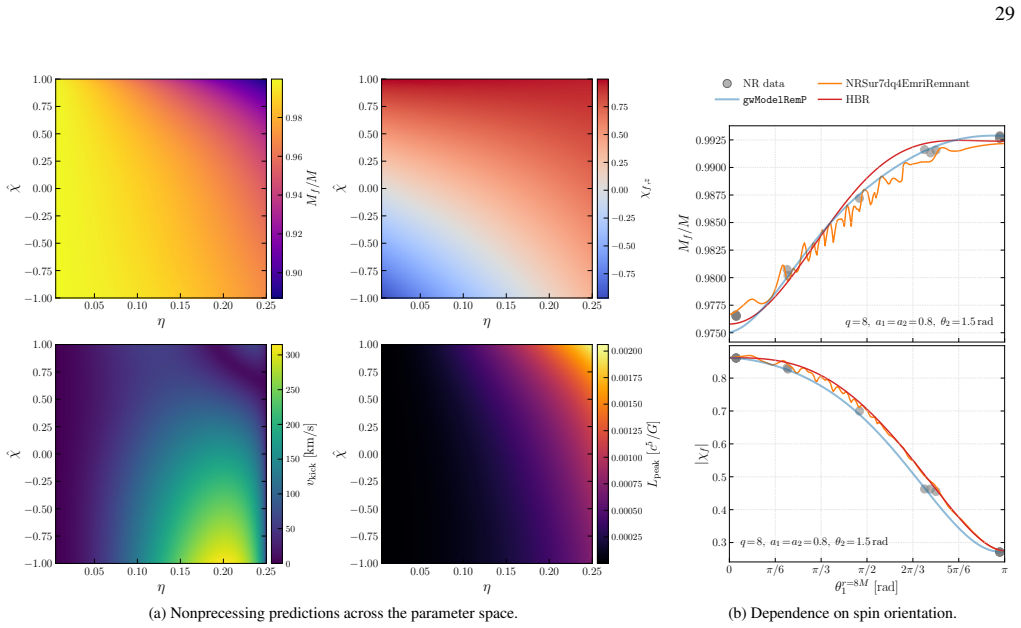
The central claim is that a single symmetry-constrained decomposition—each remnant quantity $Q$ written as $Q_{\mathrm{PP}} + Q_{\mathrm{EM}} + Q_{\mathrm{departure}} + Q_{\mathrm{asymmetry}}$ with $\eta$-dependent weights interpolating between the Kerr ISCO limit and the equal-mass limit—fits the heterogeneous NR/BHPT dataset with median validation errors around $9\times 10^{-5}$ in remnant mass, $2\times 10^{-4}$ in aligned-spin remnant spin, $1.4\%$ in peak luminosity, and $3$ km/s in recoil for gwModelRemS. For precessing binaries, gwModelRemP augments the aligned baseline with in-plane-spin terms and reaches median errors of $4\times 10^{-4}$ in mass, $8\times 10^{-3}$ in spin magnitude
Load-bearing premise
The load-bearing premise is that black-hole perturbation theory waveforms, after empirical rescaling calibrated to numerical relativity, are valid training data from $q\approx 15$ out to $q=1000$, and that surrogate-derived kicks are reliable enough to serve as down-weighted training labels; if either gives way, the claimed high-$q$ extension and the calibrated recoil distributions lose support.
Editorial extensions
If this is right
- If the fits are right, remnant predictions become effectively instantaneous: evaluating 5000 configurations takes about 0.002 seconds for the analytic models and about 0.03 seconds for the flow model, enabling large population-synthesis runs that previously required surrogates.
- The coverage extends to $q=1000$, so current detector events and future space-based observations can use the same remnant model across the intermediate-mass-ratio and extreme-mass-ratio boundary instead of stitching together separate regimes.
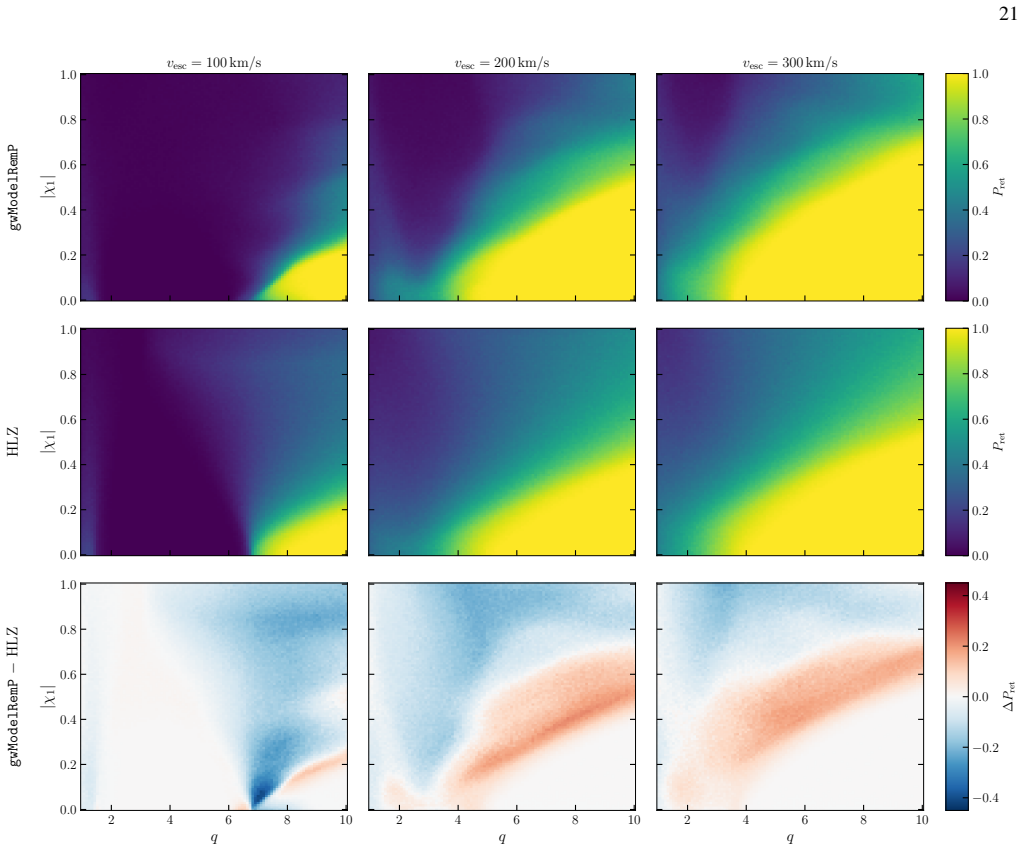
- Calibrated recoil distributions change retention predictions: the paper's application maps show systematically higher remnant retention than an older analytic fit for escape velocities of 100–300 km/s, with the largest differences at mass ratios around $q\approx 4$–$8$.
- Because the models are closed-form and public, they can replace older fitting formulas in gravitational-wave inference and cluster-simulation pipelines without generating waveforms.
- The eccentric extensions are intentionally leading-order and modest: for current eccentric NR data they reduce residuals by about 10% in remnant mass and 14% in remnant spin, so they matter mainly when eccentricity is not subdominant.
Reading between the lines
- Because the BHPT training data are made NR-like by empirical scalings, the claimed $q=1000$ reach is an extrapolation of a calibrated bridge rather than an independent check of perturbation theory; a clean test would be new NR runs at $q\approx 30$–$100$ not used in training.
- The success of the same four-sector decomposition across mass, spin, luminosity, and recoil suggests the structural scaffold may transfer to other remnant problems, such as neutron-star-black-hole mergers, should waveform and flux diagnostics become available.
- The flow's measured calibration (87.9% coverage at the nominal 90% level) implies the seven-dimensional recoil problem can be collapsed to five conditioning variables without obvious miscalibration for isotropic spin populations; anisotropic spin distributions remain a stress test.
- Since the paper explicitly defers deterministic precessing kicks, any application needing a single kick for a specified spin geometry still requires a surrogate; the flow model should not be read as resolving that degeneracy.
Editorial analysis
A structured set of objections, weighed in public.
Referee Report
Summary. The paper constructs a suite of analytic remnant models for binary black hole mergers: gwModelRemS for aligned-spin binaries, gwModelRemP for precessing binaries, gwModelRemSE/gwModelRemPE for eccentric systems, a normalizing-flow model gwModelRemP_flow for precessing recoil-kick distributions, and an analytic EMRI-limit model. The fits are anchored to point-particle/ISCO limits and post-Newtonian-inspired decompositions, and calibrated to a heterogeneous dataset of roughly 5,000 NR and 1,200 BHPT simulations spanning mass ratios up to q=1000. The authors report 5-fold cross-validated median errors of about 9e-5 in remnant mass, 1.8e-4 in remnant spin, 1.4% in peak luminosity, and 2.8 km/s in nonprecessing recoil, with comparable or competitive performance against existing surrogates. The models are made publicly available and are orders of magnitude faster than waveform surrogates.
Significance. If the accuracy and domain claims hold, this is a valuable contribution: fully analytic, fast, public remnant models spanning from equal mass to large mass ratio would be directly useful for GW parameter estimation, population synthesis, and cluster dynamics. The paper has concrete strengths: 5-fold cross-validation is used throughout, coefficient tables with uncertainties are provided, physical limits (Kerr ISCO, equal-mass symmetry, vanishing recoil in symmetric limits) are enforced by construction, and the flux-extraction method for kick labels is benchmarked against SXS catalog values in Appendix E. The main caveat is that the high-mass-ratio extension rests on NR-calibrated BHPT labels and on surrogate-derived kick labels, so part of the validation is in-sample with respect to those labels. This does not invalidate the models but means the advertised domain needs either additional external validation or more cautious wording.
major comments (3)
- [Sec. II A and Sec. II C] The high-mass-ratio validation is not independent of the NR calibration. The BHPT waveforms for 15<=q<=1000 are 'modified using mode-dependent empirical scalings designed to capture nonlinear effects [75-77]', and Refs. [75,77] are themselves NR-calibrated constructions. The 5-fold CV therefore mainly confirms interpolation of these modified-BHPT labels; the quoted BHPT-regime errors (median 4.2e-6 in Mf/M, 0.11 km/s in kick) do not by themselves establish accuracy at q=15-1000. I request an external anchor: hold out RIT q=128 NR data or compare with unmodified second-order self-force data at intermediate q. If no such test is available, the 'equal-mass to EMRI' domain claim should be reworded to make its dependence on the empirical scalings explicit.
- [Sec. III A and Table I] The precessing model's stated domain 1<=q<~1000 exceeds the precessing calibration data. The precessing BHPT subset covers only q=30-100 (Sec. III A; the introduction says 30<=q<=100), and the q>100 behavior rests on the nonprecessing baseline plus augmentation terms fitted only to q<=100. Table I nevertheless lists gwModelRemP as 1<=q<~1000. Either restrict the validity statement to q<~100 for precessing configurations, or provide a quantitative extrapolation test (e.g., leave out all precessing simulations with q>50 and assess the fit there).
- [Sec. III B 4 and Sec. III C] The flow-model validation against NRSur7dq4Remnant is partly a self-consistency check because 5000 training labels are derived from NRSur7dq4 waveforms via gw_remnant. The JSD comparison in Fig. 6 therefore measures agreement with the same surrogate family used to generate labels. Appendix E validates the flux-extraction method on SXS waveforms, which is useful, but it does not validate the NRSur7dq4 waveform labels themselves. Please report the flow's accuracy against direct NR/BHPT kicks separately from the surrogate-informed augmentation, and in the Fig. 7b PP test state the fraction of test points that are direct NR/BHPT versus surrogate-derived.
minor comments (4)
- [Abstract and Sec. III B 4] The phrase 'marginalized over the in-plane spin orientations' is inaccurate. The flow conditions on S_perp and Delta_perp (Eqs. 49-50), which are functions of the in-plane spin components, so it marginalizes only over orientation degrees of freedom not represented in the five-dimensional context. Please revise the abstract/Table I accordingly.
- [Sec. II A] The text first states 'approximately 1400 NR simulations' and 500 BHPT simulations, but the final mass/spin fit uses 1922 simulations after quality-control cuts. This presumably includes the q=1 symmetry augmentation; please state the count reconciliation explicitly.
- [Sec. VI / Table II] The entry for NRSur7dq4EmriRemnant reports a speedup of ~0.8, i.e., it is slower than NRSur7dq4Remnant. The table is otherwise clear, but this entry may confuse readers; consider adding a footnote that only the analytic models are intended to show speed advantages.
- [Sec. IV B] The eccentric correction reduces residuals by 9.9% (mass), 13.7% (spin), and 2.2% (kick). These are modest improvements, as the authors acknowledge. The abstract's phrase 'simple eccentric extensions' could be more explicit that the corrections are leading-order and small relative to quasi-circular scatter.
Circularity Check
High-q extension rests on NR-calibrated BHPT labels, and the precessing-flow validation is partly self-consistency against surrogate-derived training inputs.
-
self citation load bearing
[Sec. II A (Training dataset), first paragraph; Sec. II C (gwModelRemS model accuracy)]
"These BHPT waveforms are modified using mode-dependent empirical scalings designed to capture nonlinear effects [75–77], yielding agreement with NR results in the comparable-mass regime."
Refs. [75–77] are prior works by the same group (Islam, Khanna, Field, et al.) in which BHPT waveforms were corrected by fitting empirical scaling factors to NR simulations. The present paper uses those corrected waveforms as the q≥15 training labels and then reports small 'BHPT-regime' validation errors. The q=1000-capable prediction is therefore not first-principles BHPT; it is an interpolation of NR-informed labels whose extrapolation to high q is assumed rather than independently tested. The load-bearing high-mass-ratio content is imported from self-citations that are themselves calibrated fits, not external mathematical facts or independent simulations.
-
fitted input called prediction
[Sec. II B 1 (model construction / 5-fold CV) and Sec. II C (BHPT-regime validation)]
"The coefficients reported below correspond to the average values obtained across the five folds ... In the BHPT regime, the median and 90th-percentile errors decrease to 4.2×10⁻⁶ and 1.1×10⁻⁴, respectively."
The BHPT-regime numbers are 5-fold cross-validation errors computed on the same modified-BHPT dataset used for training. A 5-fold split only checks that the fitted curve interpolates the NR-calibrated modified-BHPT labels; it cannot detect a systematic error in those labels. Because the labels themselves are produced by NR-calibrated empirical scalings (see previous step), reporting these as validation errors for the q=15–1000 regime presents interpolation of the training input as independent prediction. The small errors are statistically expected from a 15-parameter fit to a smooth dataset, not evidence that the underlying modified-BHPT labels are correct at high q.
1 more flagged steps
-
fitted input called prediction
[Sec. III B 4 (gwModelRemP_flow training) and Sec. III C (gwModelRemP model accuracy / JSD comparison)]
"We generate precessing waveforms with NRSur7dq4 and evaluate their recoils with gw_remnant. From a candidate set of surrogate evaluations, we select 5000 samples ... they receive a reduced training weight of 0.5 ... We find good overall agreement across the calibration region ... median JSD of 0.10."
The flow model's training set includes 5000 recoil labels computed from NRSur7dq4 waveforms. The model is then validated in Sec. III C by comparing its output recoil distributions to NRSur7dq4Remnant. The low median JSD is therefore partly a self-consistency statement: the flow was trained, with reduced weight, on data produced by the same surrogate family against which it is being checked. The authors disclose the down-weighting and explicitly say the surrogate labels are not treated as independent ground truth, but the JSD comparison is still presented as evidence of accuracy for gwModelRemP_flow, making it a partially circular validation rather than an independent external test.
full rationale
The comparable-mass core of the paper is a legitimate fit to multiple public NR catalogs (SXS, RIT, MAYA, BAM), and held-out NR folds provide real evidence for 1≲q≲20; the models are not circular in that domain. The circularity burden is concentrated where the claimed domain extension goes beyond those catalogs. First, the q≥15 BHPT labels are modified by empirical scalings from Refs. [75–77]—same-author fits calibrated to NR—so the 'BHPT regime' is not an independent perturbative check; the 5-fold cross-validation errors only demonstrate interpolation among NR-informed labels. Second, the precessing recoil flow model is partly trained on NRSur7dq4-waveform-derived kicks and then validated against NRSur7dq4Remnant, making the reported low JSD partially a self-consistency result. These limitations are disclosed and the surrogate labels are down-weighted, and substantial independent NR content remains, so this is partial circularity rather than a fully self-referential derivation. The score of 6 reflects that the high-q extension and part of the flow-model validation reduce, by construction, to the paper's own inputs.
Assumptions & free parameters
free parameters (10)
- gwModelRemS remnant mass coefficients (15 params) =
m0..u2 listed in Sec. II B 1
- gwModelRemS remnant spin coefficients (15 params) =
mu0..upsilon2 listed in Sec. II B 2
- gwModelRemS peak luminosity coefficients (15 params) =
pi0..nu2 listed in Sec. II B 3
- gwModelRemS recoil kick coefficients (20 params) =
A, B, C, H, H2a..H4f, adeg, bdeg, cdeg listed in Sec. II B 4
- gwModelRemP mass augmentation coefficients (8 params) =
aM0..bM2 listed in Sec. III B 1
- gwModelRemP spin magnitude augmentation coefficients (7 params) =
aa0..ba2 listed in Sec. III B 2
- gwModelRemP spin direction augmentation coefficients (4 params) =
a_theta0..a_theta3 listed in Sec. III B 2
- gwModelRemP peak luminosity augmentation coefficients (5 params) =
b0..b4 listed in Sec. III B 3
- Eccentric extension parameters (28 params) =
aM1..phiL1 listed in Sec. IV A
- gwModelRemP_flow normalizing flow weights =
~155,000 trainable parameters
assumptions (6)
- standard math Kerr ISCO energy and angular momentum formulas E_ISCO and L_ISCO (Bardeen et al.)
- domain assumption BHPT waveforms with empirical scalings from Refs [75-77] approximate NR in the comparable-mass regime
- ad hoc to paper Leading-order scaling L_peak proportional to eta^2 in the EMRI limit
- domain assumption NRSur7dq4 surrogate waveforms combined with gw_remnant flux integration yield adequate low-fidelity recoil labels
- standard math Normalizing flows can represent the conditional recoil distribution
- ad hoc to paper The decomposition Q = Q_PP + Q_EM + Q_departure + Q_asymmetry with partition of unity (1-4eta), 4eta is a valid basis over eta
Cite this review
Pith. "Pith review of Unified remnant models for aligned-spin, precessing, and eccentric binary black hole mergers." pith.science (2026). https://pith.science/paper/P374QJSF
@misc{pith2026260800934,
  author       = {Pith},
  title        = {Pith review of: Unified remnant models for aligned-spin, precessing, and eccentric binary black hole mergers},
  year         = {2026},
  howpublished = {\url{https://pith.science/paper/P374QJSF}},
  note         = {Machine review of arXiv:2608.00934}
}
abstract
Using approximately $5000$ numerical-relativity (NR) simulations spanning mass ratios up to $q=128$ and $1200$ black-hole-perturbation-theory (BHPT) simulations extending to $q=1000$, we present fully analytic models for the remnant properties of quasi-circular binary black hole mergers. The models gwModelRemS (for final mass, final spin, peak luminosity, and recoil kick) and gwModelRemP (for final mass, final spin, and peak luminosity) describe nonprecessing and precessing binaries, respectively. Our approach combines analytic insights from post-Newtonian theory and point-particle limits with a data-driven fitting framework which also includes validation-guided AI-agent-assisted optimization. The resulting fits outperform existing analytic models and achieve accuracies comparable to data-driven models within their domains of validity. We also construct gwModelRemP\_flow, a normalizing-flow model for recoil kicks from precessing binaries, marginalized over the in-plane spin orientations. This model additionally utilizes an enlarged low-fidelity training set, beyond the available NR and BHPT simulations, constructed through a waveform-based data-augmentation procedure. We also include simple eccentric extensions through leading-order dependence on eccentricity and orbital anomaly. The models span the equal-mass to extreme-mass-ratio regimes and are publicly available through the gwModels package for applications in gravitational-wave astronomy, astrophysical population studies, and cosmology.
Figures


Figures from the paper (12 more)





Reference graph
Works this paper leans on
-
[1]
[53, 142, 143] show that the remnant properties exhibit an approxi- mately sinusoidal dependence on the mean anomaly
Model for the remnant mass We note that PN calculations predict eccentricity-dependent corrections to the radiated energy [109, 141], while Refs. [53, 142, 143] show that the remnant properties exhibit an approxi- mately sinusoidal dependence on the mean anomaly. Motivated by these findings, we adopt the following phenomenological model for the eccentric ...
-
[2]
Model for the remnant spin Similarly, the eccentric remnant-spin model is written as a multiplicative correction to the circular prediction, χecc f =χ circ f h 1+δ χ(eref,ℓ ref,η) i ,(79) where δχ =P χ(eref,η) h 1+α χeref cos ℓref +φ χ(η) i ,(80) with φχ(η)=φ χ 0 +φ χ 1η,(81) and Pχ(eref,η)=(a χ 1 +b χ 1η)eref +(a χ 2 +b χ 2η)e2 ref.(82) This form preserv...
-
[3]
The best-fit eccentric parameters are ak 1 = −1.561135× 10⁻¹, ak 2 =1 .017796, bk 1 =6 .682131× 10−1, bk 2 =−4.005937,αk =1.000054× 101,φk 0 =−6.802120, and φk 1 =2.049863×10 1
Model for the recoil kick For the recoil velocity, we model the eccentric recoil as a multiplicative correction to the circular prediction, vecc kick =v circ kick 1+δ k(eref,ℓ ref,η) ,(83) where δk =P k(eref,η) 1+α keref cos(ℓref +φ k(η)) ,(84) with φk(η)=φ k 0 +φ k 1η,(85) and Pk(eref,η)=(a k 1 +b k 1η)eref +(a k 2 +b k 2η)e2 ref.(86) 18 This form preser...
-
[4]
The best-fit eccentric parameters are aL 1 = −1.397943×10⁻¹, aL 2 =6.543722×10⁻¹, bL 1 =4.109220×10⁻¹, bL 2 = −2.097417, αL = −5.568125, φL 0 =5 .773265, and φL 1 =−2.966536×10 1
Model for the peak luminosity Similarly, the eccentric peak luminosity is modeled as a multiplicative correction to the circular prediction, Lecc peak =L circ peak 1+δ L(eref,ℓ ref,η) ,(87) where δL =P L(eref,η) 1−α Leref sin(ℓref +φ L(η)) ,(88) with φL(η)=φ L 0 +φ L 1η,(89) and PL(eref,η)=(a L 1 +b L 1η)eref +(a L 2 +b L 2η)e2 ref.(90) This form preserve...
-
[5]
The instantaneous linear-momentum flux instead contains an n =2 harmonic, suggesting cos 2ℓref for the recoil
Choice of anomaly harmonic At leading Newtonian quadrupole order, the instantaneous GW fluxes for an eccentric orbit of mean anomalyℓare ˙E∝1+6e ref cosℓ ref +O(e 2),(91) ˙J∝1+ 31 8 eref cosℓ ref +O(e 2),(92) | ˙⃗P|∼e ref cos 2ℓref +O(e 2).(93) Since the energy and angular-momentum fluxes modulate at the orbital frequency, M f and χ f are expected to inhe...
-
[6]
Binary black holes and recoil velocities,
F. Herrmann, I. Hinder, D. Shoemaker, and P. Laguna, “Binary black holes and recoil velocities,” AIP Conf. Proc.873, 89–93 (2006)
2006
-
[7]
Michele Maggiore,Gravitational Waves. Vol. 1: Theory and Experiments(Oxford University Press, 2007)
2007
-
[8]
Michele Maggiore,Gravitational Waves. Vol. 2: Astrophysics and Cosmology(Oxford University Press, 2018)
2018
Show all 159 references
-
[9]
Getting a kick out of numerical relativity,
John G. Baker, Joan Centrella, Dae-Il Choi, Michael Koppitz, James R. van Meter, and M. Coleman Miller, “Getting a kick out of numerical relativity,” Astrophys. J. Lett.653, L93–L96 (2006), arXiv:astro-ph/0603204
2006 arXiv
-
[10]
Modeling kicks from the merger of non-precessing black-hole binaries,
John G. Baker, William D. Boggs, Joan Centrella, Bernard J. Kelly, Sean T. McWilliams, M. Coleman Miller, and James R. van Meter, “Modeling kicks from the merger of non-precessing black-hole binaries,” Astrophys. J.668, 1140–1144 (2007), arXiv:astro-ph/0702390
2007 arXiv
-
[11]
Modeling kicks from the merger of generic black-hole binaries,
John G. Baker, William D. Boggs, Joan Centrella, Bernard J. Kelly, Sean T. McWilliams, M. Coleman Miller, and James R. van Meter, “Modeling kicks from the merger of generic black-hole binaries,” Astrophys. J. Lett.682, L29–L32 (2008), arXiv:0802.0416 [astro-ph]
2008 arXiv
-
[12]
Black-hole horizons as probes of black- hole dynamics I: post-merger recoil in head-on collisions,
Jose Luis Jaramillo, Rodrigo Panosso Macedo, Philipp Moesta, and Luciano Rezzolla, “Black-hole horizons as probes of black- hole dynamics I: post-merger recoil in head-on collisions,” Phys. Rev. D85, 084030 (2012), arXiv:1108.0060 [gr-qc]
2012 arXiv
-
[13]
Further insight into gravitational recoil,
Carlos O. Lousto and Yosef Zlochower, “Further insight into gravitational recoil,” Phys. Rev. D77, 044028 (2008), arXiv:0708.4048 [gr-qc]
2008 arXiv
-
[14]
Gravitational recoil from spin- ning binary black hole mergers,
Frank Herrmann, Ian Hinder, Deirdre Shoemaker, Pablo La- guna, and Richard A. Matzner, “Gravitational recoil from spin- ning binary black hole mergers,” Astrophys. J.661, 430–436 (2007), arXiv:gr-qc/0701143
2007 arXiv
-
[15]
Binary Black Holes: Spin Dynamics and Gravitational Recoil,
Frank Herrmann, Ian Hinder, Deirdre M. Shoemaker, Pablo Laguna, and Richard A. Matzner, “Binary Black Holes: Spin Dynamics and Gravitational Recoil,” Phys. Rev. D76, 084032 (2007), arXiv:0706.2541 [gr-qc]
2007 arXiv
-
[16]
Unequal mass binary black hole plunges and gravita- tional recoil,
Frank Herrmann, Ian Hinder, Deirdre Shoemaker, and Pablo Laguna, “Unequal mass binary black hole plunges and gravita- tional recoil,” Class. Quant. Grav.24, S33–S42 (2007)
2007
-
[17]
Gravitational Wave Recoil and the Retention of Intermediate Mass Black Holes,
Kelly Holley-Bockelmann, Kayhan Gultekin, Deirdre Shoe- maker, and Nico Yunes, “Gravitational Wave Recoil and the Retention of Intermediate Mass Black Holes,” Astrophys. J. 686, 829 (2008), arXiv:0707.1334 [astro-ph]
2008 arXiv
-
[18]
Recoil velocities from equal-mass bi- nary black-hole mergers: A Systematic investigation of spin- orbit aligned configurations,
Denis Pollneyet al., “Recoil velocities from equal-mass bi- nary black-hole mergers: A Systematic investigation of spin- orbit aligned configurations,” Phys. Rev. D76, 124002 (2007), arXiv:0707.2559 [gr-qc]
2007 arXiv
-
[19]
Recoil Velocities from Equal-Mass Binary-Black- Hole Mergers,
Michael Koppitz, Denis Pollney, Christian Reisswig, Lu- ciano Rezzolla, Jonathan Thornburg, Peter Diener, and Erik Schnetter, “Recoil Velocities from Equal-Mass Binary-Black- Hole Mergers,” Phys. Rev. Lett.99, 041102 (2007), arXiv:gr- qc/0701163
2007
-
[20]
Modeling grav- itational recoil from precessing highly-spinning unequal- mass black-hole binaries,
Carlos O. Lousto and Yosef Zlochower, “Modeling grav- itational recoil from precessing highly-spinning unequal- mass black-hole binaries,” Phys. Rev. D79, 064018 (2009), arXiv:0805.0159 [gr-qc]
2009 arXiv
-
[21]
Modeling maximum astrophysical gravitational recoil velocities,
Carlos O. Lousto and Yosef Zlochower, “Modeling maximum astrophysical gravitational recoil velocities,” Phys. Rev. D83, 024003 (2011), arXiv:1011.0593 [gr-qc]
2011 arXiv
-
[22]
Anatomy of the binary black hole recoil: A multipolar analysis,
Jeremy D. Schnittman, Alessandra Buonanno, James R. van Meter, John G. Baker, William D. Boggs, Joan Centrella, Bernard J. Kelly, and Sean T. McWilliams, “Anatomy of the binary black hole recoil: A multipolar analysis,” Phys. Rev. D 77, 044031 (2008), arXiv:0707.0301 [gr-qc]
2008 arXiv
-
[23]
Grav- itational recoil velocities from eccentric binary black hole mergers,
Carlos F. Sopuerta, Nicolas Yunes, and Pablo Laguna, “Grav- itational recoil velocities from eccentric binary black hole mergers,” Astrophys. J. Lett.656, L9–L12 (2007), arXiv:astro- ph/0611110
2007
-
[24]
Binary black hole mergers: Large kicks for generic spin orientations,
Wolfgang Tichy and Pedro Marronetti, “Binary black hole mergers: Large kicks for generic spin orientations,” Phys. Rev. D76, 061502 (2007), arXiv:gr-qc/0703075
2007 arXiv
-
[25]
Understanding the ’anti-kick’ in the merger of binary black holes,
Luciano Rezzolla, Rodrigo P. Macedo, and Jose Luis Jaramillo, “Understanding the ’anti-kick’ in the merger of binary black holes,” Phys. Rev. Lett.104, 221101 (2010), arXiv:1003.0873 [gr-qc]
2010 arXiv
-
[26]
Hangup Kicks: Still Larger Recoils by Partial Spin/Orbit Alignment of Black-Hole Binaries,
Carlos O. Lousto and Yosef Zlochower, “Hangup Kicks: Still Larger Recoils by Partial Spin/Orbit Alignment of Black-Hole Binaries,” Phys. Rev. Lett.107, 231102 (2011), arXiv:1108.2009 [gr-qc]
2011 arXiv
-
[27]
Nonlinear Gravita- tional Recoil from the Mergers of Precessing Black-Hole Bi- naries,
Carlos O. Lousto and Yosef Zlochower, “Nonlinear Gravita- tional Recoil from the Mergers of Precessing Black-Hole Bi- naries,” Phys. Rev. D87, 084027 (2013), arXiv:1211.7099 [gr-qc]
2013 arXiv
-
[28]
Gravitational Recoil From Accretion-Aligned Black-Hole Binaries,
Carlos O. Lousto, Yosef Zlochower, Massimo Dotti, and Marta V olonteri, “Gravitational Recoil From Accretion-Aligned Black-Hole Binaries,” Phys. Rev. D85, 084015 (2012), arXiv:1201.1923 [gr-qc]
2012 arXiv
-
[29]
Multipole Analysis of Kicks in Collision of Binary Black Holes,
Sarah H. Miller and R. A. Matzner, “Multipole Analysis of Kicks in Collision of Binary Black Holes,” Gen. Rel. Grav.41, 525–539 (2009), arXiv:0807.3028 [gr-qc]
2009 arXiv
-
[30]
Remnant black hole properties from numerical-relativity-informed per- turbation theory and implications for waveform modeling,
Tousif Islam, Scott E. Field, and Gaurav Khanna, “Remnant black hole properties from numerical-relativity-informed per- turbation theory and implications for waveform modeling,” Phys. Rev. D108, 064048 (2023), arXiv:2301.07215 [gr-qc]
2023 arXiv
-
[31]
Modeling Gravitational Recoil Using Numerical Relativity,
Yosef Zlochower, Manuela Campanelli, and Carlos O. Lousto, “Modeling Gravitational Recoil Using Numerical Relativity,” Class. Quant. Grav.28, 114015 (2011), arXiv:1011.2210 [gr- qc]
2011 arXiv
-
[32]
Rem- nant mass, spin, and recoil from spin aligned black-hole bi- naries,
James Healy, Carlos O. Lousto, and Yosef Zlochower, “Rem- nant mass, spin, and recoil from spin aligned black-hole bi- naries,” Phys. Rev. D90, 104004 (2014), arXiv:1406.7295 [gr-qc]
2014 arXiv
-
[33]
Remnant Masses, Spins and Recoils from the Merger of Generic Black-Hole Binaries,
Carlos O. Lousto, Manuela Campanelli, Yosef Zlochower, and Hiroyuki Nakano, “Remnant Masses, Spins and Recoils from the Merger of Generic Black-Hole Binaries,” Class. Quant. Grav.27, 114006 (2010), arXiv:0904.3541 [gr-qc]
2010 arXiv
-
[34]
Perturbative effects of spinning black holes with applications to recoil velocities,
Hiroyuki Nakano, Manuela Campanelli, Carlos O. Lousto, and Yosef Zlochower, “Perturbative effects of spinning black holes with applications to recoil velocities,” Class. Quant. Grav.28, 134005 (2011), arXiv:1011.2767 [gr-qc]. 23
2011 arXiv
-
[35]
Binary black hole merger gravitational waves and recoil in the large mass ratio limit,
Pranesh A. Sundararajan, Gaurav Khanna, and Scott A. Hughes, “Binary black hole merger gravitational waves and recoil in the large mass ratio limit,” Phys. Rev. D81, 104009 (2010), arXiv:1003.0485 [gr-qc]
2010 arXiv
-
[36]
Ef- fects of post-Newtonian Spin Alignment on the Distribution of Black-Hole Recoils,
Emanuele Berti, Michael Kesden, and Ulrich Sperhake, “Ef- fects of post-Newtonian Spin Alignment on the Distribution of Black-Hole Recoils,” Phys. Rev. D85, 124049 (2012), arXiv:1203.2920 [astro-ph.HE]
2012 arXiv
-
[37]
How black holes get their kicks: Radiation recoil in binary black hole mergers,
Scott A. Hughes, Marc Favata, and Daniel E. Holz, “How black holes get their kicks: Radiation recoil in binary black hole mergers,” inConference on Growing Black Holes: Accretion in a Cosmological Context(2004) arXiv:astro-ph/0408492
2004 arXiv
-
[38]
Black hole binary inspiral and trajectory dominance,
Richard H. Price, Gaurav Khanna, and Scott A. Hughes, “Black hole binary inspiral and trajectory dominance,” Phys. Rev. D 88, 104004 (2013), arXiv:1306.1159 [gr-qc]
2013 arXiv
-
[39]
Systematics of black hole binary inspiral kicks and the slowness approximation,
Richard H. Price, Gaurav Khanna, and Scott A. Hughes, “Systematics of black hole binary inspiral kicks and the slowness approximation,” Phys. Rev. D83, 124002 (2011), arXiv:1104.0387 [gr-qc]
2011 arXiv
-
[40]
Black- hole kicks from numerical-relativity surrogate models,
Davide Gerosa, François Hébert, and Leo C. Stein, “Black- hole kicks from numerical-relativity surrogate models,” Phys. Rev. D97, 104049 (2018), arXiv:1802.04276 [gr-qc]
2018 arXiv
-
[41]
Comparing Remnant Properties from Horizon Data and Asymptotic Data in Numerical Relativity,
Dante A. B. Iozzoet al., “Comparing Remnant Properties from Horizon Data and Asymptotic Data in Numerical Relativity,” Phys. Rev. D103, 124029 (2021), arXiv:2104.07052 [gr-qc]
2021 arXiv
-
[42]
The mass gap, the spin gap, and the origin of merging binary black holes,
Vishal Baibhav, Davide Gerosa, Emanuele Berti, Kaze W. K. Wong, Thomas Helfer, and Matthew Mould, “The mass gap, the spin gap, and the origin of merging binary black holes,” Phys. Rev. D102, 043002 (2020), arXiv:2004.00650 [astro- ph.HE]
2020 arXiv
-
[43]
Growth of intermediate - mass black holes in globu- lar clusters,
Kayhan Gultekin, M. Coleman Miller, and Douglas P. Hamil- ton, “Growth of intermediate - mass black holes in globu- lar clusters,” Astrophys. J.616, 221–230 (2004), arXiv:astro- ph/0402532
2004
-
[44]
Black hole kicks as new gravitational wave observables,
Davide Gerosa and Christopher J. Moore, “Black hole kicks as new gravitational wave observables,” Phys. Rev. Lett.117, 011101 (2016), arXiv:1606.04226 [gr-qc]
2016 arXiv
-
[45]
Gravitational-wave Kicks Impact the Spins of Black Holes from Hierarchical Mergers,
Angela Borchers, Claire S. Ye, and Maya Fishbach, “Gravitational-wave Kicks Impact the Spins of Black Holes from Hierarchical Mergers,” Astrophys. J.987(2025), 10.3847/1538-4357/addec6, arXiv:2503.21278 [astro-ph.HE]
2025 arXiv
-
[46]
High mass but low spin: an exclusion region to rule out hierarchical black-hole mergers as a mechanism to populate the pair-instability mass gap,
Davide Gerosa, Nicola Giacobbo, and Alberto Vecchio, “High mass but low spin: an exclusion region to rule out hierarchical black-hole mergers as a mechanism to populate the pair-instability mass gap,” Astrophys. J.915, 56 (2021), arXiv:2104.11247 [astro-ph.HE]
2021 arXiv
-
[47]
Are merging black holes born from stellar collapse or previous mergers?
Davide Gerosa and Emanuele Berti, “Are merging black holes born from stellar collapse or previous mergers?” Phys. Rev. D 95, 124046 (2017), arXiv:1703.06223 [gr-qc]
2017 arXiv
-
[48]
Building a bridge between comparable and extreme mass ratio black hole binaries: A single spin precessing model for the final state,
Maria de Lluc Planas, Joan Llobera-Querol, and Sascha Husa, “Building a bridge between comparable and extreme mass ratio black hole binaries: A single spin precessing model for the final state,” Phys. Rev. D109, 124028 (2024), arXiv:2401.13342 [gr-qc]
2024 arXiv
-
[49]
Constraining the fraction of binary black holes formed in isolation and young star clusters with gravitational-wave data,
Yann Bouffanais, Michela Mapelli, Davide Gerosa, Ugo N. Di Carlo, Nicola Giacobbo, Emanuele Berti, and Vishal Baib- hav, “Constraining the fraction of binary black holes formed in isolation and young star clusters with gravitational-wave data,” (2019), 10.3847/1538-4357/ab4a79...
2019 arXiv
-
[50]
The final spin from binary black holes in quasi-circular orbits,
Fabian Hofmann, Enrico Barausse, and Luciano Rezzolla, “The final spin from binary black holes in quasi-circular orbits,” Astrophys. J. Lett.825, L19 (2016), arXiv:1605.01938 [gr-qc]
2016 arXiv
-
[51]
On the mass radiated by coalescing black-hole binaries,
Enrico Barausse, Viktoriya Morozova, and Luciano Rezzolla, “On the mass radiated by coalescing black-hole binaries,” Astro- phys. J.758, 63 (2012), [Erratum: Astrophys.J. 786, 76 (2014)], arXiv:1206.3803 [gr-qc]
2012 arXiv
-
[52]
Predicting the direc- tion of the final spin from the coalescence of two black holes,
Enrico Barausse and Luciano Rezzolla, “Predicting the direc- tion of the final spin from the coalescence of two black holes,” Astrophys. J. Lett.704, L40–L44 (2009), arXiv:0904.2577 [gr- qc]
2009 arXiv
-
[53]
Supermassive recoil velocities for binary black-hole mergers with antialigned spins,
J. A. Gonzalez, M. D. Hannam, U. Sperhake, Bernd Brueg- mann, and S. Husa, “Supermassive recoil velocities for binary black-hole mergers with antialigned spins,” Phys. Rev. Lett.98, 231101 (2007), arXiv:gr-qc/0702052
2007 arXiv
-
[54]
Optimizing neural network surrogate models: Application to black hole merger remnants,
Lucy M. Thomas, Katerina Chatziioannou, Vijay Varma, and Scott E. Field, “Optimizing neural network surrogate models: Application to black hole merger remnants,” Phys. Rev. D111, 104029 (2025), arXiv:2501.16462 [gr-qc]
2025 arXiv
-
[55]
Hierarchi- cal data-driven approach to fitting numerical relativity data for nonprecessing binary black holes with an application to final spin and radiated energy,
Xisco Jiménez-Forteza, David Keitel, Sascha Husa, Mark Hannam, Sebastian Khan, and Michael Pürrer, “Hierarchi- cal data-driven approach to fitting numerical relativity data for nonprecessing binary black holes with an application to final spin and radiated energy,” Phys. Rev.D...
2017 arXiv
-
[56]
Surrogate models for precessing binary black hole simulations with unequal masses,
Vijay Varma, Scott E. Field, Mark A. Scheel, Jonathan Black- man, Davide Gerosa, Leo C. Stein, Lawrence E. Kidder, and Harald P. Pfeiffer, “Surrogate models for precessing binary black hole simulations with unequal masses,” Phys. Rev. Re- search.1, 033015 (2019), arXiv:1905.09...
2019 arXiv
-
[57]
High-accuracy mass, spin, and recoil predic- tions of generic black-hole merger remnants,
Vijay Varma, Davide Gerosa, Leo C. Stein, François Hébert, and Hao Zhang, “High-accuracy mass, spin, and recoil predic- tions of generic black-hole merger remnants,” Phys. Rev. Lett. 122, 011101 (2019), arXiv:1809.09125 [gr-qc]
2019 arXiv
-
[58]
Eccentric binary black hole surrogate models for the gravitational waveform and remnant properties: comparable mass, nonspinning case,
Tousif Islam, Vijay Varma, Jackie Lodman, Scott E. Field, Gaurav Khanna, Mark A. Scheel, Harald P. Pfeiffer, Davide Gerosa, and Lawrence E. Kidder, “Eccentric binary black hole surrogate models for the gravitational waveform and remnant properties: comparable mass, nonspinning...
2021 arXiv
-
[59]
Merger remnant and eccentric- ity dynamics surrogates for eccentric nonspinning black hole binaries,
Adhrit Ravichandranet al., “Merger remnant and eccentric- ity dynamics surrogates for eccentric nonspinning black hole binaries,” (2026), arXiv:2605.00124 [gr-qc]
2026 arXiv
-
[60]
The influence of gravitational wave momentum losses on the centre of mass motion of a Newtonian binary 24 system,
M. J. Fitchett, “The influence of gravitational wave momentum losses on the centre of mass motion of a Newtonian binary 24 system,” Mon. Not. Roy. Astron. Soc.203, 1049–1062 (1983)
1983
-
[61]
Extending black-hole remnant surro- gate models to extreme mass ratios,
Matteo Boschiniet al., “Extending black-hole remnant surro- gate models to extreme mass ratios,” Phys. Rev. D108, 084015 (2023), arXiv:2307.03435 [gr-qc]
2023 arXiv
-
[62]
Accurate models for re- coil velocity distribution in black hole mergers with comparable to extreme mass-ratios and their astrophysical implications,
Tousif Islam and Digvijay Wadekar, “Accurate models for re- coil velocity distribution in black hole mergers with comparable to extreme mass-ratios and their astrophysical implications,” (2025), arXiv:2511.11536 [gr-qc]
2025 arXiv
-
[63]
Gravitational recoil of inspiralling black-hole binaries to sec- ond post-Newtonian order,
Luc Blanchet, Moh’d S. S. Qusailah, and Clifford M. Will, “Gravitational recoil of inspiralling black-hole binaries to sec- ond post-Newtonian order,” Astrophys. J.635, 508 (2005), arXiv:astro-ph/0507692
2005 arXiv
-
[64]
Gravi- tational Recoil from Binary Black Hole Mergers: The Close- Limit Approximation,
Carlos F. Sopuerta, Nicolas Yunes, and Pablo Laguna, “Gravi- tational Recoil from Binary Black Hole Mergers: The Close- Limit Approximation,” Phys. Rev. D74, 124010 (2006), [Erra- tum: Phys.Rev.D 75, 069903 (2007), Erratum: Phys.Rev.D 78, 049901 (2008)], arXiv:astro-ph/0608600
2006 arXiv
-
[65]
How black holes get their kicks: Gravitational radiation recoil revisited,
Marc Favata, Scott A. Hughes, and Daniel E. Holz, “How black holes get their kicks: Gravitational radiation recoil revisited,” Astrophys. J. Lett.607, L5–L8 (2004), arXiv:astro-ph/0402056
2004 arXiv
-
[66]
The SXS collaboration’s third catalog of binary black hole simulations,
Mark A. Scheelet al., “The SXS collaboration’s third catalog of binary black hole simulations,” Class. Quant. Grav.42, 195017 (2025), arXiv:2505.13378 [gr-qc]
2025
-
[67]
Linear momentum and gravitational-waves - circular orbits around a schwarzschild black-hole,
M. J. Fitchett and Steven L. Detweiler, “Linear momentum and gravitational-waves - circular orbits around a schwarzschild black-hole,” Mon. Not. Roy. Astron. Soc.211, 933–942 (1984)
1984
-
[68]
Coalescing binary systems of compact ob- jects to (post)5/2 Newtonian order. 2. Higher order wave forms and radiation recoil,
Alan G. Wiseman, “Coalescing binary systems of compact ob- jects to (post)5/2 Newtonian order. 2. Higher order wave forms and radiation recoil,” Phys. Rev. D46, 1517–1539 (1992)
1992
-
[69]
Coalescing binary systems of compact objects to postNewtonian 5/2 order. 5. Spin effects,
Lawrence E. Kidder, “Coalescing binary systems of compact objects to postNewtonian 5/2 order. 5. Spin effects,” Phys. Rev. D52, 821–847 (1995), arXiv:gr-qc/9506022
1995 arXiv
-
[70]
Catalog of 174 Binary Black Hole Simulations for Gravitational Wave Astronomy,
Abdul H. Mroueet al., “Catalog of 174 Binary Black Hole Simulations for Gravitational Wave Astronomy,” Phys. Rev. Lett.111, 241104 (2013), arXiv:1304.6077 [gr-qc]
2013 arXiv
-
[71]
The SXS Collaboration catalog of binary black hole simulations,
Michael Boyleet al., “The SXS Collaboration catalog of binary black hole simulations,” Class. Quant. Grav.36, 195006 (2019), arXiv:1904.04831 [gr-qc]
2019 arXiv
-
[72]
Catalog of precessing black-hole- binary numerical-relativity simulations,
Eleanor Hamiltonet al., “Catalog of precessing black-hole- binary numerical-relativity simulations,” Phys. Rev. D109, 044032 (2024), arXiv:2303.05419 [gr-qc]
2024 arXiv
-
[73]
Third RIT binary black hole simulations catalog,
James Healy and Carlos O. Lousto, “Third RIT binary black hole simulations catalog,” Phys. Rev. D102, 104018 (2020), arXiv:2007.07910 [gr-qc]
2020 arXiv
-
[74]
Fourth RIT binary black hole simulations catalog: Extension to eccentric orbits,
James Healy and Carlos O. Lousto, “Fourth RIT binary black hole simulations catalog: Extension to eccentric orbits,” Phys. Rev. D105, 124010 (2022), arXiv:2202.00018 [gr-qc]
2022 arXiv
-
[75]
The Fifth RIT Catalog of Binary Black Hole Simulations: Multiple-Resolution Studies of Eccentric Orbits,
Giuseppe Ficarra, James Healy, and Carlos O. Lousto, “The Fifth RIT Catalog of Binary Black Hole Simulations: Multiple-Resolution Studies of Eccentric Orbits,” (2026), arXiv:2606.10104 [gr-qc]
2026 arXiv
-
[76]
Second MAYA Catalog of Bi- nary Black Hole Numerical Relativity Waveforms,
Deborah Fergusonet al., “Second MAYA Catalog of Bi- nary Black Hole Numerical Relativity Waveforms,” (2023), arXiv:2309.00262 [gr-qc]
2023 arXiv
-
[77]
Georgia Tech Catalog of Gravitational Waveforms,
Karan Jani, James Healy, James A. Clark, Lionel London, Pablo Laguna, and Deirdre Shoemaker, “Georgia Tech Catalog of Gravitational Waveforms,” Class. Quant. Grav.33, 204001 (2016), arXiv:1605.03204 [gr-qc]
2016 arXiv
-
[78]
Intermediate mass-ratio black hole binaries: Applicability of small mass- ratio perturbation theory,
Maarten van de Meent and Harald P. Pfeiffer, “Intermediate mass-ratio black hole binaries: Applicability of small mass- ratio perturbation theory,” Phys. Rev. Lett.125, 181101 (2020), arXiv:2006.12036 [gr-qc]
2020 arXiv
-
[79]
The High-Mass-Ratio Challenge in Gravitational Waveform Modelling,
Parthapratim Mahapatra, Jonathan E. Thompson, Edward Fauchon-Jones, and Mark Hannam, “The High-Mass-Ratio Challenge in Gravitational Waveform Modelling,” (2026), arXiv:2603.26521 [gr-qc]
2026
-
[80]
First ICCUB Numerical Relativity Waveform Catalog of Eccentric Black Hole Binaries,
J. Trenado, T. Andrade, A. Climent, and M. A. Ferrer, “First ICCUB Numerical Relativity Waveform Catalog of Eccentric Black Hole Binaries,” (2025), arXiv:2509.05269 [gr-qc]
2025 arXiv
-
[81]
Field, Scott A
Tousif Islam, Scott E. Field, Scott A. Hughes, Gaurav Khanna, Vijay Varma, Matthew Giesler, Mark A. Scheel, Lawrence E. Kidder, and Harald P. Pfeiffer, “Surrogate model for gravi- tational wave signals from nonspinning, comparable-to large- mass-ratio black hole binaries built...
2022 arXiv
-
[82]
Consistency of spin effects between numerical relativity and perturbation theory for inspiraling comparable-mass black hole binaries,
Tousif Islam, Gaurav Khanna, and Scott E. Field, “Consistency of spin effects between numerical relativity and perturbation theory for inspiraling comparable-mass black hole binaries,” (2025), arXiv:2510.00531 [gr-qc]
2025 arXiv
-
[83]
Gravitational wave surro- gate model for spinning, intermediate mass ratio binaries based on perturbation theory and numerical relativity,
Katie Rink, Ritesh Bachhar, Tousif Islam, Nur E. M. Rifat, Kevin Gonzalez-Quesada, Scott E. Field, Gaurav Khanna, Scott A. Hughes, and Vijay Varma, “Gravitational wave surro- gate model for spinning, intermediate mass ratio binaries based on perturbation theory and numerical r...
2024 arXiv
-
[84]
Inference of recoil kicks from binary black hole mergers up to GWTC–4 and their astrophysical implications,
Tousif Islam, “Inference of recoil kicks from binary black hole mergers up to GWTC–4 and their astrophysical implications,” (2026), arXiv:2604.04546 [astro-ph.HE]
2026 arXiv
-
[85]
Interplay between numerical relativity and black hole perturbation theory in the intermediate-mass-ratio regime,
Tousif Islam, “Interplay between numerical relativity and black hole perturbation theory in the intermediate-mass-ratio regime,” Phys. Rev. D108, 044013 (2023), arXiv:2306.08771 [gr-qc]
2023 arXiv
-
[86]
Approximate re- lation between black hole perturbation theory and numerical relativity,
Tousif Islam and Gaurav Khanna (SXS), “Approximate re- lation between black hole perturbation theory and numerical relativity,” Phys. Rev. D108, 124046 (2023), arXiv:2307.03155 [gr-qc]
2023 arXiv
-
[87]
Gravita- tional Waveforms for Compact Binaries from Second-Order Self-Force Theory,
Barry Wardell, Adam Pound, Niels Warburton, Jeremy Miller, Leanne Durkan, and Alexandre Le Tiec, “Gravita- tional Waveforms for Compact Binaries from Second-Order Self-Force Theory,” Phys. Rev. Lett.130, 241402 (2023), arXiv:2112.12265 [gr-qc]
2023 arXiv
-
[88]
Self-force calculations with a spinning secondary,
Josh Mathews, Adam Pound, and Barry Wardell, “Self-force calculations with a spinning secondary,” Phys. Rev. D105, 084031 (2022), arXiv:2112.13069 [gr-qc]
2022 arXiv
-
[89]
Postadiabatic waveform- generation framework for asymmetric precessing binaries,
Josh Mathews and Adam Pound, “Postadiabatic waveform- generation framework for asymmetric precessing binaries,” Phys. Rev. D112, 104078 (2025), arXiv:2501.01413 [gr-qc]
2025
-
[90]
Symbolic regression with a learned concept library,
Arya Grayeli, Atharva Sehgal, Omar Costilla-Reyes, Miles D. Cranmer, and Swarat Chaudhuri, “Symbolic regression with a learned concept library,” ArXivabs/2409.09359(2024)
2024 arXiv
-
[91]
Kick matters: The impact of a new recoil model on the reten- tion of hierarchical black-hole remnants in globular clusters,
Tousif Islam, Digvijay Wadekar, and Konstantinos Kritos, “Kick matters: The impact of a new recoil model on the reten- tion of hierarchical black-hole remnants in globular clusters,” (2026), arXiv:2603.10170 [astro-ph.HE]
2026
-
[92]
Progenitor of the recoiling super-massive black hole RBH-1 identified using HST/JWST imaging,
Tousif Islam, Tejaswi Venumadhav, and Digvijay Wadekar, “Progenitor of the recoiling super-massive black hole RBH-1 identified using HST/JWST imaging,” (2026), arXiv:2601.18986 [astro-ph.HE]
2026 arXiv
-
[93]
Discovery of Interpretable Surrogates via Agentic AI: Application to Gravitational Waves,
Tousif Islam, Digvijay Wadekar, Tejaswi Venumadhav, Ma- tias Zaldarriaga, Ajit Kumar Mehta, Javier Roulet, and Barak Zackay, “Discovery of Interpretable Surrogates via Agentic AI: Application to Gravitational Waves,” (2026), arXiv:2605.11280 [gr-qc]
2026 arXiv
-
[94]
Llm- sr: Scientific equation discovery via programming with large language models,
Parshin Shojaee, Kazem Meidani, Shashank Gupta, Amir Barati Farimani, and Chandan K. Reddy, “Llm- sr: Scientific equation discovery via programming with large language models,” ArXivabs/2404.18400(2024)
2024 arXiv
-
[95]
Think like a scientist: Physics-guided llm agent for equation discovery,
Jianwei Yang, Ohm Rishabh Venkatachalam, Mohammad Kianezhad, Sharvaree P. Vadgama, and Rose Yu, “Think like a scientist: Physics-guided llm agent for equation discovery,” ArXivabs/2602.12259(2026)
2026
-
[96]
AlphaEvolve: A coding agent for scientific and algorithmic discovery,
Alexander Novikov, Ngan Vu, Marvin Eisenberger, Emilien Dupont, Po-Sen Huang, Adam Zsolt Wagner, Sergey Shi- robokov, Boris Kozlovskii, Francisco J. R. Ruiz, Abbas Mehra- bian, M. Pawan Kumar, Abigail See, Swarat Chaudhuri, George Holland, Alex Davies, Sebastian Nowozin, Pushm...
2025 arXiv
-
[97]
Stride: A self-reflective agent framework for reliable automatic equation discovery,
Jiarui Su, Songjun Tu, Bei Sun, and Xiaojun Liang, “Stride: A self-reflective agent framework for reliable automatic equation discovery,” (2026), arXiv:2605.17790 [cs.AI]
2026 arXiv
-
[98]
Sr-scientist: Sci- entific equation discovery with agentic ai,
Shijie Xia, Yuhan Sun, and Pengfei Liu, “Sr-scientist: Sci- entific equation discovery with agentic ai,” arXiv preprint arXiv:2510.11661 (2025)
2025
-
[99]
Drsr: Llm based scientific equation discovery with dual reasoning from data and experience,
Runxiang Wang, Boxiao Wang, Kai Li, Yifan Zhang, and Jian Cheng, “Drsr: Llm based scientific equation discovery with dual reasoning from data and experience,” arXiv preprint arXiv:2506.04282 (2025)
2025 arXiv
-
[100]
Sr-llm: An incremental symbolic regression framework driven by llm-based retrieval-augmented genera- tion,
Zelin Guo, Siqi Wang, Yonglin Tian, Jing Yang, Hui Yu, Xi- aoxiang Na, Levente Kovács, Li Li, Petros A Ioannou, and Fei-Yue Wang, “Sr-llm: An incremental symbolic regression framework driven by llm-based retrieval-augmented genera- tion,” Proceedings of the National Academy of...
2025
-
[101]
Deliberate evolution: Agentic reasoning for sample-efficient symbolic regression with llms,
Xinyu Pang, Zhanke Zhou, Xuan Li, Fangrui Lv, Shanshan Wei, Sen Cui, Bo Han, and Changshui Zhang, “Deliberate evolution: Agentic reasoning for sample-efficient symbolic regression with llms,” (2026), arXiv:2606.04360 [cs.CL]
2026 arXiv
-
[102]
Towards adiabatic waveforms for inspiral into Kerr black holes: II. Dynamical sources and generic orbits,
Pranesh A. Sundararajan, Gaurav Khanna, Scott A. Hughes, and Steve Drasco, “Towards adiabatic waveforms for inspiral into Kerr black holes: II. Dynamical sources and generic orbits,” Phys. Rev. D78, 024022 (2008), arXiv:0803.0317 [gr-qc]
2008 arXiv
-
[103]
Straightforward mode hierarchy in eccentric binary black hole mergers and associated waveform model,
Tousif Islam, “Straightforward mode hierarchy in eccentric binary black hole mergers and associated waveform model,” (2024), arXiv:2403.15506 [astro-ph.HE]
2024 arXiv
-
[104]
Study of eccentric binary black hole mergers using numerical relativity and an inspiral-merger-ringdown model,
Tousif Islam, “Study of eccentric binary black hole mergers using numerical relativity and an inspiral-merger-ringdown model,” (2024), arXiv:2403.03487 [gr-qc]
2024 arXiv
-
[105]
Adding higher-order spherical harmonics in non-spinning eccen- tric binary black hole merger waveform models,
Tousif Islam, Gaurav Khanna, and Scott E. Field, “Adding higher-order spherical harmonics in non-spinning eccen- tric binary black hole merger waveform models,” (2024), arXiv:2408.02762 [gr-qc]
2024 arXiv
-
[106]
Teukolsky evolution of particle orbits around Kerr black holes in the time domain: elliptic and inclined orbits,
Gaurav Khanna, “Teukolsky evolution of particle orbits around Kerr black holes in the time domain: elliptic and inclined orbits,” Phys. Rev. D69, 024016 (2004), arXiv:gr-qc/0309107
2004 arXiv
-
[107]
Accurate time-domain gravi- tational waveforms for extreme-mass-ratio binaries,
Lior Burko and Gaurav Khanna, “Accurate time-domain gravi- tational waveforms for extreme-mass-ratio binaries,” Europhys. Lett.78, 60005 (2007), arXiv:gr-qc/0609002
2007 arXiv
-
[108]
Gravitational wave snap- shots of generic extreme mass ratio inspirals,
Steve Drasco and Scott A. Hughes, “Gravitational wave snap- shots of generic extreme mass ratio inspirals,” Phys. Rev. D73, 024027 (2006), [Erratum: Phys.Rev.D 88, 109905 (2013), Er- ratum: Phys.Rev.D 90, 109905 (2014)], arXiv:gr-qc/0509101
2006 arXiv
-
[109]
The Transition from inspiral to plunge for a compact body in a circular equatorial orbit around a massive, spinning black hole,
Amos Ori and Kip S. Thorne, “The Transition from inspiral to plunge for a compact body in a circular equatorial orbit around a massive, spinning black hole,” Phys. Rev. D62, 124022 (2000), arXiv:gr-qc/0003032
2000 arXiv
-
[110]
Learning about black hole binaries from their ringdown spec- tra,
Scott A. Hughes, Anuj Apte, Gaurav Khanna, and Halston Lim, “Learning about black hole binaries from their ringdown spec- tra,” Phys. Rev. Lett.123, 161101 (2019), arXiv:1901.05900 [gr-qc]
2019 arXiv
-
[111]
Exciting black hole modes via misaligned coalescences: I. Inspiral, transition, and plunge trajectories using a generalized Ori-Thorne procedure,
Anuj Apte and Scott A. Hughes, “Exciting black hole modes via misaligned coalescences: I. Inspiral, transition, and plunge trajectories using a generalized Ori-Thorne procedure,” Phys. Rev. D100, 084031 (2019), arXiv:1901.05901 [gr-qc]
2019 arXiv
-
[112]
Black Hole Perturbation Toolkit,
“Black Hole Perturbation Toolkit,” (bhptoolkit.org) (2024)
2024
-
[113]
Strong-field tidal distortions of rotating black holes: Formalism and results for circular, equatorial orbits,
Stephen O’Sullivan and Scott A. Hughes, “Strong-field tidal distortions of rotating black holes: Formalism and results for circular, equatorial orbits,” Phys. Rev. D90, 124039 (2014), [Erratum: Phys.Rev.D 91, 109901 (2015)], arXiv:1407.6983 [gr-qc]
2014 arXiv
-
[114]
Bi- nary black hole coalescence phenomenology from numerical relativity,
Richard H. Price, Ritesh Bachhar, and Gaurav Khanna, “Bi- nary black hole coalescence phenomenology from numerical relativity,” Phys. Rev. D113, 044013 (2026), arXiv:2312.15885 [gr-qc]
2026 arXiv
-
[115]
Accurate waveforms for eccentric, aligned-spin binary black holes: The multipolar effective-one- body model seobnrv5ehm,
Aldo Gamboaet al., “Accurate waveforms for eccentric, aligned-spin binary black holes: The multipolar effective-one- body model seobnrv5ehm,” Phys. Rev. D112, 044038 (2025), arXiv:2412.12823 [gr-qc]
2025 arXiv
-
[116]
Theoretical groundwork sup- porting the precessing-spin two-body dynamics of the effective-one-body waveform models SEOBNRv5,
Mohammed Khalil, Alessandra Buonanno, Hector Estelles, Deyan P. Mihaylov, Serguei Ossokine, Lorenzo Pompili, and Antoni Ramos-Buades, “Theoretical groundwork sup- porting the precessing-spin two-body dynamics of the effective-one-body waveform models SEOBNRv5,” (2023), arXiv:2...
2023 arXiv
-
[117]
Gravitational-Wave Phasing of Quasicircular Compact Binary Systems to the Fourth-and- a-Half Post-Newtonian Order,
Luc Blanchet, Guillaume Faye, Quentin Henry, François Lar- routurou, and David Trestini, “Gravitational-Wave Phasing of Quasicircular Compact Binary Systems to the Fourth-and- a-Half Post-Newtonian Order,” Phys. Rev. Lett.131, 121402 (2023), arXiv:2304.11185 [gr-qc]
2023 arXiv
-
[118]
The First Law of Binary Black Hole Mechanics in General Rel- ativity and Post-Newtonian Theory,
Alexandre Le Tiec, Luc Blanchet, and Bernard F. Whiting, “The First Law of Binary Black Hole Mechanics in General Rel- ativity and Post-Newtonian Theory,” Phys. Rev. D85, 064039 (2012), arXiv:1111.5378 [gr-qc]
2012 arXiv
-
[119]
Angu- lar momentum for black hole binaries in numerical relativity,
Ritesh Bachhar, Richard H. Price, and Gaurav Khanna, “Angu- lar momentum for black hole binaries in numerical relativity,” Phys. Rev. D108, 064019 (2023), arXiv:2301.01185 [gr-qc]
2023 arXiv
-
[120]
Real-time gravitational-wave sci- ence with neural posterior estimation,
Maximilian Dax, Stephen R. Green, J. Gair, J. Macke, A. Buo- nanno, and B. Scholkopf, “Real-time gravitational-wave sci- ence with neural posterior estimation,” Phys. Rev. Lett.127, 241103 (2021), arXiv:2106.12594
2021 arXiv
-
[121]
Rotating Black Holes: Locally Nonrotating Frames, Energy Extraction, and Scalar Synchrotron Radiation,
James M. Bardeen, William H. Press, and Saul A. Teukolsky, “Rotating Black Holes: Locally Nonrotating Frames, Energy Extraction, and Scalar Synchrotron Radiation,” Astrophysical Journal178, 347–370 (1972)
1972
-
[122]
Scipy 1.0: Funda- mental algorithms for scientific computing in python,
Pauli Virtanen, Ralf Gommers, Travis E. Oliphant, Matt Haber- land, Tyler Reddy, David Cournapeau, Evgeni Burovski, Pearu Peterson, Warren Weckesser, Jonathan Bright, Stéfan J. van der Walt, Matthew Brett, Joshua Wilson, K. Jarrod Millman, Niko- lay Mayorov, Andrew R. J. Nelso...
2020 arXiv
-
[123]
PRECESSION: Dynam- ics of spinning black-hole binaries with python,
Davide Gerosa and Michael Kesden, “PRECESSION: Dynam- ics of spinning black-hole binaries with python,” Phys. Rev. D 93, 124066 (2016), arXiv:1605.01067 [astro-ph.HE]
2016 arXiv
-
[124]
Illuminating Black Hole Binary Formation Channels with Spins in Advanced LIGO,
Carl L. Rodriguez, Michael Zevin, Chris Pankow, Vasilliki Kalogera, and Frederic A. Rasio, “Illuminating Black Hole Binary Formation Channels with Spins in Advanced LIGO,” Astrophys. J. Lett.832, L2 (2016), arXiv:1609.05916 [astro- ph.HE]
2016 arXiv
-
[125]
Gravitational- wave parameter estimation with autoregressive neural network flows,
Stephen R. Green, C. Simpson, and J. Gair, “Gravitational- wave parameter estimation with autoregressive neural network flows,” Phys. Rev. D102, 104057 (2020), arXiv:2002.07656
2020 arXiv
-
[126]
Nor- malizing Flows for Hierarchical Bayesian Analysis: A Gravita- tional Wave Population Study,
David Ruhe, K. Wong, Miles Cranmer, and Patrick Forré, “Nor- malizing Flows for Hierarchical Bayesian Analysis: A Gravita- tional Wave Population Study,” (2022), arXiv:2211.09008
2022 arXiv
-
[127]
Adapt- ing to noise distribution shifts in flow-based gravitational- wave inference,
J. Wildberger, Maximilian Dax, Stephen R. Green, J. Gair, M. Purrer, J. Macke, A. Buonanno, and B. Scholkopf, “Adapt- ing to noise distribution shifts in flow-based gravitational- wave inference,” Phys. Rev. D (2022), 10.1103/Phys- RevD.107.084046, arXiv:2211.08801
2022 arXiv
-
[128]
Fast Gravitational-wave Parameter Estimation without Compromises,
K. Wong, M. Isi, and T. Edwards, “Fast Gravitational-wave Parameter Estimation without Compromises,” Astrophys. J. 958(2023), 10.3847/1538-4357/acf5cd, arXiv:2302.05333
2023 arXiv
-
[129]
Accelerated Bayesian parameter estimation and model selection for gravitational waves with normalizing flows,
Alicja Polanska, T. Wouters, P. T. Pang, K. Wong, and Jason D. McEwen, “Accelerated Bayesian parameter estimation and model selection for gravitational waves with normalizing flows,” (2024), arXiv:2410.21076
2024 arXiv
-
[130]
Statistically-informed deep learning for gravi- tational wave parameter estimation,
Hongyu Shen, E. Huerta, E. O’Shea, Prayush Kumar, and Zhizhen Zhao, “Statistically-informed deep learning for gravi- tational wave parameter estimation,” Mach. Learn. Sci. Tech.3 (2022), 10.1088/2632-2153/ac3843, arXiv:1903.01998
2022 arXiv
-
[131]
Assess- ment of normalizing flows for parameter estimation on time- frequency representations of gravitational-wave data,
Daniel Lanchares, O. G. Freitas, L. Mornas, J. Font, 26 J. González-Nuevo, L. Toffolatti, and Pietro Vischia, “Assess- ment of normalizing flows for parameter estimation on time- frequency representations of gravitational-wave data,” Phys. Rev. D (2025), 10.1103/pz2n-b4m5, arX...
2025 arXiv
-
[132]
Advancing space-based gravitational wave as- tronomy: Rapid parameter estimation via normalizing flows,
Minghui Du, Bo Liang, He Wang, Peng Xu, Ziren Luo, and Yueliang Wu, “Advancing space-based gravitational wave as- tronomy: Rapid parameter estimation via normalizing flows,” Sci. China Phys. Mech. Astron.67(2023), 10.1007/s11433- 023-2270-7, arXiv:2308.05510
2023 arXiv
-
[133]
Gravitational wave populations and cosmology with neural posterior estima- tion,
K. Leyde, S. R. Green, A. Toubiana, and J. Gair, “Gravitational wave populations and cosmology with neural posterior estima- tion,” Phys. Rev. D (2023), 10.1103/PhysRevD.109.064056, arXiv:2311.12093
2023 arXiv
-
[134]
Rapid inference and comparison of gravitational-wave population models with neu- ral variational posteriors,
M. Mould, N. E. Wolfe, and S. Vitale, “Rapid inference and comparison of gravitational-wave population models with neu- ral variational posteriors,” Phys. Rev. D (2025), 10.1103/xk1z- fxnm, arXiv:2504.07197
2025 arXiv
-
[135]
Gravitational- wave population inference with deep flow-based generative network,
Ka-wah Wong, Gabriella Contardo, and S. Ho, “Gravitational- wave population inference with deep flow-based generative network,” Phys. Rev. D101, 123005 (2020), arXiv:2002.09491
2020 arXiv
-
[136]
Robust inference of gravitational wave source parameters in the presence of noise transients using normalizing flows,
Chun-Yu Xiong, Tiantian Sun, Jing-Fei Zhang, and Xin Zhang, “Robust inference of gravitational wave source parameters in the presence of noise transients using normalizing flows,” Phys. Rev. D111, 024019 (2024), arXiv:2405.09475
2024 arXiv
-
[137]
Efficient parameter inference for gravitational wave signals in the presence of transient noises using temporal and time-spectral fusion normalizing flow,
Xin Zhang, “Efficient parameter inference for gravitational wave signals in the presence of transient noises using temporal and time-spectral fusion normalizing flow,” Chin. Phys. C48 (2023), 10.1088/1674-1137/ad2a5f, arXiv:2312.08122
2023 arXiv
-
[138]
nflows: normalizing flows in PyTorch,
Conor Durkan, Artur Bekasov, Iain Murray, and George Papa- makarios, “nflows: normalizing flows in PyTorch,” (2020)
2020
-
[139]
Rapid parameter estimation for merging massive black hole binaries using continuous normalizing flows,
Bo Liang, Minghui Du, He Wang, Yuxiang Xu, Chang Liu, Xiaotong Wei, Peng Xu, Li-E. Qiang, and Ziren Luo, “Rapid parameter estimation for merging massive black hole binaries using continuous normalizing flows,” Mach. Learn. Sci. Tech. 5(2024), 10.1088/2632-2153/ad8da9, arXiv:2407.07125
2024 arXiv
-
[140]
Rapid Parameter Estimation for Pulsar-Timing-Array Datasets with Variational Inference and Normalizing Flows,
M. Vallisneri, M. Crisostomi, A. Johnson, and P. M. Meyers, “Rapid Parameter Estimation for Pulsar-Timing-Array Datasets with Variational Inference and Normalizing Flows,” Phys. Rev. Lett.135, 071401 (2024), arXiv:2405.08857
2024 arXiv
-
[141]
Multipole expansions for energy and momenta car- ried by gravitational waves,
Milton Ruiz, Ryoji Takahashi, Miguel Alcubierre, and Dario Nunez, “Multipole expansions for energy and momenta car- ried by gravitational waves,” Gen. Rel. Grav.40, 2467 (2008), arXiv:0707.4654 [gr-qc]
2008 arXiv
-
[142]
Multipole expansions of gravitational radia- tion,
Kip S. Thorne, “Multipole expansions of gravitational radia- tion,” Rev. Mod. Phys.52, 299–339 (1980)
1980
-
[143]
Neural Spline Flows,
Conor Durkan, Artur Bekasov, Iain Murray, and George Papamakarios, “Neural Spline Flows,” arXiv e-prints , arXiv:1906.04032 (2019), arXiv:1906.04032 [stat.ML]
1906 arXiv
-
[144]
GW231123: A Binary Black Hole Merger with Total Mass 190-265 MSun,
A. G. Abacet al.(LIGO Scientific, VIRGO, KAGRA), “GW231123: A Binary Black Hole Merger with Total Mass 190-265 MSun,” Astrophys. J. Lett.993, L25 (2025), arXiv:2507.08219 [astro-ph.HE]
2025 arXiv
-
[145]
Adam: A method for stochastic optimization,
Diederik P Kingma and Jimmy Ba, “Adam: A method for stochastic optimization,” arXiv preprint arXiv:1412.6980 (2014)
2014 arXiv
-
[146]
Defining eccentricity for gravitational wave astronomy,
Md Arif Shaikh, Vijay Varma, Harald P. Pfeiffer, Antoni Ramos- Buades, and Maarten van de Meent, “Defining eccentricity for gravitational wave astronomy,” Phys. Rev. D108, 104007 (2023), arXiv:2302.11257 [gr-qc]
2023 arXiv
-
[147]
Third post-Newtonian angular momentum flux and the secular evolution of orbital elements for inspiralling compact binaries in quasi-elliptical orbits,
K. G. Arun, Luc Blanchet, Bala R. Iyer, and Siddhartha Sinha, “Third post-Newtonian angular momentum flux and the secular evolution of orbital elements for inspiralling compact binaries in quasi-elliptical orbits,” Phys. Rev. D80, 124018 (2009), arXiv:0908.3854 [gr-qc]
2009 arXiv
-
[148]
Impact of eccentricity and mean anomaly in numerical relativity mergers,
Peter James Neeet al., “Impact of eccentricity and mean anomaly in numerical relativity mergers,” Class. Quant. Grav. 42, 135011 (2025), arXiv:2503.05422 [gr-qc]
2025 arXiv
-
[149]
Characterizing the effect of eccentricity on the dynamics of binary black hole mergers in numerical relativity,
Hao Wang, Yuan-Chuan Zou, Qing-Wen Wu, Yu Liu, and Xiaolin Liu, “Characterizing the effect of eccentricity on the dynamics of binary black hole mergers in numerical relativity,” Phys. Rev. D109, 084063 (2024), arXiv:2310.04777 [gr-qc]
2024 arXiv
-
[150]
Population synthesis of black hole binary mergers from star clusters,
Fabio Antonini and Mark Gieles, “Population synthesis of black hole binary mergers from star clusters,” Mon. Not. Roy. Astron. Soc.492, 2936–2954 (2020), arXiv:1906.11855 [astro-ph.HE]
2020 arXiv
-
[151]
Black holes: The next generation—repeated mergers in dense star clusters and their gravitational-wave properties,
Carl L. Rodriguez, Michael Zevin, Pau Amaro-Seoane, Sourav Chatterjee, Kyle Kremer, Frederic A. Rasio, and Claire S. Ye, “Black holes: The next generation—repeated mergers in dense star clusters and their gravitational-wave properties,” Phys. Rev. D100, 043027 (2019), arXiv:19...
2019 arXiv
-
[152]
Modeling Dense Star Clusters in the Milky Way and Beyond with the CMC Cluster Catalog,
Kyle Kremer, Claire S. Ye, Nicholas Z. Rui, Newlin C. Weath- erford, Sourav Chatterjee, Giacomo Fragione, Carl L. Ro- driguez, Mario Spera, and Frederic A. Rasio, “Modeling Dense Star Clusters in the Milky Way and Beyond with the CMC Cluster Catalog,” Astrophys. J. Suppl.247, ...
2020 arXiv
-
[153]
McFACTS I: Test- ing the LVK AGN Channel with Monte Carlo for AGN Channel Testing and Simulation (McFACTS),
Barry McKernan, K. E. Saavik Ford, Harrison E. Cook, Vera Delfavero, Emily McPike, Kaila Nathaniel, Jake Postiglione, Shawn Ray, and Richard O’Shaughnessy, “McFACTS I: Test- ing the LVK AGN Channel with Monte Carlo for AGN Channel Testing and Simulation (McFACTS),” Astrophys. ...
2025 arXiv
-
[154]
Mas- sive black hole assembly in nuclear star clusters,
Konstantinos Kritos, Emanuele Berti, and Joseph Silk, “Mas- sive black hole assembly in nuclear star clusters,” Phys. Rev. D 108, 083012 (2023), arXiv:2212.06845 [astro-ph.HE]
2023 arXiv
-
[155]
The cosmic evo- lution of binary black holes in young, globular, and nuclear star clusters: rates, masses, spins, and mixing fractions,
Michela Mapelli, Yann Bouffanais, Filippo Santoliquido, Manuel Arca Sedda, and M. Celeste Artale, “The cosmic evo- lution of binary black holes in young, globular, and nuclear star clusters: rates, masses, spins, and mixing fractions,” Mon. Not. Roy. Astron. Soc.511, 5797–5816...
2022 arXiv
-
[157]
Isolated and dynamical black hole mergers with B-POP: the role of star formation and dynamics, star cluster evolution, natal kicks, mass and spins, and hierarchical mergers,
Manuel Arca Sedda, Michela Mapelli, Matthew Benacquista, and Mario Spera, “Isolated and dynamical black hole mergers with B-POP: the role of star formation and dynamics, star cluster evolution, natal kicks, mass and spins, and hierarchical mergers,” Mon. Not. Roy. Astron. Soc....
2023 arXiv
-
[158]
Consequences of gravitational radiation recoil,
David Merritt, Milos Milosavljevic, Marc Favata, Scott A. Hughes, and Daniel E. Holz, “Consequences of gravitational radiation recoil,” Astrophys. J. Lett.607, L9–L12 (2004), arXiv:astro-ph/0402057
2004 arXiv
-
[159]
Merging black hole binaries in galactic nuclei: implications for advanced-LIGO detections,
Fabio Antonini and Frederic A. Rasio, “Merging black hole binaries in galactic nuclei: implications for advanced-LIGO detections,” Astrophys. J.831, 187 (2016), arXiv:1606.04889 [astro-ph.HE]. 27 Appendix A: Feature importance for non-precessing binaries To gain insight into t...
2016 arXiv
-
[620]
Nevertheless, all models introduced here remain substantially faster than the surrogate models while covering a larger parameter space
Its additional cost arises because recoil samples are gener- ated with a PyTorch normalizing flow rather than a closed-form expression. Nevertheless, all models introduced here remain substantially faster than the surrogate models while covering a larger parameter space. For a...
Reviewed August 6, 2026 · model on record in the stance chip above.
Discussion (0). Sign in to comment.