Efficient Quantum Circuits for Coherent Conversion Between General First- and Second-Quantized Many-Body Representations
Pith reviewed 2026-06-25 23:43 UTC · model grok-4.3
The pith
An explicit unitary converts first-quantized many-body states to occupation-number form while diagnosing exchange symmetry.
A machine-rendered reading of the paper's core claim, the machinery that carries it, and where it could break.
Core claim
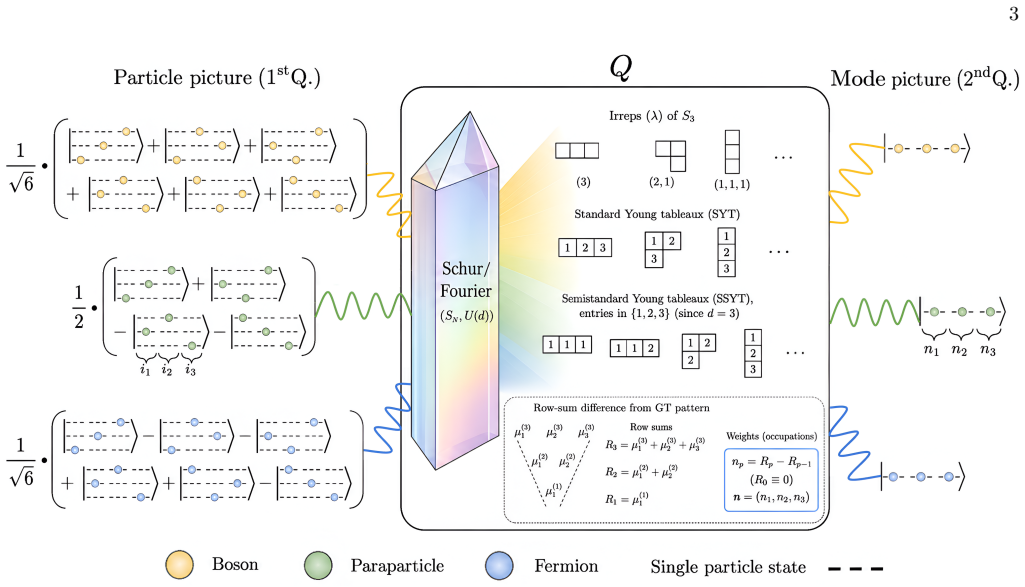
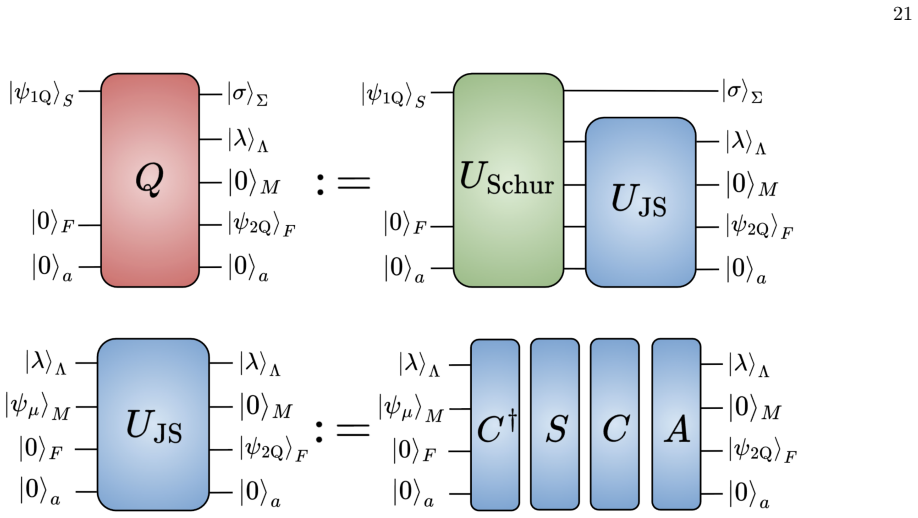
The quantum Schur transform supplied by Schur-Weyl duality is the non-abelian Fourier transform of the commuting pair (S_N, U(d)), and the occupation-number representation is its weight basis, retaining only the labels shared by both factors, the irrep λ and the u(d) weight. This reduction is lossless for bosons and fermions, while a canonical Gelfand-Tsetlin promise renders it one-to-one for the remaining sectors. Algorithmically, Q composes the strong Schur transform with reversible arithmetic that computes occupations as successive row-sum differences of the Gelfand-Tsetlin pattern, yielding gate complexity poly(N,d,log(1/ε)).
What carries the argument
The quantum Schur transform, the non-abelian Fourier transform of (S_N, U(d)) whose weight basis is the occupation-number representation, combined with arithmetic on Gelfand-Tsetlin row sums to extract occupations.
If this is right
- The converted state is prepared efficiently in quantum memory.
- Any classical algorithm that outputs the state explicitly pays a cost set by the sector dimension, which is polynomial of degree N in d at fixed N and exponential in N when d=Θ(N).
- An efficient classical sampler for the induced occupation-number distribution would yield one for arbitrary quantum circuits, contrary to standard complexity assumptions.
Where Pith is reading between the lines
- Quantum simulation algorithms could interleave first- and second-quantized steps without decoherence by applying Q and Q† as needed.
- The same Schur-based reduction may apply to other problems involving simultaneous actions of symmetric and unitary groups beyond particle statistics.
- Practical implementations would need a subroutine to certify or enforce the Gelfand-Tsetlin promise on input states before conversion.
Load-bearing premise
The input states satisfy a canonical Gelfand-Tsetlin promise that renders the mapping one-to-one for parastatistical sectors.
What would settle it
Prepare a parastatistical input state violating the Gelfand-Tsetlin promise and verify whether distinct inputs map to the same output state under Q, which would violate unitarity of the claimed conversion.
Figures
read the original abstract
Quantum simulation at fixed particle number admits two equivalent descriptions, a first-quantized (particle) representation and a second-quantized (occupation-number) representation. Their quantum resource costs differ sharply across computational tasks, so the ability to convert coherently between them is valuable. We construct an explicit unitary $Q$, with inverse $Q^\dagger$, that maps a first-quantized state to its fixed-$N$ occupation-number form while diagnosing the input's particle-exchange symmetry. The conversion is therefore symmetry-agnostic at the input yet fully resolved at the output, and it applies uniformly to bosonic, fermionic, and parastatistical sectors. At its foundation lies a structural identification that we place at the center of this work: the quantum Schur transform supplied by Schur-Weyl duality is the non-abelian Fourier transform of the commuting pair $(S_N,U(d))$, and the occupation-number representation is its weight basis, retaining only the labels shared by both factors, the irrep $\lambda$ and the $\mathfrak{u}(d)$ weight. This reduction is lossless for bosons and fermions, while a canonical Gelfand-Tsetlin promise renders it one-to-one for the remaining sectors. Algorithmically, $Q$ composes the strong Schur transform with reversible arithmetic that computes occupations as successive row-sum differences of the Gelfand-Tsetlin pattern, yielding gate complexity $\mathrm{poly}(N,d,\log(1/\epsilon))$. The converted state is prepared efficiently in quantum memory. Any classical algorithm that outputs it explicitly, however, pays a cost set by the sector dimension, which is polynomial of degree $N$ in $d$ at fixed $N$ and exponential in $N$ when $d=\Theta(N)$. Finally, an efficient classical sampler for the induced occupation-number distribution would yield one for arbitrary quantum circuits, contrary to standard complexity assumptions.
Editorial analysis
A structured set of objections, weighed in public.
Referee Report
Summary. The paper constructs an explicit unitary Q (with inverse Q†) that coherently converts between first-quantized particle representations and fixed-N second-quantized occupation-number representations. The construction composes the strong Schur transform (identified as the non-abelian Fourier transform of (S_N, U(d))) with reversible arithmetic on Gelfand-Tsetlin patterns to compute occupations via row-sum differences. The map is symmetry-agnostic at input and fully resolved at output, claimed to apply uniformly to bosonic, fermionic, and parastatistical sectors with gate complexity poly(N, d, log(1/ε)). For bosons/fermions the reduction is lossless; for other sectors a canonical Gelfand-Tsetlin promise ensures bijectivity. The paper also contrasts quantum and classical costs and derives a complexity-theoretic implication for sampling.
Significance. If the central construction holds, the result supplies an efficient quantum primitive for switching representations whose resource profiles differ across simulation tasks. The explicit poly(N,d,log(1/ε)) bound, the structural identification of the Schur transform, and the explicit contrast with classical exponential-in-N cost when d=Θ(N) are concrete strengths. The sampling implication (efficient classical sampler for the induced distribution would yield one for arbitrary circuits) is a falsifiable prediction that strengthens the contribution.
major comments (1)
- [Abstract] Abstract (and the section introducing the Gelfand-Tsetlin promise): the central claim that Q is unitary on the full space for parastatistical sectors rests on the statement that 'a canonical Gelfand-Tsetlin promise renders it one-to-one.' If an input state violates the promise, distinct first-quantized vectors can share the same occupation pattern, so the map ceases to be bijective and Q cannot be unitary. The manuscript must specify (i) the precise domain on which the promise is assumed, (ii) how the quantum circuit enforces or projects onto that domain, and (iii) whether the claimed symmetry-agnostic input / resolved output property survives when the promise is dropped. This is load-bearing for the uniform applicability asserted in the abstract.
minor comments (1)
- [Abstract] The abstract states the complexity as poly(N,d,log(1/ε)) but does not indicate whether the hidden polynomial degree is independent of the irrep label λ; a brief remark on this dependence would clarify the bound.
Simulated Author's Rebuttal
We thank the referee for their careful reading and for raising this important clarification regarding the domain of applicability of Q. We address the comment below and will revise the manuscript accordingly.
read point-by-point responses
-
Referee: [Abstract] Abstract (and the section introducing the Gelfand-Tsetlin promise): the central claim that Q is unitary on the full space for parastatistical sectors rests on the statement that 'a canonical Gelfand-Tsetlin promise renders it one-to-one.' If an input state violates the promise, distinct first-quantized vectors can share the same occupation pattern, so the map ceases to be bijective and Q cannot be unitary. The manuscript must specify (i) the precise domain on which the promise is assumed, (ii) how the quantum circuit enforces or projects onto that domain, and (iii) whether the claimed symmetry-agnostic input / resolved output property survives when the promise is dropped. This is load-bearing for the uniform applicability asserted in the abstract.
Authors: We agree that explicit specification is needed. (i) The domain is the subspace of first-quantized states whose Gelfand-Tsetlin patterns satisfy the canonical promise for the given parastatistical sector; this is precisely the set on which the map to occupation numbers is bijective. (ii) The circuit implements the Schur transform followed by reversible row-sum arithmetic and is unitary when restricted to this subspace; it does not contain an explicit projection operator, as the construction is defined under the promise (standard for promise problems). We will add text stating this assumption. (iii) The symmetry-agnostic input property means the input need not be pre-symmetrized or projected onto an exchange eigenspace; the Schur transform diagnoses the symmetry label λ. The output is resolved to explicit occupations. Both properties hold inside the promised domain. Outside it the map loses injectivity, so we will revise the abstract to state that the construction applies uniformly to bosons/fermions and to parastatistical sectors under the Gelfand-Tsetlin promise. These changes will be incorporated in the revised manuscript. revision: yes
Circularity Check
No circularity; derivation relies on standard Schur-Weyl duality and Gelfand-Tsetlin patterns
full rationale
The paper's central construction of unitary Q composes the known Schur transform (from Schur-Weyl duality) with reversible row-sum arithmetic on Gelfand-Tsetlin patterns. These are external, established mathematical objects, not defined or fitted within the paper. The Gelfand-Tsetlin promise is stated as an explicit assumption for parastatistical sectors rather than derived from the result itself. No self-citations, fitted parameters renamed as predictions, or self-definitional reductions appear in the provided text. The derivation chain is self-contained against external benchmarks.
Axiom & Free-Parameter Ledger
axioms (1)
- standard math Schur-Weyl duality supplies the quantum Schur transform as the non-abelian Fourier transform of the pair (S_N, U(d))
Reference graph
Works this paper leans on
-
[1]
Implementation of the canonical reconstruction mapC: lower canonical GT rows from occupation vectors We now describe the implementation of the reversible canonical reconstruction subroutine C defined in Eq. (111). Recall that C takes an occupation vector n together with the pre-existing top-row label λ stored in the Λ register, and writes into the work re...
-
[2]
classical memory:output an explicit list of coefficient–basis-string pairs {(n, cn)} specifying a normalized vector eψ E =P n cn |n⟩satisfying 1 2 ∥ eψ ED eψ − ψλ 2Q ψλ 2Q ∥1 ≤ϵ
-
[3]
(166)), then apply Q from Sec
Quantum runtime (quantum-memory output) The quantum algorithm is immediate: prepare ψλσcan 1Q by applying C λσcan (Eq. (166)), then apply Q from Sec. IV to obtain ψλ 2Q (Eq. (167)). The next statement is a direct specialization of Theorem 4. Theorem 6(Quantum complexity).Under the promises of Task 5, including the canonical GT promise on the intermediate ...
-
[4]
Thus, when restricted to classical computation, Task 5 reduces to producing anexplicit coefficient listthat approximates ψλ 2Q (= Q ψλσcan 1Q) as in Eq
Classical runtime lower bound (explicit classical output) A classical algorithm cannot output a quantum state in quantum memory. Thus, when restricted to classical computation, Task 5 reduces to producing anexplicit coefficient listthat approximates ψλ 2Q (= Q ψλσcan 1Q) as in Eq. (167) up to trace-distance errorϵ. 36 Recall that, under the canonical Gelf...
-
[5]
Determination of the largest sector Theorem 7 reduces the classical worst-case cost to understanding Dmax(N, d) (Eq. (171)). The bosonic sector λ = (N) and the fermionic sector λ = (1N) are weight-multiplicity-free, so for them Dλ = |Ωλ| equals the number of distinct occupation vectors: D(N)(N, d) = N+d−1 N ,(175) D(1N)(N, d) = d N (d≥N),(176) the bosonic...
-
[6]
classical memory:output an explicit list of coefficient–basis-string pairs {(i, αi)} specifying a normalized vector eψ E =P i∈[d]N αi |i⟩satisfying 1 2 eψ ED eψ − ψλσcan 1Q ED ψλσcan 1Q 1 ≤ϵ.(185)
-
[7]
Quantum runtime (quantum-memory output) The quantum algorithm is immediate: prepare ψλ 2Q by applying C λ (Eq. (182)), fix the canonical sector labels (λ, σcan) as part of the promised implementation of Q†, and then apply the coherent inverse quantization transform Q† to obtain ψλσcan 1Q (Eq. (183)). 39 Theorem 9(Quantum complexity).Under the promises of ...
-
[8]
Classical runtime lower bound (explicit classical output) We now give a worst-case lower bound for any classical algorithm that must output anexplicit classicalcoefficient list for the first-quantized computational-basis expansion of ψλσcan 1Q (Eq. (183)). a. Row and column groups and Young symmetrizers.Fix any standard Young tableau T of shape λ. Let RT ...
-
[9]
(196)), apply Q (Algorithm 1), and measure the occupation register in the computational basis
Quantum algorithm and runtime The quantum solution is immediate: prepare ψλσcan 1Q using C λσcan (Eq. (196)), apply Q (Algorithm 1), and measure the occupation register in the computational basis. Theorem 12(Quantum complexity of promised-( λ, σcan) occupation-number sampling).Under Task 11, a gate-based quantum computer can sample fromp λσcan(·)within to...
-
[10]
Here, as in Eq
A uniform classical hardness reduction We now show that an efficient classical sampler for Task 11 forallpromised inputs would yield an efficient classical sampler for the output distributions of arbitrary quantum circuits on mλ := ⌈log2 Dλ(N, d)⌉ qubits (to the same total-variation accuracy). Here, as in Eq. (169), Dλ(N, d) = |Ωλ| is the number of distin...
-
[11]
More optimal, statistics-aware transforms.The construction of Q in Sec. IV is deliberatelysymmetry- agnostic: it treats the input as an arbitrary state supported on a fixed Schur–Weyl sector, and it uses generic subroutines that do not exploit additional structure that may be knowna prioriabout the particle statistics or the relevant irrep. This generalit...
-
[12]
Symmetry verification, sector filtering, and leakage removal via the λ register.We presented Q as a transform acting on states supported on a single Young diagram λ. A natural extension is to retain the λ register output by USchur and use it to perform symmetry-resolved verification and filtering when the input state has leaked outside a target permutatio...
-
[13]
However, parabose and parafermi sectors admit naturalcolor-resolvedrealizations in which the microscopic occupation data n(α) p are explicit (Sec
Outputting the color-resolved Fock space for parastatistics.Throughout we worked in thephysical fixed-N Fock space appropriate to the chosen statistics sector, treating the Green color degrees of freedom as an unobserved multiplicity. However, parabose and parafermi sectors admit naturalcolor-resolvedrealizations in which the microscopic occupation data n...
-
[14]
For practical deployments, several refinements are important
Fault-tolerant optimization, error budgeting, and integration with simulation primitives.Our complexity statements treat the strong Schur transform and the arithmetic map as modular components and bound their costs at the level of asymptotic gate counts. For practical deployments, several refinements are important. One direction is to optimize theerror bu...
-
[15]
Hybrid workflows that alternately require fixed- N efficiency and particle-number flexibility.Many core simulation and inference routines are naturally posed at fixed particle number, where the first-quantized register size scales as N⌈log 2 d⌉ and can be dramatically smaller than a mode-register representation when N≪d (Sec. II A 3). For example, eigenst...
-
[16]
Leveraging second-quantized state-preparation routines to obtain first-quantized inputs via Q†. Preparing physically meaningful first-quantized input states is a persistent practical challenge, especially when the natural description of the target is given in terms of occupation numbers. At the same time, there is a mature and rapidly growing toolbox of s...
-
[17]
While this idea is conceptually appealing, it is also the most delicate to justify, and it is not universally beneficial
Switching representationswithinHamiltonian simulation primitivesIt is tempting to imagine toggling between representations during dynamics in order to exploit representation-dependent advantages for different Hamiltonian fragments (for example, implementing some terms more naturally in a mode basis and others more naturally in a particle basis). While thi...
-
[18]
Representation-aware post-processing: measurements, observables, and reduced data products. Even when the dynamics or state-preparation stage is naturally carried out in one representation, thequantities ultimately extractedfrom the computation may be cheaper to access in the other. Several common examples illustrate this point. First, number-diagonal obs...
-
[19]
R. P. Feynman, Simulating physics with computers, International Journal of Theoretical Physics21, 467 (1982)
1982
-
[20]
H. F. Trotter, On the product of semi-groups of operators, Proceedings of the American Mathematical Society10, 545 (1959)
1959
-
[21]
Suzuki, Fractal decomposition of exponential operators with applications to many-body theories and monte carlo simulations, Physics Letters A146, 319 (1990)
M. Suzuki, Fractal decomposition of exponential operators with applications to many-body theories and monte carlo simulations, Physics Letters A146, 319 (1990)
1990
-
[22]
A. M. Childs, Y. Su, M. C. Tran, N. Wiebe, and S. Zhu, Theory of trotter error with commutator scaling, Physical Review X11, 011020 (2021)
2021
-
[23]
A. M. Childs and N. Wiebe, Hamiltonian simulation using linear combinations of unitary operations, Quantum Information and Computation12, 901 (2012)
2012
-
[24]
D. W. Berry, A. M. Childs, R. Cleve, R. Kothari, and R. D. Somma, Simulating hamiltonian dynamics with a truncated taylor series, Physical Review Letters114, 090502 (2015)
2015
-
[25]
G. H. Low and I. L. Chuang, Optimal hamiltonian simulation by quantum signal processing, Physical Review Letters118, 010501 (2017)
2017
-
[26]
G. H. Low and I. L. Chuang, Hamiltonian simulation by qubitization, Quantum3, 163 (2019)
2019
-
[27]
Gily´ en, Y
A. Gily´ en, Y. Su, G. H. Low, and N. Wiebe, Quantum singular value transformation and beyond: Exponential improvements for quantum matrix arithmetics, Proceedings of the 51st Annual ACM SIGACT Symposium on Theory of Computing , 193 (2019)
2019
-
[28]
Preskill, Quantum computing in the NISQ era and beyond, Quantum2, 79 (2018)
J. Preskill, Quantum computing in the NISQ era and beyond, Quantum2, 79 (2018)
2018
-
[29]
Peruzzo, J
A. Peruzzo, J. McClean, P. Shadbolt, M.-H. Yung, X.-Q. Zhou, P. J. Love, A. Aspuru-Guzik, and J. L. O’Brien, A variational eigenvalue solver on a photonic quantum processor, Nature Communications5, 4213 (2014)
2014
-
[30]
J. R. McClean, J. Romero, R. Babbush, and A. Aspuru-Guzik, The theory of variational hybrid quantum-classical algorithms, New Journal of Physics18, 023023 (2016)
2016
-
[31]
Cerezo, A
M. Cerezo, A. Arrasmith, R. Babbush, S. C. Benjamin, S. Endo, K. Fujii, J. R. McClean, K. Mitarai, X. Yuan, L. Cincio, and P. J. Coles, Variational quantum algorithms, Nature Reviews Physics3, 625 (2021)
2021
-
[32]
E. T. Campbell, B. M. Terhal, and C. Vuillot, Roads towards fault-tolerant universal quantum computation, Nature549, 172 (2017)
2017
-
[33]
Reiher, N
M. Reiher, N. Wiebe, K. M. Svore, D. Wecker, and M. Troyer, Elucidating reaction mechanisms on quantum computers, Proceedings of the National Academy of Sciences114, 7555 (2017)
2017
-
[34]
J. S. Baker, P. A. M. Casares, M. S. Zini, J. Thik, D. Banerjee, C. Ling, A. Delgado, and J. M. Arrazola, Simulating optically active spin defects with a quantum computer, Physical Review A110, 10.1103/physreva.110.032606 (2024)
-
[35]
P. A. M. Casares, Y. Zhou, U. Azad, S. Fomichev, J. S. Baker, C. Ling, D. Banerjee, A. Delgado, and J. M. Arrazola, Quantum algorithms to identify optically detected magnetic resonance-active defects for quantum sensing applications, Physical Review A113, 10.1103/x8gd-fbtr (2026)
-
[36]
Motlagh, R
D. Motlagh, R. A. Lang, P. Jain, J. A. Campos-Gonzalez-Angulo, W. Maxwell, T. Zeng, A. Aspuru-Guzik, and J. Miguel Ar- razola, Quantum algorithm for vibronic dynamics: case study on singlet fission solar cell design, Quantum Science and Technology10, 045048 (2025)
2025
- [37]
-
[38]
S. Fomichev, K. Hejazi, I. Loaiza, M. S. Zini, A. Delgado, A.-C. Voigt, J. E. Mueller, and J. M. Arrazola, Simulating x-ray absorption spectroscopy of battery materials on a quantum computer (2024), arXiv:2405.11015 [quant-ph]
arXiv 2024
-
[39]
S. Fomichev, P. A. M. Casares, J. Soni, U. Azad, A. Kunitsa, A.-C. Voigt, J. E. Mueller, and J. M. Arrazola, Fast simulations of x-ray absorption spectroscopy for battery materials on a quantum computer (2025), arXiv:2506.15784 [quant-ph]. 48
arXiv 2025
-
[40]
J. Naranjo, T. H. Kyaw, G. Saxena, K. Ferreira, and J. S. Baker, Designing quantum technologies with a quantum computer (2026), arXiv:2601.22091 [quant-ph]
arXiv 2026
-
[41]
C. Ku, Y.-C. Chen, A. Hu, and M.-H. Hsieh, Optimizing quantum chemistry simulations with a hybrid quantization scheme, arXiv preprint arXiv:2507.04253 (2025), arXiv:2507.04253 [quant-ph]
Pith/arXiv arXiv 2025
-
[42]
Z. Liu, A. M. Childs, and D. Gottesman, Low-depth quantum symmetrization, arXiv preprint arXiv:2411.04019 (2024), arXiv:2411.04019 [quant-ph]
arXiv 2024
-
[43]
Wang and K
Z. Wang and K. R. A. Hazzard, Particle exchange statistics beyond fermions and bosons, Nature637, 314 (2025)
2025
-
[44]
Huerta Alderete, A
C. Huerta Alderete, A. M. Green, N. H. Nguyen, Y. Zhu, B. M. Rodr´ ıguez-Lara, and N. M. Linke, Experimental realization of para-particle oscillators, Scientific Reports15, 41498 (2025)
2025
-
[45]
N. P. D. Sawaya, T. Menke, T. H. Kyaw, S. Johri, A. Aspuru-Guzik, and G. G. Guerreschi, Resource-efficient digital quantum simulation of d-level systems for photonic, vibrational, and spin- s Hamiltonians, npj Quantum Information6, 49 (2020)
2020
-
[46]
T. N. Georges, B. K. Berntson, C. S¨ underhauf, and A. V. Ivanov, Pauli decomposition via the fast walsh-hadamard transform, New Journal of Physics27, 033004 (2025)
2025
-
[47]
Jordan and E
P. Jordan and E. Wigner, ¨Uber das Paulische ¨ aquivalenzverbot, Zeitschrift f¨ ur Physik47, 631 (1928)
1928
-
[48]
Babbush, D
R. Babbush, D. W. Berry, J. R. McClean, and H. Neven, Quantum simulation of chemistry with sublinear scaling in basis size, npj Quantum Information5, 92 (2019)
2019
-
[49]
Y. Su, D. W. Berry, N. Wiebe, N. Rubin, and R. Babbush, Fault-tolerant quantum simulations of chemistry in first quantization, PRX Quantum2, 040332 (2021)
2021
-
[50]
D. S. Abrams and S. Lloyd, Simulation of many-body fermi systems on a universal quantum computer, Phys. Rev. Lett.79, 2586 (1997)
1997
-
[51]
Ortiz, J
G. Ortiz, J. E. Gubernatis, E. Knill, and R. Laflamme, Quantum algorithms for fermionic simulations, Phys. Rev. A64, 022319 (2001)
2001
-
[52]
Kassal, S
I. Kassal, S. P. Jordan, P. J. Love, M. Mohseni, and A. Aspuru-Guzik, Polynomial-time quantum algorithm for the simulation of chemical dynamics, Proc. Natl. Acad. Sci. U.S.A.105, 18681 (2008)
2008
-
[53]
Babbush, J
R. Babbush, J. R. McClean, D. Wecker, A. Aspuru-Guzik, and N. Wiebe, Low-depth quantum simulation of materials, Physical Review X8, 011044 (2018)
2018
-
[54]
J. D. Whitfield, Communication: Spin-free quantum computational simulations and symmetry adapted states, J. Chem. Phys.139, 021105 (2013)
2013
-
[55]
D. W. Berry, N. C. Rubin, A. O. Elnabawy, G. Ahlers, I. DePrince, A. Eugene, J. Lee, C. Gogolin, and R. Babbush, Quantum simulation of realistic materials in first quantization using non-local pseudopotentials, npj Quantum Information 10, 130 (2024)
2024
-
[56]
Shokrian Zini, A
M. Shokrian Zini, A. Delgado, R. dos Reis, P. A. Moreno Casares, J. E. Mueller, A.-C. Voigt, and J. M. Arrazola, Quantum simulation of battery materials using ionic pseudopotentials, Quantum7, 1049 (2023)
2023
-
[57]
T. N. Georges, M. Bothe, C. S¨ underhauf, B. K. Berntson, R. Izs´ ak, and A. V. Ivanov, Quantum simulations of chemistry in first quantization with any basis set, npj Quantum Information 10.1038/s41534-025-00987-1 (2025), in press
-
[58]
S. B. Bravyi and A. Y. Kitaev, Fermionic quantum computation, Annals of Physics298, 210 (2002)
2002
-
[59]
J. T. Seeley, M. J. Richard, and P. J. Love, The Bravyi–Kitaev transformation for quantum computation of electronic structure, The Journal of Chemical Physics137, 224109 (2012)
2012
-
[60]
Tranter, P
A. Tranter, P. J. Love, F. Mintert, and P. V. Coveney, A comparison of the Bravyi–Kitaev and Jordan–Wigner transformations for the quantum simulation of quantum chemistry, Journal of Chemical Theory and Computation14, 5617 (2018)
2018
-
[61]
Steudtner and S
M. Steudtner and S. Wehner, Fermion-to-qubit mappings with varying resource requirements for quantum simulation, New Journal of Physics20, 063010 (2018)
2018
-
[62]
Setia, S
K. Setia, S. Bravyi, A. Mezzacapo, and J. D. Whitfield, Superfast encodings for fermionic quantum simulation, Physical Review Research1, 033033 (2019)
2019
-
[63]
McArdle, A
S. McArdle, A. Mayorov, X. Shan, S. Benjamin, and X. Yuan, Digital quantum simulation of molecular vibrations, Chemical Science10, 5725 (2019)
2019
-
[64]
Macridin, P
A. Macridin, P. Spentzouris, J. Amundson, and R. Harnik, Electron–phonon systems on a universal quantum computer, Physical Review Letters121, 110504 (2018)
2018
-
[65]
Lloyd and S
S. Lloyd and S. L. Braunstein, Quantum computation over continuous variables, Physical Review Letters82, 1784 (1999)
1999
-
[66]
Weedbrook, S
C. Weedbrook, S. Pirandola, R. Garc´ ıa-Patr´ on, N. J. Cerf, T. C. Ralph, J. H. Shapiro, and S. Lloyd, Gaussian quantum information, Reviews of Modern Physics84, 621 (2012)
2012
-
[67]
Huerta Alderete, A
C. Huerta Alderete, A. M. Green, N. H. Nguyen, Y. Zhu, N. M. Linke, and B. M. Rodr´ ıguez-Lara, Para-particle oscillator simulations on a trapped-ion quantum computer, Journal of Applied Physics138, 054401 (2025)
2025
-
[68]
H. Krovi, An efficient high dimensional quantum schur transform, Quantum3, 122 (2019), arXiv:1804.00055 [quant-ph]
Pith/arXiv arXiv 2019
-
[69]
D. Bacon, I. L. Chuang, and A. W. Harrow, The quantum schur transform: I. efficient qudit circuits, arXiv (2006), arXiv:quant-ph/0601001 [quant-ph]
Pith/arXiv arXiv 2006
-
[70]
A. Burchardt, J. Fei, D. Grinko, M. Larocca, M. Ozols, S. Timmerman, and V. Visnevskyi, High-dimensional quantum schur transforms, arXiv (2025), arXiv:2509.22640 [quant-ph]
arXiv 2025
-
[71]
M. A. Nielsen and I. L. Chuang,Quantum Computation and Quantum Information: 10th Anniversary Edition(Cambridge University Press, Cambridge, 2010)
2010
-
[72]
S. A. Cuccaro, T. G. Draper, S. A. Kutin, and D. P. Moulton, A new quantum ripple-carry addition circuit, arXiv (2004), arXiv:quant-ph/0410184. 49
Pith/arXiv arXiv 2004
- [73]
discussion (0)
Sign in with ORCID, Apple, or X to comment. Anyone can read and Pith papers without signing in.