REVIEW 2 major objections 3 minor 9 references
What Actually Serializes GPU LZ77 Decode: Three Decoders, Three Mechanisms, and an Encode-Time Lever That Removes the Last One
T0 review · 2 major / 3 minor · reviewed 2026-08-14 · deepseek-v4-flash
Pith's one-line read On an H100, parse holds 64–72% of GPU LZ77 decode time, and the last serial element can be encoded away for 0.540% ratio.
desk verdict A well-built measurement study with an exemplary reproducibility contract, but the central 'parse, not copy' claim conflates ANS entropy decoding with LZ77 parsing and needs a separate timer. read the letter →
The pith
A machine-rendered reading of the paper's core claim, the machinery that carries it, and where it could break.
The reading
What carries the argument
The load-bearing object is the per-block command stream of an absolute-offset LZ77 format, where every back-reference is an absolute position in the decompressed output and a block decodes as soon as its source blocks are present; this makes match-layer dependencies short-lived and leaves the parse as the main serial region. The key identity for self-overlap is the periodic-fill rewrite $\mathrm{out}[\mathrm{dst}+k] = \mathrm{out}[\mathrm{src} + k \bmod \mathrm{dist}]$, turning an apparent serial chain into independent writes. The parse bottleneck is measured by splitting decode time into an ANS-plus-parse stage against a copy stage across three architectures whose time is governed respectively by parse cost, wave count, and token count. The final serial dependency is the four-entry distance history behind repeat matches, which the encoder removes by encoding distances as varints while preserving the format and decoder.
What would settle it
Decode the same corpus with a version of the decoder that consumes pre-decoded LZ symbols, bypassing entropy decoding while keeping every other stage identical; if the remaining parse time is small relative to the 64–72% share, then the bottleneck is entropy coding, not the LZ parse.
Extended reading notes
Core claim
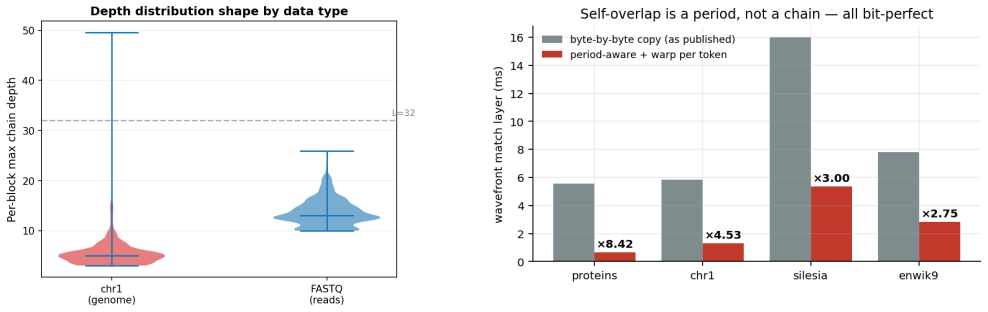
On the absolute-offset, blockwise format this paper uses, measured on a single H100, the dominant device-resident cost of LZ77 decode is the parse stage: a combined entropy and command-parsing stage accounting for 63.7–71.5% of decode time across four corpora. Chain depth is not the governor: a two-pass forced-literal encoder guarantees maximum depth at or below a chosen bound for a ratio cost within ±0.006%, yet latency changes by at most 2.8%, and because byte-level comparison of all 15,499 blocks shows the cap changes only 16 blocks, none in the latency spike cluster, the cap provably cannot affect that cluster. Self-overlapping matches are periodic fills, written as $\mathrm{out}[\mathrm{dst}+k] = \mathrm{out}[\mathrm{src} + k \bmod \mathrm{dist}]$, which makes threads independent and lets one warp per token speed the match layer by 2.75–8.42 times bit-perfect. The remaining sequential element is a four-entry distance history behind repeat matches; suppressing repeat codes in the encoder removes 5.46% to 0.02% of chained commands, grows the dependency-free run from 4 to 706 commands at the median, and costs 0.540% of ratio. The paper also establishes a memory floor: a median match of 7 bytes against a 128-byte cache line gives 4.4% bus efficiency, 39 times below a coalesced write of the same data.
Load-bearing premise
The headline 'parse, not copy' conclusion assumes that the part of the measurement called parse is mostly the LZ77 command parsing and not the entropy decoding bundled into the same timer.
Editorial extensions
If this is right
- Decoder designs should target the parse and entropy stage, since the copy path occupies only 28–36% of decode time and cannot deliver large speedups.
- Back-reference chain-depth caps are nearly free in compression ratio but are not a latency lever on this format and hardware, changing no bytes in the latency-critical region.
- Self-overlapping matches can be decoded as independent periodic writes, giving a 2.75–8.42 times bit-perfect speedup of the match layer without format changes.
- An encoder-side suppression of repeat codes buys a 176 times longer dependency-free parse run, from 4 to 706 commands at the median, at a 0.540% ratio cost, leaving the decoder unchanged.
Reading between the lines
- If the entropy decoding bundled into the 'ANS+parse' stage is actually the larger half, the actionable fix would be a faster entropy codec rather than LZ parsing; the paper's data do not separate the two, so this remains an open inference.
- The periodic-fill identity for self-overlapping matches is not CUDA-specific, so testing it on CPU SIMD or another GPU generation would show whether the 2.75–8.42 times speedup is a general property of the format or of the one-warp-per-token mapping.
- Because parse discrepancies are strictly proportional to varint expansion, an encoder that shortens or removes varint lengths, beyond suppressing repeat codes, could plausibly push the dependency-free run even closer to the 93.94% of commands that are already parallelisable by prefix sum.
Signed reviews
Editorial analysis
A structured set of objections, weighed in public.
Referee Report
Summary. The paper is a measurement study of GPU LZ77 decode in the ACEAPEX absolute-offset format, using three decoder architectures on an H100. Its headline claim is that the parse stage (token/command decode), not the copy/match stage, occupies 63.7–71.5% of device-resident decode time; that bounding back-reference chain depth is nearly free but moves latency by at most 2.8% and provably nothing in the file's own latency-spike region; that self-overlapping matches are periodic fills rather than serial dependency chains, yielding 2.75–8.42x speedups on the match layer; and that the last sequential element, a four-entry distance history, can be removed by the encoder at 0.540% ratio cost, growing the dependency-free parse run from 4 to 706 commands. The paper also reports a 4.4% bus-efficiency floor for small matches, a position-invariance result at 50 GB scale, and an equal-constraint compression-ratio comparison. All reproducible claims are backed by a scripted contract that passes 17 of 17 CPU-reachable checks.
Significance. If the parse-dominance claim survives closer measurement, the paper usefully redirects GPU LZ77 optimization from copy/match and chain-depth bounds toward the command-parse stage. The study's strengths are substantial: it ships machine-checkable reproduction (17/17 CPU checks pass with no failures), uses byte-level hash comparisons for the depth-cap negative result, performs placebo-style controls in the equal-token-mass experiment, and is unusually candid about its own methodological error (Section X item 10). The periodic-fill interpretation of self-overlapping matches and the memory-floor measurement are independent and appear robust. However, the central bottleneck claim is weakened by the ANS/parse conflation described below, and the title's 'removes the last one' is explicitly not GPU-verified by the manuscript's own limitations. The paper is thus a valuable experimental contribution whose headline needs either additional measurement or careful re-scoping.
major comments (2)
- [Section III, Table II] The abstract and Section III conclude 'parse, not copy' on the basis of the 63.7–71.5% numbers in Table II, but the governing column is labeled 'ANS+parse,' meaning entropy decoding plus LZ77 command parsing combined. No timer that excludes ANS decoding from the parse stage appears anywhere in the paper; Section V explicitly says 'entropy is outside this timer' for the match-layer results, showing that entropy-excluding measurements are feasible. Since the central, load-bearing claim is that the LZ77 parse logic itself, rather than the copy/match layer, holds most of decode time, the manuscript must either isolate the LZ parse time (for example, by a decoder variant that consumes pre-decoded symbols) or provide a bound on the ANS share. Without that, the statement supported by Table II is 'entropy+parse dominates copy,' which is a different and substantially weaker claim.
- [Section VI and Section XII (Limitations)] The title's final clause, 'an encode-time lever that removes the last one,' and the abstract's 'can be removed by the encoder' are stronger than what is measured. Section XII states: 'Removing the distance history is not verified on GPU. The chain is removed and measured on CPU; the resulting decode speedup is an estimate and is not claimed as a result.' The structural claim—that the dependency-free run grows from 4 to 706 commands—is demonstrated and is valuable, but the decode-time consequence is not. The paper should either add a GPU measurement of the no-history configuration or explicitly rephrase the abstract and title to say that the sequential dependency is removed at encode time and the speedup is estimated.
minor comments (3)
- [Table II] The column header 'parse' is ambiguous because the preceding column is already 'ANS+parse.' Rename the percentage column to 'parse share' or 'share of parse+copy' and state the formula (ANS+parse)/(ANS+parse+copy) in the caption.
- [Section X, item 6] The sentence 'Mean destination stride at level 2 is 578 B before and 578 B after—already sorted' is confusing: 'after' seems to refer to after sorting, but the wording could be read as after the optimization being refuted. Rephrase to clarify that the destination layout is already sorted and sorting does not change the stride.
- [Section VII] The reference to 'Paper 4 of this series [4]' is informal for a journal submission; spell out the authors and arXiv identifier at first mention, as is done for the other references.
Circularity Check
No significant circularity: the central bottleneck claims rest on direct measurements with independent controls, and self-citations are contextual rather than load-bearing.
full rationale
The paper is a measurement study, and its central claims are supported by direct timings, bit-perfect correctness checks, and controlled experiments rather than by equations that fold the conclusions back into the inputs. The headline 'parse, not copy' is backed by Table II timings; the table labels the combined stage 'ANS+parse,' so the abstract's shorthand 'parse' does conflate entropy decoding with LZ command parsing, but that is a measurement-scope caveat and a correctness risk, not a circular derivation, because the reported percentage is a direct timer output rather than a quantity constructed from the conclusion. The depth-cap claim is tested with a byte-level comparison over all 15,499 blocks and equal-token-mass placebo controls; the periodic-fill claim is demonstrated by bit-perfect speedups; and the distance-history removal is explicitly labeled an estimate on CPU in the Limitations section, so no unverified prediction is being renamed as a result. The fitted latency model 'latency ≈ a·waves + b·bytes' is a post hoc description of measured points and is checked against independent Section VIII measurements. Self-citations [1]–[4] are used to position the format and to note that the match-layer dependency was already removed; these are backed by the series' public code artifacts and are not the load-bearing premise of the new measurements. The reproduction record (17/17 GPU-free checks passing) further supports the experimental claims. I find no step where a claimed result reduces to its own inputs by construction.
Assumptions & free parameters
free parameters (4)
- wave cost a =
4.5-4.7 µs per wave
- byte cost b =
30-181 µs/MB across corpora
- fixed seek cost F =
293 µs
- per-token cost c =
0.26 µs/token
assumptions (5)
- domain assumption Absolute offsets and block independence in ACEAPEX make block decode depend only on source blocks being present (Section II).
- ad hoc to paper The parse stage timer 'ANS+parse' is treated as a single 'parse' layer throughout the paper (Table II).
- ad hoc to paper Latency on the three decoders is modeled as latency ≈ a*waves + b*bytes with fitted a and b (Section IV-D).
- domain assumption Byte-identical block streams imply identical decode behavior and thus equal time under the GPU execution model.
- domain assumption H100 80 GB SXM is representative of GPU LZ77 decode; one GPU only (Section XII).
Cite this review
Pith. "Pith review of What Actually Serializes GPU LZ77 Decode: Three Decoders, Three Mechanisms, and an Encode-Time Lever That Removes the Last One." pith.science (2026). https://pith.science/paper/P3O7W4OA
@misc{pith2026260810188,
  author       = {Pith},
  title        = {Pith review of: What Actually Serializes GPU LZ77 Decode: Three Decoders, Three Mechanisms, and an Encode-Time Lever That Removes the Last One},
  year         = {2026},
  howpublished = {\url{https://pith.science/paper/P3O7W4OA}},
  note         = {Machine review of arXiv:2608.10188}
}
read the original abstract
The sequential part of GPU LZ77 decode is not where the field assumes it is. Across three decoder architectures on an H100 we measure that parse, not copy, holds 64-72% of device-resident decode time; that bounding back-reference chain depth - provable, and costing 0.006% in ratio - moves latency by at most 2.8% and, for the file's own latency spike, provably by nothing at all, since a byte-level comparison of all 15,499 blocks shows the cap alters none of the 181 blocks involved; that self-overlapping matches are periodic fills rather than dependency chains, which makes them fully parallel and speeds the match layer by 2.75-8.42x bit-perfect; and that the last genuinely sequential element, a four-entry distance history, can be removed by the encoder for 0.540% of ratio, growing the dependency-free parse run from 4 commands to 706. We also report the floor the format runs into: with a median match of 7 bytes against a 128-byte cache line, bus efficiency is 4.4% and a coalesced write of the same data is 39x faster. A separate section records ten hypotheses these measurements refuted, including one methodological error of our own. Every reproducible claim carries a machine-checkable record: a fresh clone of the tagged release passes 17 of 17 checks reachable without a GPU, none failing.
Figures


Figures from the paper (7 more)



Reference graph
Works this paper leans on
-
[1]
Parallel LZ77 decoding via encode-time absolute offset resolution,
Y . Shavidze, “Parallel LZ77 decoding via encode-time absolute offset resolution,” arXiv:2606.04268, 2026
arXiv 2026
-
[2]
Y . Shavidze, “Compressed-resident genomics,” arXiv:2606.18900, 2026
arXiv 2026
-
[3]
Y . Shavidze, “Unified position-invariant random access through two compression layers,” arXiv:2606.24531, 2026
work page Pith review arXiv 2026
-
[4]
Y . Shavidze, “What governs decode throughput in absolute-offset GPU LZ77?” arXiv:2607.18541, 2026
work page Pith review arXiv 2026
-
[5]
CODAG: Characterizing and Optimizing Decompression Algorithms for GPUs
Parket al., “CODAG: characterizing and optimizing decompression algorithms for GPUs,” arXiv:2307.03760, 2023
work page Pith review arXiv 2023
-
[6]
Massively-Parallel Lossless Data Decompression
E. Sitaridi, R. Mueller, T. Kaldewey, G. Lohman, and K. A. Ross, “Massively-parallel lossless data decompression,” inProc. 45th Int. Conf. on Parallel Processing (ICPP), 2016. arXiv:1606.00519
work page Pith review arXiv 2016
-
[7]
Height-bounded Lempel-Ziv encodings
H. Bannai, M. Funakoshi, D. Hendrian, M. Matsuda, and S. J. Puglisi, “Height-bounded Lempel-Ziv encodings,” inProc. 32nd Annual European Symposium on Algorithms (ESA), LIPIcs vol. 308, pp. 18:1–18:18, 2024. doi:10.4230/LIPIcs.ESA.2024.18, arXiv:2403.08209
work page Pith review arXiv 2024
-
[8]
LZ77-like compression with fast random access,
S. Kreft and G. Navarro, “LZ77-like compression with fast random access,” Proc. DCC, 2010, pp. 239–248
work page 2010
Show all 9 references
-
[9]
Balancing straight-line programs,
M. Ganardi, A. Je ˙z, and M. Lohrey, “Balancing straight-line programs,” J. ACM, 2021
2021
Reviewed August 14, 2026 · model on record in the stance chip above.
Discussion (0). Continue with ORCID to comment.