REVIEW 5 major objections 8 minor 58 references
EDEN: Entorhinal Driven Egocentric Navigation Toward Robotic Deployment
T0 review · 5 major / 8 minor · reviewed 2026-08-07 · deepseek-v4-flash
Pith's one-line read This paper claims that feeding a reinforcement-learning navigation policy a compact 72-dimensional grid code—periodic activations inspired by mammalian entorhinal grid cells—yields 99% success in simple and over 94% in complex simulated…
desk verdict Plausible RL navigation result with hand-coded grid codes; the headline encoder is never tested in closed-loop, so the main claim is under-supported. read the letter →
The pith
A machine-rendered reading of the paper's core claim, the machinery that carries it, and where it could break.
The reading
What carries the argument
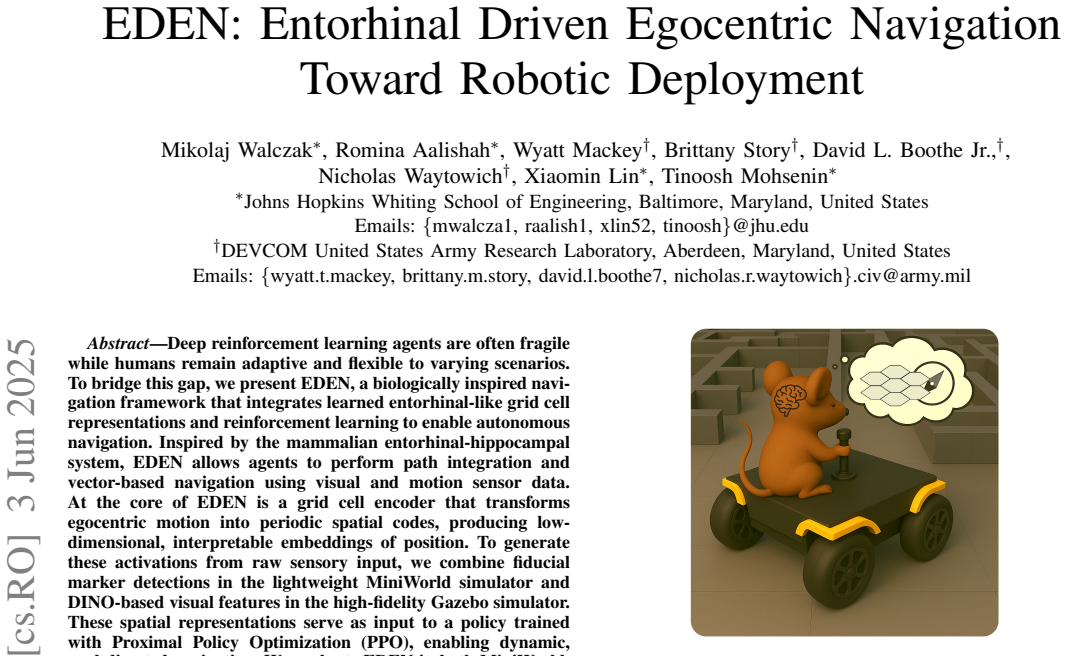
The central object is the grid cell encoder: a supervised LSTM that maps MLP-transformed motion signals and visual features—AprilTag corner coordinates in MiniWorld, DINOv2 features in Gazebo—to 72 periodic activation targets plus a $\sin(\theta), \cos(\theta)$ head-direction encoding. The targets are generated by a cosine formula over rotated spatial coordinates with manually selected scales, phase shifts, and two rotation frames; overlapping periodicities encode position. This 74-dimensional vector is concatenated with velocity and fed to a PPO policy, replacing raw position, raw pixels, or detected-object centroids. The mechanism carries the argument because the paper attributes the agent's efficient, reliable navigation to this periodic latent code rather than to the raw observations.
What would settle it
Run the trained EDEN policy in MiniWorld and Gazebo using LSTM-predicted activations instead of ground-truth activations, under the same reward function and hyperparameters, and measure success rate. If success falls below the reported 94% or collision rates rise substantially, the central deployment claim fails. A second check is to vary the floorplan layout without retraining and observe whether the grid-code policy generalizes beyond the two fixed scenarios.
Extended reading notes
Core claim
On its own terms, the paper establishes that a hand-specified grid code, formed by cosine activations over rotated and scaled coordinates, carries enough spatial structure for a PPO agent to solve goal-directed navigation without access to global coordinates. In the MiniWorld complex scenario, grid activations outperform both raw images and YOLO object detections, while raw normalized position fails to learn a path around the wall. In Gazebo, where every baseline also receives LiDAR, grid encoding reaches a success rate comparable to YOLO by one million training steps. The paper further shows that a supervised LSTM trained on ground-truth activations produces predicted grid patterns that match the ground truth in translation, scale, and rotation, positioning this learned encoder as a drop-in replacement for the idealized activations used during policy training.
Load-bearing premise
The load-bearing premise is that the hand-picked grid formula with 72 cells and manually selected scales, phases, and rotations is a sufficient and robust spatial code for navigation, and that the supervised LSTM trained on ground-truth activations can replace those activations inside the trained policy even though that substitution is never tested in closed-loop RL.
Editorial extensions
If this is right
- With the grid-code input, the agent achieves 99% success in simple scenarios and over 94% in complex floorplans with occluded paths across MiniWorld and Gazebo.
- In the MiniWorld complex scenario, grid activations outperform raw images and YOLO detections, while raw normalized position fails to learn a viable path around the wall.
- The MiniWorld EDEN policy totals only 0.9M parameters versus 4.29M for the raw-image policy, showing that the compact grid code can replace a convolutional encoder.
- The learned LSTM encoder reproduces grid activations from visual and motion inputs, so that ground-truth position or ground-truth activations are not required at inference time.
- EDEN operates without an explicit map or SLAM state, instead maintaining an internal periodic estimate of position from self-motion and visual cues.
Reading between the lines
- A direct test the paper leaves implicit is running the trained policy in closed loop with the LSTM-predicted activations instead of ground-truth activations; the reported heatmap similarity alone does not guarantee that the policy's behavior is preserved.
- If the manually chosen 72-cell configuration is robust, a natural extension is to learn or optimize the scales, phases, and rotations per environment, potentially making the representation adaptive rather than hand-tuned.
- The grid-code representation could complement SLAM by acting as a drift-resistant internal prior for localization, or by providing a compact observation space for map-free planning in novel layouts.
- A stronger deployment claim would require testing under occlusion, sensor noise, and layout changes beyond the two fixed floorplans reported here.
Editorial analysis
A structured set of objections, weighed in public.
Referee Report
Summary. The paper presents EDEN, a navigation framework in which a PPO policy is trained on 72-dimensional hand-crafted periodic grid-cell-like activations plus a head-direction encoding, with the intent that a trainable LSTM encoder will later predict these activations from vision and proprioception so that ground-truth positions are not needed at deployment. The work is evaluated in two simulators (MiniWorld and Gazebo) against baselines using raw position, raw images, and YOLO detections. The paper claims 99% success in simple scenarios, >94% in complex floorplans, and that the learned encoder can act as a drop-in replacement for the ground-truth activations, enabling robotic deployment.
Significance. If the claims were fully supported, EDEN would be a useful demonstration that a compact hand-designed periodic code can serve as a more reliable and efficient policy input than raw coordinates, raw pixels, or object detections for goal-directed navigation. The paper has concrete strengths: the code is publicly released, the architecture is clearly described, and the comparison is performed in two different simulators with several baselines. The main significance, however, is conditional on filling the gap between the policy trained on ground-truth activations and the encoder proposed for deployment, which is currently untested in closed-loop operation.
major comments (5)
- [§5-B, §7-E, Figs. 5-7] The central deployment claim is unsupported. All success-rate results in Figure 4 are obtained with policies that receive ground-truth 72-dimensional grid activations. The trainable LSTM encoder described in Section VII-E is evaluated only through training-loss curves (Figures 6-7) and binned heatmaps (Figure 5 bottom); it is never used to replace the grid-cell input during rollout of the trained policy. As a result, the abstract's statement that the encoder is 'a replacement of ground truth activations' is not backed by any closed-loop experiment. The authors should either run the trained policy with encoder predictions as the input (including a clear description of how the initial LSTM hidden state is obtained) and report success rates/steps, or explicitly temper the deployment claim and present the encoder as a qualitative proof-of-concept.
- [§7-D, Fig. 4 caption] The 'distance-normalized steps' metric is mislabeled and potentially misleading. The Figure 4 caption states that steps are 'normalized by shortest path distance,' but Equation (VII-D) defines the metric as the number of steps divided by the sum of Manhattan distances from the agent to three doors. This sum is not a shortest-path length and is not even a well-defined distance for the open-room scenarios, where no doors exist. The efficiency comparison in Figure 4 is therefore uninterpretable as presented. The authors should replace this with a consistent metric, such as steps divided by the true shortest path length computed by a planner, or clearly rename and justify the current quantity.
- [Fig. 4] No error bars, confidence intervals, or multiple seeds are reported for any of the success-rate, reward, or step-efficiency results. PPO training is stochastic, and a single run cannot establish that EDEN reliably outperforms the baselines. At minimum, the authors should run each condition with at least 3-5 seeds and report the mean and standard deviation, and preferably perform a standard significance test on the success-rate differences.
- [§7-E, h0 equation] The initialization of the LSTM hidden state uses ground-truth information: h0 = 0.8*g0 + 0.2*θ0, where g0 is the initial grid-cell activation and θ0 is the initial orientation. If this formula is used at inference time, the encoder is not purely sensor-driven and the deployment claim is weakened. If it is used only during training, the paper must say so explicitly and specify how the hidden state is initialized at deployment. As written, this is a ground-truth leak that could inflate the apparent quality of the encoder's predictions.
- [§3-A, §7-A] The grid-code configuration (72 cells, scales α up to 5/10, 12 phase shifts, 2 orientations) is hand-selected with no sensitivity analysis. The abstract and title attribute the results to 'grid cell representations' generally, but the evidence supports only this one hand-specified configuration. A small ablation over the number of scales/phases, or a discussion of how sensitive the policy performance is to these hyperparameters, would substantially strengthen the generality claim.
minor comments (8)
- [§3-A] The grid-cell equation is garbled: the formula beginning with 'α max 0, cos(...' is missing delimiters and parentheses, making it impossible to parse. Please typeset it properly.
- [§3-A vs §4-B] Section III-A says the encoder is 'fully differentiable and trained end-to-end within the RL pipeline,' but Section IV-B describes a sequential supervised pretraining stage. Please reconcile these statements.
- [§2-A] Typo: 'they have have low flexibility' should be 'they have low flexibility'.
- [§5-A] Typo: 'planing around occluded paths' should be 'planning around occluded paths'.
- [Fig. 5 caption] The caption refers to the 'decoder's ability' while the main text calls the module a 'Grid Cell encoder.' Please unify the terminology.
- [Table I] Column headers are inconsistent ('Pre-Trained Extractor' vs 'Extractor', 'LSTM Encoder' vs 'Predictor'), and the 'Total' entries for the Position rows are blank. Please make the table self-contained and complete.
- [§6] The conclusion states an 'overall success rate exceeding 94% across all scenarios,' but the paper reports per-scenario success rates. Clarify how this aggregate is computed or remove it.
- [General] The term 'ground truth activations' is used for activations generated by a hand-specified formula. This is a target for supervised regression, not neural ground truth. Consider renaming to 'idealized' or 'target' activations to avoid confusion.
Circularity Check
The headline success rates use hand-coded ground-truth grid activations, while the trainable LSTM encoder promised as the deployment replacement is a supervised fit to the same hand-built formula and is never validated in closed-loop rollout.
-
fitted input called prediction
[Abstract; Section VII-E; Section III-A Eq. 1]
"In addition, as a replacement of ground truth activations, we present a trainable Grid Cell encoder enabling the development of periodic grid-like patterns from vision and motion sensor data, emulating the development of such patterns within biological mammals."
The 'ground truth activations' are not independent measurements: they are values of the hand-specified periodic formula in Section III-A, whose scale factors, phase shifts, and rotations are manually chosen in Section VII-A ('these values were selected as an initial base case'). Section VII-E then trains the LSTM with MSE loss 'to predict the target grid cell encodings' generated by that same formula. Any periodic grid-like pattern the encoder develops is therefore inherited from its training labels rather than discovered from data; the encoder is a function approximator for the paper's own equation, not an independently derived representation.
full rationale
The paper's central numerical claims (99% success in simple scenarios, >94% in complex floorplans) are obtained from PPO policies trained with a 72-dimensional, hand-specified grid code computed from true agent position via the Section III-A formula. That comparison against raw position, raw image, and YOLO baselines is an empirical, self-contained result and is not circular. The circularity-adjacent weakness is confined to the secondary but load-bearing deployment claim: the trainable LSTM encoder is trained with MSE loss against targets that are themselves generated by the paper's hand-built periodic equation, so its ability to produce periodic grid-like activations is by construction a supervised fit rather than an emergent or independently validated representation. Moreover, the paper states in Section IV-B that the RL policy is first trained on ground-truth activations and that the LSTM network 'serves as a drop-in replacement for the ground-truth grid activations,' but Section V-B and Section VII-E evaluate the encoder only through training losses and qualitative heatmaps, never through closed-loop RL rollouts. Thus the headline success rates do not apply to the proposed deployment system, although the numerical RL comparison itself remains independent. There is no self-citation chain or imported uniqueness theorem: the cited neuroscience and learning works (Hafting et al., Banino et al.) are external and not used to forbid alternative representations. Overall, partial circularity exists in the encoder-as-replacement narrative, but the principal empirical comparison stands on its own, yielding a moderate score rather than a finding that the whole derivation is forced.
Assumptions & free parameters
free parameters (5)
- Grid code configuration =
72 cells: 3 initial cells, 12 shifts, 2 orientations; alpha_max=5 in MiniWorld, 10 in Gazebo
- Phase shifts and rotation frames =
not specified
- Motion smoothing coefficients beta_v, beta_omega =
0.5 each
- Reward weights =
rs=-0.01, rc=-0.1, rg=1-0.2*(steps/max_steps)
- Encoder LSTM initial-state weights =
h0 = 0.8*g0 + 0.2*theta0
assumptions (5)
- domain assumption The Eq. 1 grid activation formula is a valid spatial encoding for navigation
- domain assumption DINOv2 features contain enough spatial information to recover grid codes
- domain assumption AprilTag detections act as reliable visual landmarks in MiniWorld
- domain assumption Simulated results transfer toward robotic deployment
- standard math PPO with the chosen reward can train the navigation policy
Cite this review
Pith. "Pith review of EDEN: Entorhinal Driven Egocentric Navigation Toward Robotic Deployment." pith.science (2026). https://pith.science/paper/P3RJTRFX
@misc{pith2026250603046,
  author       = {Pith},
  title        = {Pith review of: EDEN: Entorhinal Driven Egocentric Navigation Toward Robotic Deployment},
  year         = {2026},
  howpublished = {\url{https://pith.science/paper/P3RJTRFX}},
  note         = {Machine review of arXiv:2506.03046}
}
read the original abstract
Deep reinforcement learning agents are often fragile while humans remain adaptive and flexible to varying scenarios. To bridge this gap, we present EDEN, a biologically inspired navigation framework that integrates learned entorhinal-like grid cell representations and reinforcement learning to enable autonomous navigation. Inspired by the mammalian entorhinal-hippocampal system, EDEN allows agents to perform path integration and vector-based navigation using visual and motion sensor data. At the core of EDEN is a grid cell encoder that transforms egocentric motion into periodic spatial codes, producing low-dimensional, interpretable embeddings of position. To generate these activations from raw sensory input, we combine fiducial marker detections in the lightweight MiniWorld simulator and DINO-based visual features in the high-fidelity Gazebo simulator. These spatial representations serve as input to a policy trained with Proximal Policy Optimization (PPO), enabling dynamic, goal-directed navigation. We evaluate EDEN in both MiniWorld, for rapid prototyping, and Gazebo, which offers realistic physics and perception noise. Compared to baseline agents using raw state inputs (e.g., position, velocity) or standard convolutional image encoders, EDEN achieves a 99% success rate, within the simple scenarios, and >94% within complex floorplans with occluded paths with more efficient and reliable step-wise navigation. In addition, as a replacement of ground truth activations, we present a trainable Grid Cell encoder enabling the development of periodic grid-like patterns from vision and motion sensor data, emulating the development of such patterns within biological mammals. This work represents a step toward biologically grounded spatial intelligence in robotics, bridging neural navigation principles with reinforcement learning for scalable deployment.
Figures


Figures from the paper (4 more)


Reference graph
Works this paper leans on
-
[1]
Raed Alharthi et al. Novel deep reinforcement learning based collision avoidance approach for path planning of robots in unknown environment. PLOS ONE , 20(4): e0321810, 2025. doi: 10.1371/journal.pone.0312559
-
[2]
A. Banino et al. Vector-based navigation using grid-like representations in artificial agents. Nature, 557(7705): 429–433, 2018. doi: 10.1038/s41586-018-0102-6
-
[3]
Estimation with Applications to Tracking and Navigation: Theory Algorithms and Software
Yaakov Bar-Shalom et al. Estimation with Applications to Tracking and Navigation: Theory Algorithms and Software. Wiley-Interscience, 2002
work page 2002
-
[4]
Accurate path integration in continuous attractor network models of grid cells
Yoram Burak and Ila R Fiete. Accurate path integration in continuous attractor network models of grid cells. PLoS Computational Biology, 5(2):e1000291, 2009. doi: 10.1371/journal.pcbi.1000291
-
[5]
Cesar Cadena et al. Past, present, and future of simul- taneous localization and mapping: Toward the robust- perception age. IEEE Transactions on Robotics , 32(6): 1309–1332, 2016. doi: 10.1109/TRO.2016.2624754
arXiv 2016
-
[6]
A review of research on slam technol- ogy based on the fusion of lidar and vision
Peng Chen et al. A review of research on slam technol- ogy based on the fusion of lidar and vision. Sensors, 25 (5):1447, 2025. doi: 10.3390/s25051447
-
[7]
Maxime Chevalier-Boisvert et al. Minigrid & miniworld: Modular & customizable reinforcement learning environ- ments for goal-oriented tasks. CoRR, abs/2306.13831, 2023
arXiv 2023
-
[8]
Christopher J Cueva and Xue-Xin Wei. Emergence of grid-like representations by training recurrent neural networks to perform spatial localization. International Conference on Learning Representations (ICLR) , 2018. URL https://openreview.net/forum?id=B17JTOe0-
work page 2018
Show all 58 references
-
[9]
Path planning and trajectory planning algorithms: A general overview
Alessandro Gasparetto et al. Path planning and trajectory planning algorithms: A general overview. In Motion and Operation Planning of Robotic Systems , volume 29 of Mechanisms and Machine Science, pages 3–27. Springer,
-
[10]
Hafting et al
T. Hafting et al. Microstructure of a spatial map in the entorhinal cortex. Nature, 436(7052):801–806, 2005. doi: 10.1038/nature03721
2005 doi
-
[11]
Hart et al
Peter E. Hart et al. A formal basis for the heuristic deter- mination of minimum cost paths. In IEEE Transactions on Systems Science and Cybernetics , volume 4, pages 100–107. IEEE, 1968. doi: 10.1109/TSSC.1968.300136
1968
-
[12]
Hart et al
Peter E. Hart et al. Optimal and efficient path planning for partially-known environments. In IEEE International Conference on Robotics and Automation . IEEE, 1994. doi: 10.1109/ROBOT.1994.351061
1994
-
[13]
RaI-SLAM: Radar-Inertial SLAM for Autonomous Vehicles
Daniel Casado Herraez et al. RaI-SLAM: Radar-Inertial SLAM for Autonomous Vehicles. IEEE Robotics and Automation Letters , 10(6):5257–5264, June 2025. doi: 10.1109/LRA.2025.3557296
2025
-
[14]
Deep learning-emerged grid cells-based bio-inspired navigation in robotics
Maksims Ivanovs et al. Deep learning-emerged grid cells-based bio-inspired navigation in robotics. Sensors, 25(5):1576, 2025. doi: 10.3390/s25051576. URL https: //www.mdpi.com/1424-8220/25/5/1576
2025 doi
-
[15]
YOLOv5: Open-source object detec- tion model
Glenn Jocher et al. YOLOv5: Open-source object detec- tion model. https://github.com/ultralytics/yolov5, 2020. Accessed: 2025-04-28
2020
-
[16]
Path planning using an improved a- star algorithm
Chunyu Ju et al. Path planning using an improved a- star algorithm. In 2020 11th International Conference on Prognostics and System Health Management (PHM- 2020 Jinan) , pages 23–26. IEEE, 2020. doi: 10.1109/ PHM-Jinan48558.2020.00012. URL https://ieeexplore. ieee.org/document/9296641
2020
-
[17]
R.E. Kalman. A new approach to linear filtering and prediction problems. Journal of Basic Engineering , 82 (1):35–45, 1960
1960
-
[18]
Environmental deformations dynamically shift the grid cell spatial metric
Alexandra T Keinath et al. Environmental deformations dynamically shift the grid cell spatial metric. Elife, 7: e38169, 2018
2018
-
[19]
Kober et al
J. Kober et al. Reinforcement learning in robotics: A sur- vey. The International Journal of Robotics Research , 32 (11):1238–1274, 2013. doi: 10.1177/0278364913495721. URL https://doi.org/10.1177/0278364913495721
2013 doi
-
[20]
Design and use paradigms for gazebo, an open-source multi-robot simulator
Nathan Koenig and Andrew Howard. Design and use paradigms for gazebo, an open-source multi-robot simulator. In IEEE/RSJ International Conference on Intelligent Robots and Systems (IROS), pages 2149–2154. IEEE, 2004
2004
-
[21]
Research on path-planning algorithm integrating optimization a-star algorithm and artificial potential field method
Lisang Liu et al. Research on path-planning algorithm integrating optimization a-star algorithm and artificial potential field method. Electronics, 11(22):3660, 2022. doi: 10.3390/electronics11223660. URL https://doi.org/ 10.3390/electronics11223660
2022 doi
-
[22]
Maguire et al
Eleanor A. Maguire et al. Navigation-related structural change in the hippocampi of taxi drivers. Proceedings of the National Academy of Sciences , 97(8):4398–4403,
-
[23]
Victor R. F. Miranda et al. Generalization in deep reinforcement learning for robotic navigation by re- ward shaping. IEEE Transactions on Industrial Electronics, 2023. doi: 10.1109/TIE.2023.3290244. arXiv:2209.14271
2023
-
[24]
Learning to navigate in complex environments
Piotr Mirowski et al. Learning to navigate in complex environments. International Conference on Learning Representations (ICLR), 2017. URL https://openreview. net/forum?id=SJMGPrcle
2017
-
[25]
Orb-slam: A versatile and ac- curate monocular slam system
Raul Mur-Artal et al. Orb-slam: A versatile and ac- curate monocular slam system. In IEEE Transactions on Robotics , volume 31, pages 1147–1163, 2015. doi: 10.1109/TRO.2015.2463671
2015
-
[26]
Apriltag: A robust and flexible visual fiducial system
Edwin Olson. Apriltag: A robust and flexible visual fiducial system. In Proceedings of the IEEE Interna- tional Conference on Robotics and Automation (ICRA) , pages 3400–3407. IEEE, 2011. doi: 10.1109/ICRA.2011. 5979561
2011 doi
-
[27]
Dinov2: Learning robust visual features without supervision, 2023
Maxime Oquab et al. Dinov2: Learning robust visual features without supervision, 2023
2023
-
[28]
Ros: an open-source robot operating system
Morgan Quigley et al. Ros: an open-source robot operating system. In ICRA Workshop on Open Source Software, volume 3, page 5, 2009
2009
-
[29]
Stable-baselines3: Reliable rein- forcement learning implementations
Antonin Raffin et al. Stable-baselines3: Reliable rein- forcement learning implementations. Journal of Machine Learning Research, 22(268):1–8, 2021. URL http://jmlr. org/papers/v22/20-1364.html
2021
-
[30]
cpr gazebo: Additional indoor and outdoor simulation environments for clearpath robots
Clearpath Robotics. cpr gazebo: Additional indoor and outdoor simulation environments for clearpath robots. https://github.com/clearpathrobotics/cpr gazebo,
-
[31]
Habitat: A platform for embodied AI research
Manolis Savva et al. Habitat: A platform for embodied AI research. In Proceedings of the IEEE/CVF International Conference on Computer Vision (ICCV) , pages 9339– 9347, 2019. doi: 10.1109/ICCV .2019.00943
2019
-
[32]
Proximal policy optimization algorithms
John Schulman et al. Proximal policy optimization algorithms. arXiv preprint arXiv:1707.06347 , 2017
2017 arXiv
-
[33]
A hippocampal–entorhinal sys- tem inspired model for visual concept representation
Huankun Sheng et al. A hippocampal–entorhinal sys- tem inspired model for visual concept representation. In IEEE TRANSACTIONS ON COGNITIVE AND DE- VELOPMENTAL SYSTEMS, volume 13, pages 429–441. IEEE, 2021. doi: 10.1109/TCDS.2020.2978918
2021
-
[34]
Direct visual slam using sparse depth for camera-lidar system
Yeong-Sik Shin et al. Direct visual slam using sparse depth for camera-lidar system. In Proceedings of the 2018 IEEE International Conference on Robotics and Automation (ICRA) , pages 5144–5151, Brisbane, QLD, Australia, 2018. IEEE. doi: 10.1109/ICRA.2018. 8461102
2018 doi
-
[35]
Singh et al
B. Singh et al. Reinforcement learning in robotic applications: a comprehensive survey. Artificial In- telligence Review , 55(2):945–990, 2022. doi: 10. 1007/s10462-021-09997-9. URL https://doi.org/10.1007/ s10462-021-09997-9
2022
-
[36]
Learning a deep motion plan- ning model for autonomous driving
Sheng Song et al. Learning a deep motion plan- ning model for autonomous driving. In 2018 IEEE Intelligent Vehicles Symposium (IV) , pages 1137–1142, Changshu, China, June 2018. IEEE. doi: 10.1109/IVS. 2018.8500703. URL https://doi.org/10.1109/IVS.2018. 8500703
2018
-
[37]
A unified theory for the origin of grid cells through the lens of pattern formation
Ben Sorscher et al. A unified theory for the origin of grid cells through the lens of pattern formation. Nature Communications, 14(1):1614, 2023. doi: 10.1016/ j.neuron.2022.10.003
2023
-
[38]
Connecting multiple spa- tial scales to decode the population activity of grid cells
Martin B Stemmler et al. Connecting multiple spa- tial scales to decode the population activity of grid cells. Science Advances , 1(11):e1500816, 2015. doi: 10.1126/sciadv.1500816
2015 doi
-
[39]
Deep reinforcement learning for robotics: A survey of real-world successes
Chen Tang et al. Deep reinforcement learning for robotics: A survey of real-world successes. Proceedings of the AAAI Conference on Artificial Intelligence, 39(27): 28694–28698, 2025. doi: 10.1609/aaai.v39i27.35095. URL https://doi.org/10.1609/aaai.v39i27.35095
2025 doi
-
[40]
Cognitive navigation by neuro-inspired localization, mapping, and episodic memory
Huajin Tang et al. Cognitive navigation by neuro-inspired localization, mapping, and episodic memory. In Proceed- ings of the IEEE TRANSACTIONS ON COGNITIVE AND DEVELOPMENTAL SYSTEMS , pages 751–761. IEEE,
-
[41]
Gymnasium: A standard interface for reinforcement learning environments, 2024
Mark Towers et al. Gymnasium: A standard interface for reinforcement learning environments, 2024. URL https: //arxiv.org/abs/2407.17032
2024 arXiv
-
[42]
Bioinspired perception and nav- igation of service robots in indoor environments: A review
Jing Wang et al. Bioinspired perception and nav- igation of service robots in indoor environments: A review. Biomimetics, 8(4):350, 2023. doi: 10. 3390/biomimetics8040350. URL https://www.mdpi.com/ 2313-7673/8/4/350
2023
-
[43]
An in-depth examination of slam methods: Challenges, advancements, and applications in complex scenes for autonomous driving
Ke Wang et al. An in-depth examination of slam methods: Challenges, advancements, and applications in complex scenes for autonomous driving. In IEEE Trans- actions on Intelligent Transportation Systems , pages 1–
-
[44]
Multi-sensor fusion in automated driving: A survey
Zhangjing Wang et al. Multi-sensor fusion in automated driving: A survey. IEEE Access, 8:2847–2868, 2019. doi: 10.1109/ACCESS.2019.2962554
2019
-
[45]
A fault detection algorithm for lidar/imu integrated localization systems with non- gaussian noises
Penggao Yan et al. A fault detection algorithm for lidar/imu integrated localization systems with non- gaussian noises. In Proceedings of the 2024 International Technical Meeting of The Institute of Navigation , pages 561–574, 2024. doi: 10.33012/2024.19564
2024
-
[46]
Gazebo models and worlds collec- tion
Chao Yao. Gazebo models and worlds collec- tion. https://github.com/leonhartyao/gazebo models worlds collection, 2025. Accessed: 2025-05-20
2025
-
[47]
Path planning for the mobile robot: A review
Han ye Zhang, Wei ming Lin, and Ai xia Chen. Path planning for the mobile robot: A review. Symmetry, 10 (10):450, 2018. doi: 10.3390/sym10100450. URL https: //doi.org/10.3390/sym10100450
2018 doi
-
[48]
doi: 10.1109/TITS.2025.3545479
IEEE, 2025. doi: 10.1109/TITS.2025.3545479
2025
-
[49]
A bionic robot navigation algo- rithm based on cognitive mechanism of hippocampus
Naigong Yu et al. A bionic robot navigation algo- rithm based on cognitive mechanism of hippocampus. IEEE TRANSACTIONS ON AUTOMATION SCIENCE AND ENGINEERING, , 16(4):1640–1652, 2019. doi: 10.1109/TASE.2019.2909638. VII. A PPENDIX A. Grid Cell Module Within this work we utilize...
2019
-
[53]
A real-time cogni- tive map construction method based on the entorhinal- hippocampal working mechanism of the rat’s brain
Liao Yishen and Naigong Yu. A real-time cogni- tive map construction method based on the entorhinal- hippocampal working mechanism of the rat’s brain. Cognitive Computation and Systems , 09 2024. doi: 10.1049/ccs2.12101
2024 doi
-
[55]
Raw Image: A 96 × 96 × 3 RGB image is provided directly to the network
-
[56]
YOLO: To reduce complexity, only the x-coordinate of the detected object’s centroid (with respect to the agent’s egocentric view) is used. This value is encoded using sine and cosine functions to maintain continuity across image boundaries and to enable smooth transitions as t...
-
[57]
Position: The agent’s current [x, y] position is normal- ized with respect to environment bounds and encoded using sine and cosine, yielding a final 4-dimensional input vector
-
[58]
Grid Cell: A 72-dimensional grid cell activation vector is concatenated with sine and cosine encodings of the agent’s orientation, producing a 74-dimensional input vector. Using these modalities, the policies interact with the sce- narios using and the Gymnasium reinforcement ...
-
[2000]
doi: 10.1073/pnas.070039597
-
[2015]
URL https: //doi.org/10.1007/978-3-319-14705-5 1
doi: 10.1007/978-3-319-14705-5 1. URL https: //doi.org/10.1007/978-3-319-14705-5 1
-
[2018]
doi: 10.1109/TCDS.2017.2776965
2017
-
[2025]
Accessed: 2025-05-20
2025
Reviewed August 7, 2026 · model on record in the stance chip above.
Discussion (0). Sign in to comment.