REVIEW 2 major objections 4 minor 55 references
Vulnerable Window of Yield Strength for Swelling-Driven Fracture of Phase-Transforming Battery Materials
T0 review · 2 major / 4 minor · reviewed 2026-08-14 · deepseek-v4-flash
Pith's one-line read Lithiating silicon nanopillars fracture only inside a 'vulnerable window' of yield strength, with two distinct crack modes, and the window narrows as fracture energy rises.
desk verdict A serious computational study with a novel coupled framework and a plausible vulnerable-window mechanism, but its quantitative yield-strength predictions hinge on the unconstrained process-zone ratio ξ/R. read the letter →
The pith
A machine-rendered reading of the paper's core claim, the machinery that carries it, and where it could break.
The reading
What carries the argument
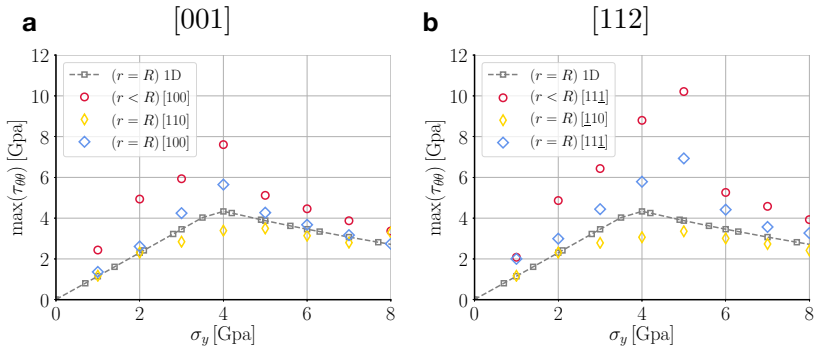
The load-bearing machinery is a multi-physics phase-field framework uniting three fields: a non-conserved phase field $\psi$ that tracks the c-Si/a-Li$_x$Si interface with anisotropic reaction-limited mobility; a fracture phase field $\varphi$ with a process zone size $\xi$ in the variational (Griffith-type) sense, which lets cracks nucleate from an instability of the pristine state rather than from a pre-seeded flaw; and a decomposition of the deformation gradient into swelling, elastic, and plastic parts through the multiplicative form $F = \sqrt{J_\psi}F^eF^p$ with neo-Hookean elasticity and J2 plasticity. The argument is carried by the hat-shaped curve of the maximum hoop stress versus yield strength: for $\sigma_y$ below the critical value the maximum hoop stress rises linearly as $2\sigma_y/\sqrt{3}$, while above it the stress falls because less volumetric expansion remains available during the shrinking of the crystalline core, and the peak of that curve defines the center of the vulnerable window.
What would settle it
Count fracture events in lithiated silicon nanopillars whose yield strength is deliberately varied across the predicted range (for example by lithiation rate, temperature, or doping): if fracture probability increases monotonically with $\sigma_y$ instead of rising and then falling, the vulnerable-window claim fails. A complementary check is in-situ transmission electron microscopy of crack initiation to measure the process zone size $\xi$ directly; that value of $\xi/R$ decides whether the operative fracture range is the 1.5–2 GPa estimate or the lower 0.5–1 GPa one.
Extended reading notes
Core claim
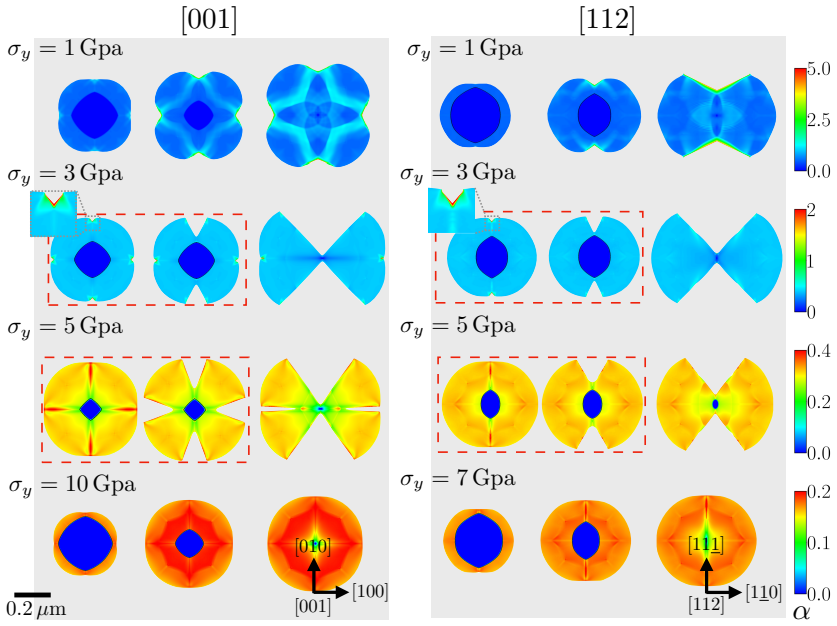
Within a single multi-physics phase-field model that evolves the anisotropic c-Si/a-Li$_x$Si interface, large-deformation J2 elastoplasticity, and the fracture phase field together, the paper discovers that swelling-driven fracture of Si nanopillars is confined to a vulnerable window of yield strength: below the window the material is too soft to build up the tensile stresses needed for crack initiation, and above it compressive yielding is too limited to generate them. Inside the window, two fracture modes appear—at lower $\sigma_y$, shear localization first carves V-shaped notches on the surface that concentrate stress and seed cracks, and at higher $\sigma_y$, cracks nucleate later in charging without such prior localization, with one crack pair arresting and the other propagating by symmetry breaking. The paper further establishes that substituting axisymmetric stresses into the Griffith criterion underestimates the fracture energy required and therefore overestimates the safe radius, while stresses from two-dimensional simulations that include notch localization bracket the fracture boundary. Matching the experimentally observed 120 nm safe radius with measured fracture energies yields a yield-strength range of about 1.5–2 GPa at $\xi/R = 0.02$, broadly consistent with the experimental and theoretical range of 0.5–2 GPa.
Load-bearing premise
The quantitative boundaries of the window rest on the process-zone-to-radius ratio $\xi/R$, which the paper states is not precisely known and spans a 20-fold range (0.01–0.2); at $G_c/(\mu_a R) = 0.01$ the predicted fracture range shifts from about $\sigma_y = 1.5$\u20132 GPa down to 0.5\u20131 GPa as $\xi/R$ rises, so the specific yield-strength numbers and safe radii move even though the existence of a window in the model does not.
Editorial extensions
If this is right
- Yield strength becomes a design variable with a non-monotonic effect: pillars made of either very soft or very stiff lithiated material should both survive complete lithiation, whereas intermediate materials crack.
- Safe-radius estimates built from axisymmetric stresses plus the Griffith criterion are too optimistic; accounting for plastic localization at V-shaped notch-like corners is needed to place the crack-initiation threshold.
- The stress-to-yield-strength relation is universal when stresses are scaled by $\mu_a\beta$, so materials with smaller volume changes, such as Ge, have their vulnerable window shifted to lower yield strengths rather than removed.
- Hollow nanopillars resist fracture mainly at moderately high yield strength; at low yield strength (about 1 GPa in the simulations) the hollow geometry's protective effect disappears.
- Fitting the window to the observed 120 nm safe radius and measured fracture energies of 5–7 J m$^{-2}$ gives a Si yield strength near the experimental range, and analogous fits for amorphous Si and Ge predict 0.4–1.2 GPa and 1.5–4.6 GPa.
Reading between the lines
- A direct experiment that varies yield strength deliberately—via lithiation rate, temperature, or pre-straining of identically sized nanopillars—should show fracture incidence peaking at intermediate $\sigma_y$; a monotonic response would contradict the window.
- The window concept suggests that fracture in other large-volume-change anodes (germanium, tin, alloy particles) is controlled by the ratio $\sigma_y/(\mu_a\beta)$, so materials data of this kind would let the model predict safe sizes without new fracture simulations.
- Because the model nucleates cracks without pre-existing flaws, the effective process zone $\xi$ plays the role of a dominant flaw; measuring $\xi$ in situ during crack initiation would resolve the 20-fold quantitative spread of the predicted window and sharpen the yield-strength estimate.
- Surface engineering that suppresses V-notch formation—smoother pillars, coatings, or graded lithiation—should inflate the safe radius more than bulk toughening, since the lower-$\sigma_y$ fracture mode feeds on those notches.
Signed reviews
Editorial analysis
A structured set of objections, weighed in public.
Referee Report
Summary. This paper uses a multi-physics phase-field approach to simulate anisotropic phase transformation, finite-strain J2 plasticity, and phase-field fracture during lithiation of Si nanopillars. The central claim is that fracture occurs only within a two-dimensional 'vulnerable window' in yield strength and dimensionless fracture energy, with two distinct crack modes depending on whether plastic localization creates V-shaped notches prior to fracture. The authors build the argument in three stages: 1D axisymmetric no-fracture simulations show a non-monotonic maximum hoop stress versus yield strength; 2D anisotropic no-fracture simulations show stress amplification by plastic localization and V-notch formation; and full 2D fracture simulations confirm that cracking occurs over an intermediate range of yield strength. They compare the fracture boundary with a Griffith-theory estimate based on no-fracture stresses, and use experimental safe-radius data for c-Si and a-Si to estimate the yield strength range. They also study hollow nanopillars and find that increased slenderness suppresses fracture for higher yield strength but not for lower yield strength.
Significance. The vulnerable-window concept is a potentially important design principle for phase-transforming battery materials: it predicts that both very low and very high yield strengths can suppress swelling-driven fracture, and that plastic localization can promote fracture by creating stress-concentrating notches. The three-stage computational strategy is a strength, and the fracture boundary is genuinely generated by full simulations rather than by inserting fitted stresses into a fracture criterion. If the quantitative claims held, the comparison with experimental safe radii would provide a useful validation. However, the quantitative location of the window is strongly conditioned on an uncalibrated process-zone-size ratio, and the paper's validation claim is not sharply discriminating. The central qualitative result appears robust, but the quantitative yield-strength inference needs to be re-evaluated or reframed.
major comments (2)
- [Size effects, Fig. 4b] The paper states that ξ/R is not precisely known and investigates the range 0.01–0.2. Figure 4b shows that at Gc/(µaR)=0.01 the fracture boundary shifts from approximately 1.5–2 GPa at ξ/R=0.02 to 0.5–1 GPa at ξ/R=0.2, a factor of 2–4 that spans nearly the whole experimentally reported yield-stress range. The subsequent claim that the results are consistent with the estimated σy range 0.5–2 GPa is therefore not discriminating. Furthermore, no single ξ/R is shown to reproduce both the c-Si safe radius of 120 nm and the a-Si safe radius of 1 µm; the isotropic a-Si analysis gives σy≈0.4–1.2 GPa over the same ξ/R range, so a consistent pair exists only near ξ/R≈0.2 and σy≈0.5–1 GPa, whereas the main simulations use ξ/R=0.02. The authors should either calibrate ξ/R independently, demonstrate a single consistent (ξ/R, σy) pair, or revise the quantitative validation claim to be explicitly conditional on ξ/R.
- [Model / Results (Vulnerable window)] The introduction states that the 2D simulations are plane-strain (∂z≡0) while also specifying an unconstrained nanopillar with τzz=0. These two conditions are incompatible: plane strain with εzz=0 gives a nonzero τzz in general, whereas τzz=0 defines plane stress. The surface yield relation max(τθθ)=2σy/√3 quoted in the Results corresponds to plane-strain, incompressible behavior, not to plane stress (where max(τθθ)=σy at a traction-free surface). The authors should state the out-of-plane boundary condition actually used in the finite-element implementation and justify the relation used in Eq. (9); the current text does not allow the stress calculation to be reproduced.
minor comments (4)
- [Results, 'Vulnerable window of yield strength'] The text 'see Figure ??' is an unresolved placeholder; the claimed universal scaling of max(τθθ)/(µaβ) versus σy/(µaβ) should be displayed in a figure or the claim should be removed.
- [Figure 4 captions] The captions of Figure 4a and 4b reference 'Eq. (1)' for the stress-based boundary, but the relevant closed-form expression is Eq. (9).
- [Throughout] There are multiple typos, including 'dimensionelss' and 'red ciricles' in Figure 4a; the manuscript should be proofread.
- [Abstract] The abstract refers to a two-dimensional parameter space of yield strength and fracture energy, while the phase diagram in Figure 4a uses the dimensionless fracture energy Gc/(µaR); this should be stated consistently.
Circularity Check
No significant circularity: the vulnerable-window result is generated by direct phase-field fracture simulations, and the Griffith-theory comparisons are checks, not inputs.
full rationale
The central claim, the existence of a vulnerable window of yield strength for swelling-driven fracture, is produced by full two-dimensional phase-field simulations that couple anisotropic phase transformation, finite-strain J2 plasticity, and fracture. Fracture is not inferred by inserting fitted stresses into a crack criterion; it is simulated directly, and the phase diagram in Figure 4a is a scan over yield strength and dimensionless fracture energy. The Griffith-theory expression, Eq. (9), is explicitly used as a post-hoc comparison: the authors show that a 1D-based line underestimates the boundary, while using 2D no-fracture stresses brackets it. Thus the comparison is not the generator of the reported fracture boundary. The prefactor C = 4/3 is taken from the external stability analysis of Pham and Marigo [49], not from the authors' own prior work, and the self-citations present ([26], [28], [30], [36]) are methodological and non-load-bearing. The paper's acknowledged uncertainty in the process-zone-size-to-radius ratio xi/R (Section 'Size effects', Figure 4b: 'While the precise value of xi/R is not known') shifts the inferred yield-strength range and weakens quantitative validation against the 120 nm safe-radius experiment, but this is parameter uncertainty and incomplete identifiability, not circularity: xi/R is not fitted to the target experimental observation and then renamed as a prediction. The qualitative vulnerable window is a direct simulation result, so no circular step can be exhibited from the paper's own equations or argument chain.
Assumptions & free parameters
free parameters (2)
- Process zone size to radius ratio ξ/R =
Main runs use 0.02; varied from 0.01 to 0.2
- Anisotropic interface mobility parameters =
Not reported in the paper
assumptions (5)
- domain assumption Multiplicative decomposition of deformation gradient with phase-dependent volumetric swelling, F = sqrt(J_psi) F^e F^p
- domain assumption J2 yield criterion with linear isotropic hardening, tau_eq <= sigma_y + K alpha
- domain assumption Variational phase-field fracture with isochoric-volumetric split and no direct plastic-fracture coupling
- domain assumption Crack nucleation occurs through phase-field instability with critical stress tau_c ~ sqrt(Gc mu / xi) and prefactor C = 4/3 imported from Pham and Marigo [49]
- domain assumption Two-dimensional cross-section model with vanishing z-derivatives while also enforcing tau_zz = 0
Cite this review
Pith. "Pith review of Vulnerable Window of Yield Strength for Swelling-Driven Fracture of Phase-Transforming Battery Materials." pith.science (2026). https://pith.science/paper/P426CGOQ
@misc{pith2026190802175,
  author       = {Pith},
  title        = {Pith review of: Vulnerable Window of Yield Strength for Swelling-Driven Fracture of Phase-Transforming Battery Materials},
  year         = {2026},
  howpublished = {\url{https://pith.science/paper/P426CGOQ}},
  note         = {Machine review of arXiv:1908.02175}
}
read the original abstract
Despite numerous experimental and theoretical investigations of the mechanical behavior of high-capacity Si and Ge Li-ion battery anodes, our basic understanding of swelling-driven fracture in these materials remains limited. Existing theoretical studies have provided insights into elasto-plastic deformations caused by large volume change phase transformations, but have not modeled fracture explicitly beyond Griffith's criterion. Here we use a multi-physics phase-field approach to model self-consistently anisotropic phase transformation, elasto-plastic deformation, and crack initiation and propagation during lithiation of Si nanopillars. Our results reveal the existence of a vulnerable window of yield strength inside which pillars fracture during lithiation. They identify two different modes of fracture inside that window with and without surface localization of plastic deformation prior to fracture for lower and higher yield strength, respectively, and highlight the importance of taking into account this localization to accurately predict the onset of fracture within Griffith theory. The results further demonstrate how the increased robustness of hollow nanopillars can be understood as a direct effect of anode geometry on the size of this vulnerable window. Those insights provide an improved theoretical basis for designing mechanically stable phase-transforming battery materials undergoing large volume changes.
Figures

Figures from the paper (2 more)


Reference graph
Works this paper leans on
-
[1]
Uday Kasavajjula, Chunsheng Wang, and A. John Appleby. Nano- and bulk- silicon-based insertion anodes for lithium-ion secondary cells. Journal of Power Sources, 163(2):1003–1039, 2007
work page 2007
-
[2]
Germanium-based electrode materials for lithium-ion batteries
Yang Liu, Sulin Zhang, and Ting Zhu. Germanium-based electrode materials for lithium-ion batteries. ChemElectroChem, 1(4):706–713, 2014
work page 2014
-
[3]
Xiao Hua Liu, He Zheng, Li Zhong, Shan Huang, Khim Karki, Li Qiang Zhang, Yang Liu, Akihiro Kushima, Wen Tao Liang, Jiang Wei Wang, Jeong- Hyun Cho, Eric Epstein, Shadi A. Dayeh, S. Tom Picraux, Ting Zhu, Ju Li, John P. Sullivan, John Cumings, Chunsheng Wang, Scott X. Mao, Zhi Zhen Ye, Sulin Zhang, and Jian Yu Huang. Anisotropic swelling and fracture of s...
work page 2011
-
[4]
Xiao Hua Liu, Li Qiang Zhang, Li Zhong, Yang Liu, He Zheng, Jiang Wei Wang, Jeong-Hyun Cho, Shadi A. Dayeh, S. Tom Picraux, John P. Sullivan, Scott X. Mao, Zhi Zhen Ye, and Jian Yu Huang. Ultrafast electrochemical lithiation of individual si nanowire anodes. Nano Letters, 11(6):2251–2258, 06 2011
work page 2011
-
[5]
Mao, Ting Zhu, and Jian Yu Huang
Xiao Hua Liu, Li Zhong, Shan Huang, Scott X. Mao, Ting Zhu, and Jian Yu Huang. Size-dependent fracture of silicon nanoparticles during lithiation. ACS Nano, 6(2):1522–1531, 02 2012
work page 2012
-
[6]
Seok Woo Lee, Matthew T. McDowell, Lucas A. Berla, William D. Nix, and Yi Cui. Fracture of crystalline silicon nanopillars during electrochem- ical lithium insertion. Proceedings of the National Academy of Sciences , 109(11):4080–4085, 2012
work page 2012
- [7]
-
[8]
Vijay A. Sethuraman, Michael J. Chon, Maxwell Shimshak, Venkat Srini- vasan, and Pradeep R. Guduru. In situ measurements of stress evolution in silicon thin films during electrochemical lithiation and delithiation. Journal of Power Sources, 195(15):5062–5066, 8 2010. 17
work page 2010
Show all 55 references
-
[9]
Soni, Brian W
Sumit K. Soni, Brian W. Sheldon, Xingcheng Xiao, and Anton Tokranov. Thickness effects on the lithiation of amorphous silicon thin films. Scripta Materialia, 64(4):307–310, 2 2011
2011
-
[10]
Hier- archical micro/nano porous silicon li-ion battery anodes
Yu Zhao, Xizheng Liu, Huiqiao Li, Tianyou Zhai, and Haoshen Zhou. Hier- archical micro/nano porous silicon li-ion battery anodes. Chemical Commu- nications, 48(42):5079–5081, 2012
2012
-
[11]
Bulk-nanoporous-silicon negative electrode with extremely high cyclability for lithium-ion batteries prepared using a top-down process
Takeshi Wada, Tetsu Ichitsubo, Kunio Yubuta, Haruhiko Segawa, Hirokazu Yoshida, and Hidemi Kato. Bulk-nanoporous-silicon negative electrode with extremely high cyclability for lithium-ion batteries prepared using a top-down process. Nano letters, 14(8):4505–4510, 2014
2014
-
[12]
Porous doped silicon nanowires for lithium ion battery anode with long cycle life
Mingyuan Ge, Jiepeng Rong, Xin Fang, and Chongwu Zhou. Porous doped silicon nanowires for lithium ion battery anode with long cycle life. Nano letters, 12(5):2318–2323, 2012
2012
-
[13]
Geometric design of micron-sized crystalline silicon an- odes through in situ observation of deformation and fracture behaviors
Xing-yu Zhang, Wei-Li Song, Zhanli Liu, Hao-Sen Chen, Teng Li, Yujie Wei, and Dai-ning Fang. Geometric design of micron-sized crystalline silicon an- odes through in situ observation of deformation and fracture behaviors. Jour- nal of Materials Chemistry A , 5(25):12793–12802, 2017
2017
-
[14]
Zhang, X
Y. Zhang, X. G. Zhang, H. L. Zhang, Z. G. Zhao, F. Li, C. Liu, and H. M. Cheng. Composite anode material of silicon/graphite/carbon nanotubes for li-ion batteries. Electrochimica Acta, 51(23):4994–5000, 2006
2006
-
[15]
Carbon scaffold structured silicon anodes for lithium-ion batteries
Juchen Guo, Xilin Chen, and Chunsheng Wang. Carbon scaffold structured silicon anodes for lithium-ion batteries. Journal of Materials Chemistry , 20(24):5035–5040, 2010
2010
-
[16]
Enhanced reversible lithium storage in a nano-si/mwcnt free-standing paper electrode prepared by a simple filtration and post sintering process
Lu Yue, Haoxiang Zhong, and Lingzhi Zhang. Enhanced reversible lithium storage in a nano-si/mwcnt free-standing paper electrode prepared by a simple filtration and post sintering process. Electrochimica Acta, 76:326–332, 2012
2012
-
[17]
Si/c hybrid nanostructures for li-ion anodes: An overview
Maria Letizia Terranova, Silvia Orlanducci, Emanuela Tamburri, Valeria Guglielmotti, and Marco Rossi. Si/c hybrid nanostructures for li-ion anodes: An overview. Journal of Power Sources , 246:167–177, 2014
2014
-
[18]
Electrochemical characterization of silicon/graphene/mwcnt hybrid lithium-ion battery anodes produced via rf magnetron sputtering
Ubeyd To¸ co˘ glu, Gizem Hatipo˘ glu, Mira¸ c Alaf, Fuat Kayı¸ s, and Hatem Ak- bulut. Electrochemical characterization of silicon/graphene/mwcnt hybrid lithium-ion battery anodes produced via rf magnetron sputtering. Applied Surface Science, 389:507–513, 2016
2016
-
[19]
McDowell, Jang Wook Choi, and Yi Cui
Seok Woo Lee, Matthew T. McDowell, Jang Wook Choi, and Yi Cui. Anoma- lous shape changes of silicon nanopillars by electrochemical lithiation. Nano Letters, 11(7):3034–3039, 07 2011
2011
-
[20]
In situ atomic-scale imaging of electrochemical lithiation in silicon
Xiao Hua Liu, Jiang Wei Wang, Shan Huang, Feifei Fan, Xu Huang, Yang Liu, Sergiy Krylyuk, Jinkyoung Yoo, Shadi A Dayeh, Albert V Davydov, 18 et al. In situ atomic-scale imaging of electrochemical lithiation in silicon. Nature nanotechnology, 7(11):749–756, 2012
2012
-
[21]
Orientation- dependent interfacial mobility governs the anisotropic swelling in lithiated silicon nanowires
Hui Yang, Shan Huang, Xu Huang, Feifei Fan, Wentao Liang, Xiao Hua Liu, Long-Qing Chen, Jian Yu Huang, Ju Li, Ting Zhu, et al. Orientation- dependent interfacial mobility governs the anisotropic swelling in lithiated silicon nanowires. Nano letters, 12(4):1953–1958, 2012
1953
-
[22]
A chemo-mechanical model of lithiation in silicon
Hui Yang, Feifei Fan, Wentao Liang, Xu Guo, Ting Zhu, and Sulin Zhang. A chemo-mechanical model of lithiation in silicon. Journal of the Mechanics and Physics of Solids , 70:349–361, 2014
2014
-
[23]
Mitigating mechanical failure of crystalline silicon electrodes for lithium batteries by morphological design
Yonghao An, Brandon C Wood, Jianchao Ye, Yet-Ming Chiang, Y Morris Wang, Ming Tang, and Hanqing Jiang. Mitigating mechanical failure of crystalline silicon electrodes for lithium batteries by morphological design. Physical Chemistry Chemical Physics , 17(27):17718–17728, 2015
2015
-
[24]
Concurrent reaction and plasticity during initial lithiation of crystalline silicon in lithium-ion batteries
Kejie Zhao, Matt Pharr, Qiang Wan, Wei L Wang, Efthimios Kaxiras, Joost J Vlassak, and Zhigang Suo. Concurrent reaction and plasticity during initial lithiation of crystalline silicon in lithium-ion batteries. Journal of the Elec- trochemical Society, 159(3):A238–A243, 2012
2012
-
[25]
Vlassak, and Zhigang Suo
Kejie Zhao, Matt Pharr, Lauren Hartle, Joost J. Vlassak, and Zhigang Suo. Fracture and debonding in lithium-ion batteries with electrodes of hollow core–shell nanostructures. Journal of Power Sources , 218:6–14, 2012
2012
-
[26]
Kessler, and Herbert Levine
Alain Karma, David A. Kessler, and Herbert Levine. Phase-field model of mode iii dynamic fracture. Phys. Rev. Lett., 87:045501, Jul 2001
2001
-
[27]
Bourdin, G
B. Bourdin, G. A. Francfort, and J.-J. Marigo. The variational approach to fracture. Journal of Elasticity , 91(1):5–148, 2008
2008
-
[28]
Atomistic to continuum modeling of so- lidification microstructures
Alain Karma and Damien Tourret. Atomistic to continuum modeling of so- lidification microstructures. Current Opinion in Solid State and Materials Science, 20(1):25–36, 2016
2016
-
[29]
Bourdin, J.-J
B. Bourdin, J.-J. Marigo, C. Maurini, and P. Sicsic. Morphogenesis and propagation of complex cracks induced by thermal shocks. Phys. Rev. Lett., 112:014301, Jan 2014
2014
-
[30]
Pons, and Alain Karma
Chih-Hung Chen, Tristan Cambonie, Veronique Lazarus, Matteo Nicoli, An- tonio J. Pons, and Alain Karma. Crack front segmentation and facet coars- ening in mixed-mode fracture. Phys. Rev. Lett., 115:265503, Dec 2015
2015
-
[31]
Ambati, T
M. Ambati, T. Gerasimov, and L. De Lorenzis. Phase-field modeling of ductile fracture. pages 1–24, 2015
2015
-
[32]
A phase-field formulation for fracture in ductile materials: Finite deformation balance law derivation, plastic degradation, and stress triaxiality effects
Michael J Borden, Thomas JR Hughes, Chad M Landis, Amin Anvari, and Isaac J Lee. A phase-field formulation for fracture in ductile materials: Finite deformation balance law derivation, plastic degradation, and stress triaxiality effects. Computer Methods in Applied Mechanics and...
2016
-
[33]
Miehe, H
C. Miehe, H. Dal, and A. Raina. A phase field model for chemo-mechanical in- duced fracture in lithium-ion battery electrode particles. International Jour- nal for Numerical Methods in Engineering , pages n/a–n/a, 2015
2015
-
[34]
A phase field model coupling lithium diffusion and stress evolution with crack propagation and application in lithium ion batteries
Peng Zuo and Ya-Pu Zhao. A phase field model coupling lithium diffusion and stress evolution with crack propagation and application in lithium ion batteries. Physical Chemistry Chemical Physics , 17(1):287–297, 2015
2015
-
[35]
Klinsmann, D
M. Klinsmann, D. Rosato, M. Kamlah, and R. M. McMeeking. Modeling crack growth during li extraction in storage particles using a fracture phase field approach. Journal of The Electrochemical Society , 163(2):A102–A118, 01 2016
2016
-
[36]
Phase field modeling of chemo- mechanical fracture of intercalation electrodes: Role of charging rate and dimensionality
Ataollah Mesgarnejad and Alain Karma. Phase field modeling of chemo- mechanical fracture of intercalation electrodes: Role of charging rate and dimensionality. arXiv preprint arXiv:1906.07655 , 2019
1906 arXiv
-
[37]
Crack nucleation in variational phase-field models of brittle fracture
Erwan Tann´ e, Tianyi Li, Blaise Bourdin, J-J Marigo, and Corrado Maurini. Crack nucleation in variational phase-field models of brittle fracture. Journal of the Mechanics and Physics of Solids , 110:80–99, 2018
2018
-
[38]
M. J. Chon, V. A. Sethuraman, A. McCormick, V. Srinivasan, and P. R. Guduru. Real-time measurement of stress and damage evolution during initial lithiation of crystalline silicon. Physical Review Letters , 107(4):045503–, 07 2011
2011
-
[39]
Matt Pharr, Zhigang Suo, and Joost J. Vlassak. Measurements of the frac- ture energy of lithiated silicon electrodes of li-ion batteries. Nano Letters , 13(11):5570–5577, 11 2013
2013
-
[40]
Wang, John Gregoire, Matt Pharr, Zhigang Suo, Joost J
Kejie Zhao, Wei L. Wang, John Gregoire, Matt Pharr, Zhigang Suo, Joost J. Vlassak, and Efthimios Kaxiras. Lithium-assisted plastic deformation of sil- icon electrodes in lithium-ion batteries: A first-principles theoretical study. Nano Letters, 11(7):2962–2967, 07 2011
2011
-
[41]
A framework for finite strain elastoplasticity based on maxi- mum plastic dissipation and the multiplicative decomposition: Part i
Juan C Simo. A framework for finite strain elastoplasticity based on maxi- mum plastic dissipation and the multiplicative decomposition: Part i. contin- uum formulation. Computer methods in applied mechanics and engineering , 66(2):199–219, 1988
1988
-
[42]
A framework for finite strain elastoplasticity based on maxi- mum plastic dissipation and the multiplicative decomposition
Juan C Simo. A framework for finite strain elastoplasticity based on maxi- mum plastic dissipation and the multiplicative decomposition. part ii: com- putational aspects. Computer methods in applied mechanics and engineering , 68(1):1–31, 1988
1988
-
[43]
Computational inelasticity, volume 7
Juan C Simo and Thomas JR Hughes. Computational inelasticity, volume 7. Springer Science & Business Media, 2006. 20
2006
-
[44]
Verma, Herv´ e Henry, and Mathis Plapp
S´ ebastien Nguyen, Roger Folch, Vijay K. Verma, Herv´ e Henry, and Mathis Plapp. Phase-field simulations of viscous fingering in shear-thinning fluids. Physics of Fluids , 22(10), 2010
2010
-
[45]
Jensen, and A
BR Lawn, T. Jensen, and A. Arora. Brittleness as an indentation size effect. Journal of materials science , 11(3):573–575, 1976
1976
-
[46]
Dorin Ruse
Lubna Alkadi and N. Dorin Ruse. Fracture toughness of two lithium disilicate dental glass ceramics. The Journal of Prosthetic Dentistry , 116(4):591–596, 2016
2016
-
[47]
M. R. M. Aliha and H. R. Fattahi Amirdehi. Fracture toughness prediction using weibull statistical method for asphalt mixtures containing different air void contents. Fatigue & Fracture of Engineering Materials & Structures , 40(1):55–68, 2019/08/02 2017
2019
-
[48]
Fracture and size effect in concrete and other quasibrittle materials
Zdenek P Bazant. Fracture and size effect in concrete and other quasibrittle materials. Routledge, 2019
2019
-
[49]
From the onset of damage to rupture: construction of responses with damage localization for a general class of gra- dient damage models
Kim Pham and Jean-Jacques Marigo. From the onset of damage to rupture: construction of responses with damage localization for a general class of gra- dient damage models. Continuum Mechanics and Thermodynamics , pages 1–25, 2013
2013
-
[50]
McDowell, Seok Woo Lee, Justin T
Matthew T. McDowell, Seok Woo Lee, Justin T. Harris, Brian A. Korgel, Chongmin Wang, William D. Nix, and Yi Cui. In situ tem of two-phase lithiation of amorphous silicon nanospheres. Nano Letters, 13(2):758–764, 02 2013
2013
-
[51]
Two-phase electrochemical lithiation in amorphous silicon
Jiang Wei Wang, Yu He, Feifei Fan, Xiao Hua Liu, Shuman Xia, Yang Liu, C Thomas Harris, Hong Li, Jian Yu Huang, Scott X Mao, et al. Two-phase electrochemical lithiation in amorphous silicon. Nano letters, 13(2):709–715, 2013
2013
-
[52]
Berla, Seok Woo Lee, Ill Ryu, Yi Cui, and William D
Lucas A. Berla, Seok Woo Lee, Ill Ryu, Yi Cui, and William D. Nix. Ro- bustness of amorphous silicon during the initial lithiation/delithiation cycle. Journal of Power Sources , 258:253–259, 2014
2014
-
[53]
Nix, and Yi Cui
Seok Woo Lee, Ill Ryu, William D. Nix, and Yi Cui. Fracture of crystalline germanium during electrochemical lithium insertion. Extreme Mechanics Let- ters, 2:15–19, 3 2015
2015
-
[54]
Adams, Jed Brown, Peter Brune, Kris Buschelman, Lisandro Dalcin, Victor Eijkhout, William D
Satish Balay, Shrirang Abhyankar, Mark F. Adams, Jed Brown, Peter Brune, Kris Buschelman, Lisandro Dalcin, Victor Eijkhout, William D. Gropp, Di- nesh Kaushik, Matthew G. Knepley, Dave A. May, Lois Curfman McInnes, Karl Rupp, Patrick Sanan, Barry F. Smith, Stefano Zampini, Hon...
2017
-
[55]
B. S. Kirk, Peterson J. W., Stogner R. H., and Carey G. F. libMesh: A C++ Library for Parallel Adaptive Mesh Refinement/Coarsening Simulations. En- gineering with Computers , 22(3–4):237–254, 2006. 22
2006
Reviewed August 14, 2026 · model on record in the stance chip above.
Discussion (0). Continue with ORCID to comment.