REVIEW 3 major objections 5 minor 4 references
SDM-NET: Deep Generative Network for Structured Deformable Mesh
T0 review · 3 major / 5 minor · reviewed 2026-08-14 · deepseek-v4-flash
Pith's one-line read Deforming boxes yields structured, detailed 3D mesh generation.
desk verdict Solid, well-engineered paper on structured deformable mesh generation; the genus-zero part assumption is real but openly discussed. read the letter →
The pith
A machine-rendered reading of the paper's core claim, the machinery that carries it, and where it could break.
The reading
What carries the argument
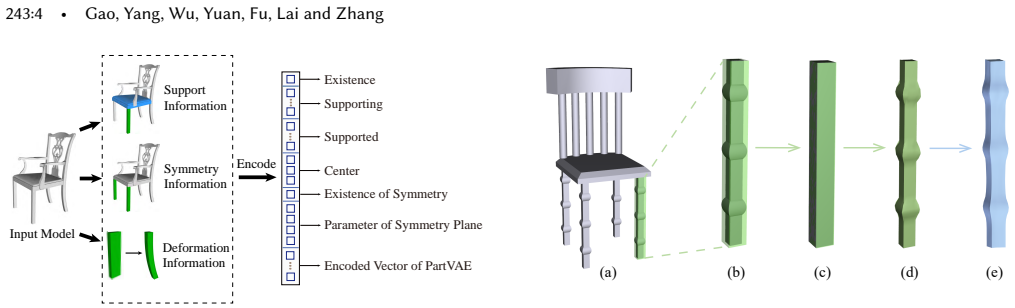
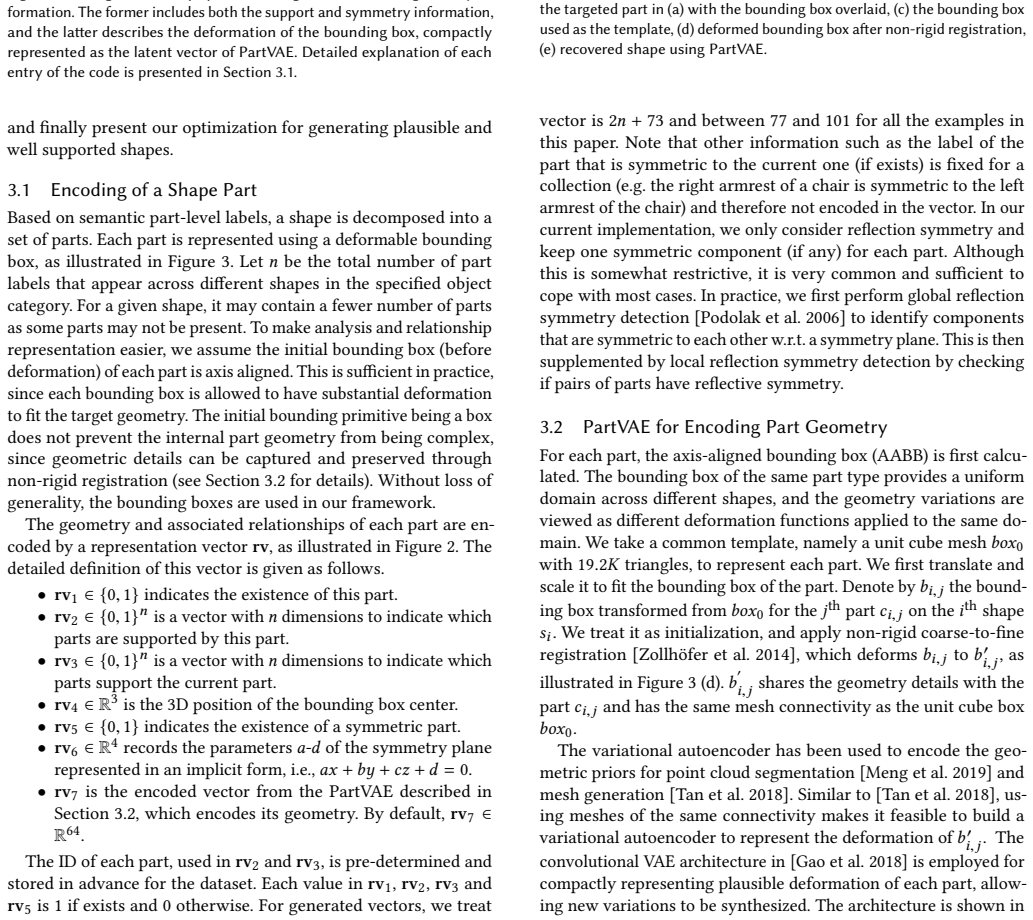
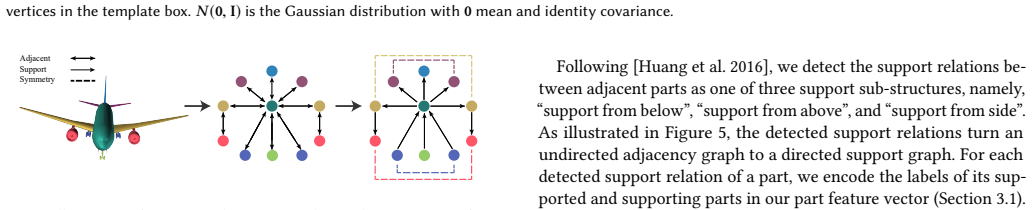
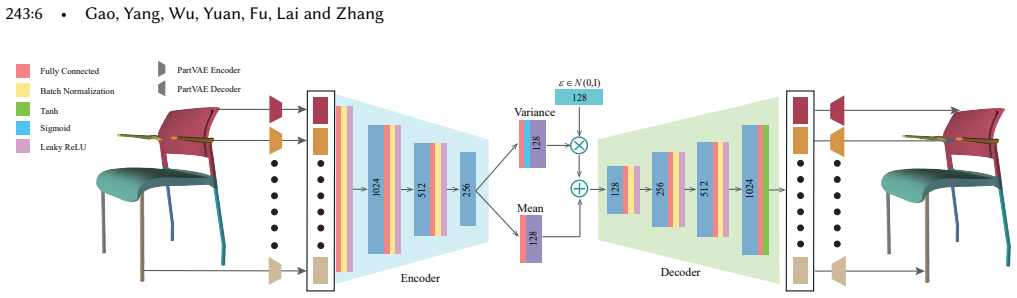
The central mechanism is the deformable bounding box: each semantic part is represented by a unit-cube mesh with 19.2K triangles, aligned to the part's axis-aligned bounding box, and fitted to the target geometry by non-rigid registration. All parts of a given type share this template connectivity, which is what makes a convolutional VAE over local 1-ring deformation features possible. Each part's representation vector carries existence, supported and supporting labels, center, symmetry indicator and plane, and the PartVAE latent code; SP-VAE then encodes the concatenated representation. Decoded shapes pass through a quadratic-integer refinement optimization that enforces symmetry, equal length, support tangency and containment, and stable support constraints.
What would settle it
Take a shape category where a semantic part contains a hole, such as a mug handle segmented as one part or a guitar headstock with string holes, and measure reconstruction accuracy near the hole: if the PartVAE closes the hole or the Chamfer distance is dominated by the missing boundary, the box-homeomorphism assumption gives way. The paper's own failure cases already show this qualitatively.
Extended reading notes
Core claim
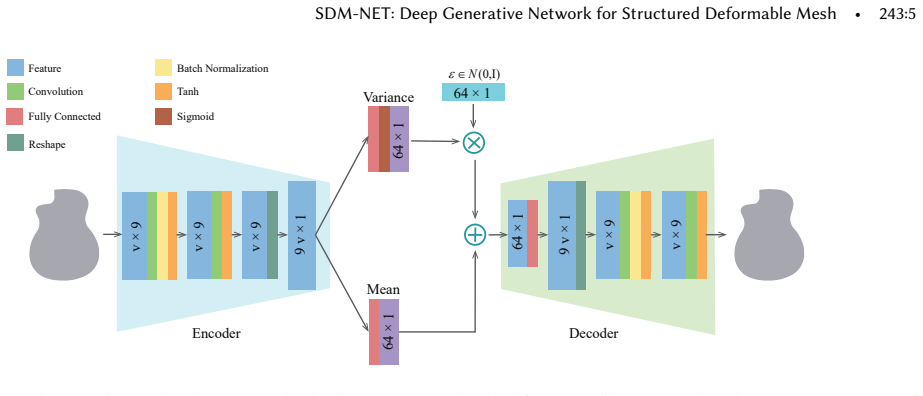
The paper's claim is that structured deformable meshes can serve as the output representation for deep generative shape modeling, and that a two-level VAE can learn them. At the part level, a PartVAE encodes the deformation of a fixed-connectivity, sphere-like template box into a 64-dimensional code. At the structure level, a Structured Parts VAE (SP-VAE) takes concatenated per-part codes that include existence, support relations, symmetry-plane parameters, box center, and the PartVAE geometry code, and jointly encodes them in a 128-dimensional latent space. Because structure and geometry share one latent space, interpolation and random sampling produce shapes whose parts are mutually consistent in style and physically plausible after a support-based refinement optimization. The paper reports lower reconstruction error than voxel-, point-, and patch-based generators on several metrics, and shows interpolation that changes topology, such as armrests appearing or disappearing.
Load-bearing premise
Every part of every target shape can be faithfully approximated by deforming a sphere-like box, so parts that themselves contain holes are out of reach.
Editorial extensions
If this is right
- Shape interpolation in the joint latent space can change part topology, such as armrests or handles appearing and disappearing, while keeping geometry coherent.
- Generated shapes are immediately editable: deleting a part also deletes its symmetric counterpart, and dragging one leg propagates to equal-length legs through the refinement constraints.
- Because each output part is a watertight mesh, the result can feed directly into assembly-based modeling or a watertight reconstruction step.
- A single per-category model can reconstruct unseen shapes when semantic segmentation is supplied by a pretrained point-cloud segmenter.
- Random sampling from the latent space produces novel, physically stable shapes with variable part counts, up to the maximum number of part labels.
Reading between the lines
- If the box-deformation assumption is the true limit, then the representation is bounded to genus-zero parts, so extending to parts with holes would require higher-genus templates or a hole-aware deformation field; the paper's own failure cases point in that direction.
- The support-based refinement step could be detached and reused as a post-process for other generative models that output box or graph structures without contact and stability guarantees.
- The joint latent space suggests that semantic attribute editing, such as making every table taller, might be implemented as linear directions in the 128-dimensional code, though the paper does not demonstrate vector arithmetic.
- Since all parts use the same template resolution, storage could be cut by assigning adaptive resolutions to different part types without losing visible detail, as the paper itself notes as future work.
Signed reviews
Editorial analysis
A structured set of objections, weighed in public.
Referee Report
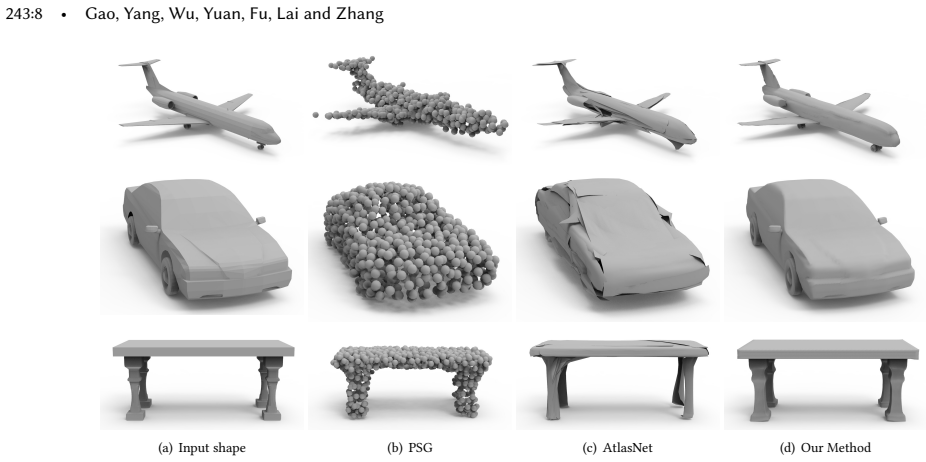
Summary. SDM-NET proposes a two-level variational autoencoder for generating structured deformable meshes. A shape is decomposed into semantic parts, each represented by a fixed-connectivity genus-zero box deformed through a part-level VAE (PartVAE), while a structure-level VAE (SP-VAE) jointly encodes part geometry and global structure such as symmetry and support relations. A post-hoc optimization enforces support stability, equal lengths, and symmetry. The paper evaluates reconstruction, generation, interpolation, ablation studies, editability, and generalizability on ShapeNet and ModelNet categories, comparing against PSG, AtlasNet, Adaptive O-CNN, GRASS, G2L, and SAGNet.
Significance. If the central claims hold, SDM-NET is a useful mesh-native generative representation: it produces part-structured, editable, deformable meshes rather than point clouds or voxels, and its joint structure-geometry encoding supports semantically meaningful interpolation and generation. Strengths of the paper include a clearly specified architecture, explicit loss definitions, extensive ablations (support vs. adjacency, separate vs. end-to-end training, joint vs. decoupled encoding, box resolution, per-type vs. single PartVAE), and importantly the authors disclose representative failure cases in the Limitations section. The reported runtime (36 ms per generation plus 100 ms optimization) is also useful. However, the evidence supporting some of the stronger comparative claims needs tightening: the quantitative comparisons lack error bars and significance tests, the method uses part-level supervision not given to several baselines, and the central genus-zero part assumption is only evaluated anecdotally.
major comments (3)
- [Sections 1, 3.2, 5 (Limitations)] The central representational assumption, stated in Section 1 and used throughout Section 3.2, is that every part can be approximated by deforming a genus-zero box template. The Limitations section concedes that parts with holes cannot be represented exactly and that such parts are 'projected' back to training-set-like deformations, with Figure 26 showing the guitar headstock and grid chair back as failures. The paper never reports how many parts or shapes in the evaluated categories violate the genus-zero assumption, and Chamfer distance does not penalize topology. As a result, the quantitative results in Tables 5-7 may overstate reconstruction quality on exactly the cases the representation cannot handle. Please report per-category statistics on non-genus-zero parts, and either exclude such shapes from the headline claims or add a topology-aware error metric so readers can assess how much of the claimed 'flexible topology' coverage is actually achieved.
- [Section 5, Tables 5 and 6] The quantitative comparisons report single-run averages without error bars, standard deviations, or significance tests. Some advantages are marginal: in Table 5, Chair JSD is 0.0364 for SDM-NET versus 0.0369 for AtlasNet, and in Table 6, SAGNet achieves a lower MMD-CD (0.0024) than SDM-NET (0.00274) despite the text claiming superiority in 'most cases'. Because the 75/25 random split is not repeated (or at least not reported as repeated for Tables 5 and 6), the current evidence does not establish that the differences are statistically reliable. Please provide variance over multiple seeds or splits, state how many generated samples are used for JSD/COV/MMD, and qualify the 'nearly all metrics' statement accordingly.
- [Section 5 (Shape Reconstruction)] The reconstruction comparisons in Table 5 are not apples-to-apples with respect to supervision: SDM-NET is trained with part-level semantic labels and support relations, whereas PSG, AtlasNet, and Adaptive O-CNN are not given this supervision. The reported superiority may therefore reflect the additional label information rather than the mesh/part representation alone. To support the 'state-of-the-art' claim, the authors should either include structure-aware baselines trained with the same labels (e.g., GRASS or StructureNet-type models) or compare against an unsupervised variant of SDM-NET, for example using the automatically predicted segmentation pipeline shown in Figure 23 as input instead of ground-truth labels.
minor comments (5)
- [Section 4.1] The citation '[Qi et al. 2017,?]' appears incomplete and should be replaced with a specific reference for supervised semantic segmentation methods or removed.
- [Section 2] The text refers to 'Dominic et al. [2018]', but the reference list entry is 'Jack, Pontes, Sridharan, Fookes, Shirazi, Maire, and Eriksson' (2018). Please align the in-text citation with the reference list.
- [Section 3.1] The binarization rule for the existence, support, and symmetry indicators (rv1, rv2, rv3, rv5) is stated in a parenthetical ('above 0.5 true'); it would be clearer to specify explicitly that this threshold is applied to the decoded SP-VAE output and to state whether it is applied before or after the refinement optimization.
- [Equations (1)-(3)] In the SP-VAE loss, LRegVAE is described as a squared l2 regularization term after Equation (3), but it would help to state explicitly which network parameters it regularizes and to give its relative weight or state that it is included with equal weight.
- [Section 5, Table 5 caption] The table caption repeats the direction of each metric ('For JSD and MMD, the smaller the better') inside the table area; consider moving this to the caption only to avoid duplication.
Circularity Check
No significant circularity: SDM-NET's claims are supported by an independently trained two-level VAE and external comparisons.
full rationale
The paper's central contribution is an architecture, not a derived physical or mathematical constant, so the main circularity patterns do not apply. The PartVAE is trained as an autoencoder on registered deformable-box parts and its reconstruction quality is measured on held-out test shapes, so the reported reconstruction capability is an empirical result rather than a quantity forced by construction. The SP-VAE jointly encodes the concatenated representation vectors of structure and part geometry, and its losses are standard VAE reconstruction, KL, and regularization terms; there is no equation in which an output quantity is identical to a fitted input by definition. The genus-zero deformable-box assumption is stated explicitly as the paper's representational premise, and its failure modes are acknowledged in the Limitations section, but an acknowledged limitation is not a circular derivation. Citations to prior work by the same authors (e.g., the convolutional VAE architecture in Gao et al. 2018, and the deformation representation in Tan et al. 2018) are used as implementation building blocks or hyperparameter sources, not as load-bearing uniqueness theorems or as substitutes for the paper's own evaluation. The support-refinement optimization enforces physical and structural constraints rather than predicting them from fitted data, so it does not create a self-definitional loop. Comparisons against external methods such as AtlasNet, PSG, Adaptive O-CNN, GRASS, and SAGNet provide independent evidence for the paper's qualitative and quantitative claims. Therefore, the derivation chain is self-contained and no specific circular step can be exhibited.
Assumptions & free parameters
free parameters (5)
- Latent dimension of PartVAE =
64
- Latent dimension of SP-VAE =
128
- SP-VAE loss weights (lambda1, lambda2) =
(1.0, 0.5)
- Refinement weight alpha =
10
- Support overlap epsilon =
0.1
assumptions (4)
- domain assumption Each part of a shape is homeomorphic to a genus-zero box and can be represented by deforming a template box.
- domain assumption A consistent semantic segmentation with part labels is available for all training shapes.
- domain assumption Non-rigid registration reliably aligns the template box to each part.
- domain assumption Support relations detected by the method of Huang et al. 2016 are correct and fixed.
invented entities (1)
-
Deformable box part representation
Cite this review
Pith. "Pith review of SDM-NET: Deep Generative Network for Structured Deformable Mesh." pith.science (2026). https://pith.science/paper/P43GQOXW
@misc{pith2026190804520,
  author       = {Pith},
  title        = {Pith review of: SDM-NET: Deep Generative Network for Structured Deformable Mesh},
  year         = {2026},
  howpublished = {\url{https://pith.science/paper/P43GQOXW}},
  note         = {Machine review of arXiv:1908.04520}
}
read the original abstract
We introduce SDM-NET, a deep generative neural network which produces structured deformable meshes. Specifically, the network is trained to generate a spatial arrangement of closed, deformable mesh parts, which respect the global part structure of a shape collection, e.g., chairs, airplanes, etc. Our key observation is that while the overall structure of a 3D shape can be complex, the shape can usually be decomposed into a set of parts, each homeomorphic to a box, and the finer-scale geometry of the part can be recovered by deforming the box. The architecture of SDM-NET is that of a two-level variational autoencoder (VAE). At the part level, a PartVAE learns a deformable model of part geometries. At the structural level, we train a Structured Parts VAE (SP-VAE), which jointly learns the part structure of a shape collection and the part geometries, ensuring a coherence between global shape structure and surface details. Through extensive experiments and comparisons with the state-of-the-art deep generative models of shapes, we demonstrate the superiority of SDM-NET in generating meshes with visual quality, flexible topology, and meaningful structures, which benefit shape interpolation and other subsequently modeling tasks.
Figures

Figures from the paper (20 more)








Reference graph
Works this paper leans on
-
[4]
IEEE Transactions on Visualization and Computer Graphics (2018)
AutoSweep: Recovering 3D Editable Objects from a Single Photograph. IEEE Transactions on Visualization and Computer Graphics (2018). Sheng Yang, Jie Xu, Kang Chen, and Hongbo Fu. 2017. View suggestion for interactive segmentation of indoor scenes. Computational Visual Media 3, 2 (2017), 131–146. Li Yi, Vladimir G Kim, Duygu Ceylan, I Shen, Mengyan Yan, Ha...
work page 2018
-
[2017]
GRASS: Generative Recursive Autoencoders for Shape Structures. ACM Trans. Graph. 36, 4 (2017), 52:1–52:14. Haggai Maron, Meirav Galun, Noam Aigerman, Miri Trope, Nadav Dym, Ersin Yumer, Vladimir G Kim, and Yaron Lipman. 2017. Convolutional neural networks on surfaces via seamless toric covers. ACM Trans. Graph. 36, 4 (2017), 71:1–71:10. Hsien-Yu Meng, Lin...
work page 2017
-
[2018]
In IEEE Conference on Computer Vision and Pattern Recognition (CVPR)
AtlasNet: A Papier-Mâché Approach to Learning 3D Surface Generation. In IEEE Conference on Computer Vision and Pattern Recognition (CVPR) . Salt Lake City, United States. Heli Ben Hamu, Haggai Maron, Itay Kezurer, Gal Avineri, and Yaron Lipman. 2018. Multi-chart generative surface modeling. ACM Trans. Graph. 37, 6 (2018), 215:1– 215:15. Rana Hanocka, Amir...
arXiv 2018
- [2019]
Reviewed August 14, 2026 · model on record in the stance chip above.
Discussion (0). Continue with ORCID to comment.