REVIEW 3 major objections 5 minor 3 cited by
Meta-Learning with Warped Gradient Descent
T0 review · 3 major / 5 minor · reviewed 2026-08-14 · deepseek-v4-flash
Pith's one-line read The paper claims that gradient-based meta-learning can be made scalable by learning a gradient preconditioner from sampled parameter trajectories, without ever backpropagating through the task-adaptation process.
desk verdict WarpGrad is a genuine and broadly validated step for gradient-based meta-learning, but its theoretical framing leans on an unexamined coupled-sampling assumption and an overbroad scalability claim. read the letter →
The pith
A machine-rendered reading of the paper's core claim, the machinery that carries it, and where it could break.
The reading
What carries the argument
The central object is the warp-layer: a neural network $\omega$ inserted between layers of a task learner so that the Jacobian $D_x\omega$ multiplies gradients during backpropagation and implicitly defines a preconditioning matrix $P$. The argument rides on the trajectory-agnostic meta-objective, which treats the $K$ iterates of stochastic gradient descent on a task as Monte-Carlo samples from an empirical prior $p(\theta|\tau)$ rather than as a differentiable path. This turns meta-learning into an expectation over a joint search space of tasks and parameter positions, so the meta-gradient can be computed at each sampled iterate independently. The supporting geometric identity is $G(\gamma;\varphi)^{-1} = [D_x\Omega][D_x\Omega]^T$, which connects the warped update to steepest descent under a Riemann metric, with the first-order Taylor equivalence $(L \circ \Omega)(\theta - \alpha\Delta\theta) = L(\gamma - \alpha\Delta\gamma) + O(\alpha^2)$ showing that a step in the warped space is a step in the original space up to second order.
What would settle it
Meta-train WarpGrad on task trajectories of length $K=5$ and then freeze the warp for $K=500$ adaptation steps on held-out tasks; if the warp performs no better than identity preconditioning at the long horizon, the empirical-prior assumption is not carrying the claimed transfer. A sharper variant is to meta-train on only every other SGD iterate and check that performance does not degrade, as the sampling view predicts.
Extended reading notes
Core claim
On the paper's own terms, the central discovery is that preconditioned gradient descent can be meta-learned pointwise in parameter space, without backpropagating through the optimization trajectory. The update rule is $\theta \leftarrow \theta - \alpha P(\theta;\varphi)\nabla L(\theta)$, with $P$ realized implicitly by interleaving warp-layers $\omega$ in the forward computation of the task learner. The meta-objective is $L(\varphi) = \sum_{\tau \sim p(\tau)} \sum_{\theta^\tau \sim p(\theta|\tau)} L^\tau_{\mathrm{meta}}(\theta^\tau - \alpha \nabla L^\tau_{\mathrm{task}}(\theta^\tau;\varphi); \varphi)$, an expectation over samples from the empirical distribution of parameters visited during task adaptation. Because the outer gradient flows only through the warp parameters at sampled points and not through the chain that produced them, the method avoids the exploding-gradient and credit-assignment problems of MAML-style training. The paper also claims a geometric reading: a non-degenerate warp induces a positive-definite metric $G(\gamma;\varphi)^{-1} = [D_x\Omega][D_x\Omega]^T$ on the original parameter manifold, and gradient descent in the warped space is first-order equivalent to Riemannian descent in the original space. Empirically, the claim is that WarpGrad improves on MAML, Reptile, Leap, and T-Nets in few-shot and multi-shot benchmarks and works in maze-navigation RL and continual-learning settings.
Load-bearing premise
The load-bearing premise is that the $K$ intermediate points visited by stochastic gradient descent on a task are representative samples of task parameters, so a warp meta-trained on those samples transfers to unseen tasks, longer adaptation horizons, and different learning settings.
Editorial extensions
If this is right
- Long-horizon gradient-based meta-learning becomes computationally feasible: WarpGrad runs 100 or 640 adaptation steps without differentiating through them and outperforms Reptile and Leap on multi-shot tieredImageNet.
- The stop-gradient objective keeps all the task-gradient terms and discards only local second-order effects, so the meta-learner can be trained at first-order cost while retaining most of the full-objective performance.
- Warp geometry and initialisation transfer are complementary: by optimizing $J(\varphi,\theta_0) = L(\varphi) + \lambda C(\theta_0)$, WarpGrad can be stacked with MAML-style or Leap-style initialisation learners.
- Non-linear warp-layers make the preconditioner data-dependent and break the block-diagonal limit of T-Nets and Meta-Curvature; the Omniglot ablations show capacity in the warp directly improves held-out accuracy.
- Because the meta-objective does not require a differentiable learning process, recurrent task-learners and reinforcement-learning objectives can be handled, as demonstrated by the maze-navigation Warp-RNN result.
Reading between the lines
- Because the meta-objective only needs parameter samples, the same training rule could in principle consume trajectories from any optimizer, such as Adam, momentum, or second-order methods, as long as those trajectories define a representative empirical prior; the paper demonstrates SGD-based and actor-critic trajectories only.
- The ablations show that more expressive non-linear warp-layers improve accuracy while post-warp activation covariances stay far from the identity, suggesting the learned geometry is not a Fisher-metric approximation; if that interpretation holds, the right design target is a task-distribution-specific descent geometry rather than curvature.
- The offline replay-buffer variant effectively turns task trajectories into a dataset, so one could meta-train a warp on a mixture of task families from the same buffer; the paper only uses buffers within a single family, but the objective is agnostic to how the buffer is filled.
Signed reviews
Editorial analysis
A structured set of objections, weighed in public.
Referee Report
Summary. The paper proposes WarpGrad, a meta-learning method that interleaves meta-learned "warp-layers" into a task-learner so that gradient descent during task adaptation is preconditioned by the Jacobians of these layers. The central idea is a trajectory-agnostic meta-objective (Eq. 11) that is optimized by sampling task-parameter iterates from K steps of SGD without backpropagating through the adaptation trajectory. The authors derive a first-order equivalence between warped gradient descent and Riemannian gradient descent (Eqs. 7-9), integrate the method with learned initializations (Warp-MAML, Warp-Leap, Warp-RNN), and report experiments on few-shot image classification, multi-shot Omniglot and tieredImageNet, a maze-navigation RL task, and a continual learning benchmark.
Significance. If the meta-objective is sound, WarpGrad would be a notable advance: it decouples meta-gradients from the inner loop, enabling long adaptation horizons and non-feed-forward task learners. The paper contains a clean derivation of the first-order equivalence, a broad experimental evaluation, and several strong ablations. In particular, Appendix G (Table 4) shows that warp-layers alone, without a meta-learned initialization, improve held-out Omniglot accuracy from 40.1% (SGD) to 68.0% (linear warps) and 81.3% (non-linear warps), and Appendix F systematically varies warp architecture and meta-objective. The open-source implementation and detailed appendices support reproducibility. The main weakness is that the meta-objective's sampling distribution is coupled to the very parameters being learned, and this circularity is not analyzed; this is a correctness risk for the central theoretical claim, though the empirical contribution remains substantial even if the theory is weakened.
major comments (3)
- [Section 2.4, Eq. (11)] The meta-objective is optimized over samples drawn from a distribution p(θ|τ) that is itself a function of φ through the adaptation rule θ_{k+1}=θ_k−α∇L_task(θ_k;φ) (Algorithm 1, line 8). The paper states that "we assume this distribution is given" and "any sampling strategy is valid," but in Algorithms 1-2 the samples are generated using the current φ, so the actual objective is an expectation under p_φ(θ|τ), not under a fixed distribution. The meta-gradient in Eq. (11) as written omits the dependence of p_φ on φ; no convergence, consistency, or bias analysis is provided for this coupled stochastic approximation. The quoted sentence in Section 2.5, "alternating between sampling task parameters from p(τ,θ) given the current parameter values for φ," acknowledges the coupling but does not analyze it. The online-vs-offline gap in Appendix F (76.3% vs 84.4%) is consistent with a biased-gradient concern. I ask the authors to either prove (or state conditions under which) the coupled sampling procedure consistently estimates the geometry in Eq. (10), treat p(θ|τ) as a fixed off-policy distribution and adjust the estimator accordingly, or explicitly present the method as a heuristic and qualify the claim that Eq. (11) is the canonical objective being optimized.
- [Section 2.3, Eqs. (7)-(9)] The claim that WarpGrad "inherits gradient descent properties, importantly guarantees of convergence" is not established for non-linear warp-layers. Equation (9) is a one-step first-order Taylor equivalence between the update in P-space and the ideal Riemannian update in W-space; it does not imply that the full K-step trajectory under the learned warp converges. Moreover, the metric G defined by G^{-1}=DΩDΩ^T is positive definite only if DΩ is non-singular, which is not guaranteed for a generic neural warp-layer. Please either state explicit regularity conditions (e.g., full-rank Jacobians and Lipschitz continuity) under which a convergence statement holds, or weaken the convergence claim to a local first-order approximation.
- [Abstract and Section 5] The abstract's claim that WarpGrad "can scale to arbitrarily large meta-learning problems" is contradicted by the conclusion, which acknowledges "linear computational complexity in the number of adaptation steps, currently an unresolved limitation." The method avoids backpropagating through the adaptation process, but it still requires executing K steps of task adaptation to obtain the samples in Eq. (11), so the cost is linear in K. This overclaim should be corrected in the revision.
minor comments (5)
- [Section 1 and Section 3] Several citations are placeholders: "???" appears in the introduction and "?" appears in Section 3 for Hochreiter et al. and in the discussion of second-order methods; these should be completed.
- [Appendix G, Table 4] The table caption says "mean test error" while the column header says "Accuracy," and the main text in Section 4.2 describes the same numbers as accuracies (error reduced from ~42% to ~19%). Please correct the caption/header to be consistent.
- [Section 4.3 and Figure 4] Figure 4 states Warp-RNN reaches a mean cumulative reward of ~160 in 60,000 episodes, while Section 4.3 says it reaches ~150 after 200,000 episodes; these numbers should be reconciled.
- [Eq. (6)] Equation (6) uses E[...] without defining the expectation; please specify that it is over the data distribution (or the relevant mini-batch) to avoid ambiguity.
- [Appendix B, Algorithm 2] Line 4 of Algorithm 2, "T ← {τ : [θ0] for τ in B}," is unclear; please rewrite it in standard set-builder notation or plain prose.
Circularity Check
No significant circularity: WarpGrad's meta-objective is a genuine stochastic approximation, and the warp component is validated independently of self-cited initialisation methods.
full rationale
The derivation chain is self-contained. The meta-objective in Eq. 11 is obtained from the canonical objective in Eq. 10 via the first-order equivalence in Eq. 9 and the factorization p(τ,θ)=p(θ|τ)p(τ); no fitted parameter is renamed as a prediction. The paper explicitly states that p(θ|τ) is assumed to be given and that 'any sampling strategy is valid' (Section 2.4), so using SGD iterates as Monte-Carlo samples is a stated modeling assumption, not a hidden equivalence. The fact that those samples depend on the current warp parameters φ is a real correctness risk—the paper provides no bias or convergence analysis for the coupled stochastic approximation—but it does not make Eq. 11 equal to its inputs by construction. The conclusion also candidly flags linear-in-K complexity as 'currently an unresolved limitation of gradient-based meta-learning.' Self-citations to Leap (Flennerhag et al., 2019) and HyperNetwork modulation (Flennerhag et al., 2018) are not load-bearing: Appendix G isolates warp-layers from a random initialisation by setting λC(θ0)=0 and still improves held-out accuracy from 40.1 (SGD) to 68.0 (linear warp) and 81.3 (nonlinear warp), while external baselines (MAML, Reptile, Meta-SGD, T-Nets, KFAC, Hebbian RL agents) provide the comparative support. No uniqueness theorem or prior-work ansatz is invoked to force the WarpGrad choice. Therefore the central claim does not reduce to its inputs.
Assumptions & free parameters
free parameters (6)
- Task learning rate alpha =
tuned per experiment (e.g., 0.001 in continual learning)
- Meta-learning rate beta =
tuned per experiment
- Initialisation objective weight lambda =
tuned per experiment
- Number of adaptation steps K =
K=5 (few-shot), 100 (Omniglot), 640 (tieredImageNet), 100 (continual)
- Offline meta-batch size eta =
eta=1 in Omniglot
- Meta-learned initialisation theta0 in Warp-MAML/Warp-Leap =
learned during meta-training
assumptions (4)
- domain assumption SGD iterates theta_tau_k form a Monte-Carlo sample from an empirical prior p(theta|tau)
- domain assumption The warp map Omega is non-degenerate, so G = (D Omega D Omega^T)^(-1) is a valid positive-definite Riemann metric
- standard math First-order Taylor expansion with O(alpha^2) error for small task learning rate alpha
- standard math Warp-layers are universal function approximators
invented entities (1)
-
Warp-layer
Cite this review
Pith. "Pith review of Meta-Learning with Warped Gradient Descent." pith.science (2026). https://pith.science/paper/P4APBI2Z
@misc{pith2026190900025,
  author       = {Pith},
  title        = {Pith review of: Meta-Learning with Warped Gradient Descent},
  year         = {2026},
  howpublished = {\url{https://pith.science/paper/P4APBI2Z}},
  note         = {Machine review of arXiv:1909.00025}
}
read the original abstract
Learning an efficient update rule from data that promotes rapid learning of new tasks from the same distribution remains an open problem in meta-learning. Typically, previous works have approached this issue either by attempting to train a neural network that directly produces updates or by attempting to learn better initialisations or scaling factors for a gradient-based update rule. Both of these approaches pose challenges. On one hand, directly producing an update forgoes a useful inductive bias and can easily lead to non-converging behaviour. On the other hand, approaches that try to control a gradient-based update rule typically resort to computing gradients through the learning process to obtain their meta-gradients, leading to methods that can not scale beyond few-shot task adaptation. In this work, we propose Warped Gradient Descent (WarpGrad), a method that intersects these approaches to mitigate their limitations. WarpGrad meta-learns an efficiently parameterised preconditioning matrix that facilitates gradient descent across the task distribution. Preconditioning arises by interleaving non-linear layers, referred to as warp-layers, between the layers of a task-learner. Warp-layers are meta-learned without backpropagating through the task training process in a manner similar to methods that learn to directly produce updates. WarpGrad is computationally efficient, easy to implement, and can scale to arbitrarily large meta-learning problems. We provide a geometrical interpretation of the approach and evaluate its effectiveness in a variety of settings, including few-shot, standard supervised, continual and reinforcement learning.
Figures


Figures from the paper (10 more)


Forward citations
Cited by 3 Pith papers
-
LLMs are Greedy Agents: Effects of RL Fine-tuning on Decision-Making Abilities
RL fine-tuning on self-generated chain-of-thought rationales increases exploration and lowers regret for LLM agents in bandits and tic-tac-toe, but the stated knowing-doing gap narrowing is not directly measured.
-
Evaluating Data Influence in Meta Learning
The paper derives closed-form influence functions that estimate the effect of removing tasks or instances on meta-learning parameters in bilevel optimization.
-
From Trajectories to Instructions: Language-Conditioned Meta-Reinforcement Learning
A language-instruction embedding can replace the gradient-based inner loop of MAML, yielding competitive BabyAI performance with lower per-iteration wall-clock time.
Reference graph
Works this paper leans on
-
[1]
bτ i∼ Cat(−5,−4,..., 4, 5). The task is to minimise the given objective from a randomly sampled initialisation, x{i=1,2}∼U(−3, 3). During meta-training, we train on a task for 100 steps using a learning rate of 0.1. Each task has a unique loss-surface that the learner traverses from the randomly sampled initialisation. While each loss-surface is unique, t...
work page 2019
-
[5]
Meta-sgd: Learning to learn quickly for few-shot learning
Li, Zhenguo, Zhou, Fengwei, Chen, Fei, and Li, Hang. Meta-sgd: Learning to learn quickly for few-shot learning. arXiv preprint arXiv:1707.09835,
-
[6]
Deep learning via hessian-free optimization
12 Published as a conference paper at ICLR 2020 Martens, James. Deep learning via hessian-free optimization. InInternational Conference on Machine Learning,
work page 2020
-
[7]
Mendonca, Russell, Gupta, Abhishek, Kralev, Rosen, Abbeel, Pieter, Levine, Sergey, and Finn, Chelsea. Guided meta-policy search. arXiv preprint arXiv:1904.00956,
work page Pith review arXiv 1904
-
[9]
Park, Eunbyung and Oliva, Junier B. Meta-curvature. arXiv preprint arXiv:1902.03356,
work page Pith review arXiv 1902
-
[10]
Efficient off-policy meta-reinforcement learning via probabilistic context variables
Rakelly, Kate, Zhou, Aurick, Quillen, Deirdre, Finn, Chelsea, and Levine, Sergey. Efficient off-policy meta-reinforcement learning via probabilistic context variables. arXiv preprint arXiv:1903.08254,
arXiv 1903
-
[11]
Evolutionary principles in self-referential learning
13 Published as a conference paper at ICLR 2020 Schmidhuber, Jürgen. Evolutionary principles in self-referential learning. PhD thesis, Technische Universität München,
work page 2020
-
[12]
Deep meta-learning: Learning to learn in the concept space
Zhou, Fengwei, Wu, Bin, and Li, Zhenguo. Deep meta-learning: Learning to learn in the concept space. arXiv preprint arXiv:1802.03596,
Show all 27 references
-
[13]
Orange represents task layers and blue represents warp-layers.⊕ denotes residual connections and⊙ any form of gating mechanism
14 Published as a conference paper at ICLR 2020 APPENDIX A W ARP GRAD DESIGN PRINCIPLES FOR NEURAL NETS x warp task conv block conv y (a) Warp-ConvNet x conv block conv BN ⊕ BN y (b) Warp-ResNet x h z LSTM LSTM h linear y (c) Warp-LSTM x c h ⊙ ⊙ 4x linear 4x linear ⊙ ⊙ ⊙ h lin...
2020
-
[14]
For convolutional neural networks, we may use any form of convolution, learned normalization (e.g
or LSTMs. For convolutional neural networks, we may use any form of convolution, learned normalization (e.g. Ioffe & Szegedy, 2015), or adaptor module (e.g. Rebuffi et al., 2017; Perez et al.,
2015
-
[15]
For recurrent networks, we can use stacked LSTMs to interleave warped layers, as well as any type of HyperNetwork 15 Published as a conference paper at ICLR 2020 architecture (e.g
to design task and warp-layers. For recurrent networks, we can use stacked LSTMs to interleave warped layers, as well as any type of HyperNetwork 15 Published as a conference paper at ICLR 2020 architecture (e.g. Ha et al., 2016; Suarez, 2017; Flennerhag et al.,
2020
-
[16]
Mujika et al., 2017)
or partitioning of fast and slow weights (e.g. Mujika et al., 2017). Figure 6 illustrates this process. B W ARP GRAD META-TRAINING ALGORITHMS In this section, we provide the variants of WarpGrad training algorithms used in this paper. Algo- rithm 1 describes a simple online al...
2017
-
[17]
toθ0 (Eq. 16), J Warp-Leap :=L(φ) +λCLeap(θ0), (15) where the Leap objective is defined by minimising the expected cumulative chordal distance, CLeap(θ0) := ∑ τ∼p(τ ) Kτ∑ k=1 ‖‖sg [ϑτ k]−ϑτ k−1 ‖‖ 2, ϑ τ k = (θτ k,0,...,θ τ k,n,Lτ task (θτ k;φ)). (16) Note that the Leap meta-gr...
2020
-
[18]
meta-objectives, and several implementations of the warp-layers on Omniglot in Appendix F. Warp-RNN For our Reinforcement Learning experiment, we define a WarpGrad optimiser by meta-learning an LSTM that modulates the weights of the task-learner (see Appendix I for details). Fo...
2016
-
[19]
For example, losses from the first sub-task, defined using the interval [−5,−3], will appearnT times in the meta-objective
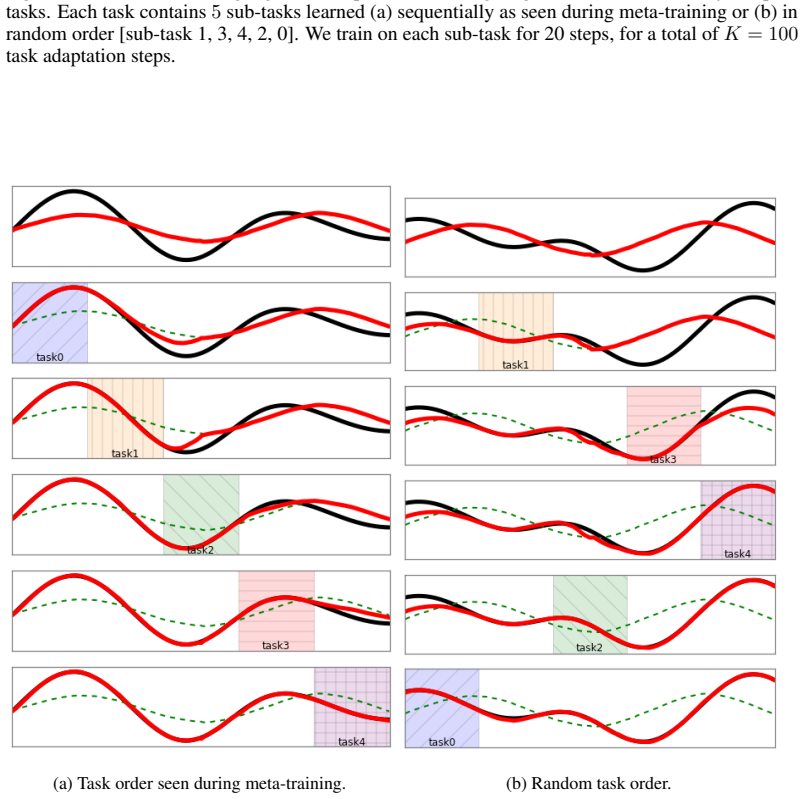
This meta-objective gives equal weight to all the tasks in the sequence by averaging the regression step loss over all sub-tasks where a prior sub-task should be learned or remembered. For example, losses from the first sub-task, defined using the interval [−5,−3], will appearnT...
2020
-
[20]
11), where we evaluateLτ meta on a randomly sampled mini-batch of data from the corresponding task
For each mini-batch, we updateφ by applying gradient descent under the canonical meta-objective (Eq. 11), where we evaluateLτ meta on a randomly sampled mini-batch of data from the corresponding task. Consequently, for each meta-batch, we take (up to) 2000 meta-gradient steps ...
2019
-
[21]
First, we isolate the effect of warping task loss surfaces by fixing a random initialisation and only meta-learning warp parameters
and Natural Neural Nets (Desjardins et al., 2015). First, we isolate the effect of warping task loss surfaces by fixing a random initialisation and only meta-learning warp parameters. That is, in this experiment, we set λC(θ0) = 0 . We compare against two baselines, stochastic ...
2015
-
[22]
Left: Comparison of mean activation value E[h(x)] across layers, pre- and post-warping
83.1±2.7 3×3conv Online full 76.3±2.1 3×3conv Offline full, learned α 83.1±3.3 Scaling‡ Offline full 77.5±1.8 1×1conv Offline full 79.4±2.2 3×3conv+ReLU Offline full 83.4±1.6 3×3conv+BN† Offline full 84.7±1.7 3×3conv+BN† + ReLU Offline full 85.0±0.9 3×3conv+BN† + Res§ +ReLU Offline f...
2016
-
[25]
and Hebbian meta-learners (Miconi et al., 2018; 2019). The task-learner in all cases is an advantage actor-critic (Wang et al., 2016), where the actor and critic share an underlying basic RNN, whose hidden state is projected into a policy and value function by two separate lin...
2018
-
[128]
The last 3 convolutional layers were followed by warp-layers with 128 filters each
was flattened and mapped, using a linear layer, to the 5 output units. The last 3 convolutional layers were followed by warp-layers with 128 filters each. Only the final 3 task-layer parameters and their corresponding scale and offset batch-norm parameters were adapted during tas...
2020
-
[200]
slow” weights to facilitate learning of “fast
Meta- learning arises in this setting as each episode encodes a different task, as the goal location moves, and by learning across episodes the RNN is encoding meta-information in its parameters that it can leverage during task adaptation (via its hidden state (Hochreiter & Sc...
2019
-
[256]
Hyper-parameters were tuned independently for each algorithm, version, and baseline using random grid search for highest test accuracy on meta-validation left-out tasks
was flattened and mapped, using a linear layer, to the 10 output units. Hyper-parameters were tuned independently for each algorithm, version, and baseline using random grid search for highest test accuracy on meta-validation left-out tasks. Grid sizes were 200 for all multi-sh...
2018
-
[1999]
Dynamic few-shot visual learning without forgetting
11 Published as a conference paper at ICLR 2020 Gidaris, Spyros and Komodakis, Nikos. Dynamic few-shot visual learning without forgetting. In International Conference on Computer Vision and Pattern Recognition,
2020
-
[2015]
Meta-learning representations for continual learning
Javed, Khurram and White, Martha. Meta-learning representations for continual learning. arXiv preprint arXiv:1905.12588,
1905 arXiv
-
[2016]
Universal representations: The missing link between faces, text, planktons, and cat breeds
Bilen, Hakan and Vedaldi, Andrea. Universal representations: The missing link between faces, text, planktons, and cat breeds. arXiv preprint arXiv:1701.07275,
-
[2018]
On First-Order Meta-Learning Algorithms
Nichol, Alex, Achiam, Joshua, and Schulman, John. On First-Order Meta-Learning Algorithms. arXiv preprint ArXiv:1803.02999,
-
[2019]
Bayesian model-agnostic meta-learning
Kim, Taesup, Yoon, Jaesik, Dia, Ousmane, Kim, Sungwoong, Bengio, Yoshua, and Ahn, Sungjin. Bayesian model-agnostic meta-learning. arXiv preprint arXiv:1806.03836,
Reviewed August 14, 2026 · model on record in the stance chip above.
Discussion (0). Continue with ORCID to comment.