Beyond the Mouth: Upper-Face Affective Cues in Audiovisual Sentence Recognition under Acoustic Uncertainty
Pith reviewed 2026-06-28 18:07 UTC · model grok-4.3
The pith
Upper-face affective cues improve calibration in audiovisual sentence recognition under noise without encoding lexical content.
A machine-rendered reading of the paper's core claim, the machinery that carries it, and where it could break.
Core claim
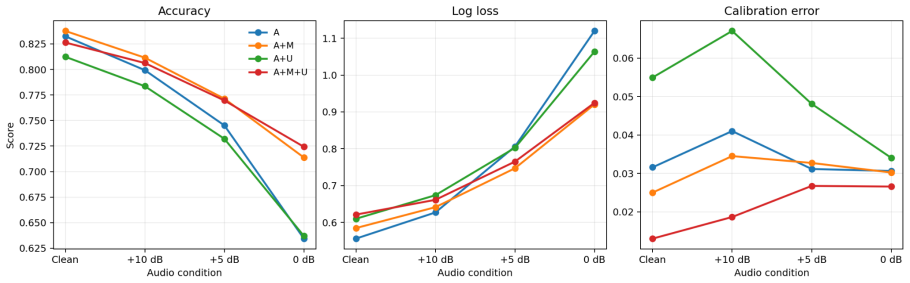
Using the CREMA-D audiovisual emotional speech corpus, feature-based sentence classifiers show that mouth/lower-face features raise accuracy substantially at low SNR while upper-face affective cues produce only small further accuracy gains yet consistently improve calibration across SNR levels and outperform shuffled upper-face controls under noisy conditions, indicating that affective facial information supports multimodal robustness and confidence estimation without directly encoding lexical content.
What carries the argument
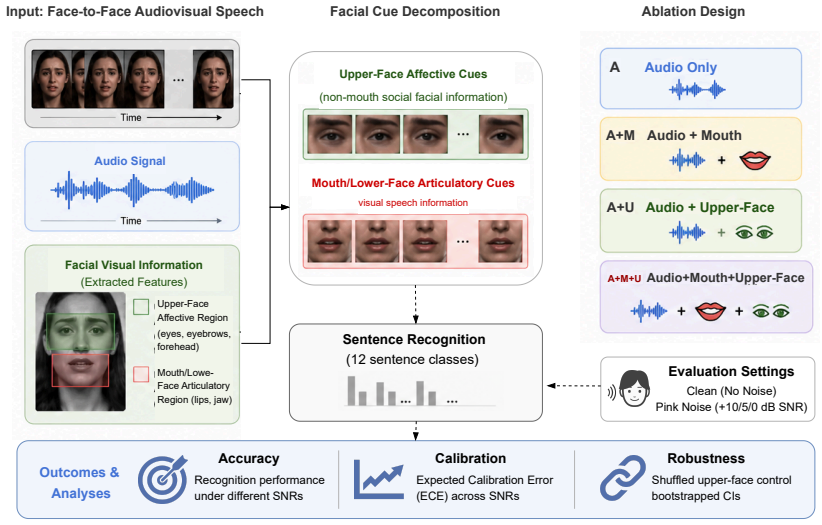
Feature-based sentence classifiers trained under four cue conditions (audio only, audio plus mouth/lower-face, audio plus upper-face, audio plus both) on the CREMA-D corpus and evaluated with actor-independent splits under pink-noise degradation at +10 dB, +5 dB, and 0 dB SNR.
If this is right
- Mouth/lower-face features improve accuracy over audio alone by 0.0794 at 0 dB SNR.
- Full-face models improve calibration across all tested SNR levels.
- Full-face models outperform shuffled upper-face controls under noisy conditions.
- Affective upper-face cues appear not to encode lexical content directly.
Where Pith is reading between the lines
- The same upper-face signals could be tested for benefit under other real-world degradations such as reverberation or competing speakers.
- Speech systems might use upper-face tracking to decide when to request clarification or lower their output speed.
- Human listeners may exploit the same affective cues to gauge their own understanding during noisy conversations.
Load-bearing premise
The upper-face features are driven primarily by affective expression and do not carry lexical or articulatory information that overlaps with mouth cues, while the shuffled controls isolate any true affective contribution.
What would settle it
If shuffled upper-face versions produce the same calibration scores and accuracy as real upper-face versions at 0 dB SNR, the claim that affective cues contribute separately would be falsified.
Figures
read the original abstract
Face-to-face speech comprehension is inherently multimodal, integrating acoustic signals with visible articulation, facial expression, head motion, and other socially relevant cues. While audiovisual speech systems typically focus on the mouth region as the primary visual source of linguistic information, affective facial expressions are often treated separately as emotion-recognition targets. This paper investigates whether upper-face affective information contributes to audiovisual sentence recognition beyond audio and mouth-region cues, particularly under acoustic degradation. Using the CREMA-D audiovisual emotional speech corpus, we train feature-based sentence classifiers under four cue conditions: audio only (A), audio plus mouth/lower-face features (A+M), audio plus upper-face features (A+U), and audio plus both mouth and upper-face features (A+M+U). Models are evaluated on clean audio and pink-noise conditions at +10 dB, +5 dB, and 0 dB SNR using actor-independent splits. Results show that mouth/lower-face features provide substantial robustness benefits under degraded audio. At 0 dB SNR, A+M improves accuracy over A by 0.0794, with an actor-bootstrap 95% confidence interval of [0.0296, 0.1298]. Upper-face affective cues exhibit a more nuanced effect. Although the direct accuracy gain of A+M+U over A+M is small, full-face models consistently improve calibration across SNR levels and outperform shuffled upper-face controls under noisy conditions. These findings suggest that affective facial information may support multimodal robustness and confidence estimation under acoustic uncertainty without directly encoding lexical content. More broadly, the study highlights the potential role of socially expressive facial cues in human-centered audiovisual interaction systems.
Editorial analysis
A structured set of objections, weighed in public.
Referee Report
Summary. The paper claims that upper-face affective cues contribute to audiovisual sentence recognition under acoustic degradation beyond audio and mouth-region features. Using the CREMA-D corpus and actor-independent splits, it trains classifiers under A, A+M, A+U, and A+M+U conditions and reports that mouth features yield clear accuracy gains (e.g., +0.0794 at 0 dB SNR with bootstrap 95% CI [0.0296, 0.1298]), while upper-face features produce smaller direct accuracy improvements but consistent calibration gains and outperform shuffled-upper-face controls under noise, suggesting affective signals aid robustness and confidence estimation without encoding lexical content.
Significance. If the central claim holds after addressing methodological gaps, the work would usefully extend audiovisual speech research by demonstrating a potential role for socially expressive upper-face cues in multimodal robustness under uncertainty. Strengths include use of a public corpus, explicit control conditions (shuffled baselines), actor-independent evaluation, and reporting of bootstrap CIs; these elements make the empirical design falsifiable and reproducible in principle.
major comments (2)
- [Abstract / Results] Abstract and Results: The central claim that upper-face features contribute via affective signals 'without directly encoding lexical content' rests on outperforming shuffled upper-face controls, yet the manuscript provides no description of the shuffling procedure (temporal structure preservation, actor-level statistics, or sentence-identity correlations across the 12-sentence set). This omission leaves open the possibility of residual lexical or articulatory leakage, directly undermining the interpretation that gains are purely affective.
- [Methods] Methods (implied by abstract reporting): Feature extraction details, exact model architecture, training procedure, and full statistical reporting (beyond the single accuracy delta and CIs) are absent. Without these, the reported gains (e.g., A+M improvement at 0 dB SNR) cannot be evaluated for robustness or replication, which is load-bearing for the multimodal robustness conclusion.
minor comments (1)
- [Abstract] Abstract: The phrase 'full-face models consistently improve calibration across SNR levels' would benefit from explicit metrics (e.g., ECE or Brier score values) rather than the qualitative statement.
Simulated Author's Rebuttal
We thank the referee for the constructive feedback highlighting the need for greater methodological transparency. We address each major comment below and will revise the manuscript to incorporate the requested clarifications.
read point-by-point responses
-
Referee: [Abstract / Results] The central claim that upper-face features contribute via affective signals 'without directly encoding lexical content' rests on outperforming shuffled upper-face controls, yet the manuscript provides no description of the shuffling procedure (temporal structure preservation, actor-level statistics, or sentence-identity correlations across the 12-sentence set). This omission leaves open the possibility of residual lexical or articulatory leakage.
Authors: We agree that the shuffling procedure must be explicitly described to support the interpretation. The revised manuscript will add a dedicated paragraph in the Methods section specifying that shuffling was performed at the sentence level (random permutation of upper-face feature sequences across the 12-sentence vocabulary while preserving intra-sentence temporal dynamics and actor-specific statistics) to disrupt lexical and articulatory correlations. This detail was inadvertently omitted and directly addresses the concern about potential leakage. revision: yes
-
Referee: [Methods] Feature extraction details, exact model architecture, training procedure, and full statistical reporting (beyond the single accuracy delta and CIs) are absent. Without these, the reported gains cannot be evaluated for robustness or replication.
Authors: We acknowledge that the current manuscript version under-reports these elements in sufficient detail for replication. The revised submission will expand the Methods section to include: (i) precise feature extraction pipelines (e.g., OpenFace 2.0 landmarks and AU intensities for upper-face, mouth ROI cropping), (ii) classifier architecture and hyperparameters, (iii) training protocol (actor-independent splits, optimization details), and (iv) additional metrics such as full per-SNR accuracy tables and calibration plots. These additions will enable independent evaluation of the multimodal robustness claims. revision: yes
Circularity Check
No circularity: empirical ML study on public corpus with controls
full rationale
This paper reports an empirical audiovisual speech recognition experiment on the external CREMA-D corpus using actor-independent splits and explicit control conditions (audio-only, audio+mouth, audio+upper-face, audio+both, plus shuffled-upper-face baselines). No equations, derivations, fitted parameters renamed as predictions, or self-citation chains appear in the provided text. Results consist of accuracy and calibration metrics on held-out data; the central claim rests on experimental comparisons rather than any reduction to inputs by construction. The study is therefore self-contained against external benchmarks.
Axiom & Free-Parameter Ledger
axioms (2)
- domain assumption Actor-independent splits in CREMA-D prevent speaker identity leakage during evaluation
- domain assumption Pink noise at +10 dB, +5 dB, and 0 dB SNR adequately models real acoustic uncertainty for the claim
Reference graph
Works this paper leans on
-
[1]
McGurk, J
H. McGurk, J. MacDonald, Hearing lips and seeing voices, Nature 264 (1976) 746–748. doi: 10. 1038/264746a0
1976
-
[2]
W. H. Sumby, I. Pollack, Visual contribution to speech intelligibility in noise, Journal of the Acoustical Society of America 26 (1954) 212–215. doi:10.1121/1.1907309
-
[3]
J. Holler, S. C. Levinson, Multimodal language processing in human communication, Trends in Cognitive Sciences 23 (2019) 639–652. doi:10.1016/j.tics.2019.05.006
-
[4]
S. Benetti, A. Ferrari, F. Pavani, Multimodal processing in face-to-face interactions: A bridging link between psycholinguistics and sensory neuroscience, Frontiers in Human Neuroscience 17 (2023) 1108354. doi:10.3389/fnhum.2023.1108354
-
[5]
H. Cao, D. G. Cooper, M. K. Keutmann, R. C. Gur, A. Nenkova, R. Verma, CREMA-D: Crowd-sourced emotional multimodal actors dataset, IEEE Transactions on Affective Computing 5 (2014) 377–390. doi:10.1109/TAFFC.2014.2336244
-
[6]
D. Ryumin, E. Ryumina, D. Ivanko, EMOLIPS: Towards reliable emotional speech lip-reading, Mathematics 11 (2023) 4787. doi:10.3390/math11234787
-
[7]
W. Tan, J. Lian, H. Inaguma, P. Tomasello, P. Koehn, X. Ma, Seeing is believing: Emotion- aware audio-visual language modeling for expressive speech generation, in: Findings of the Association for Computational Linguistics: EMNLP 2025, 2025. URL: https://aclanthology.org/2025. findings-emnlp.140/
2025
-
[8]
F. Eyben, M. Wöllmer, B. Schuller, openSMILE: The Munich versatile and fast open-source audio feature extractor, in: Proceedings of the 18th ACM International Conference on Multimedia, 2010, pp. 1459–1462. doi:10.1145/1873951.1874246
-
[9]
F. Eyben, K. R. Scherer, B. W. Schuller, J. Sundberg, E. André, C. Busso, L. Y. Devillers, J. Epps, P. Laukka, S. S. Narayanan, K. P. Truong, The Geneva minimalistic acoustic parameter set (GeMAPS) for voice research and affective computing, IEEE Transactions on Affective Computing 7 (2016) 190–202. doi:10.1109/TAFFC.2015.2457417
-
[10]
Google AI Edge, MediaPipe face landmarker, https://ai.google.dev/edge/mediapipe/solutions/ vision/face_landmarker, 2024
2024
-
[11]
Pedregosa, G
F. Pedregosa, G. Varoquaux, A. Gramfort, V. Michel, B. Thirion, O. Grisel, M. Blondel, P. Prettenhofer, R. Weiss, V. Dubourg, J. Vanderplas, A. Passos, D. Cournapeau, M. Brucher, M. Perrot, É. Duchesnay, Scikit-learn: Machine learning in Python, Journal of Machine Learning Research 12 (2011) 2825–
2011
-
[12]
URL: https://jmlr.org/papers/v12/pedregosa11a.html
-
[13]
C. Guo, G. Pleiss, Y. Sun, K. Q. Weinberger, On calibration of modern neural networks, in: Proceedings of the 34th International Conference on Machine Learning, volume 70 ofPMLR, 2017, pp. 1321–1330. URL: https://proceedings.mlr.press/v70/guo17a.html
2017
discussion (0)
Sign in with ORCID, Apple, or X to comment. Anyone can read and Pith papers without signing in.