REVIEW 4 major objections 4 minor 41 references
Group Pruning using a Bounded-Lp norm for Group Gating and Regularization
T0 review · 4 major / 4 minor · reviewed 2026-08-14 · deepseek-v4-flash
Pith's one-line read Exponential gates and a bounded-Lp penalty can drive unneeded channels exactly to zero during training, yielding high pruning rates with accuracy close to baseline.
desk verdict Useful pruning paper with competitive results, but the 'exact zero' claim for L2-regularized exponential gates is overstated and needs a precision caveat. read the letter →
The pith
A machine-rendered reading of the paper's core claim, the machinery that carries it, and where it could break.
The reading
What carries the argument
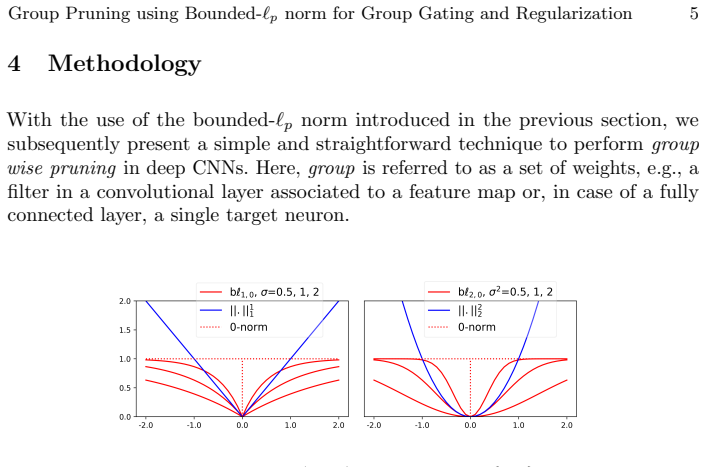
The bounded-$\ell_{p,0}$ norm, defined coefficient-wise as $1 - \exp(-|x|^p/\sigma^p)$, interpolates between the $\ell_p$ and $\ell_0$ norms as $\sigma$ shrinks. Used as a regularizer on gate parameters with $p=1$ (bounded-$\ell_1$), it penalizes small gates strongly and saturates for large gate values. The exponential gating layer uses the same function with $p=2$ and $\sigma=1$ to produce gate values in $[0,1)$ that multiply each channel; because the gate activation and the regularizer both vanish only at a gate parameter of zero, channels can be driven exactly to zero. The paper also schedules $\sigma$ during training, gradually reducing it to strengthen regularization and steer insignificant gates to zero.
What would settle it
Train MobileNetV2 on ImageNet with a fixed $\sigma$ (no scheduling) and measure whether the pruning rate collapses or accuracy drops beyond the reported trade-off; a clear degradation would show that the scheduled-$\sigma$ mechanism is load-bearing.
Extended reading notes
Core claim
The central claim is that a multiplicative gating layer with activation $1-e^{-g^2}$ (exponential gates) combined with a sparsity regularizer on the gate parameters can drive whole channels to exactly zero during training, while the saturating nature of the proposed bounded-$\ell_1$ penalty lets larger-magnitude gates escape heavy penalization and be optimized primarily by the task loss. This decouples parameter importance from parameter magnitude, which the paper argues improves pruning rates and preserves accuracy compared with standard $\ell_1$ regularization on linear (batch-norm scaling) gates. The paper shows empirically that the exponential gates achieve their best pruning rates at a threshold of exactly zero, meaning removable channels are exactly nulled out, and that the bounded-$\ell_1$ regularizer improves accuracy or pruning rate over plain $\ell_1$ on several models.
Load-bearing premise
The reported pruning-accuracy trade-offs assume that the hand-designed $\sigma$ schedules and per-architecture hyperparameter choices transfer to new architectures and datasets, since the paper provides no principled rule for setting them.
Editorial extensions
If this is right
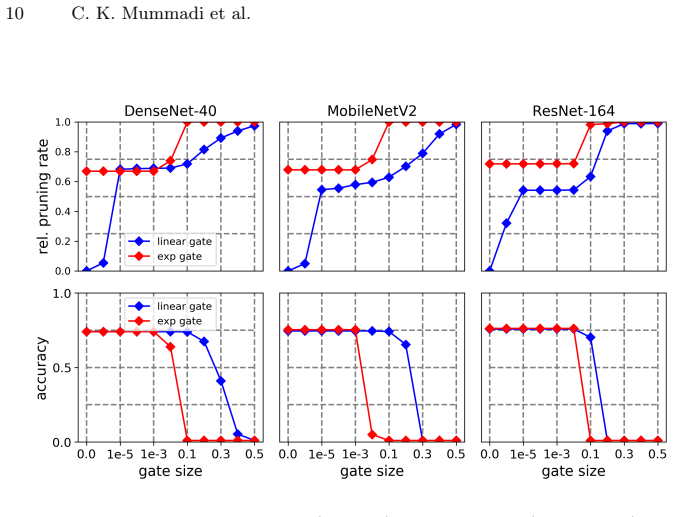
- Channel sparsity becomes exact for exponential gates, so pruning thresholds become unnecessary; a zero threshold is nearly optimal.
- Pruned networks can be deployed without fine-tuning when no batch-norm follows the gate, and with only a few epochs otherwise.
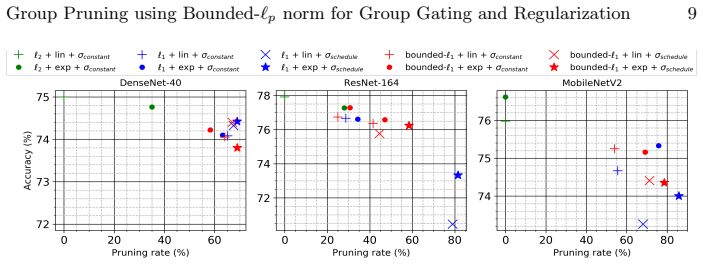
- The bounded-$\ell_1$ regularizer yields higher pruning rates than plain $\ell_1$ at similar accuracy on MobileNetV2 and ResNet-164, indicating that saturating penalties help retain important channels.
- Combining exponential gates with $\ell_2$ regularization can improve MobileNetV2 accuracy over standard training while still pruning, suggesting the gating layer acts as a helpful architectural inductive bias.
Reading between the lines
- The same bounded-penalty idea could be applied to other structured units, such as attention heads or transformer blocks, where magnitude-based pruning suffers from the same importance-vs-magnitude entanglement the paper identifies.
- Because the gates are deterministic and can be merged into the preceding convolution weights, the method may translate to hardware without dedicated sparse kernels, though the paper does not measure latency or energy outcomes.
- A testable extension: replace the hand-scheduled $\sigma$ with a learned or automatically annealed schedule and check whether the reported pruning/accuracy trade-offs hold outside the tuned hyperparameter ranges.
Signed reviews
Editorial analysis
A structured set of objections, weighed in public.
Referee Report
Summary. This paper proposes two mechanisms for structured channel pruning during training: a trainable exponential gating layer h(g)=1-exp(-g^2) inserted after convolutional layers, and a bounded-l1 regularizer that interpolates between l1 and l0 penalties. The authors argue that exponential gates, combined with l1/l2/bounded-l1 regularization of the gate parameters, drive unimportant channels to exactly zero and thereby remove the need for a carefully chosen pruning threshold. They provide empirical results on LeNet-5/MNIST, DenseNet-40, ResNet-164, and MobileNetV2 on CIFAR-100, plus ResNet-50 and MobileNetV2 on ImageNet, reporting parameter reductions of 30%, 69%, and 75% on CIFAR-100 for ResNet-164, DenseNet-40, and MobileNetV2, and state-of-the-art pruning trade-offs for ResNet-50 on ImageNet. A supplementary section gives the proof of Lemma 1 and detailed training hyperparameters.
Significance. If the empirical claims hold, the paper makes a useful practical contribution: it proposes a simple, trainable group-gating mechanism that can be combined with off-the-shelf regularizers, and a bounded-l1 penalty whose derivative is easy to compute and whose behavior is intuitively appealing. The empirical breadth is a strength: results span several architectures and two datasets of very different scale, and the appendix is transparent about many training details. The mathematical Lemma 1 is simple but correctly proved in the supplement. However, the central exact-zero claim is not rigorously established for the l2-regularized exponential gates used in several headline results, and the comparisons would be stronger with error bars and with baselines trained under identical budgets. These issues are fixable and do not invalidate the overall approach, but they are load-bearing for the paper's main conclusions.
major comments (4)
- [Section 4, 'Bounded-l2 for group gating', and Section 5, Fig. 3] The exact-zero claim for exponential gates under l2 regularization is not supported in exact arithmetic. From Eqs. (8)-(9) with R(g)=g^2, if the task-loss gradient for a channel vanishes, the gate obeys dg/dt = -2 lambda2 g, so g(t)=g(0) exp(-2 lambda2 t) > 0 for every finite t; and because h'(0)=0, the same obstruction holds for any smooth regularizer. The threshold-zero pruning reported for l2+exp in Fig. 4 and Table 2 therefore depends either on the discrete optimization dynamics or on numerical underflow, neither of which is described or justified. Please either restrict the exact-zero conclusion to l1/bounded-l1, or define the numerical criterion under which a gate is treated as zero and show that the reported pruning rates are stable under small threshold perturbations and across floating-point precisions.
- [Section 5, Tables 1-2 and Fig. 4] Central empirical comparisons are presented without uncertainty measures. Figure 2 reports averages over 3 runs but no error bars, while Table 2 and Fig. 4 report single numbers, and several claimed differences are small in magnitude (e.g., 69.9 vs. 69.54 top-1 accuracy on MobileNetV2, or bounded-l1 vs. l1 on linear gates). Please report standard deviations or confidence intervals over at least three seeds for all headline accuracy/pruning pairs, and state whether the qualitative conclusions are stable across seeds.
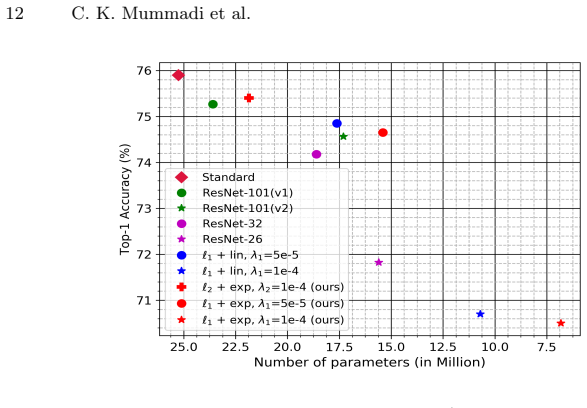
- [Section 5, Table 2, and Appendix A2] The MobileNetV2 ImageNet comparison is confounded by training budget and by the unvalidated reimplementation of the network-slimming baseline. Table 2 and the appendix state that MobileNetV2 was trained for 100 epochs on ImageNet, in contrast to the standard 400-epoch training, so comparisons with published baselines may reflect training length rather than the pruning method. The paper also states that [24] was reimplemented, but it does not demonstrate that the reimplementation reproduces the original published accuracy/pruning trade-off. Please train all baselines under the identical training schedule and, for reference, also report the original [24] numbers.
- [Appendix A2 and Section 4] The reported behavior depends on per-architecture hand-designed sigma schedules and lambda settings (e.g., MobileNetV2 sigma initialized to 2.0 and decayed by 0.99 per epoch; ResNet-164 and DenseNet-40 increase lambda after epoch 120 and use custom sigma decays), yet no selection rule or sensitivity analysis is provided. Because the bounded-l1 regularizer's interpolation between l1 and l0 is controlled by these choices, the claim that the method generalizes to new architectures is currently supported only by anecdotal tuning rather than by a demonstrated robustness to hyperparameter variation.
minor comments (4)
- [Section 3, Eq. (4)] The notation in Eq. (4) is garbled in the typeset text; it should read approximately (1/sigma^p) * sum_i |x_i|^p = (||x||_p / sigma)^p. Please fix the formatting.
- [Section 3, Eq. (1)] The indicator notation 1_a(b) is unconventional and should be written as 1_{a}(b), with the convention that this equals 1 when a=b and 0 otherwise.
- [Figure 2 caption] The caption states that 'two identical markers represent settings with different regularization strengths,' but the markers are not visually distinguished in the figure. Please use different marker styles or annotate the settings directly so the reader can identify them.
- [Supplementary, proof of Lemma 1] The proof is correct, but the claim lim_{sigma->0} exp(-|x_i|^p/sigma^p) = 1_0(x_i) should be stated with the convention that the limit at x_i=0 is 1 and at x_i != 0 is 0; this is understood but not explicitly stated.
Circularity Check
No circular derivation: the method is empirically evaluated against external baselines, and the only self-citation is a non-load-bearing related-work mention.
full rationale
We walked the claimed derivation chain and found no step in which an output is equivalent to an input by construction. The exponential gating layer is defined in Eq. 8 (h(g)=1-exp(-g^2)) and the regularizers are defined in Eqs. 5, 6, and 9; the reported pruning rates and accuracies are measured outcomes of training with those losses, not quantities fitted from the reported numbers. The paper's pruning protocol uses fixed thresholds (1e-4 for linear gates, zero for exponential gates) stated in Sec. 5, and the empirical comparisons are made against independent external baselines: network slimming from Liu et al. [24], L0 regularization from Louizos et al. [26], and block pruning from Huang and Wang [19]. No parameter is fit to the target pruning rate, and no 'prediction' is renamed from a fitted value. The only author-overlapping citation is [1] (Achterhold et al., which includes author Tim Genewein), used in the related-work survey for weight ternarization; it is not load-bearing for the gating, regularization, or pruning claims. The bounded-Lp norm result in Lemma 1 is a standard limit/Taylor expansion, and the paper attributes the underlying function to Weston et al. [37]. The hand-selected sigma schedules and lambda searches in Sec. A2 are hyperparameter choices, not circular inputs. The mathematical concern that l2-regularized exponential gates cannot reach exact zero in exact arithmetic and may only do so by floating-point underflow is a correctness/numerical reproducibility caveat, not a circularity: the paper's central 'exactly zero' claim is empirical, and its gate definition does not make that claim true by definition. Accordingly, no specific circular reduction can be quoted, and the analysis should not be scored above the minor-self-citation level.
Assumptions & free parameters
free parameters (5)
- λ1 (L1/bounded-L1 regularization strength) =
e.g., 5e-5 to 1e-4 on ImageNet; 1e-3 to 4e-3 on MNIST; 1e-4 to 5e-4 on CIFAR100
- λ2 (weight decay) =
e.g., 1e-5, 4e-5, 5e-4, 1e-4
- σ initial value and schedule =
e.g., init 2.0; ResNet-164/DenseNet-40: decay 0.02/epoch until 0.2 then 0.99/epoch; MobileNetV2: decay 0.99/epoch
- Gate initialization =
g=1.0 for exponential gates; γ=0.5 for linear gates
- Pruning threshold =
0 for exponential gates; 1e-4 for linear gates
assumptions (3)
- standard math Taylor expansion of exp around zero is used to prove Lemma 1 (Eq. 3 in supplementary).
- domain assumption The regularized loss can be optimized by SGD to a state where unimportant gate parameters become exactly zero.
- domain assumption Pruning channels with zero gates does not significantly alter the network function.
invented entities (1)
-
Exponential gating layer
Cite this review
Pith. "Pith review of Group Pruning using a Bounded-Lp norm for Group Gating and Regularization." pith.science (2026). https://pith.science/paper/P52PUBAZ
@misc{pith2026190803463,
  author       = {Pith},
  title        = {Pith review of: Group Pruning using a Bounded-Lp norm for Group Gating and Regularization},
  year         = {2026},
  howpublished = {\url{https://pith.science/paper/P52PUBAZ}},
  note         = {Machine review of arXiv:1908.03463}
}
read the original abstract
Deep neural networks achieve state-of-the-art results on several tasks while increasing in complexity. It has been shown that neural networks can be pruned during training by imposing sparsity inducing regularizers. In this paper, we investigate two techniques for group-wise pruning during training in order to improve network efficiency. We propose a gating factor after every convolutional layer to induce channel level sparsity, encouraging insignificant channels to become exactly zero. Further, we introduce and analyse a bounded variant of the L1 regularizer, which interpolates between L1 and L0-norms to retain performance of the network at higher pruning rates. To underline effectiveness of the proposed methods,we show that the number of parameters of ResNet-164, DenseNet-40 and MobileNetV2 can be reduced down by 30%, 69% and 75% on CIFAR100 respectively without a significant drop in accuracy. We achieve state-of-the-art pruning results for ResNet-50 with higher accuracy on ImageNet. Furthermore, we show that the light weight MobileNetV2 can further be compressed on ImageNet without a significant drop in performance.
Figures
Figures from the paper (1 more)
Reference graph
Works this paper leans on
-
[24]
In: Computer Vision (ICCV), 2017 IEEE International Conference on
Liu, Z., Li, J., Shen, Z., Huang, G., Yan, S., Zhang, C.: Learning efficient convo- lutional networks through network slimming. In: Computer Vision (ICCV), 2017 IEEE International Conference on. pp. 2755–2763. IEEE (2017)
work page 2017
-
[1]
Achterhold, J., Koehler, J.M., Schmeink, A., Genewein, T.: Variational network quantization. ICLR2018 (2018)
work page 2018
-
[2]
Alvarez, J.M., Salzmann, M.: Learning the number of neurons in deep networks. In: Adv. in Neural Info. Process. Syst. (NIPS). pp. 2270–2278 (2016)
work page 2016
-
[3]
Chen, W., Wilson, J., Tyree, S., Weinberger, K., Chen, Y.: Compressing neural networks with the hashing trick. Int. Conf. on Machine Learning (ICML) pp. 2285–2294 (2015)
work page 2015
-
[4]
Cheng, Y., Wang, D., Zhou, P., Zhang, T.: A survey of model compression and acceleration for deep neural networks. arXiv:1710.09282 (2017)
arXiv 2017
-
[5]
Courbariaux, M., Hubara, I., Soudry, D., El-Yaniv, R., Bengio, Y.: Binarized neural networks: Training deep neural networks with weights and activations constrained to + 1 or -1. arXiv:1602.02830 (2016)
arXiv 2016
-
[6]
Federici, M., Ullrich, K., Welling, M.: Improved Bayesian compression. arXiv:1711.06494 (2017)
work page Pith review arXiv 2017
-
[7]
Frankle, J., Carbin, M.: The lottery ticket hypothesis: Finding small, trainable neural networks. arXiv:1803.03635 (2018)
arXiv 2018
Show all 41 references
-
[8]
arXiv:1806.05975 (2018)
Ghosh, S., Yao, J., Doshi-Velez, F.: Structured variational learning of Bayesian neural networks with horseshoe priors. arXiv:1806.05975 (2018)
2018 arXiv
-
[9]
arXiv:1412.6115 (2014)
Gong, Y., Liu, L., Yang, M., Bourdev, L.: Compressing deep convolutional networks using vector quantization. arXiv:1412.6115 (2014)
2014 arXiv
-
[10]
Guo, Y., Yao, A., Chen, Y.: Dynamic network surgery for efficient dnns. Adv. in Neural Info. Process. Syst. (NIPS) pp. 1379–1387 (2016)
2016
-
[11]
IEEE Trans
Gysel, P., Pimentel, J., Motamedi, M., Ghiasi, S.: Ristretto: A framework for empirical study of resource-efficient inference in convolutional neural networks. IEEE Trans. on Neural Networks and Learning Syst. (2018)
2018
-
[12]
Han, S., Mao, H., Dally, W.J.: Deep compression: Compressing deep neural networks with pruning, trained quantization and Huffman coding. In: Int. Conf. on Learning Representations (ICLR) (2016)
2016
-
[13]
Han, S., Pool, J., Narang, S., Mao, H., Tang, S., Elsen, E., Catanzaro, B., Tran, J., Dally, W.J.: Dsd: Regularizing deep neural networks with dense-sparse-dense training flow. Int. Conf. on Learning Representations (ICLR) (2017)
2017
-
[14]
Han, S., Pool, J., Tran, J., Dally, W.: Learning both weights and connections for efficient neural network. Adv. in Neural Info. Process. Syst. (NIPS) pp. 1135–1143 (2015)
2015
-
[15]
Hanson, S.J., Pratt, L.Y.: Comparing biases for minimal network construction with back-propagation. Adv. in Neural Info. Process. Syst. (NIPS) pp. 177–185 (1989)
1989
-
[16]
In: International Conference on Computer Vision (ICCV)
He, Y., Zhang, X., Sun, J.: Channel pruning for accelerating very deep neural networks. In: International Conference on Computer Vision (ICCV). vol. 2 (2017)
2017
-
[17]
arXiv:1704.04861 (2017)
Howard, A.G., Zhu, M., Chen, B., Kalenichenko, D., Wang, W., Weyand, T., Andreetto, M., Adam, H.: Mobilenets: Efficient convolutional neural networks for mobile vision applications. arXiv:1704.04861 (2017)
2017 arXiv
-
[18]
arXiv:1607.03250 (2016)
Hu, H., Peng, R., Tai, Y.W., Tang, C.K.: Network trimming: A data-driven neuron pruning approach towards efficient deep architectures. arXiv:1607.03250 (2016)
2016 arXiv
-
[19]
arXiv:1707.01213 (2017)
Huang, Z., Wang, N.: Data-driven sparse structure selection for deep neural networks. arXiv:1707.01213 (2017)
2017 arXiv
-
[20]
Hubara, I., Courbariaux, M., Soudry, D., El-Yaniv, R., Bengio, Y.: Quantized neural networks: Training neural networks with low precision weights and activations. J. of Machine Learning Research (JMLR) 18(1), 6869–6898 (2017) 14 C. K. Mummadi et al
2017
-
[21]
arXiv:1602.07360 (2016)
Iandola, F.N., Han, S., Moskewicz, M.W., Ashraf, K., Dally, W.J., Keutzer, K.: Squeezenet: Alexnet-level accuracy with 50x fewer parameters and¡ 0.5 mb model size. arXiv:1602.07360 (2016)
2016 arXiv
-
[22]
arXiv:1505.07765 (2015)
Karaletsos, T., R¨ atsch, G.: Automatic relevance determination for deep generative models. arXiv:1505.07765 (2015)
2015 arXiv
-
[23]
Li, H., Kadav, A., Durdanovic, I., Samet, H., Graf, H.P.: Pruning filters for efficient convnets. Int. Conf. on Learning Representations (ICLR) (2017)
2017
-
[25]
Advances in Neural Information Processing Systems (2017)
Louizos, C., Ullrich, K., Welling, M.: Bayesian compression for deep learning. Advances in Neural Information Processing Systems (2017)
2017
-
[26]
ICLR 2018 (2018)
Louizos, C., Welling, M., Kingma, D.P.: Learning sparse neural networks through l0 regularization. ICLR 2018 (2018)
2018
-
[27]
ICCV2017 (2017)
Luo, J.H., Wu, J., Lin, W.: Thinet: A filter level pruning method for deep neural network compression. ICCV2017 (2017)
2017
-
[28]
Network: Computation in Neural Systems 6(3), 469–505 (1995)
MacKay, D.J.: Probable networks and plausible predictions - a review of practical Bayesian methods for supervised neural networks. Network: Computation in Neural Systems 6(3), 469–505 (1995)
1995
-
[29]
ICML 2017 (2017)
Molchanov, D., Ashukha, A., Vetrov, D.: Variational dropout sparsifies deep neural networks. ICML 2017 (2017)
2017
-
[30]
ICLR2017 (2017)
Molchanov, P., Tyree, S., Karras, T., Aila, T., Kautz, J.: Pruning convolutional neural networks for resource efficient inference. ICLR2017 (2017)
2017
-
[31]
Neal, R.M.: Bayesian Learning for Neural Networks. Ph.D. thesis, University of Toronto (1995)
1995
-
[32]
arXiv:1705.07283 (2017)
Neklyudov, K., Molchanov, D., Ashukha, A., Vetrov, D.: Structured Bayesian pruning via log-normal multiplicative noise. arXiv:1705.07283 (2017)
2017 arXiv
-
[33]
In: European Conference on Computer Vision
Rastegari, M., Ordonez, V., Redmon, J., Farhadi, A.: Xnor-net: Imagenet classi- fication using binary convolutional neural networks. In: European Conference on Computer Vision. pp. 525–542. Springer (2016)
2016
-
[34]
arXiv:1703.09039 (2017)
Sze, V., Chen, Y.H., Yang, T.J., Emer, J.: Efficient processing of deep neural networks: A tutorial and survey. arXiv:1703.09039 (2017)
2017 arXiv
-
[35]
ICLR 2017 (2017)
Ullrich, K., Meeds, E., Welling, M.: Soft weight-sharing for neural network com- pression. ICLR 2017 (2017)
2017
-
[36]
In: Advances in Neural Information Processing Systems
Wen, W., Wu, C., Wang, Y., Chen, Y., Li, H.: Learning structured sparsity in deep neural networks. In: Advances in Neural Information Processing Systems. pp. 2074–2082 (2016)
2016
-
[37]
Weston, J., Elisseeff, A., Sch¨ olkopf, B., Tipping, M.: Use of the zero-norm with linear models and kernel methods. J. of Machine Learning Research (JMLR)
-
[38]
arXiv:1802.04680 (2018)
Wu, S., Li, G., Chen, F., Shi, L.: Training and inference with integers in deep neural networks. arXiv:1802.04680 (2018)
2018 arXiv
-
[39]
arXiv:1802.00124 (2018)
Ye, J., Lu, X., Lin, Z., Wang, J.Z.: Rethinking the smaller-norm-less-informative assumption in channel pruning of convolution layers. arXiv:1802.00124 (2018)
2018 arXiv
-
[40]
arXiv:1702.03044 (2017)
Zhou, A., Yao, A., Guo, Y., Xu, L., Chen, Y.: Incremental network quantization: Towards lossless cnns with low-precision weights. arXiv:1702.03044 (2017)
2017 arXiv
-
[41]
In: European Conference on Computer Vision
Zhou, H., Alvarez, J.M., Porikli, F.: Less is more: Towards compact cnns. In: European Conference on Computer Vision. pp. 662–677. Springer (2016) Group Pruning using a Bounded- 𝓁p norm for Group Gating and Regularization Supplementary material A1 Proof of Lemma 1 (Lemma 1): T...
2016
Reviewed August 14, 2026 · model on record in the stance chip above.
Discussion (0). Continue with ORCID to comment.