REVIEW 1 major objections 56 references
Simultaneous Estimation of Partial-Transpose Moments with Active Memory Independent of the Moment Order
T0 review · 1 major / 0 minor · reviewed 2026-06-29 · grok-4.3
Pith's one-line read A qubit-reuse circuit estimates all partial-transpose moments up to order K using at most 2n+1 active qubits independent of K.
desk verdict The paper claims a qubit-reuse protocol for simultaneous partial-transpose moment estimation capped at 2n+1 active qubits independent of K, plus near-matching lower bounds, but the construction needs explicit verification. read the letter →
The pith
A machine-rendered reading of the paper's core claim, the machinery that carries it, and where it could break.
The reading
What carries the argument
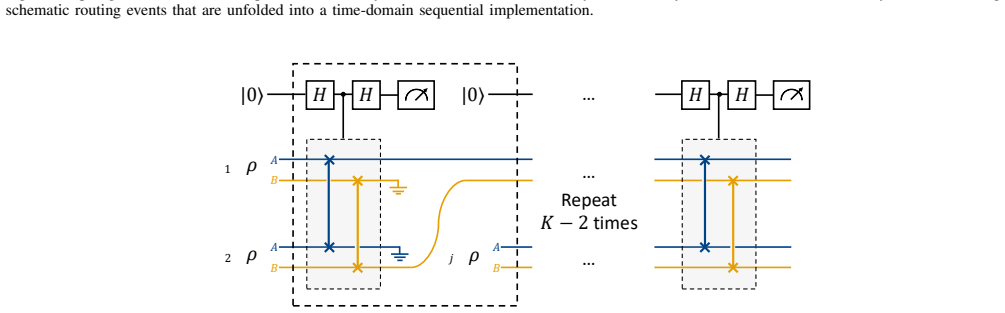
The sequential qubit-reuse realization of the partial-transpose permutation, which decomposes the operation into local gates and reuses to keep the number of simultaneously active qubits at most 2n+1 for any K.
What would settle it
An explicit circuit decomposition or numerical check showing that, for some K larger than 2, realizing the K-th partial-transpose permutation on n qubits requires more than 2n+1 active qubits at once.
Extended reading notes
Core claim
We give a sequential qubit-reuse realization of the partial-transpose permutation that uses at most 2n+1 active qubits, independent of K, and estimates all moments p₂,…,p_K to uniform additive error ε with total copy complexity O(K log K / ε²). We also prove two converse bounds. First, any uniformly accurate simultaneous estimator requires Ω(K/ε²) copies in the worst case. Second, the same scaling holds on an explicit isospectral two-qubit negative-partial-transpose (NPT) family whose ordinary moments are constant while the partial-transpose moments vary.
Load-bearing premise
The partial-transpose permutation circuit admits a sequential decomposition into local operations and qubit reuses that never requires more than 2n+1 simultaneously active qubits, regardless of how large K grows.
Editorial extensions
If this is right
- All moments from order 2 to K are obtained to uniform additive error ε with total copy count O(K log K / ε²).
- The active-qubit count remains capped at 2n+1 no matter how high the target moment order becomes.
- Any simultaneous estimator that works uniformly over all moments still needs at least Ω(K / ε²) copies in the worst case.
- The same linear-in-K lower bound applies even to an explicit two-qubit NPT family whose ordinary moments stay constant.
Reading between the lines
- The reuse technique might extend to simultaneous estimation of other nonlinear spectral functionals that currently demand growing memory.
- Hardware implementations could test whether the 2n+1 bound remains practical when n is moderate and K reaches dozens.
- The NPT example indicates that partial-transpose moments can separate states that are indistinguishable by ordinary moment estimates alone.
Editorial analysis
A structured set of objections, weighed in public.
Referee Report
Summary. The manuscript studies simultaneous estimation of partial-transpose moments p_j(ρ_AB) = Tr[(ρ_AB^{T_B})^j] for j = 2 to K of an unknown n-qubit bipartite state. It claims a sequential qubit-reuse realization of the partial-transpose permutation using at most 2n+1 active qubits independent of K, achieving uniform additive error ε with total copy complexity O(K log K / ε²). It also proves matching lower bounds Ω(K/ε²) in the worst case and on an explicit isospectral two-qubit NPT family.
Significance. If the central construction and bounds hold, the result characterizes the copy complexity of the partial-transpose moment hierarchy up to logarithmic factors and extends simultaneous nonlinear estimation techniques from ordinary state powers to partial-transpose spectral data under an active-memory constraint independent of moment order. The explicit NPT family lower bound is a concrete strength.
major comments (1)
- [abstract and qubit-reuse protocol section] The central claim of memory independence rests on the existence of a sequential qubit-reuse decomposition of the partial-transpose permutation that never exceeds 2n+1 simultaneously active qubits for arbitrary K (abstract and § on the realization). The manuscript must supply the explicit inductive construction, gate sequence, or reuse schedule together with a proof that no K-dependent coherent or measurement errors are introduced; without this, both the O(K log K / ε²) upper bound and the uniform-error guarantee cannot be verified.
Simulated Author's Rebuttal
We thank the referee for their careful reading of the manuscript and for the positive assessment of its significance. We address the single major comment below.
read point-by-point responses
-
Referee: [abstract and qubit-reuse protocol section] The central claim of memory independence rests on the existence of a sequential qubit-reuse decomposition of the partial-transpose permutation that never exceeds 2n+1 simultaneously active qubits for arbitrary K (abstract and § on the realization). The manuscript must supply the explicit inductive construction, gate sequence, or reuse schedule together with a proof that no K-dependent coherent or measurement errors are introduced; without this, both the O(K log K / ε²) upper bound and the uniform-error guarantee cannot be verified.
Authors: We agree that the explicit inductive construction, gate sequence, and reuse schedule, together with the accompanying error analysis, must be supplied in full detail to allow verification of the memory-independence claim. In the revised manuscript we will insert a new subsection (immediately following the current high-level description of the protocol) that presents the inductive construction of the sequential qubit-reuse decomposition of the partial-transpose permutation. The subsection will contain: (i) the base case for K=2, (ii) the inductive step that re-uses at most one additional ancilla while keeping the total active-qubit count ≤ 2n+1 for any K, (iii) the explicit gate sequence and measurement schedule, and (iv) a short proof that the construction introduces no K-dependent coherent or measurement errors. This addition will directly support both the stated copy-complexity upper bound and the uniform additive-error guarantee. revision: yes
Circularity Check
No significant circularity; new protocol construction and information-theoretic bounds are self-contained.
full rationale
The paper presents an explicit sequential qubit-reuse construction for the partial-transpose permutation (at most 2n+1 active qubits independent of K) together with matching upper and lower bounds on copy complexity. These rest on a direct circuit decomposition and standard information-theoretic arguments rather than any fitted parameters, self-referential definitions, or load-bearing self-citations. The abstract and claimed results introduce no reduction of the target quantities to their own inputs by construction; the derivation chain is therefore independent and self-contained.
Assumptions & free parameters
assumptions (1)
- domain assumption Independent identical copies of the unknown bipartite state are available and standard quantum operations (including partial transpose via permutation) can be performed.
Cite this review
Pith. "Pith review of Simultaneous Estimation of Partial-Transpose Moments with Active Memory Independent of the Moment Order." pith.science (2026). https://pith.science/paper/P5NTXHOE
@misc{pith2026260614204,
  author       = {Pith},
  title        = {Pith review of: Simultaneous Estimation of Partial-Transpose Moments with Active Memory Independent of the Moment Order},
  year         = {2026},
  howpublished = {\url{https://pith.science/paper/P5NTXHOE}},
  note         = {Machine review of arXiv:2606.14204}
}
abstract
We study the simultaneous estimation of partial-transpose moments $p_j(\rho_{AB})=\mathrm{Tr}[(\rho_{AB}^{T_B})^j]$, $j=2,\ldots,K$, of an unknown bipartite $n$-qubit state from independent copies under an explicit active-memory constraint. We give a sequential qubit-reuse realization of the partial-transpose permutation that uses at most $2n+1$ active qubits, independent of $K$, and estimates all moments $p_2,\ldots,p_K$ to uniform additive error $\epsilon$ with total copy complexity $O(K\log K/\epsilon^2)$. We also prove two converse bounds. First, any uniformly accurate simultaneous estimator requires $\Omega(K/\epsilon^2)$ copies in the worst case. Second, the same scaling holds on an explicit isospectral two-qubit negative-partial-transpose (NPT) family whose ordinary moments are constant while the partial-transpose moments vary. These results characterize the copy complexity of the partial-transpose moment hierarchy up to a logarithmic factor and extend simultaneous nonlinear-functional estimation from ordinary state powers to partial-transpose spectral data under active quantum memory independent of the target moment order.
Figures


Figures from the paper (3 more)


Reference graph
Works this paper leans on
-
[1]
Separability criterion for density matrices,
A. Peres, “Separability criterion for density matrices,”Physical Review Letters, vol. 77, no. 8, pp. 1413–1415, 1996
1996
-
[2]
Separability of mixed states: Necessary and sufficient conditions,
M. Horodecki, P. Horodecki, and R. Horodecki, “Separability of mixed states: Necessary and sufficient conditions,”Physics Letters A, vol. 223, no. 1–2, pp. 1–8, 1996
1996
-
[3]
Separability of n-particle mixed states: necessary and sufficient conditions in terms of linear maps,
——, “Separability of n-particle mixed states: necessary and sufficient conditions in terms of linear maps,”Physics Letters A, vol. 283, no. 1-2, pp. 1–7, 2001
2001
-
[4]
A computable measure of entanglement,
G. Vidal and R. F. Werner, “A computable measure of entanglement,”Physical Review A, vol. 65, no. 3, p. 032314, 2002
2002
-
[5]
An introduction to entanglement measures,
M. B. Plenio and S. Virmani, “An introduction to entanglement measures,”Quantum Information and Computation, vol. 7, no. 1-2, pp. 1–51, 2007
2007
-
[6]
Entanglement in many-body systems,
L. Amico, R. Fazio, A. Osterloh, and V . Vedral, “Entanglement in many-body systems,”Reviews of Modern Physics, vol. 80, no. 2, pp. 517–576, 2008
2008
-
[7]
Entanglement negativity in quantum field theory,
P. Calabrese, J. Cardy, and E. Tonni, “Entanglement negativity in quantum field theory,”Physical Review Letters, vol. 109, no. 13, p. 130502, 2012
2012
-
[8]
Entanglement negativity in extended systems: A field theoretical approach,
——, “Entanglement negativity in extended systems: A field theoretical approach,”Journal of Statistical Mechanics: Theory and Experiment, vol. 2013, no. 02, p. P02008, 2013
2013
Show all 56 references
-
[9]
Partial time-reversal transformation and entanglement negativity in fermionic systems,
H. Shapourian, K. Shiozaki, and S. Ryu, “Partial time-reversal transformation and entanglement negativity in fermionic systems,”Physical Review B, vol. 95, no. 16, p. 165101, 2017
2017
-
[10]
Measuring fermionic entanglement: Entropy, negativity, and spin structure,
E. Cornfeld, E. Sela, and M. Goldstein, “Measuring fermionic entanglement: Entropy, negativity, and spin structure,”Physical Review A, vol. 99, no. 6, p. 062309, 2019
2019
-
[11]
Method for direct detection of quantum entanglement,
P. Horodecki and A. Ekert, “Method for direct detection of quantum entanglement,”Physical Review Letters, vol. 89, no. 12, p. 127902, 2002
2002
-
[12]
Direct estimations of linear and nonlinear functionals of a quantum state,
A. K. Ekert, C. M. Alves, D. K. Oi, M. Horodecki, P. Horodecki, and L. C. Kwek, “Direct estimations of linear and nonlinear functionals of a quantum state,”Physical Review Letters, vol. 88, no. 21, p. 217901, 2002
2002
-
[13]
Measuring polynomial invariants of multiparty quantum states,
M. S. Leifer, N. Linden, and A. Winter, “Measuring polynomial invariants of multiparty quantum states,”Physical Review A, vol. 69, no. 5, p. 052304, 2004
2004
-
[14]
Noiseless quantum circuits for the Peres separability criterion,
H. A. Carteret, “Noiseless quantum circuits for the Peres separability criterion,”Physical Review Letters, vol. 94, no. 4, p. 040502, 2005
2005
-
[15]
Measuring entanglement growth in quench dynamics of bosons in an optical lattice,
A. J. Daley, H. Pichler, J. Schachenmayer, and P. Zoller, “Measuring entanglement growth in quench dynamics of bosons in an optical lattice,”Physical Review Letters, vol. 109, no. 2, p. 020505, 2012
2012
-
[16]
Measuring entanglement entropy in a quantum many-body system,
R. Islam, R. Ma, P. M. Preiss, M. Eric Tai, A. Lukin, M. Rispoli, and M. Greiner, “Measuring entanglement entropy in a quantum many-body system,” Nature, vol. 528, no. 7580, pp. 77–83, 2015
2015
-
[17]
Probing R ´enyi entanglement entropy via randomized measurements,
T. Brydges, A. Elben, P. Jurcevic, B. Vermersch, C. Maier, B. P. Lanyon, P. Zoller, R. Blatt, and C. F. Roos, “Probing R ´enyi entanglement entropy via randomized measurements,”Science, vol. 364, no. 6437, pp. 260–263, 2019
2019
-
[18]
Detecting entanglement in quantum many-body systems via permutation moments,
Z. Liu, Y . Tang, H. Dai, P. Liu, S. Chen, and X. Ma, “Detecting entanglement in quantum many-body systems via permutation moments,”Physical Review Letters, vol. 129, no. 26, p. 260501, 2022
2022
-
[19]
Predicting many properties of a quantum system from very few measurements,
H.-Y . Huang, R. Kueng, and J. Preskill, “Predicting many properties of a quantum system from very few measurements,”Nature Physics, vol. 16, no. 10, pp. 1050–1057, 2020
2020
-
[20]
Mixed-state entanglement from local randomized measurements,
A. Elben, R. Kueng, H.-Y . Huang, R. van Bijnen, C. Kokail, M. Dalmonte, P. Calabrese, B. Kraus, J. Preskill, P. Zolleret al., “Mixed-state entanglement from local randomized measurements,”Physical Review Letters, vol. 125, no. 20, p. 200501, 2020
2020
-
[21]
The randomized measurement toolbox,
A. Elben, S. T. Flammia, H.-Y . Huang, R. Kueng, J. Preskill, B. Vermersch, and P. Zoller, “The randomized measurement toolbox,”Nature Reviews Physics, vol. 5, no. 1, pp. 9–24, 2023
2023
-
[22]
Machine-learning-assisted many-body entanglement measurement,
J. Gray, L. Banchi, A. Bayat, and S. Bose, “Machine-learning-assisted many-body entanglement measurement,”Physical Review Letters, vol. 121, no. 15, p. 150503, 2018
2018
-
[23]
Single-copies estimation of entanglement negativity,
Y . Zhou, P. Zeng, and Z. Liu, “Single-copies estimation of entanglement negativity,”Physical Review Letters, vol. 125, no. 20, p. 200502, 2020
2020
-
[24]
Symmetry-resolved entanglement detection using partial transpose moments,
A. Neven, J. Carrasco, V . Vitale, C. Kokail, A. Elben, M. Dalmonte, P. Calabrese, P. Zoller, B. Vermersch, R. Kuenget al., “Symmetry-resolved entanglement detection using partial transpose moments,”npj Quantum Information, vol. 7, no. 1, p. 152, 2021
2021
-
[25]
Entanglement phase diagrams from partial transpose moments,
J. Carrasco, M. V otto, V . Vitale, C. Kokail, A. Neven, P. Zoller, B. Vermersch, and B. Kraus, “Entanglement phase diagrams from partial transpose moments,”Physical Review A, vol. 109, p. 012422, 2024
2024
-
[26]
Many-body entropies and entanglement from polynomially many local measurements,
B. Vermersch, M. Ljubotina, J. I. Cirac, P. Zoller, M. Serbyn, and L. Piroli, “Many-body entropies and entanglement from polynomially many local measurements,”Phys. Rev. X, vol. 14, p. 031035, 2024
2024
-
[27]
Optimal entanglement certification from moments of the partial transpose,
X.-D. Yu, S. Imai, and O. G ¨uhne, “Optimal entanglement certification from moments of the partial transpose,”Physical Review Letters, vol. 127, no. 6, p. 060504, 2021
2021
-
[28]
Partial transpose moments, principal minors and entanglement detection,
M. Ali, “Partial transpose moments, principal minors and entanglement detection,”Quantum Information Processing, vol. 22, p. 207, 2023
2023
-
[29]
A closed form for moment-based entanglement tests associated to the PPT criterion,
Z. P. Bradshaw and M. L. LaBorde, “A closed form for moment-based entanglement tests associated to the PPT criterion,”arXiv preprint arXiv:2503.17525, 2025
2025
-
[30]
A characterization of entangled two-qubit states via partial-transpose-moments,
L. Zhang, M.-J. Zhao, L. Chen, H. Xiang, and Y . Shen, “A characterization of entangled two-qubit states via partial-transpose-moments,”Annalen der Physik, vol. 534, no. 11, p. 2200289, 2022
2022
-
[31]
Visualization of all two-qubit states via partial-transpose-moments,
L. Zhang, Y . Shen, H. Xiang, Q. Qian, and B. Li, “Visualization of all two-qubit states via partial-transpose-moments,”Physical Review A, vol. 108, p. 012414, 2023
2023
-
[32]
Quantifying mixed-state entanglement via partial transpose and realignment moments,
P. S. Tarabunga and T. Haug, “Quantifying mixed-state entanglement via partial transpose and realignment moments,”arXiv preprint arXiv:2507.13840, 2025
2025
-
[33]
An online approach for entanglement verification using classical shadows,
M. Marso, S. Herbst, J. Wilkens, V . De Maio, I. Brandic, and R. Kueng, “An online approach for entanglement verification using classical shadows,” arXiv preprint arXiv:2603.26602, 2026
2026
-
[34]
Online estimation of partial transpose moments via fast classical updates,
H. Cha and J. Lee, “Online estimation of partial transpose moments via fast classical updates,”arXiv preprint arXiv:2605.01433, 2026
2026 arXiv
-
[35]
Detecting entanglement from few partial transpose moments and their decay via weight enumerators,
D. Miller and J. Eisert, “Detecting entanglement from few partial transpose moments and their decay via weight enumerators,”arXiv preprint arXiv:2604.12576, 2026
2026 arXiv
-
[36]
Sample-optimal tomography of quantum states,
J. Haah, A. W. Harrow, Z. Ji, X. Wu, and N. Yu, “Sample-optimal tomography of quantum states,” inProceedings of the forty-eighth annual ACM symposium on Theory of Computing, 2016, pp. 913–925
2016
-
[37]
Efficient quantum tomography,
R. O’Donnell and J. Wright, “Efficient quantum tomography,” inProceedings of the forty-eighth annual ACM symposium on Theory of Computing, 2016, pp. 899–912
2016
-
[38]
Sample-efficient estimation of nonlinear quantum state functions,
H. Yao, Y . Liu, T. Lin, and X. Wang, “Sample-efficient estimation of nonlinear quantum state functions,”Communications Physics, 2026
2026
-
[39]
Entanglement detection with trace polynomials,
A. Rico and F. Huber, “Entanglement detection with trace polynomials,”Physical Review Letters, vol. 132, no. 7, p. 070202, 2024
2024
-
[40]
State–entanglement-witness contraction,
A. Rico, “State–entanglement-witness contraction,”Physical Review Letters, vol. 135, no. 17, p. 170201, 2025
2025
-
[41]
Simultaneous estimation of nonlinear functionals of a quantum state,
K. Chen, Q. Wang, Z. Yu, and Z. Zhang, “Simultaneous estimation of nonlinear functionals of a quantum state,”arXiv preprint arXiv:2505.16715, 2025
2025
-
[42]
Multivariate trace estimation in constant quantum depth,
Y . Quek, E. Kaur, and M. M. Wilde, “Multivariate trace estimation in constant quantum depth,”Quantum, vol. 8, p. 1220, 2024
2024
-
[43]
Qubit-efficient entanglement spectroscopy using qubit resets,
J. Yirka and Y . Subas ¸ı, “Qubit-efficient entanglement spectroscopy using qubit resets,”Quantum, vol. 5, p. 535, 2021
2021
-
[44]
Near-optimal simultaneous estimation of quantum state moments,
X. Shi, J. Jiang, X. Wu, J. Xie, H. Yao, and X. Wang, “Near-optimal simultaneous estimation of quantum state moments,”arXiv preprint arXiv:2509.24842, 2025
2025
-
[45]
Exploiting dynamic quantum circuits in a quantum algorithm with superconducting qubits,
A. D. C ´orcoles, M. Takita, K. Inoue, S. Lekuch, Z. K. Minev, J. M. Chow, and J. M. Gambetta, “Exploiting dynamic quantum circuits in a quantum algorithm with superconducting qubits,”Physical Review Letters, vol. 127, no. 10, p. 100501, 2021. 24
2021
-
[46]
Qubit-reuse compilation with mid-circuit measurement and reset,
M. DeCross, E. Chertkov, M. Kohagen, and M. Foss-Feig, “Qubit-reuse compilation with mid-circuit measurement and reset,”Physical Review X, vol. 13, no. 4, p. 041057, 2023
2023
-
[47]
T. J. Rivlin,Chebyshev polynomials. Courier Dover Publications, 2020
2020
-
[48]
Hamiltonian simulation using linear combinations of unitary operations,
A. M. Childs and N. Wiebe, “Hamiltonian simulation using linear combinations of unitary operations,”Quantum Information and Computation, vol. 12, no. 11-12, pp. 901–924, 2012
2012
-
[49]
Probability inequalities for sums of bounded random variables,
W. Hoeffding, “Probability inequalities for sums of bounded random variables,”Journal of the American statistical association, vol. 58, no. 301, pp. 13–30, 1963
1963
-
[50]
Uniform mean estimation via generic chaining,
D. Bartl and S. Mendelson, “Uniform mean estimation via generic chaining,”arXiv preprint arXiv:2502.15116, 2025
2025
-
[51]
Distribution estimation under the infinity norm,
A. Kontorovich and A. Painsky, “Distribution estimation under the infinity norm,”Journal of Machine Learning Research, vol. 26, no. 162, pp. 1–30, 2025
2025
-
[52]
C. W. Helstrom,Quantum Detection and Estimation Theory. New York: Academic Press, 1976
1976
-
[53]
Watrous,The Theory of Quantum Information
J. Watrous,The Theory of Quantum Information. Cambridge: Cambridge University Press, 2018
2018
-
[54]
F. W. J. Olver, D. W. Lozier, R. F. Boisvert, and C. W. Clark, Eds.,NIST Handbook of Mathematical Functions. New York, NY: Cambridge University Press, 2010
2010
-
[55]
Quantum computing with Qiskit,
A. Javadi-Abhari, M. Treinish, K. Krsulich, C. J. Wood, J. Lishman, J. Gacon, S. Martiel, P. D. Nation, L. S. Bishop, A. W. Cross, B. R. Johnson, and J. M. Gambetta, “Quantum computing with Qiskit,”arXiv preprint arXiv:2405.08810, 2024
2024 arXiv
-
[56]
Error mitigation with clifford quantum-circuit data,
P. Czarnik, A. Arrasmith, P. J. Coles, and L. Cincio, “Error mitigation with clifford quantum-circuit data,”Quantum, vol. 5, p. 592, 2021
2021
Reviewed June 29, 2026 · model on record in the stance chip above.
Discussion (0). Sign in to comment.