REVIEW 3 major objections 5 minor 75 references
GSurf: Learning Signed Distance Fields from Splatting Opaque Gaussians for High-quality 3D Reconstruction
T0 review · 3 major / 5 minor · reviewed 2026-08-12 · deepseek-v4-flash
Pith's one-line read This paper claims that a signed distance field can be learned directly from the centers of Gaussian splatting primitives, supervised by $L_{\mathrm{pos}} = \sum_k |f_{\mathrm{sdf}}(p_k)|$, so that the volume-rendering branch can be…
desk verdict A genuinely faster SDF-from-Gaussian-centers method with honest ablations, but the key premise that Gaussian centers lie on the true surface is not enforced and the DTU numbers lag strong baselines; still worth refereeing with targeted fixes. read the letter →
The pith
A machine-rendered reading of the paper's core claim, the machinery that carries it, and where it could break.
The reading
What carries the argument
The machinery is a joint training loop with three modules: 2D Gaussian disks from 2DGS as discrete primitives, a geometry MLP $f_{\mathrm{sdf}}$ that outputs signed distance and a geometric feature per center, and an appearance MLP that colors each Gaussian from position, viewing direction, SDF normal, and geometric feature. The load-bearing term is the position constraint $L_{\mathrm{pos}} = \sum_k |f_{\mathrm{sdf}}(p_k)|$: it is what lets the SDF be learned without volume rendering. The opacity entropy loss $L_{\mathrm{ent}}$ is what makes that constraint valid by forcing each Gaussian's opacity toward 0 or 1, so low-opacity floaters that contribute to images but not to the true surface are pruned. Together these let the zero-level set of the SDF take over the role that TSDF fusion or Poisson reconstruction played in earlier Gaussian methods.
What would settle it
Measure the distance from the optimized Gaussian centers to the ground-truth mesh on a reflective or sparse-view object: if a substantial fraction of centers lie farther from the surface than the resolution of the mesh, then $L_{\mathrm{pos}}$ is not actually pinning the SDF to the true surface and the geometry quality should degrade accordingly.
Extended reading notes
Core claim
The central claim is that a correct surface can be recovered by jointly optimizing Gaussians and an SDF MLP with the loss $L_{\mathrm{sdf}} = \lambda_1 L_{\mathrm{pos}} + \lambda_2 L_{\mathrm{eik}} + \lambda_3 L_{\mathrm{off}} + \lambda_4 L_{\mathrm{ori}} + \lambda_5 L_{\mathrm{nor}}$, where $L_{\mathrm{pos}} = \sum_k |f_{\mathrm{sdf}}(p_k)|$ supplies direct 3D supervision from Gaussian centers and the other terms enforce Eikonal behavior, off-surface separation, orientation alignment, and normal-map agreement. The authors argue this works because the opacity entropy loss $L_{\mathrm{ent}} = -\lambda_6 \sum_k o_k \ln(o_k)$ drives Gaussian opacities toward 0 or 1, pruning the transparent off-surface primitives that would pull the SDF away from the true surface, and because normals and geometric features from the SDF are fed into the appearance MLP so that color prediction reinforces geometry. With only Gaussian splatting for rendering, the method reaches Chamfer distances and normal consistency comparable to VolSDF and NeuS on the DTU and OmniObjects3D benchmarks while training in 40 minutes to 1.3 hours, and it reconstructs semi-transparent or strongly lit objects that depth-fusion approaches fail on.
Load-bearing premise
The method assumes that, after optimization, the positions of the rendering splats lie close to the true object surface, so that forcing the signed-distance field to be zero at those positions yields the correct shape.
Editorial extensions
If this is right
- If the central claim holds, volume-rendering branches in Gaussian+SDF hybrids are unnecessary, cutting training from 2–16 hours to under 1.3 hours.
- SDF regularization replaces holes and noise from unreliable depth fusion with a continuous zero-level set, producing smoother and more complete meshes.
- Opacity entropy pruning concentrates mass in opaque, surface-aligned primitives, so scenes can be represented with fewer Gaussians than prior GS-based reconstruction methods.
- Feeding SDF normals and geometric features into the appearance MLP captures fine geometric detail that spherical-harmonic appearance alone misses.
- Because geometry no longer depends on rendered depth maps, the method can also handle strong-lighting and semi-transparent objects that TSDF and point-fusion approaches get wrong.
Reading between the lines
- A natural extension would be to weight $L_{\mathrm{pos}}$ by opacity so that already-opaque, on-surface Gaussians dominate the SDF fit, which could stabilize training before the entropy loss has pruned floaters.
- If the direct-supervision recipe is the real cause of the speedup, the same loss should work with non-Gaussian oriented points or surfels, which would separate the SDF-learning idea from the splatting renderer.
- For reflective or sparse-view objects, where the authors concede Gaussian centers can be sparse or inaccurate, adding a pull or normal-consistency term on the centroids themselves would be a direct extension of the method's own objective.
- The paper does not isolate how much of the gain comes from $L_{\mathrm{pos}}$ versus the opacity entropy loss; removing each separately would reveal which ingredient is load-bearing for the reported geometry quality.
Editorial analysis
A structured set of objections, weighed in public.
Referee Report
Summary. The paper proposes GSurf, an end-to-end framework that trains a neural signed distance field (SDF) directly under the supervision of 2D Gaussian primitive positions, without a volume-rendering branch. The SDF is fit to Gaussian centroids via a position loss (Lpos, Eq. 2), regularized by Eikonal, off-surface, orientation, and normal-map constraints. An opacity entropy loss (Eq. 3) is introduced to binarize opacities, and an appearance MLP consumes geometric features and gradients from the SDF to model view-dependent color. Experiments on DTU, OmniObjects3D, OO3D-SL, and α-NeuS claim reconstruction quality comparable to VolSDF and NeuS with training times of 40 minutes to 1.3 hours and significantly fewer Gaussian primitives than competing GS-based methods.
Significance. If the central premise holds, GSurf offers a conceptually simple and computationally efficient way to combine the smoothness of SDFs with the speed of Gaussian splatting, potentially useful for practical 3D reconstruction pipelines. The paper is clearly written, the training pipeline is specified in enough detail to reproduce, and the ablations in Tables 2 and 3 isolate the contributions of opacity regularization and geometry-guided appearance modeling. The claim of reduced primitive count is supported by the reported counts in Fig. 4. However, the validity of the whole approach rests on the assumption that optimized Gaussian centroids lie close enough to the true surface to serve as anchors for the SDF zero level set. The paper's own supplementary limitation (§7) concedes that under sparse views or reflective surfaces the Gaussians may be generated inaccurately, which directly undercuts the generality of the headline claim. Moreover, the quantitative evidence is mixed: on DTU the method is not state-of-the-art (Table 1), and the paper's response is to argue that Chamfer distance is misleading without providing an alternative quantitative metric on that dataset.
major comments (3)
- [Sec. 3.3–3.4, Eq. (2)–(3)] The central training signal Lpos fits the SDF zero level set to the Gaussian centers pk, but no term in the total loss (Eq. 6) directly pulls pk onto the true surface; the opacity entropy loss (Eq. 3) depends only on opacity values, not on 3D positions. The assertion in Sec. 3.4 that this loss "ensures that all Gaussian centroids are correctly positioned on the surface" is not supported by the loss formulation. The supplementary limitation in Sec. 7 explicitly concedes that under sparse-view or reflective conditions the Gaussians may be generated sparsely or inaccurately, which compromises the reconstructed geometry. Because every downstream geometry claim depends on the accuracy of the centers as surface proxies, the paper should either add an explicit surface-pulling mechanism (e.g., a gradient-based pull term as in GS-Pull) or provide empirical evidence that the learned centers lie close to the ground-truth surface in the evaluated scenes (e.g., measure the distance from centers to the true mesh). Without this, the core claim that GSurf learns a reliable SDF from Gaussian positions is not established.
- [Sec. 4.2, Table 1] The DTU quantitative evaluation shows GSurf's mean Chamfer distance (0.84) is worse than 2DGS (0.80) and GOF (0.74), and the paper's rebuttal that CD is misleading because of cropping and ground-truth noise is introduced only in the text, not supported by an alternative quantitative metric on DTU. The claim of "high-quality" reconstruction should be backed by a quantitative measure that favors the method (e.g., F-score or normal consistency on DTU, or a user study), or the paper should temper the claim to "comparable to VolSDF and NeuS" without asserting overall superiority to GS-based baselines.
- [Sec. 4.2, OO3D-SL and α-NeuS] The paper claims robustness to strong lighting and success on semi-transparent surfaces, but no quantitative results are reported for OO3D-SL or α-NeuS; the only support is visual comparisons. This is particularly concerning because the supplementary limitation (Sec. 7) lists reflective surfaces as a failure mode, and Sec. 3.4 states the method is designed for opaque objects. The authors should provide numeric metrics on these datasets or explicitly scope the claims to opaque objects with benign lighting; otherwise the headline claim of generality is not supported.
minor comments (5)
- [Eq. (3) and Sec. 3.4] The entropy loss -Σ o ln(o) is minimized both as o→0 and o→1, so the text "to converge to either 0 or 1" is accurate, but the later statement "aim for the Gaussians to be as opaque as possible" is inconsistent with the loss; clarify that the threshold-based pruning (not the loss itself) enforces high opacity for the surviving Gaussians.
- [Fig. 1 caption] The phrase "and state-of-the-art GS-based reconstruction techniques such as 2DGS [19], GOF [65] and GaussianSurfels [11], and neural implicit surface techniques such as VolSDF [63] and Voxurf [56]" is repeated verbatim in the caption; please remove the duplicate.
- [Sec. 3.6] The statement "the SDF is initialized as a sphere" should be specified more precisely (e.g., the sphere radius and the MLP initialization scheme) to ensure reproducibility, since the paper otherwise does not describe the network initialization.
- [Title] The title in the submitted text ("GSurf: 3D Reconstruction via Signed Distance Fields with Direct Gaussian Supervision") differs from the title in the abstract ("GSurf: Learning Signed Distance Fields from Splatting Opaque Gaussians for High-quality 3D Reconstruction"); please ensure the final manuscript uses one consistent title.
- [Table 2] The per-scene result for Ornament 8 (Ours CD 18.04, NC 0.856 vs. GaussianSurfels 13.95, 0.886) is substantially worse than a leading baseline, but the ranking highlighting may obscure this; consider reporting error bars or discussing such outliers to give a balanced view.
Circularity Check
No significant circularity: GSurf is an empirical fitting pipeline whose reconstruction quality is measured against external ground-truth meshes.
full rationale
The paper's central step is Eq. (2): the SDF is trained with Lpos = Σ_k |f_sdf(p_k)| so its zero level set follows the optimized Gaussian centers. This is a supervision signal, not a relabeled prediction; the benchmark quantities (Chamfer distance and normal consistency on DTU, OmniObjects3D, and α-NeuS) are computed against ground-truth meshes that are not produced by Eq. (2), so the reconstruction claim is falsifiable outside the paper's own fitted values. No fitted parameter is renamed as a prediction, and no uniqueness theorem or load-bearing result is imported from the authors' prior work; self-citations (refs. 28, 29, 59, 60, 68) appear in related-work and dataset contexts without supplying the derivation's core premise. The supplementary limitation ('reliance on Gaussian centroids as keypoints... Gaussians may be generated sparsely or inaccurately, compromising the quality of the reconstructed geometry') identifies a genuine correctness risk in sparse-view or reflective scenes, and the opacity entropy loss Eq. (3) does not by itself prove that centers lie on the true surface, but these are empirical robustness concerns rather than instances where the claimed output reduces by construction to the input.
Assumptions & free parameters
free parameters (3)
- Loss weights λ1..λ6 =
λ1=0.1, λ2=λ3=λ6=0.01, λ4=λ5=0.05
- Off-surface exponent α =
100
- Opacity pruning threshold =
Not specified
assumptions (4)
- domain assumption Gaussian centroids converge near the true surface under photometric loss
- domain assumption Opacity entropy loss drives most opacities to 1, making centroids surface points
- domain assumption 2DGS rendering model with depth distortion and depth-normal consistency losses provides a valid rendering geometry
- standard math Eikonal constraint plus off-surface constraint yields a true signed distance field
Cite this review
Pith. "Pith review of GSurf: Learning Signed Distance Fields from Splatting Opaque Gaussians for High-quality 3D Reconstruction." pith.science (2026). https://pith.science/paper/P5RB457H
@misc{pith2026241115723,
  author       = {Pith},
  title        = {Pith review of: GSurf: Learning Signed Distance Fields from Splatting Opaque Gaussians for High-quality 3D Reconstruction},
  year         = {2026},
  howpublished = {\url{https://pith.science/paper/P5RB457H}},
  note         = {Machine review of arXiv:2411.15723}
}
read the original abstract
High-fidelity surface reconstruction from multi-view images is a core problem in 3D computer vision. While neural implicit surfaces like SDFs offer smooth geometry, they are often bottlenecked by the computational intensity of volume rendering. Conversely, 3D Gaussian Splatting (3DGS) provides rapid training but lacks geometry continuity, often leading to fragmented surfaces. This paper presents a novel framework that integrates Signed Distance Fields directly into the splatting pipeline. By leveraging the continuous nature of SDFs to regularize Gaussian primitives, our method effectively fills geometric holes and suppresses noise inherent in sparse point clouds. Unlike hybrid approaches that rely on heavy volumetric sampling, our approach utilizes the efficiency of splatting to achieve faster convergence. Extensive evaluations demonstrate that our method produces high-quality surfaces with significantly fewer primitives, offering a more compact and efficient representation for both indoor and outdoor environments.
Figures
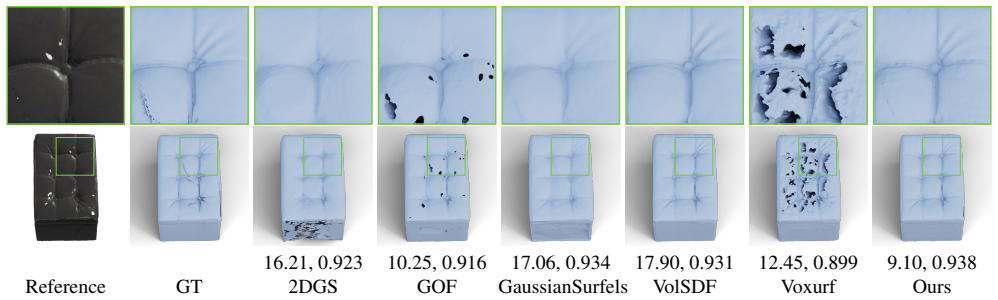


Figures from the paper (6 more)


Reference graph
Works this paper leans on
-
[1]
Sine: Semantic-driven image-based nerf editing with prior-guided editing field
Chong Bao, Yinda Zhang, Bangbang Yang, Tianxing Fan, Zesong Yang, Hujun Bao, Guofeng Zhang, and Zhaopeng Cui. Sine: Semantic-driven image-based nerf editing with prior-guided editing field. In Proceedings of the IEEE/CVF Conference on Computer Vision and Pattern Recognition , pages 20919–20929, 2023. 1
work page 2023
-
[2]
Ma Baorui, Han Zhizhong, Liu Yu-Shen, and Zwicker Matthias. Neural-pull: Learning signed distance functions from point clouds by learning to pull space onto surfaces. In International Conference on Machine Learning (ICML) ,
-
[3]
Reconstruct- ing surfaces for sparse point clouds with on-surface priors
Ma Baorui, Liu Yu-Shen, and Han Zhizhong. Reconstruct- ing surfaces for sparse point clouds with on-surface priors. In Proceedings of the IEEE/CVF Conference on Computer Vision and Pattern Recognition (CVPR), 2022. 2, 4
work page 2022
-
[4]
Barron, Ben Mildenhall, Dor Verbin, Pratul P
Jonathan T. Barron, Ben Mildenhall, Dor Verbin, Pratul P. Srinivasan, and Peter Hedman. Mip-nerf 360: Unbounded anti-aliased neural radiance fields. CVPR, 2022. 3
work page 2022
-
[5]
pi-gan: Periodic implicit generative adversarial networks for 3d-aware image synthesis
Eric R Chan, Marco Monteiro, Petr Kellnhofer, Jiajun Wu, and Gordon Wetzstein. pi-gan: Periodic implicit generative adversarial networks for 3d-aware image synthesis. In Pro- ceedings of the IEEE/CVF conference on computer vision and pattern recognition, pages 5799–5809, 2021. 1
work page 2021
-
[6]
Efficient geometry-aware 3d generative adversarial networks
Eric R Chan, Connor Z Lin, Matthew A Chan, Koki Nagano, Boxiao Pan, Shalini De Mello, Orazio Gallo, Leonidas J Guibas, Jonathan Tremblay, Sameh Khamis, et al. Efficient geometry-aware 3d generative adversarial networks. In Pro- ceedings of the IEEE/CVF conference on computer vision and pattern recognition, pages 16123–16133, 2022. 1, 2
work page 2022
-
[7]
Pgsr: Planar-based gaussian splatting for efficient and high-fidelity surface reconstruction
Danpeng Chen, Hai Li, Weicai Ye, Yifan Wang, Weijian Xie, Shangjin Zhai, Nan Wang, Haomin Liu, Hujun Bao, and Guofeng Zhang. Pgsr: Planar-based gaussian splatting for efficient and high-fidelity surface reconstruction. arXiv preprint arXiv:2406.06521, 2024. 2
arXiv 2024
-
[8]
Neusg: Neural im- plicit surface reconstruction with 3d gaussian splatting guid- ance
Hanlin Chen, Chen Li, and Gim Hee Lee. Neusg: Neural im- plicit surface reconstruction with 3d gaussian splatting guid- ance. arXiv preprint arXiv:2312.00846, 2023. 1, 5
arXiv 2023
Show all 75 references
-
[9]
Vcr-gaus: View consistent depth-normal regularizer for gaussian surface reconstruction
Hanlin Chen, Fangyin Wei, Chen Li, Tianxin Huang, Yun- song Wang, and Gim Hee Lee. Vcr-gaus: View consistent depth-normal regularizer for gaussian surface reconstruction. arXiv preprint arXiv:2406.05774, 2024. 2
2024 arXiv
-
[10]
Neurbf: A neural fields repre- sentation with adaptive radial basis functions
Zhang Chen, Zhong Li, Liangchen Song, Lele Chen, Jingyi Yu, Junsong Yuan, and Yi Xu. Neurbf: A neural fields repre- sentation with adaptive radial basis functions. In Proceed- ings of the IEEE/CVF International Conference on Com- puter Vision (ICCV), pages 4182–4194, 2023. 1
2023
-
[11]
High-quality surface recon- struction using gaussian surfels
Pinxuan Dai, Jiamin Xu, Wenxiang Xie, Xinguo Liu, Huamin Wang, and Weiwei Xu. High-quality surface recon- struction using gaussian surfels. In ACM SIGGRAPH 2024 Conference Papers, pages 1–11, 2024. 2, 5, 6, 7, 1
2024
-
[12]
Mirres: Multi-bounce in- verse rendering using reservoir sampling
Yuxin Dai, Qi Wang, Jingsen Zhu, Dianbing Xi, Yuchi Huo, Chen Qian, and Ying He. Mirres: Multi-bounce in- verse rendering using reservoir sampling. arXiv preprint arXiv:2406.16360, 2024. 1
2024 arXiv
-
[13]
Plenoxels: Radiance fields without neural networks
Sara Fridovich-Keil, Alex Yu, Matthew Tancik, Qinhong Chen, Benjamin Recht, and Angjoo Kanazawa. Plenoxels: Radiance fields without neural networks. In Proceedings of the IEEE/CVF conference on computer vision and pattern recognition, pages 5501–5510, 2022. 2
2022
-
[14]
Geo-neus: Geometry-consistent neural implicit sur- faces learning for multi-view reconstruction
Qiancheng Fu, Qingshan Xu, Yew Soon Ong, and Wenbing Tao. Geo-neus: Geometry-consistent neural implicit sur- faces learning for multi-view reconstruction. In Advances in Neural Information Processing Systems , pages 3403–3416,
-
[15]
Implicit geometric regularization for learning shapes
Amos Gropp, Lior Yariv, Niv Haim, Matan Atzmon, and Yaron Lipman. Implicit geometric regularization for learning shapes. In Proceedings of Machine Learning and Systems 2020, pages 3569–3579. 2020. 2
2020
-
[16]
Sugar: Surface- aligned gaussian splatting for efficient 3d mesh reconstruc- tion and high-quality mesh rendering
Antoine Gu ´edon and Vincent Lepetit. Sugar: Surface- aligned gaussian splatting for efficient 3d mesh reconstruc- tion and high-quality mesh rendering. In Proceedings of the IEEE/CVF Conference on Computer Vision and Pattern Recognition, pages 5354–5363, 2024. 2
2024
-
[17]
Surface reconstruction from un- organized points
Hugues Hoppe, Tony DeRose, Tom Duchamp, John McDon- ald, and Werner Stuetzle. Surface reconstruction from un- organized points. In Proceedings of the 19th Annual Con- ference on Computer Graphics and Interactive Techniques , page 71–78, New York, NY , USA, 1992. 2
1992
-
[18]
Iterative poisson surface reconstruc- tion (ipsr) for unoriented points
Fei Hou, Chiyu Wang, Wencheng Wang, Hong Qin, Chen Qian, and Ying He. Iterative poisson surface reconstruc- tion (ipsr) for unoriented points. ACM Trans. Graph. , 41 (4), 2022. 2
2022
-
[19]
2d gaussian splatting for geometrically ac- curate radiance fields
Binbin Huang, Zehao Yu, Anpei Chen, Andreas Geiger, and Shenghua Gao. 2d gaussian splatting for geometrically ac- curate radiance fields. In ACM SIGGRAPH 2024 Conference Papers, pages 1–11, 2024. 2, 3, 5, 6, 7
2024
-
[20]
Large scale multi-view stereopsis eval- uation
Rasmus Jensen, Anders Dahl, George V ogiatzis, Engil Tola, and Henrik Aanæs. Large scale multi-view stereopsis eval- uation. In 2014 IEEE Conference on Computer Vision and Pattern Recognition, pages 406–413. IEEE, 2014. 5, 1
2014
-
[21]
Robust geometry and reflectance disen- tanglement for 3d face reconstruction from sparse-view im- ages
Daisheng Jin, Jiangbei Hu, Baixin Xu, Yuxin Dai, Chen Qian, and Ying He. Robust geometry and reflectance disen- tanglement for 3d face reconstruction from sparse-view im- ages. arXiv preprint arXiv:2312.06085, 2023. 1
2023 arXiv
-
[22]
Tensoir: Tensorial inverse rendering
Haian Jin, Isabella Liu, Peijia Xu, Xiaoshuai Zhang, Song- fang Han, Sai Bi, Xiaowei Zhou, Zexiang Xu, and Hao Su. Tensoir: Tensorial inverse rendering. In Proceedings of the IEEE/CVF Conference on Computer Vision and Pattern Recognition, pages 165–174, 2023. 1
2023
-
[23]
Screened poisson sur- face reconstruction
Michael Kazhdan and Hugues Hoppe. Screened poisson sur- face reconstruction. ACM Transactions on Graphics (ToG), 32(3):1–13, 2013. 2
2013
-
[24]
Poisson surface reconstruction
Michael Kazhdan, Matthew Bolitho, and Hugues Hoppe. Poisson surface reconstruction. In Proceedings of the fourth Eurographics symposium on Geometry processing, 2006. 2
2006
-
[25]
3d gaussian splatting for real-time radiance field rendering
Bernhard Kerbl, Georgios Kopanas, Thomas Leimk ¨uhler, and George Drettakis. 3d gaussian splatting for real-time radiance field rendering. ACM Trans. Graph., 42(4):139–1,
-
[26]
Adam: A method for stochastic opti- mization
Diederik P Kingma. Adam: A method for stochastic opti- mization. arXiv preprint arXiv:1412.6980, 2014. 5
2014 arXiv
-
[27]
Tanks and temples: Benchmarking large-scale scene reconstruction
Arno Knapitsch, Jaesik Park, Qian-Yi Zhou, and Vladlen Koltun. Tanks and temples: Benchmarking large-scale scene reconstruction. ACM Transactions on Graphics (ToG) , 36 (4):1–13, 2017. 3
2017
-
[28]
J. Li, Z. Wen, L. Zhang, J. Hu, F. Hou, Z. Zhang, and Y . He. Gs-octree: Octree-based 3d gaussian splatting for robust object-level 3d reconstruction under strong lighting. Com- puter Graphics Forum, 2024. 2
2024
-
[29]
Real-time volume render- ing with octree-based implicit surface representation
Jiaze Li, Luo Zhang, Jiangbei Hu, Zhebin Zhang, Hongyu Sun, Gaochao Song, and Ying He. Real-time volume render- ing with octree-based implicit surface representation. Com- puter Aided Geometric Design, 111:102322, 2024. 2, 5
2024
-
[30]
Neuralangelo: High-fidelity neural surface reconstruction
Zhaoshuo Li, Thomas M ¨uller, Alex Evans, Russell H Tay- lor, Mathias Unberath, Ming-Yu Liu, and Chen-Hsuan Lin. Neuralangelo: High-fidelity neural surface reconstruction. In Proceedings of the IEEE/CVF Conference on Computer Vi- sion and Pattern Recognition, pages 8456–8465, 2023. 2
2023
-
[31]
Sur- face reconstruction from point clouds without normals by parametrizing the gauss formula
Siyou Lin, Dong Xiao, Zuoqiang Shi, and Bin Wang. Sur- face reconstruction from point clouds without normals by parametrizing the gauss formula. ACM Trans. Graph. , 42 (2), 2022. 2
2022
-
[32]
Sparseneus: Fast generalizable neural sur- face reconstruction from sparse views
Xiaoxiao Long, Cheng Lin, Peng Wang, Taku Komura, and Wenping Wang. Sparseneus: Fast generalizable neural sur- face reconstruction from sparse views. In European Con- ference on Computer Vision (ECCV), pages 210–227, 2022. 2
2022
-
[33]
Marching cubes: A high resolution 3d surface construction algorithm
William E Lorensen and Harvey E Cline. Marching cubes: A high resolution 3d surface construction algorithm. InSem- inal graphics: pioneering efforts that shaped the field, pages 347–353. 1998. 3
1998
-
[34]
3dgsr: Implicit surface reconstruction with 3d gaussian splat- ting
Xiaoyang Lyu, Yang-Tian Sun, Yi-Hua Huang, Xiuzhe Wu, Ziyi Yang, Yilun Chen, Jiangmiao Pang, and Xiaojuan Qi. 3dgsr: Implicit surface reconstruction with 3d gaussian splat- ting. arXiv preprint arXiv:2404.00409, 2024. 3
2024 arXiv
-
[35]
Occupancy networks: Learning 3d reconstruction in function space
Lars Mescheder, Michael Oechsle, Michael Niemeyer, Se- bastian Nowozin, and Andreas Geiger. Occupancy networks: Learning 3d reconstruction in function space. InProceedings of the IEEE/CVF conference on computer vision and pattern recognition, pages 4460–4470, 2019. 1
2019
-
[36]
Nerf: Representing scenes as neural radiance fields for view syn- thesis
Ben Mildenhall, Pratul P Srinivasan, Matthew Tancik, Jonathan T Barron, Ravi Ramamoorthi, and Ren Ng. Nerf: Representing scenes as neural radiance fields for view syn- thesis. Communications of the ACM, 65(1):99–106, 2021. 1, 2
2021
-
[37]
Instant neural graphics primitives with a multires- olution hash encoding
Thomas M ¨uller, Alex Evans, Christoph Schied, and Alexan- der Keller. Instant neural graphics primitives with a multires- olution hash encoding. ACM Trans. Graph. , 41(4):102:1– 102:15, 2022. 2
2022
-
[38]
Multi-level partition of unity implic- its
Yutaka Ohtake, Alexander Belyaev, Marc Alexa, Greg Turk, and Hans-Peter Seidel. Multi-level partition of unity implic- its. ACM Trans. Graph., 22(3):463–470, 2003. 2
2003
-
[39]
Deepsdf: Learning con- tinuous signed distance functions for shape representation
Jeong Joon Park, Peter Florence, Julian Straub, Richard Newcombe, and Steven Lovegrove. Deepsdf: Learning con- tinuous signed distance functions for shape representation. In Proceedings of the IEEE/CVF conference on computer vi- sion and pattern recognition , pages 165–174, 20...
2019
-
[40]
Binary opacity grids: Capturing fine geometric detail for mesh-based view syn- thesis
Christian Reiser, Stephan Garbin, Pratul Srinivasan, Dor Verbin, Richard Szeliski, Ben Mildenhall, Jonathan Barron, Peter Hedman, and Andreas Geiger. Binary opacity grids: Capturing fine geometric detail for mesh-based view syn- thesis. ACM Transactions on Graphics (TOG), 43(4):1–14,
-
[41]
Pifu: Pixel-aligned implicit function for high-resolution clothed human digitiza- tion
Shunsuke Saito, Zeng Huang, Ryota Natsume, Shigeo Mor- ishima, Angjoo Kanazawa, and Hao Li. Pifu: Pixel-aligned implicit function for high-resolution clothed human digitiza- tion. In Proceedings of the IEEE/CVF international confer- ence on computer vision, pages 2304–2314, 2019. 1
2019
-
[42]
Structure-from-motion revisited
Johannes Lutz Sch ¨onberger and Jan-Michael Frahm. Structure-from-motion revisited. In Conference on Com- puter Vision and Pattern Recognition (CVPR), 2016. 5
2016
-
[43]
Pixelwise view selection for un- structured multi-view stereo
Johannes Lutz Sch ¨onberger, Enliang Zheng, Marc Pollefeys, and Jan-Michael Frahm. Pixelwise view selection for un- structured multi-view stereo. In European Conference on Computer Vision (ECCV), 2016. 5
2016
-
[44]
Deep implicit moving least-squares functions for 3d reconstruction
Liu Shi-Lin, Guo Hao-Xiang, Pan Hao, Peng-Shuai Wang, Tong Xin, and Liu Yang. Deep implicit moving least-squares functions for 3d reconstruction. InIEEE/CVF Conference on Computer Vision and Pattern Recognition, 2021. 2, 4
2021
-
[45]
Nuvo: Neural uv mapping for unruly 3d representations
Pratul P Srinivasan, Stephan J Garbin, Dor Verbin, Jonathan T Barron, and Ben Mildenhall. Nuvo: Neural uv mapping for unruly 3d representations. In European Con- ference on Computer Vision , pages 18–34. Springer, 2025. 1
2025
-
[46]
Direct voxel grid optimization: Super-fast convergence for radiance fields reconstruction
Cheng Sun, Min Sun, and Hwann-Tzong Chen. Direct voxel grid optimization: Super-fast convergence for radiance fields reconstruction. In Proceedings of the IEEE/CVF conference on computer vision and pattern recognition , pages 5459– 5469, 2022. 2
2022
-
[47]
Neus: Learning neural im- plicit surfaces by volume rendering for multi-view recon- struction
Peng Wang, Lingjie Liu, Yuan Liu, Christian Theobalt, Taku Komura, and Wenping Wang. Neus: Learning neural im- plicit surfaces by volume rendering for multi-view recon- struction. In Advances in Neural Information Processing Systems, pages 27171–27183, 2021. 1, 2, 4, 6
2021
-
[48]
Dual octree graph networks for learning adaptive volumetric shape rep- resentations
Peng-Shuai Wang, Yang Liu, and Xin Tong. Dual octree graph networks for learning adaptive volumetric shape rep- resentations. ACM Transactions on Graphics , 41(4):1–15,
-
[49]
Hf-neus: Improved surface reconstruction using high-frequency de- tails
Yiqun Wang, Ivan Skorokhodov, and Peter Wonka. Hf-neus: Improved surface reconstruction using high-frequency de- tails. Advances in Neural Information Processing Systems , 35:1966–1978, 2022. 2
1966
-
[50]
Neus2: Fast learning of neural implicit surfaces for multi-view recon- struction
Yiming Wang, Qin Han, Marc Habermann, Kostas Dani- ilidis, Christian Theobalt, and Lingjie Liu. Neus2: Fast learning of neural implicit surfaces for multi-view recon- struction. In Proceedings of the IEEE/CVF International Conference on Computer Vision (ICCV), 2023. 2
2023
-
[51]
Pet-neus: Positional encoding tri-planes for neural surfaces
Yiqun Wang, Ivan Skorokhodov, and Peter Wonka. Pet-neus: Positional encoding tri-planes for neural surfaces. In Pro- ceedings of the IEEE/CVF Conference on Computer Vision and Pattern Recognition, pages 12598–12607, 2023. 2
2023
-
[52]
Adaptive shells for efficient neural radiance field rendering
Zian Wang, Tianchang Shen, Merlin Nimier-David, Nicholas Sharp, Jun Gao, Alexander Keller, Sanja Fidler, Thomas M¨uller, and Zan Gojcic. Adaptive shells for efficient neural radiance field rendering. arXiv preprint arXiv:2311.10091,
-
[53]
Neural-imls: Self-supervised im- plicit moving least-squares network for surface reconstruc- tion
Zixiong Wang, Pengfei Wang, Pengshuai Wang, Qiujie Dong, Junjie Gao, Shuangmin Chen, Shiqing Xin, Changhe Tu, and Wenping Wang. Neural-imls: Self-supervised im- plicit moving least-squares network for surface reconstruc- tion. IEEE Transactions on Visualization and Computer Gr...
2023
-
[54]
Neural-singular-hessian: Implicit neural representation of unoriented point clouds by enforcing sin- gular hessian
Zixiong Wang, Yunxiao Zhang, Rui Xu, Fan Zhang, Peng- Shuai Wang, Shuangmin Chen, Shiqing Xin, Wenping Wang, and Changhe Tu. Neural-singular-hessian: Implicit neural representation of unoriented point clouds by enforcing sin- gular hessian. ACM Transactions on Graphics (TOG) ,...
2023
-
[55]
Surface re- construction from gaussian splatting via novel stereo views
Yaniv Wolf, Amit Bracha, and Ron Kimmel. Surface re- construction from gaussian splatting via novel stereo views. arXiv preprint arXiv:2404.01810, 2024. 2
2024 arXiv
-
[56]
V oxurf: V oxel-based efficient and accurate neural surface reconstruction
Tong Wu, Jiaqi Wang, Xingang Pan, Xudong Xu, Christian Theobalt, Ziwei Liu, and Dahua Lin. V oxurf: V oxel-based efficient and accurate neural surface reconstruction. arXiv preprint arXiv:2208.12697, 2022. 2, 4
2022 arXiv
-
[57]
Omniobject3d: Large-vocabulary 3d object dataset for realistic perception, reconstruction and generation
Tong Wu, Jiarui Zhang, Xiao Fu, Yuxin Wang, Liang Pan Jiawei Ren, Wayne Wu, Lei Yang, Jiaqi Wang, Chen Qian, Dahua Lin, and Ziwei Liu. Omniobject3d: Large-vocabulary 3d object dataset for realistic perception, reconstruction and generation. In IEEE/CVF Conference on Computer V...
2023
-
[58]
Gaussian- room: Improving 3d gaussian splatting with sdf guidance and monocular cues for indoor scene reconstruction
Haodong Xiang, Xinghui Li, Xiansong Lai, Wanting Zhang, Zhichao Liao, Kai Cheng, and Xueping Liu. Gaussian- room: Improving 3d gaussian splatting with sdf guidance and monocular cues for indoor scene reconstruction. arXiv preprint arXiv:2405.19671, 2024. 3
2024 arXiv
-
[59]
Deformable model-driven neural rendering for high-fidelity 3d reconstruction of human heads under low- view settings
Baixin Xu, Jiarui Zhang, Kwan-Yee Lin, Chen Qian, and Ying He. Deformable model-driven neural rendering for high-fidelity 3d reconstruction of human heads under low- view settings. In Proceedings of the IEEE/CVF International Conference on Computer Vision, pages 17924–17934, 2...
2023
-
[60]
Parameterization-driven neu- ral surface reconstruction for object-oriented editing in neu- ral rendering
Baixin Xu, Jiangbei Hu, Fei Hou, Kwan-Yee Lin, Wayne Wu, Chen Qian, and Ying He. Parameterization-driven neu- ral surface reconstruction for object-oriented editing in neu- ral rendering. 2024. 1
2024
-
[61]
Globally consistent normal orientation for point clouds by regularizing the winding-number field
Rui Xu, Zhiyang Dou, Ningna Wang, Shiqing Xin, Shuang- min Chen, Mingyan Jiang, Xiaohu Guo, Wenping Wang, and Changhe Tu. Globally consistent normal orientation for point clouds by regularizing the winding-number field. ACM Trans. Graph., 42(4), 2023. 2
2023
-
[62]
Multiview neu- ral surface reconstruction by disentangling geometry and ap- pearance
Lior Yariv, Yoni Kasten, Dror Moran, Meirav Galun, Matan Atzmon, Basri Ronen, and Yaron Lipman. Multiview neu- ral surface reconstruction by disentangling geometry and ap- pearance. In Advances in Neural Information Processing Systems, pages 2492–2502, 2020. 5
2020
-
[63]
V ol- ume rendering of neural implicit surfaces
Lior Yariv, Jiatao Gu, Yoni Kasten, and Yaron Lipman. V ol- ume rendering of neural implicit surfaces. In Advances in Neural Information Processing Systems , pages 4805–4815,
-
[64]
Gsdf: 3dgs meets sdf for improved rendering and reconstruction
Mulin Yu, Tao Lu, Linning Xu, Lihan Jiang, Yuanbo Xiangli, and Bo Dai. Gsdf: 3dgs meets sdf for improved rendering and reconstruction. arXiv preprint arXiv:2403.16964, 2024. 1, 3, 5
2024 arXiv
-
[65]
Gaussian opacity fields: Efficient and compact surface reconstruc- tion in unbounded scenes
Zehao Yu, Torsten Sattler, and Andreas Geiger. Gaussian opacity fields: Efficient and compact surface reconstruc- tion in unbounded scenes. arXiv preprint arXiv:2404.10772,
-
[66]
General neural gauge fields
Fangneng Zhan, Lingjie Liu, Adam Kortylewski, and Chris- tian Theobalt. General neural gauge fields. arXiv preprint arXiv:2305.03462, 2023. 1
2023 arXiv
-
[67]
Point-neus: Point-guided neural implicit surface reconstruction by vol- ume rendering
Chen Zhang, Wanjuan Su, and Wenbing Tao. Point-neus: Point-guided neural implicit surface reconstruction by vol- ume rendering. arXiv preprint arXiv:2310.07997, 2023. 1
2023 arXiv
-
[68]
From transparent to opaque: Rethinking neural implicit surfaces with α-neus
Haoran Zhang, Junkai Deng, Xuhui Chen, Fei Hou, Wencheng Wang, Hong Qin, Chen Qian, and Ying He. From transparent to opaque: Rethinking neural implicit surfaces with α-neus. In Advances in Neural Information Processing Systems (NeurIPS), 2024. 5, 8
2024
-
[69]
Neilf++: Inter-reflectable light fields for geometry and material esti- mation
Jingyang Zhang, Yao Yao, Shiwei Li, Jingbo Liu, Tian Fang, David McKinnon, Yanghai Tsin, and Long Quan. Neilf++: Inter-reflectable light fields for geometry and material esti- mation. In Proceedings of the IEEE/CVF International Con- ference on Computer Vision, pages 3601–3610...
2023
-
[70]
Spiking gs: To- wards high-accuracy and low-cost surface reconstruction via spiking neuron-based gaussian splatting
Weixing Zhang, Zongrui Li, De Ma, Huajin Tang, Xudong Jiang, Qian Zheng, and Gang Pan. Spiking gs: To- wards high-accuracy and low-cost surface reconstruction via spiking neuron-based gaussian splatting. arXiv preprint arXiv:2410.07266, 2024. 2
-
[71]
Neu- ral signed distance function inference through splatting 3d gaussians pulled on zero-level set
Wenyuan Zhang, Yu-Shen Liu, and Zhizhong Han. Neu- ral signed distance function inference through splatting 3d gaussians pulled on zero-level set. arXiv preprint arXiv:2410.14189, 2024. 3
2024 arXiv
-
[72]
Ner- factor: Neural factorization of shape and reflectance under an unknown illumination
Xiuming Zhang, Pratul P Srinivasan, Boyang Deng, Paul De- bevec, William T Freeman, and Jonathan T Barron. Ner- factor: Neural factorization of shape and reflectance under an unknown illumination. ACM Transactions on Graphics (ToG), 40(6):1–18, 2021. 1
2021
-
[73]
Pointavatar: Deformable point-based head avatars from videos
Yufeng Zheng, Wang Yifan, Gordon Wetzstein, Michael J Black, and Otmar Hilliges. Pointavatar: Deformable point-based head avatars from videos. In Proceedings of the IEEE/CVF conference on computer vision and pattern recognition, pages 21057–21067, 2023. 1 GSurf: 3D Reconstruct...
2023
-
[74]
Implementation details We disable the sigmoid activation function in appearance modeling, as we observed that it may hinder the gradients of screen points in terms of densification and splitting. GaussianSurfels [11] employs Poisson reconstruction for mesh extraction, which of...
-
[75]
8 and Fig
Additional results We provide the remaining results for the DTU dataset [20] in Fig. 8 and Fig. 9. We also report rendering results on the OmniObjects-d dataset, where the images for each ob- ject are split with a training-to-evaluation ratio of 8:1. We evaluate performance us...
Reviewed August 12, 2026 · model on record in the stance chip above.
Discussion (0). Continue with ORCID to comment.