Walker diffusion method for solution of ohmic circuit problems
Pith reviewed 2026-05-25 16:40 UTC · model grok-4.3
The pith
Walker diffusion solves ohmic circuit problems by mapping random walker probabilities to voltages and currents.
A machine-rendered reading of the paper's core claim, the machinery that carries it, and where it could break.
Core claim
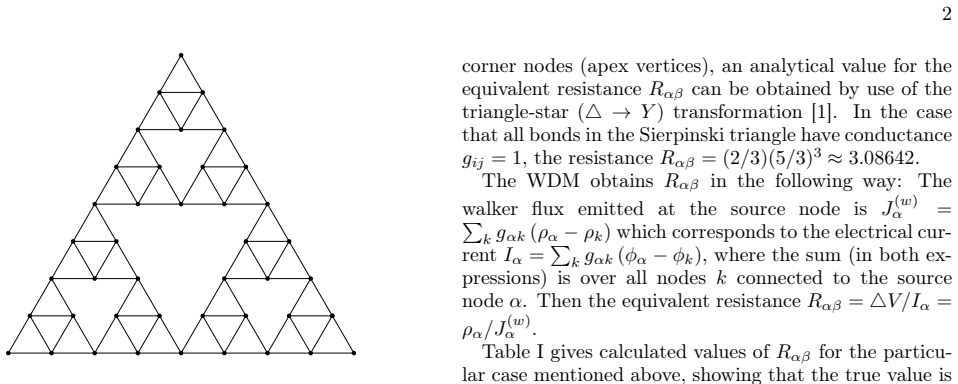
A probabilistic method is derived for solution of ohmic circuit problems. It is compared to the standard approach, which is construction and solution of a set of coupled, linear equations manifesting Kirchhoff's laws. An example is made of an electrical circuit that has the complicated connectivity of a bond-and-node Sierpinski triangle, which would be tedious to solve by matrix methods.
What carries the argument
The walker diffusion process, whose transition probabilities are set by the conductances between nodes so that the resulting occupation probabilities and net flows reproduce the voltage and current distributions.
If this is right
- The mapping holds for arbitrary network topologies.
- Voltages and currents are obtained from walker occupation probabilities and crossing rates without assembling a matrix.
- Complex connectivities such as the Sierpinski triangle become tractable because only local transitions are needed.
- The method supplies the same numerical solution as the linear-algebra route when the diffusion reaches steady state.
Where Pith is reading between the lines
- The formulation may allow Monte Carlo sampling to replace direct linear solves on very large graphs.
- Similar walker constructions could be tested on time-varying or nonlinear networks.
- Effective resistance between any pair of nodes emerges directly as an expectation over walker paths.
- Parallel or distributed implementations could exploit independent walker trajectories.
Load-bearing premise
The steady-state statistics of the walker process must exactly match the voltage and current values required by Kirchhoff's laws on any network topology.
What would settle it
Run the walker simulation on a small series-parallel circuit whose effective resistance is known analytically and check whether the extracted resistance converges to the exact value.
Figures
read the original abstract
A probabilistic method is derived for solution of ohmic circuit problems. It is compared to the standard approach, which is construction and solution of a set of coupled, linear equations manifesting Kirchhoff's laws. An example is made of an electrical circuit that has the complicated connectivity of a bond-and-node Sierpinski triangle, which would be tedious to solve by matrix methods.
Editorial analysis
A structured set of objections, weighed in public.
Referee Report
Summary. The manuscript derives a probabilistic walker diffusion method for solving ohmic circuit problems on resistor networks. It contrasts this approach with the standard construction and solution of linear equations enforcing Kirchhoff's current and voltage laws, and illustrates the method on a bond-and-node Sierpinski triangle network whose connectivity would be tedious to treat by matrix methods.
Significance. If the claimed equivalence between the long-time walker statistics and the exact Kirchhoff solution holds for arbitrary topologies and heterogeneous conductances, the method could supply a Monte Carlo alternative for large or recursively connected networks where direct linear algebra becomes cumbersome. No machine-checked proofs, reproducible code, or parameter-free derivations are described.
major comments (2)
- [Abstract] Abstract: the central claim that the walker diffusion process reproduces the unique solution of Kirchhoff's laws on arbitrary graphs (including the non-planar Sierpinski topology) rests on an unverified mapping. For heterogeneous conductances the stationary occupation measure must be shown to recover node voltages exactly rather than a degree-weighted or boundary-conditioned quantity; the abstract supplies neither the master-equation fixed-point derivation nor the discrete Green's function argument that would establish this identity.
- [Abstract] Abstract: no error analysis, convergence rate, or numerical validation against the matrix solution is provided, so it is impossible to assess whether the probabilistic method yields the exact voltages/currents or only an approximation whose discrepancy grows with network size or conductance contrast.
Simulated Author's Rebuttal
We thank the referee for the careful reading and constructive comments on our manuscript. We address the points raised below.
read point-by-point responses
-
Referee: [Abstract] Abstract: the central claim that the walker diffusion process reproduces the unique solution of Kirchhoff's laws on arbitrary graphs (including the non-planar Sierpinski topology) rests on an unverified mapping. For heterogeneous conductances the stationary occupation measure must be shown to recover node voltages exactly rather than a degree-weighted or boundary-conditioned quantity; the abstract supplies neither the master-equation fixed-point derivation nor the discrete Green's function argument that would establish this identity.
Authors: The abstract is intended only as a concise summary. The master-equation fixed-point derivation, showing that the stationary occupation probabilities recover the exact node voltages for arbitrary graphs and heterogeneous conductances (via transition rates proportional to conductances and detailed balance), is presented in full in Section II of the manuscript. The supporting discrete Green's function argument appears in the appendix. We have revised the abstract to direct readers to these sections. revision: partial
-
Referee: [Abstract] Abstract: no error analysis, convergence rate, or numerical validation against the matrix solution is provided, so it is impossible to assess whether the probabilistic method yields the exact voltages/currents or only an approximation whose discrepancy grows with network size or conductance contrast.
Authors: The analytical derivation establishes exact equivalence in the long-time limit. To address the request for practical assessment, the revised manuscript adds a direct numerical comparison of walker-derived voltages against the matrix solution of Kirchhoff's laws for the Sierpinski network, together with an analysis of convergence versus number of walker steps. revision: yes
Circularity Check
No circularity: walker diffusion derivation is independent of its Kirchhoff target
full rationale
The paper presents a probabilistic walker method derived for ohmic circuits and contrasts it with direct solution of Kirchhoff linear equations. The abstract and description contain no equations, no self-definitional mappings, no fitted parameters renamed as predictions, and no load-bearing self-citations. The claimed equivalence for arbitrary topologies (including Sierpinski) is asserted as a derived result rather than presupposed by definition or prior author work. No quoted reduction of the central mapping to its own inputs is possible from the given text, so the derivation remains self-contained against external benchmarks.
Axiom & Free-Parameter Ledger
Reference graph
Works this paper leans on
-
[1]
H. Taitelbaum and S. Havlin, Superconductivity exponen t for the Sierpinski gasket in two dimensions, J. Phys. A: Math. Gen. 21, 2265–71 (1988)
work page 1988
-
[2]
C. DeW. Van Siclen, Conductivity properties of the Sier- pinski triangle, e-print arXiv:1710.06346v1 (2017). [A va il- able at https://arxiv.org/abs/1710.06346]
work page internal anchor Pith review Pith/arXiv arXiv 2017
discussion (0)
Sign in with ORCID, Apple, or X to comment. Anyone can read and Pith papers without signing in.