REVIEW 4 major objections 4 minor 19 references
Airway Segmentation Network for Enhanced Tubular Feature Extraction
T0 review · 4 major / 4 minor · reviewed 2026-08-06 · deepseek-v4-flash
Pith's one-line read TfeNet claims that rotating convolution kernels, not offset-based deformation, recovers fine airway branches and reports the top ATM22 score of 94.95%.
desk verdict Novel rotation-parameterized kernel with broad benchmark work, but the SOTA headline rests on margins that are within per-case noise. read the letter →
The pith
A machine-rendered reading of the paper's core claim, the machinery that carries it, and where it could break.
The reading
What carries the argument
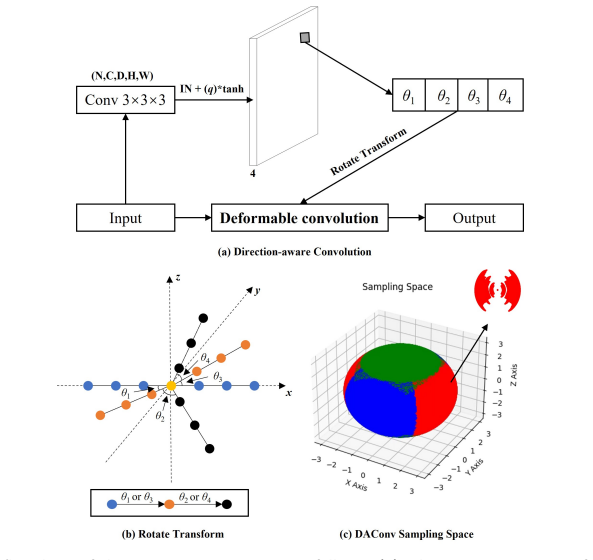
The load-bearing object is DAConv, a direction-aware convolution: a linear kernel of length $k$ is split at its center and the two arms are each rotated twice (around the y-axis then z-axis for the x-direction kernel) by angles learned per location, with the chain $3\times3\times3$ conv, instance norm, tanh, and scale $q\in(0,\pi]$ turning features into angles bounded by $q=\pi/4$. The rotation matrices $R_x(\theta)$, $R_y(\theta)$, $R_z(\theta)$ define the new sampling positions, so the kernel becomes a bendable line segment or polyline in 3D instead of a fixed straight bar, and trilinear interpolation reads the image at fractional coordinates. Around it sits the TFFM, which fuses DAConv responses from the x, y, and z axes with a standard $3\times3\times3$ branch and preserves the input via residual addition. Training uses the General Union Loss with local-imbalance weights (Tversky loss in ATM22's first stage), patch-based 128$^3$ sampling, and a two-stage Output1 plus Output2 protocol, with nnU-Net serving as Output1 on AIIB23; post-processing keeps the largest connected component and fills holes, which directly supports the reported topology scores.
What would settle it
A controlled replication would settle it: train the top ATM22 entries and TfeNet as single models under an identical protocol, with the same patches, loss, and GPU budget, and compare MeanScore on the same 150-case test split; if the 94.95% figure does not stay on top, or if an offset-based deformable convolution with equal parameter count and a continuity regularizer matches DAConv's TD and BD, then rotation is not the mechanism carrying the result.
Extended reading notes
Core claim
The paper claims that rotation-based kernel deformation is better than offset-based deformation for tree-like tubular structures, and that this mechanism drives top-ranked airway segmentation. DAConv takes the linear kernels $k\times1\times1$, $1\times k\times1$, and $1\times1\times k$ along the three axes, splits each kernel at its center $(k-1)/2$, and rotates the two halves around the travel axis by angles $\theta_1,\dots,\theta_4$ produced on the fly from the input feature map via a $3\times3\times3$ convolution, instance normalization, tanh, and a scale factor $q=\pi/4$; the resulting fractional sampling positions are read with trilinear interpolation. Because the two arms remain connected through the fixed rotation center, the kernel can bend but never disintegrate into scattered points, which is the failure the paper attributes to deformable convolutions. The Tubular Feature Fusion Module concatenates the three directional DAConv responses with a $3\times3\times3$ context branch and adds the input back through a $1\times1\times1$ residual, preserving faint airway signal. On this machinery the paper reports the best MeanScore (87.37%), tree-length detection (84.27%), and branch detection (77.51%) on BAS; the top DSC (95.49%) and MeanScore (94.95%) on the ATM22 test set; and second place (89.26%) on the fibrosis-focused AIIB23 validation set.
Load-bearing premise
The headline ranking assumes that the published scores of rival methods are fair comparisons, with equal compute and no multi-model ensembling on their side, while TfeNet's numbers come from combining two model outputs and its 0.42-point lead over second place sits well below the 3.90-point case-to-case variation.
Editorial extensions
If this is right
- If the mechanism claim holds, any tubular-structure segmentation task, including vessels, coronary arteries, and nerves, can swap offset-based deformable blocks for DAConv blocks and expect more connected predictions, since the paper frames DAConv as generic tubular feature extraction rather than an airway-specific trick.
- The reported balance on ATM22, a spread of only 2.2% between the best and worst of the four metrics, means a single TfeNet model needs no accuracy-versus-continuity tuning knob, unlike leaderboard entries that score about 97% on tree length by sacrificing roughly 8 points of precision.
- Because TFFM is plug-and-play, existing 3D U-Net-family models can gain branch continuity by replacing convolution blocks rather than redesigning losses or adding a second network.
- The ablation's monotone pattern, with $q=\pi/4$ beating $q=\pi/3$ and $q=\pi/2$, implies the benefit comes from restricting the rotation range, so practitioners should keep $q$ small rather than letting angles roam.
- On BAS, combining Output1 with Output2 adds 1.99 to 2.66 points of tree-length and branch-detection score over Output1 alone, so the two-stage protocol is itself a large part of the topological gain, a corollary the paper states explicitly.
Reading between the lines
- My read: DAConv's four learned angles are far fewer free parameters than deformable convolution's per-location offsets, so part of the reported gain may be a low-degree-of-freedom regularization effect; a parameter-matched comparison between rotation and offset designs would separate the geometry from the regularization.
- My read: the fixed $q=\pi/4$ was tuned on the BAS test set and carried to ATM22 and AIIB23; fibrosis-distorted airways on AIIB23 may want a different rotation range, so a per-dataset or learned $q$ is a natural extension that could widen or shrink the reported margins.
- My read: the ATM22 margin over the runner-up (94.95 vs 94.53) is smaller than the reported per-case standard deviation of 3.90, so the exact leaderboard position is fragile even if the in-house BAS comparison stands; the mechanism claim and the precise ranking should be weighed differently.
- My read: the two-stage pipeline, with nnU-Net as Output1 on AIIB23, means the challenge numbers include an ensemble effect; the BAS results, where both TfeNet1 and TfeNet2 come from TfeNet alone, are the cleaner evidence for the DAConv mechanism.
Editorial analysis
A structured set of objections, weighed in public.
Referee Report
Summary. The manuscript proposes TfeNet, a 3D airway segmentation network combining a novel Direction-Aware Convolution (DAConv) that rotates linear kernel segments via learned angles, and a Tubular Feature Fusion Module (TFFM) that fuses x/y/z DAConv features with a standard convolution via residual connections. The network is evaluated on the BAS, ATM22, and AIIB23 datasets. The paper claims the highest MeanScore (94.95%) on ATM22 test set, best MeanScore on BAS (87.37%), and second overall score on AIIB23 validation (89.26%). The authors also report ablations on BAS comparing DAConv against linear and DSConv constructions, and provide public code.
Significance. If the reported performance differences are real, the paper makes a modest but useful contribution to tubular-structure segmentation: DAConv provides a constrained, interpretable alternative to offset-based deformable convolutions, and the full architecture achieves competitive results on three benchmarks. The strengths are the public code, the disclosure of the loss-function switch after validation inspection, and the controlled in-house BAS comparison with several baselines. However, the headline claims of superiority are not yet supported by the reported statistics: all key comparisons have margins within the per-case standard deviations, and no significance tests are reported. The paper's central claim therefore requires additional evidence or reframing before it can be considered established.
major comments (4)
- [§5.2, Table 5] The abstract and Section 5.2 claim that TfeNet 'achieves the highest overall score of 94.95%' on ATM22. The margin over the runner-up (Timi, 94.53) is 0.42 points, while the reported per-case standard deviation is 3.90 for TfeNet and 4.68 for Timi on n=150. This difference is far from significant (approximate Welch t ≈ 0.84, p ≈ 0.40, 95% CI containing 0). Similarly, the BAS results in Table 2 (87.37 vs 86.37, n=20) are within noise. The paper should report appropriate significance tests (paired where applicable, with multiplicity correction) or effect sizes, and the wording should be moderated if the differences are not statistically meaningful.
- [§6.1, Table 7] The rotation limit q is selected by comparing DAConv45, DAConv60, and DAConv90 on the BAS test set (Table 7), and this selected value q=π/4 is then used in all experiments, including the BAS results in Table 2. This constitutes test-set tuning and makes the reported BAS superiority non-independent; the same concern applies to the transfer of q to other datasets. The authors should select q on a validation split, or at minimum justify the choice from domain knowledge, and disclose this limitation.
- [§6.1, Table 7 and §2.2] The central sub-claim that rotation-based kernels improve over offset-based deformable convolutions is not directly tested. Table 7 compares linear, DSConv, and DAConv within the same TFFM, but DSConv is a continuity-constrained snake convolution, not a standard offset-based deformable convolution. The only offset-based baseline, DCUNet in Table 2, differs in the overall architecture (3D-UNet without TFFM), so the difference cannot be attributed to the kernel parameterization. An ablation arm using classic deformable convolution (with learned offsets) inside the same TFFM is needed to support the stated sub-claim.
- [§5.3 and §4.2] The AIIB23 and ATM22 results are obtained with a two-stage pipeline in which nnUNet serves as Output1 and TfeNet as Output2 (Section 4.2; Section 5.3). The leaderboard comparators in Tables 5 and 6 are not necessarily two-stage or ensemble-based, so the comparison may conflate the method's contribution with the benefits of ensembling/refinement. Reporting the Output2-only result (or the single-stage variant of TfeNet) on these datasets would clarify the contribution of DAConv and TFFM.
minor comments (4)
- [§4.1, Table 1] The text says the BAS test set contains 'more than 20 scans' while Table 1 lists 20; the numbers should be reconciled.
- [§6.1] The sentence 'Compared to Linear, TD and BD increase by 2.% and 2.57%, respectively' contains an incomplete percentage; should read '2.32%' or the correct value.
- [§3.1, Eq. (1)] The definition of the sampling locations in Eq. (1) is confusing: the set lists (x−1,1,1), (x−2,1,1), ..., (x+1,1,1), (x+2,1,1), which is not the expected ordered set for a k×1×1 kernel. Please define the coordinates consistently and use proper indexing in Eqs. (4)–(6).
- [§2.1] The phrase 'profits from its innovative encoder-decoder structure' should be 'benefits from its innovative encoder-decoder structure'.
Circularity Check
No significant circularity: DAConv and TFFM are defined from rotation and fusion equations that are independent of the reported benchmark targets, and the external leaderboard claims are not constructed from the paper's own outputs.
full rationale
The paper's derivation chain is architectural rather than an analytic derivation of the reported scores. DAConv is defined by the rotation matrices in Eqs. (3)-(6) and the angle predictor in Eq. (8); TFFM is defined by concatenation and residual addition in Eqs. (9)-(10); and the losses and metrics (GUL, Tversky, and Eqs. (15)-(22)) are standard external definitions. No equation equates the claimed ATM22, BAS, or AIIB23 results to a fitted parameter of the model, and no 'prediction' is a renamed input. The disclosed tuning choices, namely q=pi/4 selected from the BAS ablation in Table 7 and the switch to Tversky loss after ATM22 validation inspection, are validation/test selection issues rather than circular reductions: q is a fixed hyperparameter, not a fitted value that mathematically determines the reported MeanScore. The external benchmark claims rest on official leaderboard or offline Docker evaluation, and the BAS comparison is against independently reproduced baselines. The statistical weakness of the 0.42-point ATM22 margin relative to the reported per-case standard deviation is a strength-of-evidence concern, not a circularity concern. No load-bearing self-citation chain, imported uniqueness theorem, or ansatz smuggled in via citation is present.
Assumptions & free parameters
free parameters (6)
- q (DAConv rotation angle limit) =
pi/4
- Alpha in General Union Loss =
0.05 (Stage 1), 0.1 (Stage 2)
- Lambda in LIB weight =
0.05
- Root exponent r in LIB weight =
random in [2, 3]
- Rotation augmentation threshold =
0.7 (Stage 1), 0.9 (Stage 2)
- DAConv kernel length k =
7
assumptions (5)
- standard math Rotation matrices (Eq. 3) and trilinear interpolation (Eq. 7) describe DAConv's deformed sampling positions.
- domain assumption Airway branching can be represented by rotated linear kernels along the x, y, and z axes, using 'I'-shaped and 'V'-shaped motifs.
- ad hoc to paper Four learned angles per kernel segment are sufficient to capture local airway direction.
- domain assumption GUL with LIB weights (Zheng et al. 2020, 2021) and Tversky loss are appropriate for this task.
- domain assumption Leaderboard baseline numbers (ATM22, AIIB23) are valid comparators produced under comparable protocols.
invented entities (2)
-
Direction-Aware Convolution (DAConv)
independent evidence
-
Tubular Feature Fusion Module (TFFM)
independent evidence
Cite this review
Pith. "Pith review of Airway Segmentation Network for Enhanced Tubular Feature Extraction." pith.science (2026). https://pith.science/paper/P6DKETWF
@misc{pith2026250706581,
  author       = {Pith},
  title        = {Pith review of: Airway Segmentation Network for Enhanced Tubular Feature Extraction},
  year         = {2026},
  howpublished = {\url{https://pith.science/paper/P6DKETWF}},
  note         = {Machine review of arXiv:2507.06581}
}
read the original abstract
Manual annotation of airway regions in computed tomography images is a time-consuming and expertise-dependent task. Automatic airway segmentation is therefore a prerequisite for enabling rapid bronchoscopic navigation and the clinical deployment of bronchoscopic robotic systems. Although convolutional neural network methods have gained considerable attention in airway segmentation, the unique tree-like structure of airways poses challenges for conventional and deformable convolutions, which often fail to focus on fine airway structures, leading to missed segments and discontinuities. To address this issue, this study proposes a novel tubular feature extraction network, named TfeNet. TfeNet introduces a novel direction-aware convolution operation that first applies spatial rotation transformations to adjust the sampling positions of linear convolution kernels. The deformed kernels are then represented as line segments or polylines in 3D space. Furthermore, a tubular feature fusion module (TFFM) is designed based on asymmetric convolution and residual connection strategies, enhancing the network's focus on subtle airway structures. Extensive experiments conducted on one public dataset and two datasets used in airway segmentation challenges demonstrate that the proposed TfeNet achieves more accuracy and continuous airway structure predictions compared with existing methods. In particular, TfeNet achieves the highest overall score of 94.95% on the current largest airway segmentation dataset, Airway Tree Modeling(ATM22), and demonstrates advanced performance on the lung fibrosis dataset(AIIB23). The code is available at https://github.com/QibiaoWu/TfeNet.
Figures


Figures from the paper (4 more)


Reference graph
Works this paper leans on
-
[1]
Armato,S.G.,Mclennan,G.,Bidaut,L.,McNitt-Gray,M.F.,Meyer,C.R.,Reeves,A.P.,Zhao,B.,2011. Thelungimagedatabaseconsortium(lidc) and image database resource initiative (idri): a completed reference database of lung nodules on ct scans. Medical physics 38 2, 915–31. URL: https://api.semanticscholar.org/CorpusID:21883326. Azad, R., Niggemeier, L., Huttemann, M....
work page 2011
-
[4]
Isensee,F.,Jaeger,P.F.,Kohl,S.A.A.,Petersen,J.,Maier-Hein,K.H.,2020
URL:https://api.semanticscholar.org/ CorpusID:221183043. Isensee,F.,Jaeger,P.F.,Kohl,S.A.A.,Petersen,J.,Maier-Hein,K.H.,2020. nnu-net:aself-configuringmethodfordeeplearning-basedbiomedical image segmentation. Nature Methods 18, 203 –
work page 2020
-
[6]
Landmark based bronchoscope localization for needle insertion under respiratory deformation. 2023 IEEE/RSJ International Conference on Intelligent Robots and Systems (IROS) , 6593–6600URL:https: //api.semanticscholar.org/CorpusID:264376617. He, K., Zhang, X., Ren, S., Sun, J.,
work page 2023
-
[9]
URL:https://api.semanticscholar.org/CorpusID:41343397
3d convolutional neural networks with graph refinement for airway segmentation using incomplete data labels, in: MLMI@MICCAI. URL:https://api.semanticscholar.org/CorpusID:41343397. Jin,Q.,Meng,Z.P.,Pham,T.D.,Chen,Q.,Wei,L.,Su,R.,2018. Dunet:Adeformablenetworkforretinalvesselsegmentation. Knowl.BasedSyst. 178, 149–162. URL:https://api.semanticscholar.org/C...
work page 2018
-
[13]
Dynamic snake convolution based on topological geometric constraints for tubular structure segmentation. 2023 IEEE/CVF International Conference on Computer Vision (ICCV) , 6047–6056URL:https://api.semanticscholar. org/CorpusID:259937654. Qin, Y., Chen, M., Zheng, H., Gu, Y., Shen, M., Yang, J., Huang, X., Zhu, Y.M., Yang, G.Z.,
work page 2023
-
[14]
URL:https://api.semanticscholar.org/CorpusID:196831594
Airwaynet: A voxel-connectivity aware approachforaccurateairwaysegmentationusingconvolutionalneuralnetworks,in:InternationalConferenceonMedicalImageComputingand Computer-Assisted Intervention. URL:https://api.semanticscholar.org/CorpusID:196831594. Qin, Y., Gu, Y., Zheng, H., Chen, M., Yang, J., Zhu, Y.M., 2020a. Airwaynet-se: A simple-yet-effective appro...
work page 2020
-
[17]
Artificial intelligence in medicine 143, 102637
Two-stage contextual transformer- based convolutional neural network for airway extraction from ct images. Artificial intelligence in medicine 143, 102637. URL:https: //api.semanticscholar.org/CorpusID:254685958. Yao,T.,Xu,Y.,Huang,H.,Yan,H.,Ma,Y.,2024. Objectre-identificationnetworkbasedondynamicsnakeattentionmodule. 20245thInternational Conference on Co...
work page 2024
-
[19]
IEEETransactionsonMedicalRoboticsandBionics4,588–598
Robotic-assisted automatic orientation and insertion for bronchoscopy based on imageguidance. IEEETransactionsonMedicalRoboticsandBionics4,588–598. URL: https://api.semanticscholar.org/CorpusID: 251145028. Çiçek,Ö.,Abdulkadir,A.,Lienkamp,S.S.,Brox,T.,Ronneberger,O.,2016. 3du-net:Learningdensevolumetricsegmentationfromsparseannota- tion,in:InternationalCon...
work page 2016
Show all 19 references
-
[2009]
URL: https://api
Airway segmentation framework for clinical environments. URL: https://api. semanticscholar.org/CorpusID:18882098. Wang,A.,Tam,T.C.C.,Poon,H.,Yu,K.C.,Lee,W.N.,2022. Naviairway:abronchiole-sensitivedeeplearning-basedairwaysegmentationpipeline for planning of navigation bronchosc...
2022 arXiv
-
[2012]
IEEETransactionsonMedicalImaging31,2093–2107
Extraction of airwaysfromct(exact’09). IEEETransactionsonMedicalImaging31,2093–2107. URL: https://api.semanticscholar.org/CorpusID: 215761541. Milletarì, F., Navab, N., Ahmadi, S.A.,
-
[2015]
2016 IEEE Conference on Computer Vision and Pattern Recognition (CVPR) , 770–778URL:https://api.semanticscholar.org/CorpusID:206594692
Deep residual learning for image recognition. 2016 IEEE Conference on Computer Vision and Pattern Recognition (CVPR) , 770–778URL:https://api.semanticscholar.org/CorpusID:206594692. Hofmanninger, J., Prayer, F., Pan, J., Röhrich, S., Prosch, H., Langs, G.,
2016
-
[2016]
2016 Fourth International Conference on 3D Vision (3DV) , 565–571URL:https://api.semanticscholar.org/CorpusID:206429151
V-net: Fully convolutional neural networks for volumetric medical image segmentation. 2016 Fourth International Conference on 3D Vision (3DV) , 565–571URL:https://api.semanticscholar.org/CorpusID:206429151. : Preprint submitted to Elsevier Page 17 of 19 Nan, Y., Ser, J.D., Tan...
2016
-
[2017]
2017 IEEE International Conference on Computer Vision (ICCV) , 764–773URL:https://api.semanticscholar.org/CorpusID:4028864
Deformable convolutional networks. 2017 IEEE International Conference on Computer Vision (ICCV) , 764–773URL:https://api.semanticscholar.org/CorpusID:4028864. Ding, X., Guo, Y., Ding, G., Han, J.,
2017
-
[2018]
2019 International Conference on Robotics and Automation (ICRA) , 5046–5052URL:https://api.semanticscholar.org/CorpusID: 52288689
Offsetnet: Deep learning for localization in the lung using rendered images. 2019 International Conference on Robotics and Automation (ICRA) , 5046–5052URL:https://api.semanticscholar.org/CorpusID: 52288689. Shen, M., Giannarou, S., Yang, G.Z.,
2019
-
[2019]
2019IEEE/CVFInternationalConferenceonComputerVision(ICCV),1911–1920URL: https://api.semanticscholar.org/CorpusID: 199543841
Acnet: Strengthening the kernel skeletons for powerful cnn via asymmetric convolution blocks. 2019IEEE/CVFInternationalConferenceonComputerVision(ICCV),1911–1920URL: https://api.semanticscholar.org/CorpusID: 199543841. Fried, I., Hoelscher, J., Akulian, J.A., Pizer, S.M., Alte...
1911
-
[2020]
Neurocomputing 453, 853–864
Adaptive deformable convolutional network. Neurocomputing 453, 853–864. URL: https://api.semanticscholar.org/CorpusID:225273004. Cheng,G.,Wu,X.,Xiang,W.,Guo,C.,Ji,H.,He,L.,2021. Segmentationoftheairwaytreefromchestctusingtinyatrousconvolutionalnetwork. IEEE Access 9, 33583–335...
2021
-
[2021]
URL:https://api.semanticscholar.org/ CorpusID:237621292
Refined local-imbalance-based weight for airway segmentation in ct, in: International Conference on Medical Image Computing and Computer-Assisted Intervention. URL:https://api.semanticscholar.org/ CorpusID:237621292. : Preprint submitted to Elsevier Page 18 of 19 Zheng,H.,Qin,...
2020
-
[2022]
IEEE Transactions on Neural Networks and Learning Systems 35, 7391–7404
Fuzzy attention neural network to tackle discontinuity in airway segmentation. IEEE Transactions on Neural Networks and Learning Systems 35, 7391–7404. URL: https://api.semanticscholar.org/CorpusID:252089332. Nan,Y.,Xing,X.,Wang,S.,Tang,Z.,Felder,F.,Zhang,S.,Ledda,R.E.,Ding,X....
2023
-
[2023]
2024 IEEE/CVF Winter Conference on Applications of Computer Vision (WACV) , 1276–1286URL:https://api.semanticscholar.org/CorpusID:261493753
Beyond self-attention: Deformable large kernel attention for medical image segmentation. 2024 IEEE/CVF Winter Conference on Applications of Computer Vision (WACV) , 1276–1286URL:https://api.semanticscholar.org/CorpusID:261493753. Chen, F., Wu, F., Xu, J., Gao, G., Ge, Q., Jing, X.,
2024
Reviewed August 6, 2026 · model on record in the stance chip above.
Discussion (0). Sign in to comment.