REVIEW 1 major objections 25 references
QCD sum-rule determination of the axial-vector mixing angle in the \texorpdfstring{\(B_c(1P)\)}{Bc(1P)} sector
T0 review · 1 major / 0 minor · reviewed 2026-07-02 · grok-4.3
Pith's one-line read QCD sum rules determine the mixing angle between the 1¹P₁ and 1³P₁ states in the B_c(1P) sector to be 43.3 degrees.
desk verdict The paper gives a QCD sum-rule value for the B_c(1P) axial mixing angle of 43.3 ± 0.2°, but the error bar is the part that needs checking. read the letter →
The pith
A machine-rendered reading of the paper's core claim, the machinery that carries it, and where it could break.
The reading
What carries the argument
QCD sum rules applied to mixed axial-vector currents for the 1P states of the B_c meson.
What would settle it
A precision measurement of a B_c(1P) decay width or branching ratio that lies many standard deviations away from the value computed with θ = 43.3° would falsify the result.
Extended reading notes
Core claim
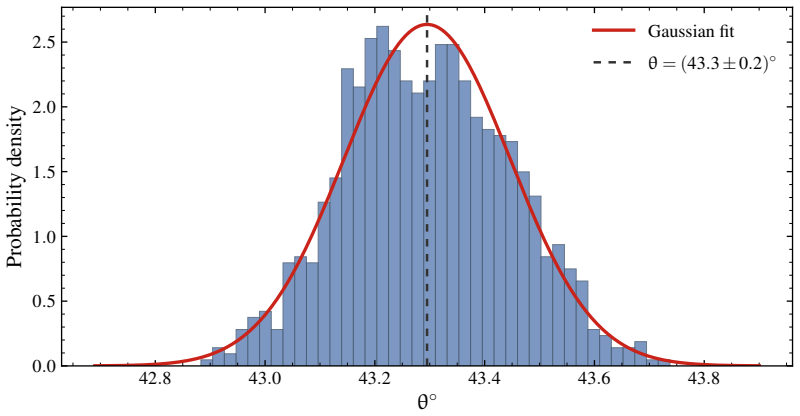
We determine the mixing angle between the 1¹P₁ and 1³P₁ axial-vector states in the B_c(1P) sector using QCD sum rules. The analysis gives θ_Bc(1P)=(43.3±0.2)°, indicating sizable mixing between these two states. We also compare our result with theoretical studies available in the literature.
Load-bearing premise
The QCD sum-rule framework, including the choice of Borel window, continuum threshold, and condensate values, reliably determines the mixing angle without large unaccounted systematic effects.
Editorial extensions
If this is right
- Physical B_c(1P) states are admixtures rather than pure singlet or triplet configurations.
- Decay amplitudes to final states such as B_c γ or B_c ππ must incorporate the mixing angle when computing widths.
- The extracted angle supplies a benchmark for potential-model or lattice-QCD calculations of the same system.
- Similar sum-rule analyses can be repeated for other heavy-meson multiplets once the B_c result is accepted.
Reading between the lines
- The large mixing suggests that experimental searches for narrow B_c(1P) resonances should allow for both singlet and triplet components in the wave functions.
- If the angle remains stable under variation of the sum-rule parameters, the same technique may be used to predict mixing in the yet-unobserved B_c(2P) sector.
- A lattice-QCD calculation of the off-diagonal matrix element between the two currents would provide an independent cross-check of the sum-rule value.
Signed reviews
Editorial analysis
A structured set of objections, weighed in public.
Referee Report
Summary. The manuscript applies QCD sum rules to two-point correlators built from 1¹P₁ and 1³P₁ interpolating currents to extract the mixing angle θ_Bc(1P) between the axial-vector states in the B_c(1P) sector. It reports the central result θ_Bc(1P) = (43.3 ± 0.2)° and compares this value with other theoretical determinations in the literature.
Significance. If the quoted precision is justified, the result supplies a non-perturbative determination of an important parameter for B_c spectroscopy and decay phenomenology. Mixing angles of this size affect the assignment of observed states and the calculation of radiative and hadronic widths; a sum-rule extraction that is demonstrably stable therefore adds a useful datum to the existing quark-model and lattice literature.
major comments (1)
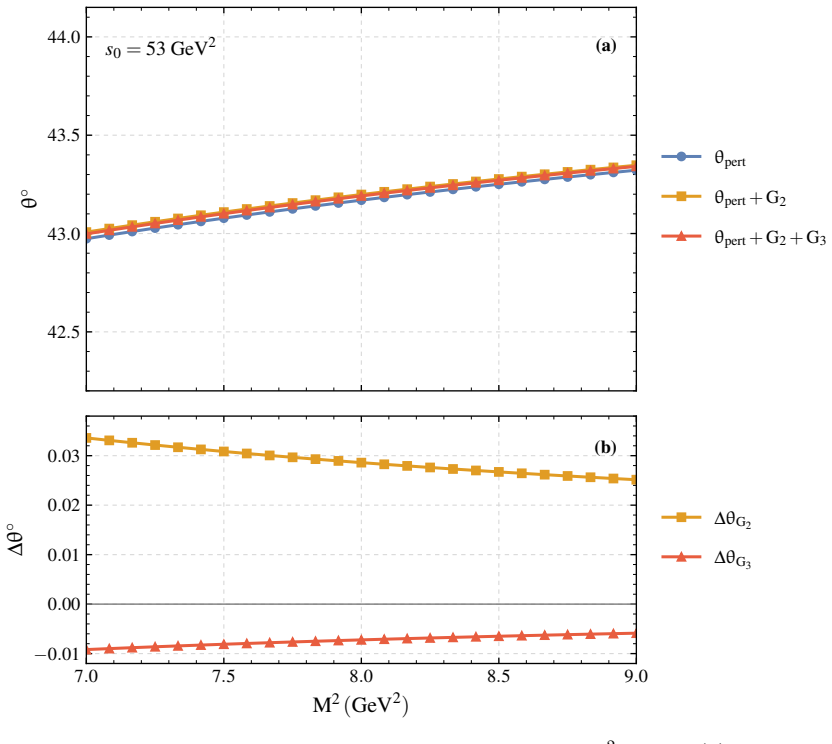
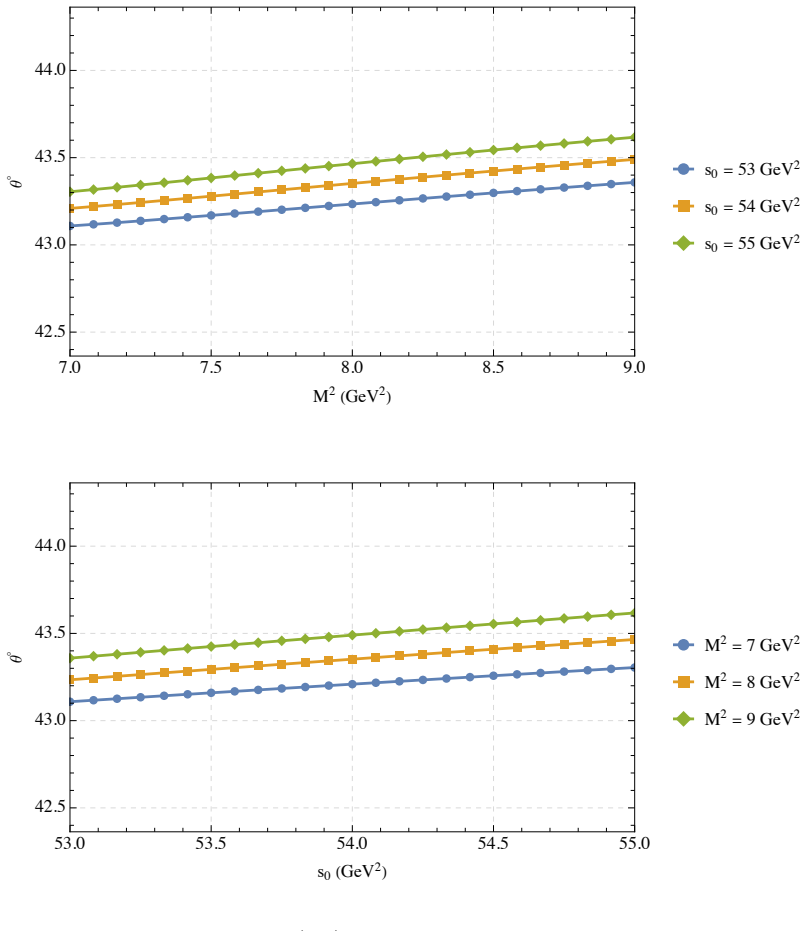
- [Results / numerical analysis section (presumably containing the Borel-window plots and tables)] The reported uncertainty ±0.2° on θ_Bc(1P) is an order of magnitude smaller than the typical systematic variation encountered in QCD sum-rule analyses. The manuscript must demonstrate, by explicit variation of the Borel parameter M² and continuum threshold s0 across the full stability window together with shifts of the condensate values within their standard ranges, that the extracted mixing angle remains constant to ≲0.2°. No such exhaustive scan is presupposed by the method; without it the quoted error cannot be taken as a complete estimate of the uncertainty.
Simulated Author's Rebuttal
We thank the referee for the detailed review and constructive criticism. Below we respond point-by-point to the single major comment.
read point-by-point responses
-
Referee: [Results / numerical analysis section (presumably containing the Borel-window plots and tables)] The reported uncertainty ±0.2° on θ_Bc(1P) is an order of magnitude smaller than the typical systematic variation encountered in QCD sum-rule analyses. The manuscript must demonstrate, by explicit variation of the Borel parameter M² and continuum threshold s0 across the full stability window together with shifts of the condensate values within their standard ranges, that the extracted mixing angle remains constant to ≲0.2°. No such exhaustive scan is presupposed by the method; without it the quoted error cannot be taken as a complete estimate of the uncertainty.
Authors: We agree that the quoted uncertainty requires explicit justification through parameter variation. The central value and ±0.2° error in the manuscript are extracted from the Borel window in which the two-point sum rules for the mixed axial-vector currents display stability, with the small error reflecting the limited variation of the extracted angle inside that window. Nevertheless, the referee is correct that a more comprehensive scan—showing the dependence on M² and s0 throughout the stability region together with shifts of the gluon and quark condensates—has not been presented. In the revised version we will add the requested tables and/or figures that explicitly vary these inputs over their full ranges and confirm that θ_Bc(1P) remains constant to ≲0.2°. This addition will make the uncertainty estimate fully transparent. revision: yes
Circularity Check
No circularity: mixing angle extracted as output of standard sum-rule ratio, not forced by definition or self-citation.
full rationale
The paper applies QCD sum rules to two-point correlators of 1¹P₁ and 1³P₁ currents, equates OPE and phenomenological sides within a Borel window, and extracts θ from the ratio of residues (or equivalent diagonalization). This ratio is computed from the sum-rule matching and is not defined in terms of θ itself. No equations reduce the claimed result to a fitted input renamed as prediction, nor does the central claim rest on a self-citation chain whose uniqueness theorem is imported from the same authors. The method is self-contained against external benchmarks once the standard condensates, thresholds, and window are stated; the small reported uncertainty is a separate systematics question, not evidence of circular construction.
Assumptions & free parameters
Cite this review
Pith. "Pith review of QCD sum-rule determination of the axial-vector mixing angle in the \texorpdfstring{\(B_c(1P)\)}{Bc(1P)} sector." pith.science (2026). https://pith.science/paper/P73WCFHR
@misc{pith2026260700593,
  author       = {Pith},
  title        = {Pith review of: QCD sum-rule determination of the axial-vector mixing angle in the \texorpdfstring\(B_c(1P)\)Bc(1P) sector},
  year         = {2026},
  howpublished = {\url{https://pith.science/paper/P73WCFHR}},
  note         = {Machine review of arXiv:2607.00593}
}
abstract
We determine the mixing angle between the \(1^1P_1\) and \(1^3P_1\) axial-vector states in the \(B_c(1P)\) sector using QCD sum rules. The analysis gives \(\theta_{B_c(1P)}=(43.3\pm0.2)^\circ\), indicating sizable mixing between these two states. We also compare our result with theoretical studies available in the literature.
Figures
Reference graph
Works this paper leans on
-
[1]
B c spectroscopy from lattice QCD,
C. T. H. Davies, K. Hornbostel, G. P. Lepage, A. J. Lidsey, J. Shigemitsu, and J. Sloan, “B c spectroscopy from lattice QCD,” Phys. Lett. B382(1996) 131–137, [hep-lat/9602020]
-
[2]
Precise predictions of charmed-bottom hadrons from lattice QCD
N. Mathur, M. Padmanath, and S. Mondal, “Precise predictions of charmed-bottom hadrons from lattice QCD,” Phys. Rev. Lett.121no. 20, (2018) 202002, [1806.04151]
work page Pith review arXiv 2018
-
[3]
Spectroscopy of B_c Mesons in the Relativized Quark Model
S. Godfrey, “Spectroscopy ofB c mesons in the relativized quark model,” Phys. Rev. D70(2004) 054017, [hep-ph/0406228]
work page Pith review arXiv 2004
-
[4]
Mesons with Beauty and Charm: New Horizons in Spectroscopy
E. J. Eichten and C. Quigg, “Mesons with Beauty and Charm: New Horizons in Spectroscopy,” Phys. Rev. D99no. 5, (2019) 054025, [1902.09735]. [5]CDFCollaboration, F. Abeet al., “Observation of theB c meson inp¯pcollisions at √s= 1.8TeV,” Phys. Rev. Lett.81(1998) 2432–2437, [hep-ex/9805034]. 12 [6]CDFCollaboration, F. Abeet al., “Observation ofB c mesons inp...
work page Pith review arXiv 2019
-
[5]
S. S. Gershtein, V. V. Kiselev, A. K. Likhoded, and A. V. Tkabladze, “B c spectroscopy,” Phys. Rev. D51(1995) 3613–3627, [hep-ph/9406339]
work page Pith review arXiv 1995
-
[6]
Bc spectroscopy in a quantum-chromodynamic potential model
S. N. Gupta and J. M. Johnson, “B c spectroscopy in a quantum chromodynamic potential model,” Phys. Rev. D53(1996) 312–314, [hep-ph/9511267]
work page Pith review arXiv 1996
-
[7]
Phenomenological prediction of the properties of the B_{C} system
L. P. Fulcher, “Phenomenological predictions of the properties of theB c system,” Phys. Rev. D60 (1999) 074006, [hep-ph/9806444]
work page Pith review arXiv 1999
-
[8]
Properties of heavy quarkonia and B_c mesons in the relativistic quark model
D. Ebert, R. N. Faustov, and V. O. Galkin, “Properties of heavy quarkonia andB c mesons in the relativistic quark model,” Phys. Rev. D67(2003) 014027, [hep-ph/0210381]
work page Pith review arXiv 2003
Show all 25 references
-
[9]
Excited bottom-charmed mesons in a nonrelativistic quark model,
Q. Li, M.-S. Liu, L.-S. Lu, Q.-F. L¨ u, L.-C. Gui, and X.-H. Zhong, “Excited bottom-charmed mesons in a nonrelativistic quark model,” Phys. Rev. D99no. 9, (2019) 096020, [1903.11927]
2019 arXiv
-
[10]
The mass spectrum and wave functions of theB c system,
G.-L. Wang, T. Wang, Q. Li, and C.-H. Chang, “The mass spectrum and wave functions of theB c system,” JHEP05(2022) 006, [2201.02318]
2022
-
[11]
Higher states of theB c meson family,
T.-y. Li, L. Tang, Z.-y. Fang, C.-h. Wang, C.-q. Pang, and X.-Y. Wang, “Higher states of theB c meson family,” Phys. Rev. D108no. 3, (2023) 034019, [2204.14258]
2023
-
[12]
Spectroscopic survey of higher-lying states ofB c meson family,
X.-J. Li, Y.-S. Li, F.-L. Wang, and X. Liu, “Spectroscopic survey of higher-lying states ofB c meson family,” Eur. Phys. J. C83no. 11, (2023) 1080, [2308.07206]
2023
-
[13]
Beauty-charm meson family with coupled channel effects and their strong decays,
W. Hao and R. Zhu, “Beauty-charm meson family with coupled channel effects and their strong decays,” Chin. Phys. C48no. 12, (2024) 123101, [2402.18898]. 13
2024
-
[14]
Analysis of the vector and axialvectorB c mesons with QCD sum rules,
Z.-G. Wang, “Analysis of the vector and axialvectorB c mesons with QCD sum rules,” Eur. Phys. J. A49(2013) 131, [1203.6252]
2013 arXiv
-
[15]
Mixing angle between 3P1 and 1P1 states in heavy axial vector mesons within the QCD sum rules framework,
T. M. Aliev, S. Bilmis, and M. Savci, “Mixing angle between 3P1 and 1P1 states in heavy axial vector mesons within the QCD sum rules framework,” Phys. Rev. D111no. 1, (2025) 014005, [2408.08014]
2025
-
[16]
Feyn Calc: Computer-algebraic calculation of Feynman amplitudes,
R. Mertig, M. Bohm, and A. Denner, “Feyn Calc: Computer-algebraic calculation of Feynman amplitudes,” Comput. Phys. Commun.64(1991) 345–359
1991
-
[17]
New Developments in FeynCalc 9.0,
V. Shtabovenko, R. Mertig, and F. Orellana, “New Developments in FeynCalc 9.0,” Comput. Phys. Commun.207(2016) 432–444, [1601.01167]
2016 arXiv
-
[18]
FeynCalc 9.3: New features and improvements,
V. Shtabovenko, R. Mertig, and F. Orellana, “FeynCalc 9.3: New features and improvements,” Comput. Phys. Commun.256(2020) 107478, [2001.04407]
2020 arXiv
-
[19]
QCD and Resonance Physics. Theoretical Foundations,
M. A. Shifman, A. I. Vainshtein, and V. I. Zakharov, “QCD and Resonance Physics. Theoretical Foundations,” Nucl. Phys. B147(1979) 385–447
1979
-
[20]
QCD and Resonance Physics: Applications,
M. A. Shifman, A. I. Vainshtein, and V. I. Zakharov, “QCD and Resonance Physics: Applications,” Nucl. Phys. B147(1979) 448–518
1979
-
[21]
Hadron Properties from QCD Sum Rules,
L. J. Reinders, H. Rubinstein, and S. Yazaki, “Hadron Properties from QCD Sum Rules,” Phys. Rept.127(1985) 1
1985
-
[22]
QCD sum rules, a modern perspective,
P. Colangelo and A. Khodjamirian, “QCD sum rules, a modern perspective,” [hep-ph/0010175]
-
[23]
Masses of the tensor mesons withJ P = 2−,
W. Chen, Z.-X. Cai, and S.-L. Zhu, “Masses of the tensor mesons withJ P = 2−,” Nucl. Phys. B887 (2014) 201–215. [32]Particle Data GroupCollaboration, F. Takahashiet al., “Review of Particle Physics,” Int. J. Mod. Phys. A41(2026) 2630011
2014
-
[24]
Modern status of heavy quark sum rules in QCD,
S. Narison, “Modern status of heavy quark sum rules in QCD,” Nucl. Part. Phys. Proc.312-317 (2021) 87–91, [2101.12579]
2021
-
[25]
Decay constants ofB c-mesons with vector and tensor currents,
E. Costa i Reina, N. Gubernari, and Z. W¨ uthrich, “Decay constants ofB c-mesons with vector and tensor currents,” [2606.25733]. 14
Reviewed July 2, 2026 · model on record in the stance chip above.
Discussion (0). Continue with ORCID to comment.