REVIEW 4 major objections 6 minor 14 references
End-to-End Modeling of a Volatile TiO2 Memristor for Neuromorphic Circuit Simulation
T0 review · 4 major / 6 minor · reviewed 2026-07-30 · grok-4.5
Pith's one-line read A leakage-extended Yakopcic SPICE model fitted to a volatile TiO2 memristor reproduces its measured switching and runs a leaky integrate-and-fire neuron.
desk verdict Solid local engineering: a fitted, leakage-extended Yakopcic SPICE subcircuit for one volatile TiO2 stack, useful if you co-design with similar devices, not a modeling breakthrough. read the letter →
The pith
A machine-rendered reading of the paper's core claim, the machinery that carries it, and where it could break.
The reading
What carries the argument
The leakage-extended Yakopcic model: a hyperbolic-sine I–V relation coupled to a thresholded state ODE that includes a Biolek window and the relaxation term l(x)=−(x−x_eq)/τ, realized as two behavioral sources plus a 1 F integrator capacitor in a SPICE subcircuit.
What would settle it
Build the same leaky-integrate-and-fire circuit with the physical TiO2 devices and check whether the measured spike timing and recovery match the SPICE prediction under identical current-pulse trains; systematic mismatch in inter-spike intervals or failure to recover would falsify the claim that the fitted model is adequate for neuromorphic simulation.
Extended reading notes
Core claim
The authors show that a Yakopcic memristor model extended by a Biolek window and a simple exponential leakage term, with parameters optimized to their TiO2 device data, reproduces the measured pinched hysteresis below compliance and the volatile resistance relaxation under pulsed excitation well enough to serve as a SPICE subcircuit for neuromorphic circuit simulation, as demonstrated by repeated spiking in a memristor-based leaky integrate-and-fire neuron.
Load-bearing premise
A single deterministic state variable that always relaxes exponentially toward a fixed equilibrium is enough to stand in for the device’s real, noisy, cycle-to-cycle filament dynamics.
Editorial extensions
If this is right
- Volatile TiO2 memristors characterized at low compliance current can be dropped directly into SPICE netlists for neuromorphic design.
- The leakage term is what enables repetitive spiking; without it the neuron would lock into a low-resistance state after the first fire.
- The same five-stage workflow (data assessment, model selection, parameter fit, SPICE packaging, validation) can be reused for other volatile memristor technologies.
- Circuit-level studies of larger memristive networks become possible once each device is represented by this parameterized subcircuit.
Reading between the lines
- Because the paper already flags metastable intermediate states and cycle-to-cycle scatter, the next natural model upgrade is a stochastic x_eq or a multi-state filament description rather than a finer deterministic fit.
- The very low compliance current that produces volatility also caps the ON/OFF ratio; the same modeling pipeline could quantify how raising compliance trades volatility for retention and thereby maps the usable design space for synaptic versus memory use.
- Once the SPICE subcircuit is public, standard oscillator and network-stability tools can be applied to memristor LIF arrays without re-deriving device physics each time.
Signed reviews
Editorial analysis
A structured set of objections, weighed in public.
Referee Report
Summary. The manuscript develops an end-to-end workflow for a volatile lateral Pt/TiO2/Ag memristor: experimental I–V and pulse characterization, selection of a Yakopcic-type model with Biolek window and an added exponential leakage term, coordinate-descent NMSE fitting of parameters (plus algebraic extraction of τ from READ decay), translation into a SPICE subcircuit, qualitative comparison of simulated vs. measured traces, and a purely simulated leaky integrate-and-fire neuron in which the memristor replaces the MOSFET threshold element. The central claim is that the fitted leakage-extended model reproduces the device’s pinched hysteresis (below compliance) and volatile relaxation well enough for circuit-level neuromorphic simulation.
Significance. If the fitted SPICE model is reliable under the excitation regimes of interest, the work supplies a practical, reusable subcircuit and a clear measurement-to-model pipeline for volatile TiO2 devices, which is useful for neuromorphic circuit designers who need device-level models rather than idealized non-volatile memristors. Strengths include the explicit leakage extension needed for repetitive spiking, the open SPICE listing, and the side-by-side measurement/simulation figures. Novelty is incremental: Yakopcic, Biolek, and forgetting/leakage terms are established; the contribution is primarily engineering integration and device-specific parameterization rather than a new physical model or multi-device statistical validation.
major comments (4)
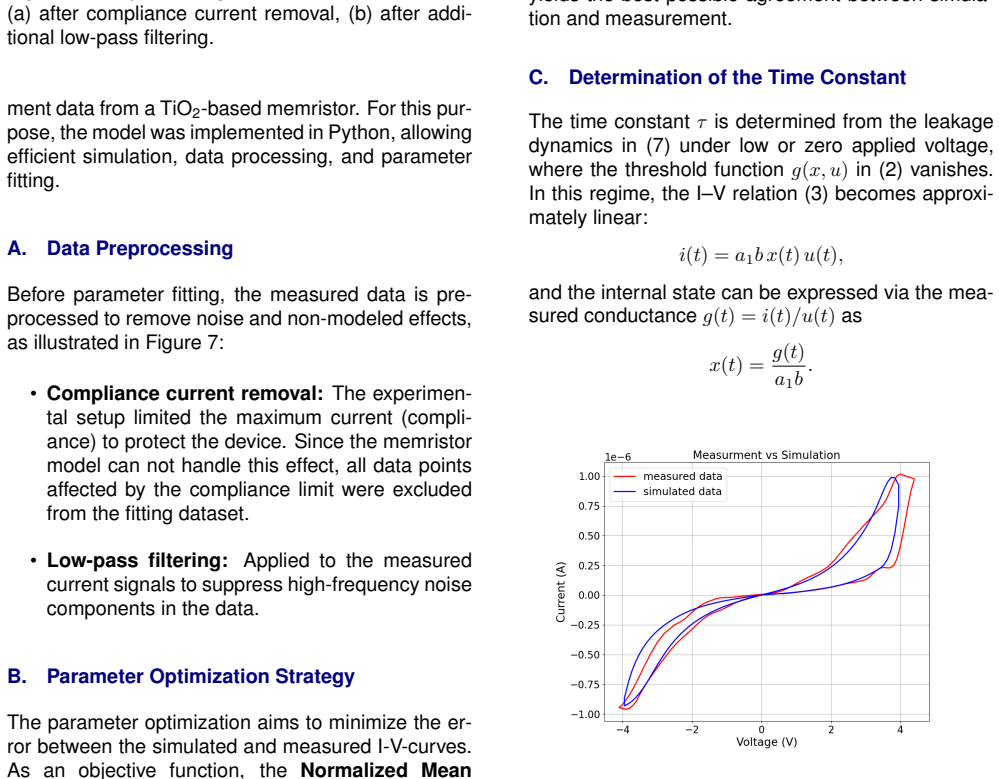
- [§VI.B–D, §VIII.B] §VI.B–D and §VIII.B: Parameter identification (NMSE coordinate descent on compliance-stripped, filtered I–V conductance; τ from averaged READ decay via Eqs. 9–11 with x_eq=0) and ‘validation’ use the same device traces and protocols. No held-out pulse protocol, no quantitative error (e.g., per-cycle NMSE or resistance RMSE on unseen sequences), and no multi-device statistics are reported. The Abstract and §VIII claim of suitability for neuromorphic circuit simulation therefore rests on qualitative visual agreement with the fitting data. A minimum fix is a quantitative held-out comparison and explicit error bars or cycle statistics.
- [§VI.C, Eq. (6), Table 1] §VI.C–D, §III.D, §VIII.B, §IX: The model assumes deterministic single-exponential leakage l(x)=−(x−x_eq)/τ with fixed x_eq=0 (Eq. 6, Table 1). The paper itself documents cycle-to-cycle READ scatter (40–100 MΩ), metastable intermediate states ‘not captured by the leakage term,’ and stochastic filament fluctuations. These are load-bearing for retention and for any circuit that integrates subthreshold activity over many cycles. Either demonstrate that average-trace fidelity still yields acceptable LIF/network statistics under the observed variance, or treat x_eq (or τ) as stochastic as the authors themselves propose only in future work.
- [§VIII.C, §VI.C] §VIII.C vs §VI.C: The LIF demonstration uses ~28 ms pulse periods and produces repetitive spikes that explicitly require the leakage term, while τ≈4.2 s was extracted from 15 s READ averages. On the LIF timescale the leakage is almost frozen (Δx/x ~ few percent per cycle unless the state is driven near threshold every cycle). The manuscript should quantify how sensitive spike rate and threshold crossing are to τ and to the unmodeled metastability, and justify that a τ fitted on 15 s decays remains appropriate for tens-of-ms neuromorphic operation.
- [Table 1, Eq. (4), §VI.D] Table 1 and §VI.D: An is negative (−0.0012), which inverts the usual polarity of the negative-threshold branch of g(u) (Eq. 4). The text notes this reflects decreasing memristance under negative bias, but does not show that the resulting dx/dt remains consistent with the window and with 0≤x≤1 under bipolar sweeps, nor that the fit is unique under coordinate descent. A short sensitivity or sign-constraint check is needed so that the SPICE subcircuit does not rely on an accidental local minimum.
minor comments (6)
- [Fig. 9, Eq. (6)] Fig. 9 / Leakage func: SPICE code implements Leakage(x)=−(x+x_eq)/tau while Eq. (6) is −(x−x_eq)/τ. With the fitted x_eq=0 the two coincide, but the listing is inconsistent with the equation and will be wrong if x_eq≠0 is used later.
- [§VI.C] §VI.C: τ is reported as τ̄≈−4.2 s then used as τ=4.2 s in Table 1. Clarify that the minus sign is an artifact of the log formula and that the physical time constant is positive.
- [§IV–VI] Notation: g(t) is used both for conductance and for the threshold function g(u); rename one to avoid confusion in §IV–VI.
- [Fig. 1b] Fig. 1b and related plots: ‘normalized’ u(t), i(t), g(t) lack stated normalization constants; add them for reproducibility.
- [§V, References] References: Biolek window and Yakopcic are appropriately cited; a brief pointer to other volatile/diffusive memristor SPICE models would help position the leakage extension.
- Minor typos: ‘Y akopcic’ spacing, ‘Indigital’ → ‘In digital’, ‘memristance’ vs resistance consistency, and arXiv date stamp ‘29 Jul 2026’ looks like a metadata error.
Circularity Check
Parameters (incl. τ) are fitted to the same I–V/pulse traces that the SPICE ‘validation’ then replays; agreement is largely by construction, not an independent prediction.
-
fitted input called prediction
[§VI.B Eq. (8); Table 1; §VIII.B; Abstract/§IX]
"The parameter optimization aims to minimize the error between the simulated and measured I-V-curves. As an objective function, the Normalized Mean Squared Error (NMSE) is used... Using the optimized parameter set from Table 1, the SPICE model was simulated under the same excitation conditions as the measurements... the SPICE implementation captures the main qualitative features of the measured device behavior... Comparison with experimental measurements demonstrated that the proposed model accurately reproduces the electrical behavior of the investigated device."
Coefficients are explicitly optimized so simulated conductance matches the preprocessed measured I–V set. The subsequent SPICE ‘validation’ replays the same class of triangular/pulse excitations on that fitted parameter vector and treats visual/qualitative agreement as evidence the model reproduces the device. That agreement is the objective of the fit, not an out-of-sample prediction; the Abstract/Conclusion wording elevates the training match to independent confirmation.
-
fitted input called prediction
[§VI.C Eqs. (9)–(11); Fig. 2b; §VIII.B pulsed validation]
"For the experimental data (see Figure 2b), x_eq = 0 was assumed, and the read interval corresponds to t1−t0 = t_read = 15 s. Using the averaged resistance values M̄(t0)=3 MΩ and M̄(t1)=108 MΩ, the mean time constant is obtained as τ̄≈4.2 s... For pulsed excitation, the simulation captures the volatile switching behavior of the device, including the resistance increase during the write pulse and the subsequent relaxation during the read pulse."
τ is not predicted; it is solved from the measured READ conductance decay by inverting the analytical leakage solution that the model already assumes (with x_eq fixed to 0). The pulsed SPICE comparison then cites the same relaxation behavior as validation of volatility. The decay timescale used to claim the model captures volatile retention is the fitted input itself.
full rationale
This is a standard phenomenological device-modeling paper (select Yakopcic+Biolek+leakage, fit coefficients, drop into SPICE). The model structure and leakage ansatz are imported from external literature, and the LIF neuron is only a simulated application demo—so there is real engineering content and no self-citation uniqueness chain. Circularity is limited to the validation claim: a1,a2,b,Vp,Vn,Ap,An are chosen by coordinate-descent NMSE on preprocessed measured conductance (Eq. 8, §VI.B; Fig. 8), and τ≈4.2 s is algebraically read off the same device’s READ decay under the assumed exponential leakage solution (Eqs. 9–11, §VI.C). Section VIII.B then excites the fitted SPICE subcircuit with triangular/pulsed waveforms of the same character and reports ‘good agreement’ with those measurements. That match is statistically forced by the fit; there is no held-out protocol, multi-device set, or independent observable. Score 5 reflects partial fitted-input-as-prediction on the central reproducibility claim, not a fully tautological derivation.
Assumptions & free parameters
free parameters (10)
- a1 (positive-bias sinh prefactor) =
2.6e-6
- a2 (negative-bias sinh prefactor) =
1.2e-6
- b (sinh nonlinearity) =
0.85
- Vp, Vn (threshold voltages) =
1.5 V, 1.0 V
- Ap, An (threshold rate scales) =
0.0055, -0.0012
- p (Biolek window exponent) =
1
- tau (leakage time constant) =
4.2 s
- x_eq (equilibrium state) =
0
- eta, x0 =
eta=1, x0=0
- compliance current / CC-removal mask =
1 µA
assumptions (7)
- domain assumption Memristive behavior is identified with a pinched I–V hysteresis through the origin (Chua phenomenological definition).
- domain assumption Device dynamics obey i=G(x,u)u and dx/dt = η g(x,u) f(x,u) + l(x) with 0≤x≤1.
- domain assumption Yakopcic sinh I–V plus exponential threshold g(u) is an adequate conduction/switching skeleton for this oxide device.
- domain assumption Biolek window f(x,u,p) correctly enforces state boundaries for this device.
- ad hoc to paper Voltage-free relaxation is a single-exponential leak l(x)=−(x−x_eq)/τ toward a fixed equilibrium.
- ad hoc to paper Coordinate-descent minimization of conductance NMSE on compliance-stripped, low-pass-filtered traces yields parameters that generalize to circuit operation.
- standard math Standard circuit calculus / SPICE behavioral sources and a 1 F integrator capacitor correctly realize the state ODE.
Cite this review
Pith. "Pith review of End-to-End Modeling of a Volatile TiO2 Memristor for Neuromorphic Circuit Simulation." pith.science (2026). https://pith.science/paper/P7CYL3AW
@misc{pith2026260726815,
  author       = {Pith},
  title        = {Pith review of: End-to-End Modeling of a Volatile TiO2 Memristor for Neuromorphic Circuit Simulation},
  year         = {2026},
  howpublished = {\url{https://pith.science/paper/P7CYL3AW}},
  note         = {Machine review of arXiv:2607.26815}
}
read the original abstract
Memristors are promising devices for applications such as non-volatile memory, neuromorphic computing, logic circuits, and analog signal processing. The development of such systems requires accurate simulations based on models that reproduce the electrical behavior of real devices under both continuous and pulsed excitation. This work presents the development of a simulation environment for a volatile TiO2-based memristor. Experimental measurement data are analyzed to verify the memristive behavior of the device and to identify a suitable model. The model parameters are then optimized to match the measured characteristics. The resulting model is implemented in SPICE and validated by comparing simulation results with measurement data. The comparison shows a good agreement between simulation and experiment, demonstrating that the developed model is suitable for reproducing the electrical behavior of the investigated memristor and can be applied in circuit-level simulations, as demonstrated by a leaky integrate-and-fire neuron.
Figures


Figures from the paper (8 more)




Reference graph
Works this paper leans on
-
[1]
D. B. Strukov, G. S. Snider, D. R. Stewart, and R. S. Williams, “The missing memristor found,” 9 nature, vol. 453, no. 7191, pp. 80–83, 2008. DOI:10.1038/nature06932
-
[2]
Memristor-the missing circuit ele- ment,
L. Chua, “Memristor-the missing circuit ele- ment,”IEEE Transactions on circuit theory, vol. 18, no. 5, pp. 507–519, 1971.DOI:10 . 1109/tct.1971.1083337
arXiv 1971
-
[3]
The case for rejecting the mem- ristor as a fundamental circuit element,
I. Abraham, “The case for rejecting the mem- ristor as a fundamental circuit element,”Scien- tific reports, vol. 8, no. 1, p. 10 972, 2018,ISSN: 2045-2322.DOI:10.1038/s41598-018-29394- 7
-
[4]
Memristor spice modeling,
C. Y akopcic, T. M. Taha, G. Subramanyam, and R. E. Pino, “Memristor spice modeling,” in Advances in Neuromorphic Memristor Science and Applications, R. Kozma, R. E. Pino, and G. E. Pazienza, Eds., Springer, 2012, ch. 12, pp. 211–244.DOI:10 . 1007 / 978 - 94 - 007 - 4491-2_12
2012
-
[5]
Everything you wish to know about memristors but are afraid to ask,
L. Chua, “Everything you wish to know about memristors but are afraid to ask,” inHandbook of Memristor Networks, Springer, 2019, pp. 89– 157.DOI:10.1007/978-3-319-76375-0_3
-
[6]
Current compliance impact on the variability of hfo 2-based rram devices,
M. Zhang, S. Long, Y . Li, Q. Liu, H. Lv, and M. Liu, “Current compliance impact on the variability of hfo 2-based rram devices,” in 2016 IEEE Silicon Nanoelectronics Workshop (SNW), IEEE, IEEE, 2016, pp. 96–97.DOI: https : / / doi . org / 10 . 1109 / SNW . 2016 . 7578002
2016
-
[7]
Effect of the compliance current on the retention time of cu/hfo2-based mem- ristive devices,
K. Humood, S. Saylan, B. Mohammad, and M. Abi Jaoude, “Effect of the compliance current on the retention time of cu/hfo2-based mem- ristive devices,”Journal of Electronic Materials, vol. 50, no. 8, pp. 4397–4406, 2021.DOI:10. 1007/s11664-021-08995-5
2021
-
[8]
Memristive devices for computing,
J. J. Y ang, D. B. Strukov, and D. R. Stew- art, “Memristive devices for computing,”Nature nanotechnology, vol. 8, no. 1, pp. 13–24, Dec. 2013,ISSN: 1748-3395.DOI:10.1038/nnano. 2012.240
doi:10.1038/nnano 2013
Show all 14 references
-
[9]
Generalized memristive de- vice spice model and its application in cir- cuit design,
C. Y akopcic, T. M. Taha, G. Subramanyam, and R. E. Pino, “Generalized memristive de- vice spice model and its application in cir- cuit design,”IEEE Transactions on Computer- Aided Design of Integrated Circuits and Sys- tems, vol. 32, no. 8, pp. 1201–1214, 2013.DOI: 10.1109/tc...
2013
-
[10]
Spice model of memristor with nonlinear dopant drift.,
Z. Biolek, D. Biolek, and V. Biolkova, “Spice model of memristor with nonlinear dopant drift.,”Radioengineering, vol. 18, no. 2, 2009, ISSN: 1805-9600. [Online]. Available:https:// www . radioeng . cz / fulltexts / 2009 / 09 _ 02 _ 210_214.pdf
2009
-
[11]
A synapse memristor model with forget- ting effect,
L. Chen, C. Li, T. Huang, Y . Chen, S. Wen, and J. Qi, “A synapse memristor model with forget- ting effect,”Physics Letters A, vol. 377, no. 45- 48, pp. 3260–3265, 2013.DOI:10 . 1016 / j . physleta.2013.10.024
2013
-
[12]
Leaky integrate and fire neu- ron by charge-discharge dynamics in floating- body mosfet,
S. Dutta, V. Kumar, A. Shukla, N. R. Mohapatra, and U. Ganguly, “Leaky integrate and fire neu- ron by charge-discharge dynamics in floating- body mosfet,”Scientific reports, vol. 7, no. 1, p. 8257, 2017.DOI:10 . 1038 / s41598 - 017 - 07418-y
2017
-
[13]
A data-driven stochastic memris- tor model for integrated circuit simulation,
L. Xie et al., “A data-driven stochastic memris- tor model for integrated circuit simulation,”IEEE Transactions on Computer-Aided Design of In- tegrated Circuits and Systems, 2024.DOI:10. 1109/tcad.2024.3485584
2024
-
[14]
J. M. T. Thompson and H. B. Stewart,Nonlin- ear dynamics and chaos. John Wiley and Sons, 2002. 10
2002
Reviewed July 30, 2026 · model on record in the stance chip above.
Discussion (0). Continue with ORCID to comment.