Quantum Kernels are Spectral Tensor Networks
Pith reviewed 2026-06-26 16:57 UTC · model grok-4.3
The pith
Quantum kernels are spectral tensor networks because entangling forms factor as matrix product operators on Fourier coefficient tensors.
A machine-rendered reading of the paper's core claim, the machinery that carries it, and where it could break.
Core claim
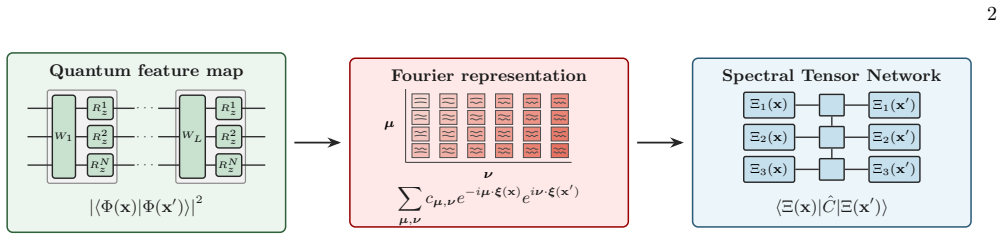
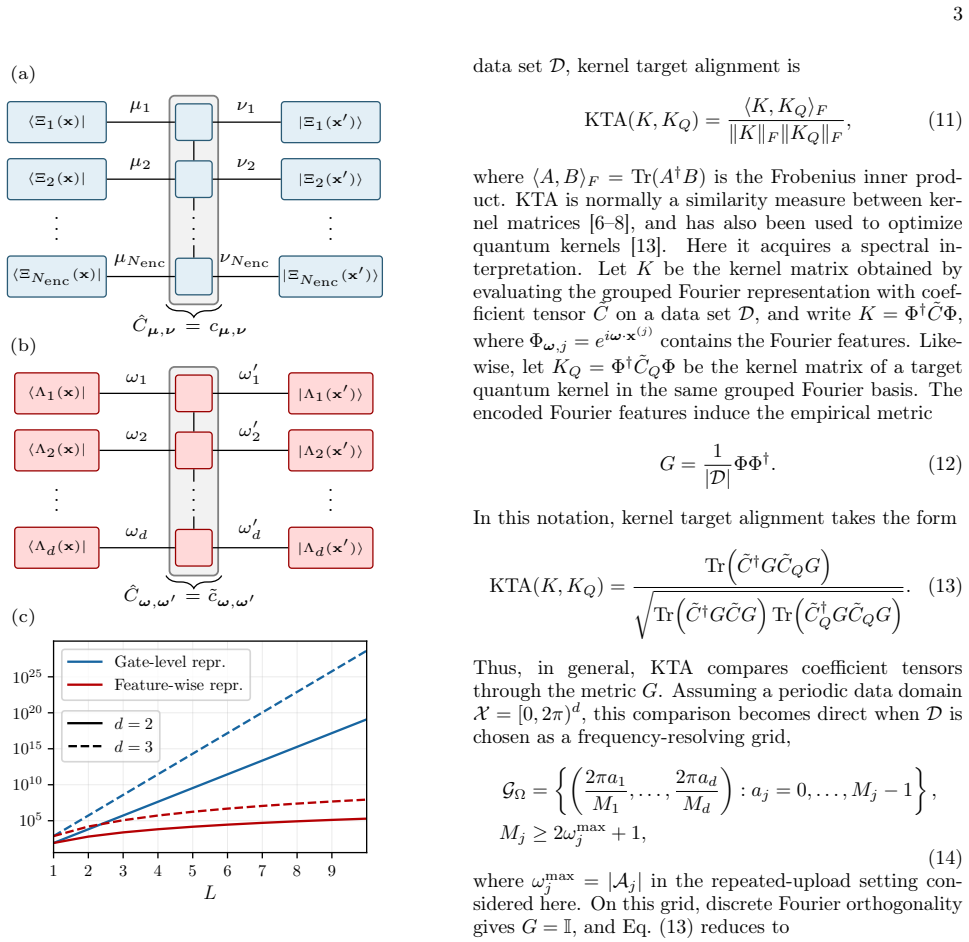
We show that entangling tensor kernels are matrix product operator factorizations of the corresponding Fourier coefficient tensors, thereby identifying quantum kernels as spectral tensor networks. By grouping gate-level frequency configurations that yield the same feature-wise frequency, we obtain a grouped Fourier form that induces a more compact spectral tensor network representation of the kernel. We further show that kernel target alignment serves as a bridge between the Fourier and tensor network views. On a grid that resolves the accessible Fourier modes, it becomes the Frobenius cosine similarity between Fourier coefficient tensors.
What carries the argument
Matrix product operator factorizations of the Fourier coefficient tensors (spectral tensor networks)
If this is right
- Grouped Fourier forms produce compact matrix product operator representations of the kernel.
- Kernel target alignment equals the Frobenius cosine similarity between the Fourier coefficient tensors on a frequency-resolving grid.
- Layered kernels admit accurate representations at small bond dimension when Fourier modes are correlated.
- The observed compressibility diagnoses whether the kernel remains classically representable and whether its evaluation stays classically tractable.
Where Pith is reading between the lines
- If the factorization holds, classical tensor-network simulators could evaluate certain quantum kernels without quantum hardware once the bond dimension is verified to be small.
- The same grouping step that yields compactness may also reveal which subsets of frequencies dominate the kernel's expressive power.
- Correlations between Fourier modes that permit low bond dimension could be used to design new feature maps whose kernels are guaranteed to compress well.
Load-bearing premise
The Fourier representation fixed by the data-encoding gates fully captures the kernel, and grouping frequencies that share the same feature-wise value introduces no loss when forming the matrix product operator factorization.
What would settle it
Direct computation of kernel values on a set of data points fails to match the values reconstructed from the matrix product operator factorization of the corresponding Fourier coefficient tensor.
Figures
read the original abstract
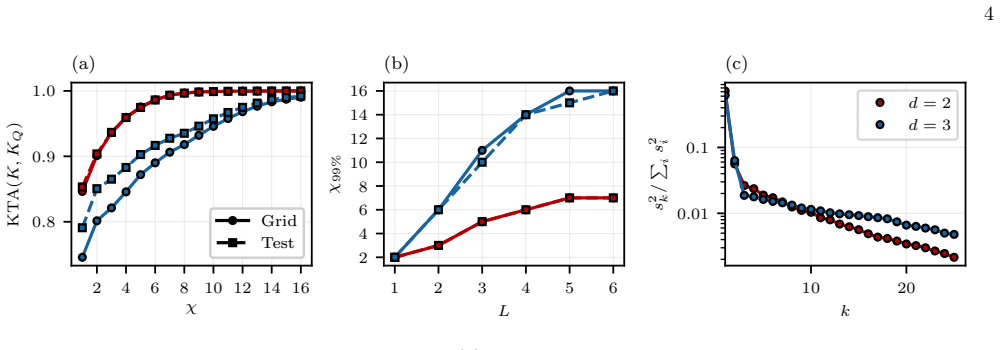
Quantum kernels admit Fourier representations whose frequencies are determined by the data-encoding gates of the underlying feature map. We show that entangling tensor kernels are matrix product operator factorizations of the corresponding Fourier coefficient tensors, thereby identifying quantum kernels as spectral tensor networks. By grouping gate-level frequency configurations that yield the same feature-wise frequency, we obtain a grouped Fourier form that induces a more compact spectral tensor network representation of the kernel. We further show that kernel target alignment serves as a bridge between the Fourier and tensor network views. On a grid that resolves the accessible Fourier modes, it becomes the Frobenius cosine similarity between Fourier coefficient tensors. Our numerical experiments show that layered quantum kernels admit accurate representations with small bond dimension, revealing a compressibility governed by correlations between Fourier modes. This compressibility provides a diagnostic of classical representability and of whether kernel evaluation is likely to remain classically tractable.
Editorial analysis
A structured set of objections, weighed in public.
Referee Report
Summary. The manuscript claims that quantum kernels induced by entangling feature maps admit exact matrix-product-operator (MPO) factorizations of their Fourier coefficient tensors, thereby identifying them as spectral tensor networks. Grouping of gate-level frequency configurations yields a more compact grouped Fourier form; kernel target alignment on a frequency-resolving grid is shown to equal the Frobenius cosine similarity of the coefficient tensors; and numerical experiments demonstrate that layered kernels admit accurate low-bond-dimension MPO representations whose compressibility is governed by inter-mode correlations.
Significance. If the identification holds, the work supplies a direct tensor-network dictionary for quantum kernels that converts questions of classical simulability into questions of MPO bond dimension. The explicit link between Fourier spectra and MPO structure, together with the observed compressibility diagnostic, offers a concrete, falsifiable criterion for when a given kernel remains classically tractable—an insight that is currently missing from the quantum-kernel literature.
minor comments (3)
- §2.2, after Eq. (8): the transition from the ungrouped to the grouped Fourier sum is presented without an explicit statement that the grouping operation is a simple summation of coefficients and therefore exact; adding one sentence would remove any ambiguity about information loss.
- Figure 3 caption and surrounding text: the bond-dimension values reported for the layered kernels are given only as “small” without the numerical values or the precise truncation threshold used; supplying the actual numbers would make the compressibility claim reproducible from the figure alone.
- §4, paragraph 2: the phrase “kernel evaluation is likely to remain classically tractable” is used without a quantitative threshold on bond dimension or contraction cost; a brief remark relating bond dimension to classical runtime would tighten the diagnostic claim.
Simulated Author's Rebuttal
We thank the referee for their thorough reading, positive summary, and recommendation to accept the manuscript. The report contains no major comments requiring a point-by-point response.
Circularity Check
No significant circularity identified
full rationale
The paper's identification of entangling tensor kernels as MPO factorizations of Fourier coefficient tensors follows from the exact trigonometric expansion of the kernel (determined by the encoding unitaries) followed by standard tensor decomposition after exact frequency grouping via coefficient summation. The KTA equivalence to Frobenius cosine similarity on a resolving grid is a direct algebraic consequence of substituting the Fourier form into the KTA definition and is presented as a bridge, not an independent prediction or fitted result. No self-citation chains, ansatz smuggling, or self-definitional reductions appear in the abstract or described claims; the derivation is a re-expression using established Fourier and tensor-network tools and remains self-contained.
Axiom & Free-Parameter Ledger
axioms (1)
- domain assumption Quantum kernels admit Fourier representations whose frequencies are determined by the data-encoding gates
Reference graph
Works this paper leans on
-
[1]
Havlíček, A
V. Havlíček, A. D. Córcoles, K. Temme, A. W. Harrow, A. Kandala, J. M. Chow, and J. M. Gambetta, Nature 567, 209 (2019)
2019
-
[2]
Schuld and N
M. Schuld and N. Killoran, Physical Review Letters122, 040504 (2019)
2019
- [3]
-
[4]
M. Schuld, Supervised quantum machine learning models are kernel methods (2021), arXiv:2101.11020 [quant-ph]
arXiv 2021
-
[5]
S. Shin, R. Sweke, and H. Jeong, Physical Review Re- search8, 023181 (2026)
2026
-
[6]
Cristianini, J
N. Cristianini, J. Shawe-Taylor, A. Elisseeff, and J. Kan- dola, inAdvances in Neural Information Processing Sys- tems, Vol. 14, edited by T. G. Dietterich, S. Becker, and Z. Ghahramani (MIT Press, 2001) pp. 367–373
2001
-
[7]
Cortes, M
C. Cortes, M. Mohri, and A. Rostamizadeh, J. Mach. Learn. Res.13, 795 (2012)
2012
-
[8]
Schölkopf and A
B. Schölkopf and A. J. Smola,Learning with Kernels: Support Vector Machines, Regularization, Optimization, and Beyond(The MIT Press, 2001)
2001
-
[9]
Jozsa, Journal of Modern Optics41, 2315 (1994)
R. Jozsa, Journal of Modern Optics41, 2315 (1994)
1994
-
[10]
Vidal, Physical Review Letters91, 147902 (2003)
G. Vidal, Physical Review Letters91, 147902 (2003)
2003
-
[11]
Vidal, Physical Review Letters93, 040502 (2004)
G. Vidal, Physical Review Letters93, 040502 (2004)
2004
-
[12]
Orus, Annals of Physics349, 117 (2014), arXiv:1306.2164 [cond-mat]
R. Orus, Annals of Physics349, 117 (2014), arXiv:1306.2164 [cond-mat]
Pith/arXiv arXiv 2014
-
[13]
Hubregtsen, D
T. Hubregtsen, D. Wierichs, E. Gil-Fuster, P.-J. H. S. Derks, P. K. Faehrmann, and J. J. Meyer, Physical Re- view A106, 042431 (2022)
2022
-
[14]
Werner, D
A. Werner, D. Jaschke, P. Silvi, M. Kliesch, T. Calarco, J. Eisert, and S. Montangero, Physical Review Letters 116, 237201 (2016)
2016
-
[15]
G. D. l. Cuevas, N. Schuch, D. Pérez-García, and J. Ig- nacio Cirac, New Journal of Physics15, 123021 (2013)
2013
-
[16]
D. P. Kingma and J. Ba, inInternational Conference on Learning Representations(2015) arXiv:1412.6980 [cs.LG]
Pith/arXiv arXiv 2015
-
[17]
E. M. Åsgrim, 10.5281/zenodo.20737526 (2026)
-
[18]
E. M. Åsgrim, SpectralETK,https://doi.org/10. 5281/zenodo.20737945(2026), version 1.0.0
2026
- [19]
-
[20]
Schollwoeck, Annals of Physics326, 96 (2011), arXiv:1008.3477 [cond-mat]
U. Schollwoeck, Annals of Physics326, 96 (2011), arXiv:1008.3477 [cond-mat]. 6 Appendix A: Derivation of the spectral tensor network identity We consider anL-layer feature map in which the data enter through single-qubitZrotations interleaved with data-independent unitaries [3–5], |Φ(x)⟩= LY l=1 NO n=1 R(n) z (ξ(l,n)(x))W (l) ! |0⟩⊗N .(A1) We use the comp...
Pith/arXiv arXiv 2011
discussion (0)
Sign in with ORCID, Apple, or X to comment. Anyone can read and Pith papers without signing in.