REVIEW 4 major objections 4 minor 2 cited by
Probing the axion-electron coupling at cavity experiments
T0 review · 4 major / 4 minor · reviewed 2026-08-06 · deepseek-v4-flash
Pith's one-line read The paper claims that axion dark matter drives a chiral-magnetic current in cavity walls, that this wall radiation lets existing experiments bound the axion-electron coupling to $g_{ae}\lesssim 10^{-5}$, and that carbon-based walls could…
desk verdict Elegant electrodynamics built on an imported CME current that the paper does not justify; the g_ae bounds and carbon-wall projection stand or fall with Eq. (6). read the letter →
The pith
A machine-rendered reading of the paper's core claim, the machinery that carries it, and where it could break.
The reading
What carries the argument
The load-bearing object is the chiral magnetic effect current, $\vec{j}_{\rm cme}=v_F e^2/(2\pi^2)\,\mu_5\,\vec{B}_0$, with the axion field supplying the axial chemical potential $\mu_5=g_{ae}\,\dot{a}/(2m)$. The paper folds this current into Maxwell's equations by defining an effective coupling $\bar{g}_{a\gamma}=g_{a\gamma}+(\alpha/\pi)v_F g_{ae}/m$, so that wall radiation and ordinary axion-photon conversion obey the same sourced wave equation; the argument then proceeds by solving the boundary-value problem at the conductor surface and expanding the radiated fields in cavity modes. The conductivity $\sigma$ enters twice, once in the penetration depth of the wall fields and once in the ohmic response, and together these produce the $m_a^2/\sigma^2$ suppression that is the paper's main quantitative handle.
What would settle it
Run a haloscope with the magnetic field confined to the wall region and the cavity interior shielded; if no resonance-sourced power of the size predicted by the paper's power formula appears at the expected axion mass, the CME radiation mechanism is falsified. The carbon-wall projection could be tested the same way by measuring the wall-sourced power as a function of conductivity and checking the predicted inverse scaling.
Extended reading notes
Core claim
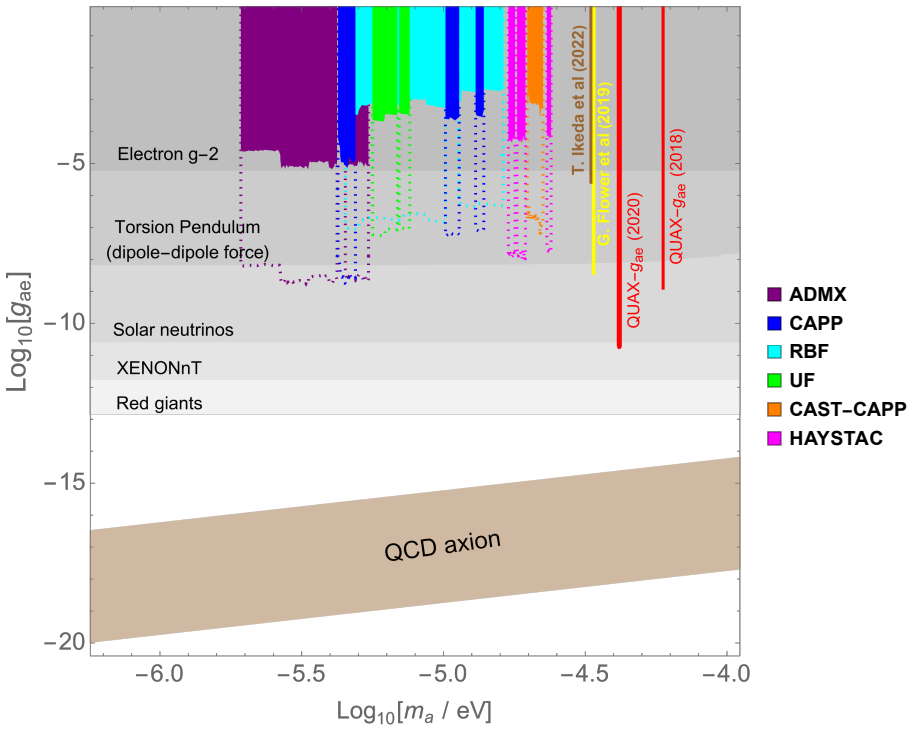
The paper's central discovery is that a conductor exposed to axion dark matter and an external magnetic field radiates electromagnetic waves from its surface, because the axion-electron interaction acts as an oscillating axial chemical potential that drives a persistent chiral magnetic current along the field. Solving Maxwell's equations in a conducting half-space and then in a slab cavity, the authors find that this wall current is equivalent to an effective axion-photon coupling $\bar{g}_{a\gamma}=g_{a\gamma}+(\alpha/\pi)v_F g_{ae}/m$, and that the emitted power grows with the square of that coupling while falling as $1/\sigma^2$, so good conductors suppress the signal by $m_a^2/\sigma^2\sim 10^{-20}$ relative to ordinary axion-photon conversion. Despite that suppression, the power is large enough that existing cavity sensitivities already translate into $g_{ae}\lesssim 10^{-5}$ in the $1\!-\!20\,\mu\text{eV}$ window, and poorer conductors such as carbon would raise the reach to $g_{ae}\sim 10^{-9}$ while also opening higher axion masses that are harder for conventional cavity searches.
Load-bearing premise
The load-bearing premise is that an oscillating axion field inside a metal creates a coherent, unscreened persistent current along an applied magnetic field; if that current is absent or much weaker for massive electrons, the predicted wall radiation, the $g_{ae}\lesssim 10^{-5}$ bound, and the carbon-wall projection all disappear.
Editorial extensions
If this is right
- Existing cavity experiments can place a new bound on the axion-electron coupling, $g_{ae}\lesssim 10^{-5}$, across the scanned axion mass window around $1$ to $20\,\mu\text{eV}$.
- Replacing the copper wall with a carbon-based conductor would improve the reach to $g_{ae}\sim 10^{-9}$ and extend it to higher axion masses than standard axion-photon searches.
- Because the CME signal originates at the wall and does not depend on the cavity form factor, higher-order cavity modes with larger quality factors can be used to scan higher masses.
- A positive signal can be attributed to the CME current if it persists when the magnetic field inside the cavity is turned off while the field in the wall is kept on.
Reading between the lines
- The same wall-radiation mechanism implies that any magnetized conductor sitting in the galactic axion halo is a weak radio emitter, so the method could be adapted to magnets that were not built as axion cavities.
- The signal's strong inverse dependence on conductivity predicts an optimal wall material with conductivity near the axion frequency; scanning wall conductivities would directly test that trade-off.
- A null run of a carbon-walled cavity at the projected sensitivity would not just lower the bound on $g_{ae}$; it would also challenge the premise that the CME current survives in ordinary metals without screening.
Editorial analysis
A structured set of objections, weighed in public.
Referee Report
Summary. The paper solves Maxwell's equations for a conducting half-space and a slab cavity in the presence of a homogeneous, oscillating axion dark-matter field and an external magnetic field, treating the chiral magnetic effect (CME) current as an additional source. The CME current is absorbed into an effective axion-photon coupling, \bar g_{a\gamma}, and the radiated power from the cavity wall is derived, yielding a suppression of m_a^2/\sigma^2 relative to the conventional axion-photon conversion signal. The authors then translate existing cavity-experiment sensitivities into bound on the axion-electron coupling, g_{ae} \lesssim 10^{-5}, and project that replacing copper walls with carbon-based conductors could reach g_{ae} \sim 10^{-9}, with an improved high-mass reach due to the absence of form-factor suppression.
Significance. If the underlying CME-current premise is correct, the paper offers a genuinely new detection channel for the axion-electron coupling that is complementary to existing axion-photon haloscopes and could be implemented with a minimal modification of current experiments. The Maxwell boundary-value problem is solved cleanly, the result agrees with the known screening behavior in the literature (e.g., ref. [22]) for the axion-photon part, and the scaling P_a \propto \sigma^{-1.5} is checked with COMSOL simulations. These technical strengths are real and would make the paper publishable if the physical input were independently supported. However, the central claim rests entirely on the CME current formula of Eq. (6), which is imported from the authors' own prior work (ref. [7]) and is not re-derived, cross-checked, or validated against experiment for ordinary, spin-degenerate conductors. The Maxwell solution cannot validate its own source, so the significance of the claimed bounds and projections is conditional on an unverified microscopic premise.
major comments (4)
- [Sec. II, Eq. (6)] The CME current formula, j_cme = v_F e^2/(2\pi^2) \mu_5 B_0 with \mu_5 = g_ae \dot a/(2m), is the single physical input that makes the paper work. It is taken from ref. [7] (the authors' own paper) and folded into \bar g_{a\gamma} in Eq. (15); every derived bound and projection (Eqs. (33), (44), (45), Fig. 3) scales as \bar g_{a\gamma}^2. The manuscript does not derive this formula for an ordinary, spin-degenerate metal such as copper; refs. [18,19] concern Weyl/relativistic systems, and the paper concedes in footnote 2 that the axial number is not conserved for massive electrons. This is a load-bearing gap: if the CME current in a real conductor is absent, screened, or significantly smaller than Eq. (6), the entire signal and all numerical results disappear. I ask the authors to provide a self-contained derivation or an independent benchmark for the CME current in a non-relativistic Fermi liquid, or to clearly state the validity conditions and the resulting uncertainty in the bound.
- [Sec. II, Eq. (5) vs. Eq. (6)] The momentum shift derived in Eq. (5) is spin-dependent: \delta \vec p = (2/3) \mu_5 \vec\Sigma. In an unpolarized Fermi liquid, spin-up and spin-down electrons receive opposite shifts, so the net current would cancel; in a magnetic field the imbalance is at most of order the Pauli spin polarization, \mu_B B/E_F \sim 10^{-4}, not the full density implied by Eq. (6). The manuscript does not address this cancellation or explain why the coefficient in Eq. (6) remains valid despite the spin-degenerate nature of the conduction band. This is not a minor point---it directly determines the magnitude of the source term. I recommend either a detailed microscopic derivation that shows how the spin cancellation is avoided in a metal, or a quantitative estimate of the resulting suppression factor.
- [Footnotes 2 and 8] Footnote 2 admits that the axial charge is not conserved for massive electrons and then asserts, without derivation, that a Fermi-liquid version survives; footnote 8 states that any conductor with a Fermi surface exhibits CME. These assertions are load-bearing because they justify applying the chiral magnetic effect to ordinary metals, yet they are supported only by reference to the authors' own work. The paper needs to either establish these claims with a concrete calculation (e.g., using a simple parabolic-band model or a Fermi-liquid effective action) or cite independent experimental or lattice evidence for a CME-like current in such systems. Without this, the central premise remains an unverified assumption.
- [Sec. IV and Fig. 3] The translation of existing g_{a\gamma} bounds into g_{ae} bounds (around Eq. (45) and Fig. 3) assumes that the CME radiation is the only additional contribution beyond the conventional axion-photon conversion, and that the wall geometry and magnetic-field profile of each experiment are known. The manuscript does not specify the experimental parameters (wall conductivity, magnetic field strength in the walls, surface area, loaded quality factor) used to draw each exclusion curve in Fig. 3. To make the constraint reproducible and to assess the systematic uncertainties, I ask for a table or appendix listing these parameters for each experiment, and a discussion of how the quoted sensitivities translate to the CME signal.
minor comments (4)
- [Conclusion] In the final paragraph, 'emphase' should be spelled 'emphasize'.
- [Eq. (33) and surrounding text] The normalization \langle \dot a^2 \rangle = 0.45 \text{ GeV/cm}^3 is used without comment; the standard local dark-matter density is usually taken as ~0.3 GeV/cm^3. A brief clarification of the chosen value and its origin would improve reproducibility.
- [Fig. 2] The COMSOL simulation is described only by a reference to the software version. Adding a short description of the cavity geometry, material parameters, and the fitting procedure would strengthen confidence in the numerical scaling result.
- [References and notation] The effective coupling \bar g_{a\gamma} is defined in the text after Eq. (15), but it is used in equations in Sec. III.A before its definition is fully explained; moving the definition just before Eq. (15) or adding a sentence after Eq. (13) would avoid confusion.
Circularity Check
Eq. (6) imports the CME current from the authors' prior paper [7], and every derived bound scales with that input; the cavity electrodynamics is self-contained, but the central physical premise is a load-bearing self-citation.
-
self citation load bearing
[Section II, Eq. (6) and footnote 2; Section III.A, Eq. (15); Conclusion, footnote 8]
"Microscopically, the axion field a(t) or the axial chemical potential µ5 shifts the electron momentum along its spin direction ... This phenomenon is known as chiral magnetic effects that magnetic fields spontaneously create a persistent electric current [18, 19] ⃗jcme = v_F e^2/(2π^2) µ5 ⃗B0, (6) in a medium of charged fermions having Fermi velocity v_F [7] with non-vanishing axial chemical potential, µ5."
The paper's central predictions—the g_ae ≲ 10^-5 bound and the carbon-wall projection g_ae ~ 10^-9—are obtained by substituting Eq. (6) into Maxwell's equations and absorbing it into the effective coupling ar g_aγ ≡ g_aγ + (α/π)v_F g_ae/m in Eq. (15); every subsequent power estimate (Eqs. (33), (44), (45)) is proportional to ar g_aγ^2. Eq. (6) is not derived or benchmarked in this paper; it is imported from the authors' own ref. [7]. Footnote 2 concedes that the axial number is not conserved for massive electrons and refers back to [7] for the Fermi-liquid extension: 'The axial number is not conserved for massive electrons.
full rationale
The electromagnetic part of the paper is a legitimate derivation: given a source current of the form Eq. (6), the solution of Maxwell's equations with conducting boundaries, the resonant-cavity enhancement, and the power scaling P ∝ σ^-1.5 are internally consistent and checked against COMSOL and ref. [22]. The translation of existing haloscope null results into g_ae bounds is a derived comparison, not a fit to the same data, so no fitted-input circularity is present. The only load-bearing element with circularity concern is the microscopic CME current in ordinary conductors: it is the single physical input that makes the signal nonzero, and it is justified by the authors' prior work [7] rather than by independent evidence presented here. Because the new content (cavity electrodynamics, mode expansion, experimental projections) is independent of how Eq. (6) was obtained, the paper is not wholly circular; but the headline reach claims inherit their entire g_ae dependence from a self-cited premise, so a moderate circularity score of 4 is appropriate.
Assumptions & free parameters
free parameters (2)
- Fermi velocity v_F in units of c =
10^-2
- Loaded quality factor Q =
4.5×10^4 (in Eq 45)
assumptions (5)
- domain assumption The CME current in a conductor is j_cme = v_F e^2/(2π^2) μ_5 B0 with μ_5 = g_ae ȧ/(2m)
- domain assumption The axion DM field is homogeneous: the gradient term is negligible, with frequency concentrated at m_a
- domain assumption In conductors with ω ≪ σ, the induced current is ohmic, j1 = σ E1, and the dielectric and magnetic responses are those of vacuum
- standard math Electromagnetic fields and currents are continuous at the conductor boundary with no surface charge or current (μ_m = 1)
- domain assumption Cavity modes are expanded as standing waves with the wall-sourced radiation coherent, and the axion coherence length is larger than the cavity
Cite this review
Pith. "Pith review of Probing the axion-electron coupling at cavity experiments." pith.science (2026). https://pith.science/paper/PA5OXNKD
@misc{pith2026250720830,
  author       = {Pith},
  title        = {Pith review of: Probing the axion-electron coupling at cavity experiments},
  year         = {2026},
  howpublished = {\url{https://pith.science/paper/PA5OXNKD}},
  note         = {Machine review of arXiv:2507.20830}
}
abstract
Axion dark matter induces electromagnetic radiation in conductors through nearly perpetual oscillations of electrons, driven by axion-electron interactions through the so-called chiral magnetic effect. It therefore provides a complementary probe of the axion-electron coupling $g_{ae}$ beyond the conventional axion-photon coupling $g_{a \gamma}$ in cavities. We show that existing axion cavity experiments can constrain the coupling to $g_{ae}\lesssim 10^{-5}$ over the scanned axion mass ranges, $1\,\mu\, {\rm eV}\lesssim m_a\lesssim 20\,\mu\,{\rm eV}$. Although we find that the radiation due to $g_{ae}$ at the copper cavity surface of electric conductivity $\sigma$ is suppressed by $m_a^2/\sigma^2\sim 10^{-20}$, compared to the radiation inside the cavity by the axion-photon conversion due to $g_{a\gamma}$, a sensitivity of about $10^{-9}$ could be achieved for $g_{ae}$ over a wider range of $m_a$, including values higher than those previously probed, if copper walls are replaced with carbon-based conductors.
Figures


Forward citations
Cited by 2 Pith papers
-
Probing Axion Dark Matter via the Chiral Magnetic Effect in Zero-Bias Weyl Semimetals
Proposal to detect axion dark matter via chiral magnetic effect in Weyl semimetals, claiming observable femto-amp signals in 1 cm² samples at 10 T that can probe couplings below stellar cooling bounds.
-
Revisiting the Axial Anomaly and Chiral Magnetic Effect in Dense Matter, with Applications to Axion Dark Matter
Axial anomaly form is unchanged in dense matter via Ward identity cancellation, yielding a Fermi-velocity-suppressed persistent chiral magnetic current set by axial chemical potential.
Reference graph
Works this paper leans on
-
[7]
D. K. Hong, S. H. Im, K. S. Jeong and D. h. Yeom, Phys. Rev. D110(2024) no.5, 055036 doi:10.1103/PhysRevD.110.055036 [arXiv:2207.06884 [hep-ph]]
arXiv 2024
-
[22]
D. J. E. Marsh, J. I. McDonald, A. J. Millar and J. Sch¨ utte-Engel, Phys. Rev. D107, no.3, 035036 (2023) doi:10.1103/PhysRevD.107.035036 [arXiv:2209.12909 [hep-ph]]
work page Pith review arXiv 2023
-
[1]
R. D. Peccei and H. R. Quinn, Phys. Rev. Lett.38, 1440-1443 (1977)
work page 1977
-
[2]
Weinberg, Phys
S. Weinberg, Phys. Rev. Lett.40, 223-226 (1978)
1978
-
[3]
Wilczek, Phys
F. Wilczek, Phys. Rev. Lett.40, 279-282 (1978)
1978
-
[4]
N. Aghanimet al.[Planck], Astron. Astrophys.641, A6 (2020) [erratum: Astron. Astrophys. 652, C4 (2021)] doi:10.1051/0004-6361/201833910 [arXiv:1807.06209 [astro-ph.CO]]
arXiv 2020
-
[5]
P. Sikivie, Phys. Rev. Lett.51, 1415-1417 (1983) [erratum: Phys. Rev. Lett.52, 695 (1984)] doi:10.1103/PhysRevLett.51.1415 14
-
[6]
See, for example, I. G. Irastorza and J. Redondo, Prog. Part. Nucl. Phys.102, 89-159 (2018) doi:10.1016/j.ppnp.2018.05.003 [arXiv:1801.08127 [hep-ph]]
arXiv 2018
Show all 57 references
-
[8]
J. E. Kim, Phys. Rev. Lett.43, 103 (1979)
1979
-
[9]
M. A. Shifman, A. I. Vainshtein and V. I. Zakharov, Nucl. Phys. B166, 493-506 (1980)
1980
-
[10]
A. R. Zhitnitsky, Sov. J. Nucl. Phys.31, 260 (1980)
1980
-
[11]
M. Dine, W. Fischler and M. Srednicki, Phys. Lett. B104, 199-202 (1981)
1981
-
[12]
Carosiet al.[ADMX], [arXiv:2504.07279 [hep-ex]]
G. Carosiet al.[ADMX], [arXiv:2504.07279 [hep-ex]]
-
[13]
Ahnet al.[CAPP], Phys
S. Ahnet al.[CAPP], Phys. Rev. X14, no.3, 031023 (2024) doi:10.1103/PhysRevX.14.031023 [arXiv:2402.12892 [hep-ex]]
2024 arXiv
-
[14]
Krauss, J
L. Krauss, J. Moody, F. Wilczek and D. E. Morris, Phys. Rev. Lett.55, 1797 (1985) doi:10.1103/PhysRevLett.55.1797
1985 doi
-
[15]
Preskill, M
J. Preskill, M. B. Wise and F. Wilczek, Phys. Lett. B120, 127-132 (1983)
1983
-
[16]
L. F. Abbott and P. Sikivie, Phys. Lett. B120, 133-136 (1983)
1983
-
[17]
Dine and W
M. Dine and W. Fischler, Phys. Lett. B120, 137-141 (1983)
1983
-
[18]
Fukushima, D
K. Fukushima, D. E. Kharzeev and H. J. Warringa, Phys. Rev. D78, 074033 (2008)
2008
-
[19]
D. K. Hong, Phys. Lett. B699, 305-308 (2011) doi:10.1016/j.physletb.2011.04.010 [arXiv:1010.3923 [hep-th]]
2011 arXiv
-
[20]
J. C. Slonczewski, Phys. Rev. D32, 3338-3341 (1985) doi:10.1103/PhysRevD.32.3338
1985 doi
-
[21]
Mitridate, T
A. Mitridate, T. Trickle, Z. Zhang and K. M. Zurek, Phys. Rev. D102, no.9, 095005 (2020) doi:10.1103/PhysRevD.102.095005 [arXiv:2005.10256 [hep-ph]]
2020 arXiv
-
[23]
Berlin and T
A. Berlin and T. Trickle, Phys. Rev. Lett.132, no.18, 181801 (2024) doi:10.1103/PhysRevLett.132.181801 [arXiv:2305.05681 [hep-ph]]
2024 arXiv
-
[24]
Berlin, A
A. Berlin, A. J. Millar, T. Trickle and K. Zhou, JHEP05, 314 (2024) doi:10.1007/JHEP05(2024)314 [arXiv:2312.11601 [hep-ph]]
2024 arXiv
-
[25]
Landau and E.M
See, for example, chapter 7 in L.D. Landau and E.M. Lifshitz, Electrodynamics of Continuous Media, Pergamon, New York (1984) [ISBN: 9780080302751]. 15
1984
-
[26]
H. O. Pierson, Handbook of carbon, graphite, diamond and fullerenes, Noyes publications, New Jersey (1993) [ISBN: 0-8155-1339-9]
1993
-
[27]
The simulations were performed using COMSOL Multiphysics®software, version 6.2
-
[28]
Goodmanet al.[ADMX], Phys
C. Goodmanet al.[ADMX], Phys. Rev. Lett.134, no.11, 111002 (2025) doi:10.1103/PhysRevLett.134.111002 [arXiv:2408.15227 [hep-ex]]
2025 arXiv
-
[29]
Bartramet al.[ADMX], Phys
C. Bartramet al.[ADMX], Phys. Rev. Lett.127, no.26, 261803 (2021) doi:10.1103/PhysRevLett.127.261803 [arXiv:2110.06096 [hep-ex]]
2021 arXiv
-
[30]
Braineet al.[ADMX], Phys
T. Braineet al.[ADMX], Phys. Rev. Lett.124, no.10, 101303 (2020) doi:10.1103/PhysRevLett.124.101303 [arXiv:1910.08638 [hep-ex]]
2020 arXiv
-
[31]
Duet al.[ADMX], Phys
N. Duet al.[ADMX], Phys. Rev. Lett.120, no.15, 151301 (2018) doi:10.1103/PhysRevLett.120.151301 [arXiv:1804.05750 [hep-ex]]
2018 arXiv
-
[32]
S. J. Asztaloset al.[ADMX], Phys. Rev. Lett.104, 041301 (2010) doi:10.1103/PhysRevLett.104.041301 [arXiv:0910.5914 [astro-ph.CO]]
2010 arXiv
-
[33]
S. Bae, J. Jeong, Y. Kim, S. Youn, H. Park, T. Seong, S. Oh and Y. K. Semertzidis, Phys. Rev. Lett.133, no.21, 211803 (2024) doi:10.1103/PhysRevLett.133.211803 [arXiv:2403.13390 [hep-ex]]
2024 arXiv
-
[34]
Y. Kim, J. Jeong, S. Youn, S. Bae, K. Lee, A. F. van Loo, Y. Nakamura, S. Oh, T. Seong and S. Uchaikin,et al.Phys. Rev. Lett.133, no.5, 051802 (2024) doi:10.1103/PhysRevLett.133.051802 [arXiv:2312.11003 [hep-ex]]
2024 arXiv
-
[35]
B. Yang, H. Yoon, M. Ahn, Y. Lee and J. Yoo, Phys. Rev. Lett.131, no.8, 081801 (2023) doi:10.1103/PhysRevLett.131.081801 [arXiv:2308.09077 [hep-ex]]
2023 arXiv
-
[36]
A. K. Yi, S. Ahn, C ¸ . Kutlu, J. Kim, B. R. Ko, B. I. Ivanov, H. Byun, A. F. van Loo, S. Park and J. Jeong,et al.Phys. Rev. Lett.130, no.7, 071002 (2023) doi:10.1103/PhysRevLett.130.071002 [arXiv:2210.10961 [hep-ex]]
2023 arXiv
-
[37]
J. Kim, O. Kwon, C ¸ . Kutlu, W. Chung, A. Matlashov, S. Uchaikin, A. F. van Loo, Y. Nakamura, S. Oh and H. Byun,et al.Phys. Rev. Lett.130, no.9, 091602 (2023) doi:10.1103/PhysRevLett.130.091602 [arXiv:2207.13597 [hep-ex]]
2023 arXiv
-
[38]
Y. Lee, B. Yang, H. Yoon, M. Ahn, H. Park, B. Min, D. Kim and J. Yoo, Phys. Rev. Lett. 128, no.24, 241805 (2022) doi:10.1103/PhysRevLett.128.241805 [arXiv:2206.08845 [hep-ex]]
2022 arXiv
-
[39]
Kwonet al.[CAPP], Phys
O. Kwonet al.[CAPP], Phys. Rev. Lett.126, no.19, 191802 (2021) doi:10.1103/PhysRevLett.126.191802 [arXiv:2012.10764 [hep-ex]]. 16
2021 arXiv
-
[40]
Jeong, S
J. Jeong, S. Youn, S. Bae, J. Kim, T. Seong, J. E. Kim and Y. K. Semertzidis, Phys. Rev. Lett. 125, no.22, 221302 (2020) doi:10.1103/PhysRevLett.125.221302 [arXiv:2008.10141 [hep-ex]]
2020 arXiv
-
[41]
S. Lee, S. Ahn, J. Choi, B. R. Ko and Y. K. Semertzidis, Phys. Rev. Lett.124, no.10, 101802 (2020) doi:10.1103/PhysRevLett.124.101802 [arXiv:2001.05102 [hep-ex]]
2020 arXiv
-
[42]
De Panfilis, A
S. De Panfilis, A. C. Melissinos, B. E. Moskowitz, J. T. Rogers, Y. K. Semertzidis, W. Wuensch, H. J. Halama, A. G. Prodell, W. B. Fowler and F. A. Nezrick, Phys. Rev. Lett.59, 839 (1987) doi:10.1103/PhysRevLett.59.839
1987 doi
-
[43]
Hagmann, P
C. Hagmann, P. Sikivie, N. S. Sullivan and D. B. Tanner, Phys. Rev. D42, 1297-1300 (1990) doi:10.1103/PhysRevD.42.1297
1990 doi
-
[44]
C. M. Adair, K. Altenm¨ uller, V. Anastassopoulos, S. A. Cuendis, J. Baier, K. Barth, A. Belov, D. Bozicevic, H. Br¨ auninger and G. Cantatore,et al.Nature Commun.13, no.1, 6180 (2022) doi:10.1038/s41467-022-33913-6 [arXiv:2211.02902 [hep-ex]]
2022 arXiv
-
[45]
Baiet al.[HAYSTAC], Phys
X. Baiet al.[HAYSTAC], Phys. Rev. Lett.134, no.15, 151006 (2025) doi:10.1103/PhysRevLett.134.151006 [arXiv:2409.08998 [hep-ex]]
2025 arXiv
-
[46]
K. M. Backeset al.[HAYSTAC], Nature590, no.7845, 238-242 (2021) doi:10.1038/s41586- 021-03226-7 [arXiv:2008.01853 [quant-ph]]
2021 arXiv
-
[47]
B. M. Brubaker, L. Zhong, Y. V. Gurevich, S. B. Cahn, S. K. Lamoreaux, M. Simanovskaia, J. R. Root, S. M. Lewis, S. Al Kenany and K. M. Backes,et al.Phys. Rev. Lett.118, no.6, 061302 (2017) doi:10.1103/PhysRevLett.118.061302 [arXiv:1610.02580 [astro-ph.CO]]
2017 arXiv
-
[48]
Crescini, D
N. Crescini, D. Alesini, C. Braggio, G. Carugno, D. Di Gioacchino, C. S. Gallo, U. Gam- bardella, C. Gatti, G. Iannone and G. Lamanna,et al.Eur. Phys. J. C78, no.9, 703 (2018) [erratum: Eur. Phys. J. C78, no.9, 813 (2018)] doi:10.1140/epjc/s10052-018-6163- 8 [arXiv:1806.00310 ...
2018 arXiv
-
[49]
Cresciniet al.[QUAX], Phys
N. Cresciniet al.[QUAX], Phys. Rev. Lett.124, no.17, 171801 (2020) doi:10.1103/PhysRevLett.124.171801 [arXiv:2001.08940 [hep-ex]]
2020 arXiv
-
[50]
Flower, J
G. Flower, J. Bourhill, M. Goryachev and M. E. Tobar, Phys. Dark Univ.25, 100306 (2019) doi:10.1016/j.dark.2019.100306 [arXiv:1811.09348 [physics.ins-det]]
2019
-
[51]
Ikeda, A
T. Ikeda, A. Ito, K. Miuchi, J. Soda, H. Kurashige and Y. Shikano, Phys. Rev. D105(2022) no.10, 102004 doi:10.1103/PhysRevD.105.102004 [arXiv:2102.08764 [hep-ex]]
2022 arXiv
-
[52]
H. Yan, G. A. Sun, S. M. Peng, H. Guo, B. Q. Liu, M. Peng and H. Zheng, Eur. Phys. J. C 79, no.11, 971 (2019) doi:10.1140/epjc/s10052-019-7442-8 17
2019 doi
-
[53]
W. A. Terrano, E. G. Adelberger, J. G. Lee and B. R. Heckel, Phys. Rev. Lett.115, no.20, 201801 (2015) doi:10.1103/PhysRevLett.115.201801 [arXiv:1508.02463 [hep-ex]]
2015 arXiv
-
[54]
Gondolo and G
P. Gondolo and G. G. Raffelt, Phys. Rev. D79, 107301 (2009) doi:10.1103/PhysRevD.79.107301 [arXiv:0807.2926 [astro-ph]]
2009 arXiv
-
[55]
Aprileet al.[XENON], Phys
E. Aprileet al.[XENON], Phys. Rev. Lett.129, no.16, 161805 (2022) doi:10.1103/PhysRevLett.129.161805 [arXiv:2207.11330 [hep-ex]]
2022 arXiv
-
[56]
Capozzi and G
F. Capozzi and G. Raffelt, Phys. Rev. D102, no.8, 083007 (2020) doi:10.1103/PhysRevD.102.083007 [arXiv:2007.03694 [astro-ph.SR]]
2020 arXiv
-
[57]
Chang, T
C. Chang, T. J. Hobbs, D. Jin, Y. Li, M. Lisovenko, V. Novosad, Z. H. Saleem, T. Trickle and G. Wang, [arXiv:2504.16160 [hep-ph]]. 18
Reviewed August 6, 2026 · model on record in the stance chip above.
Discussion (0). Sign in to comment.