REVIEW 3 major objections 5 minor 56 references
ManifoldFlow: SPD-Relaxed Stiefel Layers with Learnable Singular Spectrum
T0 review · 3 major / 5 minor · reviewed 2026-07-11 · grok-4.5
Pith's one-line read When a neural layer benefits from an orthonormal basis, its singular values need not stay frozen at one.
desk verdict Clean, scoped Stiefel relaxation with solid factorization math and honest boundaries; headline gains are real in direction but under-quantified for seed variance. read the letter →
The pith
A machine-rendered reading of the paper's core claim, the machinery that carries it, and where it could break.
The reading
What carries the argument
The parametrization W = Q S^{1/2} with Q on the Stiefel manifold and S symmetric positive definite. The exact identity W transpose W = S turns eigenvalue clipping of S into direct singular-value control on the realized weight, recovering fixed Stiefel when S is held at the identity.
What would settle it
On a recurrent language-model projection task where the Stiefel prior is known to help, if enabling the bounded SPD spectrum under the paper’s matched 1000-epoch protocol fails to reduce validation perplexity relative to fixed Stiefel, the main empirical claim is false.
Extended reading notes
Core claim
When the architecture, optimizer, data, and Stiefel update are held fixed, replacing a unit-spectrum Stiefel layer by ManifoldFlow’s factorization W = Q S^{1/2} improves the paired layer in the reported sequence, tabular, and image settings where an orthonormal basis is a useful prior. The identity W transpose W = S makes the eigenvalues of the SPD factor exactly the squared singular values of the forward weight, so a bounded spectrum can be learned without abandoning orthonormal directions.
Load-bearing premise
The claim only holds when an orthonormal basis is already a useful prior for the layer; if that prior is wrong, freeing its spectrum does not fix the mismatch.
Editorial extensions
If this is right
- Recurrent language-model projections that currently pin singular values at one can free a bounded spectrum without abandoning orthonormality and expect lower perplexity, especially under SGD.
- Layer-internal spectrum learning can supply structured preconditioning that external adaptive optimizers only partially replace.
- Network spectral-complexity and Jacobian bounds can be written directly in terms of the learned eigenvalues of S rather than external spectral normalization.
- Fixed-Stiefel training is recovered exactly by zeroing the geometry step, so the method is a controlled relaxation of an existing layer family rather than a separate architecture.
Reading between the lines
- On tasks where dense or diagonal-spectrum layers already dominate the Stiefel family, first imposing orthonormality and then relaxing its spectrum is likely the wrong design path; spectrum learning without the Stiefel constraint may be preferable.
- Very large wrapped dimensions will need structured, diagonal-plus-low-rank, or blockwise SPD updates before the method is practical inside large Transformer feed-forward blocks.
- Because equal-norm symmetric directions induce equal local SPD motion near isotropic S, many geometry directions beyond rejected-gradient pressure could realize the same spectrum-relaxation benefit.
Editorial analysis
A structured set of objections, weighed in public.
Referee Report
Summary. The paper proposes ManifoldFlow, a product-manifold relaxation of fixed-spectrum Stiefel layers that keeps an orthonormal factor Q on St(p,r) while learning a clipped SPD spectrum S through W=Q S^{1/2}. The central identity W^T W=S makes eigenvalue clipping direct singular-value control; Fixed-Stiefel is recovered by freezing S=I. Theory covers rejected-gradient pressure as a Gram signal, feasible affine-invariant SPD updates, product-manifold stationarity (including biased geometry estimators and bounded preconditioners), spectral complexity, and local preconditioning interpretations. Empirically, the paper runs matched FS/MF pairs across recurrent language-model projections, tabular and image MLPs, a Mini-Transformer FFN, and convolutional classifier heads, reporting the largest gains on recurrent projections (especially under SGD) and treating CNN heads and dense/diagonal alternatives as scope boundaries rather than universal wins.
Significance. If the paired gains hold under proper multi-seed quantification, the contribution is a clean, scoped modeling tool rather than a broad architecture replacement: when an orthonormal basis is already a useful prior, freezing its spectrum at one is an unnecessary restriction. Strengths include the exact Gram/singular-value identity, nested FS baseline (geometry LR set to zero), explicit clipping and product-manifold analysis, pressure ablations that correctly de-emphasize the heuristic, and released code. The work sits usefully between pure Stiefel layers and unconstrained dense maps, and the boundary audit (dense/Qdiag/Intrinsic Muon) is a responsible scope statement rather than overclaim.
major comments (3)
- Tables 1 and 5 and the summary heatmap (Fig. 11) report the load-bearing 1000-epoch FS/MF deltas as single-run endpoints under plateau early-stopping, with multi-seed means/± only in the short-budget exploratory cells (Table 3; Appendix Table 9). The largest claimed effects (e.g., LSTM/WikiText-2 SGD ΔPPL=+184.51; GRU/WikiText-2 SGD +218.61) are therefore unquantified for seed variance. For a methods claim whose empirical support is the paired improvement under matched architecture/optimizer/Stiefel update, the main convergence batch needs multi-seed means and standard errors (or at least 3–5 seeds on the headline sequence and Adult/Covertype cells) before the signed gains can be treated as stable.
- Section 6.6 and Appendix Table 10 use archived short-protocol dense, Qdiag(s), and Intrinsic Muon baselines to delimit scope, while the converged Covertype FS/MF gains in Table 6 are much larger than the earlier exploratory numbers. The paper correctly refuses to claim dominance over dense layers, but the protocol split makes the “Stiefel prior is useful here” premise hard to audit on the same footing as the main FS/MF cells. Either rerun the key boundary baselines under the 1000-epoch protocol for Covertype and the LSTM projection, or move those archived numbers fully out of the main interpretive narrative and state that scope is conditioned only on FS/MF pairs.
- Free parameters controlling the SPD path (clip bounds α,β; ρ_geo / γ_t; pressure EMA β_P; gate thresholds in Eq. (15); λ_S in Eq. (16)) are not systematically reported for the main cells. Table 4 shows that EMA/gate/random-pressure ablations change Adult/Covertype accuracy by ≤0.1%, which supports spectrum relaxation over pressure uniqueness, but does not show robustness of the large sequence Δs to α,β and ρ_geo. A short sensitivity table on LSTM/WikiText-2 (or Adult) for clip bounds and geometry step size would make the empirical claim less dependent on unreported defaults.
minor comments (5)
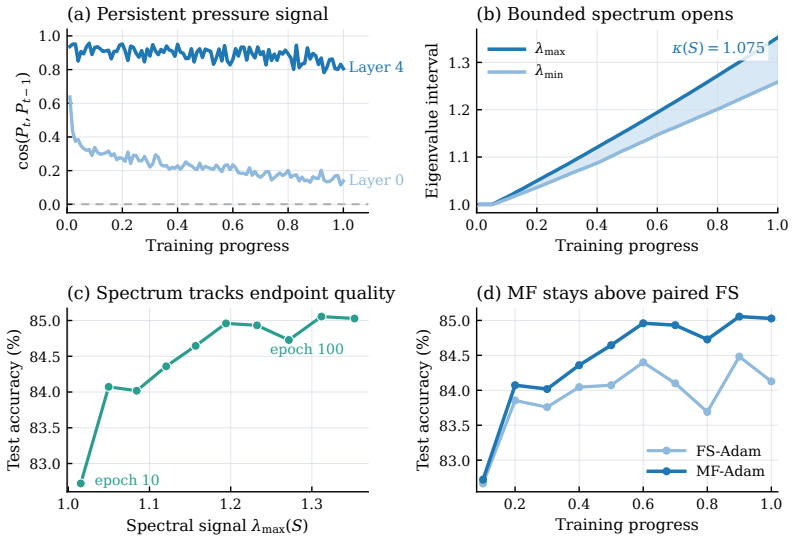
- Figure 2 and Figure 6 are informative, but axis labels and panel captions sometimes mix “spectral signal,” eigenvalue interval, and κ(S) without restating the clip box S_{α,β}; a one-line reminder of (α,β) in each spectral figure would help.
- Mini-Transformer results (Table 3, Fig. 5) are correctly labeled exploratory/short-budget, yet they still appear in the main experimental narrative; a clearer visual separation (e.g., appendix-only or a dedicated “exploratory” subsection header) would reduce protocol confusion.
- Proposition 8’s local inverse-Hessian alignment condition is a useful interpretation of the SGD amplification, but the manuscript could note more explicitly that it is a sufficient local model rather than a verified property of the trained recurrent projections.
- Code link is given; adding the exact clip bounds, ρ_geo, and gate hyperparameters used for each main table in Appendix B would improve reproducibility without lengthening the main text.
- Minor notation consistency: both S≻0 and S∈SPD(r), and both St(p,r) and Stiefel, appear; pick one primary convention in the preliminaries and stick to it.
Circularity Check
No significant circularity: parametrization identities, manifold updates, and paired FS/MF experiments are self-contained and not forced by construction or self-citation.
full rationale
ManifoldFlow is an empirical methods paper whose central claim is a nested comparison (enable vs. freeze the SPD factor under matched architecture/optimizer/Stiefel update). Proposition 2’s identity WᵀW = S and σᵢ²(W) = λᵢ(S) follows by direct algebra from the definition W = QS^{1/2} with Q on Stiefel; it is the intended spectral meaning of the parametrization, not a prediction derived from data or a prior uniqueness theorem. Stationarity (Theorems 1–2), feasible SPD retraction (Prop. 3), and complexity bounds (Thm. 3) are standard product-manifold arguments under stated smoothness/clipping assumptions; they do not import load-bearing uniqueness results from the authors’ prior work. Empirical gains are measured against the exact nested baseline obtained by setting ρ_geo = 0 (recovering Fixed-Stiefel), not against quantities fitted to the same metric being reported. Boundary audits and ablations further delimit scope rather than close a definitional loop. No fitted-input-as-prediction, self-definitional, or ansatz-via-self-citation steps appear.
Assumptions & free parameters
free parameters (4)
- SPD eigenvalue clip bounds (α, β)
- geometry learning rate ρ_geo and schedule γ_t
- pressure EMA β_P and geometry gate thresholds (τ_c, τ_r, α_c, α_r)
- log-barrier coefficient λ_S
assumptions (4)
- standard math Stiefel tangent projection, retractions, and standard Riemannian SGD stationarity on compact product manifolds
- standard math Affine-invariant SPD metric, exponential map, and log-Euclidean barrier geometry
- domain assumption An orthonormal basis is a useful inductive prior in the positive experimental cells
- ad hoc to paper Rejected normal component (pressure) is a practical default SPD direction near isotropic S
invented entities (2)
-
ManifoldFlow layer W=Q S^{1/2}
-
Rejected-gradient pressure P_t and geometry gate a_t
Cite this review
Pith. "Pith review of ManifoldFlow: SPD-Relaxed Stiefel Layers with Learnable Singular Spectrum." pith.science (2026). https://pith.science/paper/PAB5S5EL
@misc{pith2026260704535,
  author       = {Pith},
  title        = {Pith review of: ManifoldFlow: SPD-Relaxed Stiefel Layers with Learnable Singular Spectrum},
  year         = {2026},
  howpublished = {\url{https://pith.science/paper/PAB5S5EL}},
  note         = {Machine review of arXiv:2607.04535}
}
read the original abstract
Orthogonal and Stiefel layers give neural weights exact spectral control, but they also impose a strong modeling constraint: all represented singular values are fixed at one. Many settings that benefit from an orthonormal basis still need direction-dependent attenuation or amplification. We introduce ManifoldFlow, a minimal relaxation of a fixed-spectrum Stiefel layer that keeps the basis on the Stiefel manifold while learning a bounded positive spectrum through W = Q S^{1/2}, with Q^T Q = I and S positive definite. Since W^T W = S, the eigenvalues of S are exactly the squared singular values of the realized weight, making eigenvalue clipping a direct singular-value control mechanism. Across paired sequence, tabular, and image experiments, the learnable SPD spectrum improves the fixed-spectrum Stiefel counterpart in the reported settings where the Stiefel prior is useful, with the largest gains in recurrent language-model projections. Boundary cases in convolutional classifier heads clarify the intended scope: ManifoldFlow is not a universal dense-layer replacement, but a spectrum-learnable Stiefel relaxation for settings where an orthonormal basis is a useful prior. When the basis should be orthonormal, its spectrum need not be frozen. Code available at https://github.com/Hik289/manifold_flow
Figures


Figures from the paper (8 more)


Reference graph
Works this paper leans on
-
[1]
P.-A. Absil, R. Mahony, and R. Sepulchre.Optimization Algorithms on Matrix Manifolds. Princeton University Press, Dec 2008. ISBN 9781400830244. doi: 10.1515/9781400830244. URLhttp://dx.doi.org/10.1515/9781400830244
-
[2]
Vincent Arsigny, Pierre Fillard, Xavier Pennec, and Nicholas Ayache. Geometric means in a novel vector space structure on symmetric positive-definite matrices.SIAM Journal on Matrix Analysis and Applications, 29(1):328–347, Jan 2007. ISSN 1095-7162. doi: 10.1137/050637996. URLhttp://dx.doi.org/10.1137/050637996
-
[3]
Peter L. Bartlett and Shahar Mendelson. Rademacher and gaussian complexities: Risk bounds and structural results. InProceedings of the 15th Annual Conference on Computational Learning Theory, pages 224–240. Springer, 2002. doi: 10.1007/3-540-45435-7_16
-
[4]
Bartlett, Dylan J
Peter L. Bartlett, Dylan J. Foster, and Matus J. Telgarsky. Spectrally-normalized margin bounds for neural networks. InAdvances in Neural Information Processing Systems, vol- ume 30, 2017. URL https://proceedings.neurips.cc/paper_files/paper/2017/ file/b22b257ad0519d4500539da3c8bcf4dd-Paper.pdf
2017
-
[5]
Riemannian adaptive optimization methods
Gary Bécigneul and Octavian-Eugen Ganea. Riemannian adaptive optimization methods. In International Conference on Learning Representations, 2019. URL https://openreview. net/forum?id=r1eiqi09K7
2019
-
[6]
Springer, 1997
Rajendra Bhatia.Matrix Analysis. Springer, 1997. ISBN 9780387948461
1997
-
[7]
Princeton University Press, 2007
Rajendra Bhatia.Positive Definite Matrices. Princeton University Press, 2007. ISBN 9780691129181
2007
-
[8]
Jock A. Blackard and Denis J. Dean. Comparative accuracies of artificial neural networks and discriminant analysis in predicting forest cover types from cartographic variables.Computers and Electronics in Agriculture, 24(3):131–151, 1999. doi: 10.1016/S0168-1699(99)00046-0
Show all 56 references
-
[9]
Stochastic gradient descent on riemannian manifolds.IEEE Transactions on Automatic Control, 58(9):2217–2229, 2013
Silvère Bonnabel. Stochastic gradient descent on riemannian manifolds.IEEE Transactions on Automatic Control, 58(9):2217–2229, 2013. doi: 10.1109/TAC.2013.2254619. 17
2013 doi
-
[10]
Cambridge University Press, Mar 2023
Nicolas Boumal.An Introduction to Optimization on Smooth Manifolds. Cambridge University Press, Mar 2023. ISBN 9781009166157. doi: 10.1017/9781009166164. URL http://dx. doi.org/10.1017/9781009166164
2023 doi
-
[11]
Learning phrase representations using rnn encoder– decoder for statistical machine translation
Kyunghyun Cho, Bart van Merriënboer, Caglar Gulcehre, Dzmitry Bahdanau, Fethi Bougares, Holger Schwenk, and Yoshua Bengio. Learning phrase representations using rnn encoder– decoder for statistical machine translation. InProceedings of the 2014 Conference on Empirical Methods ...
2014 doi
-
[12]
Modeling wine preferences by data mining from physicochemical properties.Decision Support Systems, 47(4):547–553, 2009
Paulo Cortez, António Cerdeira, Fernando Almeida, Telmo Matos, and José Reis. Modeling wine preferences by data mining from physicochemical properties.Decision Support Systems, 47(4):547–553, 2009
2009
-
[13]
Uci machine learning repository, 2017
Dheeru Dua and Casey Graff. Uci machine learning repository, 2017. URLhttps://archive. ics.uci.edu/
2017
-
[14]
Adaptive subgradient methods for online learning and stochastic optimization.Journal of Machine Learning Research, 12:2121–2159, 2011
John Duchi, Elad Hazan, and Yoram Singer. Adaptive subgradient methods for online learning and stochastic optimization.Journal of Machine Learning Research, 12:2121–2159, 2011. URL https://jmlr.org/papers/v12/duchi11a.html
2011
-
[15]
Understanding the difficulty of training deep feedforward neural networks
Xavier Glorot and Yoshua Bengio. Understanding the difficulty of training deep feedforward neural networks. InProceedings of the Thirteenth International Conference on Artificial Intelligence and Statistics, pages 249–256. PMLR, 2010. URL https://proceedings.mlr. press/v9/glor...
2010
-
[16]
Golub and Charles F
Gene H. Golub and Charles F. Van Loan.Matrix Computations. Johns Hopkins University Press, 4 edition, 2013. ISBN 9781421407944. doi: 10.56021/9781421407944. URL http: //dx.doi.org/10.56021/9781421407944
2013 doi
-
[17]
Shampoo: Preconditioned stochastic tensor optimization
Vineet Gupta, Tomer Koren, and Yoram Singer. Shampoo: Preconditioned stochastic tensor optimization. InProceedings of the 35th International Conference on Machine Learning, pages 1842–1850. PMLR, 2018. URL https://proceedings.mlr.press/v80/gupta18a.html
2018
-
[18]
Train faster, generalize better: Stability of stochastic gradient descent
Moritz Hardt, Benjamin Recht, and Yoram Singer. Train faster, generalize better: Stability of stochastic gradient descent. InProceedings of the 33rd International Conference on Machine Learning, pages 1225–1234. PMLR, 2016. URL https://proceedings.mlr.press/v48/ hardt16.html
2016
-
[19]
Delving deep into rectifiers: Surpassing human-level performance on imagenet classification
Kaiming He, Xiangyu Zhang, Shaoqing Ren, and Jian Sun. Delving deep into rectifiers: Surpassing human-level performance on imagenet classification. In2015 IEEE International Conference on Computer Vision, pages 1026–1034, 2015. doi: 10.1109/ICCV .2015.123
2015 doi
-
[20]
Deep residual learning for image recognition
Kaiming He, Xiangyu Zhang, Shaoqing Ren, and Jian Sun. Deep residual learning for image recognition. In2016 IEEE Conference on Computer Vision and Pattern Recognition (CVPR), pages 770–778. IEEE, June 2016. doi: 10.1109/CVPR.2016.90. URLhttp://dx.doi.org/ 10.1109/CVPR.2016.90
2016 doi
-
[21]
Orthogonal recurrent neural networks with scaled cayley transform
Kyle Helfrich, Devin Willmott, and Qiang Ye. Orthogonal recurrent neural networks with scaled cayley transform. InProceedings of the 35th International Conference on Machine Learning, pages 1969–1978. PMLR, 2018. URL https://proceedings.mlr.press/v80/ helfrich18a.html
1969
-
[22]
Higham.Functions of Matrices: Theory and Computation
Nicholas J. Higham.Functions of Matrices: Theory and Computation. Society for Industrial and Applied Mathematics, January 2008. ISBN 9780898717778. doi: 10.1137/1.9780898717778. URLhttp://dx.doi.org/10.1137/1.9780898717778
2008 doi
-
[23]
Long short-term memory.Neural Computation, 9 (8):1735–1780, 1997
Sepp Hochreiter and Jürgen Schmidhuber. Long short-term memory.Neural Computation, 9 (8):1735–1780, 1997. doi: 10.1162/neco.1997.9.8.1735
1997 doi
-
[24]
Orthogonal weight normalization: Solution to optimization over multiple dependent stiefel manifolds in deep neural networks, 2017
Lei Huang, Xianglong Liu, Bo Lang, Adams Wei Yu, Yongliang Wang, and Bo Li. Orthogonal weight normalization: Solution to optimization over multiple dependent stiefel manifolds in deep neural networks, 2017. URLhttps://arxiv.org/abs/1709.06079. 18
2017 arXiv
-
[25]
Batch normalization: Accelerating deep network training by reducing internal covariate shift
Sergey Ioffe and Christian Szegedy. Batch normalization: Accelerating deep network training by reducing internal covariate shift. InProceedings of the 32nd International Conference on Machine Learning, pages 448–456. PMLR, 2015. URL https://proceedings.mlr.press/ v37/ioffe15.html
2015
-
[26]
Gated orthogonal recurrent units: On learning to forget, 2017
Li Jing, Caglar Gulcehre, John Peurifoy, Yichen Shen, Max Tegmark, Marin Soljacic, and Yoshua Bengio. Gated orthogonal recurrent units: On learning to forget, 2017. URL https: //arxiv.org/abs/1706.02761
2017 arXiv
-
[27]
Muon: An optimizer for hidden layers in neural networks
Keller Jordan. Muon: An optimizer for hidden layers in neural networks. GitHub repository,
-
[28]
URLhttps://github.com/KellerJordan/Muon
-
[29]
Kingma and Jimmy Ba
Diederik P. Kingma and Jimmy Ba. Adam: A method for stochastic optimization, 2014. URL https://arxiv.org/abs/1412.6980
2014 arXiv
-
[30]
Geoopt: Riemannian optimization in pytorch.arXiv preprint arXiv:2005.02819, 2020
Maxim Kochurov, Rasul Karimov, and Serge Kozlukov. Geoopt: Riemannian optimization in pytorch.arXiv preprint arXiv:2005.02819, 2020. URL https://arxiv.org/abs/2005. 02819
2005 arXiv
-
[31]
Adult data set, 1996
Ron Kohavi and Barry Becker. Adult data set, 1996. URL https://archive.ics.uci.edu/ ml/datasets/adult
1996
-
[32]
Learning multiple layers of features from tiny images
Alex Krizhevsky and Geoffrey Hinton. Learning multiple layers of features from tiny images. Technical report, University of Toronto, 2009. URLhttps://www.cs.toronto.edu/~kriz/ learning-features-2009-TR.pdf
2009
-
[33]
Gradient-based learning applied to document recognition.Proceedings of the IEEE, 86(11):2278–2324, 1998
Yann LeCun, Léon Bottou, Yoshua Bengio, and Patrick Haffner. Gradient-based learning applied to document recognition.Proceedings of the IEEE, 86(11):2278–2324, 1998. doi: 10.1109/5.726791
1998 doi
-
[34]
Trivializations for gradient-based optimization on manifolds, 2019
Mario Lezcano-Casado. Trivializations for gradient-based optimization on manifolds, 2019. URLhttps://arxiv.org/abs/1909.09501
2019 arXiv
-
[35]
Intrinsic muon: Spectral optimization on riemannian matrix manifolds, 2026
Yibang Li, Bihari Lal Pandey, Ravi Sah, Andi Han, Cyrus Mostajeran, Pratik Jawanpuria, and Bamdev Mishra. Intrinsic muon: Spectral optimization on riemannian matrix manifolds, 2026. URLhttps://arxiv.org/abs/2605.09238
2026 arXiv
-
[36]
Decoupled weight decay regularization
Ilya Loshchilov and Frank Hutter. Decoupled weight decay regularization. InInternational Conference on Learning Representations, 2019. URL https://openreview.net/forum? id=Bkg6RiCqY7
2019
-
[37]
Pointer sentinel mixture models, 2016
Stephen Merity, Caiming Xiong, James Bradbury, and Richard Socher. Pointer sentinel mixture models, 2016. URLhttps://arxiv.org/abs/1609.07843
2016 arXiv
-
[38]
Efficient orthogonal parametrisation of recurrent neural networks using householder reflections
Zakaria Mhammedi, Andrew Hellicar, Ashfaqur Rahman, and James Bailey. Efficient orthogonal parametrisation of recurrent neural networks using householder reflections. InProceedings of the 34th International Conference on Machine Learning, pages 2401–2409. PMLR, 2017. URL https...
2017
-
[39]
All you need is a good init
Dmytro Mishkin and Jiri Matas. All you need is a good init. InInternational Conference on Learning Representations, 2016. URLhttps://arxiv.org/abs/1511.06422
2016 arXiv
-
[40]
Spectral normalization for generative adversarial networks, 2018
Takeru Miyato, Toshiki Kataoka, Masanori Koyama, and Yuichi Yoshida. Spectral normalization for generative adversarial networks, 2018. URLhttps://arxiv.org/abs/1802.05957
2018 arXiv
-
[41]
A differential geometric approach to the geometric mean of symmetric positive- definite matrices.SIAM Journal on Matrix Analysis and Applications, 26(3):735–747, 2005
Maher Moakher. A differential geometric approach to the geometric mean of symmetric positive- definite matrices.SIAM Journal on Matrix Analysis and Applications, 26(3):735–747, 2005. doi: 10.1137/S0895479803436937
2005 doi
-
[42]
Vinod Nair and Geoffrey E. Hinton. Rectified linear units improve restricted boltzmann machines. InProceedings of the 27th International Conference on Machine Learning, pages 807–814, 2010. URLhttps://icml.cc/Conferences/2010/papers/432.pdf. 19
2010
-
[43]
A riemannian framework for tensor com- puting.International Journal of Computer Vision, 66(1):41–66, Jan 2006
Xavier Pennec, Pierre Fillard, and Nicholas Ayache. A riemannian framework for tensor com- puting.International Journal of Computer Vision, 66(1):41–66, Jan 2006. ISSN 1573-1405. doi: 10.1007/s11263-005-3222-z. URLhttp://dx.doi.org/10.1007/s11263-005-3222-z
2006 doi
-
[44]
Schoenholz, and Surya Ganguli
Jeffrey Pennington, Samuel S. Schoenholz, and Surya Ganguli. Resurrecting the sigmoid in deep learning through dynamical isometry: Theory and practice. InAdvances in Neural Information Processing Systems, volume 30, 2017. URL https://proceedings.neurips.cc/paper_ files/paper/2...
2017
-
[45]
Reddi, Satyen Kale, and Sanjiv Kumar
Sashank J. Reddi, Satyen Kale, and Sanjiv Kumar. On the convergence of adam and beyond. In International Conference on Learning Representations, 2018. URL https://openreview. net/forum?id=ryQu7f-RZ
2018
-
[46]
A stochastic approximation method.The Annals of Mathematical Statistics, 22(3):400–407, 1951
Herbert Robbins and Sutton Monro. A stochastic approximation method.The Annals of Mathematical Statistics, 22(3):400–407, 1951. doi: 10.1214/aoms/1177729586
1951 doi
-
[47]
The perceptron: A probabilistic model for information storage and organiza- tion in the brain.Psychological Review, 65(6):386–408, 1958
Frank Rosenblatt. The perceptron: A probabilistic model for information storage and organiza- tion in the brain.Psychological Review, 65(6):386–408, 1958. doi: 10.1037/h0042519
1958 doi
-
[48]
Rumelhart, Geoffrey E
David E. Rumelhart, Geoffrey E. Hinton, and Ronald J. Williams. Learning representations by back-propagating errors.Nature, 323(6088):533–536, 1986. doi: 10.1038/323533a0
1986 doi
-
[49]
Tim Salimans and Diederik P. Kingma. Weight normalization: A simple reparameterization to accelerate training of deep neural networks, 2016. URL https://arxiv.org/abs/1602. 07868
2016
-
[50]
Saxe, James L
Andrew M. Saxe, James L. McClelland, and Surya Ganguli. Exact solutions to the nonlinear dynamics of learning in deep linear neural networks. InInternational Conference on Learning Representations, 2014. URLhttps://openreview.net/forum?id=_wzZwKpTDF_9C
2014
-
[51]
Dropout: A simple way to prevent neural networks from overfitting.Journal of Machine Learning Research, 15(56):1929–1958, 2014
Nitish Srivastava, Geoffrey Hinton, Alex Krizhevsky, Ilya Sutskever, and Ruslan Salakhut- dinov. Dropout: A simple way to prevent neural networks from overfitting.Journal of Machine Learning Research, 15(56):1929–1958, 2014. URL https://jmlr.org/papers/ v15/srivastava14a.html
1929
-
[52]
Gomez, Lukasz Kaiser, and Illia Polosukhin
Ashish Vaswani, Noam Shazeer, Niki Parmar, Jakob Uszkoreit, Llion Jones, Aidan N. Gomez, Lukasz Kaiser, and Illia Polosukhin. Attention is all you need, 2017. URL https://arxiv. org/abs/1706.03762
2017 arXiv
-
[53]
On orthogonality and learning recurrent networks with long term dependencies
Eugene V orontsov, Chiheb Trabelsi, Samuel Kadoury, and Chris Pal. On orthogonality and learning recurrent networks with long term dependencies. InProceedings of the 34th International Conference on Machine Learning, pages 3570–3578. PMLR, 2017. URL https://proceedings.mlr.pre...
2017
-
[54]
A feasible method for optimization with orthogonality constraints
Zaiwen Wen and Wotao Yin. A feasible method for optimization with orthogonality constraints. Mathematical Programming, 142(1–2):397–434, Aug 2012. ISSN 1436-4646. doi: 10.1007/ s10107-012-0584-1. URLhttp://dx.doi.org/10.1007/s10107-012-0584-1
2012 doi
-
[55]
Full-capacity unitary recurrent neural networks
Scott Wisdom, Thomas Powers, John Hershey, Jonathan Le Roux, and Les Atlas. Full-capacity unitary recurrent neural networks. InAdvances in Neural Information Processing Systems, volume 29, 2016. URL https://proceedings.neurips.cc/paper_files/paper/2016/ file/44ec5716c9b803c27a...
2016
-
[56]
LnetY l=1 λmax(Sl) #
Han Xiao, Kashif Rasul, and Roland V ollgraf. Fashion-mnist: a novel image dataset for benchmarking machine learning algorithms.arXiv preprint arXiv:1708.07747, 2017. 20 A Theory and Proofs This appendix proves the statements in Section 5. All wrapped weights are written as W(...
2017 arXiv
Reviewed July 11, 2026 · model on record in the stance chip above.
Discussion (0). Sign in to comment.