Sharp Inequalities for Products of Principal Minors of Positive Definite Matrices
Pith reviewed 2026-06-26 05:37 UTC · model grok-4.3
The pith
Closed-form solutions exist for a family of nonconvex optimization problems over the positive definite cone, yielding the exact infimum 16/27 for the Ingleton ratio in dimension 4.
A machine-rendered reading of the paper's core claim, the machinery that carries it, and where it could break.
Core claim
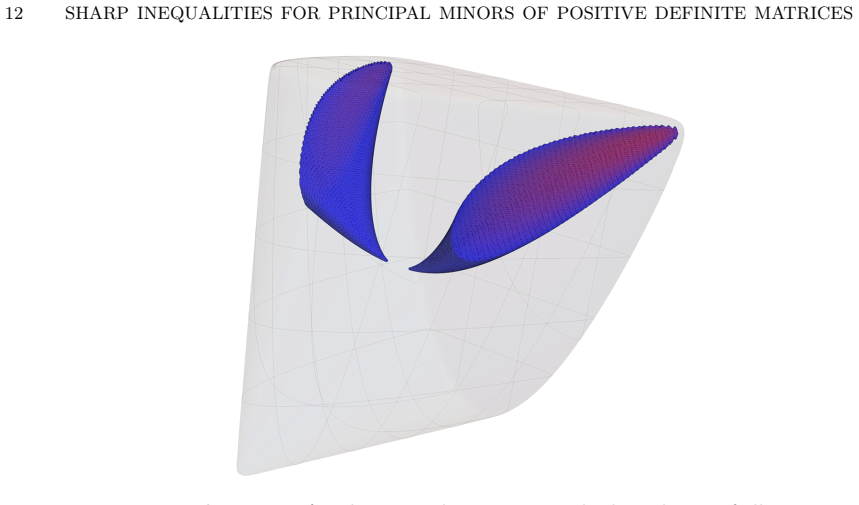
Our main result gives a closed-form solution to a family of nonconvex optimization problems over the positive definite cone. As a special case, we prove that the infimum of the Ingleton ratio over 4×4 positive definite matrices is 16/27, confirming a conjecture of Hall and Johnson. We also show that the cone of absolutely bounded ratios of products of principal minors is not polyhedral for n≥4, and that it is not semialgebraic over Q.
What carries the argument
Closed-form solutions to nonconvex optimization problems over the positive definite cone, obtained by exploiting the algebraic structure of principal minors.
If this is right
- The Ingleton ratio on 4 by 4 positive definite matrices is bounded below by exactly 16/27.
- The cone of absolutely bounded ratios of principal-minor products is not polyhedral once the dimension is at least 4.
- The same cone is not semialgebraic over the field of rational numbers.
- Other members of the family of ratio-optimization problems over the positive definite cone likewise possess closed-form solutions.
Where Pith is reading between the lines
- The algebraic approach may produce exact bounds for additional families of minor-product ratios in dimensions greater than 4.
- The demonstrated failure of semialgebraicity over Q indicates that exact descriptions of the cone will generally require transcendental or non-rational coefficients.
Load-bearing premise
The family of nonconvex optimization problems over the positive definite cone admits analytically derivable closed-form solutions based on the algebraic structure of principal minors.
What would settle it
Exhibiting a single 4 by 4 positive definite matrix whose Ingleton ratio is strictly less than 16/27 would falsify the claimed infimum.
Figures
read the original abstract
We study sharp inequalities for ratios of products of principal minors of real positive definite matrices. Our main result gives a closed-form solution to a family of nonconvex optimization problems over the positive definite cone. As a special case, we prove that the infimum of the Ingleton ratio over $4\times 4$ positive definite matrices is $16/27$, confirming a conjecture of Hall and Johnson. We also show that the cone of absolutely bounded ratios of products of principal minors is not polyhedral for $n\ge 4$, and that it is not semialgebraic over $\mathbb{Q}$.
Editorial analysis
A structured set of objections, weighed in public.
Referee Report
Summary. The manuscript studies sharp inequalities for ratios of products of principal minors of real positive definite matrices. The main result provides closed-form solutions to a family of nonconvex optimization problems over the positive definite cone. As a special case, it proves that the infimum of the Ingleton ratio over 4×4 positive definite matrices is 16/27, confirming a conjecture of Hall and Johnson. It further shows that the cone of absolutely bounded ratios of products of principal minors is not polyhedral for n≥4 and not semialgebraic over Q.
Significance. If the derivations hold, this work resolves an open conjecture with an explicit constant and provides structural results on the geometry of certain cones associated with principal minors. The closed-form solutions to the optimization problems represent a notable achievement in handling nonconvex problems over the PD cone. The demonstration that the cone is not polyhedral or semialgebraic adds to the understanding of its complexity. These results could impact areas like optimization, matrix analysis, and algebraic geometry.
minor comments (2)
- [Introduction] The definition of the Ingleton ratio could benefit from an explicit formula early in the paper to aid readers unfamiliar with the term.
- [§3] Some equations in the optimization section use notation that is introduced later; consider reordering for clarity.
Simulated Author's Rebuttal
We thank the referee for the careful reading and positive assessment of the manuscript, including the recommendation for minor revision. No specific major comments were listed in the report.
Circularity Check
No significant circularity; derivation self-contained against external conjecture
full rationale
The paper's central claim is a closed-form solution to a family of optimization problems over the positive definite cone, with the Ingleton ratio infimum of 16/27 presented as confirmation of an external conjecture by Hall and Johnson. The abstract and available description frame the work as an independent algebraic result without reference to fitted parameters, self-definitional ratios, or load-bearing self-citations. No equations or derivation steps are supplied that reduce the claimed infimum or closed-form solutions to inputs by construction. Per the hard rules, absence of quotable reductions means the finding is no circularity (score 0).
Axiom & Free-Parameter Ledger
axioms (1)
- domain assumption The set of real positive definite matrices is an open convex cone in which all principal minors are positive.
Reference graph
Works this paper leans on
-
[1]
Abeer Al Ahmadieh, Felipe Rincón, Cynthia Vinzant, and Josephine Yu.Tropicalizing Principal Minors of Positive Definite Matrices. 2025. arXiv:2410.11220 [math.CO]
arXiv 2025
-
[2]
Saugata Basu, Richard Pollack, and Marie-Françoise Roy.Algorithms in Real Algebraic Geometry. 2nd ed. Vol. 10. Algorithms and Computation in Mathematics. Springer, 2006
2006
-
[3]
Positive Definite Completion Problems for Bayesian Networks
Emanuel Ben-David and Bala Rajaratnam. “Positive Definite Completion Problems for Bayesian Networks”. In:SIAM Journal on Matrix Analysis and Applications33.2 (2012), pp. 617–638.doi: 10.1137/110861051
-
[4]
No Eleventh Conditional Ingleton Inequality
Tobias Boege. “No Eleventh Conditional Ingleton Inequality”. In:Experimental Mathematics33.4 (2024), pp. 808–816.doi: 10.1080/10586458.2023.2294827
-
[5]
Determinantal point processes
Alexei Borodin. “Determinantal point processes”. In:The Oxford handbook of random matrix theory. Ed. by Gernot Akemann, Jinho Baik, and Philippe Di Francesco. Oxford University Press, 2011, pp. 231–249
2011
-
[6]
Balanced information inequalities
Terence H. Chan. “Balanced information inequalities”. In:IEEE Trans. Inf. Theory49.12 (2003), pp. 3261–3267.doi: 10.1109/TIT.2003.820037
-
[7]
Entropy functions and determinant inequalities
Terence H. Chan, Dongning Guo, and Raymond W. Yeung. “Entropy functions and determinant inequalities”. In:2012 IEEE International Symposium on Information Theory Proceedings. Institute of Electrical and Electronics Engineers (IEEE), 2012, pp. 1251–1255.doi: 10.1109/ISIT.2012. 6283057
-
[8]
Determinant inequalities via information theory
Thomas M. Cover and Joy A. Thomas. “Determinant inequalities via information theory”. In:SIAM J. Matrix Anal. Appl.9.3 (1988), pp. 384–392.doi: 10.1137/0609033
-
[9]
Laszlo Csirmaz. Exploring the entropic region. 2025. arXiv:2509.12439 [cs.IT]
arXiv 2025
-
[10]
Randall Dougherty, Chris Freiling, and Kenneth Zeger.Non-Shannon Information Inequalities in Four Random Variables. 2011. arXiv:1104.3602 [cs.IT]
Pith/arXiv arXiv 2011
-
[11]
Sur le septième problème de Hilbert
A. O. Gel’fond. “Sur le septième problème de Hilbert”. In:Izvestiya Akademii Nauk SSSR7 (1934), pp. 623–630
1934
-
[12]
Defining the almost-entropic regions by algebraic inequalities
Arley Gómez, Carolina Mejía, and Juan Andrés Montoya. “Defining the almost-entropic regions by algebraic inequalities”. In:Int. J. Inf. Coding Theory4.1 (2017), pp. 1–18.doi: 10.1504/IJICOT. 2017.081456
-
[13]
How to Use Undiscovered Information Inequalities: Direct Applications of the Copy Lemma
Emirhan Gürpınar and Andrei Romashchenko. “How to Use Undiscovered Information Inequalities: Direct Applications of the Copy Lemma”. In:2019 IEEE International Symposium on Information Theory (ISIT). Institute of Electrical and Electronics Engineers (IEEE), 2019, pp. 1377–1381.doi: 10.1109/ISIT.2019.8849309
-
[14]
H. Tracy Hall and Charles R. Johnson.Bounded Ratios of Products of Principal Minors of Positive Definite Matrices. 2008. arXiv:0806.2645 [math.CO]
Pith/arXiv arXiv 2008
-
[15]
Babak Hassibi and Sormeh Shadbakht.On the entropy region of Gaussian random variables. 2011. arXiv: 1112.0061 [cs.IT]
Pith/arXiv arXiv 2011
-
[16]
Horn and Charles R
Roger A. Horn and Charles R. Johnson.Topics in matrix analysis. Cambridge University Press, 1991
1991
-
[17]
Ryszard Horodecki, Paweł Horodecki, Michał Horodecki, and Karol Horodecki. “Quantum entangle- ment”. In:Rev. Mod. Phys.81.2 (2009), pp. 865–942.doi: 10.1103/RevModPhys.81.865
-
[18]
Representation of matroids
Aubrey W. Ingleton. “Representation of matroids”. In:Combinatorial Mathematics and its Applica- tions. Proceedings of a Conference held at the Mathematical Institute, Oxford, from 7–10 July, 1969. Ed. by Dominic J. A. Welsh. 1971, pp. 149–167
1969
-
[19]
Determinantal inequalities for positive definite matrices
Charles R. Johnson and Wayne W. Barrett. “Determinantal inequalities for positive definite matrices”. In: Discrete Math.119.1-3 (1993), pp. 97–106.doi: 10.1016/0012-365X(93)90119-E
-
[20]
Conditional information inequalities for entropic and almost entropic points
Tarik Kaced and Andrei Romashchenko. “Conditional information inequalities for entropic and almost entropic points”. In:IEEE Trans. Inf. Theory59.11 (2013), pp. 7149–7167.issn: 0018-9448. doi: 10.1109/TIT.2013.2274614
-
[21]
ToghrulKarimov,JorisNieuwveld,JoëlOuaknine,MihirVahanwala,andJamesWorrell.“Algorithmic Applications of Schanuel’s Conjecture”. In:Principles of Formal Quantitative Analysis: Essays Dedicated to Christel Baier on the Occasion of Her 60th Birthday. Ed. by Nathalie Bertrand, Clemens Dubslaff, and Sascha Klüppelholz. Springer, 2026, pp. 118–138.doi: 10.1007/9...
-
[22]
How to use cylindrical algebraic decomposition
Manuel Kauers. “How to use cylindrical algebraic decomposition”. In:Sémin. Lothar. Comb.65 (2010). REFERENCES 21
2010
-
[23]
Apoorva Khare.Matrix analysis and entrywise positivity preservers. Vol. 471. London Mathematical Society Lecture Note Series. With a foreword by Mihai Putinar. Cambridge University Press, Cambridge, 2022, pp. xxii+292.isbn: 978-1-108-79204-2; [9781108867122]
2022
-
[24]
On entropic and almost multilinear representability of matroids
Lukas Kühne and Geva Yashfe. “On entropic and almost multilinear representability of matroids”. In: Duke Math. Journal(2026)
2026
-
[25]
From log-determinant inequalities to Gaussian entanglement via recoverability theory
Ludovico Lami, Christoph Hirche, Gerardo Adesso, and Andreas Winter. “From log-determinant inequalities to Gaussian entanglement via recoverability theory”. In:IEEE Trans. Inf. Theory63.11 (2017), pp. 7553–7568.issn: 0018-9448. doi: 10.1109/TIT.2017.2737546
-
[26]
Jean Bernard Lasserre.An introduction to polynomial and semi-algebraic optimization. Camb. Texts Appl. Math. Cambridge University Press, 2015.doi: 10.1017/CBO9781107447226
-
[27]
Cheuk Ting Li. “Undecidability of network coding, conditional information inequalities, and con- ditional independence implication”. In:IEEE Trans. Inf. Theory69.6 (2023), pp. 3493–3510.doi: 10.1109/TIT.2023.3247570
-
[28]
On the tightness of the Zhang-Yeung inequality for Gaussian vectors
Radim Lněnička. “On the tightness of the Zhang-Yeung inequality for Gaussian vectors”. In:Commun. Inf. Syst.3.1 (2003), pp. 41–46.issn: 1526-7555. doi: 10.4310/CIS.2003.v3.n1.a3
-
[29]
On the decidability of the real exponential field
Angus J. Macintyre and Alex J. Wilkie. “On the decidability of the real exponential field”. In: Kreiseliana: About and around Georg Kreisel. Ed. by Piergiorgio Odifreddi. A. K. Peters, 1996, pp. 441–467.isbn: 1-56881-061-X
1996
-
[30]
Model theory and exponentiation
David Marker. “Model theory and exponentiation”. In:Notices Am. Math. Soc.43.7 (1996), pp. 753– 759
1996
-
[31]
Infinitely many information inequalities
František Matúš. “Infinitely many information inequalities”. In:Proceedings of the 2007 IEEE International Symposium on Information Theory. Institute of Electrical and Electronics Engineers (IEEE), 2007, pp. 41–44.doi: 10.1109/ISIT.2007.4557201
-
[32]
Conditional independences among four random variables. I
František Matúš and Milan Studený. “Conditional independences among four random variables. I”. In: Combin. Probab. Comput.4.3 (1995), pp. 269–278.doi: 10.1017/S0963548300001644
-
[33]
Rostislav Matveev and Andrei Romashchenko.Structural Properties of Entropic Vectors and Stability of the Ingleton Inequality. 2025. arXiv:2512.02767 [cs.IT]
arXiv 2025
-
[34]
G-varieties and the principal minors of symmetric matrices
Luke Oeding. “G-varieties and the principal minors of symmetric matrices”. PhD thesis. Texas A&M University, 2009
2009
-
[35]
Transzendenzuntersuchungen periodischer Funktionen. I. Transzendenz von Potenzen
Theodor Schneider. “Transzendenzuntersuchungen periodischer Funktionen. I. Transzendenz von Potenzen”. In:Journal für die reine und angewandte Mathematik172 (1935), pp. 65–69
1935
-
[36]
Probabilistic conditional independence structures
Milan Studený. Probabilistic conditional independence structures. Inf. Sci. Stat. Springer, 2005
2005
-
[37]
Milan Studený. “Conditional independence structures over four discrete random variables revisited: conditional ingleton inequalities”. In:IEEE Trans. Inf. Theory67.11 (2021), pp. 7030–7049.issn: 0018-9448. doi: 10.1109/TIT.2021.3104250
-
[38]
Thorsten Theobald.Real algebraic geometry and optimization. Vol. 241. Grad. Stud. Math. American Mathematical Society (AMS), 2024.doi: 10.1090/gsm/241
-
[39]
Mathematica
Wolfram Research, Inc. Mathematica. Champaign, IL. Version 13.3. 2023
2023
-
[40]
Geva Yashfe.On the recognition problem for limits of entropy functions. 2025. arXiv:2509.06302 [math.CO]
arXiv 2025
-
[41]
Raymond W. Yeung.A first course in information theory. Information Technology: Transmission, Processing and Storage. Springer, 2005, pp. xxiv + 412.isbn: 0-306-46791-7. doi: 10.1007/978-1- 4419-8608-5
-
[42]
On characterization of entropy function via information inequalities
Zhen Zhang and Raymond W. Yeung. “On characterization of entropy function via information inequalities.” In:IEEE Trans. Inf. Theory44.4 (1998), pp. 1440–1452.issn: 0018-9448. doi: 10. 1109/18.681320
1998
-
[43]
Günter M. Ziegler.Lectures on polytopes. Vol. 152. Grad. Texts Math. Springer, 1995.isbn: 3-540- 94365-X. doi: 10.1007/978-1-4613-8431-1. Department of Mathematics and Statistics, UiT The Arctic University of Nor w ay, Tromsø, Nor w ay Email address: post@taboege.de Département de mathématiques et statistiques, Université La v al, Québec, Canada Email add...
discussion (0)
Sign in with ORCID, Apple, or X to comment. Anyone can read and Pith papers without signing in.