Interstellar extinction, polarization efficiency, and grain alignment in the direction towards bright-rimmed clouds and cometary globules
Pith reviewed 2026-06-29 21:27 UTC · model grok-4.3
The pith
Polarization efficiency of dust grains decreases with increasing extinction toward bright-rimmed clouds and cometary globules, supporting radiative torque alignment where fields are ordered.
A machine-rendered reading of the paper's core claim, the machinery that carries it, and where it could break.
Core claim
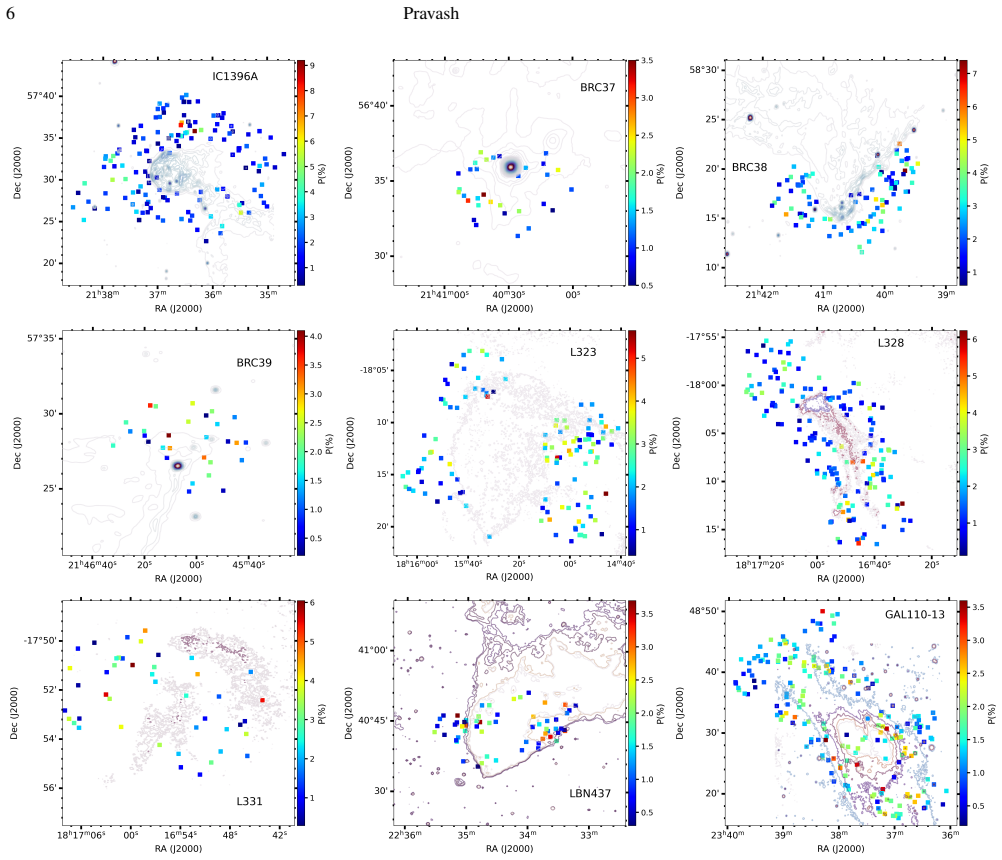
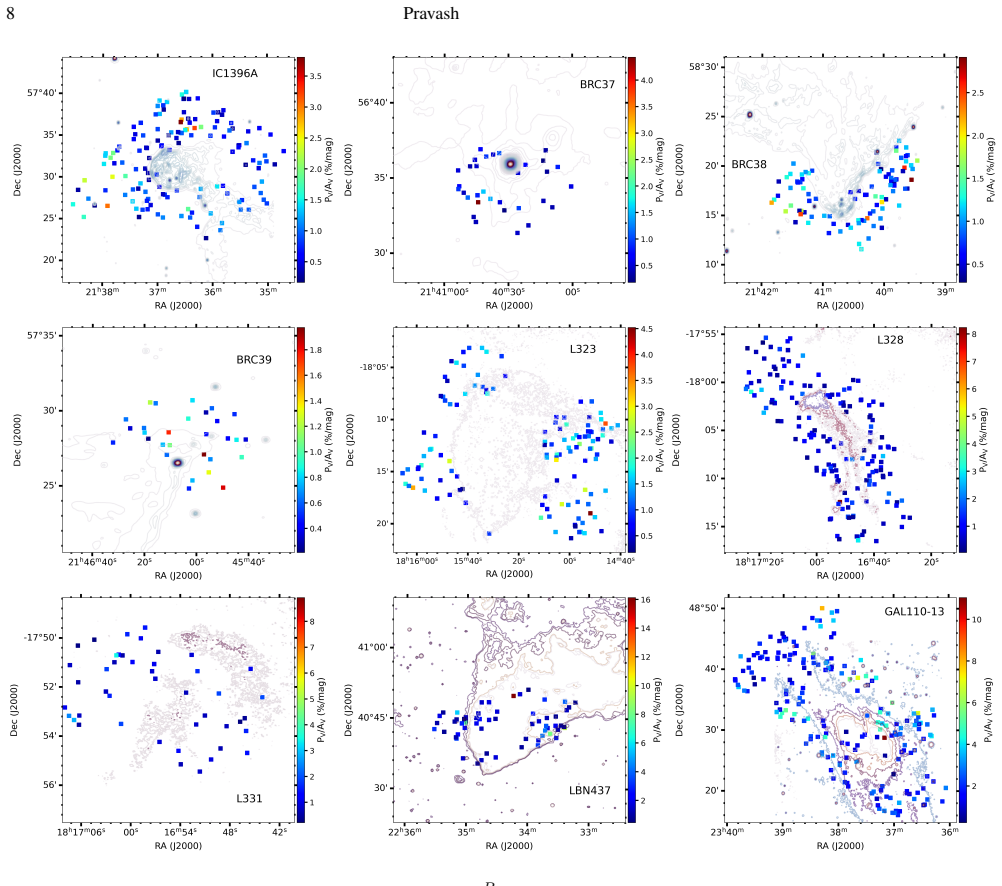
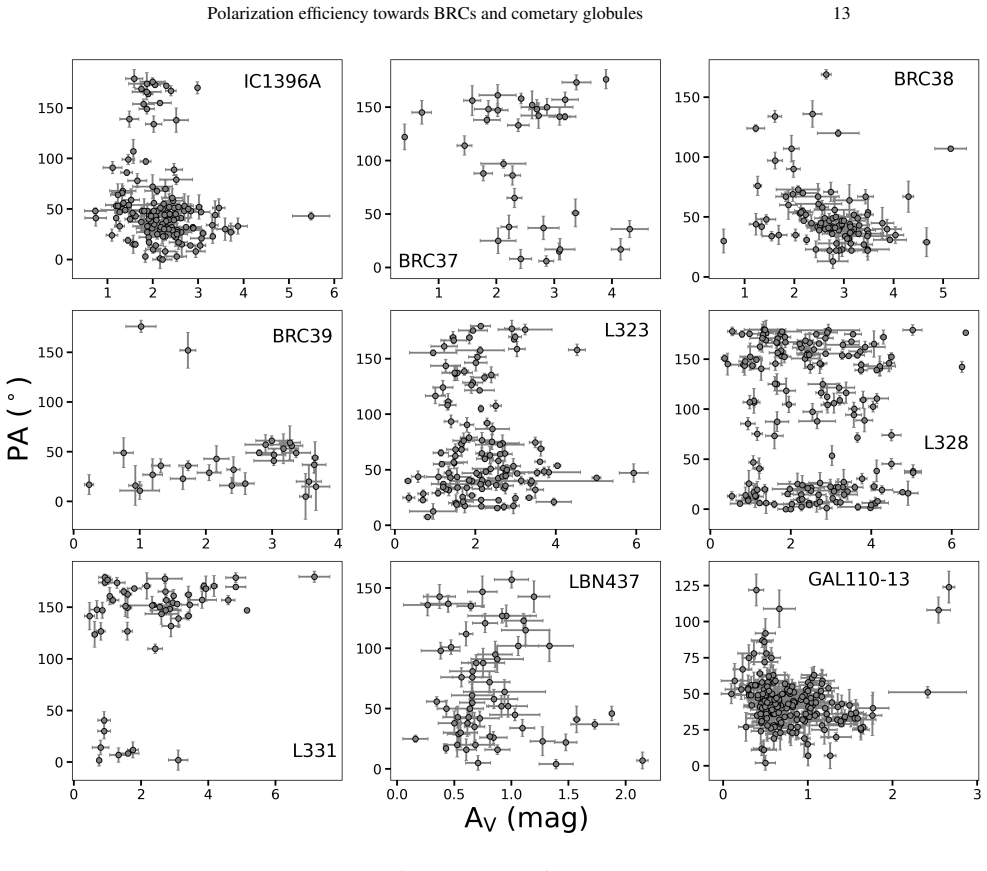
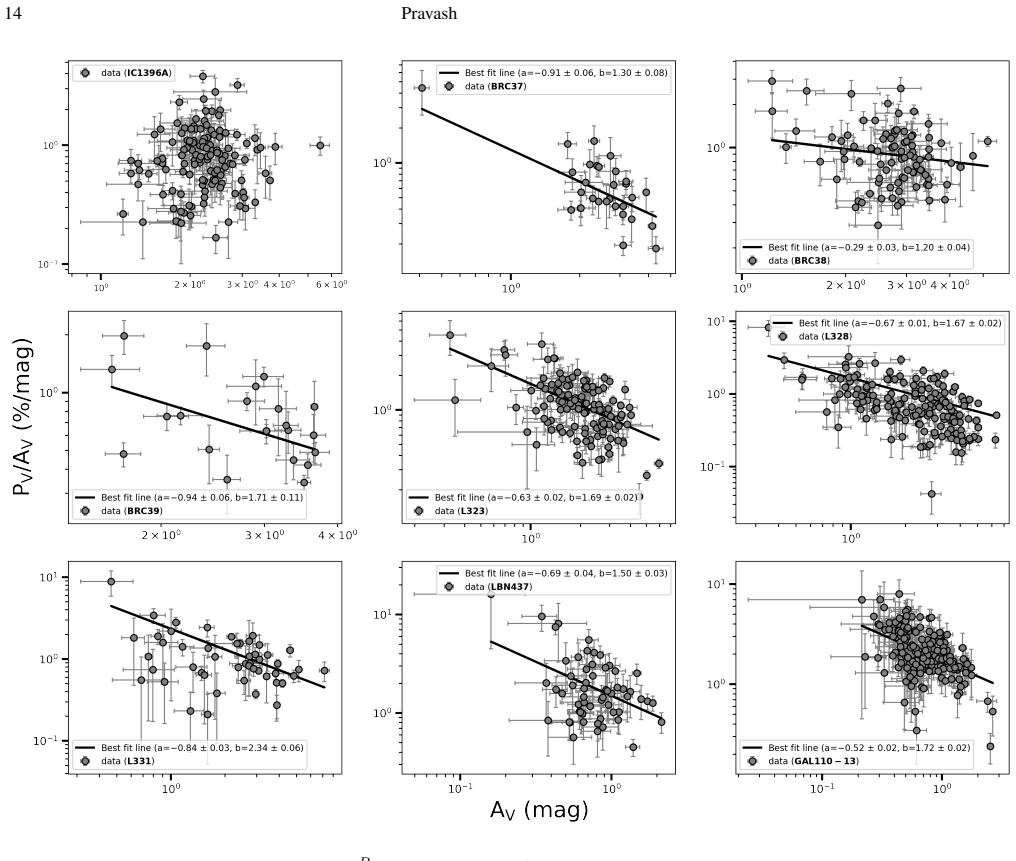
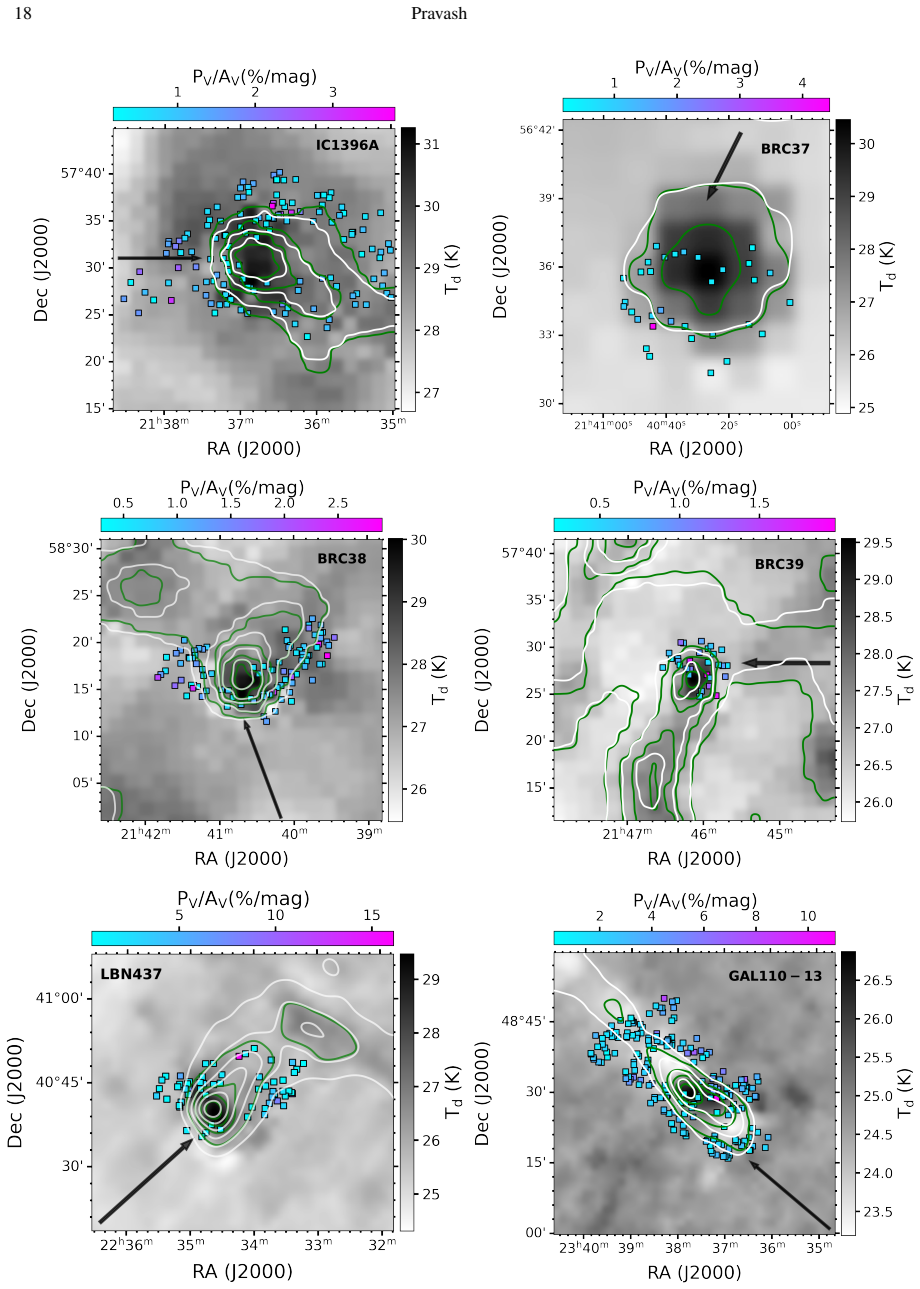
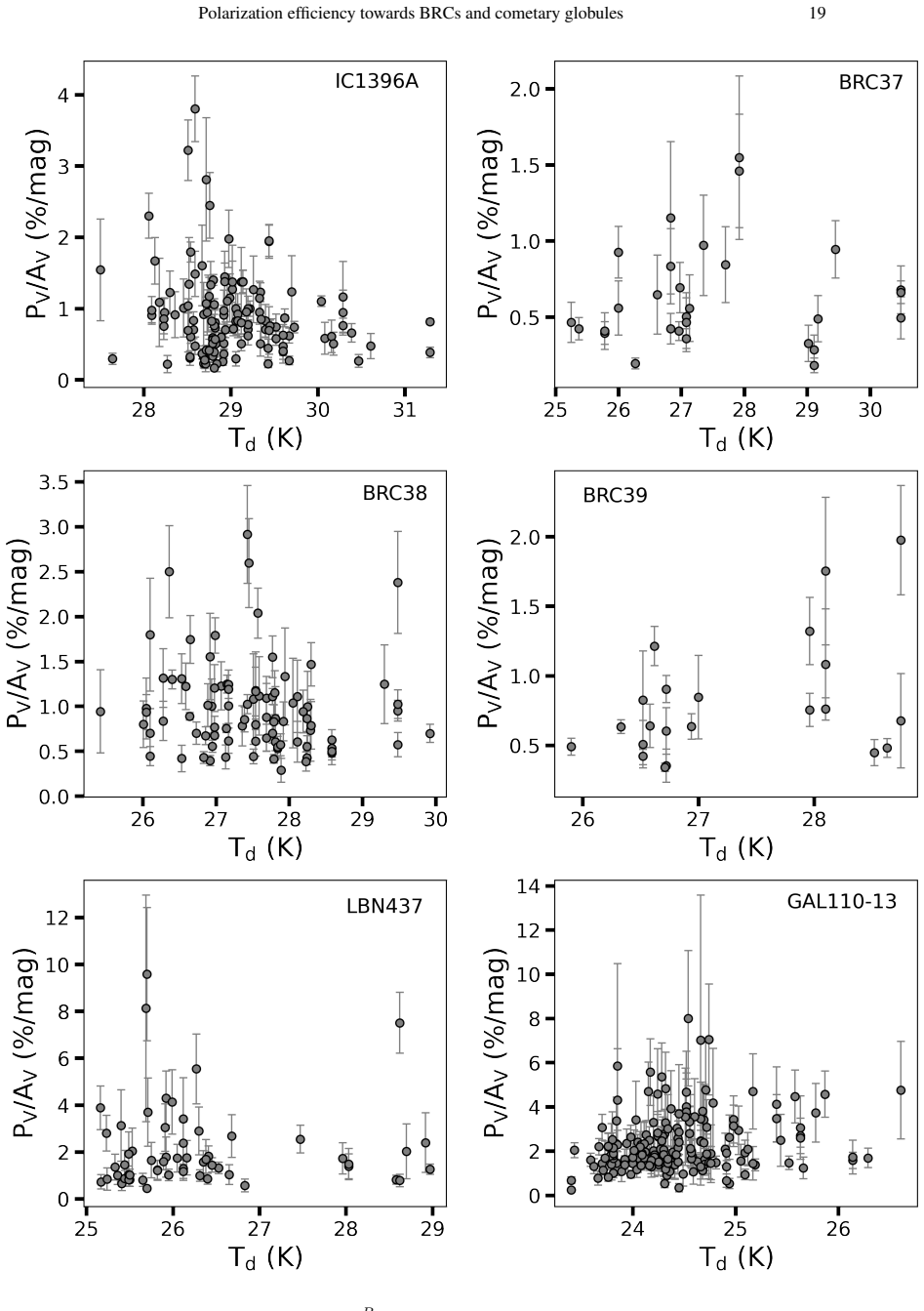
Polarization efficiency decreases with increasing extinction and shows a slight increase with dust temperature for some clouds associated with more ordered magnetic field orientations, providing an implication for the alignment of grains by radiative torques, whereas for some other clouds the decrease in the polarization efficiency with extinction may be caused by more fluctuations in the magnetic field orientations.
What carries the argument
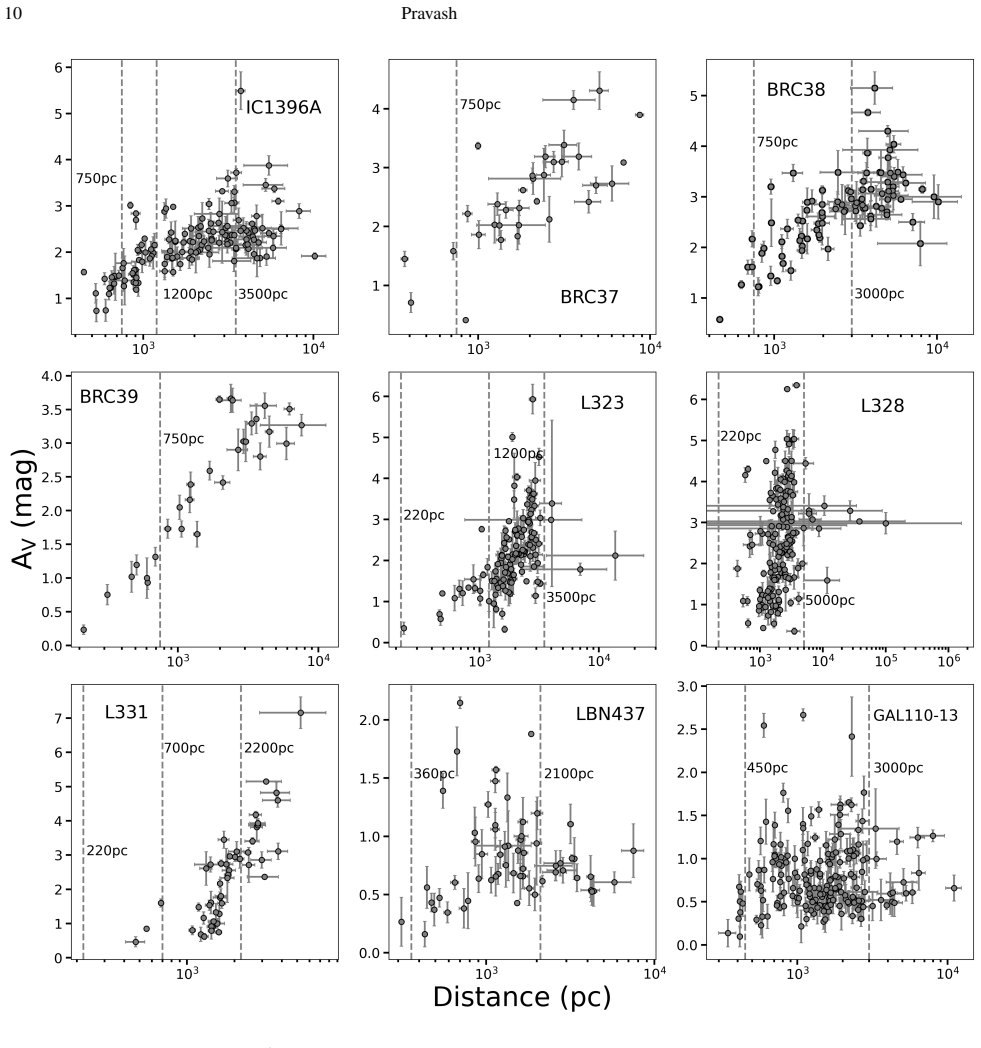
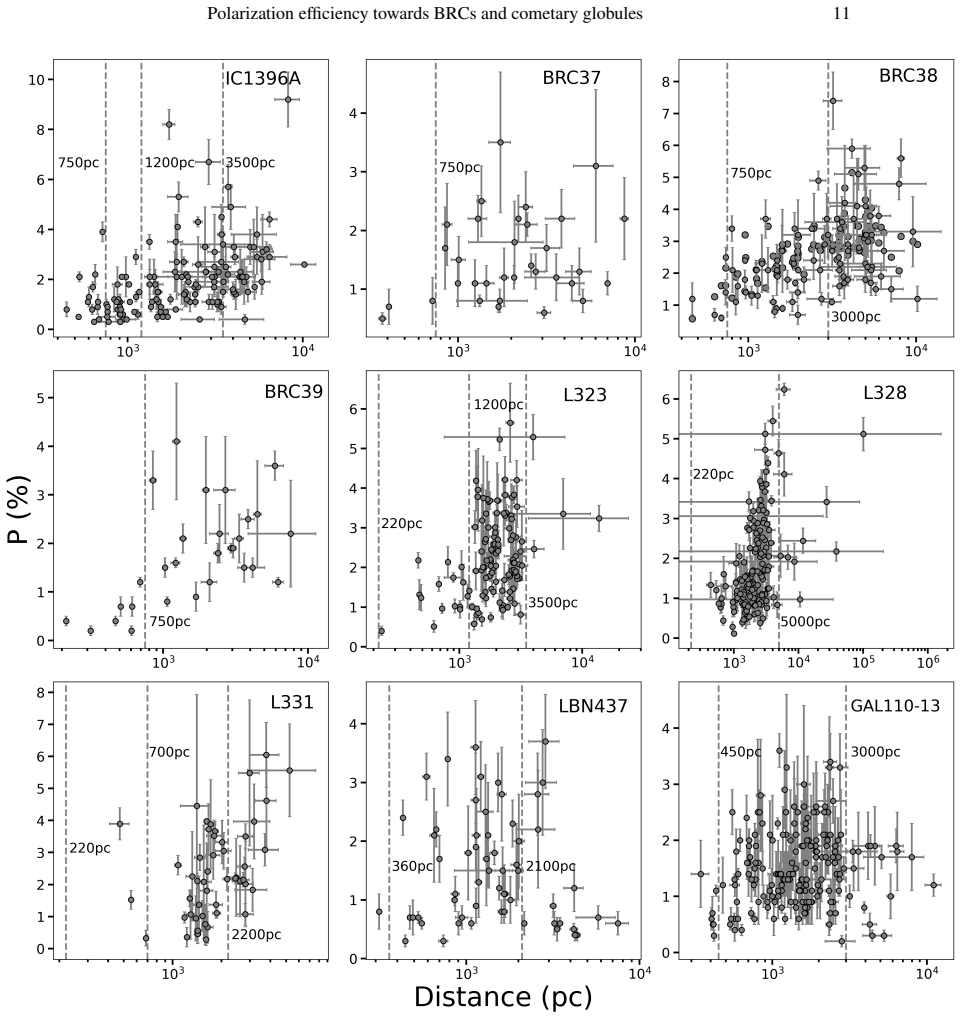
Polarization efficiency, the ratio of polarization degree to extinction, tracked against distance, extinction, and dust temperature to test alignment mechanisms in cloud envelopes.
If this is right
- Polarizing dust layers can be located at specific distances by joint rises in extinction and polarization degree.
- Radiative torque alignment is consistent with the observed efficiency rise with temperature in regions of ordered fields.
- Magnetic field orientation fluctuations can suppress polarization efficiency independently of grain properties.
- These trends apply to the diffuse outer envelopes rather than denser cloud interiors.
Where Pith is reading between the lines
- Polarization maps might indirectly trace magnetic field coherence across cloud populations.
- Similar efficiency trends could appear in other cloud types exposed to strong radiation fields.
- Multi-wavelength polarization measurements could check whether the efficiency patterns persist for different grain populations.
Load-bearing premise
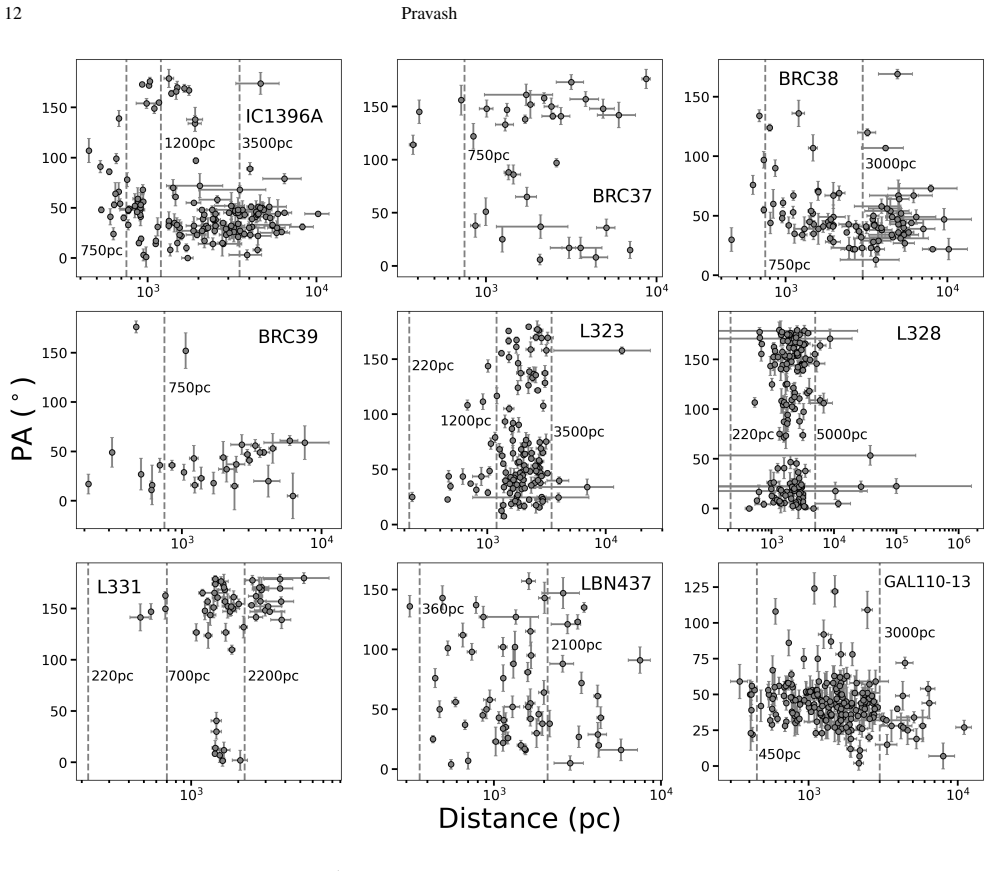
That discrete enhancements in extinction and polarization at specific distances correctly mark the polarizing dust as lying in the outer envelopes of the target clouds rather than unrelated foreground or background layers.
What would settle it
A data set showing polarization efficiency increasing with extinction or showing no temperature dependence even in clouds with ordered field orientations.
Figures
read the original abstract
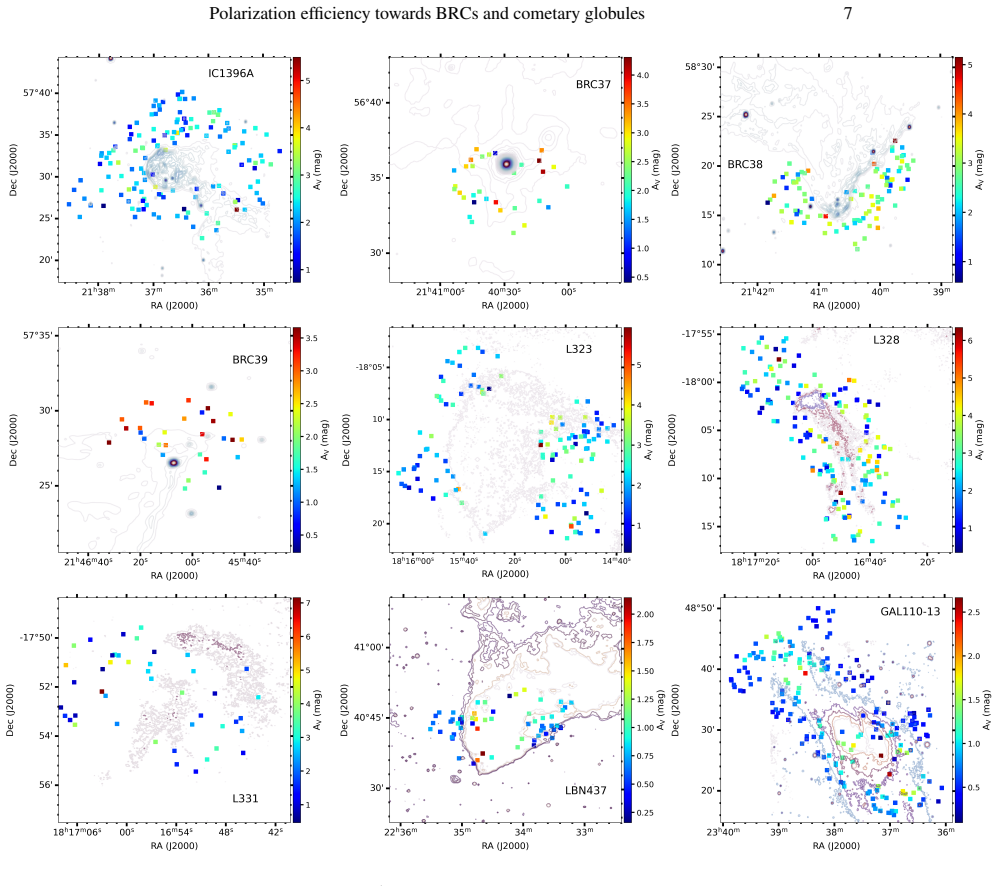
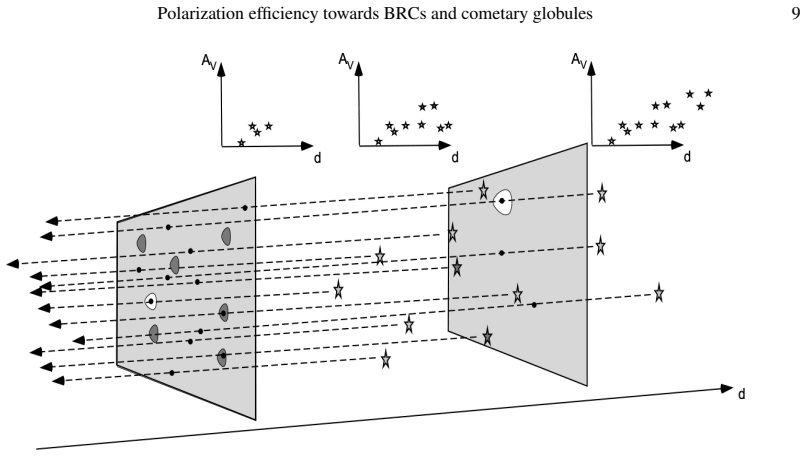
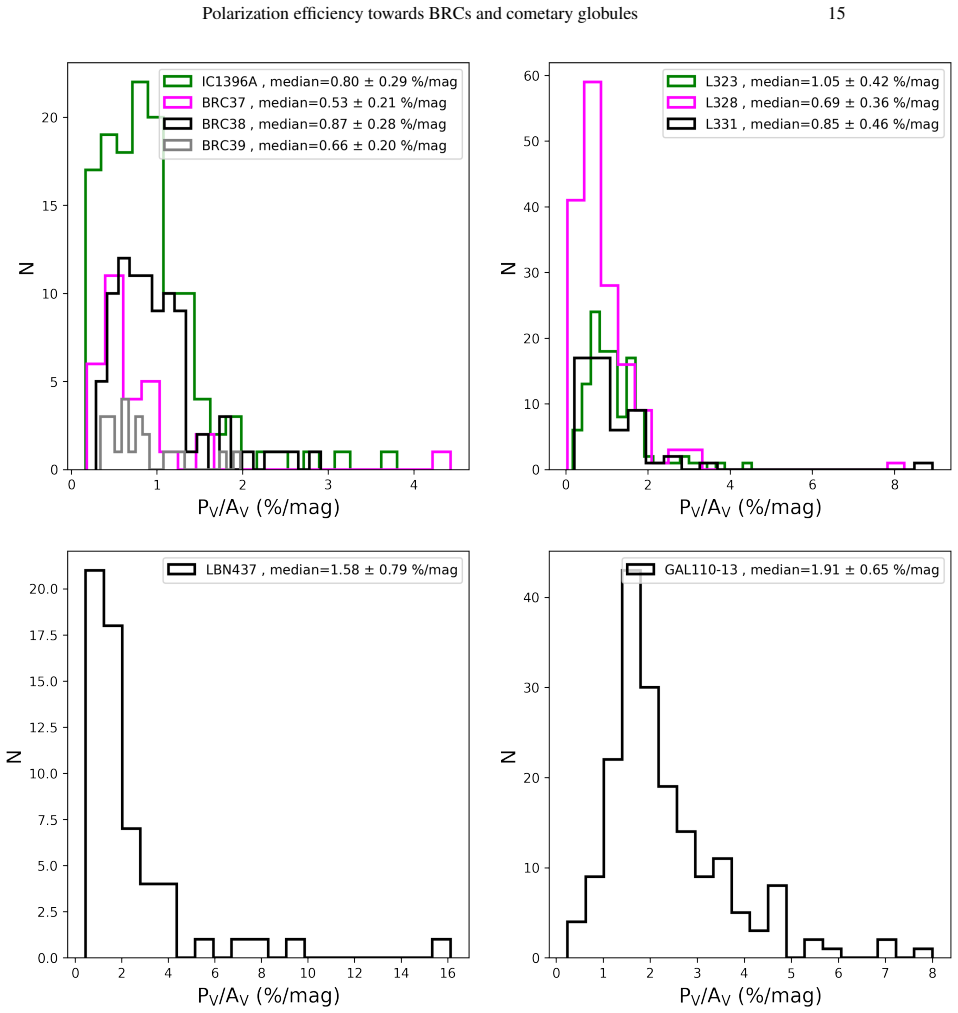
The polarization of starlight and thermal dust emission, resulting from non-spherical grains aligned with the interstellar magnetic field (B-field), act as a powerful tool to trace the B-field morphologies and strengths in molecular clouds and constrain the grain alignment mechanisms and grain properties. The exact alignment mechanisms of grains is not yet fully clear. However, the leading theory is the alignment induced by RAdiative Torques (RATs), known as RAT theory. In this work, we use optical polarization observations of background stars projected towards nine of Bright-Rimmed Clouds (BRCs) and Cometary Globules(CGs) to study the polarization efficiencies and the alignment mechanisms of the grains in the direction towards the outer diffuse envelopes of these clouds. We use distance and extinction data of the stars from Gaia EDR3 and StarHorse 2 Catalogue. We study the variations of the degree and position angle of polarization, and the extinction, as functions of distance of the stars. For some of the clouds, we find discrete enhancement of the extinction at certain distances along with an increase in polarization degree, signifying the presence of polarizing dust layers. We estimate the polarization efficiency of grains towards each of the clouds. We find that it decreases with increasing extinction, and also shows a slight increase with dust temperature for some clouds associated with more ordered magnetic field orientations, providing an implication for the alignment of grains by RATs. Whereas, for some other clouds, the decrease in the polarization efficiency with extinction may be caused by more fluctuations in the magnetic field orientations.
Editorial analysis
A structured set of objections, weighed in public.
Referee Report
Summary. The paper reports optical polarization observations of background stars towards nine bright-rimmed clouds (BRCs) and cometary globules (CGs). Using Gaia EDR3 and StarHorse distances and extinctions, it identifies discrete enhancements in extinction and polarization degree at specific distances, which are interpreted as arising in the outer envelopes of the target clouds. Polarization efficiency is estimated and reported to decrease with increasing extinction; for some clouds with ordered magnetic field orientations it shows a mild increase with dust temperature, taken as support for radiative torque (RAT) alignment, while for others the efficiency drop is attributed to magnetic-field fluctuations.
Significance. If the distance-based attribution of the observed jumps to the target envelopes survives scrutiny, the work would supply observational constraints on grain alignment in diffuse cloud envelopes and on the role of magnetic-field order in modulating RAT efficiency. The reliance on public Gaia/StarHorse catalogs is a positive feature that aids reproducibility.
major comments (3)
- [distance-variation analysis] The central attribution of discrete extinction and polarization enhancements at specific distances to the outer envelopes of the BRCs/CGs (invoked to interpret all subsequent efficiency trends) is not accompanied by any reported Monte Carlo propagation of Gaia EDR3 parallax uncertainties, tests of binning sensitivity, or comparison to off-cloud control sightlines. Without these, it remains possible that the reported steps reflect unrelated foreground/background layers or statistical fluctuations.
- [polarization-efficiency results] Trends in polarization efficiency versus extinction and versus dust temperature are stated without error bars, per-cloud sample sizes, or measures of statistical significance. The abstract also omits the precise definition of polarization efficiency (e.g., P/A_V, P/A_V normalized by wavelength, etc.) and any description of how field-orientation order was quantified.
- [interpretation of efficiency trends] The distinction drawn between clouds showing an efficiency–temperature upturn (linked to “more ordered” B-fields) and those showing only an efficiency drop (linked to “more fluctuations”) is used to support the RAT interpretation, yet the quantitative criterion for ordering (e.g., position-angle dispersion threshold) and its correlation with the efficiency trends are not specified.
minor comments (1)
- [abstract] The abstract would be clearer if it stated the total number of stars analyzed and the typical range of A_V values probed for each cloud.
Simulated Author's Rebuttal
We thank the referee for the constructive report. We respond point-by-point to the three major comments and will incorporate all requested clarifications and additional analyses in the revised manuscript.
read point-by-point responses
-
Referee: The central attribution of discrete extinction and polarization enhancements at specific distances to the outer envelopes of the BRCs/CGs (invoked to interpret all subsequent efficiency trends) is not accompanied by any reported Monte Carlo propagation of Gaia EDR3 parallax uncertainties, tests of binning sensitivity, or comparison to off-cloud control sightlines. Without these, it remains possible that the reported steps reflect unrelated foreground/background layers or statistical fluctuations.
Authors: We agree that a quantitative robustness assessment is needed. In the revised manuscript we will add Monte Carlo realizations propagating Gaia EDR3 parallax uncertainties into the distance-extinction and distance-polarization diagrams, test sensitivity to bin width choices, and present parallel analyses of off-cloud control fields. These results will be shown in a dedicated subsection to demonstrate that the reported steps are statistically distinguishable from fluctuations or unrelated layers. revision: yes
-
Referee: Trends in polarization efficiency versus extinction and versus dust temperature are stated without error bars, per-cloud sample sizes, or measures of statistical significance. The abstract also omits the precise definition of polarization efficiency (e.g., P/A_V, P/A_V normalized by wavelength, etc.) and any description of how field-orientation order was quantified.
Authors: We will revise the abstract to state that polarization efficiency is defined as P_V/A_V and that magnetic-field order is quantified by the dispersion in polarization position angles. In the main text we will list the number of stars used for each cloud, attach propagated error bars to all efficiency values, and report Spearman rank coefficients (with p-values) for the trends versus extinction and temperature. revision: yes
-
Referee: The distinction drawn between clouds showing an efficiency–temperature upturn (linked to “more ordered” B-fields) and those showing only an efficiency drop (linked to “more fluctuations”) is used to support the RAT interpretation, yet the quantitative criterion for ordering (e.g., position-angle dispersion threshold) and its correlation with the efficiency trends are not specified.
Authors: We will define the ordering metric explicitly as the standard deviation of polarization position angles about the mean for each cloud and tabulate this value for all nine targets. We will also show the correlation between this dispersion and the presence/absence of the efficiency-temperature upturn, thereby making the observational basis for the RAT-supporting interpretation fully quantitative. revision: yes
Circularity Check
No circularity: observational trends derived from independent public catalogs without fitted parameters or self-referential definitions.
full rationale
The paper performs an observational analysis using Gaia EDR3 and StarHorse distances/extinctions plus optical polarization data. It reports empirical trends (P_eff vs A_V decrease; mild T_dust correlation in ordered B-field cases) after binning stars by distance and noting co-located extinction/polarization jumps. No equations, ansatzes, or fitted parameters are defined in terms of the reported efficiencies or alignments. No self-citations are invoked to justify uniqueness or load-bearing premises. The distance-binning step is interpretive and could be sensitive to parallax errors, but this is a methodological limitation rather than a circular reduction of the result to its inputs by construction. The derivation chain is self-contained against external benchmarks.
Axiom & Free-Parameter Ledger
free parameters (1)
- distance bins or thresholds for identifying discrete extinction layers
axioms (2)
- domain assumption Observed polarization is produced by aligned non-spherical dust grains interacting with the interstellar magnetic field
- domain assumption Gaia EDR3 distances and StarHorse extinctions accurately place background stars relative to the target clouds
Reference graph
Works this paper leans on
-
[1]
Alves, F. O., Frau, P., Girart, J. M., et al. 2014, A&A, 569, L1, doi:10.1051/0004-6361/201424678 16, 22
-
[3]
G., Lazarian, A., & Vaillancourt, J
Andersson, B. G., Lazarian, A., & Vaillancourt, J. E. 2015, ARA&A, 53, 501, doi: 10.1146/ annurev-astro-082214-122414 2, 17, 21, 22
2015
-
[4]
Andersson, B. G., & Potter, S. B. 2007, ApJ, 665, 369, doi: 10.1086/519755 5 Astropy Collaboration, Robitaille, T. P., Tollerud, E. J., et al. 2013, A&A, 558, A33, doi: 10.1051/ 0004-6361/201322068 23 Astropy Collaboration, Price-Whelan, A. M., Sip ˝ocz, B. M., et al. 2018, AJ, 156, 123, doi: 10.3847/ 1538-3881/aabc4f 23
-
[5]
Davis, Leverett, J., & Greenstein, J. L. 1951, ApJ, 114, 206, doi: 10.1086/145464 2
-
[6]
Dolginov, A. Z., & Mitrofanov, I. G. 1976, Ap&SS, 43, 291, doi: 10.1007/BF00640010 2
-
[7]
Draine, B. T. 2003, ARA&A, 41, 241, doi: 10.1146/annurev.astro.41.011802.094840 1
work page internal anchor Pith review Pith/arXiv arXiv doi:10.1146/annurev.astro.41.011802.094840 2003
-
[8]
Draine, B. T., & Weingartner, J. C. 1997, ApJ, 480, 633, doi:10.1086/304008 2 Falceta-Gonc ¸alves, D., Lazarian, A., & Kowal, G. 2008, ApJ, 679, 537, doi:10.1086/587479 14
-
[9]
Garrison, R. F., & Kormendy, J. 1976, PASP, 88, 865, doi:10.1086/130037 3
-
[10]
1952, MNRAS, 112, 215, doi: 10.1093/mnras/112.2.215 2 24 Pravash
Gold, T. 1952, MNRAS, 112, 215, doi: 10.1093/mnras/112.2.215 2 24 Pravash
-
[11]
Hall, J. S. 1949, Science, 109, 166, doi: 10.1126/science.109.2825.166 2
-
[12]
Hiltner, W. A. 1949a, ApJ, 109, 471, doi: 10.1086/145151 2 —. 1949b, Science, 109, 165, doi: 10.1126/science.109.2825.165 2
-
[13]
Hoang, T., & Lazarian, A. 2008, MNRAS, 388, 117, doi: 10.1111/j.1365-2966.2008.13249.x 2, 14 —. 2016, ApJ, 831, 159, doi: 10.3847/0004-637X/831/2/159 2, 14
-
[14]
N., Lee, H., Diep, P
Hoang, T., Tram, L. N., Lee, H., Diep, P. N., & Ngoc, N. B. 2021, ApJ, 908, 218, doi: 10.3847/ 1538-4357/abd54f 21
2021
-
[15]
Jones, T. J. 1989, ApJ, 346, 728, doi: 10.1086/168054 14
-
[16]
J., Bagley, M., Krejny, M., Andersson, B
Jones, T. J., Bagley, M., Krejny, M., Andersson, B. G., & Bastien, P. 2015, AJ, 149, 31, doi: 10.1088/ 0004-6256/149/1/31 16, 22
2015
-
[17]
Jones, T. J., Klebe, D., & Dickey, J. M. 1992, ApJ, 389, 602, doi: 10.1086/171233 14, 16
-
[18]
2023, MNRAS, 524, 1219, doi:10.1093/mnras/stad1845 3, 4, 10, 12
Kumar, S., Soam, A., & Roy, N. 2023, MNRAS, 524, 1219, doi:10.1093/mnras/stad1845 3, 4, 10, 12
-
[19]
Lazarian, A., & Hoang, T. 2007, MNRAS, 378, 910, doi: 10.1111/j.1365-2966.2007.11817.x 2, 17, 21
-
[20]
Lee, H.-T., & Chen, W. P. 2007, ApJ, 657, 884, doi:10.1086/510893 4
-
[21]
Lynds, B. T. 1962, ApJS, 7, 1, doi: 10.1086/190072 4
-
[22]
Maheswar, G., Lee, C. W., & Dib, S. 2011, A&A, 536, A99, doi: 10.1051/0004-6361/201116438 3
-
[23]
Medan, I., & Andersson, B. G. 2019, ApJ, 873, 87, doi: 10.3847/1538-4357/ab063c 2, 16, 21, 22
-
[24]
W., & Tej, A
Neha, S., Maheswar, G., Soam, A., Lee, C. W., & Tej, A. 2016, A&A, 588, A45, doi: 10.1051/ 0004-6361/201526845 3, 4, 12
2016
-
[25]
F., & Lockman, F
Odenwald, S. F., & Lockman, F. J. 1988, in Bulletin of the American Astronomical Society, V ol. 20, 957 4
1988
-
[26]
A., Walmsley, C
Olano, C. A., Walmsley, C. M., & Wilson, T. L. 1994, A&A, 290, 235 4
1994
-
[27]
A., Goldsmith, P
Patel, N. A., Goldsmith, P. F., Snell, R. L., Hezel, T., & Xie, T. 1995, ApJ, 447, 721, doi: 10.1086/ 175912 3 Planck Collaboration, Aghanim, N., Akrami, Y ., et al. 2020, A&A, 641, A12, doi: 10.1051/ 0004-6361/201833885 13, 14
1995
-
[28]
Queiroz, A. B. A., Anders, F., Santiago, B. X., et al. 2018, MNRAS, 476, 2556, doi: 10.1093/mnras/ sty330 4
-
[29]
S., Joshi, G
Rautela, B. S., Joshi, G. C., & Pandey, J. C. 2004, Bulletin of the Astronomical Society of India, 32, 159 4
2004
-
[30]
https://doi.org/10.5281/zenodo
Robitaille, T. 2019, APLpy v2.0: The Astronomical Plotting Library in Python, doi: 10.5281/zenodo. 2567476 23
-
[31]
2012, APLpy: Astronomical Plotting Library in Python, Astrophysics Source Code Library, record ascl:1208.017 23
Robitaille, T., & Bressert, E. 2012, APLpy: Astronomical Plotting Library in Python, Astrophysics Source Code Library, record ascl:1208.017 23
2012
-
[32]
Schnee, S. L., Ridge, N. A., Goodman, A. A., & Li, J. G. 2005, ApJ, 634, 442, doi: 10.1086/491729 17
-
[33]
Schwartz, R. D., Wilking, B. A., & Giulbudagian, A. L. 1991, ApJ, 370, 263, doi: 10.1086/169812 3 Polarization efficiency towards BRCs and cometary globules 25
-
[34]
Serkowski, K., Mathewson, D. S., & Ford, V . L. 1975, ApJ, 196, 261, doi:10.1086/153410 5
-
[35]
1959, ApJS, 4, 257, doi: 10.1086/190049 4
Sharpless, S. 1959, ApJS, 4, 257, doi: 10.1086/190049 4
-
[36]
Singh, S., Pandey, J. C., & Hoang, T. 2022, MNRAS, 513, 4899, doi: 10.1093/mnras/stac1211 22
-
[37]
Singh, S., Pandey, J. C., Hoang, T., et al. 2024, AJ, 167, 242, doi: 10.3847/1538-3881/ad36c3 22
-
[38]
Soam, A., Maheswar, G., Bhatt, H. C., Lee, C. W., & Ramaprakash, A. N. 2013, MNRAS, 432, 1502, doi: 10.1093/mnras/stt576 3, 4, 12
-
[39]
Soam, A., Maheswar, G., Lee, C. W., et al. 2015, A&A, 573, A34, doi: 10.1051/0004-6361/ 201322536 10
-
[40]
W., Neha, S., & Kim, K.-T
Soam, A., Maheswar, G., Lee, C. W., Neha, S., & Kim, K.-T. 2018, MNRAS, 476, 4782, doi: 10.1093/ mnras/sty517 3, 4, 8, 9
2018
-
[41]
Soam, A., Andersson, B. G., Straiˇzys, V ., et al. 2021, AJ, 161, 149, doi:10.3847/1538-3881/abdd3b 2, 6, 9, 20, 21, 22
-
[42]
Vaillancourt, J. E. 2006, PASP, 118, 1340, doi:10.1086/507472 4
-
[43]
E., et al
Virtanen, P., Gommers, R., Oliphant, T. E., et al. 2020, Nature Methods, 17, 261, doi: 10.1038/ s41592-019-0686-2 23
2020
-
[44]
Walborn, N. R., & Panek, R. J. 1984, ApJ, 286, 718, doi: 10.1086/162647 3
discussion (0)
Sign in with ORCID, Apple, or X to comment. Anyone can read and Pith papers without signing in.