REVIEW 3 major objections 4 minor 117 references
Unbounded entanglement-sustaining sequential local quantum state discrimination
T0 review · 3 major / 4 minor · reviewed 2026-08-07 · deepseek-v4-flash
Pith's one-line read For any two entangled two-qubit states, sequential observers can beat random guessing indefinitely while preserving entanglement.
desk verdict Correct special-case result, but Theorem 3 rests on a basis-dependent error in Appendix B that breaks the arbitrary-round claim. read the letter →
The pith
A machine-rendered reading of the paper's core claim, the machinery that carries it, and where it could break.
The reading
What carries the argument
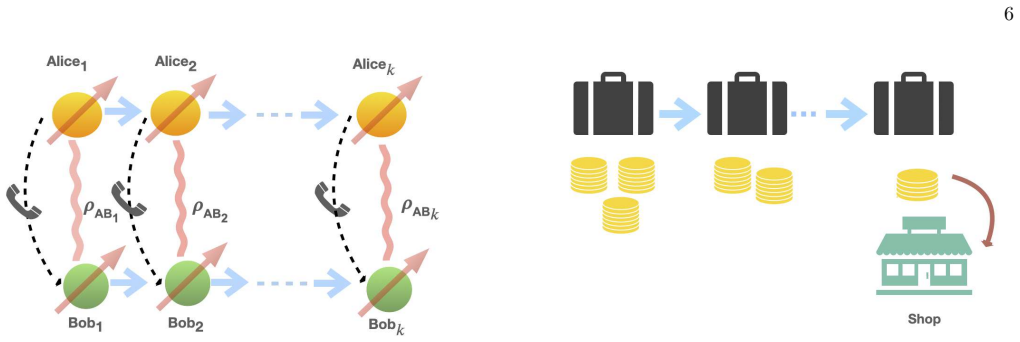
The central mechanism is the unsharp POVM: each sharp rank-one projector P_j is replaced by Q_j = λP_j + (1−λ) I/d, so part of the measurement acts as a ‘do nothing’ channel. Tuning λk controls the trade-off between information gain and entanglement damage. The state is propagated between rounds by the von Neumann–Lüders update ρ_k^b = Σ_j √(O_j^k) ρ_{k−1}^b √(O_j^k). Entanglement retention is quantified by logarithmic negativity for the special family and certified by the witness operator W_k^b for the general family; the next round’s sharpness parameter is set to λ_{k+1} = (1+ε_k) times the maximum of the ratios (1+Tr[σ3⊗σ3 ρ_k^b])/Tr[σ2⊗σ2 ρ_k^b], designed to keep the witness negative.
What would settle it
Take the paper's own initial state |Φ1⟩ = √µ1|00⟩ + √(1−µ1)|1⟩(cosθ|0⟩ + sinθ|1⟩) and compute Tr[σ3⊗σ3|Φ1⟩⟨Φ1|] = µ1 − (1−µ1)cos2θ. For µ1 = 0.4 and θ = π/3 this equals 0.7, not −1, so the Appendix B basis for concluding λ2→0 fails for that generic choice; running the witness inequality (20) explicitly for round 2 with these parameters would settle whether arbitrarily many rounds can all certify entanglement for every state in the claimed family.
Extended reading notes
Core claim
The central claim is that for any two orthogonal, entangled, two-qubit pure states prepared with equal probability, there exist unsharp one-way LOCC measurements such that an arbitrary number of sequential pairs can discriminate the states with average success probability strictly greater than 1/2 at every round, while the state handed on by each pair remains entangled. The protocol starts from the optimal sharp LOCC measurement for two orthogonal two-qubit states and replaces each projector with a noisy version whose sharpness parameter λk is chosen round by round. For the special family |κ1⟩ and |κ2⟩, the success probability at round k is 1/2 + λ̄_k²/2 and the logarithmic negativity of each post-measurement state is log2[1 + 2ϑ_b(1 − S_k)], both strictly positive for λ̄_k ∈ (0,1). For the general family, entanglement is certified by a witness operator W_k^b = (1/4)(I⊗I + σ3⊗σ3 − g2^k σ2⊗σ2), with g2^k chosen so that Tr[W_k^b ρ_k^b] < 0, and the success probability is claimed to exceed 1/2 for arbitrarily many rounds.
Load-bearing premise
The load-bearing premise is that both initial states have Tr[σ3⊗σ3ρ0_b] = −1; in the paper's own parametrization of general two-qubit states this equality holds only for special parameter choices, so the chain λ2→0, λ3→0, ... that keeps the witness valid for arbitrarily many rounds is not guaranteed for all states the theorem claims to cover.
Editorial extensions
If this is right
- If the main theorem is correct, arbitrarily many receiver pairs can extract classical information from an entangled two-qubit resource while preserving a usable entangled state for later tasks.
- For the special family, each round's success probability depends only on that round's sharpness parameter, so earlier observers' choices do not degrade later discrimination power.
- A final pair that declines to decode can still use the remaining entangled state, since every two-qubit entangled state is distillable.
- The protocol works under one-way LOCC, so it uses the same experimental resources as standard sequential state discrimination.
- For the special family, the success probability can be made arbitrarily close to 1 by taking λ̄_k close to 1 while keeping nonzero logarithmic negativity.
Reading between the lines
- If the missing σ3⊗σ3 condition is enforced by rotating the initial states into a basis where each is Schmidt anti-correlated, the witness construction might extend cleanly to all entangled pairs; this is an editorial projection, not a claim in the paper.
- One testable extension is to apply the same unsharp-measurement replacement to unambiguous sequential discrimination or to multipartite states; the paper only treats the minimum-error two-qubit case.
- The numerical checks at k = 2 in the general-case proof could likely be replaced by a fully analytic computation of the R and R′ recursion coefficients in closed form, which would remove the remaining numerical step.
- The sharpness parameter acts like an entanglement budget that each observer can choose independently; for the special family the budget is not depleted by previous rounds, suggesting a modular resource interpretation that the paper does not develop.
Editorial analysis
A structured set of objections, weighed in public.
Referee Report
Summary. The paper proposes a sequential state discrimination protocol (SSDSE) in which multiple pairs of observers distinguish two orthogonal entangled two-qubit pure states by unsharp local measurements with classical communication, while aiming to keep the post-measurement states entangled at every round. For a particular two-state family (Sec. IV) the authors derive the per-round success probability and the residual logarithmic negativity; for general orthogonal entangled two-qubit states (Sec. V) they claim, in Theorem 3, that arbitrarily many rounds can succeed with probability above random guessing while entanglement is witnessed in each round. The general-case proof relies on a witness construction in Sec. V A and on Appendices B and C.
Significance. The specific-case results are concrete and checkable: Theorems 1 and 2 give P^k_suc = 1/2 + λ_k^2/2 and E^k_b = log2[1 + 2ϑ_b(1 − S_k)], and direct calculation confirms these formulae. If the general claim were established, the paper would be a useful contribution to the recent literature on recycling quantum correlations by sequential weak measurements. However, the general-case Theorem 3 is the central new assertion of the paper, and its proof is invalid at a load-bearing point: the witness construction does not certify the initial states in the computational basis used by the protocol, and the arbitrary-round success-probability proof is not rigorous. The general claim is therefore not established by this manuscript.
major comments (3)
- [Appendix B; Sec. V A] The chain argument for arbitrarily many rounds is based on the claim that Tr[σ3⊗σ3 ρ0_b] = −1 for both initial states. Appendix B obtains this by writing a pure entangled state, up to local unitary, as √m|01⟩+√(1−m)|10⟩. But the states in Eq. (1) are fixed in a computational basis that is not the Schmidt basis of either state, and the protocol's measurements are defined in that same computational basis. In the computational basis, for |Φ1⟩=√µ1|00⟩+√(1−µ1)|1ς1⟩ one obtains Tr[σ3⊗σ3 ρ0_1] = µ1−(1−µ1)cos2θ, which equals −1 only for µ1=0 or special θ, outside the entangled regime µ1∈(0,1). For |Φ2⟩=√µ2|01⟩+√(1−µ2)|1ς1⊥⟩ one obtains Tr[σ3⊗σ3 ρ0_2] = −µ2+(1−µ2)cos2θ, which is also not −1 in general. Hence the inference λ1→0 ⇒ λ2→0 ⇒ ⋯ in Eq. (B1) has no valid base, and the claimed existence of witnesses W^k_b for arbitrarily many rounds is unsupported.
- [Sec. V A, Eqs. (19)–(22)] The witness condition is transcribed with the wrong inequality direction when Tr[σ2⊗σ2 ρ] is negative. For W^k_b = 1/4(I + σ3⊗σ3 − g^k_2 σ2⊗σ2), the condition Tr[W^k_b ρ] < 0 is 1 + Tr[σ3⊗σ3 ρ] − g Tr[σ2⊗σ2 ρ] < 0. For both initial states in Eq. (1), with the standard Pauli σ2 and in the computational basis, Tr[σ2⊗σ2 ρ0_b] < 0; for example, at µ1=µ2=1/2, θ=π/2, Tr[σ2⊗σ2 ρ0_1] = Tr[σ2⊗σ2 ρ0_2] = −1. In this case the correct inequality is g < (1+Tr[σ3⊗σ3 ρ])/Tr[σ2⊗σ2 ρ], not the > in Eq. (20), and since 1+Tr[σ3⊗σ3 ρ] ≥ 0 for any state, no g∈[0,1] can make Tr[W ρ] < 0. Thus the witness operator of Eq. (19) cannot certify the entanglement of the initial states in the protocol's measurement basis, and the recursive construction in Eq. (22) has no valid starting point.
- [Appendix C; Theorem 3] The proof that Q^k_b > 0 for θ∈(π/4,π/2] and hence that P^k_suc > 1/2 for all k is not a proof as written. Several key steps are justified only by numerical inspection for k = 2 (Figs. 2–5) or by assertions such as 'it can be shown' and 'it can be checked numerically' for functions h, a, c whose sign properties are stated to hold 'in the limit λ_k→0' without closed-form demonstration. The induction to arbitrary k also requires the sequence {λ_k} to be strictly increasing while satisfying the witness-prescribed recursion (22) and remaining in (0,1], but no argument establishes that such a sequence exists for every finite k. Consequently, Theorem 3's claim of arbitrarily many rounds with per-round success probability strictly above 1/2 is not established.
minor comments (4)
- [Sec. I and Sec. IV] There are several typographical errors: the Introduction ends with 'lastly conclude in Sec. V B', which should refer to the conclusion section; Sec. IV says 'discriminating |κ1⟩ and |κ1⟩' where the second state should be |κ2⟩; and the sentence 'the states ¯ρb are pure entangled states of the form ¯ρb = |κb⟩⟨κb|' uses an undefined index b before the states are introduced.
- [Sec. II B 1, Eq. (1)] The parameterization in Eq. (1) is taken from Ref. [91] and the entangled regime is stated as µ1,2∈(0,1), θ∈(0,π/2]. The paper should explicitly note that this covers all orthogonal entangled pairs only up to local unitary, since the subsequent witness construction is basis-dependent; the present wording could mislead the reader into thinking the computational basis is the Schmidt basis.
- [Sec. V A, Eq. (18)] The witness form in Eq. (18) is cited from Refs. [109,118,119] with |g_q|≤1. The paper then restricts to g_1=0, g_3=1, g_2∈[0,1] without justifying that this restricted family can witness every entangled two-qubit state in the computational basis; as shown in the major comments, it cannot for the states considered.
- [Sec. III, Eq. (5)] The definition of unsharp measurement in Eq. (5) requires λ∈(0,1), but later the paper also discusses λ=1 and λ→0. Please clarify the allowed range of λ in each statement and whether λ=0 corresponds to a valid measurement or only to a limiting case.
Circularity Check
No significant circularity: the protocol's construction and success-probability proofs are self-contained, and the only author-overlapping citation is not load-bearing.
full rationale
The derivation chain is not circular. The witness form in Eq. (18) is cited to Refs. [109, 118, 119]; Ref. [109] shares two authors with this paper, but the same witness form is independently established in Refs. [118, 119] and the bound Tr[W Sigma] >= 0 for all separable states is a standard result, so the self-citation is not load-bearing. The construction in Eq. (22), where lambda_{k+1} is set equal to the witness parameter g^k_2, is a constructive existence argument rather than a fit-then-predict cycle: the subsequent success-probability bound P^k_suc > 1/2 is derived analytically from the explicit recursion relations in Eqs. (A1) and (C1), not assumed. The positivity of Q^k_b is proved for an increasing sequence lambda_k -> 0, which is the same regime required for the witness bound; satisfying both constraints is a parameter-choice argument, not an input-output identity. The Appendix B step Tr[sigma_3 tensor sigma_3 rho^0_b] = -1, even if mathematically incorrect due to a basis mismatch, is a correctness defect rather than a circular reduction: it is used as a lemma to justify the existence of witnesses, not assumed as the conclusion of the paper. No step in the paper's derivation reduces by construction to its own inputs.
Assumptions & free parameters
free parameters (2)
- epsilon_k (k=1,...,K) =
unspecified positive reals
- lambda_1 (initial sharpness, general case) =
tends to 0
assumptions (5)
- standard math Any two pure orthogonal two-qubit states can, up to local unitary, be written as in Eq (1) with parameters µ1,µ2,θ
- standard math Unsharp measurements of the form Q_j=λP_j+(1-λ)I/d are valid quantum measurements and can be implemented in LOCC by sequential local unsharp measurements
- standard math The post-measurement state after an unsharp measurement follows the von Neumann-Lüders rule (Eq 9)
- standard math The witness operator form in Eq (18) with |g_q|≤1 is an entanglement witness on C2⊗C2
- ad hoc to paper Tr[σ3⊗σ3ρ0_b]=-1 for both initial states in the computational basis
Cite this review
Pith. "Pith review of Unbounded entanglement-sustaining sequential local quantum state discrimination." pith.science (2026). https://pith.science/paper/PATT75AW
@misc{pith2026250606466,
  author       = {Pith},
  title        = {Pith review of: Unbounded entanglement-sustaining sequential local quantum state discrimination},
  year         = {2026},
  howpublished = {\url{https://pith.science/paper/PATT75AW}},
  note         = {Machine review of arXiv:2506.06466}
}
read the original abstract
Two pure orthogonal quantum states can be perfectly distinguished by sequential local action of multiple pairs of parties. However, this process typically leads to the complete dissolution of entanglement in the states being discriminated. We propose a protocol that allows an arbitrary number of pairs of parties to distinguish between any two orthogonal, entangled, two-qubit pure states using local quantum operations and classical communication, with a success probability greater than that of random guessing, while ensuring that at each step, the individual ensemble states retain a finite amount of entanglement. Our protocol employs the minimum-error state discrimination approach. For demonstrating the retention of entanglement in the ensemble states at each step, we use logarithmic negativity as well as the concept of entanglement witnessing. For a large family of sets of the two states, the success probability of discrimination can be as close as required to unity, while sustaining a finite amount of entanglement in each step.
Figures


Figures from the paper (2 more)


Reference graph
Works this paper leans on
-
[1]
Example: LOCC discrimination of two pure orthogonal two-qubit states According to Ref. [91], any two pure orthogonal two- qubit states, |Φ1⟩ and |Φ2⟩, up to local unitary, can be expressed as follows: |Φ1⟩ = √µ1 |00⟩AB + p 1 − µ1 |1ς1⟩AB , |Φ2⟩ = √µ2 |01⟩AB + p 1 − µ2 1ς ⊥ 1 AB . (1) Here 0 ≤ µ1, µ2 ≤ 1, ⟨0|1⟩A/B = 0 and ς1 ς ⊥ 1 B = 0. Without loss of ge...
-
[2]
p 1 + λk + p 1 − λk I2 + p 1 + λk − p 1 − λk σ3 # , q Ak 1 = q Bk 1|0 = 1 2 √ 2
(8) To compute the average success probability for the subsequent round, k > 1, we first determine the post- measurement state at an arbitrary ( k − 1)th round. For this, we recall that if the state at the end of (k−2)th round is ¯ρk−2 b then the post-measurement state after ( k − 1)th round by using the von Neumann-L¨ uder’s rule [117] ¯ρk−1 b = X j q ¯O...
-
[3]
A single quantum cannot be cloned,
W. K. Wootters and W. H. Zurek, “A single quantum cannot be cloned,” Nat. 299, 803 (1982)
1982
-
[4]
Quantum cryptogra- phy: Public key distribution and coin tossing,
C. H. Bennett and G. Brassard, “Quantum cryptogra- phy: Public key distribution and coin tossing,” Theor. Comput. Sci. 560, 11 (2014)
2014
-
[5]
Quantum state discrimination,
A. Chefles, “Quantum state discrimination,” Contemp. Phys. 41, 424 (2000)
2000
-
[6]
J. A. Bergou, U. Herzog, and M. Hiller, Quantum state estimation (Springer, 2004) p. 465
2004
-
[7]
Quantum state discrimination and se- lected applications,
J. A. Bergou, “Quantum state discrimination and se- lected applications,” 84, 012001 (2007)
2007
-
[8]
Quantum state discrimi- nation,
S. M. Barnett and S. Croke, “Quantum state discrimi- nation,” AOP 1, 278 (2009)
2009
Show all 117 references
-
[9]
Discrimination of quantum states,
J. A. Bergou, “Discrimination of quantum states,” J. Mod. Opt. 57, 180 (2010)
2010
-
[10]
Quantum state discrimination 19 and its applications,
J. Bae and L.-C. Kwek, “Quantum state discrimination 19 and its applications,” Journal of Physics A: Mathemat- ical and Theoretical 48, 083001 (2015)
2015
-
[11]
Quantum state sepa- ration, unambiguous discrimination and exact cloning,
A. Chefles and S. M. Barnett, “Quantum state sepa- ration, unambiguous discrimination and exact cloning,” Journal of Physics A: Mathematical and General 31, 10097 (1998)
1998
-
[12]
Unambigu- ous state discrimination in quantum cryptography with weak coherent states,
M. Duˇ sek, M. Jahma, and N. L¨ utkenhaus, “Unambigu- ous state discrimination in quantum cryptography with weak coherent states,” Phys. Rev. A 62, 022306 (2000)
2000
-
[13]
Unambiguous discrimination between lin- early dependent states with multiple copies,
A. Chefles, “Unambiguous discrimination between lin- early dependent states with multiple copies,” Phys. Rev. A 64, 062305 (2001)
2001
-
[14]
Optimum un- ambiguous discrimination between linearly independent nonorthogonal quantum states and its optical realiza- tion,
Y. Sun, M. Hillery, and J. A. Bergou, “Optimum un- ambiguous discrimination between linearly independent nonorthogonal quantum states and its optical realiza- tion,” Phys. Rev. A 64, 022311 (2001)
2001
-
[15]
Optimum unam- biguous discrimination between subsets of nonorthogo- nal quantum states,
Y. Sun, J. A. Bergou, and M. Hillery, “Optimum unam- biguous discrimination between subsets of nonorthogo- nal quantum states,” Phys. Rev. A 66, 032315 (2002)
2002
-
[16]
Unambiguous state discrimination of co- herent states with linear optics: Application to quantum cryptography,
S. J. van Enk, “Unambiguous state discrimination of co- herent states with linear optics: Application to quantum cryptography,” Phys. Rev. A 66, 042313 (2002)
2002
-
[17]
A semidefinite programming approach to optimal unambiguous discrimination of quantum states,
Y. C. Eldar, “A semidefinite programming approach to optimal unambiguous discrimination of quantum states,” IEEE Trans. Inf. Theory 49, 446 (2003)
2003
-
[19]
Unambiguous dis- crimination between mixed quantum states,
Y. Feng, R. Duan, and M. Ying, “Unambiguous dis- crimination between mixed quantum states,” Phys. Rev. A 70, 012308 (2004)
2004
-
[20]
Optimum unambiguous discrimination of two mixed quantum states,
U. Herzog and J. A. Bergou, “Optimum unambiguous discrimination of two mixed quantum states,” Phys. Rev. A 71, 050301 (2005)
2005
-
[21]
Universal programmable quantum state discriminator that is optimal for un- ambiguously distinguishing between unknown states,
J. A. Bergou and M. Hillery, “Universal programmable quantum state discriminator that is optimal for un- ambiguously distinguishing between unknown states,” Phys. Rev. Lett. 94, 160501 (2005)
2005
-
[22]
A general approach to physi- cal realization of unambiguous quantum-state discrimi- nation,
B. He and J. A. Bergou, “A general approach to physi- cal realization of unambiguous quantum-state discrimi- nation,” Phys. Lett. A 356, 306 (2006)
2006
-
[23]
Optimal unambiguous discrimination of quan- tum states,
M. A. Jafarizadeh, M. Rezaei, N. Karimi, and A. R. Amiri, “Optimal unambiguous discrimination of quan- tum states,” Phys. Rev. A 77, 042314 (2008)
2008
-
[24]
Struc- tural approach to unambiguous discrimination of two mixed quantum states,
M. Kleinmann, H. Kampermann, and D. Bruß, “Struc- tural approach to unambiguous discrimination of two mixed quantum states,” J. Math. Phys. 51 (2010)
2010
-
[25]
Unam- biguous discrimination of mixed quantum states: Opti- mal solution and case study,
M. Kleinmann, H. Kampermann, and D. Bruß, “Unam- biguous discrimination of mixed quantum states: Opti- mal solution and case study,” Phys. Rev. A 81, 020304 (2010)
2010
-
[26]
Unambiguous discrimination of lin- early independent pure quantum states: Optimal aver- age probability of success,
S. Bandyopadhyay, “Unambiguous discrimination of lin- early independent pure quantum states: Optimal aver- age probability of success,” Phys. Rev. A 90, 030301 (2014)
2014
-
[27]
Unambiguous discrimination of nonorthogonal quan- tum states in cavity QED,
R. J. de Assis, J. S. Sales, and N. G. de Almeida, “Unambiguous discrimination of nonorthogonal quan- tum states in cavity QED,” Phys. Lett. A 381, 2927 (2017)
2017
-
[28]
Protocol for unambiguous quan- tum state discrimination using quantum coherence,
S. Kim, L. Li, A. Kumar, X. Chunhe, S. Das, U. Sen, A. Pati, and J. Wu, “Protocol for unambiguous quan- tum state discrimination using quantum coherence,” QIC 21, 931 (2021)
2021
-
[29]
Quantum detection and estimation theory,
C. W. Helstrom, “Quantum detection and estimation theory,” J Stat Phys 1, 231 (1969)
1969
-
[30]
Minimum-error discrimi- nation between subsets of linearly dependent quantum states,
U. Herzog and J. A. Bergou, “Minimum-error discrimi- nation between subsets of linearly dependent quantum states,” Phys. Rev. A 65, 050305 (2002)
2002
-
[31]
Finding op- timal strategies for minimum-error quantum-state dis- crimination,
M. Jeˇ zek, J. ˇReh´ aˇ cek, and J. Fiur´ aˇ sek, “Finding op- timal strategies for minimum-error quantum-state dis- crimination,” Phys. Rev. A 65, 060301 (2002)
2002
-
[32]
Minimum-error discrimina- tion between symmetric mixed quantum states,
C.-L. Chou and L. Y. Hsu, “Minimum-error discrimina- tion between symmetric mixed quantum states,” Phys. Rev. A 68, 042305 (2003)
2003
-
[33]
Distinguishing mixed quantum states: Minimum-error discrimination versus optimum unambiguous discrimination,
U. Herzog and J. A. Bergou, “Distinguishing mixed quantum states: Minimum-error discrimination versus optimum unambiguous discrimination,” Phys. Rev. A 70, 022302 (2004)
2004
-
[34]
Minimum-error discrimination between mixed quantum states,
D. Qiu, “Minimum-error discrimination between mixed quantum states,” Phys. Rev. A 77, 012328 (2008)
2008
-
[35]
On the conditions for dis- crimination between quantum states with minimum er- ror,
S. M. Barnett and S. Croke, “On the conditions for dis- crimination between quantum states with minimum er- ror,” arXiv preprint arXiv:0810.1919 (2008)
2008 arXiv
-
[36]
Minimum-error discrimination of quantum states: Bounds and comparisons,
D. Qiu and L. Li, “Minimum-error discrimination of quantum states: Bounds and comparisons,” Phys. Rev. A 81, 042329 (2010)
2010
-
[37]
Effi- cient optimal minimum error discrimination of symmet- ric quantum states,
A. Assalini, G. Cariolaro, and G. Pierobon, “Effi- cient optimal minimum error discrimination of symmet- ric quantum states,” Phys. Rev. A 81, 012315 (2010)
2010
-
[39]
Minimum error discrimination between similarity- transformed quantum states,
M. A. Jafarizadeh, R. Sufiani, and M. Y. Khi- avi, “Minimum error discrimination between similarity- transformed quantum states,”
-
[40]
Structure of minimum-error quantum state dis- crimination,
J. Bae, “Structure of minimum-error quantum state dis- crimination,” New Journal of Physics15, 073037 (2013)
2013
-
[41]
Experimental minimum- error quantum-state discrimination in high dimensions,
M. A. Sol ´ ıs-Prosser, M. F. Fernandes, O. Jim´ enez, A. Delgado, and L. Neves, “Experimental minimum- error quantum-state discrimination in high dimensions,” Phys. Rev. Lett. 118, 100501 (2017)
2017
-
[42]
General lower and upper bounds under minimum-error quantum state discrimination,
E. R. Loubenets, “General lower and upper bounds under minimum-error quantum state discrimination,” Phys. Rev. A 105, 032410 (2022)
2022
-
[43]
Bound on local minimum-error discrimination of bipartite quantum states,
D. Ha and J. S. Kim, “Bound on local minimum-error discrimination of bipartite quantum states,” Phys. Rev. A 105, 032421 (2022)
2022
-
[44]
Minimal- error quantum state discrimination versus robustness of entanglement: More indistinguishability with less entan- glement,
D. Saha, K. Sen, C. Srivastava, and U. Sen, “Minimal- error quantum state discrimination versus robustness of entanglement: More indistinguishability with less entan- glement,” arXiv preprint arXiv:2402.05074 (2024)
2024
-
[45]
The opera- tional meaning of min-and max-entropy,
R. Konig, R. Renner, and C. Schaffner, “The opera- tional meaning of min-and max-entropy,” IEEE Trans. Inf. Theory 55, 4347 (2009)
2009
-
[46]
Dimension witnesses and quantum state discrimination,
N. Brunner, M. Navascu´ es, and T. V´ ertesi, “Dimension witnesses and quantum state discrimination,” Phys. Rev. Lett. 110, 150501 (2013)
2013
-
[47]
Dense quantum coding and a lower bound for 1-way quantum automata,
A. Ambainis, A. Nayak, A. Ta-Shma, and U. Vazirani, “Dense quantum coding and a lower bound for 1-way quantum automata,” (1999)
1999
-
[48]
Optimal lower bounds for quantum au- tomata and random access codes,
A. Nayak, “Optimal lower bounds for quantum au- tomata and random access codes,” in 40th Annual Symposium on Foundations of Computer Science (Cat. No.99CB37039) (1999) p. 376
1999
-
[49]
Dense quantum coding and quantum finite automata,
A. Ambainis, A. Nayak, A. Ta-Shma, and U. Vazirani, “Dense quantum coding and quantum finite automata,” 20 49, 496 (2002)
2002
-
[50]
Quantum random access codes with shared random- ness,
A. Ambainis, D. Leung, L. Mancinska, and M. Ozols, “Quantum random access codes with shared random- ness,” arXiv preprint arXiv:0810.2937 (2008)
2008 arXiv
-
[51]
Biased ran- dom access codes,
G. P. Alves, N. Gigena, and J. Kaniewski, “Biased ran- dom access codes,” Phys. Rev. A 108, 042608 (2023)
2023
-
[52]
Generalized parity-oblivious com- munication games powered by quantum preparation contextuality,
P. Roy and A. Pan, “Generalized parity-oblivious com- munication games powered by quantum preparation contextuality,” arXiv preprint arXiv:2311.04490 (2023)
2023 arXiv
-
[53]
Quantum- enhanced measurements: Beating the standard quantum limit,
V. Giovannetti, S. Lloyd, and L. Maccone, “Quantum- enhanced measurements: Beating the standard quantum limit,” Science 306, 1336 (2004)
2004
-
[54]
Quantum metrology,
V. Giovannetti, S. Lloyd, and L. Maccone, “Quantum metrology,” Phys. Rev. Lett. 96, 010401 (2006)
2006
-
[55]
Quantum estimation for quantum tech- nology,
M. G. Paris, “Quantum estimation for quantum tech- nology,” Int. J. Quantum Inf 7, 125 (2009)
2009
-
[56]
General framework for estimating the ultimate preci- sion limit in noisy quantum-enhanced metrology,
B. M. Escher, R. L. de Matos Filho, and L. Davidovich, “General framework for estimating the ultimate preci- sion limit in noisy quantum-enhanced metrology,” Nat. Phys 7, 406 (2011)
2011
-
[57]
Advances in quantum metrology,
V. Giovannetti, S. Lloyd, and L. Maccone, “Advances in quantum metrology,” Nat. Photonics 5, 222 (2011)
2011
-
[58]
Quantum metrology from a quantum information science perspective,
G. T´ oth and I. Apellaniz, “Quantum metrology from a quantum information science perspective,” J. Phys. A Math. Theor. . 47, 424006 (2014)
2014
-
[59]
Quantum metrology with nonclassi- cal states of atomic ensembles,
L. Pezz` e, A. Smerzi, M. K. Oberthaler, R. Schmied, and P. Treutlein, “Quantum metrology with nonclassi- cal states of atomic ensembles,” Rev. Mod. Phys. 90, 035005 (2018)
2018
-
[60]
Quantum- enhanced measurements without entanglement,
D. Braun, G. Adesso, F. Benatti, R. Floreanini, U. Mar- zolino, M. W. Mitchell, and S. Pirandola, “Quantum- enhanced measurements without entanglement,” Rev. Mod. Phys. 90, 035006 (2018)
2018
-
[61]
A fidelity measure for quantum chan- nels,
M. Raginsky, “A fidelity measure for quantum chan- nels,” Physics Letters A 290, 11–18 (2001)
2001
-
[62]
Minimum error discrimination of Pauli channels,
M. F. Sacchi, “Minimum error discrimination of Pauli channels,” J. opt., B Quantum semiclass. 7, S333 (2005)
2005
-
[63]
Mem- ory effects in quantum channel discrimination,
G. Chiribella, G. M. D’Ariano, and P. Perinotti, “Mem- ory effects in quantum channel discrimination,” Phys. Rev. Lett. 101, 180501 (2008)
2008
-
[64]
Base norms and discrimination of general- ized quantum channels,
A. Jenˇ cov´ a, “Base norms and discrimination of general- ized quantum channels,” JMP 55, 022201 (2014)
2014
-
[65]
Conditions for optimal input states for discrimination of quantum channels,
A. Jenˇ cov´ a and M. Pl´ avala, “Conditions for optimal input states for discrimination of quantum channels,” Journal of Mathematical Physics 57, 122203 (2016)
2016
-
[66]
Channel discrimination power of bipartite quantum states,
M. Caiaffa and M. Piani, “Channel discrimination power of bipartite quantum states,” Phys. Rev. A 97, 032334 (2018)
2018
-
[67]
Coherent quantum channel discrimination,
M. Wilde, “Coherent quantum channel discrimination,” in 2020 IEEE International Symposium on Information Theory (ISIT) (2020) pp. 1915–1920
2020
-
[68]
Communication via one- and two-particle operators on Einstein-Podolsky- Rosen states,
C. H. Bennett and S. J. Wiesner, “Communication via one- and two-particle operators on Einstein-Podolsky- Rosen states,” Phys. Rev. Lett. 69, 2881 (1992)
1992
-
[69]
Optimal dense coding with mixed state entanglement,
T. Hiroshima, “Optimal dense coding with mixed state entanglement,” J. Phys. A: Math. Theor. 34, 6907 (2001)
2001
-
[70]
Gen- eral scheme for superdense coding between multipar- ties,
X. S. Liu, G. L. Long, D. M. Tong, and F. Li, “Gen- eral scheme for superdense coding between multipar- ties,” Phys. Rev. A 65, 022304 (2002)
2002
-
[71]
Entangled graphs: Bipartite entanglement in multiqubit systems,
M. Plesch and V. Buˇ zek, “Entangled graphs: Bipartite entanglement in multiqubit systems,” Phys. Rev. A 67, 012322 (2003)
2003
-
[72]
Distributed quantum dense coding,
D. Bruß, G. M. D’Ariano, M. Lewenstein, C. Macchi- avello, A. Sen(De), and U. Sen, “Distributed quantum dense coding,” Phys. Rev. Lett. 93, 210501 (2004)
2004
-
[73]
Determinis- tic dense coding with partially entangled states,
S. Mozes, J. Oppenheim, and B. Reznik, “Determinis- tic dense coding with partially entangled states,” Phys. Rev. A 71, 012311 (2005)
2005
-
[74]
On quantum advantage in dense coding,
M. Horodecki and M. Piani, “On quantum advantage in dense coding,” J. Phys. A: Math. Theor. 45, 105306 (2012)
2012
-
[75]
One- shot conclusive multiport quantum dense coding capac- ities,
C. Srivastava, A. Bera, A. Sen(De), and U. Sen, “One- shot conclusive multiport quantum dense coding capac- ities,” Phys. Rev. A 100, 052304 (2019)
2019
-
[76]
Experimental demonstration of optimal unambiguous state discrimination,
R. B. M. Clarke, A. Chefles, S. M. Barnett, and E. Riis, “Experimental demonstration of optimal unambiguous state discrimination,” Phys. Rev. A 63, 040305 (2001)
2001
-
[77]
Experimental realization of optimal detection strategies for overcomplete states,
R. B. M. Clarke, V. M. Kendon, A. Chefles, S. M. Bar- nett, E. Riis, and M. Sasaki, “Experimental realization of optimal detection strategies for overcomplete states,” Phys. Rev. A 64, 012303 (2001)
2001
-
[79]
Op- tical realization of optimal unambiguous discrimination for pure and mixed quantum states,
M. Mohseni, A. M. Steinberg, and J. A. Bergou, “Op- tical realization of optimal unambiguous discrimination for pure and mixed quantum states,” Phys. Rev. Lett. 93, 200403 (2004)
2004
-
[80]
Minimum-error discrimination of en- tangled quantum states,
Y. Lu, N. Coish, R. Kaltenbaek, D. R. Hamel, S. Croke, and K. J. Resch, “Minimum-error discrimination of en- tangled quantum states,” Phys. Rev. A 82, 042340 (2010)
2010
-
[81]
M -ary- state phase-shift-keying discrimination below the homo- dyne limit,
F. E. Becerra, J. Fan, G. Baumgartner, S. V. Polyakov, J. Goldhar, J. T. Kosloski, and A. Migdall, “ M -ary- state phase-shift-keying discrimination below the homo- dyne limit,” Phys. Rev. A 84, 062324 (2011)
2011
-
[82]
Experimental demonstration of a receiver beating the standard quan- tum limit for multiple nonorthogonal state discrimina- tion,
F. E. Becerra, J. Fan, G. B. Baumgartner, J. Gold- har, J. T. Kosloski, and A. L. Migdall, “Experimental demonstration of a receiver beating the standard quan- tum limit for multiple nonorthogonal state discrimina- tion,” Nat. Photonics 7, 147 (2013)
2013
-
[83]
Implementation of generalized quantum measurements for unambigu- ous discrimination of multiple non-orthogonal coherent states,
F. Becerra, J. Fan, and A. Migdall, “Implementation of generalized quantum measurements for unambigu- ous discrimination of multiple non-orthogonal coherent states,” Nat. Commun. 4, 2028 (2013)
2013
-
[85]
Multi-state discrimination below the quantum noise limit at the single-photon level,
A. R. Ferdinand, M. T. DiMario, and F. E. Becerra, “Multi-state discrimination below the quantum noise limit at the single-photon level,” Npj Quantum Inf 3, 43 (2017)
2017
-
[86]
Time-resolving quantum measurement en- ables energy-efficient, large-alphabet communication,
I. A. Burenkov, M. V. Jabir, A. Battou, and S. V. Polyakov, “Time-resolving quantum measurement en- ables energy-efficient, large-alphabet communication,” PRX Quantum 1, 010308 (2020)
2020
-
[87]
Quantum receiver for phase-shift keying at the single-photon level,
J. S. Sidhu, S. Izumi, J. S. Neergaard-Nielsen, C. Lupo, and U. L. Andersen, “Quantum receiver for phase-shift keying at the single-photon level,” PRX Quantum 2, 010332 (2021)
2021
-
[88]
Exper- imental multi-state quantum discrimination in the fre- 21 quency domain with quantum dot light,
A. Laneve, M. B. Rota, F. B. Basset, N. P. Fiorente, T. M. Krieger, S. F. C. da Silva, Q. Buchinger, S. Stroj, S. Hoefling, T. Huber-Loyola, et al. , “Exper- imental multi-state quantum discrimination in the fre- 21 quency domain with quantum dot light,” arXiv preprint arXiv:2...
2022 arXiv
-
[89]
Extracting information from a qubit by multiple observers: Toward a theory of sequential state discrimination,
J.A. Bergou, E. Feldman, and M. Hillery, “Extracting information from a qubit by multiple observers: Toward a theory of sequential state discrimination,” Phys. Rev. Lett. 111, 100501 (2013)
2013
-
[90]
Sequential discrimination of qudits by multiple observers,
M. Hillery and J. Mimih, “Sequential discrimination of qudits by multiple observers,” J. Phys. A-Math. 50, 435301 (2017)
2017
-
[91]
Experimental multiparty sequential state discrimina- tion,
M. A. Sol ´ ıs-Prosser, P. Gonz´ alez, J. Fuenzalida, S. G´ omez, G. B. Xavier, A. Delgado, and G. Lima, “Experimental multiparty sequential state discrimina- tion,” Phys. Rev. A 94, 042309 (2016)
2016
-
[92]
Discriminating bipartite mixed states by local operations,
J.-H. Zhang, F.-L. Zhang, Z. Wang, L.-M. Lai, and S.- M. Fei, “Discriminating bipartite mixed states by local operations,” Physical Review A 101, 032316 (2020)
2020
-
[93]
Local distinguishability of multipartite orthogonal quantum states,
J. Walgate, A. J. Short, L. Hardy, and V. Vedral, “Local distinguishability of multipartite orthogonal quantum states,” Phys. Rev. Lett. 85, 4972 (2000)
2000
-
[94]
Optimal local discrimination of two mul- tipartite pure states,
S. Virmani, M. F. Sacchi, M. B. Plenio, and D. Markham, “Optimal local discrimination of two mul- tipartite pure states,” Physics Letters A 288, 68 (2001)
2001
-
[95]
Optimal sequential measurements for bipartite state discrimina- tion,
S. Croke, S. M. Barnett, and Graeme Weir, “Optimal sequential measurements for bipartite state discrimina- tion,” Phys. Rev. A 95, 052308 (2017)
2017
-
[96]
Generalized bipartite quantum state discrimination problems with sequential measurements,
K. Nakahira, K. Kato, and T. S. Usuda, “Generalized bipartite quantum state discrimination problems with sequential measurements,” Phys. Rev. A 97, 022340 (2018)
2018
-
[97]
Sequential state discrimination with quantum correlation,
J.-H. Zhang, F.-L. Zhang, and M.-L. Liang, “Sequential state discrimination with quantum correlation,” Quan- tum Inf. Process. 17 (2017)
2017
-
[98]
Sequential state discrimination and require- ment of quantum dissonance,
C.-Q. Pang, F.-L. Zhang, L.-F. Xu, M.-L. Liang, and J.- L. Chen, “Sequential state discrimination and require- ment of quantum dissonance,” Phys. Rev. A 88, 052331 (2013)
2013
-
[99]
Deterministic and probabilistic entanglement swapping of nonmaximally entangled states assisted by optimal quantum state discrimination,
M. A. Sol ´ ıs-Prosser, A. Delgado, O. Jim´ enez, and L. Neves, “Deterministic and probabilistic entanglement swapping of nonmaximally entangled states assisted by optimal quantum state discrimination,” Phys. Rev. A 89, 012337 (2014)
2014
-
[100]
Conclusive discrim- ination by sequential receivers between arbitrary quan- tum states,
E. R. Loubenets and M. Namkung, “Conclusive discrim- ination by sequential receivers between arbitrary quan- tum states,” Russian Journal of Mathematical Physics 30, 238 (2021)
2021
-
[101]
Two-sequential conclusive discrimination between binary coherent states via indirect measurements,
M. Namkung and E. R. Loubenets, “Two-sequential conclusive discrimination between binary coherent states via indirect measurements,” Phys. Scr.96 (2021)
2021
-
[102]
Discrimination of coherent states via atom–field interaction without rotation wave approx- imation,
J.-H. Zhang, F.-L. Zhang, M.-L. Liang, Z. Wang, and S.-M. Fei, “Discrimination of coherent states via atom–field interaction without rotation wave approx- imation,” Communications in Theoretical Physics 75 (2023)
2023
-
[103]
Sequential quantum maximum confidence discrimination,
H. Lee, K. Flatt, and J. Bae, “Sequential quantum maximum confidence discrimination,” arXiv preprint arXiv:2411.12550 (2024)
2024 arXiv
-
[104]
Teleporting an un- known quantum state via dual classical and Einstein- Podolsky-Rosen channels,
C. H. Bennett, G. Brassard, C. Cr´ epeau, R. Jozsa, A. Peres, and W. K. Wootters, “Teleporting an un- known quantum state via dual classical and Einstein- Podolsky-Rosen channels,” Phys. Rev. Lett. 70, 1895 (1993)
1993
-
[105]
Experimental realization of teleporting an unknown pure quantum state via dual classical and Einstein-Podolsky-Rosen Channels,
D. Boschi, S. Branca, F. De Martini, L. Hardy, and S. Popescu, “Experimental realization of teleporting an unknown pure quantum state via dual classical and Einstein-Podolsky-Rosen Channels,” Phys. Rev. Lett. 80, 1121 (1998)
1998
-
[106]
Rank two bipartite bound entangled states do not exist,
P. Horodecki, J. A Smolin, B. M. Terhal, and A. V. Thapliyal, “Rank two bipartite bound entangled states do not exist,” Theor. Comput. Sci 292, 596 (2003)
2003
-
[107]
Multiple observers can share the nonlocality of half of an entangled pair by using optimal weak measure- ments,
R. Silva, N. Gisin, Y. Guryanova, and S. Popescu, “Multiple observers can share the nonlocality of half of an entangled pair by using optimal weak measure- ments,” Phys. Rev. Lett. 114, 250401 (2015)
2015
-
[108]
Sharing of nonlocality of a single member of an entangled pair of qubits is not possible by more than two unbiased observers on the other wing,
S. Mal, A. S. Majumdar, and D. Home, “Sharing of nonlocality of a single member of an entangled pair of qubits is not possible by more than two unbiased observers on the other wing,” Mathematics 4 (2016), 10.3390/math4030048
2016 doi
-
[109]
Arbitrarily many inde- pendent observers can share the nonlocality of a single maximally entangled qubit pair,
P. J. Brown and R. Colbeck, “Arbitrarily many inde- pendent observers can share the nonlocality of a single maximally entangled qubit pair,” Phys. Rev. Lett. 125, 090401 (2020)
2020
-
[110]
Sequen- tial measurement-device-independent entanglement de- tection by multiple observers,
C. Srivastava, S. Mal, A. Sen(De), and U. Sen, “Sequen- tial measurement-device-independent entanglement de- tection by multiple observers,” Phys. Rev. A 103, 032408 (2021)
2021
-
[111]
Entanglement witnessing by arbitrarily many independent observers recycling a local quantum shared state,
C. Srivastava, M. Pandit, and U. Sen, “Entanglement witnessing by arbitrarily many independent observers recycling a local quantum shared state,” Phys. Rev. A 105, 062413 (2022)
2022
-
[112]
Recycled entan- glement detection by arbitrarily many sequential and independent pairs of observers,
M. Pandit, C. Srivastava, and U. Sen, “Recycled entan- glement detection by arbitrarily many sequential and independent pairs of observers,” Phys. Rev. A 106, 032419 (2022)
2022
-
[113]
Unbounded recycling of genuine multiparty entanglement for any number of qubits,
C. Srivastava, M. Pandit, and U. Sen, “Unbounded recycling of genuine multiparty entanglement for any number of qubits,” Phys. Rev. A 111, 012413 (2025)
2025
-
[114]
Lo- cal entanglement transfer to multiple pairs of spatially separated observers,
T. Mondal, K. Sen, C. Srivastava, and U. Sen, “Lo- cal entanglement transfer to multiple pairs of spatially separated observers,” (2023), arXiv:2307.10961 [quant- ph]
2023
-
[115]
Volume of the set of separable states,
K. ˙Zyczkowski, P. Horodecki, A. Sanpera, and M. Lewenstein, “Volume of the set of separable states,” Phys. Rev. A 58, 883 (1998)
1998
-
[116]
Computable measure of entanglement,
G. Vidal and R. F. Werner, “Computable measure of entanglement,” Phys. Rev. A 65, 032314 (2002)
2002
-
[117]
Logarithmic negativity: A full entangle- ment monotone that is not convex,
M. B. Plenio, “Logarithmic negativity: A full entangle- ment monotone that is not convex,” Phys. Rev. Lett. 95, 090503 (2005)
2005
-
[118]
Entanglement in quantum information the- ory,
J. Eisert, “Entanglement in quantum information the- ory,” arXiv preprint quant-ph/0610253 (2006)
2006 arXiv
-
[119]
Lahti, and Peter Mittel- staedt, The Quantum Theory of Measurement , 2nd ed
Paul Busch, Pekka J. Lahti, and Peter Mittel- staedt, The Quantum Theory of Measurement , 2nd ed. (Springer, Berlin, Heidelberg, 1996)
1996
-
[120]
Detection of entan- glement with few local measurements,
O. G¨ uhne, P. Hyllus, D. Bruß, A. Ekert, M. Lewenstein, C. Macchiavello, and A. Sanpera, “Detection of entan- glement with few local measurements,” Phys. Rev. A 66, 062305 (2002)
2002
-
[121]
Experimental de- tection of entanglement via witness operators and local measurements,
O. G¨ uhne, P. Hyllus, D. Bruß, A. Ekert, M. Lewenstein, C. Macchiavello, and A. Sanpera, “Experimental de- tection of entanglement via witness operators and local measurements,” J. Mod. Opt. 50, 1102 (2003)
2003
Reviewed August 7, 2026 · model on record in the stance chip above.
Discussion (0). Sign in to comment.