REVIEW 6 major objections 4 minor 42 references
Breather-to-soliton transitions and nonlinear wave interactions for the higher-order generalized Gerdjikov-Ivanov equation
T0 review · 6 major / 4 minor · reviewed 2026-08-06 · deepseek-v4-flash
Pith's one-line read Equalizing the speeds of the hyperbolic and trigonometric parts of the first-order Darboux solution forces the HMGI breather to degenerate into a continuous soliton, yielding W-shaped, M-shaped, multi-peak, anti-dark and periodic waves.
desk verdict Routine breather-to-soliton machinery applied to the HMGI equation, with a sound central condition but figure captions that don't satisfy it; fix and it's publishable. read the letter →
The pith
A machine-rendered reading of the paper's core claim, the machinery that carries it, and where it could break.
The reading
What carries the argument
The load-bearing object is the $n$-fold Darboux transformation with the determinant formula $q^{[n]}=q^{[0]}-2i|\Omega_1|/|\Omega_2|$, driven by eigenfunctions built from the Lax pair (3). Each eigenfunction contains the square-root quantity $H_j=\sqrt{-4d^4\delta^2-4d^2\delta\lambda_j^2+4ad^2\delta-d^2\lambda_j^2-\lambda_j^4+2a\lambda_j^2-a^2}$, whose real and imaginary parts $H_{j,R},H_{j,I}$ enter the hyperbolic and trigonometric arguments. The switch that carries the argument is the velocity equality $V_{1,H}/H_{1,R}=V_{1,T}/H_{1,I}$ (Eq. (8)), which says the localized and periodic factors no longer drift relative to each other; the sign conditions (6) and (7) act as secondary switches between anti-dark and periodic regimes, and (9) separates the multi-peak case from the degenerate case. For the double-pole solutions, the same switch is applied to the derivative-with-respect-to-spectral-parameter limit $\epsilon\to0$ in (10), and the asymptotic balance $e^{\pm D_2}\sim t$ produces the formulas (12)-(13).
What would settle it
Numerically evaluate the first-order Darboux solution (4) for a parameter set satisfying Eq. (8) with the opposite sign of $H_1$: if the peak amplitude still oscillates in time, or if the long-time limit differs from the claimed traveling soliton, the condition is incomplete. Alternatively, check that when Eq. (8) holds but condition (9) is violated, the solution really is a multi-peak soliton and not a breather with a very long period.
Extended reading notes
Core claim
The paper's central finding is that the breather-to-soliton transition for the HMGI equation is controlled by a velocity-degeneracy condition rather than by a special choice of the spectral parameter alone. Writing the first-order solution from the Darboux transformation as a combination of $\cosh(V_{1,H}t+H_{1,R}x)$, $\sin(V_{1,T}t+H_{1,I}x)$ and their companions, the authors identify the breather as the case where the two traveling frames disagree, $V_{1,H}/H_{1,R}\neq V_{1,T}/H_{1,I}$. Setting their Eq. (8), $V_{1,H}/H_{1,R}=V_{1,T}/H_{1,I}$, locks the two frames together and converts the solution into a continuous soliton; additional conditions (5), (6), (7) and (9) then select whether the result is a multi-peak (W- or M-shaped) soliton, an anti-dark soliton, or a periodic wave that becomes a rational W-shaped soliton in the $H_{1,I}\to0$ limit. The same equality is shown to convert the double-pole solution into double-pole versions of these waves, and the asymptotic analysis of the double-pole anti-dark soliton yields the explicit far-field formulas (12) and (13), whose curved characteristic lines carry logarithmic phase shifts.
Load-bearing premise
The classification rests on the premise that decomposing the first-order Darboux solution into a hyperbolic part and a trigonometric part, and equating their velocities, exactly captures the breather-to-soliton transition for every allowed choice of sign and branch of the square root $H_1$, and that the inherited Lax pair and determinant formulas are correct.
Editorial extensions
If this is right
- Every set of HMGI parameters satisfying Eq. (8) converts the first-order Darboux breather into a traveling wave with fixed amplitude profile, so no time-periodic compression of the peak remains.
- Reversing the sign of $\beta_1$ flips the converted wave between W-shaped and M-shaped multi-peak solitons, giving a simple spectral knob for choosing the wave form.
- Double-pole breathers obey the same transition rule; the double-pole anti-dark soliton splits into two asymptotic solitons whose curved characteristic lines contain logarithmic phase shifts, matching the exact solution in the far field.
- Interactions between converted waves (W-W, W-anti-dark, anti-dark-anti-dark, breather-converted) are elastic: amplitude, velocity and shape are preserved after collision.
- The transition mechanism is driven by the higher-order self-steepening and Raman-like terms of the HMGI equation, so the family of converted waves is a property of the higher-order model rather than of the lower-order GI equation.
Reading between the lines
- Since condition (8) is stated for the first-order solution, a direct extension would be to check whether an analogous velocity equality for each pair of spectral parameters in the $n$-th order determinant produces multi-soliton complexes without any interaction-induced breathing; the paper does not test this.
- The $H_{1,I}\to0$ limit turning a periodic wave into a rational W-shaped soliton suggests that the same limit could be taken directly in the breather determinant to generate rational W-shaped solutions at higher order, rather than as a separate formula.
- If the classification is robust, it implies that the presence of higher-order terms is sufficient to trigger soliton metamorphosis without tuning the background frequency, a feature that could be tested experimentally in optical-fiber systems modeled by HMGI-type equations.
- The asymptotic formulas (12)-(13) show logarithmic phase shifts typical of double-pole degeneracy; one could use the same balance method to predict the interaction of double-pole converted waves with ordinary breathers.
Editorial analysis
A structured set of objections, weighed in public.
Referee Report
Summary. The manuscript studies breather-to-soliton transitions and nonlinear wave interactions for the higher-order generalized Gerdjikov–Ivanov (HMGI) equation. Using a plane-wave seed and the Darboux transformation from Refs. [37,38], it derives first-order breather solutions, claims that under the velocity-degeneracy condition V1,H/H1,R = V1,T/H1,I (Eq. (8)) the breather degenerates into continuous solitons of W-shaped, M-shaped, multi-peak, anti-dark, and periodic type, and illustrates these outcomes by parameter-fitted figures. Section 3 extends the study to second-order solutions and claims elastic interactions among converted waves. Section 4 derives double-pole solutions exhibiting breather-to-soliton transitions, provides asymptotic formulas (12)-(13) for the double-pole anti-dark soliton, and compares them with the exact solution in Fig.15.
Significance. If correct, the paper would be a useful extension of the known breather-to-soliton conversion mechanism to a higher-order derivative-NLS model that has not been treated this way before, and it would provide the first double-pole converted waves for the HMGI equation. The asymptotic matching shown in Fig.15 is a welcome quantitative check. The paper also compiles a broad family of converted-wave examples and their interactions. However, as submitted, the central classification is not supported by the evidence: at least one displayed example violates the paper's own transition condition, the derivation of the velocity formulas and type conditions is omitted, and the displayed Lax pair contains apparent typos. These issues must be fixed before the claims can be evaluated.
major comments (6)
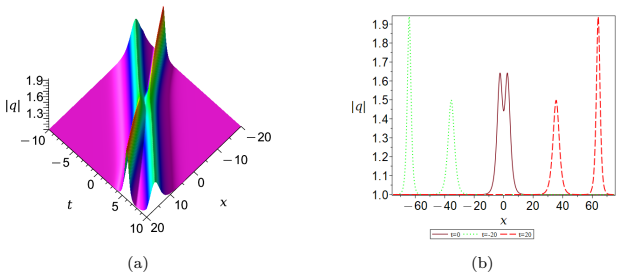
- [§2.2, Eq. (8) and Fig. 4(c)] The anti-dark soliton in Fig. 4(c) is claimed to arise under condition (8), but substituting the stated parameters λ1 = 7/10 + √59/10 i, a = 3/10, d = 1, δ = -3/20 yields -2d²δ + 2δ - d²/2 - 2β1² + 2α1² + a = -0.4, not 0. The displayed wave therefore does not satisfy the very condition from which the conversion is supposed to follow. Please correct the parameter values or the condition, and re-check every figure in Section 2 against Eqs. (8) and (5)-(7).
- [§2.2, Fig. 4(a)] The rational W-shaped soliton in Fig. 4(a) uses δ = -3/50. Using condition (5) in the form that is consistent with the double-pole reduction in Section 4, namely α1² - β1² + (4δ+1)d²/2 - a = 0, the stated parameters give 0.35 - 0.25 + 0.38 - 0.30 = 0.18 ≠ 0. The condition would be satisfied with δ = -3/20, so this appears to be a typographical error in the caption or text, but as printed the example does not conform to the stated transition condition. Please verify and correct all parameter sets.
- [§2, Lax pair (3)] The displayed Lax pair cannot be correct as written. Q1 contains the term (488+12)|q|²q, which has no δ and is inconsistent with Eq. (2), and Q3 contains iδ* q qx where δ* is meaningless for a real parameter δ. Since the eigenfunctions, H1, W1, and W2 used throughout the paper are derived from this Lax pair, these typos undermine reproducibility of the transition conditions. Please display the corrected Lax pair and state explicitly how it satisfies the zero-curvature condition Pt - Qx + PQ - QP = 0 generating Eq. (2).
- [§2, derivation of Eqs. (8) and (5)-(7)] The paper states that the first-order solution comprises hyperbolic and trigonometric parts with velocities V1,H/H1,R and V1,T/H1,I, and then asserts the transition condition (8) and the type conditions (5)-(7) without derivation. These conditions are the load-bearing claim of the paper. Please provide the explicit expression for |q[1]|² (or an equivalent reduction) showing how the two arguments become proportional when Eq. (8) holds, and show how conditions (5)-(7) select the periodic, anti-dark, and multi-peak regimes. Without this derivation, the classification is a list of parameter examples rather than a proven statement.
- [§4, Eqs. (11)-(13)] The exact double-pole solution qd in Eq. (11) is incomplete because E1,...,E5 and G1,...,G5 are omitted with the note 'too long to be included here'. The asymptotic formulas (12)-(13) depend on these same omitted quantities through K3 and L3. Consequently, the reader cannot verify either the expression for qd or the claimed matching in Fig.15. Please provide the full expressions, either in an appendix or as supplementary material, and confirm the asymptotic balances e^{D2}∼t and e^{-D2}∼t used to derive (12)-(13).
- [§3 and §5] The paper claims that the second-order interactions in Figs. 5-10 are 'elastic', with amplitude, velocity, and shape unchanged after collision, but provides no quantitative evidence beyond density plots. The conclusions repeat this assertion. Please provide asymptotic analyses or explicit before/after amplitude and velocity comparisons for these interactions, as is done for the double-pole case in Section 4; otherwise the elasticity claim is unsupported.
minor comments (4)
- [Fig. 4 caption] Panel (d) is described as 'The cross-sectional view of (d) at t = 0'; it should refer to panel (c).
- [§1 and §5] There are occasional typographical errors such as 'euation' for 'equation' and 'asymtotic' for 'asymptotic' (Fig. 14 caption). The paper would benefit from a careful proofreading pass.
- [§2, definition of Hj] The expression for Hj under Eq. (4) is a square root, and the branch convention for Hj,R and Hj,I is never specified. Since the velocity formulas and the sign of W2 depend on these branches, please state the branch choice used in the figures.
- [§2.2, rational limit] The statement that the periodic wave becomes the W-shaped soliton 'when the period extends to infinity, namely HI → 0' is only heuristic; please clarify how the limit is taken simultaneously with condition (8), since the velocity formula V1,T/H1,I becomes singular in that limit.
Circularity Check
No significant circularity: the transition condition is derived from the explicit Darboux solution rather than fitted, and the converted-wave and asymptotic results are explicit constructions; parameter inconsistencies in some figures are correctness concerns, not circularity.
full rationale
The paper's derivation chain starts from the Lax pair and Darboux formulas taken from Refs. [37,38], which are independent prior works with no author overlap with the present paper, so the load-bearing construction is not a self-citation. The transition condition (8) is obtained by decomposing the explicit first-order solution into hyperbolic and trigonometric parts and equating their velocities; this is a direct mathematical consequence of the explicit formula, not a fitted parameter masquerading as a prediction. The resulting classification into W-shaped, M-shaped, multi-peak, anti-dark and periodic waves is supported by explicit expressions and parameter choices, and the double-pole solutions with asymptotic forms (12)-(13) are derived from the exact solution and verified against it in Fig. 15. The paper does contain parameter mismatches (e.g., Fig. 4(c) and Fig. 5 use lambda_1 = 7/10 + sqrt(59)/10 i, for which Eq. (8) evaluates to -0.4 rather than 0, and the Fig. 4(a) parameters do not satisfy condition (5)), but these are consistency or typo concerns that affect the correctness of the examples, not circularity of the derivation. No quoted reduction shows a result being defined in terms of itself or a fitted input being renamed as a prediction.
Assumptions & free parameters
free parameters (5)
- background amplitude d =
1 in all figures
- background frequency a =
3/10, 2/5 in figures
- equation parameter delta =
-3/20, 7/10, -3/50, 1/10 in figures
- spectral parameter lambda1 = alpha1 + i beta1 =
various, e.g. 7/10 + sqrt(39)/10 i
- eigenfunction coefficients c1, c2 =
2 in most figures
assumptions (6)
- domain assumption The Lax pair (3) and zero-curvature representation for Eq. (2) as stated in the paper are correct.
- domain assumption The n-fold Darboux transformation determinant formula Eq. (4) produces exact solutions of Eq. (2) from the seed q[0].
- domain assumption The seed solution q[0] = d e^{i(ax+bt)} with b as given solves Eq. (2).
- domain assumption The eigenfunctions psi_j and phi_j as defined solve the Lax pair at lambda = lambda_j.
- domain assumption The decomposition of the first-order solution into hyperbolic and trigonometric parts, and the velocity expressions V1,H/H1,R and V1,T/H1,I, are algebraically correct.
- domain assumption In the asymptotic analysis, the balance e^{D2} ~ t and the characteristic lines D2*Delta/8 + ln K3 = 0 define the asymptotic solitons, and the omitted coefficients Ej and Gj do not change the leading-order behavior.
Cite this review
Pith. "Pith review of Breather-to-soliton transitions and nonlinear wave interactions for the higher-order generalized Gerdjikov-Ivanov equation." pith.science (2026). https://pith.science/paper/PB7CKBLJ
@misc{pith2026250623067,
  author       = {Pith},
  title        = {Pith review of: Breather-to-soliton transitions and nonlinear wave interactions for the higher-order generalized Gerdjikov-Ivanov equation},
  year         = {2026},
  howpublished = {\url{https://pith.science/paper/PB7CKBLJ}},
  note         = {Machine review of arXiv:2506.23067}
}
read the original abstract
In this paper, we systematically investigate the intricate dynamics of the breather-to-soliton transitions and nonlinear wave interactions for the higher-order generalized Gerdjikov-Ivanov equation. The transition conditions of the breather-to-soliton are established and the novel nonlinear converted waves, including the W-shaped soliton, M-shaped soliton, multi-peak soliton, anti-dark soliton and periodic wave solution are discussed. Meanwhile, the interactions among the above nonlinear converted waves are explored by choosing appropriate parameters. Furthermore, we derive the double-pole solutions exhibiting breather-to-soliton transitions and employ the asymptotic analysis method to analyze the dynamics of the asymptotic solitons for the double-pole anti-dark soliton. This work deepens the fundamental understanding of nonlinear wave metamorphosis induced by higher-order terms in integrable systems.
Figures


Figures from the paper (12 more)




Reference graph
Works this paper leans on
-
[1]
P. S. Vinayagam, R. Radha, K. Porsezian, Taming rogue waves in vector Bose-Einstein condensates. Phys. Rev. E, 2013, 88, 042906
work page 2013
-
[2]
A. Saha, B. Pradhan, S. Banerjee, Multistability and dynamical prop- erties of ion acoustic wave for the nonlinear Schr¨ odinger equation in an electron-ion quantum plasma. Phys. Scr., 2020, 95, 055602
work page 2020
-
[3]
F. Copi, S. Randoux, P. Suret, The physics of the one-dimensional non- linear Schr¨ odinger equation in fiber optics: Rogue waves, modulation instability and self-focusing phenomena. Rev. Phys., 2020, 5, 100037
work page 2020
- [4]
-
[5]
Y. F. Mao, S. Chandramouli, W. Q. Xu, M. A. Hoefer, Observation of traveling breathers and their scattering in a two-fluid system. Phys. Rev. Lett., 2023, 131, 147201
work page 2023
- [6]
-
[7]
Y. C. Ma, The perturbed plane-wave solutions of the cubic Schr¨ odinger equation. Stud. Appl. Math., 1979, 60, 43-58
work page 1979
-
[8]
N. N. Akhmediev, V. I. Korneev, Modulation instability and periodic solutions of the nonlinear Schr¨ odinger equation. Theor. Math. Phys. 1986, 69, 1089-1093
work page 1986
Show all 42 references
-
[9]
Mahnke, F
C. Mahnke, F. Mitschke, Possibility of an Akhmediev breather decaying into solitons. Phys. Rev. E, 2012, 85, 033808
2012
-
[10]
G. Y. Yang, Y. Wang, Z. Y. Qin, B. A. Malomed, D. Mihalache, L. Li, Breatherlike solitons extracted from the Peregrine rogue wave. Phys. Rev. E, 2014, 90, 062909
2014
-
[11]
C. Liu, Z. Y. Yang, L. C. Zhao, W. L. Yang, State transition induced by higher-order effects and background frequency. Phys. Rev. E, 2015, 91, 022904
2015
-
[12]
J. S. He, S. W. Xu, M. S. Ruderman, R. Erd´ elyi, State transition induced by self-steepening and self phase-modulation. Chin. Phys. Lett., 2014, 31, 010502
2014
-
[13]
Chowdury, D
A. Chowdury, D. J. Kedziora, A. Ankiewicz, N. Akhmediev, Breather- to-soliton conversions described by the quintic equation of the nonlinear Schr¨ odinger hierarchy. Phys. Rev. E, 2015, 91, 032928
2015
-
[14]
L. Wang, J. H. Zhang, Z. Q. Wang, C. Liu, M. Li, F. H. Qi, R. Guo, Breather-to-soliton transitions, nonlinear wave interactions, and modu- lational instability in a higher-order generalized nonlinear Schr¨ odinger equation. Phys. Rev. E, 2016, 93, 012214
2016
-
[15]
Q. M. Huang, Y. T. Gao, L. Hu, Breather-to-soliton transition for a sixth-order nonlinear Schr¨ odinger equation in an optical fiber. Appl. Math. Lett., 2018, 75, 135-140. 20
2018
-
[16]
Chowdury, A
A. Chowdury, A. Ankiewicz, N. Akhmediev, Moving breathers and breather-to-soliton conversions for the Hirota equation. Proc. R. Soc. A, 2015, 471, 20150130
2015
-
[17]
L. Wang, J. H. Zhang, C. Liu, M. Li, F. H. Qi, Breather transi- tion dynamics peregrine combs walls and modulation instability in a variable-coefficient nonlinear Schr¨ odinger equation with higher-order ef- fects. Phys. Rev. E, 2016, 93, 062217
2016
-
[18]
X. H. Wu, Y. T. Gao, X. Yu, On a Hirota equation in oceanic fluid mechanics: double-pole breather-to-soliton transitions. Chaos Solitons Fractals, 2014, 183, 114874
2014
-
[19]
L. C. Zhao, S. C. Li, L. M. Ling, W-shaped solitons generated from a weak modulation in the Sasa–Satsuma equation. Phys. Rev. E, 2016, 93, 032215
2016
-
[20]
J. X. Niu, R. Guo, J. W. Zhang. Solutions on the periodic background and transition state mechanisms for the higher-order Chen–Lee–Liu equation. Wave Motion, 2023, 123, 103233
2023
-
[21]
J. N. Wang, M. W. Liu, Z. Y. Zhang, H. T. Wang, W. J. Liu, Modulation instability, state transitions and dynamics of multi-peak rogue wave in a higher-order coupled nonlinear Schr¨ odinger equation. Phys. Rev. E, 2024, 524, 129823
2024
-
[22]
Wang, Y.J
L. Wang, Y.J. Zhu, Z.Q. Wang, T. Xu, F. H. Qi, Y. S. Xue, Asymmetric rogue waves breather-to-soliton conversion, and nonlinear wave interac- tions in the Hirota–Maxwell–Bloch system. J. Phys. Soc. Jpn., 2016, 85, 024001
2016
-
[23]
C. Liu, Z. Y. Yang, L. C. Zhao, W. L. Yang, Transition, coexistence, and interaction of vector localized waves arising from higher-order effects. Ann. Phys., 2015, 362, 130-138
2015
-
[24]
L. Wang, Z. Q. Wang, J. H. Zhang, F. H. Qi, M. Li, Stationary nonlinear waves, superposition modes and modulational instability characteristics in the AB system. Nonlinear Dyn., 2016, 86, 185-196. 21
2016
-
[25]
H. S. Zhang, L. Wang, X. Wang, X. Y. Xie, Transformed nonlinear waves, state transitions and modulation instability in a three-component AB model for the geophysical flows. Nonlinear Dyn., 2020, 102, 349-362
2020
-
[26]
H. S. Zhang, L. Wang, W. R. Sun, X. Wang, T. Xu, Mechanisms of stationary converted waves and their complexes in the multi-component AB system. Physica D, 2021, 419, 132849
2021
-
[27]
Z. Du, G. Q. Meng, X. X. Du, Localized waves and breather-to-soliton conversions of the coupled Fokas–Lenells system. Chaos Solitons Frac- tals, 2021, 153, 111507
2021
-
[28]
S. H. Liu, B. Tian, X. T. Gao, Lax pair, conservation laws, breather- to-soliton transitions and modulation instability for a coupled extended modified Korteweg-de Vries system in a fluid. Eur. Phys. J. Plus, 2024, 139, 496
2024
-
[29]
Olmedilla, Multiple pole solutions of the nonlinear Schr¨ odinger equa- tion
E. Olmedilla, Multiple pole solutions of the nonlinear Schr¨ odinger equa- tion. Physica D, 1987, 25, 330-346
1987
-
[30]
Gagnon, N
L. Gagnon, N. Sti´ evenart, N-soliton interaction in optical fibers: the multiple-pole case. Opt. Lett. 1994, 19, 619-621
1994
-
[31]
M. Li, J. H. Xiao, W. J. Liu, Y. Jiang, K. Sun, B. Tian, Breather and double-pole solutions of the derivative nonlinear Schr¨ odinger equation from optical fibers. Phys. Lett. A, 2011, 375, 549-557
2011
-
[32]
D. J. Kaup, A. C. Newell, An exact solution for a derivative nonlinear Schr¨ odinger equation. J. Math. Phys., 1978, 19, 798–801
1978
-
[33]
S. W. Xu, J. S. He, L. H. Wang, The Darboux transformation of the derivative nonlinear Schr¨ odinger equation. J. Phys. A, 2011, 44, 305203
2011
-
[34]
X. H. Wu, Y. T. Gao. N-soliton asymptotic analysis on the Gerd- jikov–Ivanov equation for the Alfv´ en waves in a plasma. Appl. Math. Lett., 2024, 150, 108967
2024
-
[35]
Halis, Binary Darboux transformation for the Gerdjikov–Ivanov equation
Y. Halis, Binary Darboux transformation for the Gerdjikov–Ivanov equation. Wave Motion, 2022, 113, 102991. 22
2022
-
[36]
X. Guan, H. Yang, X. Meng, W. J. Liu, Higher-order rogue waves solu- tions of the modified Gerdjikov–Ivanov equation with dispersion via gen- eralized Darboux transformation. Appl. Math. Lett., 2023, 136, 108466
2023
-
[37]
Y. D. Zhao, Y. F. Wang, S. X. Yang, X. Zhang, Y. X. Chen, Soliton, breather and rogue wave solutions of the higher-order modified Gerd- jikov–Ivanov equation. Chaos Solitons Fractals, 2024, 185, 115147
2024
-
[38]
Y. D. Zhao, Y. F. Wang, X. Zhang, Y. X. Chen, The multi-positon and interaction solutions of the higher-order modified Gerdjikov–Ivanov equation. Nonlinear Dyn., 2025, 113, 15257–15271
2025
-
[39]
M. Li, X. Zhang, T. Xu, L. L. Li, Asymptotic analysis and soliton interactions of the multi-pole solutions in the Hirota equation. J. Phys. Soc. Jpn., 2020, 89, 054004
2020
-
[40]
X. H. Wu, Y. T. Gao, X. Yu, Generalized Darboux transformation and solitons for a Kraenkel-Manna-Merle system in a ferromagnetic satura- tor. Nonlinear Dyn., 2023, 111, 14421–14433
2023
-
[41]
P. Li, J. S. He, M. H. Li, The higher-order positon and breather-positon solutions for the complex short pulse equation. Nonlinear Dyn., 2024, 112, 10239-10258
2024
-
[42]
M. Li, X. L. Yue, T. Xu, Multi-pole solutions and their asymptotic analysis of the focusing Ablowitz–Ladik equation. Phys. Scr., 2020, 95, 055222. 23
2020
Reviewed August 6, 2026 · model on record in the stance chip above.
Discussion (0). Continue with ORCID to comment.