REVIEW 1 major objections 7 minor 94 references
Galactic Center Neutrinos from Cosmic Ray-Dark Matter Interactions
T0 review · 1 major / 7 minor · reviewed 2026-07-07 · glm-5.2
Pith's one-line read Neutrino telescope data bounds dark matter down to keV masses
desk verdict New ANTARES Galactic Ridge neutrino limits on sub-GeV DM-nucleon scattering; solid methodology but limits hinge on CR transport model choice read the letter →
The pith
A machine-rendered reading of the paper's core claim, the machinery that carries it, and where it could break.
The reading
What carries the argument
The key machinery is the line-of-sight integral (Eq. 1) that convolves the Galactic dark matter density, the spatially-dependent cosmic-ray distribution from the gamma-optimized Min transport model, and the deep inelastic scattering cross section and neutrino yield from a MadGraph5 + Pythia 8 Monte Carlo pipeline. The coupling bound is set by the bin-by-bin comparison with ANTARES 99% C.L. upper limits (Eq. 3), then converted to the elastic DM-nucleon cross section via the reduced-mass relation (Eq. 4).
What would settle it
If the cosmic-ray density or spectral hardness in the Galactic Ridge is significantly lower than predicted by the gamma-optimized transport model—for instance, if the observed gamma-ray and neutrino emission is explained by a different mechanism—then the predicted DM-induced neutrino flux would be overestimated and the derived cross-section limits would be too stringent. The Base-Minimal uniform-diffusion scenario already demonstrates roughly an order-of-magnitude weakening at low masses, and any future revision of inner-Galaxy cosmic-ray transport that reduces the predicted high-energy proton
Extended reading notes
Core claim
The central result is a set of 99% confidence-level upper limits on the DM-nucleon elastic scattering cross section derived entirely from Galactic Center neutrino observations. By requiring that the neutrino flux produced by cosmic-ray dark matter deep inelastic scattering not exceed ANTARES measurements of the Galactic Ridge in any energy bin, the authors obtain constraints valid for DM masses from approximately 1 keV up to nearly 1 GeV. These limits are derived using a vector-mediator simplified model with benchmark mediator masses of 100 MeV and 5 GeV, and the authors demonstrate that the neutrino yield is computed from first-principles particle-level simulations rather than the constant-
Load-bearing premise
The derived limits depend on the gamma-optimized Min cosmic-ray transport model, which uses a spatially non-uniform diffusion coefficient tuned to reproduce Fermi-LAT gamma-ray data from the inner Galaxy. The paper itself shows that switching to a uniform-diffusion model weakens the constraints by roughly an order of magnitude at low DM masses. The correctness of this specific propagation model in the Galactic Center is not independently verified here and remains an open ast
Editorial extensions
If this is right
- Next-generation neutrino telescopes IceCube-Gen2 and KM3NeT could improve these cross-section limits by at least an order of magnitude, potentially reaching sensitivity competitive with collider-based searches for light dark matter mediators.
- A joint analysis combining Galactic neutrino data with future TeV-PeV gamma-ray observations of the Galactic Center could disentangle a potential dark matter signal from astrophysical backgrounds, since the same cosmic-ray DM interactions produce a correlated neutral-pion gamma-ray flux.
- The method is sensitive to the dark matter density profile in the innermost Galaxy; if DM spikes exist near the supermassive black hole, the constraints could strengthen significantly, while cored profiles would weaken them by up to an order of magnitude.
- The approach is largely insensitive to the spin or mediator type of the DM candidate, since the large cosmic-ray energies compensate for velocity suppressions that affect low-velocity scattering, making this a broadly applicable probe across DM model space.
Signed reviews
Editorial analysis
A structured set of objections, weighed in public.
Referee Report
Summary. This Letter proposes using Galactic Ridge neutrino observations from ANTARES to constrain dark matter (DM)–nucleon elastic scattering cross sections at sub-GeV masses. The mechanism is deep inelastic scattering of cosmic rays (CRs) off DM in the Galactic halo, producing secondary neutrinos from meson decay. The predicted neutrino flux (Eq. 1) is computed using a line-of-sight integral over the Ridge region, with CR densities from the gamma-optimized Min transport model and an NFW DM profile. The neutrino energy spectrum per interaction is obtained via a MadGraph5 + Pythia 8 Monte Carlo pipeline. Upper limits on the coupling G_D are derived by requiring the predicted flux not exceed ANTARES 99% C.L. upper limits in any energy bin (Eq. 3), then converted to sigma_el via Eq. 4. The main results (Fig. 2) show constraints spanning m_chi from ~1 keV to ~1 GeV for two benchmark mediator masses, with projections for IceCube-Gen2 and KM3NeT. Systematic uncertainties from CR transport, DM profile, PDFs, and cross-section parameterization are explored in the Supplemental Material.
Significance. The paper opens a genuinely new observational channel for light DM: using Galactic Center neutrinos to constrain DM-nucleon scattering. The methodology is well-implemented: the line-of-sight integral, the Monte Carlo pipeline for dN_nu/dE_nu, and the limit-setting procedure are all standard and correctly executed. The systematic uncertainty treatment is commendable in scope — the authors bracket CR transport uncertainties (gamma-optimized Min/Max vs. Base-Minimal, Fig. 6), DM profile choices (NFW, Burkert, Einasto, Moore, Fig. 7), PDF systematics (Fig. 8), and cross-section model dependence (Fig. 4). The use of realistic spatially-dependent CR maps, rather than a constant CR density, is a substantive improvement over prior work. The falsifiable predictions for next-generation detectors (IceCube-Gen2, KM3NeT) add value. The central claim — that these observations probe previously unexplored keV-scale parameter space — is defensible but, as discussed below, depends on the fiducial CR transport model in a way that should be more transparently reflected in the headline statements.
major comments (1)
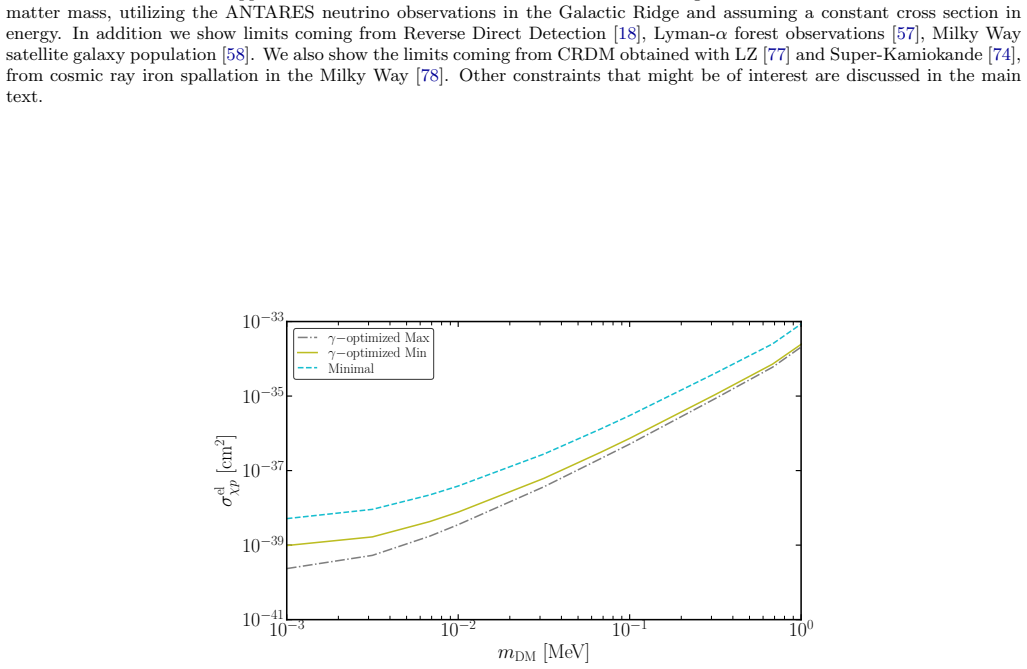
- Main text, paragraph following Eq. (1): the paper states that astrophysical uncertainties 'introduce an uncertainty of a factor of a few,' but the Supplemental Material (Fig. 6) shows that switching from the gamma-optimized Min model to the Base-Minimal scenario weakens constraints by approximately an order of magnitude at low DM masses (m_chi < 0.1 MeV). This is the single largest systematic in the analysis and is load-bearing for the claim of probing 'previously unexplored parameter space' at keV-scale masses. The 'factor of a few' statement in the main text appears to refer to the DM profile variation (Fig. 7) and the spread between gamma-optimized Min and Max, but it does not encompass the Base-Minimal comparison. The main text should explicitly acknowledge the order-of-magnitude systematic from CR transport model choice and clarify which uncertainties are included in the 'factor ofa
minor comments (7)
- The abstract states limits 'extend down to keV-scale masses' without qualification. Given the order-of-magnitude systematic from CR transport at the lowest masses, a brief qualifier (e.g., 'under the gamma-optimized CR transport model') would be appropriate.
- Section 'Existing Constraints': the discussion of N_eff constraints (Ref. [62]) notes cross sections bounded down to 10^-49 cm^2 for masses below a few MeV, but does not show these in Fig. 2. A brief explanation of why N_eff bounds are excluded from the figure, or inclusion of them, would help the reader assess the novelty for keV-scale DM.
- Supplemental Material, cross-section comparison (right panel of Fig. 4): the Kamae and AAfrag parameterizations are scaled by 0.1, but the physical motivation for this specific scaling factor is not stated. A one-sentence justification would be appropriate.
- Figure 1 caption: 'am DM' appears twice and should be 'm_DM'. Similarly, 'am DM = 10 MeV' and 'am DM = 10 keV' should be 'm_DM'.
- The projected KM3NeT sensitivity uses a factor of 3.5 (sqrt(10) rounded up), while the text states the effective area is 10-100 times larger than ANTARES. Using only the lower bound is conservative, but the range of possible improvement (3.5 to ~10) should be noted for context.
- Reference [32] is cited as 'JHEAp 53, 100565 (2026)' with a 2025 arXiv number; the year consistency should be checked.
- The paper would benefit from a brief statement in the Conclusions acknowledging that the gamma-optimized CR model, while supported by gamma-ray and IceCube data, is not yet independently confirmed, and that the Base-Minimal scenario provides a conservative lower bound on the achievable constraints.
Simulated Author's Rebuttal
We thank the referee for a careful and constructive report. We address the major comment below.
read point-by-point responses
-
Referee: Main text states astrophysical uncertainties introduce 'a factor of a few,' but Supplemental Material Fig. 6 shows switching from gamma-optimized Min to Base-Minimal weakens constraints by ~order of magnitude at low DM masses (m_chi < 0.1 MeV). The 'factor of a few' statement does not encompass the Base-Minimal comparison and should be corrected, especially given its importance for the claim of probing previously unexplored parameter space at keV-scale masses.
Authors: The referee is correct. The statement in the main text that astrophysical uncertainties 'introduce an uncertainty of a factor of a few' was intended to refer to the variation among the gamma-optimized Min/Max models and the DM profile choices (NFW vs. Burkert, Einasto, Moore), which indeed produce factor-of-few variations. However, this statement as written does not encompass the comparison to the Base-Minimal CR transport scenario, which, as shown in Fig. 6 of the Supplemental Material, weakens the constraints by approximately an order of magnitude at m_chi < 0.1 MeV. This is the largest single systematic in the analysis and is load-bearing for our claim of probing previously unexplored parameter space at keV-scale masses. We will revise the main text to explicitly acknowledge this order-of-magnitude systematic from CR transport model choice and to clarify which uncertainties are included in the 'factor of a few' statement (namely, the spread among gamma-optimized models and DM profile variations). We will also add a sentence noting that the Base-Minimal scenario, which does not reproduce the gamma-ray data toward the Galactic Center, represents a conservative lower bound on the CR density and correspondingly weakens the constraints by up to an order of magnitude at the lowest masses. This revision will make the headline claims more transparent without altering our central conclusion: even under the conservative Base-Minimal scenario, the constraints remain competitive with existing bounds across much of the mass range, and the gamma-optimized models — which are favored by multi-messenger gamma-ray and neutrino data — provide the stronger limits we quote as our fiducial results. revision: yes
Circularity Check
No significant circularity: limits derived by comparing predicted flux to external ANTARES data via standard limit-setting procedure
full rationale
The derivation chain is self-contained and not circular. The predicted neutrino flux (Eq. 1) is computed from physical inputs — DM density profile, CR distribution from the γ-optimized Min model (Ref. [33, 39], external to this paper), and DIS cross sections from MadGraph5+Pythia8 — none of which are defined in terms of the output (the cross-section limits). The limit-setting procedure (Eq. 3) iteratively scales the coupling G_D until the predicted flux saturates the 99% C.L. upper limit from ANTARES observations (Ref. [30], an external experimental measurement). This is a standard upper-limit procedure, not circular reasoning: the observational bound is independent of the theoretical prediction. The conversion from G_D to σ_el (Eq. 4) is an algebraic relation in the simplified model, not a fit disguised as a prediction. The CR transport models (Refs. [33, 39]) are cited from the broader literature — while Ref. [33] shares an author (P. De la Torre Luque) with the present paper, the model is externally falsifiable against Fermi-LAT gamma-ray data and IceCube neutrino observations, and the paper transparently quantifies the systematic uncertainty from switching to the Base-Minimal model (Fig. 6, ~order of magnitude weakening at low masses). This is a model-dependence concern, not circularity. No step in the derivation reduces to its own inputs by construction.
Assumptions & free parameters
free parameters (5)
- G_D² = (g_χ · g_q)²
- m_V (mediator mass) =
5 GeV and 100 MeV (benchmark values)
- m_χ (DM mass)
- NFW profile scale radius R_s =
20 kpc
- Local DM density ρ_⊙ =
0.4 GeV/cm³
assumptions (5)
- domain assumption The DM density profile in the Galactic halo follows an NFW profile (or alternatively Burkert, Einasto, Moore for systematic checks).
- domain assumption The γ-optimized Min CR transport model (Ref. [33, 39]) correctly describes the CR spatial and spectral distribution in the inner Galaxy.
- domain assumption The MadGraph5 + Pythia8 Monte Carlo pipeline correctly computes the neutrino yield dN_ν/dE_ν from CR-DM deep inelastic scattering, including parton showering and hadronization, down to sub-GeV DM masses.
- ad hoc to paper The DM particle is a Dirac fermion interacting via a vector mediator with universal quark couplings (benchmark model, Eq. 2).
- domain assumption The ANTARES 99% C.L. upper limits on the Galactic Ridge neutrino flux (Ref. [30]) are robust and not contaminated by unmodeled backgrounds.
invented entities (1)
-
None
Cite this review
Pith. "Pith review of Galactic Center Neutrinos from Cosmic Ray-Dark Matter Interactions." pith.science (2026). https://pith.science/paper/PBBUNC5P
@misc{pith2026260705335,
  author       = {Pith},
  title        = {Pith review of: Galactic Center Neutrinos from Cosmic Ray-Dark Matter Interactions},
  year         = {2026},
  howpublished = {\url{https://pith.science/paper/PBBUNC5P}},
  note         = {Machine review of arXiv:2607.05335}
}
read the original abstract
The IceCube and ANTARES collaborations have recently reported evidence for high-energy neutrinos associated with the Galactic plane and the Galactic Ridge, offering a new pathway to search for dark matter (DM). Deep inelastic scattering of cosmic rays with sub-GeV DM in the Galactic halo produces a distinctive neutrino signature from meson decays. Using detailed Galactic cosmic-ray maps and ANTARES observations, we derive 99% C.L. upper limits on the DM-nucleon cross section that extend down to keV-scale masses. These results establish Galactic neutrino telescopes as a powerful, complementary probe of light DM, with substantial improvements expected from upcoming IceCube-Gen2 and KM3NeT observations.
Figures


Figures from the paper (5 more)




Reference graph
Works this paper leans on
-
[1]
M. Cirelli, A. Strumia, and J. Zupan, SciPost Physics Review1, 1 (2026), arXiv:2406.01705 [hep-ph]
work page Pith review arXiv 2026
-
[2]
Light Dark Matter: Models and Constraints
S. Knapen, T. Lin, and K. M. Zurek, Phys. Rev. D96, 115021 (2017), arXiv:1709.07882 [hep-ph]
work page Pith review arXiv 2017
-
[3]
R. Essiget al., inSnowmass 2021(2022) arXiv:2203.08297 [hep-ph]
work page Pith review arXiv 2021
-
[4]
A. Mitridate, T. Trickle, Z. Zhang, and K. M. Zurek, Phys. Dark Univ.40, 101221 (2023), arXiv:2203.07492 [hep-ph]
work page Pith review arXiv 2023
-
[5]
D. S. Akeribet al., inSnowmass 2021(2022) arXiv:2203.08084 [hep-ex]
work page Pith review arXiv 2021
-
[6]
The Waning of the WIMP: Endgame?
G. Arcadi, D. Cabo-Almeida, M. Dutra, P. Ghosh, M. Lindner, Y. Mambrini, J. P. Neto, M. Pierre, S. Pro- fumo, and F. S. Queiroz, Eur. Phys. J. C85, 152 (2025), arXiv:2403.15860 [hep-ph]
work page Pith review arXiv 2025
-
[7]
On Symmetric and Asymmetric Light Dark Matter
T. Lin, H.-B. Yu, and K. M. Zurek, Phys. Rev. D85, 063503 (2012), arXiv:1111.0293 [hep-ph]
work page Pith review arXiv 2012
-
[8]
Y. Hochberg, E. Kuflik, T. Volansky, and J. G. Wacker, Phys. Rev. Lett.113, 171301 (2014), arXiv:1402.5143 [hep-ph]
work page Pith review arXiv 2014
Show all 94 references
-
[9]
Hochberg, E
Y. Hochberg, E. Kuflik, H. Murayama, T. Volansky, and J. G. Wacker, Phys. Rev. Lett.115, 021301 (2015), arXiv:1411.3727 [hep-ph]
2015 arXiv
-
[10]
Essig, M
R. Essig, M. Fernandez-Serra, J. Mardon, A. Soto, T. Volansky, and T.-T. Yu, JHEP05, 046 (2016), arXiv:1509.01598 [hep-ph]
2016 arXiv
-
[11]
Kuflik, M
E. Kuflik, M. Perelstein, N. R.-L. Lorier, and Y.-D. Tsai, Phys. Rev. Lett.116, 221302 (2016), arXiv:1512.04545 [hep-ph]
2016 arXiv
-
[12]
Carrillo Gonz´ alez and N
M. Carrillo Gonz´ alez and N. Toro, JHEP04, 060 (2022), arXiv:2108.13422 [hep-ph]
2022 arXiv
-
[13]
J. M. Cline and G. Herrera, Phys. Rev. D112, 035023 (2025), arXiv:2409.13818 [hep-ph]
2025 arXiv
-
[14]
Bringmann and M
T. Bringmann and M. Pospelov, Phys. Rev. Lett.122, 171801 (2019), arXiv:1810.10543 [hep-ph]
2019 arXiv
-
[15]
J.-W. Wang, A. Granelli, and P. Ullio, Phys. Rev. Lett. 128, 221104 (2022), arXiv:2111.13644 [astro-ph.HE]
2022 arXiv
-
[16]
C. V. Cappiello, Q. Liu, G. Mohlabeng, and A. C. Vin- cent, Phys. Rev. D110, 095031 (2024), arXiv:2405.00086 [hep-ph]
2024 arXiv
-
[17]
R. A. Gustafson, G. Herrera, M. Mukhopadhyay, K. Murase, and I. M. Shoemaker, (2025), arXiv:2508.20984 [hep-ph]
2025 arXiv
-
[18]
C. V. Cappiello, K. C. Y. Ng, and J. F. Beacom, Phys. Rev. D99, 063004 (2019), arXiv:1810.07705 [hep-ph]
2019 arXiv
-
[19]
Herrera and K
G. Herrera and K. Murase, Phys. Rev. D110, L011701 (2024), arXiv:2307.09460 [hep-ph]
2024 arXiv
-
[20]
R. A. Gustafson, G. Herrera, M. Mukhopadhyay, K. Murase, and I. M. Shoemaker, Phys. Rev. D111, L121303 (2025), arXiv:2408.08947 [hep-ph]
2025 arXiv
-
[21]
Hooper and S
D. Hooper and S. D. McDermott, Phys. Rev. D97, 115006 (2018), arXiv:1802.03025 [hep-ph]
2018 arXiv
-
[22]
Guo, Y.-L
G. Guo, Y.-L. S. Tsai, M.-R. Wu, and Q. Yuan, Phys. Rev. D102, 103004 (2020), arXiv:2008.12137 [astro- ph.HE]
2020 arXiv
-
[23]
Ambrosone, M
A. Ambrosone, M. Chianese, D. F. G. Fiorillo, A. Marinelli, and G. Miele, Phys. Rev. Lett.131, 111003 (2023), arXiv:2210.05685 [astro-ph.HE]
2023 arXiv
-
[24]
Hussein and G
A. Hussein and G. Herrera, (2025), arXiv:2510.12877 [hep-ph]
2025
-
[25]
A. G. De Marchi, A. Granelli, J. Nava, and F. Sala, Phys. Rev. D112, 043042 (2025), arXiv:2412.07861 [astro- ph.HE]
2025 arXiv
-
[26]
A. G. De Marchi, A. Granelli, J. Nava, and F. Sala, Phys. Lett. B871, 140015 (2025), arXiv:2506.06416 [hep-ph]
2025
-
[27]
P. D. Serpico and G. G. Raffelt, Phys. Rev. D70, 043526 (2004), arXiv:astro-ph/0403417
2004 arXiv
-
[28]
L. J. Hall, K. Jedamzik, J. March-Russell, and S. M. West, JHEP03, 080 (2010), arXiv:0911.1120 [hep-ph]
2010 arXiv
-
[29]
J. H. Chang, R. Essig, and A. Reinert, JHEP03, 141 (2021), arXiv:1911.03389 [hep-ph]
2021
-
[30]
Albertet al.(ANTARES), Phys
A. Albertet al.(ANTARES), Phys. Lett. B841, 137951 (2023), arXiv:2212.11876 [astro-ph.HE]
2023 arXiv
-
[31]
Abbasiet al.(IceCube), Science380, adc9818 (2023), arXiv:2307.04427 [astro-ph.HE]
R. Abbasiet al.(IceCube), Science380, adc9818 (2023), arXiv:2307.04427 [astro-ph.HE]
2023
-
[32]
Albertet al.(ANTARES), JHEAp53, 100565 (2026), arXiv:2511.01687 [astro-ph.HE]
A. Albertet al.(ANTARES), JHEAp53, 100565 (2026), arXiv:2511.01687 [astro-ph.HE]. 7
2026
-
[33]
De La Torre Luque, D
P. De La Torre Luque, D. Gaggero, D. Grasso, A. Marinelli, and M. Rocamora, JCAP12, 041 (2025), arXiv:2502.18268 [astro-ph.HE]
2025 arXiv
-
[34]
Amenomoriet al., Physical Review Letters126 (2021), 10.1103/physrevlett.126.141101
M. Amenomoriet al., Physical Review Letters126 (2021), 10.1103/physrevlett.126.141101
2021 doi
-
[36]
S. S. Cerri, D. Gaggero, A. Vittino, C. Evoli, and D. Grasso, Journal of Cosmology and Astroparticle Physics2017, 019–019 (2017)
2017
-
[37]
De la Torre Luque, D
P. De la Torre Luque, D. Gaggero, D. Grasso, and A. Marinelli, Front. Astron. Space Sci.9, 1041838 (2022), arXiv:2209.10011 [astro-ph.HE]
2022 arXiv
-
[38]
Zuriaga-Puig, P
J. Zuriaga-Puig, P. De La Torre Luque, and V. Gammaldi, Physics of the Dark Universe53, 102376 (2026)
2026
-
[39]
P. D. l. T. Luque, D. Gaggero, D. Grasso, O. Fornieri, K. Egberts, C. Steppa, and C. Evoli, Astron. Astrophys. 672, A58 (2023), arXiv:2203.15759 [astro-ph.HE]
2023 arXiv
-
[40]
Tovar-Pardo, P
´A. Tovar-Pardo, P. De La Torre Luque, and M. A. S´ anchez-Conde, JCAP11, 016 (2024), arXiv:2405.12918 [astro-ph.HE]
2024 arXiv
-
[41]
Gaggero, A
D. Gaggero, A. Urbano, M. Valli, and P. Ullio, PRD91, 083012 (2015), arXiv:1411.7623
2015 arXiv
-
[42]
Gaggero, D
D. Gaggero, D. Grasso, A. Marinelli, A. Urbano, and M. Valli, Astrophys. J. Lett.815, L25 (2015), arXiv:1504.00227
2015 arXiv
-
[43]
Aceroet al.(Fermi-LAT), Astrophys
F. Aceroet al.(Fermi-LAT), Astrophys. J. Suppl.223, 26 (2016), arXiv:1602.07246
2016 arXiv
-
[44]
R. Yang, F. Aharonian, and C. Evoli, prd93, 123007 (2016), arXiv:1602.04710
2016 arXiv
-
[45]
Lipari and S
P. Lipari and S. Vernetto, Phys. Rev. D98, 043003 (2018), arXiv:1804.10116 [astro-ph.HE]
2018 arXiv
-
[46]
Pothast, D
M. Pothast, D. Gaggero, E. Storm, and C. Weniger, JCAP10, 045 (2018), arXiv:1807.04554 [astro-ph.HE]
2018 arXiv
-
[47]
J. F. Navarro, C. S. Frenk, and S. D. M. White, Astro- phys. J.462, 563 (1996), arXiv:astro-ph/9508025
1996 arXiv
-
[48]
J. F. Navarro, C. S. Frenk, and S. D. M. White, Astrophysical Journal462, 563 (1996), arXiv:astro- ph/9508025
1996
-
[49]
J. F. Navarro, C. S. Frenk, and S. D. M. White, Astrophysical Journal490, 493 (1997), arXiv:astro- ph/9611107
1997
-
[50]
Cirelli, G
M. Cirelli, G. Corcella, A. Hektor, G. Hutsi, M. Kadastik, P. Panci, M. Raidal, F. Sala, and A. Strumia, Journal of Cosmology and Astroparticle Physics2011, 051 (2011), arXiv:1012.4515 [hep-ph]
2011 arXiv
-
[51]
Benito, A
M. Benito, A. Cuoco, and F. Iocco, JCAP2019, 033 (2019), arXiv:1901.02460 [astro-ph.GA]
2019 arXiv
-
[52]
Benito, F
M. Benito, F. Iocco, and A. Cuoco, Physics of the Dark Universe32, 100826 (2021), arXiv:2009.13523 [astro- ph.GA]
2021 arXiv
-
[53]
Burkert, Astrophys
A. Burkert, Astrophys. J. Lett.447, L25 (1995), arXiv:astro-ph/9504041
1995 arXiv
-
[54]
Alwall, R
J. Alwall, R. Frederix, S. Frixione, V. Hirschi, F. Maltoni, O. Mattelaer, H. S. Shao, T. Stelzer, P. Torrielli, and M. Zaro, JHEP07, 079 (2014), arXiv:1405.0301 [hep- ph]
2014 arXiv
-
[55]
Bierlichet al., SciPost Phys
C. Bierlichet al., SciPost Phys. Codeb.2022, 8 (2022), arXiv:2203.11601 [hep-ph]
2022 arXiv
- [56]
-
[57]
K. K. Rogers, C. Dvorkin, and H. V. Peiris, Phys. Rev. Lett.128, 171301 (2022), arXiv:2111.10386 [astro- ph.CO]
2022 arXiv
-
[58]
E. O. Nadleret al.(DES), Phys. Rev. Lett.126, 091101 (2021), arXiv:2008.00022 [astro-ph.CO]
2021 arXiv
-
[59]
Huanget al.(PandaX), Phys
D. Huanget al.(PandaX), Phys. Rev. Lett.131, 191002 (2023), arXiv:2308.01540 [hep-ex]
2023 arXiv
-
[60]
Aggarwalet al.(DAMIC-M), Phys
K. Aggarwalet al.(DAMIC-M), Phys. Rev. Lett.135, 071002 (2025), arXiv:2503.14617 [hep-ex]
2025 arXiv
-
[61]
J. B. Dent, B. Dutta, J. L. Newstead, and I. M. Shoemaker, Phys. Rev. D101, 116007 (2020), arXiv:1907.03782 [hep-ph]
2020 arXiv
-
[62]
Krnjaic and S
G. Krnjaic and S. D. McDermott, Phys. Rev. D101, 123022 (2020), arXiv:1908.00007 [hep-ph]
2020 arXiv
-
[63]
Alvey, N
J. Alvey, N. Sabti, V. Tiki, D. Blas, K. Bondarenko, A. Boyarsky, M. Escudero, M. Fairbairn, M. Orkney, and J. I. Read, Mon. Not. Roy. Astron. Soc.501, 1188 (2021), arXiv:2010.03572 [hep-ph]
2021 arXiv
-
[64]
E. O. Nadler, S. Birrer, D. Gilman, R. H. Wechsler, X. Du, A. Benson, A. M. Nierenberg, and T. Treu, Astro- phys. J.917, 7 (2021), arXiv:2101.07810 [astro-ph.CO]
2021 arXiv
-
[65]
Baraket al.(SENSEI), Phys
L. Baraket al.(SENSEI), Phys. Rev. Lett.125, 171802 (2020), arXiv:2004.11378 [astro-ph.CO]
2020 arXiv
-
[66]
K. V. Berghaus, A. Esposito, R. Essig, and M. Shola- purkar, JHEP01, 023 (2023), arXiv:2210.06490 [hep-ph]
2023 arXiv
-
[67]
Adariet al.(SENSEI), Phys
P. Adariet al.(SENSEI), Phys. Rev. Lett.134, 011804 (2025), arXiv:2312.13342 [astro-ph.CO]
2025 arXiv
-
[68]
Aprileet al.(XENON), Phys
E. Aprileet al.(XENON), Phys. Rev. Lett.123, 241803 (2019), arXiv:1907.12771 [hep-ex]
2019 arXiv
-
[69]
Agneset al.(DarkSide), Phys
P. Agneset al.(DarkSide), Phys. Rev. Lett.130, 101001 (2023), arXiv:2207.11967 [hep-ex]
2023
-
[70]
J. Xu, J. Kim, D. Adams, B. G. Lenardo, W. H. Lippin- cott, and R. Essig, (2026), arXiv:2606.03174 [hep-ex]
2026 arXiv
-
[71]
Aalberset al.(LZ), Phys
J. Aalberset al.(LZ), Phys. Rev. Lett.134, 241801 (2025), arXiv:2503.18158 [hep-ex]
2025 arXiv
-
[72]
Angloheret al.(COSINUS), (2026), arXiv:2603.22971 [hep-ph]
G. Angloheret al.(COSINUS), (2026), arXiv:2603.22971 [hep-ph]
2026
-
[73]
Bondarenko, A
K. Bondarenko, A. Boyarsky, T. Bringmann, M. Huf- nagel, K. Schmidt-Hoberg, and A. Sokolenko, JHEP03, 118 (2020), arXiv:1909.08632 [hep-ph]
2020 arXiv
-
[74]
Abeet al.(Super-Kamiokande), Phys
K. Abeet al.(Super-Kamiokande), Phys. Rev. Lett.130, 031802 (2023), [Erratum: Phys.Rev.Lett. 131, 159903 (2023)], arXiv:2209.14968 [hep-ex]
2023 arXiv
-
[75]
A. K. Mishra, N. Liu, and C.-T. Lu, Phys. Dark Univ. 49, 102050 (2025), arXiv:2504.03409 [hep-ph]
2025 arXiv
-
[76]
E. J. Chun, S. Mandal, and A. Roy, (2026), arXiv:2606.03487 [hep-ph]
2026 arXiv
-
[77]
T. N. Maity and R. Laha, Eur. Phys. J. C84, 117 (2024), arXiv:2210.01815 [hep-ph]
2024 arXiv
-
[78]
S. A. Meighen-Berger, P. S. B. Dev, and M. Hostert, Phys. Rev. D113, 103050 (2026), arXiv:2512.18093 [hep- ph]
2026
-
[79]
I. Reis, E. Moulin, A. Viana, and V. P. Goncalves, JCAP 07, 012 (2024), arXiv:2403.09343 [hep-ph]
2024 arXiv
-
[80]
Bauer, P
M. Bauer, P. Foldenauer, and J. Jaeckel, JHEP07, 094 (2018), arXiv:1803.05466 [hep-ph]
2018 arXiv
-
[81]
N. F. Bell, J. L. Newstead, and I. Shaukat-Ali, Phys. Rev. D109, 063034 (2024), arXiv:2309.11003 [hep-ph]
2024 arXiv
-
[82]
Le Breton (KM3NeT), Nucl
R. Le Breton (KM3NeT), Nucl. Instrum. Meth. A936, 204 (2019)
2019
-
[83]
M. G. Aartsenet al.(IceCube-Gen2), J. Phys. G48, 060501 (2021), arXiv:2008.04323 [astro-ph.HE]
2021
-
[84]
Bozza, PoSEPS-HEP2023, 058 (2023)
C. Bozza, PoSEPS-HEP2023, 058 (2023). 8
2023
-
[85]
Gondolo and J
P. Gondolo and J. Silk, Phys. Rev. Lett.83, 1719 (1999), arXiv:astro-ph/9906391
1999 arXiv
-
[86]
Kamae, N
T. Kamae, N. Karlsson, T. Mizuno, T. Abe, and T. Koi, Astrophys. J.647, 692 (2006), [Erratum: Astrophys.J. 662, 779 (2007)], arXiv:astro-ph/0605581
2006 arXiv
-
[87]
Kachelrieß, I
M. Kachelrieß, I. V. Moskalenko, and S. Ostapchenko, Comput. Phys. Commun.245, 106846 (2019), arXiv:1904.05129 [hep-ph]
2019 arXiv
-
[88]
Lu, Y.-L
K. Lu, Y.-L. S. Tsai, Q. Yuan, and L. Zhang, Res. Astron. Astrophys.24, 065007 (2024), arXiv:2310.12501 [astro-ph.HE]
2024 arXiv
-
[89]
Einasto, Trudy Astrofizicheskogo Instituta Alma-Ata 5, 87 (1965)
J. Einasto, Trudy Astrofizicheskogo Instituta Alma-Ata 5, 87 (1965)
1965
-
[90]
Moore, S
B. Moore, S. Ghigna, F. Governato, G. Lake, T. R. Quinn, J. Stadel, and P. Tozzi, Astrophys. J. Lett.524, L19 (1999), arXiv:astro-ph/9907411
1999 arXiv
-
[91]
H.-L. Lai, M. Guzzi, J. Huston, Z. Li, P. M. Nadolsky, J. Pumplin, and C.-P. Yuan, Phys. Rev. D82, 054021 (2010), arXiv:1007.2241 [hep-ph]
2010 arXiv
-
[92]
R. D. Ballet al.(NNPDF), Nucl. Phys. B867, 244 (2013), arXiv:1207.1303 [hep-ph]
2013 arXiv
-
[93]
R. D. Ball, V. Bertone, S. Carrazza, L. Del Deb- bio, S. Forte, A. Guffanti, N. P. Hartland, and J. Rojo (NNPDF), Nucl. Phys. B877, 290 (2013), arXiv:1308.0598 [hep-ph]
2013 arXiv
-
[94]
Min” and “Max
J. Cruz-Martinez, S. Forte, N. Laurenti, T. R. Rabe- mananjara, and J. Rojo, JHEP09, 088 (2024), arXiv:2406.12961 [hep-ph]. 9 Supplemental Material for Galactic Center Neutrinos from Cosmic Ray-Dark Matter Interactions Jorge Terol Calvo, Pedro de la Torre Luque, Mainak Mukhopa...
2024 arXiv
-
[95]
TheG 2 D coupling limit is set by the most 14 10□ 3 10□ 2 10□ 1 100 101 102 mDM [MeV] 10□ 30 10□ 29 10□ 28 10□ 27 10□ 26 10□ 25 10□ 24 σel χp [cm2] NFW Moore Burkert Einasto FIG
in the energy range 1–70 TeV, using the IceCube en- ergy bin edges. TheG 2 D coupling limit is set by the most 14 10□ 3 10□ 2 10□ 1 100 101 102 mDM [MeV] 10□ 30 10□ 29 10□ 28 10□ 27 10□ 26 10□ 25 10□ 24 σel χp [cm2] NFW Moore Burkert Einasto FIG. 7. Impact of the dark matter d...
Reviewed July 7, 2026 · model on record in the stance chip above.
Discussion (0). Continue with ORCID to comment.