REVIEW 5 major objections 5 minor 29 references
Triadic Fusion of Cognitive, Functional, and Causal Dimensions for Explainable LLMs: The TAXAL Framework
T0 review · 5 major / 5 minor · reviewed 2026-08-05 · deepseek-v4-flash
Pith's one-line read This paper claims that no single explainability dimension suffices for LLMs; only the fusion of cognitive, functional, and causal dimensions can meet stakeholder needs in high-risk domains, and it proposes the TAXAL framework to scaffold th
desk verdict A coherent triadic framework for LLM explainability, but its central necessity claim is more asserted than demonstrated; still worth a referee. read the letter →
The pith
A machine-rendered reading of the paper's core claim, the machinery that carries it, and where it could break.
The reading
What carries the argument
The TAXAL triadic fusion model: a conceptual lens that classifies any explanation strategy by its cognitive alignment (how well it matches user mental models), functional alignment (how well it supports practical workflows), and causal alignment (how faithfully it traces the model's actual decision pathway). The framework carries the argument through three artifacts: a mapping of explanation techniques to the three dimensions, scoring matrices rating their alignment strength, and cross-domain case studies showing how stakeholder roles shift the required emphasis among the dimensions.
What would settle it
A controlled study where the same explanation is presented with each dimension independently varied—for example, high cognitive clarity but deliberately unfaithful causal traces, or faithful causal traces but poor comprehensibility—within a high-risk decision task. If stakeholders still rate explanation quality as acceptable when any one dimension is absent, or if single-dimension methods match triadic fusion on trust calibration and audit outcomes, the necessity of triadic fusion is refuted.
Extended reading notes
Core claim
On the paper's own terms, the central discovery is that explainability is not a single property but a triadic alignment problem: cognitive, functional, and causal dimensions form a required unit, and no single technique excels across all of them simultaneously. The paper operationalizes this by mapping techniques such as chain-of-thought prompting, token attribution, counterfactuals, concept bottlenecks, and dialogic interfaces to the dimension they primarily serve, and by rating their alignment strength in a scoring matrix. It then argues that different stakeholders—developers, regulators, doctors, patients—require different weightings of these dimensions, and that explanation design must t
Load-bearing premise
The paper assumes the three dimensions—cognitive, functional, and causal—can be assessed independently and are jointly sufficient to determine explanation quality for all stakeholders, but it provides no measurement protocol; the high/medium/low ratings in Tables 4 and 5 are untested interpretive choices, as the paper itself concedes in its limitations on missing formal mapping criteria and empirical evaluation gaps.
Editorial extensions
If this is right
- Practitioners can use TAXAL as a structured checklist to ensure explanation pipelines cover cognitive, functional, and causal requirements instead of optimizing a single dimension.
- Evaluation of explainability should combine plausibility, faithfulness, truthfulness, and contrastivity metrics mapped onto the three axes, moving beyond static plausibility scores.
- Stakeholder-specific explanation layers—simple rationales for end users, causal traces for auditors—become a design requirement in high-risk deployments, not an optional add-on.
- Procurement and compliance processes should require documentation of which dimensions an explanation system addresses, for whom, and at what granularity.
Reading between the lines
- Inference: The triadic split implies a testable prediction—explanations rated high on cognitive and functional dimensions but low on causal fidelity will fail audit or compliance scrutiny, while high causal fidelity alone will fail to build user trust; controlled studies varying each dimension independently would reveal such interaction effects.
- Inference: TAXAL's qualitative scoring matrices (Tables 4 and 5) could be operationalized into a quantitative rubric—user-rated comprehensibility for the cognitive axis, task-completion metrics for the functional axis, and counterfactual consistency or causal tracing agreement for the causal axis—yielding a common scale for comparing explanation methods.
- Inference: For agentic LLMs that decompose tasks and chain tool calls, the causal dimension would need to expand to include goal provenance, subgoal decomposition, and inter-agent dependencies, making TAXAL a natural starting point for tracing multi-step plans rather than only single outputs.
Editorial analysis
A structured set of objections, weighed in public.
Referee Report
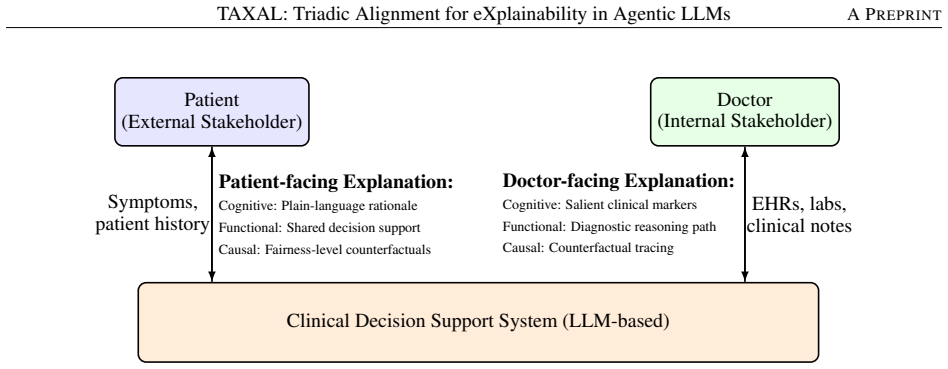
Summary. The paper introduces TAXAL, a conceptual framework for explainability of large language models (LLMs), organized around three dimensions: cognitive (user understanding), functional (practical utility), and causal (faithful reasoning). The authors argue that no single dimension suffices and that only their triadic fusion can meet the diverse needs of stakeholders in high-risk sociotechnical domains. The paper synthesizes existing XAI techniques, maps them onto the three dimensions (Tables 3-5), presents six cross-domain case studies plus a detailed medical scenario (Section 4), and proposes design patterns and adoption pathways (Sections 5.2-5.3). Section 5.4 lists limitations including lack of formal mapping criteria and empirical validation gaps.
Significance. If the TAXAL framework were properly operationalized and validated, it could provide a useful shared vocabulary for comparing and designing explanation strategies across LLM deployments, especially in regulated or safety-critical settings. The paper is clearly written, covers a broad literature, and is honest about several of its own limitations, particularly in Table 8 and the explicit note that the medical scenario is simulated. However, the paper is entirely conceptual: there is no empirical data, no quantitative evaluation, and the central claim is asserted rather than tested. The framework's practical value therefore remains a plausible hypothesis rather than a demonstrated contribution.
major comments (5)
- [§3.1, Tables 4-5, §6] The central claim (Section 6) that 'no single dimension is sufficient in isolation' presupposes a well-defined notion of a single-dimensional explanation, but none is provided. In Tables 4 and 5 every technique is rated High or Medium on at least two dimensions (e.g., CoT: High/High/Medium; SHAP: Medium/High/High), so no row instantiates the 'single dimension in isolation' regime. As stated, the claim is unfalsifiable and risks reducing to the tautology that all three measured aspects matter. The authors should define single-dimensional explanations operationally, for example by requiring a protocol that varies one dimension while holding the others fixed, and give a scoring rubric that permits such ratings.
- [§5.4, Table 8, §4.2] The limitations explicitly acknowledge 'Lack of Formal Mapping Criteria' and 'Empirical Evaluation Gaps,' and the medical scenario is explicitly labeled simulated (Section 4.2, Remark). These are not merely future-work items; they directly undermine the paper's central empirical claim that triadic integration is necessary. Without at least one real stakeholder evaluation or a clearly scoped repositioning of TAXAL as a heuristic taxonomy rather than a validated model, the conclusion in Section 6 overstates the evidence.
- [Tables 4 and 5, §3.1] The High/Medium/Low ratings are introduced as 'illustrative' but are later used to derive trade-off conclusions and design recommendations (e.g., Section 5.2). The paper does not specify how these ratings were produced, who assigned them, or what criteria distinguish High from Medium. Unless a reproducible scoring procedure is given, the tables cannot support the framework's practical claims and remain interpretive choices.
- [§4.1, case studies] The six case-study domains are selected without stated criteria, and each scenario is described using TAXAL's own categories. This makes the case studies consistent with the framework by construction rather than confirming it. The closing paragraph of Section 4.1 says the cases 'validate the framework's capacity,' which is stronger than what illustrative scenarios can establish. I recommend recasting these as worked examples and reserving 'validation' for empirical studies.
- [§2.3.1, §3.1] The mapping of evaluation criteria onto TAXAL dimensions (faithfulness→causal, plausibility→cognitive, truthfulness→functional, contrastivity→cognitive/causal) is asserted without justification or derivation. Since this mapping is foundational to the triadic split, the paper should explain why these criteria align with these dimensions rather than other groupings, or acknowledge the choice as one possible taxonomy among several.
minor comments (5)
- [Table 6] Typo: 'Sentiment Analysis Alanlysis' should be 'Sentiment Analysis Analysis' or 'Sentiment Analysis.'
- [§4.2] Grammar: 'we propose an TAXAL-based validation framework' should be 'a TAXAL-based validation framework.'
- [References [13] and [14]] The JAILJUDGE reference appears twice in different forms; please merge into one consistent entry.
- [§5.4, Table 8] The sentence 'Framework lacks validation across real-world domains and tasks' is a key admission and should be connected more explicitly in the main text to the earlier case-study claims, rather than only appearing in a table.
- [General] The manuscript uses 'demonstrates' and 'validates' in several places (abstract, Section 4.1, Conclusion) while also acknowledging the absence of empirical validation. Align the language with the actual evidence level, e.g., 'illustrates' or 'exemplifies.'
Circularity Check
No derivational circularity in the framework itself, but the illustrative mapping in Table 4 is self-authored and then used to reinforce the central claim, making that supporting evidence partially self-validating.
-
other
[Section 3.1, Table 4 and following paragraph]
"This mapping illustrates that no single technique excels in all dimensions, reinforcing the importance of stakeholder-sensitive explanation strategies that balance cognitive clarity, functional utility, and causal fidelity."
The table is constructed for TAXAL: each row is assigned High/Medium ratings by the authors with no scoring rubric (Section 5.4 admits 'Current mapping relies on qualitative judgment'), and the legend explicitly notes Low 'does not appear with the current selected XAI techniques.' The sentence after the table reads the conclusion that techniques are multi-dimensional—'no single technique excels in all dimensions'—directly off those self-assigned ratings and calls it reinforcing for the TAXAL thesis. The observation is therefore a summary of the table's own inputs, not an independent confirmation; the supporting evidence is self-validating.
full rationale
TAXAL is a conceptual framework with no equations, fitted parameters, or empirical predictions to reduce. The central claim in Section 6—'no single dimension is sufficient in isolation'—is a normative stance about stakeholder needs, not a mathematically derived result. The case studies are explicitly presented as illustrative and, in the medical scenario, as a 'simulated scenario without real doctors and patients.' The paper's self-citations (e.g., Herrera [6,7], LoBOX [8]) are present but not load-bearing: the triadic dimensions are defined in the paper itself and are mapped onto standard external XAI techniques such as SHAP, LIME, Chain-of-Thought, and counterfactuals. The main circularity-adjacent move is the use of the author-assigned qualitative ratings in Tables 4 and 5 to 'reinforce' the triadic-fusion claim; because the ratings are the authors' own classification, drawing the multi-dimensionality conclusion from them is self-validating rather than independent. Section 5.4 openly acknowledges 'Lack of Formal Mapping Criteria' and 'Empirical Evaluation Gaps,' which confirms that the tables are interpretive rather than tested. This lowers the evidential weight of the illustrative mapping but does not make the whole framework's central claim a derivation from its own inputs, so a score of 3 is appropriate rather than a higher score reserved for predictions that reduce by construction.
Assumptions & free parameters
free parameters (2)
- Technique-dimension alignment ratings (High/Medium/Low) in Tables 4 and 5 =
Various (e.g., CoT: cognitive High, functional High, causal Medium)
- Selection of six case study domains (law, education, public service, HR, mental health, jailbreak) =
N/A
assumptions (4)
- domain assumption Explainability can be decomposed into cognitive, functional, and causal dimensions that are jointly necessary and sufficient.
- domain assumption Existing explanation techniques can be meaningfully compared along these dimensions using qualitative ratings.
- domain assumption Faithful causal explanations of LLM behavior are achievable via counterfactuals, tracing, and attribution.
- ad hoc to paper The six case studies are representative of real-world high-risk deployment scenarios.
invented entities (1)
-
TAXAL framework
Cite this review
Pith. "Pith review of Triadic Fusion of Cognitive, Functional, and Causal Dimensions for Explainable LLMs: The TAXAL Framework." pith.science (2026). https://pith.science/paper/PBCD2KZZ
@misc{pith2026250905199,
  author       = {Pith},
  title        = {Pith review of: Triadic Fusion of Cognitive, Functional, and Causal Dimensions for Explainable LLMs: The TAXAL Framework},
  year         = {2026},
  howpublished = {\url{https://pith.science/paper/PBCD2KZZ}},
  note         = {Machine review of arXiv:2509.05199}
}
read the original abstract
Large Language Models (LLMs) are increasingly being deployed in high-risk domains where opacity, bias, and instability undermine trust and accountability. Traditional explainability methods, focused on surface outputs, do not capture the reasoning pathways, planning logic, and systemic impacts of agentic LLMs. We introduce TAXAL (Triadic Alignment for eXplainability in Agentic LLMs), a triadic fusion framework that unites three complementary dimensions: cognitive (user understanding), functional (practical utility), and causal (faithful reasoning). TAXAL provides a unified, role-sensitive foundation for designing, evaluating, and deploying explanations in diverse sociotechnical settings. Our analysis synthesizes existing methods, ranging from post-hoc attribution and dialogic interfaces to explanation-aware prompting, and situates them within the TAXAL triadic fusion model. We further demonstrate its applicability through case studies in law, education, healthcare, and public services, showing how explanation strategies adapt to institutional constraints and stakeholder roles. By combining conceptual clarity with design patterns and deployment pathways, TAXAL advances explainability as a technical and sociotechnical practice, supporting trustworthy and context-sensitive LLM applications in the era of agentic AI.
Figures


Reference graph
Works this paper leans on
-
[1]
Alejandro Barredo Arrieta et al. “Explainable Artificial Intelligence (XAI): Concepts, taxonomies, opportunities and challenges toward responsible AI”. In:Information Fusion58 (2020), pp. 82–115
work page 2020
-
[2]
Astrid Bertrand et al. “On selective, mutable and dialogic XAI: A review of what users say about different types of interactive explanations”. In:Proceedings of the 2023 CHI Conference on Human Factors in Computing Systems. 2023, pp. 1–21
work page 2023
-
[3]
Xai meets llms: A survey of the relation between explainable ai and large language models
Erik Cambria et al. “Xai meets llms: A survey of the relation between explainable ai and large language models”. In:arXiv preprint arXiv:2407.15248(2024)
arXiv 2024
-
[4]
Unveiling the Black Box: The Significance of XAI in Making LLMs Transparent
Murillo Edson Carvalho Souza, Murillo Edson De Carvalho Souza, and Li Weigang. “Unveiling the Black Box: The Significance of XAI in Making LLMs Transparent”. In:Authorea Preprints(2025)
work page 2025
-
[5]
Is Conversational XAI All You Need? Human-AI Deci- sion Making With a Conversational XAI Assistant
Gaole He, Nilay Aishwarya, and Ujwal Gadiraju. “Is Conversational XAI All You Need? Human-AI Deci- sion Making With a Conversational XAI Assistant”. In:Proceedings of the 30th International Conference on Intelligent User Interfaces. 2025, pp. 907–924
work page 2025
-
[6]
Francisco Herrera. “Making Sense of the Unsensible: Reflection, Survey, and Challenges for XAI in Large Language Models Toward Human-Centered AI”. In:arXiv preprint arXiv:2505.20305(2025)
work page Pith review arXiv 2025
-
[7]
Francisco Herrera. “Reflections and attentiveness on eXplainable Artificial Intelligence (XAI). The journey ahead from criticisms to human-AI collaboration”. In:Information Fusion(2025), p. 103133
work page 2025
-
[8]
Francisco Herrera and Reyes Calderón. “Opacity as a Feature, Not a Flaw: The LoBOX Governance Ethic for Role-Sensitive Explainability and Institutional Trust in AI”. In:arXiv preprint arXiv:2505.20304(2025)
work page Pith review arXiv 2025
Show all 29 references
-
[9]
An overview of model uncertainty and variability in LLM-based sentiment anal- ysis: challenges, mitigation strategies, and the role of explainability
David Herrera-Poyatos et al. “An overview of model uncertainty and variability in LLM-based sentiment anal- ysis: challenges, mitigation strategies, and the role of explainability”. In:Frontiers in Artificial Intelligence V olume 8 - 2025 (2025).ISSN: 2624-8212.DOI:10 . 3389 /...
2025
-
[10]
The effect of model size on LLM post-hoc explainability via lime
Henning Heyen et al. “The effect of model size on LLM post-hoc explainability via lime”. In:arXiv preprint arXiv:2405.05348(2024)
2024 arXiv
-
[11]
Against the opacity, and for a qualitative understanding, of artificially intelligent technologies
Mahdi Khalili. “Against the opacity, and for a qualitative understanding, of artificially intelligent technologies”. In:AI and Ethics4.4 (2024), pp. 1013–1021
2024
-
[12]
Towards trustworthy LLMs: a review on debiasing and dehallucinating in large language models
Zichao Lin et al. “Towards trustworthy LLMs: a review on debiasing and dehallucinating in large language models”. In:Artificial Intelligence Review57.9 (2024), p. 243
2024
-
[13]
Jailjudge: A comprehensive jailbreak judge benchmark with multi-agent enhanced explanation evaluation framework
Fan Liu et al. “Jailjudge: A comprehensive jailbreak judge benchmark with multi-agent enhanced explanation evaluation framework”. In:arXiv preprint arXiv:2410.12855(2024)
2024 arXiv
-
[14]
JAILJUDGE: A Comprehensive JAILBREAK judge benchmark with multi-agent enhanced explaination evaluation frameowrk
Fan et al. Liu. “JAILJUDGE: A Comprehensive JAILBREAK judge benchmark with multi-agent enhanced explaination evaluation frameowrk”. In:2025 1st International Conference on Artificial Intelligence and Com- puting. 2025
2025
-
[15]
From understanding to utilization: A survey on explainability for large language models
Haoyan Luo and Lucia Specia. “From understanding to utilization: A survey on explainability for large language models”. In:arXiv preprint arXiv:2401.12874(2024)
2024 arXiv
-
[16]
Cell your model: Contrastive explanations for large lan- guage models
Ronny Luss, Erik Miehling, and Amit Dhurandhar. “Cell your model: Contrastive explanations for large lan- guage models”. In:arXiv preprint arXiv:2406.11785v3(2025)
2025 arXiv
-
[17]
XAI for all: Can large language models simplify explainable AI?
Philip Mavrepis et al. “XAI for all: Can large language models simplify explainable AI?” In:arXiv preprint arXiv:2401.13110(2024)
2024 arXiv
-
[18]
A Unified Framework with Novel Metrics for Evaluating the Effectiveness of XAI Techniques in LLMs
Melkamu Abay Mersha et al. “A Unified Framework with Novel Metrics for Evaluating the Effectiveness of XAI Techniques in LLMs”. In:arXiv preprint arXiv:2503.05050(2025)
2025 arXiv
-
[19]
Explanation in artificial intelligence: Insights from the social sciences
Tim Miller. “Explanation in artificial intelligence: Insights from the social sciences”. In:Artificial intelligence 267 (2019), pp. 1–38
2019
-
[20]
Explainable artificial intelligence (XAI): from inherent explainability to large language models
Fuseini Mumuni and Alhassan Mumuni. “Explainable artificial intelligence (XAI): from inherent explainability to large language models”. In:arXiv preprint arXiv:2501.09967(2025)
2025 arXiv
-
[21]
A practical review of mechanistic interpretability for transformer-based language models
Daking Rai et al. “A practical review of mechanistic interpretability for transformer-based language models”. In:arXiv preprint arXiv:2407.02646(2025)
2025
-
[22]
Generative to Agentic AI: Survey, Conceptualization, and Challenges
Johannes Schneider. “Generative to Agentic AI: Survey, Conceptualization, and Challenges”. In:arXiv preprint arXiv:2504.18875(2025)
2025 arXiv
-
[23]
Bridging the Gap Between Explainability and Large Language Models
Xia Shui and Zhihao Ru. “Bridging the Gap Between Explainability and Large Language Models”. In:Hal- 05011844(2025)
2025
-
[24]
Explaining machine learning models with interactive natural language conversations using TalkToModel
Dylan Slack et al. “Explaining machine learning models with interactive natural language conversations using TalkToModel”. In:Nature Machine Intelligence5.8 (2023), pp. 873–883. 26 TAXAL: Triadic Alignment for eXplainability in Agentic LLMsA PREPRINT
2023
-
[25]
The rationality of explanation or human capacity? Understanding the impact of explainable artificial intelligence on human-AI trust and decision performance
Ping Wang and Heng Ding. “The rationality of explanation or human capacity? Understanding the impact of explainable artificial intelligence on human-AI trust and decision performance”. In:Information Processing & Management61.4 (2024), p. 103732
2024
-
[26]
Usable XAI: 10 strategies towards exploiting explainability in the LLM era
X. Wu et al. “Usable XAI: 10 strategies towards exploiting explainability in the LLM era”. In:arXiv preprint arXiv:2403.08946(2024)
2024 arXiv
-
[27]
Editing factual knowledge and explanatory ability of medical large language models
Derong Xu et al. “Editing factual knowledge and explanatory ability of medical large language models”. In: Proceedings of the 33rd ACM International Conference on Information and Knowledge Management. 2024, pp. 2660–2670
2024
-
[28]
Explainability for large language models: A survey
Haiyan Zhao et al. “Explainability for large language models: A survey”. In:ACM Transactions on Intelligent Systems and Technology15.2 (2024), pp. 1–38
2024
-
[29]
Explanation in the era of large language models
Zining Zhu et al. “Explanation in the era of large language models”. In:Proceedings of the 2024 Conference of the North American Chapter of the Association for Computational Linguistics: Human Language Technologies (Volume 5: Tutorial Abstracts). 2024, pp. 19–25. 27
2024
Reviewed August 5, 2026 · model on record in the stance chip above.
Discussion (0). Sign in to comment.