REVIEW 4 major objections 5 minor 3 references
Solitary Alfv\'en Waves
T0 review · 4 major / 5 minor · reviewed 2026-08-03 · deepseek-v4-flash
Pith's one-line read The paper shows that a localized, twisting magnetic structure with nearly constant field strength—the Alfvénon—propagates coherently in ideal MHD simulations, marking the first numerical realization of a solitary Alfvén wave packet.
desk verdict A genuinely new 3D isolated Alfvénic structure with clean numerics, but the 'exact' framing and missing convergence study need attention before I'd treat the Alfvénon as a continuum object. read the letter →
The pith
A machine-rendered reading of the paper's core claim, the machinery that carries it, and where it could break.
The reading
What carries the argument
The iterative projection algorithm: given a seed field, repeatedly remove its divergence via Helmholtz-Hodge decomposition in Fourier space and renormalize to unit magnitude; iterating drives the field toward simultaneous solenoidality and quasi-constancy of |B|. This produces the GA field used as the magnetic backbone of the Alfvénon. The supporting identity is the reduction in Section 2: with b0 constant far field and b1 localized on the constant-|b| sphere, the ideal MHD equations reduce to linear advection equations for b1 and u1.
What would settle it
Run the same iterative construction at 64^3 and 256^3 resolutions: if the standard deviation of |B| does not shrink with resolution (or the iteration fails to converge), the quasi-constant field is a grid artifact. Alternatively, extend the Alfvénon MHD run beyond t = 100 and observe whether the packet disperses or steepens as phase mixing accumulates, which would break the solitary claim.
Extended reading notes
Core claim
Using an iterative algorithm that alternates Helmholtz-Hodge projection (to enforce ∇·B = 0) with pointwise normalization (to enforce |B| ≈ 1), the authors construct a localized, three-dimensionally twisted magnetic structure embedded in a uniform background. Setting the velocity perturbation to minus the magnetic perturbation (the Walén relation) yields an ideal-MHD initial condition that propagates coherently at unit Alfvén speed; density fluctuations stay small and total energy is conserved, so the structure behaves as a nonlinear solitary Alfvénic solution. The paper claims this is the first numerical realization of a solitary Alfvén wave packet with open field-line topology and an unper
Load-bearing premise
The iterative algorithm empirically converges to a field that is both solenoidal and nearly constant in |B|, but no convergence proof, error bound, or resolution study is given; the solitary behavior rests on the residual |B| variation staying below about one percent.
Editorial extensions
If this is right
- Switchbacks in the solar wind can be understood as solitary Alfvén waves with a well-defined unperturbed background, removing the ambiguity in ensemble-averaged definitions of B0.
- The one-sided proton jets observed at switchbacks follow directly from the sign of the Walén relation: forward propagation always gives positive u1x regardless of the sign of b0.
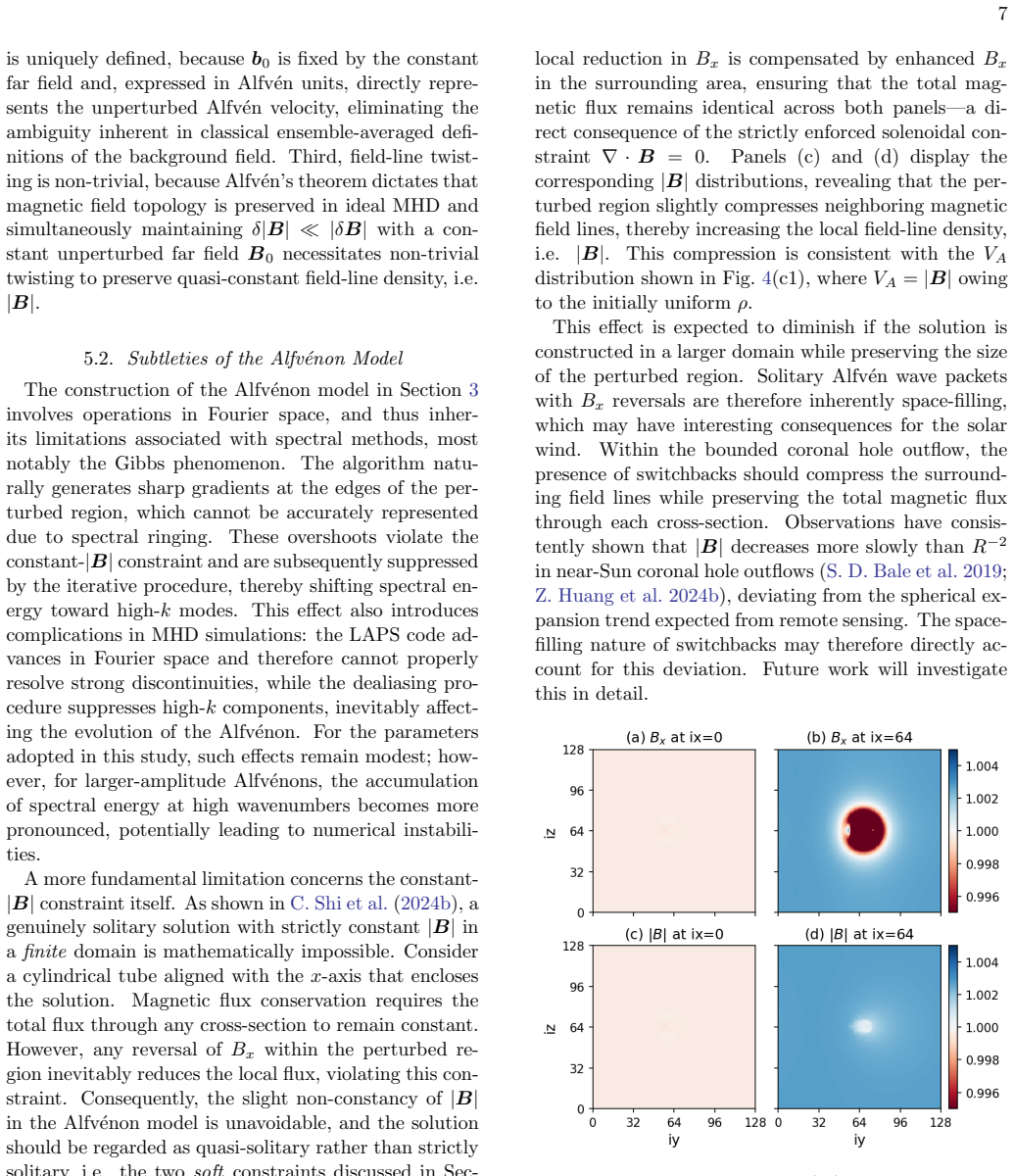
- The space-filling nature of the Alfvénon—compressing neighboring field lines while preserving total flux—offers a mechanism for the observed slower-than-R^-2 decline of |B| in coronal hole outflows.
- The model enables, for the first time, direct isolated simulations of counter-propagating Alfvén wave packet collisions, a cornerstone of MHD turbulence phenomenology.
- Because strictly constant |B| is mathematically impossible in a finite domain, the Alfvénon is inherently quasi-solitary; the ~1% residual |B| variation already causes detectable phase mixing by t = 100.
Reading between the lines
- The iterative algorithm's convergence is demonstrated only empirically; a natural test is to apply it at resolutions 64^3 and 256^3 with the same seed and check whether σ|B| decreases with resolution, which would support quasi-constancy as a continuum property rather than a grid artifact.
- If Alfvénons are also exact solutions of relativistic MHD, the same construction could extend to magnetar magnetospheres, where the one-sided jet could efficiently transport energy; the paper notes this possibility but the numerical construction here is entirely classical.
- The failure of linear superposition for solitary Alfvén waves—two localized solutions do not generally sum to a solution—suggests that Alfvénic turbulence in the corona should be formulated in terms of collisions of these packets rather than Fourier modes.
- A testable implication: if switchbacks are Alfvénons, then |B| just outside a switchback should be locally enhanced (compressed field lines) rather than merely returning to background; this can be checked in spacecraft intervals with isolated switchbacks.
Editorial analysis
A structured set of objections, weighed in public.
Referee Report
Summary. The manuscript proposes a 'solitary Alfvén wave' as an exact nonlinear ideal-MHD solution under assumptions of constant density, pressure, and |B|, with a localized perturbation of an otherwise uniform far field. The authors construct a three-dimensional field G_A on a 128^3 grid using an iterative projection/normalization algorithm, set u1 = -b1 by the Walén relation, and evolve the configuration with the pseudo-spectral LAPS code. Simulations show that the structure propagates at V_A ≈ 1 with near-perfect Alfvénic correlation through t = 10 and only mild relaxation by t = 100, while total energy is conserved to ~1e-9. The paper concludes that this is the first numerical realization of a solitary Alfvén wave packet, while acknowledging in §5.2 that the model is only quasi-solitary.
Significance. If the numerical object is robust, the paper reports a genuinely interesting first step: an isolated, three-dimensional, large-amplitude Alfvénic structure with open field-line topology and an unperturbed far field, directly relevant to solar-wind switchback observations. The simulation diagnostics are clean — energy conservation to ~1e-9, small residual energy, and comparison runs varying dealiasing and domain length are thoughtful. The iterative construction of a solenoidal, quasi-constant-|B| field is also a useful technical contribution. However, the central claim currently rests on the quasi-constancy of |B| produced by an empirically convergent algorithm, and the 'exact solution' language in the abstract exceeds what the paper itself proves.
major comments (4)
- [Abstract; §5.2] The abstract and introduction call the solitary Alfvén wave an 'exact nonlinear solution', but §5.2 states that strictly constant-|B| solitary solutions are mathematically impossible in a finite domain and explicitly labels the model 'quasi-solitary'. Since the reduction from Eq. (2) to Eqs. (8)–(9) in §2 requires ∇|B|^2 = 0 exactly, the exactness claim is not supported by the paper's own analysis. Please revise the abstract and §1 to use 'approximate' or 'quasi-solitary' consistently, or provide a precise sense in which the finite-domain model is exact.
- [§3.1, Eqs. (16)–(17); §3.2] The iterative projection algorithm is described as 'empirically converges' on a single 128^3 grid, with no proof, error bound, or grid-refinement study. The quasi-constant-|B| property is load-bearing: the coherence of the Alfvénon and the small phase-mixing rate depend on σ|B| being ~1%. Without a resolution study (e.g., 256^3 or 384^3) and quantitative convergence metrics (max |∇·B|, σ|B|, spectral error), the possibility that G_A is a finite-grid artifact cannot be excluded. This directly affects the claim that G_A represents a continuum solitary structure.
- [§2, Eq. (12); §3.3] The Alfvénic correlation u1 = -b1 and the normalization |B0| = 1 are imposed in the initial data, so the simulation's propagation at V_A ≈ 1 and near-perfect correlation are partly consequences of the construction, not emergent properties. The nontrivial result is that the structure remains coherent for long times despite the ~1% |B| variations. The paper should be careful not to present the propagation speed or the correlation as confirmations of the theory; instead, quantify how correlation (e.g., E_r/E_K or a correlation coefficient) and coherence decay with time and show that this decay is governed by the small |B| fluctuations.
- [Appendix B; §3.2] The 'open field-line topology' claim is made using a field-line tracer on a periodic box. Because the tracer wraps coordinates periodically (mod L), every traced line that exits x = 1 re-enters at x = 0 and is therefore a closed loop in the computational domain. The topological statement needs an unwrapped definition (e.g., open in the infinite periodic extension) or a demonstration that no closed loops exist when the tracer is used without periodic wrapping.
minor comments (5)
- [§4] The citation 'C. . Shi et al. 2022' contains a typographical error (extra period after the initial); also, the paper describes dealiasing option 2 in Appendix C but does not state the value of α used in the main run except through Run 1 in Fig. 5.
- [Fig. 2(a)] The convergence plot shows ∥ΔG_n∥_2 and σ|B| versus iteration number, but the final values are not given in the text. Please quote the converged σ|B| and the residual ∥∇·G_A∥ (or state that it is at machine precision) so the reader can judge the degree of quasi-constancy.
- [§3.2, Eq. (21)] The dependence of G_A on the seed parameters (A = 10, k_x = 4, σ = 1/30) is not explored. Since the iterative method is empirical, a brief study (or at least a statement about sensitivity) would strengthen confidence in the construction.
- [§5.2] The claim that the compression of neighboring field lines 'is expected to diminish if the solution is constructed in a larger domain' is testable. Either provide a test (e.g., a run with Lx = 10) or mark the statement as a conjecture.
- [General] For reproducibility, please deposit the code and the G_A field (or a precise description of the iteration count and dealiasing parameters) so that the central numerical object can be independently reconstructed.
Circularity Check
Partial circularity: the one-sided-jet 'prediction' and the simulated propagation speed are built into the assumed Walén relation and initial data; the nontrivial 3D field construction itself retains independent content.
-
self definitional
[§2, Eqs. (6)–(12) and the paragraph following Eq. (11)]
"Alfvénic solution dictates: u1 = ±b1. ... In this frame, Eqs. (6)–(7) reduce to: ∂u1/∂t = b0·∇b1, ∂b1/∂t = b0·∇u1 ... Assuming b0 = b0 xhat and b1 = −u1, Eq. (8) becomes (∂/∂t + b0∂/∂x)b1 = 0, describing a forward-propagating (+x) wave ... Thus for forward-propagating waves, u1x is always positive irrespective of the sign of b0."
The wave equations and the one-sided-jet property are not derived from ideal MHD alone; they are obtained by substituting the assumed Walén relation u1 = ±b1 into Eq. (6). The sign choice b1 = −u1 is what selects forward propagation along b0 = +x, and u1x > 0 follows immediately from that same sign choice. The 'explanation' of one-sided anti-sunward jets is therefore the input assumption rewritten as a consequence.
-
self definitional
[§3.3 and §4, paragraph after Fig. 4]
"Based on the Alfvénic correlation, we construct u1 = −b1 = −B1 to ensure forward propagation along B0, where we have adopted normalized units with ρ=1 and μ0=1, and set u0 = 0. ... The near-perfect alignment of profiles demonstrates that the Alfvénon propagates at VA = |B0|/√ρ ≃ 1 while maintaining spatial coherence with only mild relaxation."
Forward propagation at speed VA = 1 and the sign of u1 are inserted directly into the initial condition via u1 = −B1 and |B0| = 1. The simulation then reports the same propagation direction, speed, and Alfvénic correlation as confirmation. This is a numerical self-consistency check rather than an independent test of a predicted speed. However, the iterative construction of GA — a solenoidal, quasi-constant-|B| field with open topology — is nontrivial and is not itself reduced to the circular step.
full rationale
The core derivation in §2 is a restatement of the classical Walén relation u1 = ±b1 together with constant-|B| incompressibility; the one-sided-jet 'prediction' of Eq. (12) is selected by the sign convention b1 = −u1 and is therefore definitional rather than emergent. Similarly, §3.3 sets u1 = −B1 and B0 = 1, so the propagation at VA ≈ 1 observed in §4 is built into the initial data; the simulation demonstrates persistence of that property, not an independent prediction. The central numerical object, however, is the iterative projection/normalization algorithm that produces a genuinely 3D, strictly solenoidal, quasi-constant-|B| field with open field lines, and the observed mild phase mixing shows the numerical evolution is not trivially forced. The self-citation to Shi et al. (2024b) for nonexistence of strictly constant-|B| solitary solutions is accompanied by an in-text flux-conservation argument, so it is not a purely self-citation load-bearing step. Overall, there is partial circularity in the advertised predictions, but the construction retains independent content; score 5.
Assumptions & free parameters
free parameters (6)
- Seed amplitude A =
10.0
- Seed winding kx =
4
- Seed width σ =
1/30
- Iteration count =
200
- Dealiasing parameter α =
0.495 / 0.499
- Plasma beta and polytropic index =
β = 0.1, γ = 1.2
assumptions (8)
- standard math Ideal MHD equations with adiabatic closure pρ^{-γ} = const (Eqs. 1–5)
- domain assumption Incompressibility: constant |B|, ρ, p
- ad hoc to paper Walen relation u1 = ±b1 (Alfvénic correlation)
- domain assumption Constant-|b| sphere constraint: b1 restricted to |b0 + b1| = |b0|
- ad hoc to paper Convergence of the alternating projection algorithm (Eqs. 16–17)
- ad hoc to paper Existence of a 3D localized solenoidal quasi-constant-|B| field with open topology
- standard math Helmholtz–Hodge decomposition via Fourier Poisson solve (Eqs. 13–20)
- domain assumption Observational premise: switchbacks show quasi-constant |B| and open field lines
invented entities (2)
-
Alfvénon (the GA field configuration)
-
Solitary Alfvén wave as a class distinct from SPAWs (far-field background vs ensemble-average B0)
Cite this review
Pith. "Pith review of Solitary Alfv\'en Waves." pith.science (2026). https://pith.science/paper/PBSGFNLE
@misc{pith2026251202292,
  author       = {Pith},
  title        = {Pith review of: Solitary Alfv\'en Waves},
  year         = {2026},
  howpublished = {\url{https://pith.science/paper/PBSGFNLE}},
  note         = {Machine review of arXiv:2512.02292}
}
abstract
We present the solitary Alfv\'en wave as an ideal nonlinear Alfv\'enic solution in the solitary far-field limit and construct a three-dimensional numerical model -- an \emph{Alfv\'enon}. The model is characterized by an unperturbed far field, quasi-constant $|\boldsymbol{B}|$, and open field-line topology. Direct MHD simulations of the Alfv\'enon show coherent finite-time propagation, confirming that it behaves as a nonlinear solitary Alfv\'enic solution under ideal MHD evolution.
Figures


Figures from the paper (4 more)



Reference graph
Works this paper leans on
-
[1]
1942, Nature, 150, 405, doi: 10.1038/150405d0 Badman, S
Alfv´ en, H. 1942, Nature, 150, 405, doi: 10.1038/150405d0 Badman, S. T., Fargette, N., Matteini, L., et al. 2026, Space Science Reviews, 222, 14, doi: 10.1007/s11214-026-01267-w Bale, S. D., Badman, S. T., Bonnell, J. W., et al. 2019, Nature, 576, 237, doi: 10.1038/s41586-019-1818-7 Barnes, A. 1976, Journal of Geophysical Research,
doi:10.1038/150405d0 1942
-
[3]
https: //ui.adsabs.harvard.edu/abs/1944ArMAF..30A...1W Yuan, Y., Beloborodov, A. M., Chen, A. Y., et al. 2022, The Astrophysical Journal, 933, 174, doi: 10.3847/1538-4357/ac7529 Yuan, Y., Levin, Y., Bransgrove, A., & Philippov, A. 2021, The Astrophysical Journal, 908, 176, doi: 10.3847/1538-4357/abd405
-
[81]
https://ntrs.nasa.gov/citations/19760036902 Belcher, J. W., & Davis, L. 1971, Journal of Geophysical Research, 76, 3534, doi: 10.1029/JA076i016p03534 Boldyrev, S. 2005, The Astrophysical Journal, 626, L37, doi: 10.1086/431649 Boldyrev, S. 2006, Physical Review Letters, 96, 115002, doi: 10.1103/PhysRevLett.96.115002 Chandran, B. D. G. 2018, Journal of Plas...
arXiv 1971
Reviewed August 3, 2026 · model on record in the stance chip above.
Discussion (0). Sign in to comment.