Tunability of domain structure and magnonic spectra in antidot arrays of Heusler alloy
Pith reviewed 2026-05-25 02:25 UTC · model grok-4.3
The pith
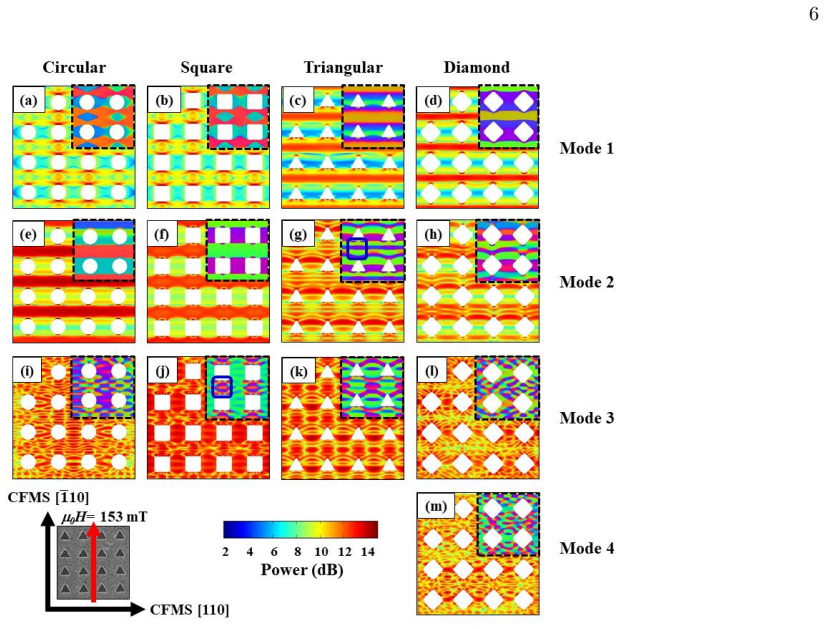
Changing the shape of holes in antidot arrays of a Heusler alloy tunes the spin-wave spectra through altered internal fields and anisotropy.
A machine-rendered reading of the paper's core claim, the machinery that carries it, and where it could break.
Core claim
Antidot arrays with different hole shapes in CFMS Heusler films display chain-like or correlated domain switching, and the optically induced spin-wave spectra change dramatically because the hole geometry modifies internal field profiles, pinning energy barriers, and anisotropy; combining magnetocrystalline anisotropy with shape anisotropy therefore supplies an additional degree of freedom for controlling magnonic modes.
What carries the argument
Antidot hole shape, which alters internal magnetic field profiles, pinning energy barriers, and effective anisotropy to modify domain switching and spin-wave spectra.
If this is right
- Different hole shapes produce either chain-like switching or larger correlated domains.
- The spin-wave spectra shift markedly across arrays with square, circular, or other hole geometries.
- Shape anisotropy adds a controllable degree of freedom when combined with the material's magnetocrystalline anisotropy.
Where Pith is reading between the lines
- Geometric patterning could be used to create frequency-selective channels in magnonic waveguides without external fields.
- The same shape-tuning principle may apply to other low-damping Heusler or ferromagnetic films for device integration.
- Domain imaging combined with time-resolved Kerr microscopy offers a direct way to map how local pinning varies with geometry.
Load-bearing premise
The differences in domains and magnonic modes between arrays are produced by the hole shape rather than by uncontrolled differences in film deposition, lithography, or measurement conditions.
What would settle it
Fabricating multiple arrays with identical hole shapes but deliberately varied film thickness or edge roughness and finding that the magnonic spectra remain unchanged would show that shape is not the dominant control parameter.
Figures



read the original abstract
Materials suitable for magnonic crystals demand low magnetic damping and long spin wave (SW) propagation distance. In this context Co based Heusler compounds are ideal candidates for magnonic based applications. In this work, antidot arrays (with different shapes) of epitaxial $\mathrm{Co}_2\mathrm{Fe}_{0.4}\mathrm{Mn}_{0.6}\mathrm{Si}$ (CFMS) Heusler alloy thin films have been prepared using e-beam lithography and sputtering technique. Magneto-optic Kerr effect and ferromagnetic resonance analysis have confirmed the presence of dominant cubic and moderate uniaxial magnetic anisotropies in the thin films. Domain imaging via x-ray photoemission electron microscopy on the antidot arrays reveals chain like switching or correlated bigger domains for different shape of the antidots. Time-resolved MOKE microscopy has been performed to study the precessional dynamics and magnonic modes of the antidots with different shapes. We show that the optically induced spin-wave spectra in such antidot arrays can be tuned by changing the shape of the holes. The variation in internal field profiles, pinning energy barrier, and anisotropy modifies the spin-wave spectra dramatically within the antidot arrays with different shapes. We further show that by combining the magnetocrystalline anisotropy with the shape anisotropy, an extra degree of freedom can be achieved to control the magnonic modes in such antidot lattices.
Editorial analysis
A structured set of objections, weighed in public.
Referee Report
Summary. The manuscript presents an experimental study on antidot arrays fabricated from epitaxial Co2Fe0.4Mn0.6Si Heusler alloy thin films with varying hole shapes (via e-beam lithography). Magneto-optic Kerr effect (MOKE) and ferromagnetic resonance (FMR) confirm dominant cubic and moderate uniaxial anisotropies. X-ray photoemission electron microscopy (XPEEM) reveals shape-dependent domain structures, such as chain-like switching or correlated domains. Time-resolved MOKE microscopy shows differences in precessional dynamics and magnonic modes. The central claim is that changing the antidot shape tunes the optically induced spin-wave spectra through variations in internal field profiles, pinning energy barriers, and anisotropy, providing an extra degree of freedom when combined with magnetocrystalline anisotropy.
Significance. If the observed tunability is robustly attributable to the proposed mechanisms, this work would offer a practical geometric approach to control magnonic spectra in low-damping Heusler materials, which is relevant for magnonic crystal applications. The combination of multiple experimental techniques strengthens the observational basis, though quantitative validation of the mechanism would enhance impact.
major comments (2)
- [Discussion (or equivalent interpretation section)] The assertion that differences in magnonic modes arise specifically from shape-induced variations in internal field profiles, pinning energy barriers, and anisotropy is not supported by micromagnetic simulations, calculated demagnetizing fields, or pinning energy estimates for each geometry. This leaves open the possibility that fabrication inconsistencies (e.g., edge roughness or thickness variations) or measurement artifacts contribute to the observed spectral shifts.
- [TR-MOKE results] The paper lacks visible error bars, statistical details on mode frequencies, or raw data traces, making it difficult to assess the precision and reproducibility of the reported differences in spin-wave spectra across shapes.
minor comments (2)
- [Abstract] The abstract mentions 'chain like switching or correlated bigger domains' but does not specify which shape corresponds to which behavior.
- [Methods] Details on the exact dimensions, lattice parameters, and film thickness for each antidot shape would aid reproducibility.
Simulated Author's Rebuttal
We thank the referee for the careful reading of our manuscript and the constructive comments. We address the major points below.
read point-by-point responses
-
Referee: [Discussion (or equivalent interpretation section)] The assertion that differences in magnonic modes arise specifically from shape-induced variations in internal field profiles, pinning energy barriers, and anisotropy is not supported by micromagnetic simulations, calculated demagnetizing fields, or pinning energy estimates for each geometry. This leaves open the possibility that fabrication inconsistencies (e.g., edge roughness or thickness variations) or measurement artifacts contribute to the observed spectral shifts.
Authors: We agree that quantitative micromagnetic simulations or explicit demagnetizing field calculations for each geometry would strengthen the mechanistic interpretation. The current manuscript relies on the consistency between XPEEM-observed domain configurations and TR-MOKE spectral shifts across shapes, together with the known magnetocrystalline anisotropy from FMR. The epitaxial films show uniform thickness and low roughness by AFM and XRD, which argues against dominant fabrication artifacts. In revision we will add simple analytical estimates of the demagnetizing fields for the different antidot shapes to support the discussion. revision: partial
-
Referee: [TR-MOKE results] The paper lacks visible error bars, statistical details on mode frequencies, or raw data traces, making it difficult to assess the precision and reproducibility of the reported differences in spin-wave spectra across shapes.
Authors: We accept that the presentation of the TR-MOKE data can be improved. The revised manuscript will include error bars on the extracted mode frequencies (derived from multiple measurements), a brief description of the fitting procedure and number of averaged traces, and representative raw time traces or spectra in the supplementary material. revision: yes
Circularity Check
No circularity: purely experimental study with direct measurements
full rationale
The paper reports sample fabrication via e-beam lithography, anisotropy characterization via MOKE/FMR, domain imaging via XMPEEM, and time-resolved dynamics via TR-MOKE. No equations, derivations, fitted parameters presented as predictions, or self-citation chains appear in the provided text. All claims rest on observed differences across independently prepared samples rather than any reduction of outputs to inputs by construction. This is the expected finding for an experimental materials paper without modeling.
Axiom & Free-Parameter Ledger
axioms (1)
- domain assumption Dominant cubic and moderate uniaxial anisotropies are present in the epitaxial CFMS films as measured by MOKE and FMR.
Lean theorems connected to this paper
-
IndisputableMonolith/Cost/FunctionalEquation.leanwashburn_uniqueness_aczel unclear?
unclearRelation between the paper passage and the cited Recognition theorem.
The variation in internal field profiles, pinning energy barrier, and anisotropy modifies the spin-wave spectra dramatically within the antidot arrays with different shapes.
-
IndisputableMonolith/Foundation/DimensionForcing.leanalexander_duality_circle_linking unclear?
unclearRelation between the paper passage and the cited Recognition theorem.
We have used the following material parameters: γ = 2.14×10^5 m/As, MS = 9.2×10^5 A/m, K2 = 3.4×10^2 J/m^3, K4 = 1.17×10^3 J/m^3, α = 0.006...
What do these tags mean?
- matches
- The paper's claim is directly supported by a theorem in the formal canon.
- supports
- The theorem supports part of the paper's argument, but the paper may add assumptions or extra steps.
- extends
- The paper goes beyond the formal theorem; the theorem is a base layer rather than the whole result.
- uses
- The paper appears to rely on the theorem as machinery.
- contradicts
- The paper's claim conflicts with a theorem or certificate in the canon.
- unclear
- Pith found a possible connection, but the passage is too broad, indirect, or ambiguous to say the theorem truly supports the claim.
Reference graph
Works this paper leans on
-
[1]
A. V. Chumak, A. A. Serga, and B. Hillebrands, Magnonic crystals for data processing,J. Phys. D: Appl. Phys. 50, 244001 (2017)
work page 2017
-
[2]
S. A. Nikitov, Ph. Tailhades, and C. S. Tsai, Spin waves in periodic magnetic structures - magnonic crystals, J. Magn. Magn. Mater. 236, 320 (2001)
work page 2001
-
[3]
R. P. Cowburn, A. O. Adeyeye, and J. A. C. Bland, Mag- netic domain formation in lithographically defined anti- dot Permalloy arrays, Appl. Phys. Lett. 70, 2309 (1997)
work page 1997
-
[4]
S. Bedanta and W. Kleemann, Supermagnetism,J. Phys. D: Appl. Phys. 42, 013001 (2009)
work page 2009
-
[5]
P. Vavassori, G. Gubbiotti, G. Zangari, C. T. Yu, H. Yin, H. Jiang, and G. J. Mankey, Lattice symmetry and magnetization reversal in micron-size antidot arrays in Permalloy film,J. Appl. Phys. 91, 7992 (2002)
work page 2002
-
[6]
C. T. Yu, M. J. Pechan, and G. J. Mankey, Dipolar in- duced, spatially localized resonance in magnetic antidot arrays, Appl. Phys. Lett. 83, 3948 (2003)
work page 2003
-
[7]
A. O. Adeyeye, J. A. C. Bland, and C. Daboo, Mag- netic properties of arrays of holes in Ni80Fe20 films, Appl. Phys. Lett. 70, 3164 (1997)
work page 1997
-
[8]
S. Mallick, and S. Bedanta, Size and shape dependence study of magnetization reversal in magnetic antidot lat- tice arrays, J. Magn. Magn. Mater. 382, 158 (2015)
work page 2015
-
[9]
S. Mallick, S. Mallik, and S. Bedanta, Effect of substrate rotation on domain structure and magnetic relaxation in magnetic antidot lattice arrays, J. Appl. Phys. 118, 083904 (2015)
work page 2015
-
[10]
F. J. Castano, K. Nielsch, C. A. Ross, J. W. A. Robin- son, R. Krishnan, Anisotropy and magnetotransport in ordered magnetic antidot arrays, Appl. Phys. Lett. 85, 2872 (2004)
work page 2004
-
[11]
O. N. Martyanov, V. F. Yudanov, R. N. Lee, S. A. Nepi- jko, H. J. Elmers, R. Hertel, C. M. Schneider, and G. Schoenhense, Ferromagnetic resonance study of thin film antidot arrays: Experiment and micromagnetic simula- tions, Phys. Rev. B 75, 174429 (2007)
work page 2007
-
[12]
I. Ruiz-Feal, L. Lopez-Diaz, A. Hirohata, J. Rothman, C. M. Guertler, J. A. C. Bland, L. M. Garcia, J. M. Tor- res, J. Bartolome, F. Bartolome, M. Natali, D. Decanini, and Y. Chen, Geometric coercivity scaling in magnetic thin film antidot arrays, J. Magn. Magn. Mater. 242, 597 (2002)
work page 2002
-
[13]
T. J. Meng, J. B. Laloe, S. N. Holmes, A. Husmann, and G. A. C. Jones, In-plane magnetoresistance and magne- tization reversal of cobalt antidot arrays, J. Appl. Phys. 106, 033901 (2009)
work page 2009
-
[14]
P. Vavassori, V. Metlushko, R. M. Osgood, M. Grims- ditch, U. Welp, G. Crabtree, W. Fan, S. R. J. Brueck, B. Ilic, and P. J. Hesketh, Magnetic information in the light diffracted by a negative dot array of Fe, Phys. Rev. B 59, 6337 (1999)
work page 1999
- [15]
-
[16]
A. De, S. Mondal, S. Sahoo, S. Barman, Y. Otani, R. K. Mitra, and A. Barman, Field-controlled ultrafast mag- netization dynamics in two-dimensional nanoscale ferro- magnetic antidot arrays, Beil. J. Nano. 9, 1123 (2018)
work page 2018
-
[17]
S. Neusser, G. Duerr, S. Tacchi, M. Madami, M. L. Sokolovskyy, G. Gubbiotti, M. Krawczyk, and D. Grundler, Magnonic minibands in antidot lattices with large spin-wave propagation velocities, Phys. Rev. B 84, 094454 (2011)
work page 2011
-
[18]
S. Neusser, G. Duerr, H. G. Bauer, S. Tacchi, M. Madami, G. Woltersdorf, G. Gubbiotti, C. H. Back, and D. Grundler, Anisotropic propagation and damping of spin waves in a nanopatterned antidot lattice, Phys. Rev. Lett. 105, 067208 (2010)
work page 2010
-
[19]
C. C. Wang, A. O. Adeyeye, and N. Singh, Magnetic antidot nanostructures: effect of lattice geometry, Nan- 9 otechnology 17, 1629 (2006)
work page 2006
-
[20]
S. McPhail, C. M. Gurtler, J. M. Shilton, N. J. Curson, and J. A. C. Bland, Coupling of spin-wave modes in ex- tended ferromagnetic thin film antidot arrays, Phys. Rev. B 72, 094414 (2005)
work page 2005
-
[21]
H. Ulrichs, B. Lenk, and M. Munzenberg, Magnonic spin- wave modes in CoFeB antidot lattices, Appl. Phys. Lett. 97, 092506 (2010)
work page 2010
-
[22]
S. Tacchi, B. Botters, M. Madami, J. W. Klos, M. L. Sokolovskyy, M. Krawczyk, G. Gubbiotti, G. Carlotti, A. O. Adeyeye, S. Neusser, and D. Grundler, Mode con- version from quantized to propagating spin waves in a rhombic antidot lattice supporting spin wave nanochan- nels, Phys. Rev. B 86, 014417 (2012)
work page 2012
- [23]
- [24]
-
[25]
T. Sebastian, Y. Ohdaira, T. Kubota, P. Pirro, T. Bracher, K. Vogt, A. A. Serga, H. Naganuma, M. Oogane, Y. Ando, B. Hillebrands, Low-damping spin-wave propagation in a micro-structured Co2Mn0.6Fe0.4Si Heusler waveguide, Appl. Phys. Lett. 100, 112402 (2012)
work page 2012
- [26]
-
[27]
Y. Liu, L. R. Shelford, V. V. Kruglyak, R. J. Hicken, Y. Sakuraba, M. Oogane, and Y. Ando, Optically induced magnetization dynamics and variation of damping pa- rameter in epitaxial Co2MnSi Heusler alloy films, Phys. Rev. B 81, 094402 (2010)
work page 2010
-
[28]
S. Pan, S. Mondal, T. Seki, K. Takanashi, and A. Barman, Influence of thickness-dependent struc- tural evolution on ultrafast magnetization dynamics in Co2Fe0.4Mn0.6Si Heusler alloy thin films, Phys. Rev. B 94, 184417 (2016)
work page 2016
-
[29]
Kambersk´ y, On the Landau - Lifshitz relaxation in ferromagnetic metals, C
V. Kambersk´ y, On the Landau - Lifshitz relaxation in ferromagnetic metals, C. J. Phys. 48, 2906 (1970)
work page 1970
-
[30]
S. Pan, T. Seki, K. Takanashi, and A. Barman, Role of the Cr Buffer Layer in the Thickness-Dependent Ultrafast Magnetization Dynamics of Co2Fe0.4Mn0.6Si Heusler Alloy Thin Films, Phys. Rev. Appl. 7, 064012 (2017)
work page 2017
- [31]
- [32]
-
[33]
Y. Sakuraba, M. Ueda, Y. Miura, K. Sato, S. Bosu, K. Saito, M. Shirai, T. J. Konno, and K. Takanashi, Exten- sive study of giant magnetoresistance properties in half- metallic Co2(Fe,Mn)Si-based devices, Appl. Phys. Lett. 101, 252408 (2012)
work page 2012
-
[34]
Supplemental Material
-
[35]
A. Barman, and A. Haldar, Chapter One - Time-Domain Study of Magnetization Dynamics in Magnetic Thin Films and Micro- and Nanostructures, In Solid State Physics, R. E. Camley, R. L. Stamps, Eds. Academic Press: 2014; Vol. 65, pp 1-108
work page 2014
-
[36]
L. J. Heyderman, F. Nolting, D. Backes, S. Czekaj, L. Lopez-Diaz, M. Klaui, U. Rudiger, C. A. F. Vaz, J. A. C. Bland, R. J. Matelon, U. G. Volkmann, and P. Fischer, Magnetization reversal in cobalt antidot arrays, Phys. Rev. B 73, 214429 (2006)
work page 2006
-
[37]
L. J. Heyderman, F. Nolting, and C. Quitmann, X-ray photoemission electron microscopy investigation of mag- netic thin film antidot arrays, Appl. Phys. Lett. 83, 1797 (2003)
work page 2003
- [38]
-
[39]
M. J. Donahue, and D. G. Porter, OOMMF: Object Ori- ented MicroMagnetic Framework (2016)
work page 2016
- [40]
- [41]
-
[42]
Y. B. Xu, D. J. Freeland, M. Tselepi, and J. A. C. Bland, Anisotropic lattice relaxation and uniaxial mag- netic anisotropy inFe/InAs(100)42, Phys. Rev. B 62, 1167 (2000)
work page 2000
-
[43]
Q. F. Zhan, S. Vandezande, C. Van Haesendonck, and K. Temst, Manipulation of in-plane uniaxial anisotropy in Fe/MgO(001) films by ion sputtering, Appl. Phys. Lett. 91, 122510 (2007)
work page 2007
- [44]
-
[45]
S. Mallick, S. Mallik, B. B. Singh, N. Chowdhury, R. Gienuisz, A. Maziewski, and S. Bedanta, Tuning the anisotropy and domain structure of Co films by vari- able growth conditions and seed layers, J. Phys. D: Appl. Phys. 51, 275003 (2018)
work page 2018
-
[46]
M. R. Scheinfein, LLG Micromagnetics Simulator, http://llgmicro.home.mindspring.com/
discussion (0)
Sign in with ORCID, Apple, or X to comment. Anyone can read and Pith papers without signing in.