REVIEW 4 major objections 5 minor 61 references
Cavity Tuning of the CDW--Superconductivity Interplay in a Kagome Metal
T0 review · 4 major / 5 minor · reviewed 2026-08-15 · deepseek-v4-flash
Pith's one-line read A single-mode optical cavity with out-of-plane polarization selectively softens the CDW-related V-breathing phonon in the kagome metal CsV3Sb5, counteracting pressure-induced hardening and raising the Allen-Dynes estimate of the…
desk verdict First QEDFT application to a kagome CDW material gives a plausible qualitative picture of cavity-induced CDW re-softening, but an inconsistent A0 definition and missing photon frequency undercut the quantitative claims. read the letter →
The pith
A machine-rendered reading of the paper's core claim, the machinery that carries it, and where it could break.
The reading
What carries the argument
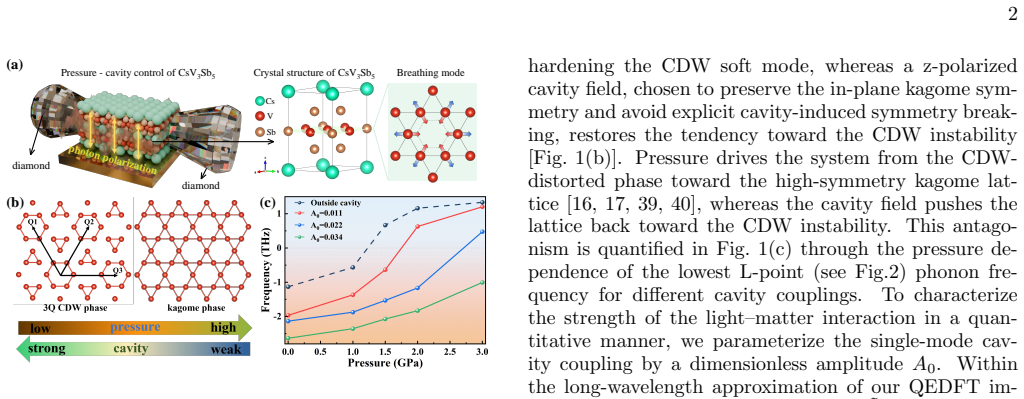
The central object is the electron-photon exchange-correlation potential in the local-density approximation (pxLDA) within quantum electrodynamical density functional theory. For a single cavity mode polarized along the crystallographic c axis, this potential contributes a polarization-dependent term proportional to derivatives of the electron density, coupling density gradients to the cavity field and producing the out-of-plane charge redistribution around the V-Sb network. That redistribution modifies the effective restoring forces of the zone-boundary phonons, selectively softening the V-breathing branch at the L point and shifting the Eliashberg spectral function $\alpha^2F(\omega)$ toward low frequencies. The dimensionless vector-potential amplitude $A_0$ controls the coupling strength, with the main results reported at $A_0 = 0.011$ and $0.022$.
What would settle it
Measure the lowest L-point phonon frequency of CsV3Sb5 at 3 GPa inside a cavity with the photon mode polarized along the c axis: the claim predicts that increasing the coupling from $A_0 = 0.011$ to $0.022$ softens (lowers) the V-breathing mode and shifts the Eliashberg spectral weight to lower frequencies, while the band structure stays nearly unchanged. If the L-point mode hardens or the spectral function is unchanged, the central mechanism is refuted. A complementary ab initio check would be to repeat the calculation with an electron-photon exchange-correlation functional beyond the local-density approximation and see whether the softening at $A_0 = 0.022$ survives.
Extended reading notes
Core claim
The central claim is that an out-of-plane polarized single-mode cavity acts as a selective perturbation that re-softens the CDW-related V-breathing phonon in CsV3Sb5, opposing the stabilizing effect of hydrostatic pressure. The paper shows that while pressure progressively hardens the soft branches and removes imaginary phonon frequencies above about 1.5 GPa, increasing cavity coupling at 3 GPa drives the lowest L-point branch back down, eventually into an imaginary-frequency instability at sufficiently large A0. In that pressure-stabilized regime, the cavity transfers electron-phonon spectral weight to lower frequencies, raises the total electron-phonon coupling, and increases the Allen-Dynes estimate of Tc. The authors emphasize that the cavity does not create a new lattice instability; it re-softens the preexisting CDW-related breathing mode, and it does so without substantially modifying the band structure or density of states near the Fermi level.
Load-bearing premise
The quantitative predictions rest on the local-density electron-photon exchange-correlation approximation being accurate for CsV3Sb5 at the cavity couplings studied, and on the effective cavity photon frequency (never specified, and with the coupling amplitude defined inconsistently between main text and Supplemental Material) lying in the regime where that approximation is valid.
Editorial extensions
If this is right
- The CDW lattice-instability boundary in CsV3Sb5 moves to higher pressures inside the cavity, so a structure that is dynamically stable at 3 GPa in free space can be made CDW-unstable by cavity coupling alone.
- Cavity coupling provides a control knob that acts on the same phonon mode as pressure but through charge redistribution rather than lattice compression, allowing the CDW-superconductivity relationship to be probed without global structural changes.
- In the pressure-stabilized regime, the Allen-Dynes estimate of $T_c$ rises from 4.1 K to 4.4 K at $A_0 = 0.011$ and to 5.5 K at $A_0 = 0.022$, driven by increased low-frequency electron-phonon coupling rather than by phonon stiffening.
- The effect is mode-selective: the cavity leaves the high-energy phonon spectrum and the electronic band structure essentially unchanged, so the coupled photon mode acts as a targeted perturbation of CDW-relevant lattice dynamics.
- These results are presented as establishing cavity quantum electrodynamics as an equilibrium route for tuning intertwined charge order, lattice dynamics, and superconductivity in kagome materials.
Reading between the lines
- A direct experimental test would be a pressure-cell measurement of the L-point phonon in a c-polarized cavity; the predicted roughly 1.4 K rise in $T_c$ at 3 GPa may be observable in transport if the vacuum field can be realized at the required coupling.
- The same charge-redistribution mechanism should in principle apply to other layered CDW materials with out-of-plane polarizable networks, though the sign and magnitude of the effect would depend on the band structure and the specific soft-mode character.
- Benchmarking pxLDA against a higher-level electron-photon functional for this material would sharpen the quantitative claim; if the L-point softening at $A_0 = 0.022$ survives such a benchmark, the mechanism is robust, but if it does not, the $T_c$ shift is likely an artifact of the local-density approximation.
Signed reviews
Editorial analysis
A structured set of objections, weighed in public.
Referee Report
Summary. The manuscript applies QEDFT with the pxLDA electron-photon functional to study a single z-polarized cavity mode coupled to CsV3Sb5. It reports that pressure hardens the CDW-related L-point phonon and suppresses the imaginary-frequency instability, while increasing cavity amplitude A0 softens the same branch and, at 3 GPa, restores softening and eventually an imaginary frequency. The associated Eliashberg function shifts to lower frequency, the total electron-phonon coupling increases from 0.615 to 0.758, and the Allen-Dynes estimate of Tc increases from 4.1 K to 5.5 K. The authors attribute the effect to an out-of-plane charge redistribution around the V-Sb network and argue that the response is mode-selective rather than a uniform electronic-structure change. The central claim is that equilibrium cavity coupling can act as a pressure-counteracting, polarization-selective control knob for the CDW-superconductivity interplay.
Significance. If the central results hold, the paper would provide a concrete first-principles prediction that a single-mode cavity can renormalize a specific CDW soft phonon and the low-frequency electron-phonon coupling in a kagome metal, together with a microscopic charge-redistribution mechanism. The strengths are the controlled comparison between cavity-free and cavity-coupled calculations with identical numerical settings, the mode-resolved phonon analysis identifying the L-point V-breathing character, and the explicit charge-density-difference maps. These are falsifiable predictions (softening of the L mode, redistribution of alpha^2F, and a Tc trend) that could be tested in future experiments. However, the quantitative content is currently compromised by an underspecified and internally inconsistent definition of the cavity parameter A0, by the absence of the photon frequency, and by missing technical details in the QEDFT Hamiltonian; these issues must be resolved before the specific numbers can be accepted.
major comments (4)
- [Main text (A0 definition) and SM Eq. (S12)] The quantitative central claim is parameterized by A0, but the manuscript gives inconsistent definitions of A0. The main text defines A0 = lambda_alpha / sqrt(2 omega_alpha), whereas Eq. (S12) as printed defines A0 = lambda_alpha sqrt(2 omega_alpha). Equation (S8) shows that the vector-potential operator prefactor is c lambda_alpha / sqrt(2 omega_alpha), so the relation between A0 and the perturbation entering the calculation is not established by the text. Because the pxLDA potential in Eq. (S11) depends on lambda_alpha^2 / omega_alpha^2, knowledge of A0 alone does not determine the cavity perturbation unless the dressed photon frequency omega_alpha is specified. The manuscript nowhere states omega_alpha, and the SM does not contain the mapping between A0 and experimental field scales that is promised in the main text. As a result, the reported numbers for the softening, lambda, and Tc cannot be reproduced or converted to physical cavity parameters. Please correct the definition, state the photon frequency actually used, and provide the mapping or remove the promise.
- [SM Eq. (S6) and the QEDFT Hamiltonian] The displayed Pauli-Fierz Hamiltonian in Eq. (S6) contains only the paramagnetic current coupling and the photon term; the diamagnetic A^2 term of minimal coupling is absent. Since the method is stated to be in the velocity gauge and the long-wavelength limit, the A^2 term is generally present and contributes to the electron-photon interaction, including possible photon-frequency renormalization. Please state explicitly whether this term is included in the implementation and, if so, where it enters in Eqs. (S9)-(S11), or whether it is absorbed into the dressed photon parameters. This matters because the reported phonon softening and EPC enhancement could depend on the treatment of this term.
- [SM Computational details and Table S1] The manuscript reports relaxed structural parameters only for the outside-cavity case and does not state whether the ionic positions and lattice parameters were re-relaxed in the presence of the cavity. If the cavity-coupled phonon calculations were performed at the free-space relaxed geometry, then the reported softening and the statement that the cavity does not create a new lattice instability are evaluated off equilibrium, and residual cavity-induced forces could alter the mode frequencies. Please state explicitly whether the geometries were re-relaxed with v_pxc included and, if not, justify why the fixed-geometry comparison is the appropriate object for the claim.
- [SM 'Cavity-coupled calculations' and main text results] The results rely on the pxLDA electron-photon functional, which is asserted to work well for high bare photon frequency or large light-matter coupling. Since neither the photon frequency nor a benchmark against a higher-level electron-photon functional is reported for CsV3Sb5, the quantitative magnitude of the mode softening and of the Tc shift carries an unquantified functional uncertainty. A concrete calibration would be to compute the L-point frequency and lambda for one representative A0 with an alternative electron-photon approximation or to show the sensitivity of the pxLDA result as the cavity photon frequency is varied. This is important because the claim is not merely that a trend exists but that A0 = 0.022 raises Tc from 4.1 K to 5.5 K; the latter depends on the specific functional and cavity parameters.
minor comments (5)
- [Conclusion] The sentence 'we demonstrate that a optical cavity provides' should read 'an optical cavity'.
- [Fig. 3 caption] The color coding for the mode projections, described in the body text as cyan and red curves, is not defined in the caption; please add a legend or explicit statement in the caption.
- [SM Eq. (S1)] The Allen-Dynes Tc estimates are reported only for mu* = 0.10; a short sensitivity check (for example, mu* = 0.12 or 0.15) would clarify how robust the 4.1 K to 5.5 K shift is.
- [Main text near Fig. 3] The statement that 'the cavity does not create a new lattice instability' should be clarified, because at 3 GPa the cavity drives the L-point branch from a stable real frequency outside the cavity to an imaginary frequency at the strongest couplings, which is an instability in the pressure-stabilized phase even if it occurs on the same branch.
- [SM Fig. S2 caption] The caption begins with 'Figure S2' and then repeats 'Figure S2' after the title; please remove the duplication.
Circularity Check
No circularity: the cavity results are self-consistent first-principles computations with an established QEDFT method; the internal A0 inconsistency is a correctness issue, not a circular reduction.
full rationale
The paper applies an existing QEDFT/pxLDA method to CsV3Sb5 and computes all cavity-modified quantities (phonon dispersions, Eliashberg function, lambda, omega_log, and Allen-Dynes Tc) self-consistently from the cavity-modified Kohn-Sham and DFPT equations for each chosen input amplitude A0. The coupling strength A0 is swept, not fitted to the target phonon softenings or Tc values, and the Coulomb pseudopotential mu*=0.10 is a fixed conventional parameter. The pressure-only phonon results are benchmarked against experimental and prior first-principles findings, giving independent support for the computational setup. Self-citations provide the QEDFT/pxLDA framework, but they do not by themselves produce the material-specific cavity-induced phonon softening, mode-selective EPC redistribution, or Tc enhancement reported here; those are outputs of the calculation. The discrepancy between the main-text definition of A0 and Eq. (S12) of the Supplemental Material is an internal-consistency and reproducibility problem, but it does not make any claimed prediction equal by construction to an input. I therefore find no circular step.
Assumptions & free parameters
free parameters (3)
- Cavity amplitude A0 =
0, 0.011, 0.022, 0.034, 0.045 (swept)
- Cavity photon frequency omega_tilde (bare photon frequency) =
not specified
- Screened Coulomb pseudopotential mu* =
0.10
assumptions (5)
- domain assumption The pxLDA local density approximation for electron-photon exchange accurately describes the cavity-modified ground state and linear response of CsV3Sb5.
- domain assumption A single cavity mode in the long-wavelength approximation with out-of-plane polarization represents the actual cavity environment.
- domain assumption Harmonic phonon calculations and the Allen-Dynes formula capture the CDW instability boundary and superconducting tendency.
- domain assumption The z-polarized cavity preserves the in-plane kagome symmetry and does not introduce explicit symmetry breaking.
- domain assumption The density response of the electron-photon exchange-correlation potential is included consistently in the DFPT linear response.
Cite this review
Pith. "Pith review of Cavity Tuning of the CDW--Superconductivity Interplay in a Kagome Metal." pith.science (2026). https://pith.science/paper/PCCBOWF6
@misc{pith2026260727769,
  author       = {Pith},
  title        = {Pith review of: Cavity Tuning of the CDW--Superconductivity Interplay in a Kagome Metal},
  year         = {2026},
  howpublished = {\url{https://pith.science/paper/PCCBOWF6}},
  note         = {Machine review of arXiv:2607.27769}
}
abstract
Kagome metals host competing electronic orders, including charge-density-wave (CDW) order and superconductivity, shaped by intertwined lattice, electronic-correlation, and kagome-geometric effects. Here, using quantum electrodynamical density functional theory, we identify an equilibrium cavity route for reshaping this balance in the kagome metal CsV$_3$Sb$_5$. An out-of-plane polarized single-mode cavity selectively softens CDW-related phonons, counteracting pressure-induced hardening and extending the CDW instability toward higher pressures. In the high-pressure regime where the CDW instability is otherwise suppressed, cavity coupling redistributes Eliashberg spectral weight toward lower frequencies, enhances the total electron--phonon coupling (EPC), and increases the EPC-based Allen--Dynes estimate of $T_c$. This response originates from a charge-density redistribution induced by the out-of-plane photon mode, which modifies lattice restoring forces and drives the phonon and EPC renormalization. These results establish cavity quantum electrodynamics as a viable equilibrium route for tuning intertwined charge order, lattice dynamics, and superconductivity in kagome materials.
Figures


Figures from the paper (1 more)

Reference graph
Works this paper leans on
-
[1]
S. D. Wilson and B. R. Ortiz, AV 3Sb5 kagome supercon- ductors, Nat. Rev. Mater.9, 420 (2024)
work page 2024
-
[2]
Neupert, M
T. Neupert, M. M. Denner, J.-X. Yin, R. Thomale, and M. Z. Hasan, Charge order and superconductivity in kagome materials, Nat. Phys.18, 137 (2022)
2022
-
[3]
Y. Hu, X. Wu, A. P. Schnyder, and M. Shi, Electronic landscape of kagome superconductors A V 3Sb5 (A = K, Rb, Cs) from angle-resolved photoemission spectroscopy, npj Quantum Mater.8, 67 (2023)
work page 2023
-
[4]
D. Di Sante, T. Neupert, G. Sangiovanni, R. Thomale, R. Comin, I. Zeljkovic, J. G. Checkelsky, and S. D. Wil- son, Kagome metals (2025), submitted on 16 Nov 2025, arXiv:2511.12731
arXiv 2025
- [5]
-
[6]
L. Zhou, F. Zhou, C. Zhang, Z. Dong, M. Ren, Y.-X. Zhao, Y. Zhang, and Y. Wang, Unusual charge density wave and superconductivity in kagome metals A V 3Sb5 (A = K, Rb, Cs), Front. Phys.21, 084301 (2026)
work page 2026
-
[7]
M. Kang, S. Fang, J.-K. Kim, B. R. Ortiz, S. H. Ryu, J. Kim, J. Yoo, G. Sangiovanni, D. Di Sante, B.-G. Park, C. Jozwiak, A. Bostwick, E. Rotenberg, E. Kaxiras, S. D. Wilson, J.-H. Park, and R. Comin, Twofold van hove sin- gularity and origin of charge order in topological kagome superconductor csv 3sb5, Nat. Phys.18, 301 (2022)
work page 2022
-
[8]
Y. Hu, X. Wu, B. R. Ortiz, S. Ju, X. Han, J. Z. Ma, N. C. Plumb, M. Radovic, R. Thomale, S. D. Wilson, A. P. Schnyder, and M. Shi, Rich nature of van hove singular- ities in kagome superconductor csv 3sb5, Nat. Commun. 13, 2220 (2022)
work page 2022
Show all 61 references
-
[9]
X. Wu, T. Schwemmer, T. M¨ uller, D. Di Sante, W. Hanke, M. Fink, and R. Thomale, Nature of uncon- ventional pairing in the kagome superconductors av 3sb5 (a = k, rb, cs), Phys. Rev. Lett.127, 177001 (2021)
2021
-
[10]
L. Nie, K. Sun, W. Ma, Y. Song, L. Zheng, Z. Li, C. Liu, A. Liang,et al., Charge-density-wave-driven electronic nematicity in a kagome superconductor, Nature604, 59 (2022)
2022
-
[11]
C. Guo, C. Putzke, S. Konyzheva, X. Huang, M. Gutierrez-Amigo, I. Errea, D. Chen, M. G. Vergniory, C. Felser, M. H. Fischer, T. Neupert, and P. J. W. Moll, Switchable chiral transport in charge-ordered kagome metal csv3sb5, Nature611, 461 (2022)
2022
-
[12]
T. Le, Z. Pan, Z. Xu, J. Liu, J. Wang, Z. Lou, X. Yang, Z. Wang, Y. Yao, C. Wu, and X. Lin, Superconduct- ing diode effect and interference patterns in kagome CsV3Sb5, Nature630, 64 (2024)
2024
-
[13]
B. R. Ortiz, S. M. L. Teicher, Y. Hu, J. L. Zuo, P. M. Sarte, E. C. Schueller, A. M. M. Abeykoon, M. J. Krogstad, S. Rosenkranz, R. Osborn, R. Seshadri, L. Ba- lents, J. He, and S. D. Wilson, Csv 3sb5: AZ 2 topologi- cal kagome metal with a superconducting ground state, Phys. ...
2020
-
[14]
Liang, X
Z. Liang, X. Hou, F. Zhang, W. Wu, T. Zhang, Z. Yang, C. Ding, L. Jiang, L. Liu, X. Wu, Y. Shi, X. Chen, H. Yang, Z. Wang, and X. Du, Three-dimensional charge density wave and surface-dependent vortex-core states in a kagome superconductor csv 3sb5, Phys. Rev. X11, 031026 (2021)
2021
-
[15]
H. Li, G. Fabbris, A. H. Said,et al., Discovery of con- joined charge density waves in the kagome superconduc- 6 tor csv3sb5, Nat. Commun.13, 6348 (2022)
2022
-
[16]
K. Y. Chen, N. N. Wang, Q. W. Yin, Z. J. Tu, C. S. Gong, J. P. Sun, H. C. Lei, Y. Uwatoko, and J.-G. Cheng, Double superconducting dome and triple enhancement oft c in the kagome superconductor csv 3sb5 under high pressure, Phys. Rev. Lett.126, 247001 (2021)
2021
-
[17]
F. H. Yu, D. H. Ma, W. Z. Zhuo, S. Q. Liu, X. K. Wen, B. Lei, J. J. Ying, and X. H. Chen, Unusual competi- tion of superconductivity and charge-density-wave state in a compressed topological kagome metal, Nat. Com- mun.12, 3645 (2021)
2021
-
[18]
Roppongi, K
M. Roppongi, K. Ishihara, Y. Tanaka, K. Ogawa, K. Okada, S. Liu, K. Mukasa, Y. Mizukami, Y. Uwa- toko, R. Grasset, M. Konczykowski, B. R. Ortiz, S. D. Wilson, K. Hashimoto, and T. Shibauchi, Bulk evidence of anisotropics-wave pairing with no sign change in the kagome supercond...
2023
-
[19]
Zheng, Z
L. Zheng, Z. Wu, Y. Yang, L. Nie, M. Shan, K. Sun, D. Song, F. Yu, J. Li, D. Zhao,et al., Emergent charge order in pressurized kagome superconductor csv3sb5, Na- ture611, 682 (2022)
2022
-
[20]
X. Feng, Z. Zhao, J. Luo, J. Yang, A. Fang, H. Yang, H. Gao, R. Zhou, and G.-q. Zheng, Commensurate-to- incommensurate transition of charge-density-wave order and a possible quantum critical point in pressurized kagome metal csv3sb5, npj Quantum Materials8, 23 (2023)
2023
-
[21]
Stier, A.-A
F. Stier, A.-A. Haghighirad, G. Garbarino, S. Mishra, N. Stilkerich, D. Chen, C. Shekhar, T. Lacmann, C. Felser, T. Ritschel, J. Geck, and M. Le Tacon, Pressure-dependent electronic superlattice in the kagome superconductor csv 3sb5, Phys. Rev. Lett.133, 236503 (2024)
2024
-
[22]
X. Wen, F. Yu, Z. Gui, Y. Zhang, X. Hou, L. Shan, T. Wu, Z. Xiang, Z. Wang, J. Ying,et al., Emergent superconducting fluctuations in compressed kagome su- perconductor csv3sb5, Science Bulletin68, 259 (2023)
2023
-
[23]
Shao, W.-C
S. Shao, W.-C. Chiu, T. Hou, N. Wang, I. Belopolski, Y. Zhao, J. Ni, Q. Zhang, Y. Li, J. Liu,et al., Interlayer charge-density-wave vector phase induced structural chi- rality, Physical Review Letters136, 156101 (2026)
2026
-
[24]
T. Qian, M. H. Christensen, C. Hu, A. Saha, B. M. An- dersen, R. M. Fernandes, T. Birol, and N. Ni, Reveal- ing the competition between charge density wave and su- perconductivity in csv3sb5 through uniaxial strain, Phys. Rev. B104, 144506 (2021)
2021
-
[25]
Frachetet al., Axis response and lack of rotational symmetry breaking within the charge-ordered state of csv3sb5 under strain, Phys
M. Frachetet al., Axis response and lack of rotational symmetry breaking within the charge-ordered state of csv3sb5 under strain, Phys. Rev. Letters132, 186001 (2024)
2024
-
[26]
Linet al., Uniaxial strain tuning of charge modula- tion and singularity in a kagome superconductor, Nat
C. Linet al., Uniaxial strain tuning of charge modula- tion and singularity in a kagome superconductor, Nat. Commun.15, 10466 (2024)
2024
-
[27]
M. Liu, T. Han, X. Hu, Y. Tu, Z. Zhang, M. Long, X. Hou, Q. Mu, and L. Shan, Evolution of superconduc- tivity and charge density wave through ta and mo doping in cs v 3 sb 5, Physical Review B106, L140501 (2022)
2022
-
[28]
Liu, C.-C
Y. Liu, C.-C. Liu, Q.-Q. Zhu, L.-W. Ji, S.-Q. Wu, Y.-L. Sun, J.-K. Bao, W.-H. Jiao, X.-F. Xu, Z. Ren,et al., Enhancement of superconductivity and suppression of charge-density wave in as-doped csv 3 sb 5, Physical Re- view Materials6, 124803 (2022)
2022
-
[29]
I.-T. Lu, D. Shin, M. K. Svendsen, S. Latini, H. H¨ ubener, M. Ruggenthaler, and A. Rubio, Cavity engineering of solid-state materials without external driving, Adv. Opt. Photonics17, 441 (2025)
2025
-
[30]
Keren, T
I. Keren, T. A. Webb, S. Zhang, J. Xu, D. Sun, B. S. Kim, D. Shin, S. S. Zhang, J. Zhang, G. Pereira,et al., Cavity- altered superconductivity, Nature650, 864 (2026)
2026
-
[31]
Graziotto, J
L. Graziotto, J. Enkner, S. Chattopadhyay, J. B. Cur- tis, E. Koskas, C. Reichl, W. Wegscheider, G. Scalari, E. Demler, and J. Faist, Cavity quantum electrodynam- ics control of quantum hall stripes, Nature Physics , 1 (2026)
2026
-
[32]
Appugliese, J
F. Appugliese, J. Enkner, G. L. Paravicini-Bagliani, M. Beck, C. Reichl, W. Wegscheider, G. Scalari, C. Ciuti, and J. Faist, Breakdown of topological protection by cav- ity vacuum fields in the integer quantum hall effect, Sci- ence375, 1030 (2022)
2022
-
[33]
Li and M
J. Li and M. Eckstein, Manipulating intertwined orders in solids with quantum light, Physical Review Letters 125, 217402 (2020)
2020
-
[34]
M. A. Sentef, M. Ruggenthaler, and A. Rubio, Cav- ity quantum-electrodynamical polaritonically enhanced electron-phonon coupling and its influence on supercon- ductivity, Sci. Adv.4, eaau6969 (2018)
2018
-
[35]
Schlawin, A
F. Schlawin, A. Cavalleri, and D. Jaksch, Cavity- mediated electron-photon superconductivity, Phys. Rev. Lett.122, 133602 (2019)
2019
-
[36]
C. Wei, L. Yang, and Q.-D. Jiang, Cavity-vacuum- induced chiral spin liquids in kagome lattices: Tuning and probing topological quantum phases via cavity quantum electrodynamics, Physical Review Letters135, 236901 (2025)
2025
-
[37]
I.-T. Lu, M. Ruggenthaler, N. Tancogne-Dejean, S. La- tini, M. Penz, and A. Rubio, Electron-photon exchange- correlation approximation for quantum-electrodynamical density-functional theory, Phys. Rev. A109, 052823 (2024)
2024
-
[38]
I.-T. Lu, S. Latini, D. Shin, H. H¨ ubener, M. Ruggen- thaler, and A. Rubio, Cavity-enhanced superconductiv- ity in mgb 2 from first principles, Proc. Natl. Acad. Sci. U.S.A.121, e2415061121 (2024)
2024
-
[39]
Zhang, K
J.-F. Zhang, K. Liu, and Z.-Y. Lu, First-principles study of the double-dome superconductivity in the kagome ma- terial CsV3Sb5 under pressure, Phys. Rev. B104, 195130 (2021)
2021
-
[40]
Si, W.-J
J.-G. Si, W.-J. Lu, Y.-P. Sun, P.-F. Liu, and B.-T. Wang, Charge density wave and pressure-dependent su- perconductivity in the kagome metal CsV 3Sb5: A first- principles study, Phys. Rev. B105, 024517 (2022)
2022
-
[41]
Fan, I.-T
B. Fan, I.-T. Lu, M. Ruggenthaler, and A. Rubio, Unified ab initio quantum-electrodynamical density-functional theory for cavity-modified electron-phonon-photon cou- pling in solids (2026), arXiv:2603.24095 [cond-mat.mtrl- sci]
2026 arXiv
-
[42]
J. Luo, Z. Zhao, Y. Zhou, J. Yang, A. Fang, H. Yang, H. Gao, R. Zhou, and G.-q. Zheng, Possible star-of-david pattern charge density wave with additional modulation in the kagome superconductor csv3sb5, npj Quantum Materials7, 30 (2022)
2022
-
[43]
Ratcliff, L
N. Ratcliff, L. Hallett, B. R. Ortiz, S. D. Wilson, and J. W. Harter, Coherent phonon spectroscopy and inter- layer modulation of charge density wave order in the kagome metal csv 3 sb 5, Physical Review Materials5, L111801 (2021)
2021
-
[44]
B. R. Ortiz, S. M. Teicher, L. Kautzsch, P. M. Sarte, 7 N. Ratcliff, J. Harter, J. P. Ruff, R. Seshadri, and S. D. Wilson, Fermi surface mapping and the nature of charge- density-wave order in the kagome superconductor csv 3 sb 5, Physical Review X11, 041030 (2021)
2021
-
[45]
Y. Xie, Y. Li, P. Bourges, A. Ivanov, Z. Ye, J.-X. Yin, M. Z. Hasan, A. Luo, Y. Yao, Z. Wang, G. Xu, and P. Dai, Electron-phonon coupling in the charge density wave state of csv3sb5, Phys. Rev. B105, L140501 (2022)
2022
-
[46]
H. Luo, Q. Gao, H. Liu, Y. Gu, D. Wu, C. Yi, J. Jia, S. Wu, X. Luo, Y. Xu, L. Zhao, Q. Wang, H. Mao, G. Liu, Z. Zhu, Y. Shi, K. Jiang, J. Hu, Z. Xu, and X. J. Zhou, Electronic nature of charge density wave and electron- phonon coupling in kagome superconductor kv 3sb5, Nat. Co...
2022
-
[47]
Uykur, B
E. Uykur, B. R. Ortiz, S. D. Wilson, M. Dressel, and A. A. Tsirlin, Optical detection of the density-wave insta- bility in the kagome metal kv 3sb5, npj Quantum Mater. 7, 16 (2022)
2022
-
[48]
Zhong, S
Y. Zhong, S. Li, H. Liu, Y. Dong, K. Aido, Y. Arai, H. Li, W. Zhang, Y. Shi, Z. Wang, S. Shin, H. N. Lee, H. Miao, T. Kondo, and K. Okazaki, Testing electron–phonon coupling for the superconductivity in kagome metal CsV3Sb5, Nature Communications14, 1945 (2023)
2023
-
[49]
P. B. Allen and R. C. Dynes, Transition temperature of strong-coupled superconductors reanalyzed, Phys. Rev. B12, 905 (1975)
1975
-
[50]
Shin, I.-T
D. Shin, I.-T. Lu, B. Fan, E. V. Bostrom, H. Liu, M. K. Svendsen, S. Latini, P. Tang, and A. Rubio, Multiple pho- ton field-induced topological states in bulk hgte, arXiv preprint arXiv:2506.23494 (2025)
2025 arXiv
-
[51]
H. Tan, Y. Liu, Z. Wang, and B. Yan, Charge den- sity waves and electronic properties of superconducting kagome metals, Phys. Rev. Lett.127, 046401 (2021)
2021
-
[52]
Liang, X
Z. Liang, X. Hou, F. Zhang, W. Ma, P. Wu, Z. Zhang, F. Yu, J.-J. Ying, K. Jiang, L. Shan, Z. Wang, and X.-H. Chen, Three-dimensional charge density wave and surface-dependent vortex-core states in a kagome super- conductor csv3sb5, Phys. Rev. X11, 031026 (2021)
2021
-
[53]
Cavity Tuning of the CDW–Superconductivity Interplay in a Kagome Metal
F. Jin, W. Ren, M. Tan, M. Xie, B. Lu, Z. Zhang, J. Ji, and Q. Zhang,πphase interlayer shift and stacking fault in the kagome superconductor csv 3sb5, Phys. Rev. Lett. 132, 066501 (2024). Supplemental Material for: “Cavity Tuning of the CDW–Superconductivity Interplay in a Kag...
2024
-
[54]
Giannozzi, S
P. Giannozzi, S. Baroni, N. Bonini, M. Calandra, R. Car, C. Cavazzoni, D. Ceresoli, G. L. Chiarotti, M. Cococcioni, I. Dabo, A. Dal Corso, S. de Gironcoli, S. Fabris, G. Fratesi, R. Gebauer, U. Gerstmann, C. Gougoussis, A. Kokalj, M. Lazzeri, L. Martin-Samos, N. Marzari, F. Ma...
2009
-
[55]
J. P. Perdew, K. Burke, and M. Ernzerhof, Phys. Rev. Lett.77, 3865 (1996)
1996
-
[56]
Vanderbilt, Phys
D. Vanderbilt, Phys. Rev. B41, 7892 (1990)
1990
-
[57]
Grimme, J
S. Grimme, J. Antony, S. Ehrlich, and H. Krieg, The Journal of Chemical Physics132, 154104 (2010)
2010
-
[58]
Baroni, S
S. Baroni, S. de Gironcoli, A. Dal Corso, and P. Giannozzi, Rev. Mod. Phys.73, 515 (2001)
2001
-
[59]
P. B. Allen and R. C. Dynes, Phys. Rev. B12, 905 (1975)
1975
-
[60]
I.-T. Lu, M. Ruggenthaler, N. Tancogne-Dejean, S. Latini, M. Penz, and A. Rubio, Phys. Rev. A109, 052823 (2024)
2024
-
[61]
I.-T. Lu, D. Shin, M. K. Svendsen, H. H¨ ubener, U. D. Giovannini, S. Latini, M. Ruggenthaler, and A. Rubio, Proceedings of the National Academy of Sciences121, e2415061121 (2024)
2024
Reviewed August 15, 2026 · model on record in the stance chip above.
Discussion (0). Continue with ORCID to comment.