Coupling-Grouped XY-QAOA for Joint Anomaly-Feature Selection
Pith reviewed 2026-06-27 06:26 UTC · model grok-4.3
The pith
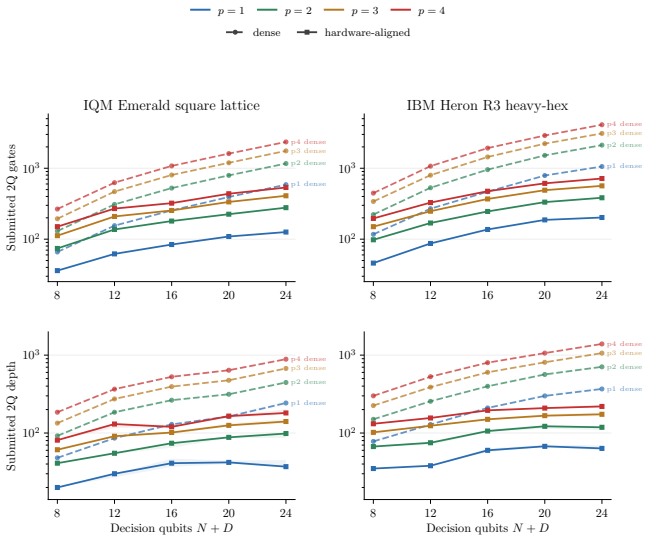
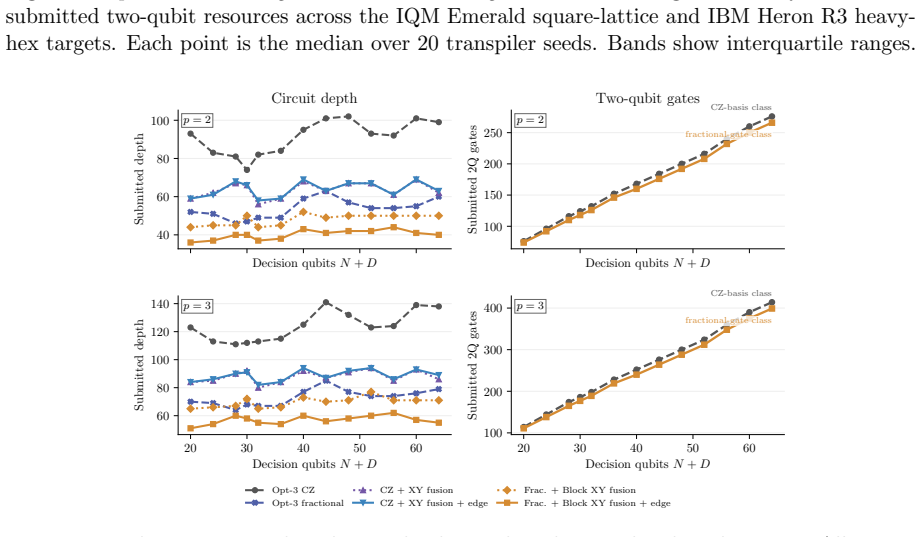
Joint sample-feature selection keeps calibration-error sensitivity constant and is solved by Coupling-Grouped XY-QAOA that cuts circuit depth 45.9-61.3%.
A machine-rendered reading of the paper's core claim, the machinery that carries it, and where it could break.
Core claim
Selecting anomalous samples and explanatory features under fixed budgets defines a coupled constrained-optimization problem. Sequential feature-first selection ranks features before choosing samples, which can overlook features whose utility depends on which samples are selected, especially when scores are calibrated from reference data that may be limited, noisy, or drifting. We instead formulate the task as joint sample-feature selection under the same fixed counts. In the analyzed formal model, calibration-error sensitivity grows linearly with the number of samples for feature-first ordering but stays constant for joint selection. We introduce Coupling-Grouped XY-QAOA, a constraint-preser
What carries the argument
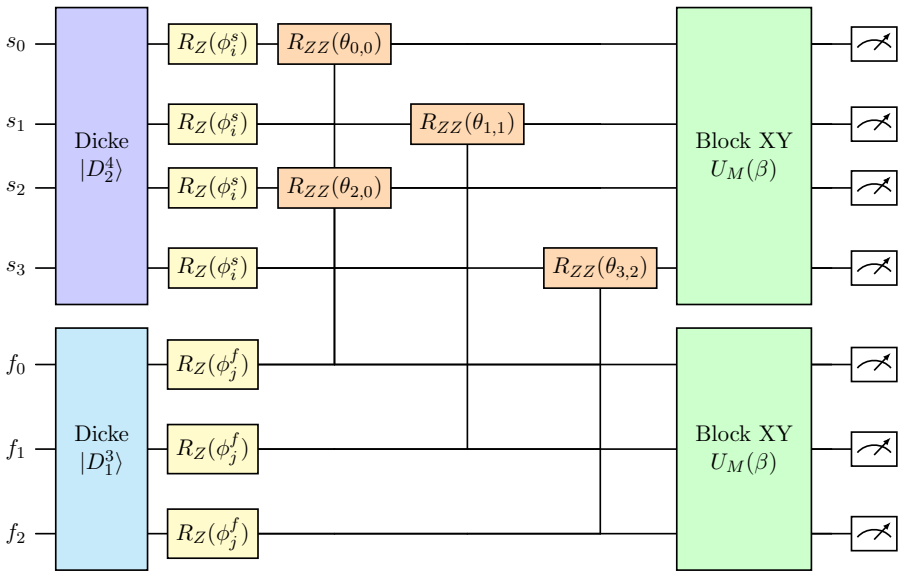
Coupling-Grouped XY-QAOA, a constraint-preserving grouped-angle variant of XY-QAOA that encodes bipartite sample-feature selection while reducing mixer depth.
If this is right
- Enables the largest reported width-depth configurations for constraint-preserving bipartite-selection QAOA: 64 qubits at p=2 and 36 qubits at p=3 with feasible-sector retention.
- Fixed-angle runs yield lower-energy feasible samples than matched random-feasible sampling across 36-64 qubits.
- Warm starts reduce the gap to strict-feasible classical references by 57.5-80.5 percent.
- Near-budget repair matches the sparse classical reference at 36 qubits.
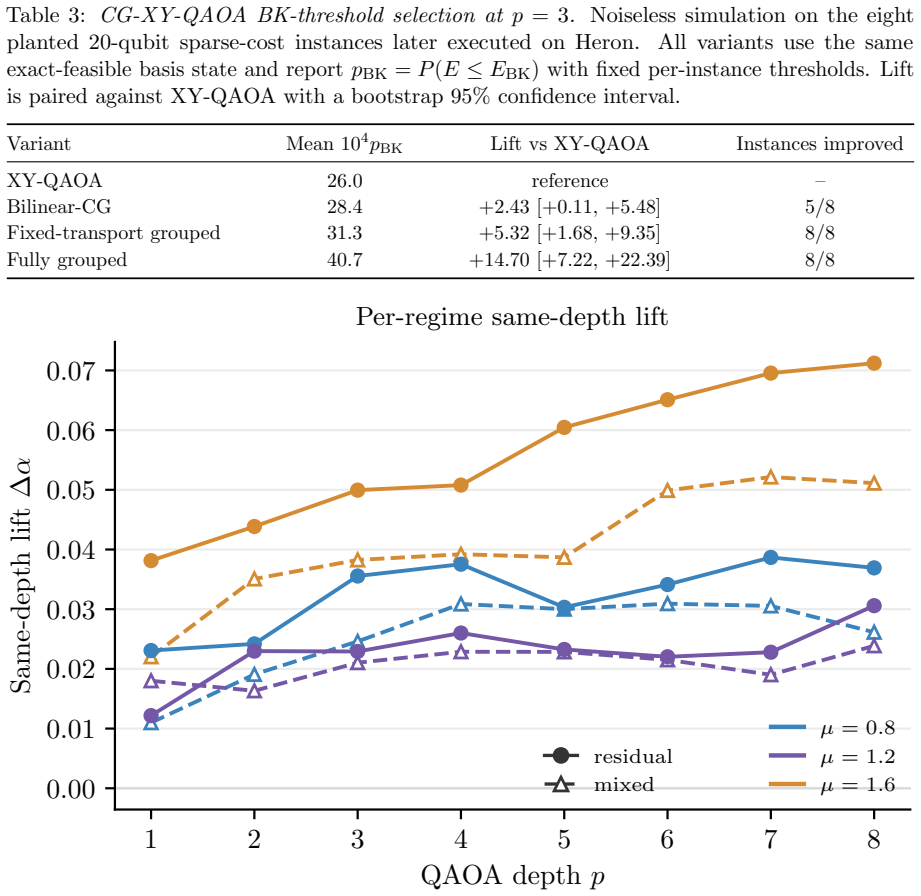
- Problem-structured angle grouping improves performance over same-depth XY-QAOA and matched-parameter randomization in noiseless simulations.
Where Pith is reading between the lines
- The constant sensitivity result suggests joint selection may remain stable on drifting reference data without repeated recalibration.
- Grouped-angle grouping may transfer to other constrained QAOA mixers that encode multiple selection variables.
- The reported 20-qubit p=5 runs retaining 63 percent valid samples indicate that feasible-sector retention scales with problem structure rather than depth alone.
Load-bearing premise
The formal model correctly shows calibration-error sensitivity grows linearly with sample count for feature-first ordering but stays constant for joint selection.
What would settle it
Measure selection accuracy under controlled calibration noise while increasing the number of samples; accuracy should degrade linearly in feature-first runs but remain flat in joint runs.
Figures
read the original abstract
Selecting anomalous samples and explanatory features under fixed budgets defines a coupled constrained-optimization problem. Sequential feature-first selection ranks features before choosing samples, which can overlook features whose utility depends on which samples are selected, especially when scores are calibrated from reference data that may be limited, noisy, or drifting. We instead formulate the task as joint sample-feature selection under the same fixed counts. In the analyzed formal model, calibration-error sensitivity grows linearly with the number of samples for feature-first ordering but stays constant for joint selection. We introduce Coupling-Grouped XY-QAOA, a constraint-preserving grouped-angle variant for the resulting optimization problem. On matched sparse IBM Heron R3 benchmarks, a hardware-aware implementation reduces circuit depth by 45.9%-61.3% and two-qubit gates by 2.6%-5.2% relative to Qiskit optimization level 3 on the CZ-basis target. It enables, to our knowledge, the largest reported width-depth configurations for constraint-preserving bipartite-selection QAOA hardware executions with feasible-sector retention: 64 qubits at p=2 and 36 qubits at p=3. The 20-qubit p=5 runs retain 63% valid samples. Across 36-64 qubits, fixed-angle runs yield lower-energy feasible samples than matched random-feasible sampling. Warm starts reduce the gap to strict-feasible classical references by 57.5%-80.5%, and near-budget repair matches the sparse classical reference at 36 qubits. Benchmarks show gains in balanced fixed-budget regimes, and noiseless simulations show that problem-structured angle grouping improves over same-depth XY-QAOA and matched-parameter, type-preserving randomization controls. Overall, the results support calibrated joint selection and hardware-realizable constrained-mixer execution in the tested regimes.
Editorial analysis
A structured set of objections, weighed in public.
Referee Report
Summary. The paper claims that joint sample-feature selection under fixed budgets outperforms sequential feature-first ordering in calibration-error sensitivity (linear growth vs constant), introduces Coupling-Grouped XY-QAOA as a constraint-preserving grouped-angle QAOA variant, and reports hardware benchmarks on IBM Heron R3 showing 45.9%-61.3% depth and 2.6%-5.2% two-qubit gate reductions relative to Qiskit level 3, enabling record configurations (64 qubits at p=2, 36 qubits at p=3) with feasible-sector retention and competitive energy/repair performance versus classical references.
Significance. If the formal model and benchmarks hold, the work provides a concrete demonstration of hardware-realizable constrained QAOA for bipartite selection in anomaly detection, with efficiency gains that expand feasible width-depth regimes and a theoretical distinction favoring joint over sequential selection under calibration noise. The explicit comparisons to random-feasible sampling, warm starts, and near-budget repair add practical value.
minor comments (3)
- Abstract: the reported depth/gate reductions and qubit records are presented without accompanying error bars, exact instance sizes, or sparsity parameters for the 'matched sparse' benchmarks, which would aid verification of the 45.9%-61.3% and 2.6%-5.2% figures.
- Abstract: the formal model result on calibration-error sensitivity (linear vs constant) is stated as an analyzed outcome but lacks a pointer to the specific equations or assumptions used in the derivation.
- The 20-qubit p=5 retention of 63% valid samples and the 57.5%-80.5% warm-start gap reduction are useful metrics but would benefit from explicit definition of 'valid samples' and the classical reference baseline in the abstract.
Simulated Author's Rebuttal
We thank the referee for the positive summary, significance assessment, and recommendation of minor revision. The report correctly captures the core claims regarding joint versus sequential selection under calibration noise, the Coupling-Grouped XY-QAOA formulation, and the reported hardware depth/gate reductions plus feasible-sector results on IBM Heron. No specific major comments appear in the provided report, so we have no point-by-point items to address.
Circularity Check
No significant circularity detected
full rationale
The paper's derivation chain consists of an analyzed formal model whose sensitivity result is stated as an output of that model, followed by an empirical QAOA construction whose performance claims (depth/gate reductions, width-depth records, feasible retention) are obtained from direct IBM Heron hardware executions and noiseless simulations. No equation or parameter is fitted to a subset and then renamed as a prediction; no self-citation is invoked as a uniqueness theorem or load-bearing premise; the joint-selection advantage is not defined in terms of itself. The reported benchmarks therefore remain independent of the paper's own fitted values or prior-author citations.
Axiom & Free-Parameter Ledger
Reference graph
Works this paper leans on
-
[1]
Peter L. Hammer and Sergiu Rudeanu. Pseudo-Boolean programming.Operations Research, 17(2):233–261, 1969. doi: 10.1287/opre.17.2.233
-
[2]
(2014) Ising formulations of many NP problems
Andrew Lucas. Ising formulations of many NP problems.Frontiers in Physics, 2:5, 2014. doi: 10.3389/fphy.2014.00005
-
[3]
Zhihui Wang, Nicholas C Rubin, Jason M Dominy, and Eleanor G Rieffel. XY mixers: Analytical and numerical results for the quantum alternating operator ansatz.Physical Review A, 101(1):012320, 2020. doi: 10.1103/PhysRevA.101.012320
-
[4]
Lotshaw, James Ostrowski, Travis S
Rebekah Herrman, Phillip C. Lotshaw, James Ostrowski, Travis S. Humble, and George Siopsis. Multi-angle quantum approximate optimization algorithm.Scientific Reports, 12 (1), 2022. doi: 10.1038/s41598-022-10555-8
-
[5]
A quantum approximate optimization algorithm.arXiv preprint arXiv:1411.4028, 2014
Edward Farhi, Jeffrey Goldstone, and Sam Gutmann. A quantum approximate optimization algorithm.arXiv preprint arXiv:1411.4028, 2014. URL https://arxiv.org/abs/1411.4 028
Pith/arXiv arXiv 2014
-
[6]
Stuart Hadfield, Zhihui Wang, Bryan O’Gorman, Eleanor G Rieffel, Davide Venturelli, and Rupak Biswas. From the quantum approximate optimization algorithm to a quantum alternating operator ansatz.Algorithms, 12(2):34, 2019. doi: 10.3390/a12020034
-
[7]
Coherence in spontaneous radiation processes.Physical Review, 93(1): 99–110, 1954
Robert H Dicke. Coherence in spontaneous radiation processes.Physical Review, 93(1): 99–110, 1954. doi: 10.1103/PhysRev.93.99
-
[8]
Deterministic preparation of Dicke states
Andreas B¨ artschi and Stephan Eidenbenz. Deterministic preparation of Dicke states. In Fundamentals of Computation Theory: 22nd International Symposium, FCT 2019, volume 11651, pages 126–139. Springer, 2019. doi: 10.1007/978-3-030-25027-0 9
-
[9]
Grover mixers for QAOA: Shifting complexity from mixer design to state preparation
Andreas B¨ artschi and Stephan Eidenbenz. Grover mixers for QAOA: Shifting complexity from mixer design to state preparation. In2020 IEEE International Conference on Quantum Computing and Engineering (QCE), pages 72–82. IEEE, 2020. doi: 10.1109/QCE49297.202 0.00020
-
[10]
Egger, Jakub Mareˇ cek, and Stefan Woerner
Daniel J. Egger, Jakub Mareˇ cek, and Stefan Woerner. Warm-starting quantum optimization. Quantum, 5:479, 2021. doi: 10.22331/q-2021-06-17-479
-
[11]
Matthew P. Harrigan et al. Quantum approximate optimization of non-planar graph problems on a planar superconducting processor.Nature Physics, 17(3):332–336, 2021. doi: 10.1038/s41567-020-01105-y
-
[12]
S. Ebadi et al. Quantum optimization of maximum independent set using Rydberg atom arrays.Science, 376(6598):1209–1215, 2022. doi: 10.1126/science.abo6587
-
[13]
Lukin, Sheng-Tao Wang, and Hannes Pichler
Minh-Thi Nguyen, Jin-Guo Liu, Jonathan Wurtz, Mikhail D. Lukin, Sheng-Tao Wang, and Hannes Pichler. Quantum optimization with arbitrary connectivity using Rydberg atom arrays.PRX Quantum, 4(1):010316, 2023. doi: 10.1103/PRXQuantum.4.010316
-
[14]
Zichang He, Ruslan Shaydulin, Shouvanik Chakrabarti, Dylan Herman, Changhao Li, Yue Sun, and Marco Pistoia. Alignment between initial state and mixer improves QAOA performance for constrained optimization.npj Quantum Information, 9(1):121, 2023. doi: 10.1038/s41534-023-00787-5. 29
-
[15]
Pradeep Niroula, Ruslan Shaydulin, Romina Yalovetzky, Pierre Minssen, Dylan Herman, Shaohan Hu, and Marco Pistoia. Constrained quantum optimization for extractive summa- rization on a trapped-ion quantum computer.Scientific Reports, 12(1):17171, 2022. doi: 10.1038/s41598-022-20853-w
-
[16]
Quantum approximate multi-objective optimization.Nature Computational Science, 5(12):1168–1177, 2025
Ayse Kotil et al. Quantum approximate multi-objective optimization.Nature Computational Science, 5(12):1168–1177, 2025. doi: 10.1038/s43588-025-00873-y
-
[17]
Short-depth QAOA circuits and quantum annealing on higher-order Ising models.npj Quantum Information, 10(30),
Elijah Pelofske, Andreas B¨ artschi, and Stephan Eidenbenz. Short-depth QAOA circuits and quantum annealing on higher-order Ising models.npj Quantum Information, 10(30),
-
[18]
127-qubit resource-matched comparison of QAOA against classical heuristics
doi: 10.1038/s41534-024-00825-w. 127-qubit resource-matched comparison of QAOA against classical heuristics
-
[19]
Ruslan Shaydulin and Marco Pistoia. QAOA with n·p≥ 200. In2023 IEEE International Conference on Quantum Computing and Engineering (QCE), pages 1074–1077, 2023. doi: 10.1109/QCE57702.2023.00121
-
[20]
Quantum approximate optimization algorithm with sparsified phase operator
Xiaoyuan Liu, Ruslan Shaydulin, and Ilya Safro. Quantum approximate optimization algorithm with sparsified phase operator. In2022 IEEE International Conference on Quantum Computing and Engineering (QCE), pages 133–141. IEEE, 2022. doi: 10.1109/QC E53715.2022.00032
work page doi:10.1109/qc 2022
-
[21]
Hodson, Brendan Ruck, Hugh Ong, David Garvin, and Stefan Dulman
Mark J. Hodson, Brendan Ruck, Hugh Ong, David Garvin, and Stefan Dulman. Portfolio rebalancing experiments using the quantum alternating operator ansatz.arXiv preprint arXiv:1911.05296, 2019. URLhttps://arxiv.org/abs/1911.05296
arXiv 1911
-
[22]
Tobias Stollenwerk, Stuart Hadfield, and Zhihui Wang. Toward quantum gate-model heuristics for real-world planning problems.IEEE Transactions on Quantum Engineering, 1:1–16, 2020. doi: 10.1109/TQE.2020.3030609
-
[23]
Pontus Vikst˚ al, Mattias Gr¨ onkvist, Marika Svensson, Martin Andersson, G¨ oran Johansson, and Giulia Ferrini. Applying the quantum approximate optimization algorithm to the tail-assignment problem.Physical Review Applied, 14(3):034009, 2020. doi: 10.1103/Phys RevApplied.14.034009
-
[24]
Fei Tony Liu, Kai Ming Ting, and Zhi-Hua Zhou. Isolation forest. In2008 Eighth IEEE International Conference on Data Mining, pages 413–422. IEEE, 2008. doi: 10.1109/ICDM .2008.17
-
[25]
LOF: identifying density-based local outliers
Markus M Breunig, Hans-Peter Kriegel, Raymond T Ng, and J¨ org Sander. LOF: identifying density-based local outliers. InProceedings of the 2000 ACM SIGMOD international conference on Management of data, pages 93–104, 2000. doi: 10.1145/342009.335388
-
[26]
Anomaly detection: A survey.ACM Computing Surveys, 41(3):1–58, 2009
Varun Chandola, Arindam Banerjee, and Vipin Kumar. Anomaly detection: A survey.ACM Computing Surveys, 41(3):1–58, 2009. doi: 10.1145/1541880.1541882
-
[27]
Jonas Herskind Sejr and Anna Schneider-Kamp. Explainable outlier detection: What, for whom and why?Machine Learning with Applications, 6:100172, 2021. doi: 10.1016/j.mlwa .2021.100172
-
[28]
Zhong Li, Yuxuan Zhu, and Matthijs van Leeuwen. A survey on explainable anomaly detection.ACM Transactions on Knowledge Discovery from Data, 18(1):23:1–23:54, 2024. doi: 10.1145/3609333
-
[29]
Contextual outlier interpretation
Ninghao Liu, Donghwa Shin, and Xia Hu. Contextual outlier interpretation. InProceedings of the Twenty-Seventh International Joint Conference on Artificial Intelligence, pages 2461– 2467, 2018. doi: 10.24963/ijcai.2018/341. 30
-
[30]
Murray Rosenblatt. Remarks on a multivariate transformation.The Annals of Mathematical Statistics, 23(3):470–472, 1952. doi: 10.1214/aoms/1177729394
-
[31]
Pascal Massart. The tight constant in the Dvoretzky-Kiefer-Wolfowitz inequality.The Annals of Probability, 18(3):1269–1283, 1990. doi: 10.1214/aop/1176990746
-
[32]
Vladimir Vovk, Alexander Gammerman, and Glenn Shafer.Algorithmic Learning in a Random World. Springer, 2022. doi: 10.1007/978-3-031-06649-8
-
[33]
and Kucukelbir, Alp and McAuliffe, Jon D
Jing Lei, Max G’Sell, Alessandro Rinaldo, Ryan J. Tibshirani, and Larry Wasserman. Distribution-free predictive inference for regression.Journal of the American Statistical Association, 113(523):1094–1111, 2018. doi: 10.1080/01621459.2017.1307116
-
[34]
Ery Arias-Castro, Emmanuel J. Cand` es, and Arnaud Durand. Detection of an anomalous cluster in a network.The Annals of Statistics, 39(1):278–304, 2011. doi: 10.1214/10-AOS839
-
[35]
Submatrix localization via message passing
Bruce Hajek, Yihong Wu, and Jiaming Xu. Submatrix localization via message passing. Journal of Machine Learning Research, 18(186):1–52, 2018. URL https://jmlr.org/pap ers/v18/17-297.html
2018
-
[36]
The maximum edge biclique problem is NP-complete.Discrete Applied Mathematics, 131(3):651–654, 2003
Ren´ e Peeters. The maximum edge biclique problem is NP-complete.Discrete Applied Mathematics, 131(3):651–654, 2003. doi: 10.1016/S0166-218X(03)00333-0
-
[37]
West.Introduction to Graph Theory
Douglas B. West.Introduction to Graph Theory. Prentice Hall, 2 edition, 2001. ISBN 9780130144003
2001
-
[38]
Qiskit: An open-source framework for quantum computing
Qiskit contributors. Qiskit: An open-source framework for quantum computing. Zenodo, 2019
2019
-
[39]
Harun Bayraktar, Ali Charara, David Clark, Saul Cohen, Timothy Costa, Yao-Lung L. Fang, Yang Gao, Jack Guan, John Gunnels, Azzam Haidar, Andreas Hehn, Markus Hohnerbach, Matthew Jones, Tom Lubowe, Dmitry Lyakh, Shinya Morino, Paul Springer, Sam Stanwyck, Igor Terentyev, Satya Varadhan, Jonathan Wong, and Takuma Yamaguchi. cuQuantum SDK: A high-performance...
-
[40]
Nicholas Metropolis, Arianna W. Rosenbluth, Marshall N. Rosenbluth, Augusta H. Teller, and Edward Teller. Equation of state calculations by fast computing machines.The Journal of Chemical Physics, 21(6):1087–1092, 1953. doi: 10.1063/1.1699114
-
[41]
Scott Kirkpatrick, C. Daniel Gelatt, and Mario P. Vecchi. Optimization by simulated annealing.Science, 220(4598):671–680, 1983. doi: 10.1126/science.220.4598.671
-
[42]
Kinetics of ising models
Kyozi Kawasaki. Kinetics of ising models. In Cyril Domb and Melville S. Green, editors, Phase Transitions and Critical Phenomena, volume 2, pages 443–501. Academic Press, 1972
1972
-
[43]
Interaction of Markov processes.Advances in Mathematics, 5(2):246–290,
Frank Spitzer. Interaction of Markov processes.Advances in Mathematics, 5(2):246–290,
-
[44]
doi: 10.1016/0001-8708(70)90034-4
-
[45]
Johnson, and Gianluca Bontempi
Andrea Dal Pozzolo, Olivier Caelen, Reid A. Johnson, and Gianluca Bontempi. Calibrating probability with undersampling for unbalanced classification. In2015 IEEE Symposium Series on Computational Intelligence, pages 159–166. IEEE, 2015. doi: 10.1109/ssci.2015.33
-
[46]
Credit card fraud detection
Machine Learning Group - ULB. Credit card fraud detection. Kaggle dataset, 2018. URL https://www.kaggle.com/datasets/mlg-ulb/creditcardfraud. Accessed 2026-01-30. 31
2018
-
[47]
Realistic synthetic financial transactions for anti-money laundering models
Erik Altman, Jovan Blanuˇ sa, Luc von Niederh¨ ausern, B´ eni Egressy, Andreea Anghel, and Kubilay Atasu. Realistic synthetic financial transactions for anti-money laundering models. InAdvances in Neural Information Processing Systems 36 (NeurIPS 2023), Datasets and Benchmarks Track, pages 29851–29874, 2023. doi: 10.52202/075280-1300. URL https://proceedi...
-
[48]
IBM transactions for anti money laundering (AML)
Erik Altman. IBM transactions for anti money laundering (AML). Kaggle dataset, 2025. URL https://www.kaggle.com/datasets/ealtman2019/ibm-transactions-for-a nti-money-laundering-aml . Public Kaggle release of the synthetic AML transaction benchmark; Accessed 2026-04-21
2025
-
[49]
Barkoutsos, Giacomo Nannicini, Anton Robert, Ivano Tavernelli, and Stefan Woerner
Panagiotis Kl. Barkoutsos, Giacomo Nannicini, Anton Robert, Ivano Tavernelli, and Stefan Woerner. Improving variational quantum optimization using CVaR.Quantum, 4:256, 2020. doi: 10.22331/q-2020-04-20-256
-
[50]
Stefan H. Sack and Daniel J. Egger. Large-scale quantum approximate optimization on non-planar graphs with machine learning noise mitigation.Physical Review Research, 6(1): 013223, 2024. doi: 10.1103/PhysRevResearch.6.013223
-
[51]
Ryan LaRose, Eleanor Rieffel, and Davide Venturelli. Mixer-phaser ans¨ atze for quantum optimization with hard constraints.Quantum Machine Intelligence, 4(1):17, 2022. doi: 10.1007/s42484-022-00069-x
-
[52]
Challenges and opportunities in quantum optimization.Nature Reviews Physics, 6(12):718–735, 2024
Amira Abbas et al. Challenges and opportunities in quantum optimization.Nature Reviews Physics, 6(12):718–735, 2024. doi: 10.1038/s42254-024-00770-9
-
[53]
Lov K. Grover. A fast quantum mechanical algorithm for database search. InProceedings of the 28th Annual ACM Symposium on Theory of Computing, pages 212–219, 1996. doi: 10.1145/237814.237866
-
[54]
Quantum amplitude amplifi- cation and estimation
Gilles Brassard, Peter Høyer, Michele Mosca, and Alain Tapp. Quantum amplitude amplifi- cation and estimation. InQuantum Computation and Information, pages 53–74. American Mathematical Society, 2002. doi: 10.1090/conm/305/05215
-
[55]
A quantum algorithm for finding the minimum.arXiv preprint quant-ph/9607014, 1996
Christoph D¨ urr and Peter Høyer. A quantum algorithm for finding the minimum.arXiv preprint quant-ph/9607014, 1996. URLhttps://arxiv.org/abs/quant-ph/9607014
Pith/arXiv arXiv 1996
-
[56]
Coles, Lukasz Cincio, Jarrod R
Martin Larocca, Supanut Thanasilp, Samson Wang, Kunal Sharma, Jacob Biamonte, Patrick J. Coles, Lukasz Cincio, Jarrod R. McClean, Zo¨ e Holmes, and Marco Cerezo. Barren plateaus in variational quantum computing.Nature Reviews Physics, 7:174–189, 2025. doi: 10.1038/s42254-025-00813-9
-
[57]
McClean, Sergio Boixo, Vadim N
Jarrod R. McClean, Sergio Boixo, Vadim N. Smelyanskiy, Ryan Babbush, and Hartmut Neven. Barren plateaus in quantum neural network training landscapes.Nature Communications, 9 (1):4812, 2018. doi: 10.1038/s41467-018-07090-4
-
[58]
Marco Cerezo, Akira Sone, Tyler Volkoff, Lukasz Cincio, and Patrick J. Coles. Cost function dependent barren plateaus in shallow parametrized quantum circuits.Nature Communications, 12(1):1791, 2021. doi: 10.1038/s41467-021-21728-w
-
[59]
Stuart Hadfield, Tad Hogg, and Eleanor G. Rieffel. Analytical framework for quantum alternating operator ans¨ atze.Quantum Science and Technology, 8(1):015017, 2023. doi: 10.1088/2058-9565/aca3ce. 32
-
[60]
2013.How to Build a Brain: A Neural Architecture for Biological Cognition
St´ ephane Boucheron, G´ abor Lugosi, and Pascal Massart.Concentration Inequalities: A Nonasymptotic Theory of Independence. Oxford University Press, 2013. ISBN 9780199535255. doi: 10.1093/acprof:oso/9780199535255.001.0001
work page doi:10.1093/acprof:oso/9780199535255.001.0001 2013
-
[61]
Wassily Hoeffding. Probability inequalities for sums of bounded random variables.Journal of the American Statistical Association, 58(301):13–30, 1963. doi: 10.1080/01621459.1963.10 500830
-
[62]
Empirical risk minimization for heavy- tailed losses.The Annals of Statistics, 43(6):2507–2536, 2015
Christian Brownlees, Emilien Joly, and G´ abor Lugosi. Empirical risk minimization for heavy- tailed losses.The Annals of Statistics, 43(6):2507–2536, 2015. doi: 10.1214/15-AOS1350
-
[63]
Sture Holm. A simple sequentially rejective multiple test procedure.Scandinavian Journal of Statistics, 6(2):65–70, 1979. URLhttps://www.jstor.org/stable/4615733
arXiv 1979
-
[64]
Rønnow, Zhihui Wang, Joshua Job, Sergio Boixo, Sergei V
Troels F. Rønnow, Zhihui Wang, Joshua Job, Sergio Boixo, Sergei V. Isakov, David Wecker, John M. Martinis, Daniel A. Lidar, and Matthias Troyer. Defining and detecting quantum speedup.Science, 345(6195):420–424, 2014. doi: 10.1126/science.1252319. 33 Supplementary Material This supplement provides proofs, robustness analyses, and extended hardware results...
-
[65]
If the calibrated field has additive row and feature bias cWij =W ij +a i +b j, then bCj =C j +A+N b j, A:= NX i=1 ai, and bB(S, F) =B(S, F) +m X i∈S ai +k X j∈F bj. Thus row-only bias cancels from the sequential feature ranking, while feature bias is amplified by the pool size N in the sequential margin and enters the joint objective only through the fea...
-
[66]
Hence centered shared drift matters to the sequential feature ranking only through its nonzero row-sum component U
If the calibrated field has rank-one drift cWij =W ij +u ivj, then bCj =C j +U v j, U:= NX i=1 ui, and bB(S, F) =B(S, F) + X i∈S ui ! X j∈F vj . Hence centered shared drift matters to the sequential feature ranking only through its nonzero row-sum component U. A mean-shifted row factor behaves like feature bias after aggregation. Proof. Both claims ...
discussion (0)
Sign in with ORCID, Apple, or X to comment. Anyone can read and Pith papers without signing in.