REVIEW 2 major objections 6 minor 98 references
No tidal debris links Boötes III to the Styx stream; the dwarf's tails are either too faint or already erased.
Reviewed by Pith at T0; open to challenge. T0 means a machine referee read the full paper against a public rubric. the ladder, T0–T4 →
T0 review · grok-4.5
2026-07-31 02:46 UTC pith:PDMEHMYT
load-bearing objection Careful multi-survey null on Boo3–Styx: new CaHK metallicities plus a geometric orbit mismatch that stands independent of selection completeness. the 2 major comments →
Characterizing the disruption of B\"ootes III: a missing link in the Galactic halo?
The pith
A machine-rendered reading of the paper's core claim, the machinery that carries it, and where it could break.
Core claim
Despite multi-tracer kinematic searches and matched-filter maps of SDSS and DELVE, there is no observational evidence that directly links Boötes III to Styx. Candidate stars beyond about five half-light radii fail both distance and proper-motion tests against the dwarf's orbit, and only a few extreme orbits graze Styx's reported track. Either Boötes III's extended debris is too diffuse to detect, or its particular orbit has erased a coherent tidal signature.
What carries the argument
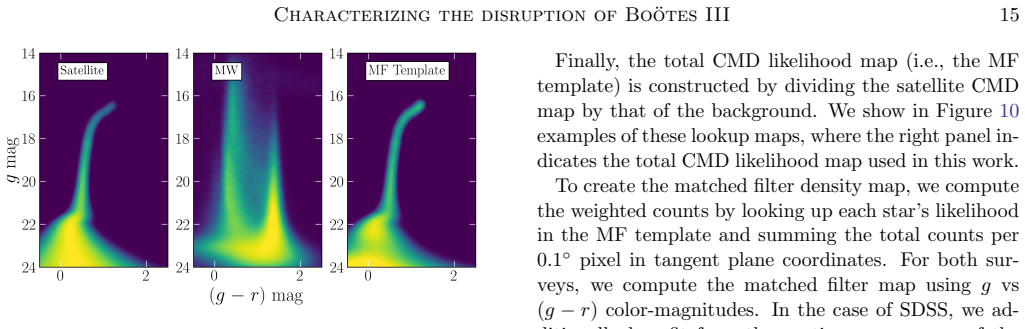
A dual search: (1) sigma-clipping of UNIONS BHB and RGB tracers in proper-motion versus sky position, anchored by mock Boötes III stars so the fit is not pulled by foreground errors; (2) matched-filter density maps built from a single old, metal-poor isochrone on SDSS and DELVE, compared directly to the integrated orbit and to digitized Styx nodes.
Load-bearing premise
That the kinematic clip and the isochrone matched filters would have recovered a real Boötes III stream if one existed above the estimated surface-brightness limit along the predicted orbit, so non-detection is astrophysical rather than a selection or distance-gradient failure.
What would settle it
Spectroscopic radial velocities and metallicities for a statistically useful sample of stars lying on the predicted leading or trailing orbit (especially the nearby 10–20 kpc trailing segment) that either match Boötes III or rule it out; or a deeper photometric detection of a stream whose surface brightness exceeds the ~33.4 mag arcsec−² upper limit reported here.
If this is right
- Styx should be treated as an orphan stream until a different progenitor is identified.
- Boötes III joins the short list of ultra-faint dwarfs whose disruption may leave no coherent tails above present detection limits.
- Upper limit on any Boötes III stream surface brightness is roughly 33.4 mag arcsec−².
- Future models of the system must include a rotating bar and the LMC if they are to test whether debris has been chaotically fanned or impulsively stripped.
- Deeper multi-band imaging plus spectroscopy remains the only practical route to settle membership of the outer candidate stars.
Where Pith is reading between the lines
- The steep distance gradient predicted near the dwarf may systematically hide leading-arm stars even in well-tuned matched filters, so null results for other eccentric UFDs should be checked against the same gradient effect.
- If bar-driven chaotic fanning operated at the most recent pericenter, similar non-detections should appear among other polar, low-pericenter streams once comparable multi-tracer searches are applied.
- The revised, narrower metallicity dispersion makes chemical tagging of any future candidate members cleaner than earlier spectroscopic estimates allowed.
Editorial analysis
A structured set of objections, weighed in public.
Referee Report
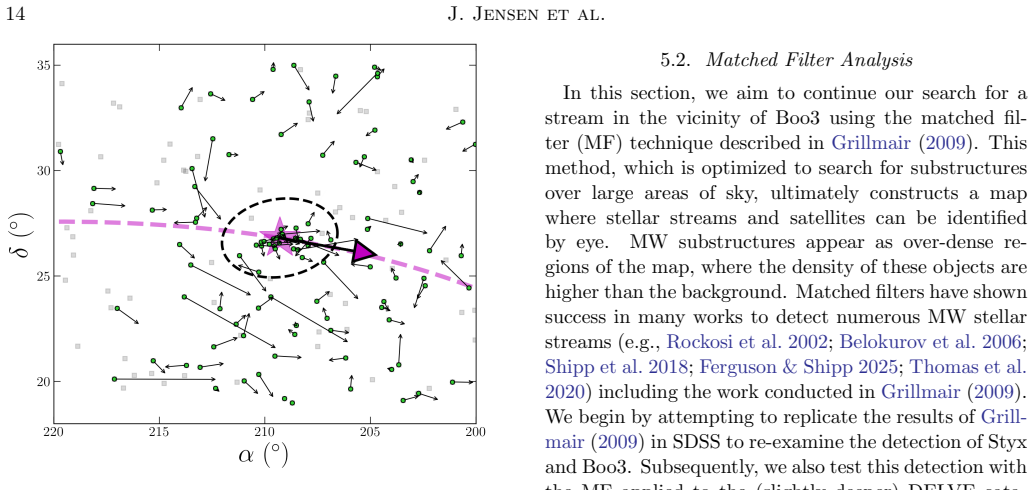
Summary. The manuscript re-examines the long-suspected association between the ultra-faint dwarf Boötes III and the Styx stellar stream. Using Gaia-selected candidates, new CFHT/MegaCam CaHK photometry (yielding [Fe/H] = −2.1 ± 0.1 and σ_Fe/H = 0.2 ± 0.1), UNIONS BHB/RGB tracers with a kinematic sigma-clipping search, and matched-filter maps from SDSS DR17 and DELVE DR2, the authors find no co-moving debris beyond ~5 rh consistent with Boo3’s orbit and no geometric alignment between Styx’s on-sky path and the bulk of Monte Carlo orbits drawn within Boo3’s observational errors (only ~4–6% of orbits pass near ≥3 Styx nodes, preferentially at extreme μδ). They conclude there is no direct observational link, attribute the non-detection either to debris below ~33.4 mag arcsec−2 or to orbital erasure of a coherent signature, and call for spectroscopy and more complete dynamical modeling.
Significance. A careful multi-tracer null result on a widely assumed progenitor–stream pair is valuable for Galactic archaeology. The work strengthens the case that morphological and kinematic disruption indicators in UFDs need not imply a detectable, coherent stream, and it supplies an independent CaHK metallicity and a reduced metallicity dispersion that will be useful for future membership work. The geometric MC orbit test against digitized Styx nodes is a particularly clean, selection-independent pillar of the non-association claim. The particle-spray exploration of distance gradients and the explicit surface-brightness upper limit make the null falsifiable with deeper data. Credit is due for the honest framing and for cross-checking SDSS against DELVE to discard an observing-stripe artifact.
major comments (2)
- [§5.2, Fig. 12] §5.2 and Fig. 12: The claim that only 4% (static) / 6% (evolving) of MC orbits align with Styx rests on nodes digitized by hand from Grillmair (2009) and transformed via Stoughton et al. (2002). The manuscript does not quantify digitization or transformation uncertainty, nor does it show how the alignment fraction changes if nodes are perturbed by plausible on-sky errors (e.g., ±0.5–1°). Because this geometric mismatch is a load-bearing pillar of the non-association result, a short sensitivity test (or an explicit uncertainty on the node positions) should be added so readers can judge robustness.
- [§7] §7: The stream surface-brightness upper limit of ~33.4 mag arcsec−2 is obtained from the ratio of MF surface density within 1 rh of Boo3 to that of a similar area along the orbit. The procedure is only sketched; the precise apertures, background treatment, and conversion from MF weight density to mag arcsec−2 are not specified. Given that this limit is used to interpret the null as astrophysical rather than purely methodological, the calculation should be written out (or moved to an appendix) with enough detail to be reproducible.
minor comments (6)
- [Table 1] Table 1 lists RV = 197.5 ± 3.8 km s−1 with citation “(−)”; please supply the reference (presumably Carlin et al. 2009 or an update).
- [§5.1] §5.1: The injection of 10,000 mock Boo3 stars to anchor the sigma-clip fit is reasonable for a null search, but a one-sentence statement that the mocks are used only to stabilize the fit (and are removed before reporting the surviving sample) would avoid confusion about sample purity.
- [Fig. 11] Fig. 11 / Appendix B.2: The SDSS stripe artifact argument is convincing; consider marking the stripe direction explicitly on the main MF figure so readers need not flip to the appendix.
- [§6.1] §6.1: The search of galstreams for a trailing-arm counterpart at 10–20 kpc is useful; briefly state the search criteria (sky box, distance window) so the non-match is reproducible.
- [Introduction / §4] The footnote on Li et al. (2026) spectroscopic members at 3–6 rh is important; a short comparison of their positions/kinematics to your Gaia/CaHK sample in §4 or §5 would strengthen continuity with concurrent work.
- Minor typography: “Bo¨ otes” / “Boötes” spacing is inconsistent in places; “DEL VE” is split oddly throughout; unify to Boötes and DELVE.
Circularity Check
No significant circularity: null Boo3–Styx association is an independent multi-survey non-detection, not a fit or self-definition.
specific steps
-
self citation load bearing
[§3.1; §5.1 (sigma-clip anchoring)]
"The first dataset used in this work is the resulting candidate list for Boo3, obtained by Jensen et al. (2024). ... In order to ensure that the trendlines indeed remain consistent to that of Boo3 ... we stabilize the fit by generating 10,000 MC sampled “stars” to represent the dwarf. ... These mock stars are appended to our sample prior to running the routine, which serves to anchor the fit to Boo3’s observables."
Membership probabilities and the PM-fit anchor both originate in prior/overlapping-author work and Boo3’s own observables. This is minor and non-load-bearing: the Styx non-association is independently supported by external UNIONS distances/PM vectors, SDSS/DELVE MF geometry, and the MC orbit–node mismatch, none of which are forced by the Jensen catalogue or the mocks.
full rationale
The paper’s load-bearing claim is a hedged observational null (no direct link between Boo3 and Styx; debris either too diffuse or orbitally erased). That conclusion is built from (i) UNIONS BHB/RGB tracers run through a sigma-clip that is checked against independent photometric distances and solar-reflex PM vectors, (ii) matched-filter maps on external SDSS DR17 and DELVE DR2 photometry that recover known satellites and Styx itself, and (iii) a geometric MC orbit test (1000 draws of µα*, µδ, D, RV in static and LMC-evolving AGAMA potentials) showing only 4–6% of orbits pass within 0.5° of ≥3 digitized Styx nodes, and those successes require µδ largely outside the 1σ Gaia error. None of these steps equals its inputs by construction: the MF template is a fixed 12 Gyr, [Fe/H]=−2.1 isochrone likelihood ratio, not a fit to Styx; the particle-spray is illustrative, not used to select candidates; metallicity ([Fe/H]=−2.1±0.1, σ=0.2±0.1) is newly fit to CaHK data and used only as a selection prior. The sole minor self-dependence is reuse of Jensen et al. (2024) Gaia membership probabilities (overlapping authors) plus 10k mock Boo3 stars to anchor the PM–RA linear fit against foreground pull—methodological stabilization, not a predicted quantity forced by a fit. Central null remains externally falsifiable and does not reduce to those inputs.
Axiom & Free-Parameter Ledger
free parameters (6)
- Boo3 mean [Fe/H] and σ_Fe/H from CaHK MCMC =
[Fe/H]=−2.1±0.1, σ=0.2±0.1
- MF isochrone age and fixed RGB color width =
12 Gyr; 0.1 mag
- Sigma-clip PM radius and distance window =
2 mas yr−1; 35–80 kpc
- Gaussian MF smoothing and background polynomial degree =
0.2°; degree 5
- Particle-spray start time and escape seeding =
3 Gyr lookback; Δt=5 Myr
- Stream SB upper-limit ratio method =
~33.4 mag arcsec−2
axioms (6)
- domain assumption Static Thomas & Battaglia (2022)-like and Vasiliev et al. (2021) MW+LMC potentials adequately represent the true Galactic potential for Boo3’s orbit over ±5 Gyr.
- domain assumption Gaia membership probabilities P_max≥0.2 from Jensen et al. (2024) plus CaHK quality cuts select a sufficiently pure Boo3 RGB sample for metallicity and spatial tests.
- domain assumption Pristine-style CaHK–Gaia photometric metallicity calibration (Martin et al. 2024) is unbiased for Boo3 RGB stars in the applied color and mcfrac range.
- ad hoc to paper Styx’s on-sky path is adequately represented by nodes digitized from Grillmair (2009) MF maps and transformed via Stoughton et al. (2002).
- domain assumption Absence of co-moving UNIONS tracers and MF overdensity along the orbit implies no detectable coherent Boo3 stream above the survey limits (not merely a failed selection).
- standard math Standard astropy Solar position/velocity and right-handed Galactocentric frame conversions.
read the original abstract
The B\"ootes III (Boo3) dwarf galaxy has long been suspected of being the progenitor of Styx, a ~50{\deg}-long stellar stream that was simultaneously discovered in the same region of sky. Boo3's diffuse morphology, large velocity dispersion, small pericenter, and excess of candidate stars at large radii suggest it is undergoing active tidal disruption. A link to Styx is therefore logical; however, a clear connection between these structures has not yet been clearly demonstrated. Here, we re-examine the Boo3-Styx association by searching for Boo3's tidal debris using a combination of Gaia-selected members, new CaHK narrow-band imaging with CFHT/MegaCam, and stellar tracer catalogues of blue horizontal branch and red giant branch stars. We also conduct a broad search for a putative stream using matched filter techniques applied to SDSS DR17 and DELVE DR2. Despite our extensive search, we find no observational evidence directly linking Boo3 to Styx. Furthermore, our results suggest that either Boo3's extended substructure is too diffuse to be detected with current data, or that its particular orbit may have erased a coherent tidal signature. Boo3 thus remains an enigmatic system, and exemplifies the need for spectroscopic follow-up to properly disentangle the nature between this faint Milky Way satellite and nearby stream.
Figures




Reference graph
Works this paper leans on
-
[1]
2022, ApJS, 259, 35, doi: 10.3847/1538-4365/ac4414 Astropy Collaboration, Robitaille, T
Abdurro’uf, Accetta, K., Aerts, C., et al. 2022, ApJS, 259, 35, doi: 10.3847/1538-4365/ac4414 Astropy Collaboration, Robitaille, T. P., Tollerud, E. J., et al. 2013, A&A, 558, A33, doi: 10.1051/0004-6361/201322068 Characterizing the disruption of Bo¨otes III25 Astropy Collaboration, Price-Whelan, A. M., Sip˝ ocz, B. M., et al. 2018, AJ, 156, 123, doi: 10....
-
[2]
Atzberger, K. R., Pace, A. B., Kallivayalil, N., et al. 2026, arXiv e-prints, arXiv:2602.21283, doi: 10.48550/arXiv.2602.21283
-
[3]
Battaglia, G., Taibi, S., Thomas, G. F., & Fritz, T. K. 2022, A&A, 657, A54, doi: 10.1051/0004-6361/202141528
-
[4]
Belokurov, V., Zucker, D. B., Evans, N. W., et al. 2006, ApJL, 642, L137, doi: 10.1086/504797
doi:10.1086/504797 2006
-
[5]
Bernard, E. J., Ferguson, A. M. N., Schlafly, E. F., et al. 2014, MNRAS, 443, L84, doi: 10.1093/mnrasl/slu089
-
[6]
Bonaca, A., & Price-Whelan, A. M. 2025, NewAR, 100, 101713, doi: 10.1016/j.newar.2024.101713
arXiv 2025
-
[7]
2013, ApJ, 779, 115, doi: 10.1088/0004-637X/779/2/115
Bovy, J., & Rix, H.-W. 2013, ApJ, 779, 115, doi: 10.1088/0004-637X/779/2/115
-
[8]
Bullock, J. S., & Boylan-Kolchin, M. 2017, ARA&A, 55, 343, doi: 10.1146/annurev-astro-091916-055313
-
[9]
Bullock, J. S., & Johnston, K. V. 2005, ApJ, 635, 931, doi: 10.1086/497422
doi:10.1086/497422 2005
-
[10]
Callingham, T. M., Cautun, M., Deason, A. J., et al. 2019, MNRAS, 484, 5453, doi: 10.1093/mnras/stz365
-
[11]
Carlin, J. L., Grillmair, C. J., Mu˜ noz, R. R., Nidever, D. L., & Majewski, S. R. 2009, ApJL, 702, L9, doi: 10.1088/0004-637X/702/1/L9
-
[12]
Carlin, J. L., & Sand, D. J. 2018, ApJ, 865, 7, doi: 10.3847/1538-4357/aad8c1
-
[13]
Cautun, M., Ben ´ ıtez-Llambay, A., Deason, A. J., et al. 2020, MNRAS, 494, 4291, doi: 10.1093/mnras/staa1017
-
[14]
Cerny, W., Pace, A. B., Drlica-Wagner, A., et al. 2021a, ApJ, 910, 18, doi: 10.3847/1538-4357/abe1af —. 2021b, ApJL, 920, L44, doi: 10.3847/2041-8213/ac2d9a
-
[16]
Correnti, M., Bellazzini, M., & Ferraro, F. R. 2009, MNRAS, 397, L26, doi: 10.1111/j.1745-3933.2009.00677.x
arXiv 2009
-
[17]
Deason, A. J., Belokurov, V., & Evans, N. W. 2011, MNRAS, 416, 2903, doi: 10.1111/j.1365-2966.2011.19237.x
arXiv 2011
-
[18]
J., Erkal, D., Belokurov, V., et al
Deason, A. J., Erkal, D., Belokurov, V., et al. 2021, MNRAS, 501, 5964, doi: 10.1093/mnras/staa3984
-
[19]
2025, A&A, 700, A154, doi: 10.1051/0004-6361/202554252
Dodd, E., Matsuno, T., Helmi, A., et al. 2025, A&A, 700, A154, doi: 10.1051/0004-6361/202554252
-
[20]
Drlica-Wagner, A., Ferguson, P. S., Adam´ ow, M., et al. 2022, ApJS, 261, 38, doi: 10.3847/1538-4365/ac78eb
-
[21]
Eilers, A.-C., Hogg, D. W., Rix, H.-W., & Ness, M. K. 2019, ApJ, 871, 120, doi: 10.3847/1538-4357/aaf648
-
[22]
Erkal, D., Belokurov, V., Laporte, C. F. P., et al. 2019, MNRAS, 487, 2685, doi: 10.1093/mnras/stz1371
-
[23]
Errani, R., & Pe˜ narrubia, J. 2020, MNRAS, 491, 4591, doi: 10.1093/mnras/stz3349 Euclid Collaboration, Mellier, Y., Abdurro’uf, et al. 2025, A&A, 697, A1, doi: 10.1051/0004-6361/202450810
-
[24]
Fardal, M. A., Huang, S., & Weinberg, M. D. 2015, MNRAS, 452, 301, doi: 10.1093/mnras/stv1198
-
[25]
Fellhauer, M., Evans, N. W., Belokurov, V., et al. 2007, MNRAS, 375, 1171, doi: 10.1111/j.1365-2966.2006.11404.x
arXiv 2007
-
[26]
The DECam Field of Streams: a deep view of the Milky Way halo
Ferguson, P., & Shipp, N. 2025, arXiv e-prints, arXiv:2506.05469, doi: 10.48550/arXiv.2506.05469
work page internal anchor Pith review Pith/arXiv arXiv doi:10.48550/arxiv.2506.05469 2025
-
[27]
Foreman-Mackey, D., Hogg, D. W., Lang, D., & Goodman, J. 2013, PASP, 125, 306, doi: 10.1086/670067
doi:10.1086/670067 2013
-
[28]
Frenk, C. S., White, S. D. M., Davis, M., & Efstathiou, G. 1988, ApJ, 327, 507, doi: 10.1086/166213 Gaia Collaboration, Brown, A. G. A., Vallenari, A., et al. 2018, A&A, 616, A1, doi: 10.1051/0004-6361/201833051 —. 2021, A&A, 649, A1, doi: 10.1051/0004-6361/202039657 Gaia Collaboration, Vallenari, A., Brown, A. G. A., et al. 2023, A&A, 674, A1, doi: 10.10...
doi:10.1086/166213 1988
-
[29]
Girardi, L., Bertelli, G., Bressan, A., et al. 2002, A&A, 391, 195, doi: 10.1051/0004-6361:20020612 Gravity Collaboration, Abuter, R., Amorim, A., et al. 2019, A&A, 625, L10, doi: 10.1051/0004-6361/201935656
-
[30]
2024, gregreen/dustmaps: v1.0.13, v1.0.13, Zenodo, doi: 10.5281/zenodo.10517733
Green, G., Edenhofer, G., Krughoff, S., et al. 2024, gregreen/dustmaps: v1.0.13, v1.0.13, Zenodo, doi: 10.5281/zenodo.10517733
-
[31]
Grillmair, C. J. 2009, ApJ, 693, 1118, doi: 10.1088/0004-637X/693/2/1118
-
[32]
Gwyn, S., McConnachie, A. W., Cuillandre, J.-C., et al. 2025, arXiv e-prints, arXiv:2503.13783. https://arxiv.org/abs/2503.13783
Pith/arXiv arXiv 2025
-
[33]
Harris, C. R., Millman, K. J., van der Walt, S. J., et al. 2020, Nature, 585, 357, doi: 10.1038/s41586-020-2649-2
-
[34]
Harris, W. E. 1996, AJ, 112, 1487, doi: 10.1086/118116
doi:10.1086/118116 1996
-
[35]
Hastings, W. K. 1970, Biometrika, 57, 97, doi: 10.1093/biomet/57.1.97
-
[36]
Hattori, K., Erkal, D., & Sanders, J. L. 2016, MNRAS, 460, 497, doi: 10.1093/mnras/stw1006
-
[37]
2020, ARA&A, 58, 205, doi: 10.1146/annurev-astro-032620-021917
Helmi, A. 2020, ARA&A, 58, 205, doi: 10.1146/annurev-astro-032620-021917
-
[38]
Helmi, A., Babusiaux, C., Koppelman, H. H., et al. 2018, Nature, 563, 85, doi: 10.1038/s41586-018-0625-x
-
[39]
Helmi, A., White, S. D. M., de Zeeuw, P. T., & Zhao, H. 1999, Nature, 402, 53, doi: 10.1038/46980
doi:10.1038/46980 1999
-
[40]
Horta, D., Schiavon, R. P., Mackereth, J. T., et al. 2023, MNRAS, 520, 5671, doi: 10.1093/mnras/stac3179
-
[41]
Hunter, J. D. 2007, Computing in Science and Engineering, 9, 90, doi: 10.1109/MCSE.2007.55 26J. Jensen et al
-
[42]
2024, ApJ, 967, 89, doi: 10.3847/1538-4357/ad382d
Ibata, R., Malhan, K., Tenachi, W., et al. 2024, ApJ, 967, 89, doi: 10.3847/1538-4357/ad382d
-
[43]
Ibata, R. A., Lewis, G. F., Irwin, M. J., & Cambr´ esy, L. 2002, MNRAS, 332, 921, doi: 10.1046/j.1365-8711.2002.05360.x
arXiv 2002
-
[44]
A., McConnachie, A., Cuilland re, J.-C., et al
Ibata, R. A., McConnachie, A., Cuilland re, J.-C., et al. 2017, ApJ, 848, 128, doi: 10.3847/1538-4357/aa855c
-
[45]
Jensen, J., Hayes, C. R., Sestito, F., et al. 2024, MNRAS, 527, 4209, doi: 10.1093/mnras/stad3322
-
[46]
Jensen, J., Thomas, G., McConnachie, A. W., et al. 2021, MNRAS, 507, 1923, doi: 10.1093/mnras/stab2325
-
[47]
Johnston, K. V., Zhao, H., Spergel, D. N., & Hernquist, L. 1999, ApJL, 512, L109, doi: 10.1086/311876 Juri´ c, M., Ivezi´ c,ˇZ., Brooks, A., et al. 2008, ApJ, 673, 864, doi: 10.1086/523619
doi:10.1086/311876 1999
-
[48]
2001, MNRAS, 322, 231, doi: 10.1046/j.1365-8711.2001.04022.x
Kroupa, P. 2001, MNRAS, 322, 231, doi: 10.1046/j.1365-8711.2001.04022.x
arXiv 2001
-
[49]
Bo\"otes III is a Tidally Disrupting Ultra-Faint Dwarf Galaxy on an Eccentric Polar Orbit
Li, T. S., Erkal, D., Pace, A. B., et al. 2026, arXiv e-prints, arXiv:2607.07803, doi: 10.48550/arXiv.2607.07803
work page internal anchor Pith review Pith/arXiv arXiv doi:10.48550/arxiv.2607.07803 2026
-
[50]
Licquia, T. C., & Newman, J. A. 2015, ApJ, 806, 96, doi: 10.1088/0004-637X/806/1/96
-
[51]
Limberg, G., Ji, A. P., Li, T. S., et al. 2025, arXiv e-prints, arXiv:2512.02177, doi: 10.48550/arXiv.2512.02177
-
[52]
2018, A&A, 616, A2, doi: 10.1051/0004-6361/201832727
Lindegren, L., Hern´ andez, J., Bombrun, A., et al. 2018, A&A, 616, A2, doi: 10.1051/0004-6361/201832727
-
[53]
2021, A&A, 649, A4, doi: 10.1051/0004-6361/202039653
Lindegren, L., Bastian, U., Biermann, M., et al. 2021, A&A, 649, A4, doi: 10.1051/0004-6361/202039653
-
[54]
2018, MNRAS, 480, 2609, doi: 10.1093/mnras/sty1986 —
Longeard, N., Martin, N., Starkenburg, E., et al. 2018, MNRAS, 480, 2609, doi: 10.1093/mnras/sty1986 —. 2020, MNRAS, 491, 356, doi: 10.1093/mnras/stz2854
-
[55]
2022, MNRAS, 516, 2348, doi: 10.1093/mnras/stac1827
Longeard, N., Jablonka, P., Arentsen, A., et al. 2022, MNRAS, 516, 2348, doi: 10.1093/mnras/stac1827
-
[56]
2023, MNRAS, 525, 3086, doi: 10.1093/mnras/stad2227
Longeard, N., Jablonka, P., Battaglia, G., et al. 2023, MNRAS, 525, 3086, doi: 10.1093/mnras/stad2227
-
[57]
Magnier, E. A., & Cuillandre, J. C. 2004, PASP, 116, 449, doi: 10.1086/420756
doi:10.1086/420756 2004
-
[58]
Ostheimer, J. C. 2003, ApJ, 599, 1082, doi: 10.1086/379504
doi:10.1086/379504 2003
-
[59]
Malhan, K., Ibata, R. A., & Martin, N. F. 2018, MNRAS, 481, 3442, doi: 10.1093/mnras/sty2474
-
[60]
2024, ApJ, 964, 104, doi: 10.3847/1538-4357/ad1885
Malhan, K., & Rix, H.-W. 2024, ApJ, 964, 104, doi: 10.3847/1538-4357/ad1885
-
[61]
F., Starkenburg, E., Yuan, Z., et al
Martin, N. F., Starkenburg, E., Yuan, Z., et al. 2024, A&A, 692, A115, doi: 10.1051/0004-6361/202347633 Mart ´ ınez-V´ azquez, C. E., Cerny, W., Vivas, A. K., et al. 2021, AJ, 162, 253, doi: 10.3847/1538-3881/ac2368
-
[62]
2023, MNRAS, 520, 5225, doi: 10.1093/mnras/stad321
Mateu, C. 2023, MNRAS, 520, 5225, doi: 10.1093/mnras/stad321
-
[63]
Mau, S., Cerny, W., Pace, A. B., et al. 2020, ApJ, 890, 136, doi: 10.3847/1538-4357/ab6c67
-
[64]
McConnachie, A. W. 2012, AJ, 144, 4, doi: 10.1088/0004-6256/144/1/4
-
[65]
McConnachie, A. W., & Venn, K. A. 2020, AJ, 160, 124, doi: 10.3847/1538-3881/aba4ab
-
[66]
McMillan, P. J. 2017, MNRAS, 465, 76, doi: 10.1093/mnras/stw2759
-
[67]
Moskowitz, A. G., & Walker, M. G. 2020, ApJ, 892, 27, doi: 10.3847/1538-4357/ab7459
-
[68]
P., Conroy, C., Bonaca, A., et al
Naidu, R. P., Conroy, C., Bonaca, A., et al. 2020, ApJ, 901, 48, doi: 10.3847/1538-4357/abaef4
-
[69]
Pace, A. B. 2025, The Open Journal of Astrophysics, 8, 142, doi: 10.33232/001c.144859
-
[71]
Pearson, S., Price-Whelan, A. M., & Johnston, K. V. 2017, Nature Astronomy, 1, 633, doi: 10.1038/s41550-017-0220-3
-
[72]
Plummer, H. C. 1911, MNRAS, 71, 460, doi: 10.1093/mnras/71.5.460
-
[73]
2017, MNRAS, 465, 1621, doi: 10.1093/mnras/stw2819
Portail, M., Gerhard, O., Wegg, C., & Ness, M. 2017, MNRAS, 465, 1621, doi: 10.1093/mnras/stw2819
-
[74]
Price-Whelan, A. M. 2017, Gala: Galactic astronomy and gravitational dynamics, Astrophysics Source Code Library, record ascl:1707.006. http://ascl.net/1707.006
2017
-
[75]
Price-Whelan, A. M., Sesar, B., Johnston, K. V., & Rix, H.-W. 2016, ApJ, 824, 104, doi: 10.3847/0004-637X/824/2/104
-
[76]
Kleyna, J. T. 2006, MNRAS, 367, 387, doi: 10.1111/j.1365-2966.2005.09959.x
arXiv 2006
-
[77]
M., Odenkirchen, M., Grebel, E
Rockosi, C. M., Odenkirchen, M., Grebel, E. K., et al. 2002, AJ, 124, 349, doi: 10.1086/340957
doi:10.1086/340957 2002
-
[78]
Sales, L. V., Wetzel, A., & Fattahi, A. 2022, Nature Astronomy, 6, 897, doi: 10.1038/s41550-022-01689-w
-
[79]
Schlafly, E. F., & Finkbeiner, D. P. 2011, ApJ, 737, 103, doi: 10.1088/0004-637X/737/2/103
-
[80]
Schlegel, D. J., Finkbeiner, D. P., & Davis, M. 1998, ApJ, 500, 525, doi: 10.1086/305772 Sch¨ onrich, R., Binney, J., & Dehnen, W. 2010, MNRAS, 403, 1829, doi: 10.1111/j.1365-2966.2010.16253.x
arXiv 1998
-
[81]
2018, ApJ, 862, 114, doi: 10.3847/1538-4357/aacdab Characterizing the disruption of Bo¨otes III27
Shipp, N., Drlica-Wagner, A., Balbinot, E., et al. 2018, ApJ, 862, 114, doi: 10.3847/1538-4357/aacdab Characterizing the disruption of Bo¨otes III27
-
[82]
2021, ApJ, 923, 149, doi: 10.3847/1538-4357/ac2e93
Shipp, N., Erkal, D., Drlica-Wagner, A., et al. 2021, ApJ, 923, 149, doi: 10.3847/1538-4357/ac2e93
discussion (0)
Sign in with ORCID, Apple, or X to comment. Anyone can read and Pith papers without signing in.