Full-Body Golf Swing Kinematic Reconstruction From a Smartwatch IMU
Pith reviewed 2026-06-26 09:12 UTC · model grok-4.3
The pith
A single smartwatch IMU reconstructs full-body golf swing joint angles via a neural network with 8.11 degree mean error.
A machine-rendered reading of the paper's core claim, the machinery that carries it, and where it could break.
Core claim
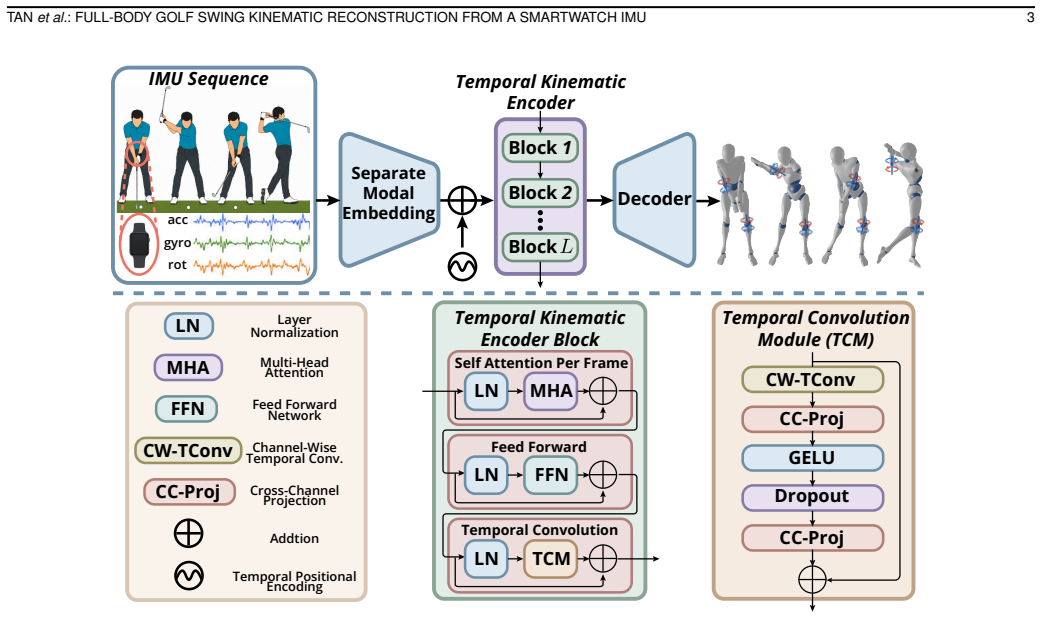
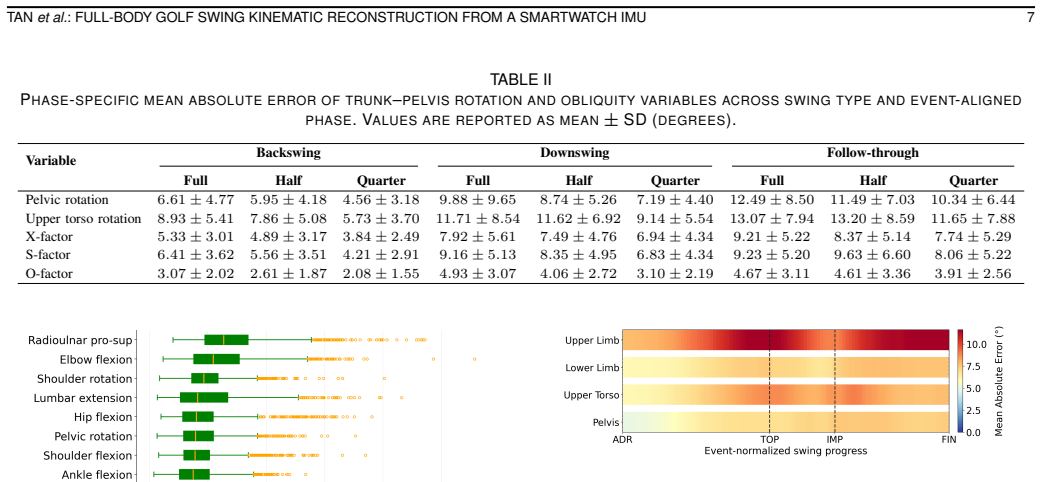
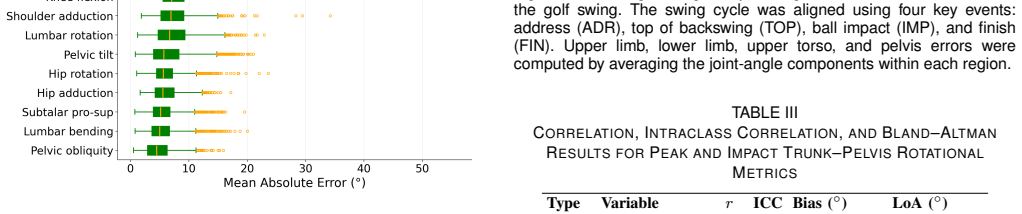
The Wrist-IMU Temporal Kinematic Network (WIT-KinNet) leverages modality-specific IMU embeddings and temporal kinematic encoding to learn wrist-to-body motion dependencies and estimate full-body joint angles during golf swings, achieving a mean absolute error of 8.11 ± 1.84° across full-body joint angles under subject-wise cross-validation on synchronized smartwatch IMU and optical motion capture data from 36 golfers.
What carries the argument
Wrist-IMU Temporal Kinematic Network (WIT-KinNet) that applies modality-specific IMU embeddings and temporal kinematic encoding to map single-wrist signals onto full-body joint angles.
Load-bearing premise
Wrist IMU signals alone contain sufficient information about full-body kinematics for a learned neural network to reconstruct joint angles accurately without multi-segment sensors, subject-specific calibration, or explicit biomechanical constraints.
What would settle it
Apply the trained network to fresh IMU recordings from new golfers and compare the output joint angles against simultaneous optical motion capture; a mean absolute error consistently above 10 degrees would falsify the reconstruction claim.
Figures
read the original abstract
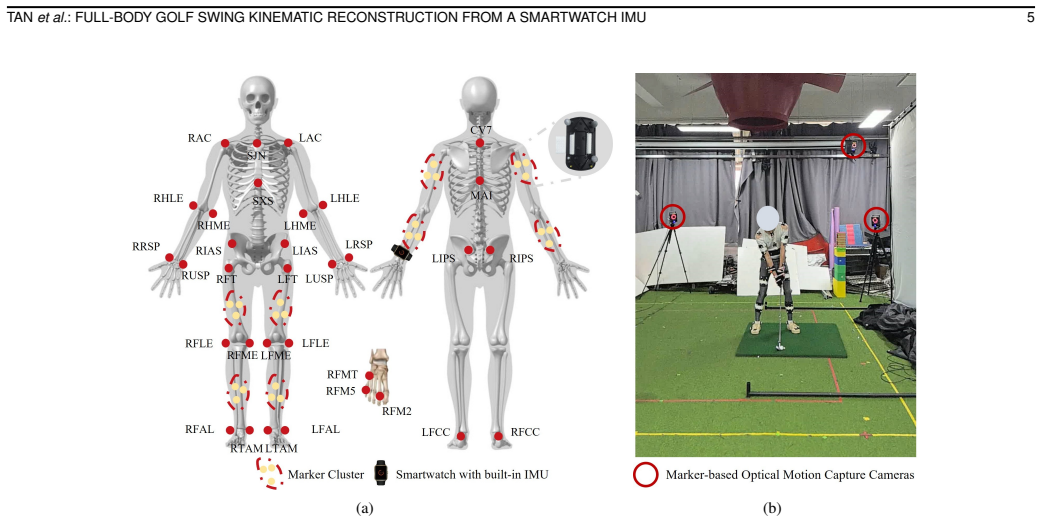
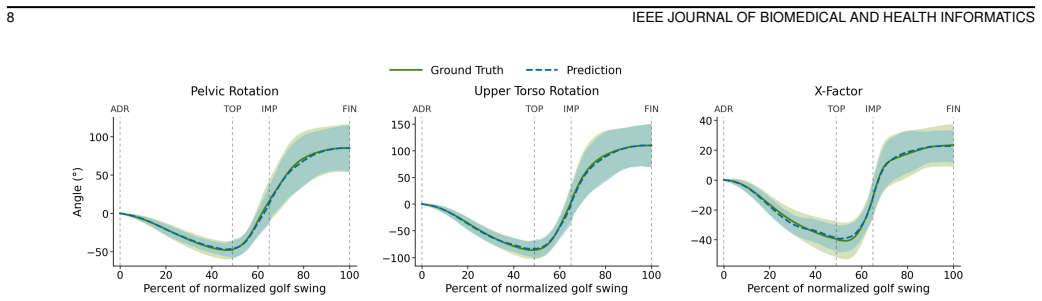
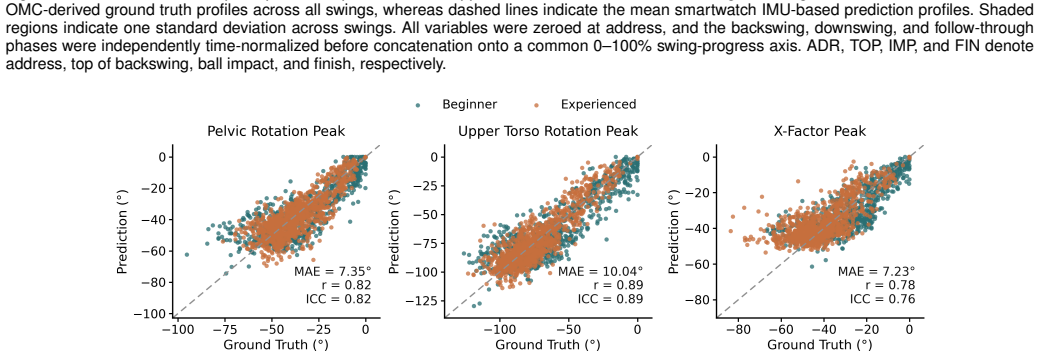
Quantitative measurement of the golf swing is critical for evaluating technique and enabling individualized feedback. However, existing methods are impractical to use on the golf course: optical motion capture is laboratory-bound, camera-based methods require impractical camera placement, and multi-sensor inertial measurement unit (IMU) systems require multi-segment setup and calibration. We thus propose a single wrist-worn IMU approach for estimating full-body joint angles during golf swings. The proposed Wrist-IMU Temporal Kinematic Network (WIT-KinNet) leverages modality-specific IMU embeddings and temporal kinematic encoding to learn wrist-to-body motion dependencies and estimate full-body joint angles during golf swings. Thirty-six golfers spanning beginner and skilled players, performed full, half, and quarter swings using seven club types: driver, 3-wood, 5-hybrid, 5-iron, 7-iron, 9-iron, and sand wedge. The proposed WIT-KinNet was evaluated under subject-wise cross-validation using synchronized smartwatch IMU data and ground-truth kinematics derived from an optical motion capture system. The proposed approach achieved a mean absolute error of 8.11 $\pm$ 1.84$^\circ$ across full-body joint angles. High temporal correlation was observed for pelvic rotation and upper torso rotation (r = 0.98 and 0.97, respectively), with X-factor and S-factor also showing strong correlation (r = 0.96 and 0.96). Linear mixed-effects models of the error revealed that swing amplitude, skill level, and club type all significantly affected measurement differences (p $<$ 0.05). The results establish the first single wrist-worn IMU approach for estimating full-body golf swing kinematics, enabling practical swing analysis during real gameplay.
Editorial analysis
A structured set of objections, weighed in public.
Referee Report
Summary. The paper claims that a single wrist-worn IMU suffices to reconstruct full-body joint angles during golf swings via the proposed WIT-KinNet model, which employs modality-specific IMU embeddings and temporal kinematic encoding to capture wrist-to-body dependencies. The approach is evaluated under subject-wise cross-validation on 36 subjects performing full/half/quarter swings with seven club types, using synchronized optical motion capture as ground truth, and reports a mean absolute error of 8.11 ± 1.84° across full-body joint angles together with high correlations (r = 0.98 pelvic rotation, r = 0.97 upper torso rotation, r = 0.96 for both X-factor and S-factor). Linear mixed-effects models further indicate that swing amplitude, skill level, and club type significantly affect the errors (p < 0.05).
Significance. If the central claim holds, the result would be significant for wearable-based sports biomechanics: it demonstrates that a consumer smartwatch IMU alone can recover full-body kinematics for a complex, high-speed athletic motion without multi-segment sensors, subject-specific calibration, or laboratory constraints. The scale of the evaluation (36 subjects, multiple amplitudes and clubs), the use of subject-wise cross-validation, and the mixed-effects analysis of error sources are concrete strengths that support practical applicability.
major comments (2)
- [Abstract] Abstract: the reported 8.11 ± 1.84° MAE is presented without any baseline comparator (e.g., a linear regressor, constant-pose predictor, or prior single-IMU method), which is load-bearing for the claim that the modality-specific embeddings and temporal encoding produce a meaningful reconstruction rather than a generic mapping.
- [Evaluation] Evaluation section: the manuscript does not supply the network architecture (layer counts, embedding dimensions), loss function, optimizer, or training hyperparameters for WIT-KinNet, preventing verification that the subject-wise cross-validation results are reproducible and that the temporal kinematic encoding is the operative component.
minor comments (2)
- [Abstract] Abstract: the ±1.84° term is not identified as standard deviation, standard error, or another quantity; this should be stated explicitly.
- [Abstract] Abstract: the mixed-effects model is summarized only by p < 0.05; the fixed/random effects structure and the specific dependent variable (per-joint or aggregate error) should be stated.
Simulated Author's Rebuttal
We thank the referee for the detailed and constructive review. The comments highlight important aspects for strengthening the presentation of our single-wrist-IMU approach for golf swing kinematics. We address each major comment below and will revise the manuscript accordingly.
read point-by-point responses
-
Referee: [Abstract] Abstract: the reported 8.11 ± 1.84° MAE is presented without any baseline comparator (e.g., a linear regressor, constant-pose predictor, or prior single-IMU method), which is load-bearing for the claim that the modality-specific embeddings and temporal encoding produce a meaningful reconstruction rather than a generic mapping.
Authors: We agree that baseline comparisons would better substantiate the contribution of the proposed components. Since the work presents the first single wrist-worn IMU method for this task, no prior single-IMU baselines exist in the literature. In the revision we will add quantitative results from two simple baselines (a constant mean-pose predictor and a linear regression model using the same IMU features) evaluated under identical subject-wise cross-validation. These will be reported alongside the 8.11° MAE to demonstrate that WIT-KinNet meaningfully outperforms generic mappings. revision: yes
-
Referee: [Evaluation] Evaluation section: the manuscript does not supply the network architecture (layer counts, embedding dimensions), loss function, optimizer, or training hyperparameters for WIT-KinNet, preventing verification that the subject-wise cross-validation results are reproducible and that the temporal kinematic encoding is the operative component.
Authors: We acknowledge that the current manuscript omits these implementation details, which are necessary for reproducibility. In the revised version we will expand the Evaluation section (or add a dedicated supplementary section) with the full WIT-KinNet architecture specification, including layer counts and embedding dimensions, the loss function, optimizer, learning rate schedule, batch size, and all other training hyperparameters used for the reported subject-wise cross-validation experiments. revision: yes
Circularity Check
No significant circularity detected
full rationale
The paper trains a neural network (WIT-KinNet) to map single-wrist IMU signals to full-body joint angles, using synchronized optical motion capture as independent ground truth. Evaluation proceeds via subject-wise cross-validation on held-out subjects and clubs, with reported MAE and correlations derived from this external reference rather than from any fitted parameter or self-referential equation within the model. No self-definitional steps, fitted-input predictions, or load-bearing self-citations appear in the derivation; the result is an empirical mapping validated against separate sensor data.
Axiom & Free-Parameter Ledger
free parameters (1)
- WIT-KinNet network weights and hyperparameters
axioms (1)
- domain assumption Wrist IMU signals contain sufficient information to reconstruct full-body joint angles via learned temporal kinematic encoding
Reference graph
Works this paper leans on
-
[1]
Nutrition and golf performance: a systematic scoping review,
A. O’Donnell, A. Murray, A. Nguyen, T. Salmon, S. Taylor, J. P. Morton, and G. L. Close, “Nutrition and golf performance: a systematic scoping review,”Sports Medicine, vol. 54, no. 12, pp. 3081–3095, 2024
2024
-
[2]
The role of biomechanics in maximising distance and accuracy of golf shots,
P. A. Hume, J. Keogh, and D. Reid, “The role of biomechanics in maximising distance and accuracy of golf shots,”Sports medicine, vol. 35, no. 5, pp. 429–449, 2005
2005
-
[3]
A three dimensional kinematic and kinetic study of the golf swing,
S. M. Nesbit, “A three dimensional kinematic and kinetic study of the golf swing,”Journal of sports science & medicine, vol. 4, no. 4, p. 499, 2005
2005
-
[4]
Golf swing biomechanics: A systematic review and methodological recommendations for kinematics,
M. Bourgain, P. Rouch, O. Rouillon, P. Thoreux, and C. Sauret, “Golf swing biomechanics: A systematic review and methodological recommendations for kinematics,”Sports, vol. 10, no. 6, p. 91, 2022
2022
-
[5]
The relationship between biomechanical variables and driving performance during the golf swing,
Y . Chu, T. C. Sell, and S. M. Lephart, “The relationship between biomechanical variables and driving performance during the golf swing,” Journal of sports sciences, vol. 28, no. 11, pp. 1251–1259, 2010
2010
-
[6]
An analysis of peak pelvis rotation speed, gluteus maximus and medius strength in high versus low handicap golfers during the golf swing,
S. Callaway, K. Glaws, M. Mitchell, H. Scerbo, M. V oight, and P. Sells, “An analysis of peak pelvis rotation speed, gluteus maximus and medius strength in high versus low handicap golfers during the golf swing,” International Journal of Sports Physical Therapy, vol. 7, no. 3, p. 288, 2012
2012
-
[7]
The control of upper body segment speed and velocity during the golf swing,
S. A. Horan and J. J. Kavanagh, “The control of upper body segment speed and velocity during the golf swing,”Sports Biomechanics, vol. 11, no. 2, pp. 165–174, 2012
2012
-
[8]
The role of upper torso and pelvis rotation in driving performance during the golf swing,
J. Myers, S. Lephart, Y .-S. Tsai, T. Sell, J. Smoliga, and J. Jolly, “The role of upper torso and pelvis rotation in driving performance during the golf swing,”Journal of sports sciences, vol. 26, no. 2, pp. 181–188, 2008
2008
-
[9]
Kinematic analysis of swing in pro and amateur golfers,
N. Zheng, S. Barrentine, G. Fleisig, and J. Andrews, “Kinematic analysis of swing in pro and amateur golfers,”International Journal of Sports Medicine, vol. 29, no. 06, pp. 487–493, 2008
2008
-
[10]
Association between the on-plane angular motions of the axle-chain system and clubhead speed in skilled male golfers,
M. V . Madrid, M. A. Avalos, N. A. Levine, N. J. Tuttle, K. A. Becker, and Y .-H. Kwon, “Association between the on-plane angular motions of the axle-chain system and clubhead speed in skilled male golfers,” Applied Sciences, vol. 10, no. 17, p. 5728, 2020
2020
-
[11]
The importance of stretching the “x-factor
P. J. Cheetham, P. E. Martin, R. E. Mottram, and B. St Laurent, “The importance of stretching the “x-factor” in the downswing of golf: The “x-factor stretch”,”Optimising performance in golf, pp. 192–199, 2001
2001
-
[12]
The most important “factor
C. Joyce, “The most important “factor” in producing clubhead speed in golf,”Human Movement Science, vol. 55, pp. 138–144, 2017
2017
-
[13]
Rotational biomechanics of the elite golf swing: Benchmarks for amateurs,
D. W. Meister, A. L. Ladd, E. E. Butler, B. Zhao, A. P. Rogers, C. J. Ray, and J. Rose, “Rotational biomechanics of the elite golf swing: Benchmarks for amateurs,”Journal of applied biomechanics, vol. 27, no. 3, pp. 242–251, 2011
2011
-
[14]
Kinematic, kinetic, and temporal metrics associated with golf proficiency,
M. P. McHugh, C. A. O’Mahoney, K. F. Orishimo, I. J. Kremenic, and S. J. Nicholas, “Kinematic, kinetic, and temporal metrics associated with golf proficiency,”The Journal of Strength & Conditioning Research, vol. 38, no. 3, pp. 599–606, 2024
2024
-
[15]
The swing performance index: Developing a single-score index of golf swing rotational biomechanics quantified with 3d kinematics,
J. Y . Zhou, A. Richards, K. Schadl, A. Ladd, and J. Rose, “The swing performance index: Developing a single-score index of golf swing rotational biomechanics quantified with 3d kinematics,”Frontiers in Sports and Active living, vol. 4, p. 986281, 2022
2022
-
[16]
Golf coaches’ perceptions of key technical swing parameters compared to biomechanical literature,
A. Smith, J. Roberts, E. Wallace, P. W. Kong, and S. Forrester, “Golf coaches’ perceptions of key technical swing parameters compared to biomechanical literature,”International Journal of Sports Science & Coaching, vol. 10, no. 4, pp. 739–755, 2015
2015
-
[17]
Position and orientation in space of bones during movement: anatomical frame definition and determination,
A. Cappozzo, F. Catani, U. Della Croce, and A. Leardini, “Position and orientation in space of bones during movement: anatomical frame definition and determination,”Clinical biomechanics, vol. 10, no. 4, pp. 171–178, 1995
1995
-
[18]
Validation of inertial measurement units for analyzing golf swing rotational biomechanics,
S. E. Kim, J. C. Burket Koltsov, A. W. Richards, J. Zhou, K. Schadl, A. L. Ladd, and J. Rose, “Validation of inertial measurement units for analyzing golf swing rotational biomechanics,”Sensors, vol. 23, no. 20, p. 8433, 2023
2023
-
[19]
Golfdb: A video database for golf swing sequencing,
W. McNally, K. Vats, T. Pinto, C. Dulhanty, J. McPhee, and A. Wong, “Golfdb: A video database for golf swing sequencing,” inProceedings of the IEEE/CVF conference on computer vision and pattern recognition workshops, 2019, pp. 0–0
2019
-
[20]
Ai golf: Golf swing analysis tool for self-training,
C.-C. Liao, D.-H. Hwang, and H. Koike, “Ai golf: Golf swing analysis tool for self-training,”IEEE Access, vol. 10, pp. 106 286–106 295, 2022
2022
-
[21]
Golfmate: Enhanced golf swing analysis tool through pose refinement network and explainable golf swing embedding for self-training,
C.-Y . Ju, J.-H. Kim, and D.-H. Lee, “Golfmate: Enhanced golf swing analysis tool through pose refinement network and explainable golf swing embedding for self-training,”Applied Sciences, vol. 13, no. 20, p. 11227, 2023
2023
-
[22]
Golfpose: from regular posture to golf swing posture,
M.-H. Lee, Y .-C. Zhang, K.-R. Wu, and Y .-C. Tseng, “Golfpose: from regular posture to golf swing posture,” inInternational Conference on Pattern Recognition. Springer, 2024, pp. 387–402
2024
-
[23]
Golf swing segmentation from a single imu using machine learning,
M. Kim and S. Park, “Golf swing segmentation from a single imu using machine learning,”Sensors, vol. 20, no. 16, p. 4466, 2020
2020
-
[24]
Enhancing accuracy and convenience of golf swing tracking with a wrist-worn single inertial sensor,
M. Kim and S. Park, “Enhancing accuracy and convenience of golf swing tracking with a wrist-worn single inertial sensor,”Scientific Reports, vol. 14, no. 1, p. 9201, 2024
2024
-
[25]
Analysis of swing tempo, swing rhythm, and functional swing plane slope in golf with a wearable inertial measurement unit sensor,
M. Cheon, B. Khuyagbaatar, J.-H. Yeom, and Y . H. Kim, “Analysis of swing tempo, swing rhythm, and functional swing plane slope in golf with a wearable inertial measurement unit sensor,”Journal of Mechanical Science and Technology, vol. 34, no. 7, pp. 3095–3101, 2020
2020
-
[26]
A sensor-based golfer-swing signature recognition method using linear support vector machine,
Z. Zhang, Y . Zhang, A. Kos, and A. Umek, “A sensor-based golfer-swing signature recognition method using linear support vector machine,” Elektrotehniski vestnik, vol. 84, no. 5, pp. 247–252, 2017
2017
-
[27]
Multisensor smart glove with unsupervised learning model for real-time wrist motion analysis in golf swing biomechanics,
T. T. V o, Q. P. Le, H. Jung, J. Choi, T. T. H. Vu, V . H. M. Doan, S. Mon- dal, and J. Oh, “Multisensor smart glove with unsupervised learning model for real-time wrist motion analysis in golf swing biomechanics,” IEEE Internet of Things Journal, vol. 12, no. 11, pp. 16 574–16 586, 2025
2025
-
[28]
Imu shoulder angle estimation: Effects of sensor-to-segment misalignment and sensor ori- entation error,
K. Zhu, J. Li, D. Li, B. Fan, and P. B. Shull, “Imu shoulder angle estimation: Effects of sensor-to-segment misalignment and sensor ori- entation error,”IEEE Transactions on Neural Systems and Rehabilitation Engineering, vol. 31, pp. 4481–4491, 2023
2023
-
[29]
3d knee and hip angle estimation with reduced wearable imus via transfer learning during yoga, golf, swimming, badminton, and dance,
J. Li, K. Zhu, D. Li, P. Kang, and P. B. Shull, “3d knee and hip angle estimation with reduced wearable imus via transfer learning during yoga, golf, swimming, badminton, and dance,”IEEE Transactions on Neural Systems and Rehabilitation Engineering, vol. 32, pp. 325–338, 2024
2024
-
[30]
Learning golf swing signatures from a single wrist-worn inertial sensor,
J. Lauer, “Learning golf swing signatures from a single wrist-worn inertial sensor,”arXiv preprint arXiv:2506.17505, 2025
arXiv 2025
-
[31]
Wham: Reconstructing world-grounded humans with accurate 3d motion,
S. Shin, J. Kim, E. Halilaj, and M. J. Black, “Wham: Reconstructing world-grounded humans with accurate 3d motion,” inProceedings of the IEEE/CVF Conference on Computer Vision and Pattern Recognition, 2024, pp. 2070–2080
2024
-
[32]
Intraclass correlations: uses in assessing rater reliability
P. E. Shrout and J. L. Fleiss, “Intraclass correlations: uses in assessing rater reliability.”Psychological bulletin, vol. 86, no. 2, p. 420, 1979
1979
-
[33]
Statistical methods for assessing agreement between two methods of clinical measurement,
J. M. Bland and D. Altman, “Statistical methods for assessing agreement between two methods of clinical measurement,”The lancet, vol. 327, no. 8476, pp. 307–310, 1986
1986
-
[34]
On the continuity of rotation representations in neural networks,
Y . Zhou, C. Barnes, J. Lu, J. Yang, and H. Li, “On the continuity of rotation representations in neural networks,” inProceedings of the IEEE/CVF conference on computer vision and pattern recognition, 2019, pp. 5745–5753
2019
-
[35]
Improving the accuracy of wearable sensor orientation using a two-step complementary filter with state machine- based adaptive strategy,
B. Fan, Q. Li, and T. Liu, “Improving the accuracy of wearable sensor orientation using a two-step complementary filter with state machine- based adaptive strategy,”Measurement Science and Technology, vol. 29, no. 11, p. 115104, 2018
2018
-
[36]
Decoupled weight decay regularization,
I. Loshchilov and F. Hutter, “Decoupled weight decay regularization,” arXiv preprint arXiv:1711.05101, 2017
Pith/arXiv arXiv 2017
-
[37]
Effects of upper-body flexibility exercise on golf performance of amateur female golfer: A case report,
G. Jung, S. Hong, D. Shin, S. Jeong, C. Kim, H. Park, and G. Lee, “Effects of upper-body flexibility exercise on golf performance of amateur female golfer: A case report,”The American Journal of Case Reports, vol. 23, pp. e936 022–1, 2022
2022
-
[38]
Random-effects models for longitudinal data,
N. M. Laird and J. H. Ware, “Random-effects models for longitudinal data,”Biometrics, pp. 963–974, 1982
1982
-
[39]
Controlling the false discovery rate: a practical and powerful approach to multiple testing,
Y . Benjamini and Y . Hochberg, “Controlling the false discovery rate: a practical and powerful approach to multiple testing,”Journal of the Royal statistical society: series B (Methodological), vol. 57, no. 1, pp. 289–300, 1995
1995
-
[40]
The relationship between isometric mid-thigh pull force-time characteristics and swing performance in high- level youth golfers,
J. Sanders, Z. Gould, and J. Moody, “The relationship between isometric mid-thigh pull force-time characteristics and swing performance in high- level youth golfers,”International Journal of Golf Science, vol. 9, no. 1, 2020
2020
-
[41]
Effects of movement speed and magnetic disturbance on the accuracy of inertial measurement units,
H. Chen, M. C. Schall Jr, and N. Fethke, “Effects of movement speed and magnetic disturbance on the accuracy of inertial measurement units,” inProceedings of the Human Factors and Ergonomics Society Annual Meeting, vol. 61, no. 1. SAGE Publications Sage CA: Los Angeles, CA, 2017, pp. 1046–1050
2017
-
[42]
Isb recommendations on the definition, estimation, and reporting of joint kinematics in human motion analysis applications using wearable inertial measurement technology,
A. Cereatti, R. Gurchiek, A. M ¨undermann, S. Fantozzi, F. Horak, S. Delp, and K. Aminian, “Isb recommendations on the definition, estimation, and reporting of joint kinematics in human motion analysis applications using wearable inertial measurement technology,”Journal of Biomechanics, vol. 173, p. 112225, 2024
2024
-
[43]
Trunk rotation and weight transfer patterns between skilled and low skilled golfers,
I. Okuda, P. Gribble, and C. Armstrong, “Trunk rotation and weight transfer patterns between skilled and low skilled golfers,”Journal of sports science & medicine, vol. 9, no. 1, p. 127, 2010. 12 IEEE JOURNAL OF BIOMEDICAL AND HEALTH INFORMATICS
2010
-
[44]
Rotational kinematics of the pelvis during the golf swing: Skill level differences and relationship to club and ball impact conditions,
S. K. Lynn, B. S. Frazier, K. N. New, W. F. Wu, P. J. Cheetham, and G. J. Noffal, “Rotational kinematics of the pelvis during the golf swing: Skill level differences and relationship to club and ball impact conditions,” International journal of golf science, vol. 2, no. 2, 2013
2013
-
[45]
Analysis of 3d kinematics concerning three different clubs in golf swing,
C. Egret, O. Vincent, J. Weber, F. Dujardin, and D. Chollet, “Analysis of 3d kinematics concerning three different clubs in golf swing,” International journal of sports medicine, vol. 24, no. 06, pp. 465–470, 2003
2003
-
[46]
Three-dimensional trunk kinematics in golf: between-club differences and relationships to clubhead speed,
C. Joyce, A. Burnett, J. Cochrane, and K. Ball, “Three-dimensional trunk kinematics in golf: between-club differences and relationships to clubhead speed,”Sports Biomechanics, vol. 12, no. 2, pp. 108–120, 2013
2013
-
[47]
As- sessment of planarity of the golf swing based on the functional swing plane of the clubhead and motion planes of the body points,
Y .-H. Kwon, C. S. Como, K. Singhal, S. Lee, and K. H. Han, “As- sessment of planarity of the golf swing based on the functional swing plane of the clubhead and motion planes of the body points,”Sports biomechanics, vol. 11, no. 2, pp. 127–148, 2012
2012
discussion (0)
Sign in with ORCID, Apple, or X to comment. Anyone can read and Pith papers without signing in.