REVIEW 2 major objections 4 minor 12 references
Low-Complexity Frequency Domain Equalization of Zak-OTFS in Doubly-Spread Channels
T0 review · 2 major / 4 minor · reviewed 2026-08-06 · deepseek-v4-flash
Pith's one-line read Frequency-domain equalization of Zak-OTFS cuts receiver complexity from cubic to quadratic while matching delay-Doppler equalizer error rates.
desk verdict A genuinely new FD I/O result for Zak-OTFS, but the O(M^2N^2) complexity claim overstates the saving once b = Θ(N) is accounted for. read the letter →
The pith
A machine-rendered reading of the paper's core claim, the machinery that carries it, and where it could break.
The reading
What carries the argument
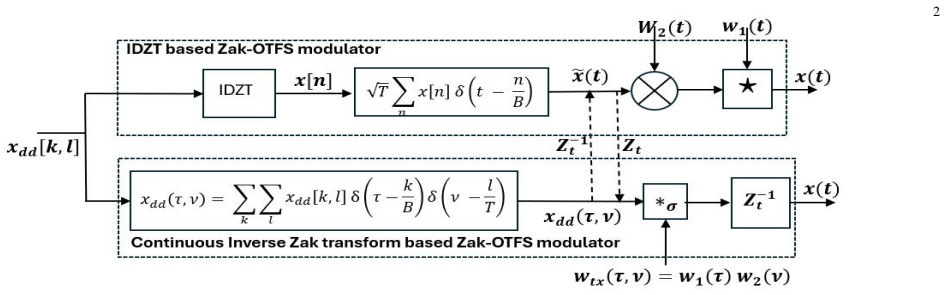
The load-bearing object is the banded effective frequency-domain channel matrix $\mathbf{H}$, together with the new conversion formula (27) that computes it from the delay-Doppler channel by a discrete Fourier Zak transform along the delay dimension. Because the delay-Doppler channel has significant taps only for $|l| \le l_{\max}$, each row of $\mathbf{H}$ is nonzero only within a window of width $2l_{\max}+1$, and this bandedness carries through to $\mathbf{H}^H\mathbf{H} + \mathbf{I}/\rho$, whose band width is $b=4l_{\max}+1$. The receiver moves the received symbols to the frequency domain with an inverse discrete Fourier Zak transform, equalizes by fast banded inversion, and returns to the delay-Doppler domain with a discrete Fourier Zak transform.
What would settle it
For a given channel profile, compute the fraction of the Frobenius energy of $\mathbf{H}$ that lies outside the band $b=4l_{\max}+1$ and compare the banded equalizer BER against full delay-Doppler equalization; if that fraction is not negligible at the operating SNR, the claimed equal performance and complexity saving will not both hold.
Extended reading notes
Core claim
The central claim is that the Zak-OTFS frequency-domain input-output relation is sparse: the frequency-domain channel coefficient $h_f[i,l]$ is significant only when $|i-l| \le l_{\max}$, where $l_{\max} = {\mathcal O}(T\nu_{\max})$ is the channel Doppler spread measured in bins. Consequently the $MN \times (MN+2l_{\max})$ frequency-domain matrix $\mathbf{H}$ is banded, and the linear MMSE estimate $\hat{\mathbf{S}} = \mathbf{H}^H(\mathbf{H}^H\mathbf{H} + \mathbf{I}/\rho)^{-1}\mathbf{Y}$ costs only ${\mathcal O}(b M^2N^2)$ with band width $b = 4l_{\max}+1$, versus ${\mathcal O}(M^3N^3)$ for inverting the dense delay-Doppler matrix. Simulations with the Veh-A channel show the same uncoded 4-QAM bit error rate as delay-Doppler domain equalization.
Load-bearing premise
The method assumes that almost all of the channel's frequency-domain energy lies in a narrow diagonal band, so the energy outside that band can be forced to zero without noticeably hurting accuracy.
Editorial extensions
If this is right
- Frequency-domain equalization of Zak-OTFS reduces the equalization complexity from ${\mathcal O}(M^3N^3)$ to ${\mathcal O}(M^2N^2)$ while matching the error-rate performance of delay-Doppler equalization.
- Because the band width is set by $T\nu_{\max}$, receivers for channels with small normalized Doppler spread can use narrow bands, making large $M,N$ frames practical at low cost.
- Channel estimation can remain in the delay-Doppler domain, where a single pilot or a spread pilot suffices, while equalization runs in the frequency domain on the converted channel.
- Truncating the band below $4\lceil T\nu_{\max}\rceil + 1$ gives an additional complexity saving at the price of slight performance degradation at high SNR.
- The proposed approach applies to doubly-spread channels where the channel delay and Doppler spreads fit within the Zak-OTFS periodicity, the regime in which Zak-OTFS channel prediction is already known to work.
Reading between the lines
- For very large Doppler-delay products, the band width $b$ could grow with $N$ and begin to erode the complexity gain; the paper's strongest regime is therefore channels with modest $T\nu_{\max}$, and the crossover point could be quantified by computing the out-of-band energy fraction as a function of $T\nu_{\max}$.
- The conversion formula is a discrete Fourier transform along the delay dimension, so the same banded structure likely appears for other quasi-periodic delay-Doppler waveforms, not only for Gaussian-pulsed Zak-OTFS; this could be tested by evaluating $\mathbf{H}$ for different pulse shapes.
- A natural extension is to replace the perfect-channel-knowledge assumption with an estimated delay-Doppler channel from a spread pilot and measure how estimation error interacts with band truncation, since the current paper defers joint channel estimation and equalization to future work.
Editorial analysis
A structured set of objections, weighed in public.
Referee Report
Summary. The paper proposes to perform linear equalization of Zak-OTFS in the frequency domain (FD). It derives an exact FD input-output relation from the DD-domain effective channel via the inverse discrete frequency Zak transform (Theorem 1), shows that the FD channel matrix is banded with width determined by lmax = O(ceil(T*nu_max)), and proposes a low-complexity conversion of the estimated DD channel to the FD channel. The LMMSE equalizer then inverts a banded matrix, which is claimed to have complexity O(bM^2N^2) with b = 4*lmax+1, compared to O(M^3N^3) for DD-domain equalization. Simulations with a Veh-A channel show that the proposed FD equalizer achieves the same uncoded 4-QAM BER as DD-domain equalization.
Significance. The derivation of the FD I/O relation in Theorem 1 is a clean, self-contained contribution, and the observation that the FD channel matrix is banded is a genuine structural insight that could enable practical equalization for Zak-OTFS. The conversion formula in (27) is novel and potentially useful. However, the headline complexity reduction is overstated as O(M^2N^2) without the band-width factor b, and the performance parity is demonstrated in only a single simulation scenario. If the complexity claim is corrected and the out-of-band leakage issue is addressed, the paper would be a solid contribution to the OTFS literature.
major comments (2)
- [Abstract, Section II-C, Section IV] The abstract and conclusion claim that FD equalization reduces complexity from O(M^3N^3) to O(M^2N^2), but Section IV gives the complexity as O(bM^2N^2) with b = 4*lmax+1, where lmax = O(ceil(T*nu_max)). Under the crystallization conditions stated in Section II-C, namely tau_p = T/N > tau_max and nu_p = N/T > nu_max, we have N*tau_max < T < N/nu_max for fixed channel parameters. Hence T = Theta(N) for an unbounded frame size, so lmax = ceil(T*nu_max) = Theta(N) and b = Theta(N). Substituting into the paper's own complexity expression gives Omega(M^2N^3) rather than O(M^2N^2) once N is allowed to scale. The advertised saving relative to DD-domain inversion is therefore a factor M, not MN, and the abstract and conclusion must be corrected, or the scaling regime in which b is constant must be explicitly stated.
- [Section IV, Section V] The claim that FD equalization achieves the same performance as DD equalization rests on a single simulation run with the Veh-A channel (Fig. 3) and on the approximation that all energy outside the band b is negligible and can be zeroed. This approximation is load-bearing for both the BER parity and the complexity, because significant out-of-band energy would force a larger b and erode the complexity gain. The paper should provide quantitative evidence on the leakage, for example the fraction of channel energy lying outside the band as a function of channel spread and pulse shape, or demonstrate performance parity across a range of channel conditions. Without such support, the generality of the 'same performance' claim is not established.
minor comments (4)
- [Section II-C] The word 'comlete' in the last sentence should be 'complete'.
- [Section III, equation (27)] It would be helpful to state explicitly that the sum over k' is modulo MN, relying on the MN-periodicity of h[k,l], rather than leaving the index range implicit.
- [Section V] The text states MN = BT, but with the given parameters M=31, N=37, B=930 kHz, and T=1.23 ms, BT = 1143.9 while MN = 1147; please clarify the rounding or adjust the values for consistency.
- [Notation] The abbreviation 'FD' is used both for 'frequency domain' and for 'FD realization'; consider using 'frequency-domain' in full in places where ambiguity might arise, or define the two uses explicitly.
Circularity Check
No circular derivation: Theorem 1 is a transform identity, and the complexity/equalization claims are not fitted to the equalizer's output.
full rationale
The core derivation is mathematically self-contained. Section III obtains the FD I/O relation by applying the IDFZT to the DD I/O relation (22), yielding the explicit conversion (27); hf is defined as a transformation of h, so the banded property is a consequence of the Doppler support bound |l|≤lmax rather than an assumption chosen to reproduce the DD equalizer's BER. The equalizer (33) is standard linear MMSE applied to the equivalent FD representation; its 'same performance' claim follows from exact equivalence when the same channel is used, not from a fitted parameter. The complexity estimate in Section IV explicitly reads O(b M^2N^2) with b=4lmax+1; the abstract's O(M^2N^2) absorbs b into the constant. If lmax is treated as fixed, this is valid asymptotic notation, though a rigorous scaling claim would need to state that b does not grow with M,N—a correctness caveat, not a circularity. References [3]–[6] are self-citations supplying the Zak-OTFS predictability and pilot-estimation background, but the equalization derivation assumes perfect knowledge of h[k,l] (stated in Section IV and Conclusion) and does not require those references to fit or force the new result; they are therefore background support, not a load-bearing circular chain. No fitted-input-as-prediction, definitional, or uniqueness-importation pattern is present.
Assumptions & free parameters
assumptions (5)
- domain assumption Doubly-spread channel with deterministic spreading function hphy(tau,nu) and additive white Gaussian noise
- domain assumption Crystallization condition: M and N exceed the delay and Doppler spreads of the effective channel hdd
- domain assumption Perfect channel state information at the receiver
- ad hoc to paper The effective FD channel is banded with negligible out-of-band energy; zeroing outside-band elements is safe
- domain assumption Gaussian pulse shaping with parameters alpha_g, beta_g chosen so that 99% of energy lies in the frame band
Cite this review
Pith. "Pith review of Low-Complexity Frequency Domain Equalization of Zak-OTFS in Doubly-Spread Channels." pith.science (2026). https://pith.science/paper/PE6HRJUL
@misc{pith2026250623045,
  author       = {Pith},
  title        = {Pith review of: Low-Complexity Frequency Domain Equalization of Zak-OTFS in Doubly-Spread Channels},
  year         = {2026},
  howpublished = {\url{https://pith.science/paper/PE6HRJUL}},
  note         = {Machine review of arXiv:2506.23045}
}
abstract
We communicate over wireless channels by first estimating and then equalizing the effective channel. In Zak-OTFS (orthogonal time frequency space) modulation the carrier waveform is a pulse in the delay-Doppler (DD) domain, formally a quasi-periodic localized function with specific periods along delay and Doppler. When the channel delay spread is less than the delay period, and the channel Doppler spread is less than the Doppler period, the response to a single Zak-OTFS carrier provides an image of the scattering environment and can be used to predict the effective channel at all other carriers. This makes DD domain channel estimation straightforward, and there is no loss in spectral efficiency since it is possible to design data and pilot signals that are mutually unbiased. However, equalization in the DD domain has high complexity ${\mathcal O}(M^3N^3)$ where $M$, $N$ are respectively the number of delay and Doppler bins in an OTFS frame, and $MN$ is the number of information symbols. We demonstrate that equalization in the frequency domain (FD) reduces complexity to only ${\mathcal O}(M^2 N^2)$ by taking advantage of the banded structure of the effective FD channel. We also derive a low-complexity method to reconstruct the effective FD channel from the estimated DD domain effective channel.
Figures


Reference graph
Works this paper leans on
-
[1]
11em plus .33em minus .07em 4000 4000 100 4000 4000 500 `\.=1000 = #1 \@IEEEnotcompsoconly \@IEEEcompsoconly #1 * [1] 0pt [0pt][0pt] #1 * [1] 0pt [0pt][0pt] #1 * \| ** #1 \@IEEEauthorblockNstyle \@IEEEcompsocnotconfonly \@IEEEauthorblockAstyle \@IEEEcompsocnotconfonly \@IEEEcompsocconfonly \@IEEEauthordefaulttextstyle \@IEEEcompsocnotconfonly \@IEEEauthor...
-
[2]
OFDM for Wireless Multimedia Communications,
R. V. Nee, and R. Prasad, “OFDM for Wireless Multimedia Communications,” Artech House Inc., 2000
work page 2000
-
[3]
Performance degradation of OFDM systems due to Doppler spreading,
T. Wang, J. G. Proakis, E. Masry and J. R. Zeidler, “Performance degradation of OFDM systems due to Doppler spreading,” IEEE Trans. on Wireless Commun., vol. 5, no. 6, June 2006
work page 2006
-
[4]
OTFS - A mathematical foundation for communication and radar sensing in the delay-Doppler domain,
S. K. Mohammed, R. Hadani, A. Chockalingam and R. Calderbank, “OTFS - A mathematical foundation for communication and radar sensing in the delay-Doppler domain," IEEE BITS the Information Theory Magazine, vol. 2, no. 2, pp. 36–55, 1 Nov. 2022
work page 2022
-
[5]
S. K. Mohammed, R. Hadani, A. Chockalingam and R. Calderbank, ``OTFS—Predictability in the Delay-Doppler Domain and Its Value to Communication and Radar Sensing," IEEE BITS the Information Theory Magazine, vol. 3, no. 2, pp. 7-31, June 2023
work page 2023
-
[6]
S. K. Mohammed, R. Hadani and A. Chockalingam, ``OTFS Modulation: Theory and Applications," IEEE Press and Wiley, Nov. 2024
work page 2024
- [7]
-
[8]
Orthogonal time frequency space modulation,
R. Hadani, S. Rakib, M. Tsatsanis, A. Monk, A. J. Goldsmith, A. F. Molisch, and R. Calderbank, “Orthogonal time frequency space modulation,” Proc. IEEE WCNC’2017, pp. 1-6, Mar. 2017
work page 2017
Show all 12 references
-
[9]
P. A. Bello, ``Characterization of Randomly Time-Variant Linear Channels," IEEE Trans. Comm. Syst. , vol. 11, pp. 360-393, 1963
1963
-
[10]
Mahmood, D
A. Mahmood, D. J. Lynch and L. D. Philipp, ``A fast banded matrix inversion using connectivity of Schur's complements," IEEE 1991 Int. Conf. on Systems Engineering, Dayton, OH, USA, 1991, pp. 303-306
1991
-
[11]
ITU-R M.1225, ``Guidelines for evaluation of radio transmission technologies for IMT-2000,'' Int. Telecom. Union Radio communication , 1997
2000
-
[12]
Gopalam, I
S. Gopalam, I. B. Collings, S. V. Hanly, H. Inaltekin, S. R. B. Pillai and P. Whiting, ``Zak-OTFS Implementation via Time and Frequency Windowing," IEEE Trans. on Communications, vol. 72, no. 7, July 2024
2024
Reviewed August 6, 2026 · model on record in the stance chip above.
Discussion (0). Continue with ORCID to comment.