REVIEW 3 major objections 8 minor 299 references
The Sun's differential rotation—fast equator, slow poles—can be sustained by a small latitudinal entropy gradient in thermal wind balance, without needing vigorous convection or Reynolds stresses. The authors demonstrate this through 20 glo
Reviewed by Pith at T0; open to challenge. T0 means a machine referee read the full paper against a public rubric. the ladder, T0–T4 →
T0 review · deepseek-v4-flash
2026-08-01 11:52 UTC pith:PEASFJEO
load-bearing objection A careful spherical-shell demonstration that a prescribed baroclinic forcing can sustain solar-like differential rotation without strong convection, but the solar scenario rests on an unmodeled entropy gradient. the 3 major comments →
Solar differential rotation driven by baroclinic forcing
The pith
A machine-rendered reading of the paper's core claim, the machinery that carries it, and where it could break.
Core claim
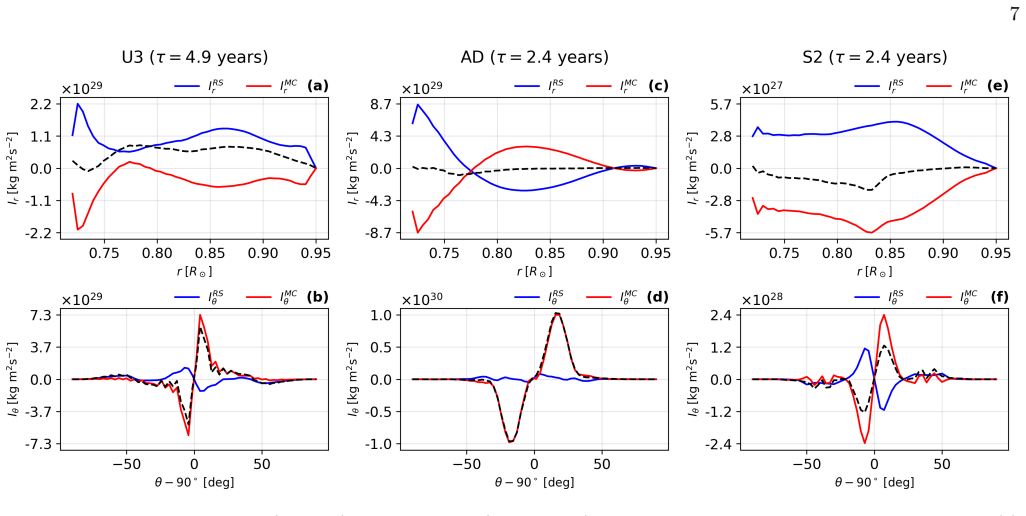
The central claim is that solar-like differential rotation can be generated and maintained in the convection zone without relying on Reynolds stresses from vigorous turbulent convection, provided a large-scale latitudinal entropy gradient exists and is sustained in thermal wind balance. In a rotating spherical shell with anelastic equations and a nudged potential-temperature profile, all simulations—whether stably stratified, adiabatic, or weakly superadiabatic—produce a rotation profile with a faster equator and slower poles. The torque analysis shows that the meridional circulation, rather than Reynolds stresses, is the main carrier of angular momentum in these runs; the Reynolds stresses
What carries the argument
The central object is the prescribed latitudinal potential-temperature gradient Θ_B, built by integrating the thermal wind balance relation (Eq. A1) against the helioseismic rotation profile. The stratification is enforced through a Newtonian cooling term in the potential-temperature equation (Eq. 3) with a long timescale (2.4–4.9 yr). The dynamical balance is expressed in the thermal wind equation: the centrifugal term C = r sinθ ∂Ω²/∂z is balanced against the baroclinic term B = (g/(Θ₀ r)) ∂Θ′/∂θ. The small residual C−B drives gyroscopic pumping, producing meridional circulation cells that redistribute angular momentum and sustain the differential rotation without the need for turbulent st
Load-bearing premise
The Sun's convection zone must actually maintain a persistent large-scale latitudinal entropy gradient, in thermal wind balance with the observed rotation, over timescales of years; if convection mixes that gradient away faster than it can be replenished, the proposed mechanism will not operate in the real Sun.
What would settle it
A direct helioseismic measurement of the latitudinal entropy gradient in the convection zone, showing it to be absent or far smaller than the thermal-wind value needed to balance the observed rotation, would falsify the mechanism. Alternatively, detection of Reynolds stress torques dominating over meridional-circulation torques in the Sun (as deduced from inversions of flow correlations) would contradict the paper's central claim.
If this is right
- If correct, the solar convection zone can be much less turbulent than mixing-length theory predicts, easing the convective conundrum.
- The observed differential rotation profile becomes a signature of large-scale thermodynamic balance rather than a direct measure of convective Reynolds stresses.
- The same baroclinic mechanism could operate in other solar-type stars, giving a common explanation for their rotation profiles.
- Models of the solar dynamo, which rely on differential rotation to stretch magnetic fields, may need to account for a rotation profile that is thermodynamically constrained rather than convectively driven.
- The work suggests that the radial tilt of the rotation contours at mid-latitudes emerges naturally from gyroscopic pumping of the baroclinic imbalance, offering a direct explanation for this long-puzzling feature.
Where Pith is reading between the lines
- A testable corollary of the paper's logic is that the observed solar rotation profile implies the existence of a sustained latitudinal entropy gradient of roughly the magnitude of Θ_B plotted in Fig. 2; if helioseismic or other measurements ever rule out such a gradient over multi-year timescales, the mechanism would be in conflict.
- The paper's preference for weak or stable stratifications suggests that the Sun's interior may contain subadiabatic layers (as in the Deardorff-layer picture); an inference is that the location and sharpness of such layers would control the shape of the rotation profile and could be constrained by the observed radial behavior near the tachocline.
- Extending this hydrodynamical framework to include magnetic fields, as the authors suggest, would test whether the baroclinically maintained rotation can survive Lorentz forces; one might predict that the magnetically active cycle modifies the entropy gradient and hence the rotation profile, providing a link to the observed torsional oscillations.
- The paper does not prescribe the origin of the entropy gradient; an inference is that any convective or tachocline-driven process that creates a large-scale latitudinal entropy variation (e.g., rotational modulation of heat transport or entropy rain) would suffice, meaning the mechanism is robust to the exact source as long as the gradient persists.
Editorial analysis
A structured set of objections, weighed in public.
Referee Report
Summary. The paper investigates whether solar differential rotation can be sustained by a prescribed large-scale latitudinal entropy gradient rather than by Reynolds stresses from vigorous convection. Global anelastic EULAG-MHD simulations of a spherical shell (0.72–0.96 R_sun) are run for 20 combinations of polytropic index (stable, adiabatic, weakly unstable) and two Newtonian-cooling timescales, with a target potential-temperature profile Θ_B derived from helioseismic differential rotation via thermal-wind balance. Time-averaged results show a fast equator and slower poles across most runs, with radially aligned mid-latitude contours; torque analysis attributes the maintenance primarily to meridional circulation, with Reynolds stresses playing a smaller or auxiliary role. The authors conclude that baroclinic forcing can maintain solar-like differential rotation without strong convective Reynolds stresses, offering a possible resolution to the convective conundrum, while acknowledging that the physical origin of the imposed entropy gradient is not modeled.
Significance. The paper has genuine strengths: the equations, boundary conditions, grid, and parameter choices are fully specified; the parameter sweep is broad; and the simulations are evolved long enough for robust temporal averages. The torque decomposition and thermal-wind diagnostics are appropriate and clearly presented. If the claims are scoped carefully, the study is a useful dynamical proof-of-concept: it shows that a baroclinic state designed to be in thermal-wind balance is nonlinearly compatible with a fast-equator rotation profile across a range of stratifications. However, the central solar-application claim is weakened by the construction of Θ_B from the very differential-rotation profile the paper explains, and by the fact that the entropy gradient is externally maintained rather than shown to exist or persist in the Sun. The paper is therefore more convincing as a controlled dynamics study than as an explanation of the origin of solar differential rotation.
major comments (3)
- [Appendix A, Eq. (A1); §4] The target profile Θ_B is constructed by integrating the thermal-wind balance using the observed helioseismic Ω profile (Eqs. A2–A3), and Eq. (3) relaxes the simulation toward this target. The solar-like Ω in the runs is therefore at least partly imposed: the forcing encodes the very observable being explained. The paper states explicitly that the physical origin of the entropy gradient is not modeled (§1, §4), but the abstract and conclusion present the result as an 'alternative scenario' for the solar rotation profile. As it stands, this is a demonstration of dynamical consistency, not a demonstration that the Sun possesses a sustained entropy gradient of the required amplitude and structure. Please narrow the claims accordingly, or provide a quantitative estimate of the required Θ_B and a discussion of whether such a gradient is consistent with observational constraints and with the r
- [§2, boundary conditions after Eq. (3)] Eq. (3) relaxes Θ′ toward Θ_B, but the boundary conditions immediately below require Θ′=0 at r=0.72 and 0.96 R_sun. The target Θ_B shown in Fig. 2 has latitudinal structure at these radii (its latitudinal average is zero, but pointwise values are not), so the homogeneous Dirichlet condition is incompatible with the nudging target at the boundaries. This will create boundary layers in Θ′ and corresponding baroclinic torques. Please clarify how the boundary condition is imposed in the code, whether the source term is suppressed at the boundary cells, and whether the reported time averages—including Fig. 3 and the torque integrals of Fig. 4—are sensitive to this treatment.
- [§3, first paragraph; §4] The paper's headline claim that solar-like differential rotation is maintained 'without relying on Reynolds stresses' is internally qualified. §3 states that 'weakly convective models ... are the only ones capable of reproducing the observed radial increase of Ω at low latitudes' and that 'the Reynolds stresses are responsible for torques capable of maintaining the radial increase of the rotation rate.' The radial increase at low latitudes is part of the observed solar profile, so the abstract and conclusions overstate the result. Please recast the claim to distinguish the baroclinically driven fast-equator/pole contrast from the low-latitude radial shear, which in the successful simulations is maintained with assistance from weak convective Reynolds stresses.
minor comments (8)
- [Eq. (10)] The symbols C and B are used before they are defined; define them explicitly or insert a sentence introducing them.
- [§2, paragraph on nudging] The phrase 'wavelength agnostic diffusivity' is vague. Since the Fourier-space form −τ^{-1}Θ̂′ is given, please explain the intended physical interpretation more concretely.
- [Throughout] Spelling is inconsistent: 'superabadicity' vs. 'superadiabaticity' and 'heliosseismic' vs. 'helioseismic'. Please check the whole text.
- [§4] The concluding paragraph ends with a stray 'a' after '...viable alternative to convection-dominated paradigms and contributes toward resolving long-standing discrepancies.'
- [Fig. 2 caption] Please state the units and color-scale range for the potential-temperature panel; currently the reader cannot estimate the amplitude of Θ_B.
- [Table 1] Entries in the second column like '1.5−1×10⁻⁴' are easy to misread as 1.5×10⁻⁴. Use explicit arithmetic (e.g., '1.4999') or add a space.
- [References] In the reference for Stefan et al. 2026, 'Guerreo' appears to be a typo for 'Guerrero'. Please check.
- [§2, numerical model] No explicit viscosity or diffusivity appears in Eqs. (1)–(3). If the runs rely on EULAG's numerical dissipation as an implicit subgrid model, please state this explicitly, since it is relevant for interpreting the Reynolds-stress torque decomposition.
Circularity Check
Solar-like rotation is partly an input: the prescribed entropy gradient Θ_B is derived from the observed helioseismic Ω profile, and the simulations are nudged toward it.
specific steps
-
self definitional
[Appendix A, Eq. (A1); Section 2, Eq. (3) and surrounding text]
"To obtain an entropy distribution compatible with the differential rotation profile inferred by helioseismic measurements, we integrate the thermal wind balance relation ... ΘB = C(r) − Θ0/g ∫ ∂Ω^2/∂z r dθ (A1). The nudging target profile Θ B implements an axis-symmetric potential temperature distribution in thermal wind balance with a velocity profile ... obtained by fitting the helioseismic observations ... into u 0 = a 0(r) + a 2(r) cos2(θ) + a 4(r) cos4(θ)."
Θ_B is constructed by integrating the thermal-wind balance from the observed helioseismic Ω profile (Eqs. A1–A3). The prognostic equation (3) then nudges Θ′ toward Θ_B on a τ ≈ 2.4–4.9 yr timescale. The simulated 'solar-like' rotation (fast equator, slow poles, radial contours) is therefore at least partly an input rather than an output: the forcing already encodes the target. The paper's own statement that the gradient is 'prescribed as a controlled forcing to test its dynamical consequences rather than to model its physical origin' confirms that the central driver is imported, not derived. Partial non-circular content remains in the departure from perfect TWB and the torque analysis.
full rationale
The paper makes a clear and honest distinction: it does not claim to derive the latitudinal entropy gradient from first principles, but rather prescribes it to test its dynamical consequences. However, the central result—that solar-like differential rotation can be generated without strong Reynolds stresses—is partially circular because the prescribed gradient itself is obtained by integrating the thermal-wind balance from the very helioseismic rotation profile that the simulations then reproduce. The Newtonian cooling term (Eq. 3) continuously relaxes the entropy perturbation toward this observed-derived target, so the pole-to-equator increase in Ω and the mid-latitude contour alignment are substantially built into the forcing. The non-vacuous content is the nonlinear dynamical consistency: the simulations show how the steady state departs from the imposed thermal-wind state via meridional circulation and how torques balance, which is a genuine result. There is no load-bearing self-citation or imported uniqueness theorem; the cited prior work (e.g., Hester et al. 2025) is used for comparison, not as a logical premise. The score of 6 reflects that one central 'prediction' (solar-like Ω) reduces by construction to the fitted input Θ_B, while the paper's own limitations statements are explicit and the dynamical analysis retains independent content.
Axiom & Free-Parameter Ledger
free parameters (4)
- Helioseismic DR fit coefficients α0, α2, α4, β0, β2, β4 (Eq. A2/A3) =
Not tabulated (multiple linear regression to Larson & Schou 2018 data)
- Gauge function C(r) of the thermal-wind integral =
Chosen by imposing vanishing latitudinal average of Θ_B
- Nudging timescale τΘ =
7.8×10^7 s (~2.4 yr) and 1.5×10^8 s (~4.9 yr)
- Ambient superadiabaticity Δ∇ (10 values via polytropic index m_a) =
Values in Table 1, ranging from −1.5×10^−7 to −1×10^−4, plus 0
axioms (6)
- domain assumption Anelastic (Lipps–Hemler) approximation is valid for the subsonic solar convection zone flow.
- ad hoc to paper Newtonian cooling with τ ≈ 2.4–4.9 yr (Eq. 3) is a faithful stand-in for whatever physical process would hold the entropy gradient in place.
- standard math The constructed state satisfies steady thermal-wind/geostrophic balance, so Θ_B from Eq. (A1) is the correct entropy pattern for the fitted Ω.
- domain assumption The background stratification is polytropic with base-state index m_0 = 1.5 (adiabatic), matched to the solar standard model at r_min.
- domain assumption Stress-free, impermeable boundaries with vanishing potential-temperature fluctuation at r_min and r_max.
- domain assumption Gravity follows an inverse-square law with mass enclosed at r_min (Eq. 4).
invented entities (1)
-
Externally prescribed, sustained latitudinal entropy (potential-temperature) gradient Θ_B in thermal wind balance with the observed rotation
no independent evidence
read the original abstract
A combination of recent observations and numerical simulations has called into question whether Sun's interior is characterized by strong turbulent convection, a problem known as convective conundrum. In light of a possible absence of vigorous convective motions, we examine whether the Sun's differential rotation, previously assumed to be tightly coupled to Reynolds stresses, may instead be sustained by the presence of a background latitudinal entropy gradient in thermal wind balance. By performing global hydrodynamical simulations of a rotating spherical shell representing the bulk of the solar convection zone, we demonstrate that solar-like differential rotation can be generated under a variety of thermal stratifications. This work proposes an alternative scenario for the origin of solar differential rotation that accommodates the previously reported discrepancies.
Figures




Reference graph
Works this paper leans on
-
[1]
New Journal of Physics , author =
A quantum information processor with trapped ions , volume =. New Journal of Physics , author =. 2013 , note =. doi:10.1088/1367-2630/15/12/123012 , abstract =
-
[2]
Experimental realization of. Nature , author =. 2001 , pages =. doi:10.1038/414883a , language =
-
[3]
Science China Information Sciences , author =
Superconducting quantum computing: a review , volume =. Science China Information Sciences , author =. 2020 , pages =. doi:10.1007/s11432-020-2881-9 , abstract =
-
[4]
SIAM Journal on Computing , author =
Strengths and. SIAM Journal on Computing , author =. 1997 , note =. doi:10.1137/S0097539796300933 , abstract =
-
[5]
Proceedings of the National Academy of Sciences , author =
Ensemble quantum computing by. Proceedings of the National Academy of Sciences , author =. 1997 , keywords =. doi:10.1073/pnas.94.5.1634 , abstract =
-
[6]
Advances in Physics , author =
The. Advances in Physics , author =. 2003 , note =. doi:10.1080/0001873021000049195 , abstract =
-
[7]
Stochastic series expansion method with operator-loop update , volume =. Physical Review B , author =. 1999 , pages =. doi:10.1103/PhysRevB.59.R14157 , language =
-
[8]
Residual. Physical Review , author =. 1967 , pages =. doi:10.1103/PhysRev.162.162 , language =
-
[9]
Computers in Physics , author =
Quantum. Computers in Physics , author =. 1992 , pages =. doi:10.1063/1.4823122 , language =
-
[10]
Progress of Theoretical Physics , author =
Relationship between d-. Progress of Theoretical Physics , author =. 1976 , pages =. doi:10.1143/PTP.56.1454 , abstract =
-
[11]
Quantum. Physical Review E , author =. 2002 , pages =. doi:10.1103/PhysRevE.66.046701 , language =
-
[12]
One-. Physical Review , author =. 1966 , pages =. doi:10.1103/PhysRev.150.321 , language =
-
[13]
Introduction to quantum integrability , volume =
Lamers, Jules , month = feb, year =. Introduction to quantum integrability , volume =. Proceedings of 10th. doi:10.22323/1.232.0001 , language =
-
[14]
and Avella, Adolfo and Mancini, Ferdinando , year =
Sandvik, Anders W. and Avella, Adolfo and Mancini, Ferdinando , year =. Computational. doi:10.1063/1.3518900 , urldate =
-
[15]
Physical Review Letters , author =
Cluster. Physical Review Letters , author =. 2001 , pages =. doi:10.1103/PhysRevLett.87.047203 , language =
-
[16]
Cluster algorithm for vertex models , volume =
Evertz, Hans Gerd and Lana, Gideon and Marcu, Mihai , year =. Cluster algorithm for vertex models , volume =
-
[17]
Journal of Fluid Mechanics , author =
Direct numerical simulation of laminar and turbulent. Journal of Fluid Mechanics , author =. 1982 , pages =. doi:10.1017/S0022112082001256 , abstract =
-
[18]
The Astrophysical Journal , author =
On the. The Astrophysical Journal , author =. 1965 , note =. doi:10.1086/148106 , abstract =
-
[19]
Thermal inertial waves in a rotating fluid layer:. Physics of Fluids , author =. 1997 , pages =. doi:10.1063/1.869317 , abstract =
-
[20]
and Margolin, Len G
Grinstein, Fenando F. and Margolin, Len G. and Rider, William , year =. Implicit large eddy simulation: computing turbulent fluid dynamics , isbn =
-
[21]
Haemorrhage and thrombosis for the
Harper, Ann , year =. Haemorrhage and thrombosis for the
-
[22]
, year =
Ballentine, Leslie E. , year =. Quantum mechanics: a modern development , isbn =
-
[23]
Living Reviews in Computational Astrophysics , author =
Modelling of stellar convection , volume =. Living Reviews in Computational Astrophysics , author =. 2017 , keywords =. doi:10.1007/s41115-017-0001-9 , abstract =
-
[24]
Journal of Computational Physics , author =
Computational design for long-term numerical integration of the equations of fluid motion:. Journal of Computational Physics , author =. 1966 , pages =. doi:10.1016/0021-9991(66)90015-5 , abstract =
-
[25]
Quarterly Journal of the Royal Meteorological Society , author =
Validity of anelastic and other equation sets as inferred from normal-mode analysis , volume =. Quarterly Journal of the Royal Meteorological Society , author =. 2003 , note =. doi:10.1256/qj.02.1951 , abstract =
-
[26]
Meteorology and Atmospheric Physics , author =
Review of numerical methods for nonhydrostatic weather prediction models , volume =. Meteorology and Atmospheric Physics , author =. 2003 , keywords =. doi:10.1007/s00703-001-0593-8 , abstract =
-
[27]
Lorenz, Edward N. , month = mar, year =. Deterministic. Journal of the Atmospheric Sciences , publisher =. doi:10.1175/1520-0469(1963)020<0130:DNF>2.0.CO;2 , abstract =
-
[28]
and Rheinhardt, Matthias and Brandenburg, Axel and Arlt, Rainer and Käpylä, Maarit J
Käpylä, Petri J. and Rheinhardt, Matthias and Brandenburg, Axel and Arlt, Rainer and Käpylä, Maarit J. and Lagg, Andreas and Olspert, Nigul and Warnecke, Jörn , month = aug, year =. Extended. The Astrophysical Journal Letters , publisher =. doi:10.3847/2041-8213/aa83ab , abstract =
-
[29]
The Astrophysical Journal Supplement Series , author =
Compressible convection in a rotating spherical shell. The Astrophysical Journal Supplement Series , author =. 1981 , note =. doi:10.1086/190714 , abstract =
doi:10.1086/190714 1981
-
[30]
Stein, R. F. and Nordlund, Å , month = jun, year =. Simulations of. The Astrophysical Journal , publisher =. doi:10.1086/305678 , language =
-
[31]
Journal of Computational Physics , author =
Building resolving large-eddy simulations and comparison with wind tunnel experiments , volume =. Journal of Computational Physics , author =. 2007 , keywords =. doi:10.1016/j.jcp.2007.08.005 , abstract =
-
[32]
Don't suppress the wiggles—. Computers & Fluids , author =. 1981 , pages =. doi:10.1016/0045-7930(81)90026-8 , abstract =
-
[33]
Klein, Rupert and Achatz, Ulrich and Bresch, Didier and Knio, Omar M. and Smolarkiewicz, Piotr K. , month = oct, year =. Regime of. Journal of the Atmospheric Sciences , publisher =. doi:10.1175/2010JAS3490.1 , abstract =
-
[34]
Barekat, A. and Brandenburg, A. , month = nov, year =. Near-polytropic stellar simulations with a radiative surface , volume =. Astronomy & Astrophysics , publisher =. doi:10.1051/0004-6361/201322461 , abstract =
-
[35]
The Astrophysical Journal , author =
The. The Astrophysical Journal , author =. 1991 , note =. doi:10.1086/170441 , abstract =
doi:10.1086/170441 1991
-
[36]
and Lecoanet, Daniel and Brown, Benjamin P
Anders, Evan H. and Lecoanet, Daniel and Brown, Benjamin P. , month = oct, year =. Entropy. The Astrophysical Journal , publisher =. doi:10.3847/1538-4357/ab3644 , abstract =
-
[37]
Living Reviews in Solar Physics , author =
Solar. Living Reviews in Solar Physics , author =. 2009 , keywords =. doi:10.12942/lrsp-2009-2 , abstract =
-
[38]
Reports on Progress in Physics , author =
Astrophysical turbulence modeling , volume =. Reports on Progress in Physics , author =. 2011 , pages =. doi:10.1088/0034-4885/74/4/046901 , abstract =
-
[39]
Greer, Benjamin J. and Hindman, Bradley W. and Featherstone, Nicholas A. and Toomre, Juri , month = apr, year =. The Astrophysical Journal Letters , publisher =. doi:10.1088/2041-8205/803/2/L17 , abstract =
-
[40]
Multichannel. Solar Physics , author =. 2012 , keywords =. doi:10.1007/s11207-011-9873-8 , abstract =
-
[41]
Journal of Computational Physics , author =
Simulations of stellar convection with. Journal of Computational Physics , author =. 2012 , keywords =. doi:10.1016/j.jcp.2011.09.026 , abstract =
-
[42]
Astronomy and Astrophysics , author =
Numerical simulations of convection at the surface of a. Astronomy and Astrophysics , author =. 1994 , note =
1994
-
[43]
Trampedach, Regner and Stein, Robert F. , month = mar, year =. The Astrophysical Journal , publisher =. doi:10.1088/0004-637X/731/2/78 , abstract =
-
[44]
Durran, Dale R. , month = jun, year =. Improving the. Journal of the Atmospheric Sciences , publisher =. doi:10.1175/1520-0469(1989)046<1453:ITAA>2.0.CO;2 , abstract =
-
[45]
Lipps, Frank B. , month = jul, year =. On the. Journal of the Atmospheric Sciences , publisher =. doi:10.1175/1520-0469(1990)047<1794:OTAAFD>2.0.CO;2 , abstract =
-
[46]
Lipps, Franik B. and Hemler, Richard S. , month = oct, year =. A. Journal of the Atmospheric Sciences , publisher =. doi:10.1175/1520-0469(1982)039<2192:ASAODM>2.0.CO;2 , abstract =
-
[47]
, volume =
Turbulent plumes in stellar convective envelopes. , volume =. Astronomy and Astrophysics , author =. 1995 , note =
1995
-
[48]
The Astrophysical Journal , author =
Topology of. The Astrophysical Journal , author =. 1989 , note =. doi:10.1086/185493 , abstract =
-
[49]
Investigative Urology , author =
Computer evaluation of the effect of urecholine on the spontaneous activity of smooth muscle from the urinary bladder of the rabbit , volume =. Investigative Urology , author =. 1975 , keywords =
1975
-
[50]
The Astrophysical Journal , author =
Numerical. The Astrophysical Journal , author =. 2022 , pages =. doi:10.3847/1538-4357/ac54b7 , abstract =
-
[51]
and Weiss, A
Kippenhahn, Rudolf and Weigert, A. and Weiss, A. , year =. Stellar structure and evolution , isbn =
-
[52]
The Astrophysical Journal , publisher =
Brandenburg, Axel , month = nov, year =. The Astrophysical Journal , publisher =. doi:10.3847/0004-637X/832/1/6 , abstract =
-
[53]
Journal of Computational Physics , author =
A fully multidimensional positive definite advection transport algorithm with small implicit diffusion , volume =. Journal of Computational Physics , author =. 1984 , pages =. doi:10.1016/0021-9991(84)90121-9 , abstract =
-
[54]
Deardorff, J. W. , month = sep, year =. The. Journal of the Atmospheric Sciences , publisher =. doi:10.1175/1520-0469(1966)023<0503:TCGHFI>2.0.CO;2 , abstract =
-
[55]
Journal of Fluid Mechanics , author =
Scaling of hard thermal turbulence in. Journal of Fluid Mechanics , author =. 1989 , pages =. doi:10.1017/S0022112089001643 , language =
-
[56]
Heslot, F. and Castaing, B. and Libchaber, A. , month = dec, year =. Transitions to turbulence in helium gas , volume =. Physical Review A , publisher =. doi:10.1103/PhysRevA.36.5870 , abstract =
-
[57]
Lantz, S. R. and Fan, Y. , month = mar, year =. Anelastic. The Astrophysical Journal Supplement Series , publisher =. doi:10.1086/313187 , language =
-
[59]
, year =
Chandrasekhar, S. , year =. Hydrodynamic and hydromagnetic stability , isbn =
-
[60]
The. Science , author =. 1996 , pages =. doi:10.1126/science.272.5266.1286 , language =
arXiv 1996
-
[61]
Computers & Fluids , author =. 2008 , pages =. doi:10.1016/j.compfluid.2007.12.001 , abstract =
-
[62]
Brown, Benjamin P. and Vasil, Geoffrey M. and Zweibel, Ellen G. , month = aug, year =. The Astrophysical Journal , publisher =. doi:10.1088/0004-637X/756/2/109 , abstract =
-
[63]
The Astrophysical Journal , publisher =
Verhoeven, Jan and Wiesehöfer, Thomas and Stellmach, Stephan , month = may, year =. The Astrophysical Journal , publisher =. doi:10.1088/0004-637X/805/1/62 , abstract =
-
[64]
and Julien, Keith and Marti, Philippe , month = mar, year =
Calkins, Michael A. and Julien, Keith and Marti, Philippe , month = mar, year =. The breakdown of the anelastic approximation in rotating compressible convection: implications for astrophysical systems , volume =. Proceedings of the Royal Society A: Mathematical, Physical and Engineering Sciences , publisher =. doi:10.1098/rspa.2014.0689 , abstract =
arXiv 2014
-
[65]
, year =
Menicucci, L.S. , year =. Computational study of the phase transitions of a tridimensional anisotropic ferromagnetic model using the roots of the energy`s
-
[66]
Roger and Seldin, J
Hindley, J. Roger and Seldin, J. P. , year =. Lambda-calculus and combinators, an introduction , isbn =
-
[67]
The physics of fluids and plasmas: an introduction for astrophysicists , isbn =
Choudhuri, Arnab Rai , year =. The physics of fluids and plasmas: an introduction for astrophysicists , isbn =
-
[68]
International Journal for Numerical Methods in Fluids , author =
Multidimensional positive definite advection transport algorithm: an overview , volume =. International Journal for Numerical Methods in Fluids , author =. 2006 , note =. doi:10.1002/fld.1071 , abstract =
doi:10.1002/fld.1071 2006
-
[69]
Journal of Computational Physics , author =
A consistent framework for discrete integrations of soundproof and compressible. Journal of Computational Physics , author =. 2014 , keywords =. doi:10.1016/j.jcp.2014.01.031 , abstract =
-
[70]
Where were you when? 180 unforgettable moments in living history , isbn =
Harrison, Ian , year =. Where were you when? 180 unforgettable moments in living history , isbn =
-
[71]
Thinking with type: a critical guide for designers, writers, editors, & students , isbn =
Lupton, Ellen , year =. Thinking with type: a critical guide for designers, writers, editors, & students , isbn =
-
[72]
a , month = mar, year =
Davidson, P. a , month = mar, year =. An
-
[73]
Living Reviews in Solar Physics , author =
Dynamo models of the solar cycle , volume =. Living Reviews in Solar Physics , author =. 2020 , keywords =. doi:10.1007/s41116-020-00025-6 , abstract =
-
[74]
The Astrophysical Journal , author =
On the. The Astrophysical Journal , author =. 1908 , pages =. doi:10.1086/141602 , language =
-
[75]
Solid State Communications , author =
Magnetic vortices in kekulene-like molecules , volume =. Solid State Communications , author =. 2021 , pages =. doi:10.1016/j.ssc.2021.114224 , language =
arXiv 2021
-
[76]
Morningstar, Colin , month = feb, year =. The. doi:10.48550/arXiv.hep-lat/0702020 , abstract =
work page internal anchor Pith review Pith/arXiv arXiv doi:10.48550/arxiv.hep-lat/0702020
-
[77]
and Wilmer, Elizabeth L
Levin, David Asher and Peres, Y. and Wilmer, Elizabeth L. and Propp, James and Wilson, David B. , year =. Markov chains and mixing times , isbn =
-
[78]
and Hibbs, Albert R
Feynman, Richard P. and Hibbs, Albert R. , year =. Quantum mechanics and path integrals , isbn =
-
[79]
Jarzynski, C. , month = nov, year =. Equilibrium free-energy differences from nonequilibrium measurements:. Physical Review E , publisher =. doi:10.1103/PhysRevE.56.5018 , abstract =
-
[80]
Out-of-equilibrium protocol for
Alba, Vincenzo , month = jun, year =. Out-of-equilibrium protocol for. Physical Review E , publisher =. doi:10.1103/PhysRevE.95.062132 , abstract =
-
[81]
Jarzynski, C. , month = apr, year =. Nonequilibrium. Physical Review Letters , publisher =. doi:10.1103/PhysRevLett.78.2690 , abstract =
discussion (0)
Sign in with ORCID, Apple, or X to comment. Anyone can read and Pith papers without signing in.