REVIEW 3 major objections 6 minor 45 references
Sequential Neural Operator Transformer for High-Fidelity Surrogates of Time-Dependent Non-linear Partial Differential Equations
T0 review · 3 major / 6 minor · reviewed 2026-08-06 · deepseek-v4-flash
Pith's one-line read The paper claims that replacing the dot-product fusion in Sequential DeepONet with cross-attention between the encoded loading sequence and spatial query points consistently improves prediction accuracy on three challenging time-dependent…
desk verdict S-NOT is a plausible incremental architecture but the empirical claim of consistent superiority over S-DON needs a fairer, multi-seed comparison before it is established. read the letter →
The pith
A machine-rendered reading of the paper's core claim, the machinery that carries it, and where it could break.
The reading
What carries the argument
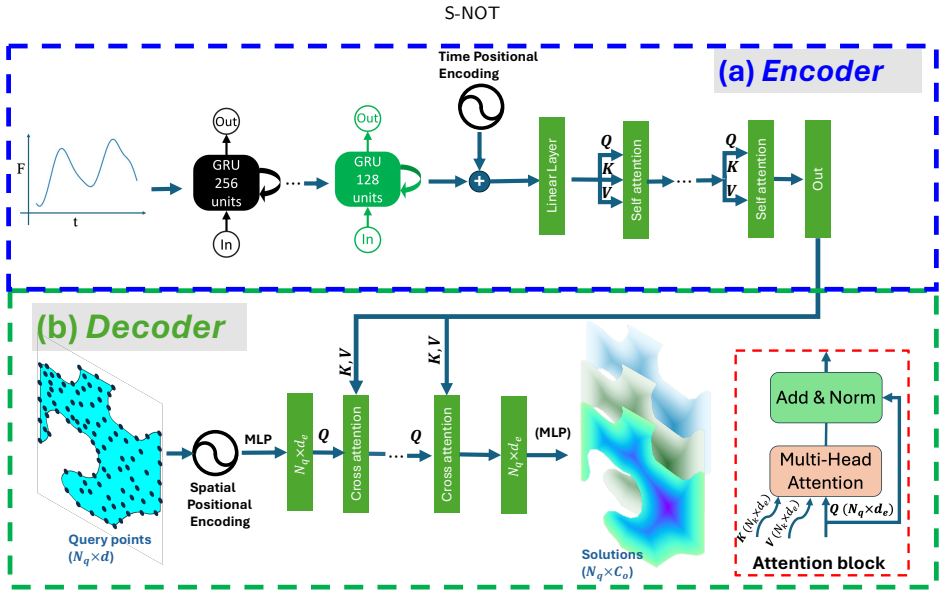
The central mechanism is cross-attention between the encoded loading history and the spatial query points, defined as $\mathrm{Attention}(Q,K,V) = \mathrm{softmax}(QK^T/\sqrt{d_e})V$. The GRU stack preserves temporal causality in the loading sequence, the sinusoidal positional encoding injects time information explicitly, self-attention lets the encoder re-weight the sequence, and cross-attention lets each spatial point aggregate the most relevant parts of the history instead of relying on a single inner product. This replacement of dot-product fusion by attention is the component the paper credits for the accuracy gain.
What would settle it
Retrain both models on the same three datasets with each model's hyperparameters tuned separately using equal budgets and several random seeds, then compute mean and 90th-percentile errors with confidence intervals. If S-DON matches or beats S-NOT in mean or tail errors under matched tuning, the claim that attention-based fusion is more accurate would be refuted.
Extended reading notes
Core claim
S-NOT uses a GRU encoder to process a sequence of loading values in time, adds sinusoidal positional encodings, and refines the representation with self-attention blocks; the resulting sequence serves as keys and values for the decoder. In the decoder, each spatial query point is embedded with a NeRF-style positional encoding followed by an MLP to form a query, and cross-attention selects the relevant portions of the load history for that point. This replaces the fixed dot product of branch and trunk outputs in S-DON. In the paper's tests, the change consistently improves accuracy, and the largest gains appear on high-error outlier samples, so the error tails become shorter.
Load-bearing premise
The comparison assumes that S-DON was trained with the same hyperparameters, training budget, and data splits as S-NOT; the paper does not report those settings, so if S-DON was undertuned the reported accuracy gap could shrink or reverse.
Editorial extensions
If this is right
- On all three reported benchmarks, S-NOT attains a lower mean error than S-DON for stress, temperature, and plastic strain fields.
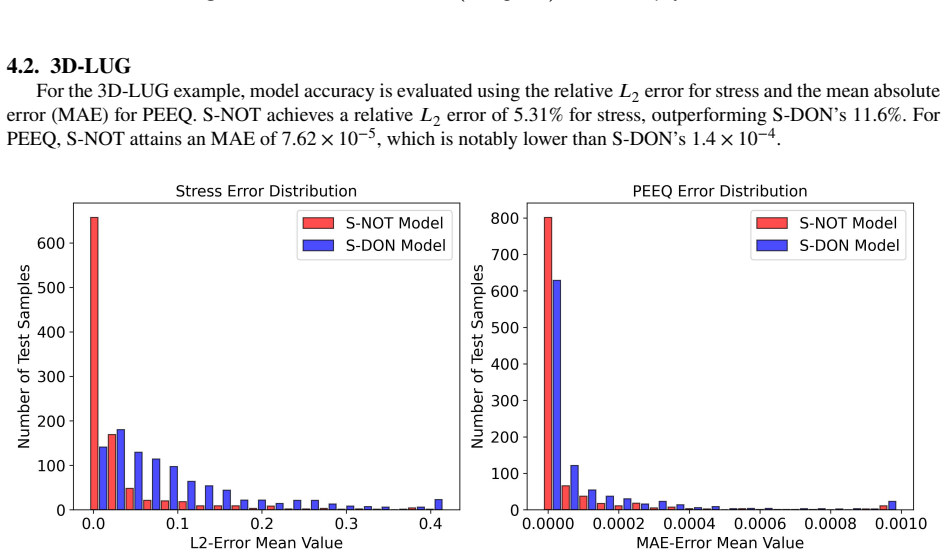
- S-NOT's test error distributions have shorter tails, so the model is more reliable on difficult or outlier samples where S-DON's accuracy degrades.
- S-NOT keeps roughly the same number of parameters and inference speed as S-DON, so the accuracy gain does not add much deployment cost.
- Surrogate inference (about $10^{-3}$ seconds per sample on GPU) is orders of magnitude faster than the reference finite element runs (20 to 333 seconds per sample on CPU), enabling repeated forward evaluations.
- The design is supported by the theoretical result that cross-attention transformers are universal operator approximators, giving the attention-based fusion a principled basis beyond the empirical gains.
Reading between the lines
- Because the accuracy gain concentrates in the error tails, S-NOT should be most valuable in safety-critical applications such as predicting hot tearing in continuous casting, where rare large errors dominate risk.
- The cross-attention decoder is agnostic to the choice of sequence encoder, so S-NOT could be combined with other temporal encoders or with physics-informed loss terms without changing the core architecture.
- A natural next test is whether S-NOT retains its advantage on loading histories sampled from distributions held out during training, a stronger out-of-distribution check than the outlier analysis reported here.
Editorial analysis
A structured set of objections, weighed in public.
Referee Report
Summary. The paper proposes the Sequential Neural Operator Transformer (S-NOT), a surrogate model that combines GRU-based sequential encoding with transformer-style self-attention and cross-attention to map time-dependent loading histories to full-field PDE solutions. The model is benchmarked on three FEM-generated datasets: multiphysics steel solidification, a 3D lug specimen, and a dog-bone specimen under path-dependent loading. The central claim, stated in the abstract and Section 1, is that S-NOT consistently achieves higher prediction accuracy than S-DON across all test cases, including outlier samples. Table 1 reports lower mean errors for S-NOT on all datasets, and Table 2 indicates comparable inference time and parameter counts. However, the evaluation is based on a single run per model, reports no training hyperparameters, uses a nonstandard split for the dog-bone dataset, and provides only qualitative evidence for the outlier claim, leaving the comparative claim insufficiently supported.
Significance. The attention-based cross-attention decoder is a natural and potentially impactful modification of S-DON for sequential operator learning, and the three realistic nonlinear PDE benchmarks are well chosen. If the claimed accuracy gains are confirmed under controlled comparison, S-NOT could provide a useful surrogate for path-dependent material simulations. The paper also makes its code and trained models available on GitHub and the datasets on Zenodo, which is a strength for reproducibility. The main weakness is that the empirical comparison is not yet rigorous enough to establish the central claim: missing training configurations, single-run results with large per-sample standard deviations, and an unmatched data split for the dog-bone dataset leave room for alternative explanations of the reported accuracy gap.
major comments (3)
- [Section 4, Table 1] The central claim that S-NOT 'consistently achieves a higher prediction accuracy than S-DON' is not supported by the present evaluation because no training hyperparameters (optimizer, learning rate, batch size, epochs, early stopping, random seeds) are reported for either model, and only a single run per model is presented. The per-sample standard deviations are large (e.g., steel stress: 4.3 ± 15.3 for S-NOT vs. 18.1 ± 23.2 for S-DON), so the observed differences may be within run-to-run stochasticity. Please provide full training configurations for both models, repeat each model over multiple seeds, and report paired statistics (e.g., per-sample error-difference distributions or a signed-rank test) to substantiate the consistency claim.
- [Section 3.3, Dog-bone split] The dog-bone dataset uses a 3,200/800 train/test split, which is neither the 80/20 split used for the other two datasets nor justified relative to the original 15,000 samples. The manuscript does not state whether the reported S-DON dog-bone results were reproduced on this exact split or quoted from He et al. [27] under a different split. This makes the S-DON comparison potentially unequal and could bias the reported accuracy gap. Please justify the split and ensure both models are trained and evaluated on identical data partitions.
- [Abstract, Section 4.3, Conclusion] The claim of superior accuracy 'even for data outliers' is supported only by qualitative percentile plots (Figs. 6, 9, 10, 12, 13) and error histograms, with no quantitative tail metrics (e.g., 90th/95th percentile errors, tail-mean, or the fraction of test samples where S-NOT outperforms S-DON). Given the heavy-tailed error distributions in Table 1, the robustness claim requires such statistics to be substantiated.
minor comments (6)
- [Abstract] The abstract contains the phrase 'a architecture' and should read 'an architecture'; it also uses 'S-DeepONet' while the main text predominantly uses 'S-DON', which should be made consistent.
- [Section 3.3] The text says 'the finnal state of von Mises stress' and should be corrected to 'the final state'.
- [Table 2] The dog-bone row for S-NOT parameter count reads '7,90952', which appears to be a typo for '790,952'.
- [Section 3.1, Eq. (7)] Equation (7) is introduced with 'given in Eq. (5)', which is incorrect; it should refer to its own equation number.
- [Section 4] The sentence 'S-NOT offers similar inference speed and parameter count to S-DON' is imprecise because Table 2 shows S-NOT has fewer parameters in the 3D Lug case but more in the other two cases; the statement should be qualified.
- [Section 2.2] The attention formula in Eq. (2) is labeled generically; the text should explicitly clarify that cross-attention in the decoder uses the same formula with Q derived from query points and K, V from the encoder, as described in the prose.
Circularity Check
No significant circularity; the S-NOT advantage over S-DON rests on held-out FEM benchmarks, not on a self-referential construction.
full rationale
The paper is an empirical architecture comparison rather than a derivation: S-NOT's output is defined by the attention operation in Eq. (2) combined with a GRU sequential encoder, and the reported accuracies are computed on held-out FEM samples using the error metrics in Eqs. (10) and (11). No fitted parameter is later renamed as a prediction, and no equation defines the claimed advantage in terms of the S-DON output or the evaluation metric. The theoretical support for cross-attention operator models is attributed to the external work of Shih et al. [34], not to the authors' own prior results. The self-citations [16], [27], [33], and [35] supply prior baselines, datasets, and related neural-operator transformer variants, but the central S-NOT-versus-S-DON comparison is presented as this paper's own benchmark rather than imported as a cited conclusion. Concerns about the dog-bone split (3,200/800) and the absence of reported hyperparameter settings are legitimate threats to the fairness and statistical strength of the comparison, but they do not make the prediction equivalent to its input by construction. Accordingly, no circular step is exhibited.
Assumptions & free parameters
free parameters (1)
- Model hyperparameters (embedding dimension, number of attention heads, number of GRU layers, learning rate, batch size) =
not reported in text (available in code repository)
assumptions (4)
- standard math Transformers with cross-attention have the universal approximation property for operator learning (Shih et al. [34]).
- domain assumption The FEM-generated datasets are accurate ground-truth solutions of the target PDE problems.
- domain assumption The random loading profiles used to generate training data are sampled from the same distribution as the test profiles.
- domain assumption The S-DON baseline is implemented and tuned with comparable effort to S-NOT.
Cite this review
Pith. "Pith review of Sequential Neural Operator Transformer for High-Fidelity Surrogates of Time-Dependent Non-linear Partial Differential Equations." pith.science (2026). https://pith.science/paper/PEJIKV5H
@misc{pith2026250703272,
  author       = {Pith},
  title        = {Pith review of: Sequential Neural Operator Transformer for High-Fidelity Surrogates of Time-Dependent Non-linear Partial Differential Equations},
  year         = {2026},
  howpublished = {\url{https://pith.science/paper/PEJIKV5H}},
  note         = {Machine review of arXiv:2507.03272}
}
read the original abstract
Partial differential equations (PDEs) are fundamental to modeling complex and nonlinear physical phenomena, but their numerical solution often requires significant computational resources, particularly when a large number of forward full solution evaluations are necessary, such as in design, optimization, sensitivity analysis, and uncertainty quantification. Recent progress in operator learning has enabled surrogate models that efficiently predict full PDE solution fields; however, these models often struggle with accuracy and robustness when faced with highly nonlinear responses driven by sequential input functions. To address these challenges, we propose the Sequential Neural Operator Transformer (S-NOT), a architecture that combines gated recurrent units (GRUs) with the self-attention mechanism of transformers to address time-dependent,nonlinear PDEs. Unlike S-DeepONet (S-DON), which uses a dot product to merge encoded outputs from the branch and trunk sub-networks, S-NOT leverages attention to better capture intricate dependencies between sequential inputs and spatial query points. We benchmark S-NOT on three challenging datasets from real-world applications with plastic and thermo-viscoplastic highly nonlinear material responses: multiphysics steel solidification, a 3D lug specimen, and a dogbone specimen under temporal and path-dependent loadings. The results show that S-NOT consistently achieves a higher prediction accuracy than S-DON even for data outliers, demonstrating its accuracy and robustness for drastically accelerating computational frameworks in scientific and engineering applications.
Figures


Figures from the paper (10 more)




Reference graph
Works this paper leans on
-
[27]
J.He,S.Kushwaha,J.Park,S.Koric,D.Abueidda,I.Jasiuk, Sequentialdeepoperatornetworks(s-deeponet)forpredictingfull-fieldsolutions under time-dependent loads, Engineering Applications of Artificial Intelligence 127 (2024) 107258
work page 2024
-
[1]
S. Kiranyaz, J. Malik, H. B. Abdallah, T. Ince, A. Iosifidis, M. Gabbouj, Exploiting heterogeneity in operational neural networks by synaptic plasticity, Neural Computing and Applications 33 (2021) 7997–8015. doi:10.1007/s00521-020-05543-w. Q. Liu et al.:Preprint submitted to Elsevier Page 12 of 14 S-NOT
-
[2]
Z.Yang,C.-H.Yu,M.J.Buehler, Deeplearningmodeltopredictcomplexstressandstrainfieldsinhierarchicalcomposites, ScienceAdvances 7 (2021) eabd7416. doi:10.1126/sciadv.abd7416
-
[3]
H. Sun, L. Peng, S. Huang, S. Li, Y. Long, S. Wang, W. Zhao, Development of a physics-informed doubly fed cross-residual deep neural network for high-precision magnetic flux leakage defect size estimation, IEEE Transactions on Industrial Informatics 18 (2021) 1629–1640. doi:10.1109/TII.2021.3089333
- [4]
-
[5]
T. Konuk, J. Shragge, Physics-guided deep learning using fourier neural operators for solving the acoustic vti wave equation, in: 82nd EAGE annualconference&exhibition,volume2021,EuropeanAssociationofGeoscientists&Engineers,2021,pp.1–5.doi: 10.3997/2214-4609. 202113304
-
[6]
N. Borrel-Jensen, S. Goswami, A. P. Engsig-Karup, G. E. Karniadakis, C.-H. Jeong, Sound propagation in realistic interactive 3d scenes with parameterized sources using deep neural operators, Proceedings of the National Academy of Sciences 121 (2024) e2312159120. doi:doi.org/10.1073/pnas.2312159120
-
[7]
Q.Liu,D.Abueidda,S.Vyas,Y.Gao,S.Koric,P.H.Geubelle, Adaptivedata-drivendeep-learningsurrogatemodelforfrontalpolymerization in dicyclopentadiene, The Journal of Physical Chemistry B 128 (2024) 1220–1230. doi:10.1021/acs.jpcb.3c07714
Show all 45 references
-
[8]
P.Cai,S.Liu,Q.Liu,P.H.Geubelle,R.Gomez-Bombarelli, Towardslongrolloutofneuraloperatorswithlocalattentionandflowmatching- inspiredcorrection:AnexampleinfrontalpolymerizationPDEs, in:MachineLearningandthePhysicalSciencesWorkshop@NeurIPS2024,
-
[9]
Abdar, F
M. Abdar, F. Pourpanah, S. Hussain, D. Rezazadegan, L. Liu, M. Ghavamzadeh, P. Fieguth, X. Cao, A. Khosravi, U. R. Acharya, et al., A review of uncertainty quantification in deep learning: Techniques, applications and challenges, Information fusion 76 (2021) 243–297. doi:10.10...
2021 doi
-
[10]
Cheng, C
S. Cheng, C. Quilodrán-Casas, S. Ouala, A. Farchi, C. Liu, P. Tandeo, R. Fablet, D. Lucor, B. Iooss, J. Brajard, et al., Machine learning with data assimilation and uncertainty quantification for dynamical systems: a review, IEEE/CAA Journal of Automatica Sinica 10 (2023) 1361–1387
2023
-
[11]
doi:/10.1061/(ASCE)MT.1943-5533.0003843
K.Li,Y.Long,H.Wang,Y.-F.Wang, Modelingandsensitivityanalysisofconcretecreepwithmachinelearningmethods, JournalofMaterials in Civil Engineering 33 (2021) 04021206. doi:/10.1061/(ASCE)MT.1943-5533.0003843
2021
-
[12]
doi:10.1016/j.chemosphere.2023.138830
S.Wang,Y.Ren,B.Xia,K.Liu,H.Li, Predictionofatmosphericpollutantsinurbanenvironmentbasedoncoupleddeeplearningmodeland sensitivity analysis, Chemosphere 331 (2023) 138830. doi:10.1016/j.chemosphere.2023.138830
2023
-
[13]
E. M. Dogo, O. Afolabi, N. Nwulu, B. Twala, C. Aigbavboa, A comparative analysis of gradient descent-based optimization algorithms on convolutionalneuralnetworks, in:2018internationalconferenceoncomputationaltechniques,electronicsandmechanicalsystems(CTEMS), IEEE, 2018, pp. 92...
2018
-
[14]
M. S. Daoud, M. Shehab, H. M. Al-Mimi, L. Abualigah, R. A. Zitar, M. K. Y. Shambour, Gradient-based optimizer (gbo): a review, theory, variants,andapplications, ArchivesofComputationalMethodsinEngineering30(2023)2431–2449.doi: 10.1007/s11831-022-09872-y
2023 doi
-
[15]
Q. Liu, P. Cai, D. Abueidda, S. Vyas, S. Koric, R. Gomez-Bombarelli, P. Geubelle, Univariate conditional variational autoencoder for morphogenic pattern design in frontal polymerization-based manufacturing, Computer Methods in Applied Mechanics and Engineering 438 (2025) 11784...
2025
- [16]
-
[17]
L. Lu, P. Jin, G. Pang, et al., Learning nonlinear operators via deeponet based on the universal approximation theorem of operators, Nature Machine Intelligence 3 (2021) 218–229
2021
-
[18]
Koric, A
S. Koric, A. Viswanath, D. W. Abueidda, N. A. Sobh, K. Khan, Deep learning operator network for plastic deformation with variable loads and material properties, Engineering with Computers 40 (2024) 917–929
2024
-
[19]
Goswami, M
S. Goswami, M. Yin, Y. Yu, G. E. Karniadakis, A physics-informed variational deeponet for predicting crack path in quasi-brittle materials, Computer Methods in Applied Mechanics and Engineering 391 (2022) 114587
2022
-
[20]
T. Zhao, W. Qian, J. Lin, H. Chen, H. Ao, G. Chen, L. He, Learning mappings from iced airfoils to aerodynamic coefficients using a deep operator network, Journal of Aerospace Engineering 36 (2023) 04023035
2023
-
[21]
L. Xu, H. Zhang, M. Zhang, Training a deep operator network as a surrogate solver for two-dimensional parabolic-equation models, The Journal of the Acoustical Society of America 154 (2023) 3276–3284
2023
-
[22]
Haghighat, U
E. Haghighat, U. b. Waheed, G. Karniadakis, En-deeponet: An enrichment approach for enhancing the expressivity of neural operators with applications to seismology, Computer Methods in Applied Mechanics and Engineering 420 (2024) 116681
2024
-
[23]
Kobayashi, J
K. Kobayashi, J. Daniell, S. B. Alam, Improved generalization with deep neural operators for engineering systems: Path towards digital twin, Engineering Applications of Artificial Intelligence 131 (2024) 107844
2024
-
[24]
Sahin, C
I. Sahin, C. Moya, A. Mollaali, G. Lin, G. Paniagua, Deep operator learning-based surrogate models with uncertainty quantification for optimizing internal cooling channel rib profiles, International Journal of Heat and Mass Transfer 219 (2024) 124813
2024
-
[25]
S.Koric,D.W.Abueidda, Data-drivenandphysics-informeddeeplearningoperatorsforsolutionofheatconductionequationwithparametric heat source, International Journal of Heat and Mass Transfer 203 (2023) 123809
2023
-
[26]
R. B. Hossain, F. Ahmed, K. Kobayashi, S. Koric, D. Abueidda, S. B. Alam, Virtual sensing-enabled digital twin framework for real-time monitoring of nuclear systems leveraging deep neural operators, npj Materials Degradation 9 (2025) 21
2025
-
[28]
Vaswani, N
A. Vaswani, N. Shazeer, N. Parmar, J. Uszkoreit, L. Jones, A. N. Gomez, L. u. Kaiser, I. Polosukhin, Attention is all you need, in: I. Guyon, U. V. Luxburg, S. Bengio, H. Wallach, R. Fergus, S. Vishwanathan, R. Garnett (Eds.), Advances in Neural Information Processing Systems,...
2017
-
[29]
Cao, Choose a transformer: Fourier or galerkin, Advances in neural information processing systems 34 (2021) 24924–24940
S. Cao, Choose a transformer: Fourier or galerkin, Advances in neural information processing systems 34 (2021) 24924–24940
2021
-
[30]
X. Liu, B. Xu, L. Zhang, Ht-net: Hierarchical transformer based operator learning model for multiscale pdes (2022)
2022
- [31]
-
[32]
12556–12569
Z.Hao,Z.Wang,H.Su,C.Ying,Y.Dong,S.Liu,Z.Cheng,J.Song,J.Zhu, Gnot:Ageneralneuraloperatortransformerforoperatorlearning, in: International Conference on Machine Learning, PMLR, 2023, pp. 12556–12569
2023
-
[33]
Q. Liu, V. Zhong, H. Meidani, D. Abueidda, S. Koric, P. Geubelle, Geometry-informed neural operator transformer, arXiv preprint arXiv:2504.19452 (2025). doi:doi.org/10.48550/arXiv.2504.19452
2025 doi
-
[34]
doi:10.1016/j.cma.2024.117560
B.Shih,A.Peyvan,Z.Zhang,G.E.Karniadakis, Transformersasneuraloperatorsforsolutionsofdifferentialequationswithfiniteregularity, Computer Methods in Applied Mechanics and Engineering 434 (2025) 117560. doi:10.1016/j.cma.2024.117560
2025
-
[35]
Kushwaha, J
S. Kushwaha, J. Park, S. Koric, J. He, I. Jasiuk, D. Abueidda, Advanced deep operator networks to predict multiphysics solution fields in materials processing and additive manufacturing, Additive Manufacturing (2024) 104266
2024
- [36]
-
[37]
Kozlowski, B
P. Kozlowski, B. Thomas, J. Azzi, H. Wang, Simple constitutive equations for steel at high temperature, Metallurgical and Materials Transactions A 23 (1992) 903–918
1992
-
[38]
Zhu, Coupled Thermo-Mechanical Finite-Element Model with Application to Initial Solidification, Ph.D
H. Zhu, Coupled Thermo-Mechanical Finite-Element Model with Application to Initial Solidification, Ph.D. thesis, University of Illinois at Urbana-Champaign, Urbana, IL, USA, 1996
1996
-
[39]
Dassault Systèmes Simulia Corp., Abaqus/Standard User’s Manual, Version 2022, Johnston, RI, USA, 2022
2022
-
[40]
Koric, B
S. Koric, B. G. Thomas, Efficient thermo-mechanical model for solidification processes, International Journal for Numerical Methods in Engineering 66 (2006) 1955–1989
2006
-
[41]
M.Zappulla,S.Cho,S.Koric,H.Lee,S.Kim,B.Thomas, Multiphysicsmodelingofcontinuouscastingofstainlesssteel, JournalofMaterials Processing Technology 278 (2020) 116469
2020
-
[42]
D.W.Abueidda,S.Koric,N.A.Sobh,H.Sehitoglu, Deeplearningforplasticityandthermo-viscoplasticity, InternationalJournalofPlasticity 136 (2021) 102852
2021
-
[43]
NCSA, Delta user documentation, 2025.https://docs.ncsa.illinois.edu/systems/delta/en/latest/index.html
2025
-
[44]
NCSA, Delta ai user documentation, 2025.https://docs.ncsa.illinois.edu/systems/deltaai/en/latest/index.html. Q. Liu et al.:Preprint submitted to Elsevier Page 14 of 14
2025
-
[2024]
URL:https://openreview.net/forum?id=CFNgeuXzPx
Reviewed August 6, 2026 · model on record in the stance chip above.
Discussion (0). Sign in to comment.