REVIEW 2 major objections 4 minor 91 references
Combinatorial mappings of exclusion processes
T0 review · 2 major / 4 minor · reviewed 2026-08-14 · deepseek-v4-flash
Pith's one-line read This review identifies the steady-state weights of the asymmetric exclusion process family with exact combinatorial counts of paths and permutations, and derives a new determinant formula for the TASEP partition function.
desk verdict A genuinely useful review with one new verified determinant formula and one honestly-flagged unproven bijection; the main claims hold up but the general-q interpolation is conjectural. read the letter →
The pith
A machine-rendered reading of the paper's core claim, the machinery that carries it, and where it could break.
The reading
What carries the argument
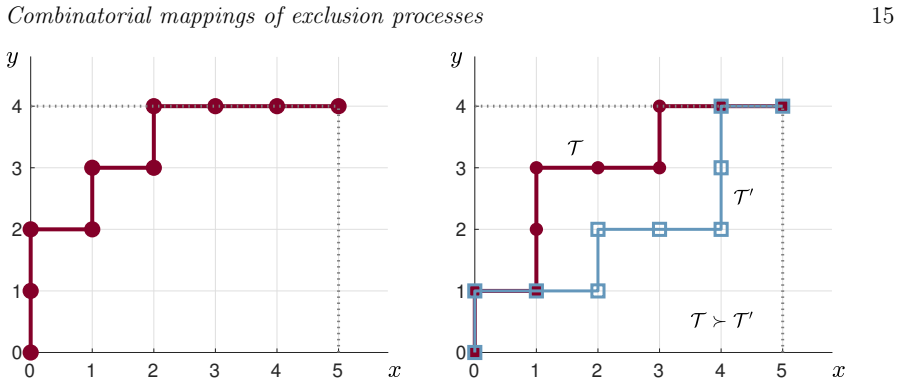
The machinery is the matrix-product representation of the steady state: each configuration is assigned to an ordered product of matrices D, E over occupied and empty sites, with reduction relations DE = qED + D + E and boundary vector conditions. Using explicit ladder-operator representations, these matrix strings become generating functions for lattice paths, specifically bicoloured Motzkin paths, and via a mapping from the combinatorial literature they also become generating functions for permutations of N+1 integers. The path-dominance formulation, where a configuration maps to a path and its weight counts the paths beneath it, carries the enumeration: its closure under the same reduction relations is what proves the equality of matrix weight and combinatorial count. The new determinant formula for the TASEP partition function arises from applying a Hessenberg-determinant recursion to the staircase path representing (D+E)^N.
What would settle it
Run the algorithm of Section 5.5 on all decorated bicoloured Motzkin paths for a small system, say N=4, and compare against all 120 permutations of {0,1,2,3,4}: if two distinct decorated paths produce the same permutation, or some permutation is never produced, the claimed one-to-one mapping is false. A numerical falsifier would be to check that the q-weight generating function over all decorated paths matches the known α=β=1 PASEP partition function term-by-term in q for N up to, say, 6.
Extended reading notes
Core claim
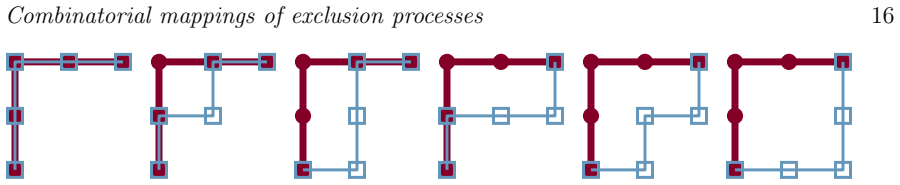
The central claim is that the matrix-product stationary weights of exclusion processes admit exact combinatorial interpretations, and these interpretations are genuinely useful. For the totally asymmetric case the weight of a configuration equals the number of lattice paths dominated by the path traced by particles and holes; this is equivalent to counting bicoloured Motzkin paths and gives Catalan and Narayana numbers as partition-function components. For the symmetric case the weight equals the number of permutations of {0,...,N} in which a prescribed set of integers is raised, giving Eulerian numbers and factorials. The paper extends these to partial asymmetry via q-weighted permutations and weighted bicoloured Motzkin paths, and contributes a new result: the TASEP partition function for general α, β can be written as the determinant of an N×N Hessenberg matrix (78)–(80). It also proposes a decorated bijection between Motzkin paths and permutations that would interpolate between the TASEP and SSEP pictures for general q.
Load-bearing premise
The load-bearing premise is the asserted one-to-one correspondence between decorated bicoloured Motzkin paths and permutations in Section 5.5; the paper itself notes that a formal proof would be welcome, and if this bijection fails, the claimed interpolation between the TASEP and SSEP pictures for general q would not be established.
Editorial extensions
If this is right
- For the TASEP with α=β=1, the partition function is the Catalan number C_{N+1}, and the total weight of configurations with P particles is the Narayana number T(N+1,P+1).
- The density profile and arbitrary-order correlation functions of the SSEP with α=β=1 follow by elementary counting of permutations, recovering linear profiles and product-form correlations.
- The new determinant expression (78)–(80) gives a closed-form generating function for the TASEP partition function at arbitrary boundary rates, equivalent to the known series expansion.
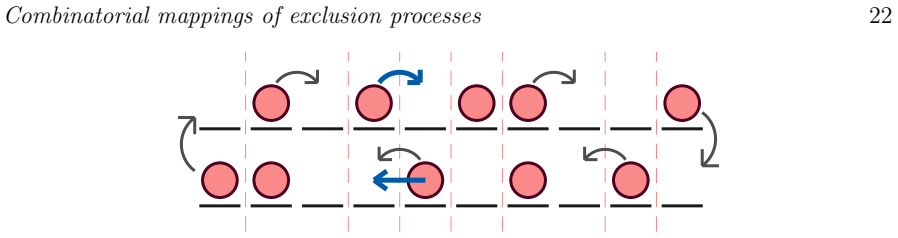
- The Rényi entropy of order two for the TASEP maps to enumerating walks in the upper quadrant; the paper gives its generating function and the phase-dependent asymptotic scaling of the sum of squared weights.
- If the proposed decorated-Motzkin-to-permutation bijection holds, the one-to-many chain from ASEP configurations through dominated paths to permutations interpolates continuously between TASEP (q=0) and SSEP (q=1) for α=β=1.
Reading between the lines
- If the bijection of Section 5.5 is established, it would supply a uniform combinatorial mechanism behind the whole ASEP family: one extended state space of permutations whose q-weighting degenerates to path counting at q=0, and one might expect q-Eulerian identities to emerge as sums over decorated paths.
- The determinant form of the partition function suggests that other observables, such as configuration weights with fixed particle numbers or boundary-condition sums, may also have Hessenberg-determinant representations, with the recursion (57) as a computational shortcut.
- The path-dominance picture could be used as a sampling tool: generating uniform dominated paths, for example through the two-row Markov chain described in the paper, yields a direct route to TASEP weights, and the same construction may extend to multispecies processes through their queueing representation.
- The Rényi-entropy mapping to upper-quadrant walks suggests that higher-order λ sums, currently unsolved, might be approached by the same kernel-method techniques if the step-set symmetry persists in λ dimensions.
Signed reviews
Editorial analysis
A structured set of objections, weighed in public.
Referee Report
Summary. This topical review surveys combinatorial interpretations of the stationary weights of the TASEP, PASEP, and SSEP within the matrix-product formalism, unifying them under dominated paths, bicoloured Motzkin paths, and permutations. It collects known results from the combinatorics and statistical-physics literature, presents new results including a determinant formula for the TASEP partition function (Eqs. (78)-(80)), and proposes in Section 5.5 a mapping between decorated bicoloured Motzkin paths and permutations intended to interpolate between the TASEP and SSEP pictures as q varies. The appendices supply derivations: Appendix C proves the path-dominance reduction relation, Appendix E proves the permutation reduction relations, and Appendix F verifies the determinant partition function by showing that its generating function matches the known TASEP generating function. The authors state explicitly that a formal proof of the proposed Motzkin-to-permutation bijection is still missing.
Significance. If the determinant formula and the various combinatorial interpretations hold, the paper is a useful synthesis for statistical physicists: the path-dominance formalism gives an intuitive account of TASEP weights, the permutation mapping yields exact SSEP density profiles and correlations, and the determinant identity is a compact new expression for the TASEP partition function. The paper is careful in several places: the partition-function determinant is checked via generating functions in Appendix F, the reduction relations for path dominance and permutations are demonstrated in Appendices C and E, and no parameters are fitted, so the results are exact. The main limitation is that the proposed Motzkin-to-permutation bijection in Section 5.5 is not proved; as it stands it is a conjecture and should be presented as such rather than as an established mapping.
major comments (2)
- [§5.5, 'Mapping between Motzkin paths and permutations for α = β = 1 and general q'] The central claim of a one-to-one mapping between decorated bicoloured Motzkin paths and permutations is asserted, but no proof is supplied; the text itself states that 'a formal proof of the proposition that there is a one-to-one mapping between decorated Motzkin paths and permutations would be welcome.' The arguments given, namely equal total cardinalities in the q→1 limit and a plausibility argument about relative order, do not establish injectivity or surjectivity of the proposed algorithm. Since this mapping is the basis for the claimed interpolation between the TASEP and SSEP pictures shown in Figure 6 and described in the abstract, please either provide a proof or explicitly label the mapping as a conjecture throughout the paper, and adjust the abstract and the Figure 6 caption so that the claim is not stated as an established result.
- [§5.5, last paragraph before Section 5.5.1] The argument that the normalisation (N+1)! 'would then follow' that every permutation is represented by exactly one decorated path relies on the unproved injectivity of the algorithm: equal cardinalities only yield a bijection after injectivity has been established. If two decorated paths can map to the same permutation, then even though the total numbers match, some permutation could be missed. Please make this logical dependency explicit and, in the absence of a proof, avoid presenting the surjectivity conclusion as a consequence of the counting argument.
minor comments (4)
- [§6.3.1, Eq. (108)] The series expansion '1 + 2z + 7z² + 30z⁴ + 146z⁵ + 772z⁶...' appears to omit the z³ term; the coefficient 30 should presumably attach to z³.
- [§6.2, text after Eq. (93)] The word 'functiion' should be 'function'.
- [§7.1 and §7.2] There are typographical errors such as 'paricles' in Section 7.2; these should be corrected in a careful copy-edit.
- [Abstract and §2.3.3] The phrase 'one-to-many mapping' is used to describe the relation from ASEP configurations to paths or permutations, but the direction described in the text is one configuration mapping to many extended objects; consider using the clearer 'one-to-many' / 'many-to-one' terminology or explicitly define the direction of the maps in the text.
Circularity Check
No circular derivation: the weight mappings are proven by reduction-relation checks, the new determinant is independently checked, and the Section 5.5 bijection is an admitted proof gap rather than a circular step.
full rationale
The paper's central derivations are self-contained checks against the matrix-product reduction relations, not fits disguised as predictions. Section 3.1 defines W(T) as an enumeration of dominated paths and proves in Appendix C that W satisfies the same relations as the q=0, alpha=beta=1 matrix product (DE=D+E), so the equality W(C)=<W|...|V> is a proven representation, not an input. Similarly, Section 4.1 and Appendix E prove the permutation-counting weights satisfy the SSEP/PASEP reduction relations including the q-deformed DE=qED+D+E, so the permutation mapping is independently established. The new determinant formula (78)-(80) is obtained algebraically from Mandelshtam's external formula (75)-(76), and Appendix F verifies it by matching the known generating function for Z_N; this is a standard independent consistency check, and although the generating function is quoted from the authors' own review [9], the partition function has independent derivations [7,20] and is not fitted to the determinant. Section 5.5's decorated-Motzkin-to-permutation mapping is explicitly not proved: the paper says 'A formal proof of the proposition that there is a one-to-one mapping between decorated Motzkin paths and permutations would be welcome.' Equal cardinality plus a map does not by itself establish a bijection, so this is a load-bearing correctness gap for the claimed q-interpolation, but it is a missing proof, not a circular reduction: nothing is defined in terms of the conclusion, and no fitted parameter is renamed as a prediction. The self-citations [13,22,26,9] are used to import established calculations and are not invoked to forbid alternative derivations. Overall circularity is negligible.
Assumptions & free parameters
assumptions (4)
- domain assumption The matrix product representation (Eqs. 2-5) solves the ASEP stationary state (from Derrida, Evans, Hakim and Pasquier 1993)
- standard math Mandelshtam's determinant formula for general alpha, beta TASEP weights (Eqs. 75-76)
- standard math Standard enumerative identities: Catalan, Narayana, Eulerian numbers, Chu-Vandermonde, reflection principle
- domain assumption Explicit semi-infinite matrix representations (Eqs. 12-15 and 81-82) yield the correct ASEP weights in the appropriate limits
invented entities (1)
-
Decorated bicoloured Motzkin paths with baubles
Cite this review
Pith. "Pith review of Combinatorial mappings of exclusion processes." pith.science (2026). https://pith.science/paper/PEQSGRBL
@misc{pith2026190800942,
  author       = {Pith},
  title        = {Pith review of: Combinatorial mappings of exclusion processes},
  year         = {2026},
  howpublished = {\url{https://pith.science/paper/PEQSGRBL}},
  note         = {Machine review of arXiv:1908.00942}
}
read the original abstract
We review various combinatorial interpretations and mappings of stationary-state probabilities of the totally asymmetric, partially asymmetric and symmetric simple exclusion processes (TASEP, PASEP, SSEP respectively). In these steady states, the statistical weight of a configuration is determined from a matrix product, which can be written explicitly in terms of generalised ladder operators. This lends a natural association to the enumeration of random walks with certain properties. Specifically, there is a one-to-many mapping of steady-state configurations to a larger state space of discrete paths, which themselves map to an even larger state space of number permutations. It is often the case that the configuration weights in the extended space are of a relatively simple form (e.g., a Boltzmann-like distribution). Meanwhile, various physical properties of the nonequilibrium steady state - such as the entropy - can be interpreted in terms of how this larger state space has been partitioned. These mappings sometimes allow physical results to be derived very simply, and conversely the physical approach allows some new combinatorial problems to be solved. This work brings together results and observations scattered in the combinatorics and statistical physics literature, and also presents new results. The review is pitched at statistical physicists who, though not professional combinatorialists, are competent and enthusiastic amateurs.
Figures



Figures from the paper (16 more)







Reference graph
Works this paper leans on
-
[1]
Schadschneider A, Chowdhury D and Nishinari K 2010 Stochastic transport in complex systems: from molecules to vehicles (Elsevier)
2010
-
[2]
Chou T, Mallick K and Zia R K P 2011 Reports on Progress in Physics 74 116601
2011
-
[3]
Lieb E H and Mattis D C 2013 Mathematical physics in one dimension: exactly soluble models of interacting particles (Academic Press)
2013
-
[4]
Evans M R 2000 Brazilian Journal of Physics 30 42–57
2000
-
[5]
Derrida B, Domany E and Mukamel D 1992 J. Stat. Phys. 69 667
1992
-
[6]
Derrida B and Evans M R 1993 Journal de Physique I 3 311–322
1993
-
[7]
Derrida B, Evans M R, Hakim V and Pasquier V 1993 Journal of Physics A: Mathematical and General 26 1493
1993
-
[8]
Sch¨ utz G and Domany E 1993J. Stat. Phys. 72
Show all 91 references
-
[9]
Blythe R A and Evans M R 2007 J. Phys. A: Math. Theor. 40 R333
2007
-
[10]
Corteel S, Josuat-Verg` es M and Williams L K 2011Advances in Applied Mathematics 46 209–225
-
[11]
Uchiyama M, Sasamoto T and Wadati M 2004 J. Phys. A.: Math. Gen. 37 4985
2004
-
[12]
Uchiyama M 2008 Chaos Solitons Fractals 35 398
2008
-
[13]
Blythe R, Evans M, Colaiori F and Essler F 2000 Journal of Physics A: Mathematical and General 33 2313
2000
-
[14]
Essler F H L and Rittenberg V 1996 Journal of Physics A: Mathematical and General 29 3375– 3407
1996
-
[15]
Mallick K and Sandow S 1997 Journal of Physics A: Mathematical and General 30 4513–4526
1997
-
[16]
Sasamoto T 1999 J. Phys. A.: Math. Gen. 32 7109
1999
-
[17]
Derrida B, Lebowitz J and Speer E 2002 Journal of statistical physics 107 599–634
2002
-
[18]
Sasamoto T, Mori S and Wadati M 1996 Journal of the Physical Society of Japan 65 2000–2008
1996
-
[19]
Vanicat M 2017 Journal of Statistical Physics 166 1129–1150
2017
-
[20]
thesis University of Oxford
Depken M 2003 Models of non-equilibrium systems Ph.D. thesis University of Oxford
2003
-
[21]
Blythe R, Janke W, Johnston D and Kenna R 2004 Journal of Statistical Mechanics: Theory and Experiment 2004 P06001
2004
-
[22]
Wood A J, Blythe R A and Evans M R 2017 J. Phys. A: Math. Theor. 50 475005
2017
-
[23]
Gould H W 1956 The American Mathematical Monthly 63 84–91
1956
-
[24]
Stanley R P and Fomin S 1999 Enumerative Combinatorics (Cambridge Studies in Advanced Mathematics vol 2) (Cambridge University Press)
1999
-
[25]
Brak R, de Gier J and Rittenberg V 2004 J. Phys. A.: Math. Gen. 37 4303 Combinatorial mappings of exclusion processes 46
2004
-
[26]
Blythe R A, Janke W, Johnston D A and Kenna R 2004 J. Stat. Mech.: Theor. Exp. P10007
2004
-
[27]
Deutsch E 1999 Discrete Mathematics 204 167–202
1999
-
[28]
Derrida B, Evans M and Mukamel D 1993 Journal of Physics A: Mathematical and General 26 4911
1993
-
[29]
Comtet L 2012 Advanced Combinatorics: The art of finite and infinite expansions (Springer Science & Business Media)
2012
-
[30]
Brak R and Essam J W 2001 Journal of Physics A: Mathematical and General 34 10763–10782
2001
-
[31]
Kreweras G and Niederhausen H 1981 Eur. J. Comb. 2 55–60
1981
-
[32]
Kreweras G 1965 Cahiers du Bureau universitaire de recherche op´ erationnelle S´ erie Recherche6 9–107
1965
-
[33]
Numer 33 261–273
Niederhausen H 1981 Congr. Numer 33 261–273
1981
-
[34]
Narayana T 1955 Journal of the Indian Society of Agricultural Statistics 5 169–178
1955
-
[35]
Sloane N J A 1996 The on-line encyclopedia of integer sequences, sequence A001263
1996
-
[36]
Kaygisiz K and Sahin A 2013 Bulletin of the Iranian Mathematical Society 39 1065–1078
2013
-
[37]
Mandelshtam O 2015 Journal of Combinatorial Theory, Series A 132 120–141
2015
-
[38]
Brak R and Essam J 2004 Journal of Physics A: Mathematical and General 37 4183
2004
-
[39]
Duchi E and Schaeffer G 2005 Journal of Combinatorial Theory, Series A 110 1–29
2005
-
[40]
Kelly F P 1979 Reversibility and stochastic networks (Chichester: Wiley)
1979
-
[41]
Corteel S and Williams L K 2007 International mathematics research notices 2007 rnm055–rnm055
2007
-
[42]
Carinci G, Giardin` a C, Giberti C and Redig F 2013 Journal of Statistical Physics 152 657–697
2013
-
[43]
Spohn H 1983 Journal of Physics A: Mathematical and General 16 4275
1983
-
[44]
Derrida B, Dou¸ cot B and Roche P E 2004 Journal of Statistical physics 115 717–748
2004
-
[45]
Worpitzky J 1883 Journal f¨ ur die reine und angewandte Mathematik 94 203–232
-
[46]
Carlitz L 1959 Mathematics Magazine 32 247–260
1959
-
[47]
Sloane N J A 1996 The on-line encyclopedia of integer sequences, sequence A008292
1996
-
[48]
Petersen T K 2015 Eulerian numbers Eulerian Numbers (Springer) pp 3–18
2015
-
[49]
Carlitz L 1954 Transactions of the American Mathematical Society 76 332–350
1954
-
[50]
Corteel S and Williams L K 2007 Advances in applied mathematics 39 293–310
2007
-
[51]
Williams L K 2005 Advances in Mathematics 190 319–342
2005
-
[52]
Brak R, Corteel S, Essam J, Parviainen R and Rechnitzer A 2006 the electronic journal of combinatorics 13 108
2006
-
[53]
Blythe R A, Janke W, Johnston D A and Kenna R 2009 J. Phys. A: Math. Theor. 42 325002
2009
-
[54]
Corteel S and Williams L K 2011 Duke Mathematical Journal 159 385–415
2011
-
[55]
Corteel S, Stanley R, Stanton D and Williams L 2012 Transactions of the American Mathematical Society 364 6009–6037
2012
-
[56]
Josuat-Verg` es M 2011Electron. J. Comb. 18 P22
-
[57]
R´ enyi A 1961 On measures of entropy and information Proceedings of the fourth Berkeley symposium on mathematical statistics and probability vol 1 pp 547–561
1961
-
[58]
Baez J C 2011 Renyi Entropy and Free Energy arXiv:1102.2098
2011 arXiv
-
[59]
Math 520 1–40
Bousquet-M´ elou M and Mishna M 2010Contemp. Math 520 1–40
-
[60]
Sloane N J A 1996 The on-line encyclopedia of integer sequences, sequence A196148
1996
-
[61]
Sloane N J A 1996 The on-line encyclopedia of integer sequences, sequence A111910
1996
-
[62]
Bostan A, Bousquet-M´ elou M, Kauers M and Melczer S 2016Annals of Combinatorics 20 661–704
-
[63]
Bacher A, Kauers M and Yatchak R 2015 arXiv preprint arXiv:1511.05763
2015 arXiv
-
[64]
Derrida B, Janowsky S A, Lebowitz J L and Speer E R 1993 Journal of Statistical Physics 73 813–842
1993
-
[65]
Evans M R, Foster D P, Godr` eche C and Mukamel D 1995 J. Stat. Phys. 80 69–102
1995
-
[66]
Arita C 2006 J. Stat. Mech.: Theor. Exp. 2006 P12008–P12008
2006
-
[67]
Ayyer A, Lebowitz J L and Speer E R 2009 Journal of Statistical Physics 135 1009–1037
2009
-
[68]
Cantini L 2017 Ann. Henri. Poincar´ e18 1121
2017
-
[69]
Aas E, Ayyer A, Linusson S and Potka S 2019 The Exact Phase Diagram For A Semipermeable Combinatorial mappings of exclusion processes 47 Tasep With Nonlocal Boundary Jumps arXiv:1902.02019
2019 arXiv
-
[70]
Crampe N, Mallick K, Ragoucy E and Vanicat M 2015 J. Phys. A: Math. Theor. 48 175002
2015
-
[71]
Crampe N, Evans M R, Mallick K, Ragoucy E and Vanicat M 2016 J. Phys. A: Math. Theor. 49 475001
2016
-
[72]
Crampe N, Ragoucy E and Vanicat M 2014 Journal of Statistical Mechanics: Theory and Experiment 2014 P11032
2014
-
[73]
Ferrari P A, Fontes L R G and Kohayakawa Y 1994 Journal of Statistical Physics 76 1153–1177
1994
-
[74]
Angel O 2006 Journal of Combinatorial Theory, Series A 113 625 – 635
2006
-
[75]
Ferrari P A and Martin J B 2007 Ann. Probab. 35 807–832
2007
-
[76]
Evans M R, Ferrari P A and Mallick K 2009 Journal of Statistical Physics 135 217–239
2009
-
[77]
Martin J 2018 Stationary distributions of the multi-type ASEP arXiv:1810.10650
2018 arXiv
-
[78]
Arita C and Mallick K 2013 J. Phys. A.: Math. Theor. 46 085002
2013
-
[79]
Ayyer A and Linusson S 2014 Adv. Appl. Math. 57 21
2014
-
[80]
Prolhac S, Evans M R and Mallick K 2009 J. Phys. A: Math. Theor. 42 165004
2009
-
[81]
Finn C, Ragoucy E and Vanicat M 2018 Journal of Statistical Mechanics: Theory and Experiment 2018 043201
2018
-
[82]
Arita C, Ayyer A, Mallick K and Prolhac S 2011 J. Phys. A: Math. Theor. 44 335004
2011
-
[83]
Arita C, Ayyer A, Mallick K and Prolhac S 2012 J. Phys. A: Math. Theor. 45 195001
2012
-
[84]
Kuniba A, Maruyama S and Okado M 2015 J. Phys. A: Math. Theor. 48 34FT02
2015
-
[85]
Kuniba A, Maruyama S and Okado M 2016 J. Phys. A: Math. Theor. 49 114001
2016
-
[86]
Cantini L, de Gier J and Wheeler M 2015 J. Phys. A: Math. Theor. 48 334001
2015
-
[87]
Cantini L, Garbali A, de Gier J and Wheeler M 2016 J. Phys. A: Math. Theor. 49 444002
2016
-
[88]
Corteel S, Mandelshtam O and William L 2019 arXiv preprint arXiv:1811.01024
2019 arXiv
-
[89]
Harary F 1969 Graph Theory (Addison-Wesley)
1969
-
[90]
Schnakenberg J 1976 Reviews of Modern physics 48 571
1976
-
[91]
Exact expression for ASEP partition function Here we present a general expression for the PASEP partition function derived in [13] and its specialisation to the case α =β = 1
Askey R 1975 Orthogonal polynomials and special functions vol 21 (Siam) Appendix A. Exact expression for ASEP partition function Here we present a general expression for the PASEP partition function derived in [13] and its specialisation to the case α =β = 1. ZN = ( 1 1−q )N N...
1975
Reviewed August 14, 2026 · model on record in the stance chip above.
Discussion (0). Continue with ORCID to comment.