Scalar contributions from 331RHN minimal model to oblique parameters
Pith reviewed 2026-06-28 05:38 UTC · model grok-4.3
The pith
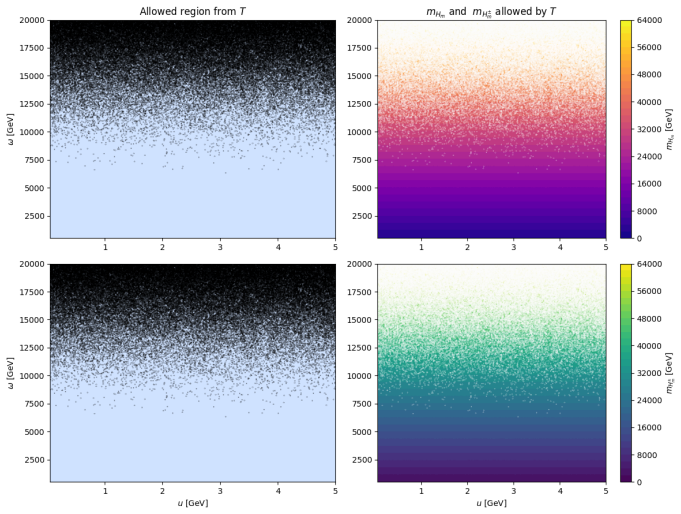
In the minimal 331RHN model, scalar contributions to the oblique parameter T impose an upper limit of about 10 TeV on the symmetry-breaking scale ω.
A machine-rendered reading of the paper's core claim, the machinery that carries it, and where it could break.
Core claim
The scalar sector of the minimal 331RHN model contributes to the oblique parameters, with the T parameter providing the dominant constraint. Current experimental bounds on T imply that the symmetry-breaking scale ω cannot exceed approximately 10 TeV.
What carries the argument
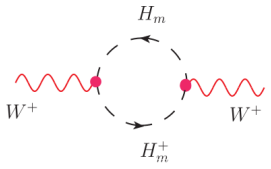
The scalar sector defined in the 331RHN model and its one-loop contributions to the T oblique parameter.
If this is right
- The T parameter dominates over S and U in constraining the scalar spectrum of the model.
- Symmetry-breaking scales ω above 10 TeV are excluded by current electroweak precision data.
- The scalar masses must be arranged such that their contributions keep T within experimental bounds.
- Electroweak precision observables directly limit the viability of the 331RHN extension.
Where Pith is reading between the lines
- Future improvements in T measurements at proposed colliders could tighten or eliminate the allowed range for ω.
- The same approach could be applied to non-minimal 331RHN variants to compare their allowed scales.
- Direct searches for the predicted scalars at the LHC gain added motivation from the precision bound.
Load-bearing premise
The scalar sector is taken exactly as defined in prior 331RHN literature, and standard oblique-parameter formulas are applied without additional model-specific corrections or higher-order effects.
What would settle it
A future measurement of T that permits ω values well above 10 TeV while remaining consistent with the model's scalar spectrum would falsify the derived upper limit.
Figures
read the original abstract
Electroweak precision observables, encoded in the oblique parameters $S$, $T$, and $U$, impose stringent constraints on extensions of the Standard Model. In this work, we analyze the scalar-sector contributions to these parameters within the minimal 331RHN model. Building on previous results obtained in the 331RHN framework, we show that the oblique parameter $T$ provides the dominant constraint on the scalar mass spectrum. Our results indicate that current experimental bounds on $T$ lead to a nontrivial upper limit on the symmetry-breaking scale, $\omega \lesssim 10~\text{TeV}$. These findings highlight the sensitivity of electroweak precision data to the scalar sector of 3-3-1 models and their viability as extensions of the Standard Model.
Editorial analysis
A structured set of objections, weighed in public.
Referee Report
Summary. The paper computes the contributions of the scalar sector in the minimal 331RHN model to the oblique parameters S, T, and U. Building on prior 331RHN results, it concludes that T supplies the dominant constraint and that current experimental bounds on T imply a nontrivial upper limit ω ≲ 10 TeV on the symmetry-breaking scale.
Significance. If the mapping from scalar masses to the T parameter is correctly derived and applied, the result supplies a concrete, testable upper bound on the new-physics scale in a 3-3-1 extension, which is useful for assessing the viability of the model against electroweak precision data.
major comments (2)
- [Abstract] Abstract: the central claim that experimental bounds on T yield ω ≲ 10 TeV is asserted without any explicit expression for the scalar contribution to T, without the relation between the scalar spectrum and the scale ω, and without error treatment or numerical inputs; this absence makes the nontriviality of the bound impossible to verify from the supplied text.
- [Abstract] Abstract: the work states that it builds on previous 331RHN results, yet supplies no indication whether the new T-derived limit on ω is independent of, or reduces by construction to, a quantity already fitted in the referenced literature; this circularity risk is load-bearing for the claim of a new constraint.
minor comments (1)
- The abstract does not specify the scalar mass spectrum or the values of free parameters adopted in the numerical evaluation of T.
Simulated Author's Rebuttal
We thank the referee for the detailed comments on the abstract. We address each point below and will make revisions to improve self-containment and clarity regarding the derivation and novelty of the bound.
read point-by-point responses
-
Referee: [Abstract] Abstract: the central claim that experimental bounds on T yield ω ≲ 10 TeV is asserted without any explicit expression for the scalar contribution to T, without the relation between the scalar spectrum and the scale ω, and without error treatment or numerical inputs; this absence makes the nontriviality of the bound impossible to verify from the supplied text.
Authors: The abstract is a high-level summary; the explicit one-loop expression for the scalar contribution ΔT (involving the masses of the doubly-charged, singly-charged and neutral scalars) appears in Section 3, together with the tree-level mass relations that tie all new scalar masses to the scale ω. The numerical bound follows from requiring |ΔT| to lie inside the PDG 1σ ellipse after adding the SM reference value, using the standard oblique-parameter definitions and the quoted experimental central values and uncertainties. We agree the abstract should be more informative and will revise it to state that T receives the leading positive contribution scaling as ω²/v² and that the 10 TeV limit is obtained by direct comparison with the measured T value. revision: yes
-
Referee: [Abstract] Abstract: the work states that it builds on previous 331RHN results, yet supplies no indication whether the new T-derived limit on ω is independent of, or reduces by construction to, a quantity already fitted in the referenced literature; this circularity risk is load-bearing for the claim of a new constraint.
Authors: The cited prior 331RHN papers provide the gauge-boson spectrum, the Yukawa sector and the minimization conditions, but do not compute the scalar-loop contributions to the oblique parameters. The present calculation of ΔT is performed from scratch using the full scalar potential and the resulting mass eigenstates; the resulting upper bound on ω is therefore independent of any previous fit. We will add an explicit sentence in the revised abstract and in the introduction clarifying that the T constraint is new. revision: yes
Circularity Check
No significant circularity
full rationale
The provided abstract and context show the paper applies standard oblique-parameter formulas to the scalar sector as defined in prior 331RHN literature, yielding a new upper bound on ω from experimental T limits. No load-bearing step is quoted that reduces the derived limit to a fitted input, self-defined quantity, or unverified self-citation chain. The central claim retains independent content from electroweak data and is not forced by construction.
Axiom & Free-Parameter Ledger
axioms (1)
- domain assumption The minimal 331RHN scalar sector matches the definition used in prior literature.
Reference graph
Works this paper leans on
-
[1]
Singer, J
M. Singer, J. W. F. Valle, and J. Schechter, Phys. Rev. D22, 738 (1980)
1980
-
[2]
F. Pisano and V . Pleitez, Phys. Rev. D46, 410 (1992), arXiv:hep-ph/9206242
Pith/arXiv arXiv 1992
-
[3]
P. H. Frampton, Phys. Rev. Lett.69, 2889 (1992)
1992
-
[4]
J. T. Liu and D. Ng, Phys. Rev. D50, 548 (1994), arXiv:hep-ph/9401228
Pith/arXiv arXiv 1994
-
[5]
F. Pisano, Mod. Phys. Lett. A11, 2639 (1996), arXiv:hep-ph/9609358
Pith/arXiv arXiv 1996
-
[6]
C. A. de Sousa Pires and O. P. Ravinez, Phys. Rev. D58, 035008 (1998), arXiv:hep-ph/9803409
Pith/arXiv arXiv 1998
-
[7]
C. A. de Sousa Pires, Phys. Rev. D60, 075013 (1999), arXiv:hep-ph/9902406
Pith/arXiv arXiv 1999
-
[8]
R. Foot, H. N. Long, and T. A. Tran, Phys. Rev. D50, R34 (1994), arXiv:hep-ph/9402243
Pith/arXiv arXiv 1994
-
[9]
P. Escalona, J. P. Pinheiro, V . Oliveira, A. Doff, and C. A. De Sousa Pires, Universe11, 396 (2025), arXiv:2510.17979 [hep-ph]
arXiv 2025
-
[10]
C. A. de S. Pires, F. S. Queiroz, and P. S. Rodrigues da Silva, Phys. Rev. D82, 065018 (2010)
2010
-
[11]
J. G. Ferreira, P. R. D. Pinheiro, C. A. d. S. Pires, and P. S. Rodrigues da Silva, Phys. Rev. D84, 095019 (2011)
2011
-
[12]
P. V . Dong, N. T. K. Ngan, and D. V . Soa, Phys. Rev. D90, 075019 (2014)
2014
-
[13]
W. A. Ponce, Y . Giraldo, and L. A. Sanchez, Phys. Rev. D67, 075001 (2003), arXiv:hep-ph/0210026
Pith/arXiv arXiv 2003
-
[14]
P. V . Dong, H. N. Long, D. T. Nhung, and D. V . Soa, Phys. Rev. D73, 035004 (2006), arXiv:hep- ph/0601046
arXiv 2006
-
[15]
H. N. Long and V . T. Van, J. Phys. G25, 2319 (1999), arXiv:hep-ph/9909302
Pith/arXiv arXiv 1999
-
[16]
A. J. Buras, F. De Fazio, and J. Girrbach-Noe, JHEP08, 039 (2014), arXiv:1405.3850 [hep-ph]
Pith/arXiv arXiv 2014
-
[17]
V . Oliveira and C. A. d. S. Pires, J. Phys. G50, 115002 (2023), arXiv:2208.00420 [hep-ph]
arXiv 2023
-
[18]
P. Escalona, J. P. Pinheiro, A. Doff, and C. A. de S. Pires, JHEP07, 105 (2025), arXiv:2503.14653 [hep-ph]
arXiv 2025
- [19]
-
[20]
Rehman, M
M. Rehman, M. A. Iqbal, M. E. G ´omez, and O. Panella, Phys. Rev. D112, 055029 (2025)
2025
-
[21]
H. N. Long and T. Inami, Phys. Rev. D61, 075002 (2000), arXiv:hep-ph/9902475
Pith/arXiv arXiv 2000
-
[22]
J. F. Gunion and H. E. Haber, Physics Reports67, 1 (2003), arXiv:0207.010 [hep-ph]
2003
-
[23]
Davidson and H
S. Davidson and H. E. Haber, Phys. Rev. D72, 035004 (2005), arXiv:0504.050 [hep-ph]. 15
2005
-
[24]
H. E. Haber and D. O’Neil, Phys. Rev. D74, 015018 (2006), arXiv:0602.242 [hep-ph]
2006
-
[25]
M. E. Peskin and T. Takeuchi, Phys. Rev. Lett.65, 964 (1990)
1990
-
[26]
M. E. Peskin and T. Takeuchi, Phys. Rev. D46, 381 (1992)
1992
-
[27]
Altarelli and R
G. Altarelli and R. Barbieri, Phys. Lett. B253, 161 (1991)
1991
-
[28]
Navas and et al
S. Navas and et al. (Particle Data Group Collaboration), Phys. Rev. D110, 030001 (2024). 16
2024
discussion (0)
Sign in with ORCID, Apple, or X to comment. Anyone can read and Pith papers without signing in.