REVIEW 3 major objections 5 minor 80 references
UNICE: Training A Universal Image Contrast Enhancer
T0 review · 3 major / 5 minor · reviewed 2026-08-06 · deepseek-v4-flash
Pith's one-line read A single model trained without human labels outperforms task-specific contrast enhancers on low-light, exposure, backlit, and HDR benchmarks.
desk verdict A strong, thoroughly tested generalization result wrapped in an overstated HDR-recovery mechanism; worth serious review, but the mechanism section needs rework. read the letter →
The pith
A machine-rendered reading of the paper's core claim, the machinery that carries it, and where it could break.
The reading
What carries the argument
The core mechanism is the synthesized multi-exposure sequence (MES) used as an intermediate representation of the scene's dynamic range. In the data stage, ~47k HDR raw images are rendered by an emulated ISP at seven exposure values, and an ensemble of multi-exposure fusion algorithms, ranked by no-reference metrics, produces pseudo-GTs. MES-Net (a one-step SD-Turbo diffusion network with LoRA adapters) maps an input sRGB image $I_j$ to another exposure $I_k$ using a style code $z$ equal to the mean intensity (Eq. 2, trained with L2 loss), thereby synthesizing a pseudo-MES from a single image. MEF-Net (same backbone) receives the pseudo-MES and learns normalized per-pixel weight maps $W(\cdot)$ that form an implicit 32-bit HDR representation (Eqs. 3-4), then fuses it into a high-quality 8-bit image matching the pseudo-GT. The two-stage decomposition separates exposure/style change from fusion, which is what lets the model transfer to unseen tasks and datasets.
What would settle it
Collect static scenes with genuine bracketed exposures at several stop-separated exposure values, fuse them with a trusted HDR algorithm as the reference, and give UNICE a single frame from each scene. Compare UNICE's output with the reference in clipped highlight and shadow regions; if its recovered details do not track the real bracketed exposures, or if UNICE performs no better than direct input-to-ground-truth mapping on such scenes, the pseudo-MES mechanism is falsified.
Extended reading notes
Core claim
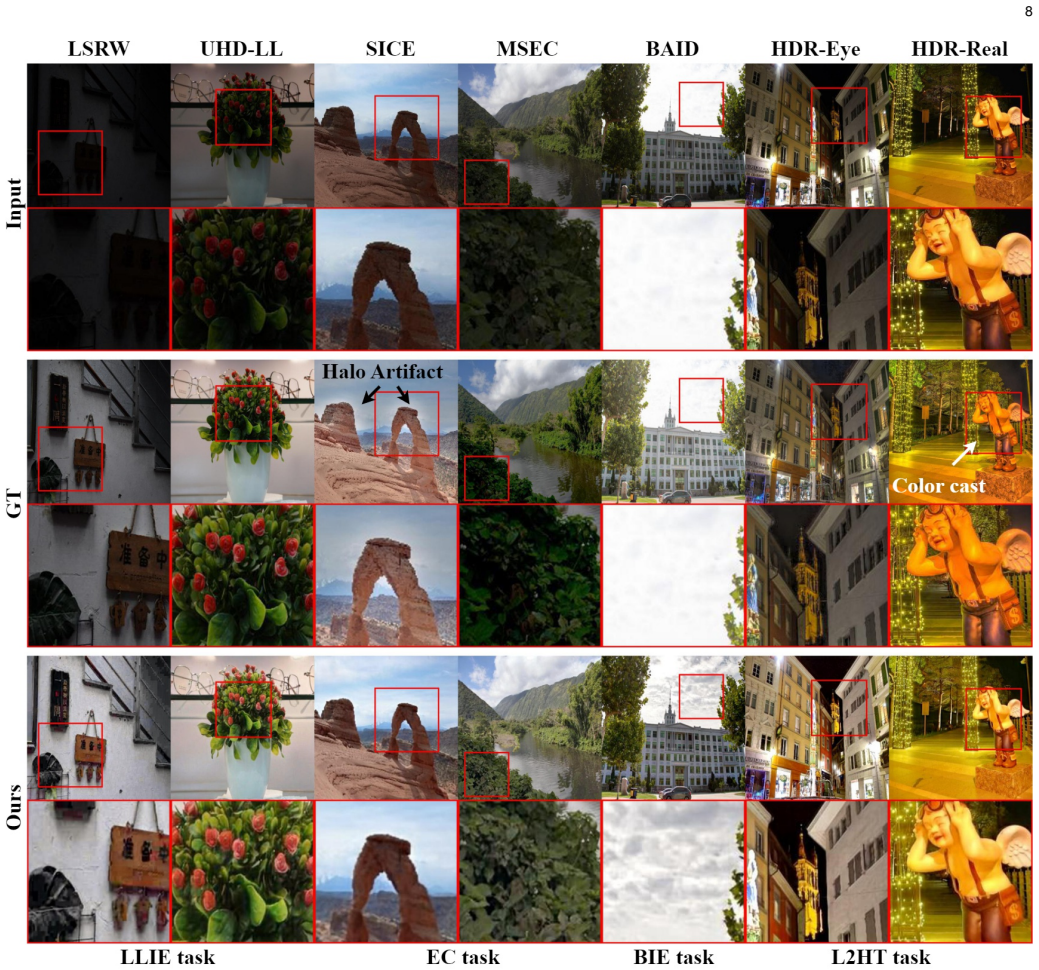
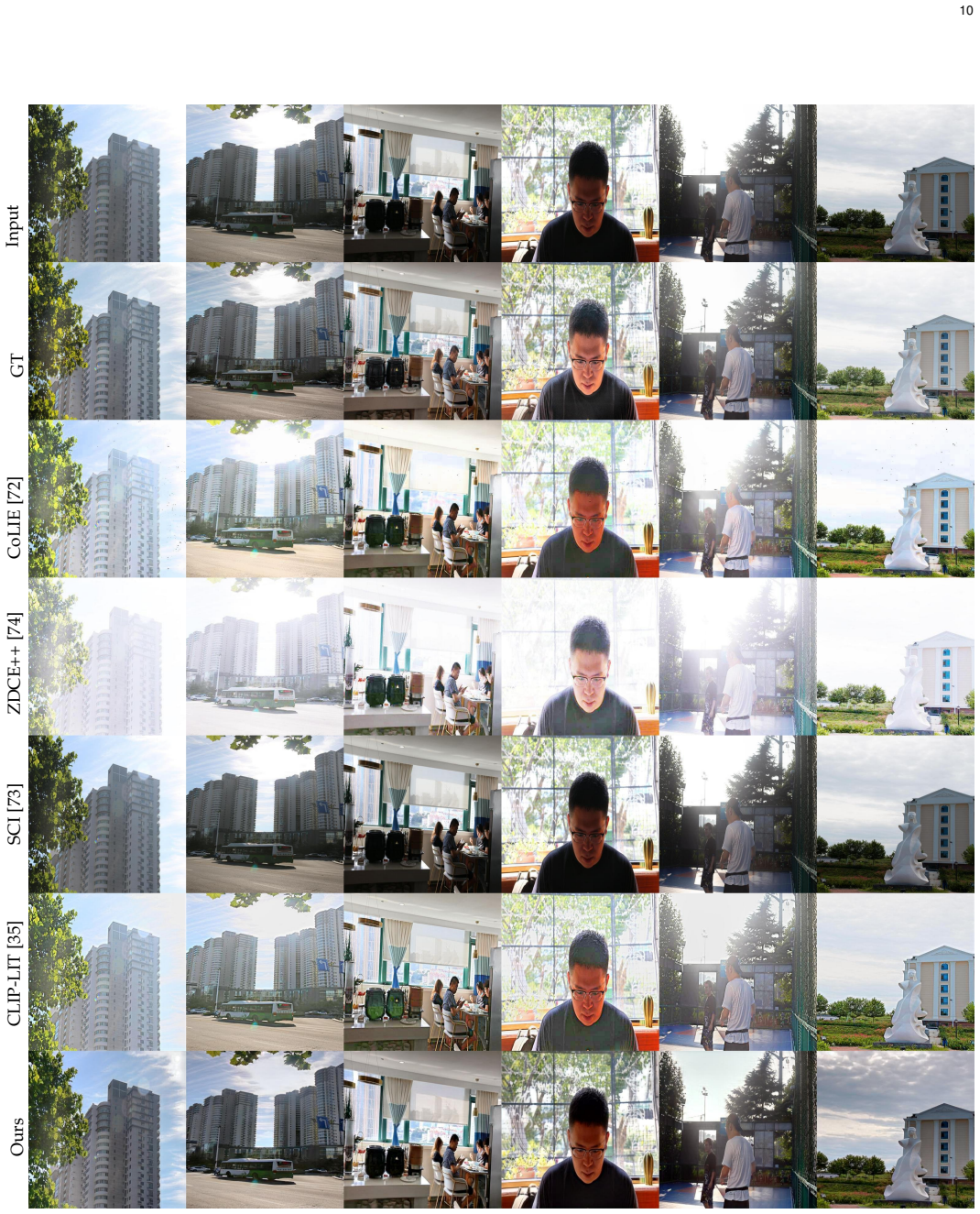
On the paper's own terms, the discovery is that a single, label-free model, called UNICE, can generalize across and within four contrast-enhancement tasks because it learns an intermediate multi-exposure representation rather than a direct input-to-output mapping. From a large set of HDR raw images, an emulated ISP renders exposure sequences, and multi-exposure fusion algorithms generate pseudo ground truths, so no human-annotated pairs are needed. MES-Net synthesizes a pseudo multi-exposure sequence from one sRGB image, and MEF-Net fuses that sequence into a high-quality 8-bit image. The authors report that UNICE outperforms task-specific baselines on held-out LLIE, EC, BIE, and L2HT datasets, and that in many cases its outputs surpass manually created ground truths in no-reference image-quality metrics.
Load-bearing premise
The whole method rests on the assumption that the three generated exposure images carry the same recoverable detail that real multi-exposure photos would, so that fusing them reconstructs true scene information; the paper never validates this against real multi-exposure captures.
Editorial extensions
If this is right
- On the tested held-out datasets, a single UNICE model outperforms task-specific baselines on most full-reference and no-reference metrics, including large gains such as 19.40 dB PSNR versus 15.90 dB on LSRW for low-light enhancement.
- Task-specific models retrained on UNICE's synthetic data improve over their original training, so the automatically generated dataset itself carries transferable value.
- The MES synthesis plus fusion pipeline, not the SD-Turbo backbone alone, drives the gains: the direct input-to-ground-truth mapping baseline SD-T underperforms UNICE.
- UNICE can match or beat manually created ground truths in multiple no-reference quality metrics, and wins 68–83% of user-study votes against per-task best models.
- Despite a large diffusion backbone (~965M parameters, ~3.3 TFLOPs at 512×512), one-step inference keeps the model usable at 5.58 FPS on an A100 GPU.
- A universal contrast enhancer reduces the need to train and deploy a separate model for each lighting-related task, which is the paper's main practical consequence.
Reading between the lines
- A direct test of the central mechanism would compare UNICE's output on clipped highlights and shadows against genuine bracketed captures of the same scene; because MES-Net only sees the 8-bit input, any detail it recovers there must be generated rather than measured, and it is an open question how often that generation is faithful.
- The style code $z$, defined as mean intensity, could be exposed as a user-controlled dial to produce continuously variable enhancement rather than the three fixed exposure levels tested in the paper.
- The same MES-then-fusion decomposition could extend to video contrast enhancement, where the pseudo-exposure sequence would need temporal consistency; this is a neighbouring task the paper does not address.
- The NR-IQA-ranked ensemble used to select pseudo-GTs could be moved to inference time, letting the model compare several fusion candidates and pick the one with the best predicted quality, which the paper does not explore.
Editorial analysis
A structured set of objections, weighed in public.
Referee Report
Summary. The paper proposes UNICE, a universal contrast enhancement model trained entirely on automatically generated data without human-annotated ground truths. The authors collect 48,361 HDR raw images from public sources, render multi-exposure sequences (MES) through an emulated ISP, generate pseudo-GTs by ensemble multi-exposure fusion (MEF) with NR-IQA-based selection, then train two one-step diffusion networks: MES-Net, which synthesizes an MES from a single sRGB image, and MEF-Net, which fuses the generated MES into an enhanced image. Experiments on LLIE, EC, BIE, and L2HT report strong cross-task and cross-dataset generalization, with UNICE often outperforming task-specific baselines and sometimes surpassing manual ground truths in no-reference IQA metrics.
Significance. If the results hold, this is a valuable contribution: the large-scale automated data pipeline (328,496 pairs) and a single model addressing four contrast-related tasks go beyond typical task-specific designs, and the SD-T baseline provides a useful control for attributing gains to the MES/MEF pipeline rather than the diffusion backbone. The release of code, model, and dataset increases reproducibility. However, two load-bearing issues temper the significance: the claim of outperforming manual GTs is circular because the same NR-IQA metrics used to select pseudo-GTs are used for that comparison, and the HDR-information-recovery mechanism of MES-Net is unvalidated given the 8-bit L2 training objective.
major comments (3)
- [Sec. 3.2.2 / Table 3] The pseudo-GT selection pipeline in Sec. 3.2.2 ranks and selects candidate MEF outputs using NIQE, BRISQUE, PI, and ARNIQA, and the same four NR-IQA metrics are then used in Table 3 to claim that UNICE outputs 'even exceed manually labeled GTs.' Because the network is trained on pseudo-GTs that were explicitly chosen to score well on these metrics, the comparison in Table 3 does not establish perceptual superiority over manual GTs; it is circular. Please replace or supplement this claim with a human perceptual study comparing UNICE outputs against manual GTs, or with FR-IQA/human-opinion metrics that were not used in pseudo-GT selection, and revise the abstract's claim accordingly if the circular evidence is removed.
- [Sec. 3.3, Eq. (2)] MES-Net is trained with an L2 loss on the mapping (z_k/z_j)*I_j -> I_k (Eq. 2), where both I_j and I_k are 8-bit sRGB renders of the same raw scene. Since the 8-bit input has already undergone quantization and clipping, no deterministic learned transform can reintroduce the lost HDR values; the statement in Sec. 3.3 that the synthesized MES 'can acquire the HDR information of the scene' is therefore not supported. The paper provides no comparison between generated MES and real multi-exposure captures from the same raw, nor any experiment showing that the fusion step recovers details that exist only in real well-exposed frames. Because the SD-T ablation (Tabs. 6-7) is the main evidence that the MES/MEF pipeline contributes beyond the backbone, the mechanism behind that gain remains unexplained. Please add a validation study (e.g., compare generated MES with real MES, check detail recovery in clipped regions) or revise the framing to attribute the gain to the learned fusion objective or inductive bias rather than HDR recovery.
- [Sec. 4.3.1 / Table 5] The cross-task generalization results in Table 5 compare UNICE only against task-specific models trained on MSEC (24,330 images) and omit the SD-T baseline, which is present in Tables 6 and 7. Without SD-T in the cross-task setting, the large gains in Table 5 over LCDPNet, RF, and CSEC could be attributed primarily to the much larger and more diverse training set (328,496 pairs) rather than to the MES/MEF pipeline. Please include SD-T in the cross-task evaluation, or explicitly report the UNICE-vs-SD-T comparison for the same cross-task protocol, so that the attribution of the generalization advantage to the proposed pipeline is properly controlled.
minor comments (5)
- [Sec. 4 (first paragraph)] The text refers to 'MSE-Net' and 'MFE-Net'; these should be 'MES-Net' and 'MEF-Net'.
- [Tables 5 and 6] Tables 5 and 6 are both titled 'Cross-dataset evaluation on LLIE and EC tasks,' but both tables include results for BIE and L2HT as well; the titles should be revised to reflect the full scope of the tables.
- [Sec. 3.3] The pretrained SD-Turbo model is cited as [71] in Sec. 3.3, but the reference list assigns [50] to the SD-Turbo paper; please correct the citation.
- [Table 4] In the BIE row of Table 4, the BAID dataset is cited as [21], but the BAID dataset is reference [4]; please fix the citation.
- [Sec. 4.6.2 / Table 10] The final row of Table 10 is the full UNICE model but is labeled 'SD-T [71] / SD-T [71]'; this label is confusing because 'SD-T' elsewhere denotes the direct-mapping baseline. Please rename the rows to distinguish the backbone choice from the SD-T baseline.
Circularity Check
NR-IQA-based pseudo-GT selection feeds the same metrics that support the 'outperforms manual GTs' claim, while the core held-out FR-IQA generalization results remain independent.
-
fitted input called prediction
[Sec. 3.2.2-3.2.3 (pseudo-GT selection/filter) then Sec. 4.2, Tab. 3 and Abstract (GT comparison)]
"We then use NR-IQA methods—including NIQE [52], BRISQUE [70], PI [53], and ARNIQA [54]—to rank both the original five fused images and the 10 weighted combinations, selecting the highest-quality result based on average scores. ... The enhanced images can even exceed manually labeled GTs in multiple no-reference image quality metrics such as NIQE [52], PI [53] and ARNIQA [54]."
The training targets are by construction the images that score best under NIQE, BRISQUE, PI and ARNIQA: Sec. 3.2.2 ranks fused candidates and selects the highest-quality result based on average scores, and Sec. 3.2.3 adds an ARNIQA-based quality threshold that removes training scenes. UNICE is then trained with L2 losses (Eqs. 2-3) to reproduce those targets, so its outputs inherit the NR-IQA-favorable statistics that the selection pipeline was engineered to maximize. Table 3 and the abstract then 'predict' that UNICE beats manually created GTs in multiple no-reference image quality metrics, measured with exactly NIQE, PI, BRISQUE and ARNIQA.
full rationale
The paper's central generalization claims (cross-task and cross-dataset, Tabs. 5-7) are grounded in held-out FR-IQA evaluation (PSNR, SSIM, LPIPS, DISTS) against real human-labeled GTs on datasets outside the training pool (LSRW, UHD-LL, MSEC, SICE, BAID, Backlit, HDR-Eye, HDR-Real); UNICE's FR-IQA advantages there rest on independent measurement and do not reduce to the pseudo-GT construction. The genuine circular component is narrower: the Tab. 3 / abstract claim that UNICE exceeds manually labeled GTs is measured with the same NR-IQA metrics (NIQE, BRISQUE, PI, ARNIQA) that were used to select the pseudo-GT training targets and to filter the training pool, so the direction of that result is inherited from the training-target construction. Since the same NR-IQA metrics also appear as columns in Tabs. 5-7, those columns carry the same bias; the FR-IQA columns do not. Separately, the mechanism claim in Sec. 3.3 that the synthesized MES 'can acquire the HDR information of the scene' is unsupported: Eq. 2 maps one 8-bit sRGB render to another 8-bit render of the same raw scene, and the generated MES is a deterministic function of the input 8-bit image, so it cannot contain information lost in 8-bit quantization; any recovered detail must come from the SD-Turbo prior rather than from fused HDR data. The paper verifies neither that the pseudo-MES matches real multi-exposure captures nor that the fusion stage recovers information absent from the input. This is a correctness/validation weakness rather than a circularity, and it does not make the held-out FR-IQA results circular. Self-citations involving the present authors ([2], [32], [58], [59]) are present but non-load-bearing: the emulated-ISP pipeline is anchored on external work [1], and the pseudo-GT ensemble combines five independent MEF methods. Overall: the core FR-IQA generalization results are self-contained, while the NR-IQA-based GT-beating claim is partially reduced by construction, supporting a score of 4.
Assumptions & free parameters
free parameters (5)
- MEF ensemble blending scores =
computed from NR-IQA ranks
- ARNIQA quality threshold =
0.5
- Inference style codes z_k =
0.25, 0.5, 0.75
- Number of fused images N =
3
- Exposure value range =
+/-3 EV
assumptions (5)
- domain assumption Emulated ISP (Adobe Camera Raw SDK) renders raw images into sRGB images that match real camera ISP output across datasets
- domain assumption Multi-exposure fusion results are valid high-quality ground truths for contrast enhancement
- domain assumption NR-IQA metrics (NIQE, BRISQUE, PI, ARNIQA) are reliable proxies for perceptual quality and can be used to select training targets
- standard math The simplified ISP model I_i = ISP(S_i Delta t) (Eq. 1) is an adequate description for exposure rendering
- ad hoc to paper A generated pseudo-MES from a single sRGB image conveys HDR information comparable to a real multi-exposure capture
invented entities (1)
-
Pseudo-MES (synthetic multi-exposure sequence)
Cite this review
Pith. "Pith review of UNICE: Training A Universal Image Contrast Enhancer." pith.science (2026). https://pith.science/paper/PGHHXRMO
@misc{pith2026250717157,
  author       = {Pith},
  title        = {Pith review of: UNICE: Training A Universal Image Contrast Enhancer},
  year         = {2026},
  howpublished = {\url{https://pith.science/paper/PGHHXRMO}},
  note         = {Machine review of arXiv:2507.17157}
}
read the original abstract
Existing image contrast enhancement methods are typically designed for specific tasks such as under-/over-exposure correction, low-light and backlit image enhancement, etc. The learned models, however, exhibit poor generalization performance across different tasks, even across different datasets of a specific task. It is important to explore whether we can learn a universal and generalized model for various contrast enhancement tasks. In this work, we observe that the common key factor of these tasks lies in the need of exposure and contrast adjustment, which can be well-addressed if high-dynamic range (HDR) inputs are available. We hence collect 46,928 HDR raw images from public sources, and render 328,496 sRGB images to build multi-exposure sequences (MES) and the corresponding pseudo sRGB ground-truths via multi-exposure fusion. Consequently, we train a network to generate an MES from a single sRGB image, followed by training another network to fuse the generated MES into an enhanced image. Our proposed method, namely UNiversal Image Contrast Enhancer (UNICE), is free of costly human labeling. However, it demonstrates significantly stronger generalization performance than existing image contrast enhancement methods across and within different tasks, even outperforming manually created ground-truths in multiple no-reference image quality metrics. The dataset, code and model are available at https://github.com/BeyondHeaven/UNICE.
Figures


Figures from the paper (24 more)






Reference graph
Works this paper leans on
-
[1]
Learning multi-scale photo exposure correction,
M. Afifi, K. G. Derpanis, B. Ommer, and M. S. Brown, “Learning multi-scale photo exposure correction,” in CVPR, 2021, pp. 9157– 9167
work page 2021
-
[2]
Learning a deep single image contrast enhancer from multi-exposure images,
J. Cai, S. Gu, and L. Zhang, “Learning a deep single image contrast enhancer from multi-exposure images,” TIP, vol. 27, no. 4, pp. 2049–2062, 2018
work page 2018
-
[3]
Deep retinex decomposi- tion for low-light enhancement,
C. Wei, W. Wang, W. Yang, and J. Liu, “Deep retinex decomposi- tion for low-light enhancement,” arXiv preprint arXiv:1808.04560 , 2018
arXiv 2018
-
[4]
Backlitnet: A dataset and network for backlit image enhancement,
X. Lv, S. Zhang, Q. Liu, H. Xie, B. Zhong, and H. Zhou, “Backlitnet: A dataset and network for backlit image enhancement,” CVIU, vol. 218, p. 103403, 2022
work page 2022
-
[5]
Single-image hdr reconstruction by learning to reverse the camera pipeline,
Y.-L. Liu, W.-S. Lai, Y.-S. Chen, Y.-L. Kao, M.-H. Yang, Y.-Y. Chuang, and J.-B. Huang, “Single-image hdr reconstruction by learning to reverse the camera pipeline,” in CVPR, 2020, pp. 1651– 1660
work page 2020
-
[7]
Color shift estimation- and-correction for image enhancement,
Y. Li, K. Xu, G. P . Hancke, and R. W. Lau, “Color shift estimation- and-correction for image enhancement,” in CVPR, 2024
work page 2024
-
[8]
Underexposed photo enhancement using deep illumination esti- mation,
R. Wang, Q. Zhang, C.-W. Fu, X. Shen, W.-S. Zheng, and J. Jia, “Underexposed photo enhancement using deep illumination esti- mation,” in CVPR, 2019, pp. 6849–6857
work page 2019
-
[9]
Low-light image enhancement via structure modeling and guidance,
X. Xu, R. Wang, and J. Lu, “Low-light image enhancement via structure modeling and guidance,” in CVPR, 2023, pp. 9893–9903
work page 2023
Show all 80 references
-
[10]
Learning semantic-aware knowledge guidance for low-light im- age enhancement,
Y. Wu, C. Pan, G. Wang, Y. Yang, J. Wei, C. Li, and H. T. Shen, “Learning semantic-aware knowledge guidance for low-light im- age enhancement,” in CVPR, 2023, pp. 1662–1671
2023
-
[11]
Retinexformer: One-stage retinex-based transformer for low-light image enhancement,
Y. Cai, H. Bian, J. Lin, H. Wang, R. Timofte, and Y. Zhang, “Retinexformer: One-stage retinex-based transformer for low-light image enhancement,” in ICCV, 2023, pp. 12 504–12 513
2023
-
[12]
Implicit neural representation for cooperative low-light image enhancement,
S. Yang, M. Ding, Y. Wu, Z. Li, and J. Zhang, “Implicit neural representation for cooperative low-light image enhancement,” in ICCV, 2023, pp. 12 918–12 927
2023
-
[13]
Embedding fourier for ultra-high-definition low-light image enhancement,
C. Li, C.-L. Guo, M. Zhou, Z. Liang, S. Zhou, R. Feng, and C. C. Loy, “Embedding fourier for ultra-high-definition low-light image enhancement,” arXiv preprint arXiv:2302.11831 , 2023
2023 arXiv
-
[14]
Exposure correction model to enhance image quality,
F. Eyiokur, D. Yaman, H. K. Ekenel, and A. Waibel, “Exposure correction model to enhance image quality,” in CVPR, 2022, pp. 676–686
2022
-
[15]
Learning sample relationship for exposure correction,
J. Huang, F. Zhao, M. Zhou, J. Xiao, N. Zheng, K. Zheng, and Z. Xiong, “Learning sample relationship for exposure correction,” in CVPR, 2023, pp. 9904–9913
2023
-
[16]
Local color distributions prior for image enhancement,
H. Wang, K. Xu, and R. W. Lau, “Local color distributions prior for image enhancement,” in ECCV. Springer, 2022, pp. 343–359
2022
-
[17]
Exposure normalization and compensation for multiple-exposure correction,
J. Huang, Y. Liu, X. Fu, M. Zhou, Y. Wang, F. Zhao, and Z. Xiong, “Exposure normalization and compensation for multiple-exposure correction,” in CVPR, 2022, pp. 6043–6052
2022
-
[18]
Fourllie: Boosting low-light image enhancement by fourier frequency information,
C. Wang, H. Wu, and Z. Jin, “Fourllie: Boosting low-light image enhancement by fourier frequency information,” in ACMMM, 2023, pp. 7459–7469
2023
-
[20]
Histogram specification-based image enhancement for backlit image,
Y. Ueda, D. Moriyama, T. Koga, and N. Suetake, “Histogram specification-based image enhancement for backlit image,” in ICIP. IEEE, 2020, pp. 958–962
2020
-
[21]
Low-artifact and fast backlit image enhancement method based on suppression of lightness order error,
M. Akai, Y. Ueda, T. Koga, and N. Suetake, “Low-artifact and fast backlit image enhancement method based on suppression of lightness order error,” ACCESS, 2023
2023
-
[22]
Backlit image enhancement based on foreground extraction,
M. Zhao, D. Cheng, and L. Wang, “Backlit image enhancement based on foreground extraction,” in ICGIP, vol. 11720. SPIE, 2021, pp. 366–373
2021
-
[23]
Hdr image reconstruction from a single exposure using deep cnns,
G. Eilertsen, J. Kronander, G. Denes, R. K. Mantiuk, and J. Unger, “Hdr image reconstruction from a single exposure using deep cnns,” TOG, vol. 36, no. 6, pp. 1–15, 2017
2017
-
[24]
Hdrunet: Single image hdr reconstruction with denoising and dequantization,
X. Chen, Y. Liu, Z. Zhang, Y. Qiao, and C. Dong, “Hdrunet: Single image hdr reconstruction with denoising and dequantization,” in CVPR, 2021, pp. 354–363
2021
-
[25]
Kunet: Imaging knowledge-inspired single hdr image reconstruction,
H. Wang, M. Ye, X. Zhu, S. Li, C. Zhu, and X. Li, “Kunet: Imaging knowledge-inspired single hdr image reconstruction,” in IJCAI, 2022, p. 8
2022
-
[26]
Learning continuous exposure value repre- sentations for single-image hdr reconstruction,
S.-K. Chen, H.-L. Yen, Y.-L. Liu, M.-H. Chen, H.-N. Hu, W.-H. Peng, and Y.-Y. Lin, “Learning continuous exposure value repre- sentations for single-image hdr reconstruction,” in ICCV, 2023, pp. 12 990–13 000
2023
-
[27]
Sagiri: Low dynamic range image enhancement with generative diffusion prior,
B. Li, S. Ma, Y. Zeng, X. Xu, Y. Fang, Z. Zhang, J. Wang, and K. Chen, “Sagiri: Low dynamic range image enhancement with generative diffusion prior,” arXiv preprint arXiv:2406.09389 , 2024
2024 arXiv
-
[28]
Learning photo- graphic global tonal adjustment with a database of input/output image pairs,
V . Bychkovsky, S. Paris, E. Chan, and F. Durand, “Learning photo- graphic global tonal adjustment with a database of input/output image pairs,” in CVPR. IEEE, 2011, pp. 97–104
2011
-
[29]
Ppr10k: A large- scale portrait photo retouching dataset with human-region mask and group-level consistency,
J. Liang, H. Zeng, M. Cui, X. Xie, and L. Zhang, “Ppr10k: A large- scale portrait photo retouching dataset with human-region mask and group-level consistency,” in CVPR, 2021
2021
-
[30]
Learning a simple low-light image enhancer from paired low-light instances,
Z. Fu, Y. Yang, X. Tu, Y. Huang, X. Ding, and K.-K. Ma, “Learning a simple low-light image enhancer from paired low-light instances,” in CVPR, 2023, pp. 22 252–22 261
2023
-
[31]
Lightendiffusion: Unsupervised low-light image enhancement with latent-retinex diffusion models,
H. Jiang, A. Luo, X. Liu, S. Han, and S. Liu, “Lightendiffusion: Unsupervised low-light image enhancement with latent-retinex diffusion models,” in ECCV, 2024, pp. 161–179
2024
-
[32]
Unsupervised exposure correction,
R. Cui, N. Li, and G. Hu, “Unsupervised exposure correction,” in ECCV, 2024
2024
-
[33]
Embedding fourier for ultra-high-definition low-light image enhancement,
C. Li, C.-L. Guo, M. Zhou, Z. Liang, S. Zhou, R. Feng, and C. C. Loy, “Embedding fourier for ultra-high-definition low-light image enhancement,” in ICLR, 2023
2023
-
[34]
R2rnet: Low-light image enhancement via real-low to real-normal network,
J. Hai, Z. Xuan, R. Yang, Y. Hao, F. Zou, F. Lin, and S. Han, “R2rnet: Low-light image enhancement via real-low to real-normal network,” in JVCI, vol. 90. Elsevier, 2023, p. 103712
2023
-
[35]
Iterative prompt learning for unsupervised backlit image enhancement,
Z. Liang, C. Li, S. Zhou, R. Feng, and C. C. Loy, “Iterative prompt learning for unsupervised backlit image enhancement,” in ICCV, 2023, pp. 8094–8103
2023
-
[36]
Exposure fusion: A simple and practical alternative to high dynamic range photography,
T. Mertens, J. Kautz, and F. Van Reeth, “Exposure fusion: A simple and practical alternative to high dynamic range photography,” in CGF, vol. 28. Wiley Online Library, 2009, pp. 161–171
2009
-
[37]
Expoblend: Information preserving exposure blend- ing based on normalized log-domain entropy,
N. D. Bruce, “Expoblend: Information preserving exposure blend- ing based on normalized log-domain entropy,” CG, vol. 39, pp. 12–23, 2014
2014
-
[39]
Scene segmentation-based luminance adjustment for multi-exposure image fusion,
Y. Kinoshita and H. Kiya, “Scene segmentation-based luminance adjustment for multi-exposure image fusion,” TIP, vol. 28, no. 8, pp. 4101–4116, 2019
2019
-
[40]
Deep guided learning for fast multi-exposure image fusion,
K. Ma, Z. Duanmu, H. Zhu, Y. Fang, and Z. Wang, “Deep guided learning for fast multi-exposure image fusion,” TIP, vol. 29, pp. 2808–2819, 2019. 15
2019
-
[41]
Mef-gan: Multi-exposure image fusion via generative adversarial networks,
H. Xu, J. Ma, and X.-P . Zhang, “Mef-gan: Multi-exposure image fusion via generative adversarial networks,”TIP, vol. 29, pp. 7203– 7216, 2020
2020
-
[42]
U2fusion: A unified unsupervised image fusion network,
H. Xu, J. Ma, J. Jiang, X. Guo, and H. Ling, “U2fusion: A unified unsupervised image fusion network,” TP AMI, vol. 44, no. 1, pp. 502–518, 2020
2020
-
[43]
Deepfuse: A deep unsupervised approach for exposure fusion with extreme exposure image pairs,
R. K. Prabhakar, S. V . Srikar, and R. V . Babu, “Deepfuse: A deep unsupervised approach for exposure fusion with extreme exposure image pairs,” in ICCV, 2017, pp. 4714–4722
2017
-
[44]
Meflut: Unsupervised 1d lookup tables for multi-exposure image fusion,
T. Jiang, C. Wang, X. Li, R. Li, H. Fan, and S. Liu, “Meflut: Unsupervised 1d lookup tables for multi-exposure image fusion,” in ICCV, 2023, pp. 10 542–10 551
2023
-
[45]
To- wards raw object detection in diverse conditions,
Z.-Y. Li, X. Jin, B. Sun, C.-L. Guo, and M.-M. Cheng, “To- wards raw object detection in diverse conditions,” arXiv preprint arXiv:2411.15678, 2024
2024 arXiv
-
[46]
Burst photography for high dynamic range and low-light imaging on mobile cameras,
S. W. Hasinoff, D. Sharlet, R. Geiss, A. Adams, J. T. Barron, F. Kainz, J. Chen, and M. Levoy, “Burst photography for high dynamic range and low-light imaging on mobile cameras,” TOG, vol. 35, no. 6, 2016
2016
-
[47]
Pascalraw: Raw image database for object detection,
A. Omid-Zohoor, D. Ta, and B. Murmann, “Pascalraw: Raw image database for object detection,” 2014-2015. [Online]. Available: http://purl.stanford.edu/hq050zr7488
2014
-
[48]
Raise: A raw images dataset for digital image forensics,
D.-T. Dang-Nguyen, C. Pasquini, V . Conotter, and G. Boato, “Raise: A raw images dataset for digital image forensics,” inMMSys, 2015, pp. 219–224
2015
-
[49]
Genisp: Neural isp for low-light machine cognition,
I. Morawski, Y.-A. Chen, Y.-S. Lin, S. Dangi, K. He, and W. H. Hsu, “Genisp: Neural isp for low-light machine cognition,” in CVPR, 2022, pp. 630–639
2022
-
[50]
Adversarial diffusion distillation,
A. Sauer, D. Lorenz, A. Blattmann, and R. Rombach, “Adversarial diffusion distillation,” arXiv preprint arXiv:2311.17042 , 2023
2023 arXiv
-
[51]
Lora: Low-rank adaptation of large language models,
E. J. Hu, Y. Shen, P . Wallis, Z. Allen-Zhu, Y. Li, S. Wang, L. Wang, and W. Chen, “Lora: Low-rank adaptation of large language models,” in ICLR, 2022. [Online]. Available: https://openreview.net/forum?id=nZeVKeeFYf9
2022
-
[52]
Making a
A. Mittal, R. Soundararajan, and A. C. Bovik, “Making a ”com- pletely blind” image quality analyzer,” SPL, vol. 20, no. 3, pp. 209–212, 2012
2012
-
[53]
The 2018 pirm challenge on perceptual image super-resolution,
Y. Blau, R. Mechrez, R. Timofte, T. Michaeli, and L. Zelnik-Manor, “The 2018 pirm challenge on perceptual image super-resolution,” in ECCV Workshops, 2018, pp. 0–0
2018
-
[54]
Arniqa: Learning distortion manifold for image quality assessment,
L. Agnolucci, L. Galteri, M. Bertini, and A. Del Bimbo, “Arniqa: Learning distortion manifold for image quality assessment,” in WACV, 2024, pp. 189–198
2024
-
[55]
Learning to see in the dark,
C. Chen, Q. Chen, J. Xu, and V . Koltun, “Learning to see in the dark,” in CVPR, 2018, pp. 3291–3300
2018
-
[56]
From fidelity to perceptual quality: A semi-supervised approach for low-light image enhancement,
W. Yang, S. Wang, Y. Fang, Y. Wang, and J. Liu, “From fidelity to perceptual quality: A semi-supervised approach for low-light image enhancement,” in CVPR, 2020, pp. 3063–3072
2020
-
[57]
Dslr-quality photos on mobile devices with deep convolutional networks,
A. Ignatov, N. Kobyshev, R. Timofte, K. Vanhoey, and L. Van Gool, “Dslr-quality photos on mobile devices with deep convolutional networks,” in ICCV, 2017, pp. 3277–3285
2017
-
[58]
Robust multi-exposure image fusion: a structural patch decomposition approach,
K. Ma, H. Li, H. Yong, Z. Wang, D. Meng, and L. Zhang, “Robust multi-exposure image fusion: a structural patch decomposition approach,” TIP, vol. 26, no. 5, pp. 2519–2532, 2017
2017
-
[59]
Fast multi-scale struc- tural patch decomposition for multi-exposure image fusion,
H. Li, K. Ma, H. Yong, and L. Zhang, “Fast multi-scale struc- tural patch decomposition for multi-exposure image fusion,” TIP, vol. 29, pp. 5805–5816, 2020
2020
-
[60]
A color multi-exposure image fusion approach using structural patch decomposition,
F. Huang, D. Zhou, R. Nie, and C. Yu, “A color multi-exposure image fusion approach using structural patch decomposition,” ACCESS, vol. 6, pp. 42 877–42 885, 2018
2018
-
[61]
Diff-retinex: Re- thinking low-light image enhancement with a generative diffusion model,
X. Yi, H. Xu, H. Zhang, L. Tang, and J. Ma, “Diff-retinex: Re- thinking low-light image enhancement with a generative diffusion model,” in ICCV, 2023, pp. 12 302–12 311
2023
-
[62]
Generative diffusion prior for unified image restoration and enhancement,
B. Fei, Z. Lyu, L. Pan, J. Zhang, W. Yang, T. Luo, B. Zhang, and B. Dai, “Generative diffusion prior for unified image restoration and enhancement,” in CVPR, 2023, pp. 9935–9946
2023
-
[63]
Low-light image enhancement with wavelet-based diffusion models,
H. Jiang, A. Luo, H. Fan, S. Han, and S. Liu, “Low-light image enhancement with wavelet-based diffusion models,” TOG, vol. 42, no. 6, pp. 1–14, 2023
2023
-
[64]
Exposurediffusion: Learning to expose for low-light image enhancement,
Y. Wang, Y. Yu, W. Yang, L. Guo, L.-P . Chau, A. C. Kot, and B. Wen, “Exposurediffusion: Learning to expose for low-light image enhancement,” in ICCV, 2023, pp. 12 438–12 448
2023
-
[65]
Difflight: Integrating content and detail for low- light image enhancement,
Y. Feng, S. Hou, H. Lin, Y. Zhu, P . Wu, W. Dong, J. Sun, Q. Yan, and Y. Zhang, “Difflight: Integrating content and detail for low- light image enhancement,” in CVPR, 2024, pp. 6143–6152
2024
-
[66]
Visualizing data using t-sne
L. Van der Maaten and G. Hinton, “Visualizing data using t-sne.” JMLR, vol. 9, no. 11, 2008
2008
-
[67]
A multi-exposure image fusion based on the adaptive histogram partition and the weighted entropy,
H. Li, X.-J. Wu, and J. Kittler, “A multi-exposure image fusion based on the adaptive histogram partition and the weighted entropy,” in ICPR. IEEE, 2018, pp. 2129–2134. [Online]. Available: https://ieeexplore.ieee.org/document/8451153
2018
-
[68]
Multi-exposure image fusion based on linear embeddings and watershed masking,
O. Ulucan, D. Karakaya, and M. Turkan, “Multi-exposure image fusion based on linear embeddings and watershed masking,” SP, vol. 178, p. 107791, 2021
2021
-
[69]
Perceptual multi-exposure fusion,
X. Liu, “Perceptual multi-exposure fusion,” arXiv preprint arXiv:2210.09604, 2022
2022 arXiv
-
[70]
No-reference image quality assessment in the spatial domain,
A. Mittal, A. K. Moorthy, and A. C. Bovik, “No-reference image quality assessment in the spatial domain,” TIP, vol. 21, no. 12, pp. 4695–4708, 2012
2012
-
[71]
One-step image translation with text-to-image models,
G. Parmar, T. Park, S. Narasimhan, and J.-Y. Zhu, “One-step image translation with text-to-image models,” arXiv preprint arXiv:2403.12036, 2024
2024 arXiv
-
[72]
Fast context-based low-light image enhancement via neural implicit representations,
T. Chobola, Y. Liu, H. Zhang, J. A. Schnabel, and T. Peng, “Fast context-based low-light image enhancement via neural implicit representations,” in ECCV, 2024
2024
-
[73]
Toward fast, flexible, and robust low-light image enhancement,
L. Ma, T. Ma, R. Liu, X. Fan, and Z. Luo, “Toward fast, flexible, and robust low-light image enhancement,” in CVPR, 2022, pp. 5637– 5646
2022
-
[74]
Learning to enhance low-light image via zero-reference deep curve estimation,
C. Li, C. G. Guo, and C. C. Loy, “Learning to enhance low-light image via zero-reference deep curve estimation,” in TP AMI, 2021
2021
-
[75]
Image quality assessment: From error visibility to structural similarity,
Z. Wang, A. C. Bovik, H. R. Sheikh, and E. P . Simoncelli, “Image quality assessment: From error visibility to structural similarity,” TIP, vol. 13, no. 4, pp. 600–612, 2004
2004
-
[76]
The unreasonable effectiveness of deep features as a perceptual metric,
R. Zhang, P . Isola, A. A. Efros, E. Shechtman, and O. Wang, “The unreasonable effectiveness of deep features as a perceptual metric,” in CVPR, 2018, pp. 586–595
2018
-
[77]
Image quality assessment: Unifying structure and texture similarity,
K. Ding, K. Ma, S. Wang, and E. P . Simoncelli, “Image quality assessment: Unifying structure and texture similarity,” TP AMI, vol. 44, no. 5, pp. 2567–2581, 2020
2020
-
[78]
Ntire 2017 challenge on single image super-resolution: Dataset and study,
E. Agustsson and R. Timofte, “Ntire 2017 challenge on single image super-resolution: Dataset and study,” in CVPR Workshops , July 2017
2017
-
[79]
Dynamic range reduction inspired by photoreceptor physiology,
E. Reinhard and K. Devlin, “Dynamic range reduction inspired by photoreceptor physiology,” TVCG, vol. 11, no. 1, pp. 13–24, 2005
2005
-
[80]
A multi-exposure image fusion based on the adaptive weights reflecting the relative pixel intensity and global gradient,
S.-h. Lee, J. S. Park, and N. I. Cho, “A multi-exposure image fusion based on the adaptive weights reflecting the relative pixel intensity and global gradient,” in ICIP. IEEE, 2018, pp. 1737–1741
2018
-
[81]
U-net: Convolutional networks for biomedical image segmentation,
O. Ronneberger, P . Fischer, and T. Brox, “U-net: Convolutional networks for biomedical image segmentation,” in MICCAI, 2015, pp. 234–241. 1 Supplementary Material for “UNICE: Training A Universal Image Contrast Enhancer” In the supplementary file, we provide the following materials:
2015
-
[82]
4.2 of the main paper)
More visual comparisons with GT images across various datasets and tasks (referring to Sec. 4.2 of the main paper)
-
[83]
4.3 of the main paper)
More results on cross-dataset experiments (referring to Sec. 4.3 of the main paper). 6 M ORE VISUAL COMPARISONS WITH GT In Sec. 4.2 of the main paper, we have demonstrated that UNICE, despite being trained without human annotated data, can deliver high-quality contrast enhance...
Reviewed August 6, 2026 · model on record in the stance chip above.
Discussion (0). Continue with ORCID to comment.