REVIEW 3 major objections 5 minor 104 references
Comet C/2018 V1 (Machholz-Fujikawa-Iwamoto): dislodged from the Oort Cloud or coming from interstellar space?
T0 review · 3 major / 5 minor · reviewed 2026-08-14 · deepseek-v4-flash
Pith's one-line read C/2018 V1 is likely to leave the Solar system forever, and its past is consistent with either a recent Oort Cloud dislodgement or a slow interstellar arrival; the paper argues the interstellar option cannot be excluded and that such slow…
desk verdict A careful, honestly hedged single-object study whose population-level conclusion outruns the evidence; worth reviewing, but the interstellar claim is an ambiguity, not a detection. read the letter →
The pith
A machine-rendered reading of the paper's core claim, the machinery that carries it, and where it could break.
The reading
What carries the argument
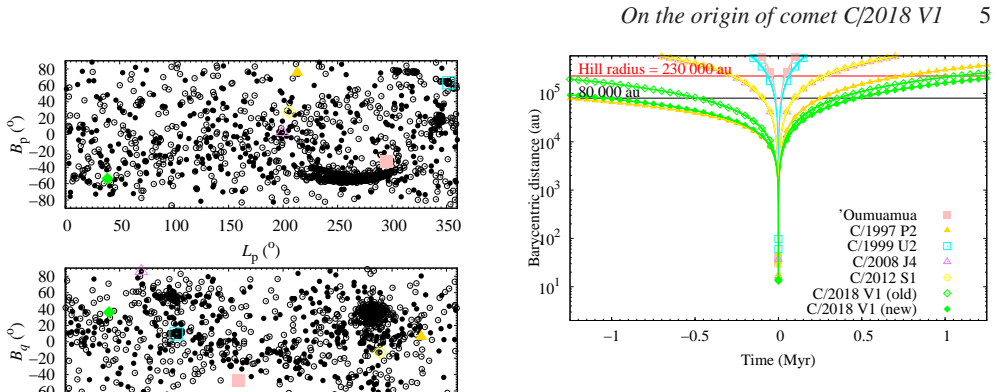
The central mechanism is the velocity parameter, the difference between a control orbit's barycentric velocity and the local escape velocity in units of the escape velocity, evaluated at the barycentric distance reached 1 or 5 million years before and after the observed epoch. Control orbits are drawn from the covariance matrix of the latest orbit determination and integrated with a Hermite N-body code that includes eight planets, the Earth-Moon system, Pluto-Charon, Ceres, Pallas, and Vesta. A positive velocity parameter at large distance means the comet was or will be genuinely unbound; the 0.5 km/s capture threshold from Valtonen and Innanen separates low-velocity interstellar arrivals from bodies that could have been captured. The same inbound trajectory is then transformed into heliocentric Galactic velocity components and matched against Gaia DR2 stars, which is how the two solar-sibling candidates are identified.
What would settle it
Take all astrometric observations from discovery through the end of 2019, fit the orbit with and without nongravitational accelerations, and recompute the control-orbit fractions. If a substantial fraction of the resulting orbits, say more than half, are bound 5 million years in the past, then the interstellar-origin branch would be effectively ruled out and the Oort Cloud interpretation would stand.
Extended reading notes
Core claim
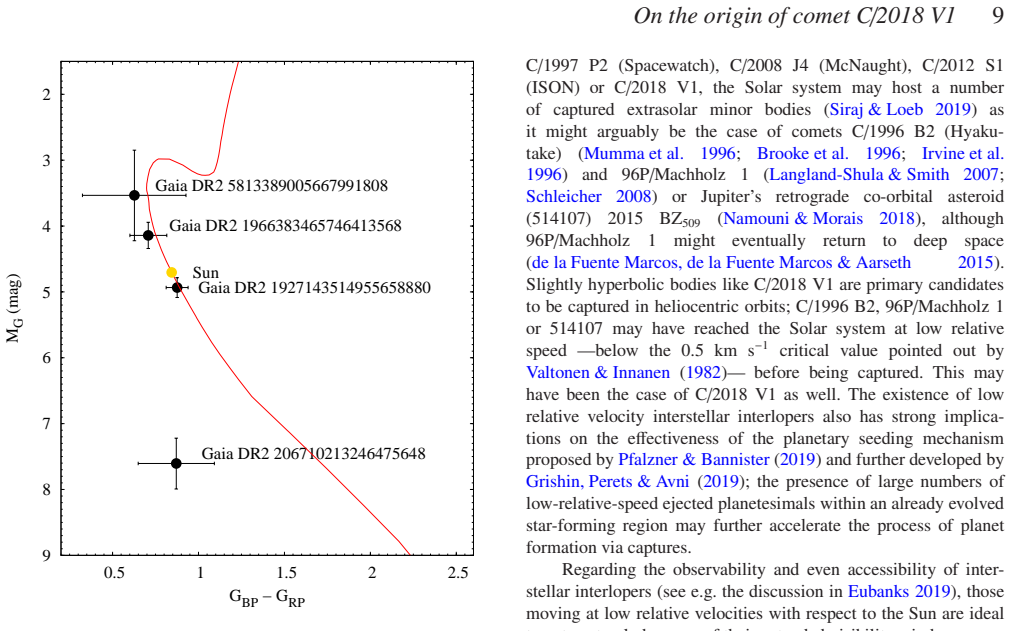
Using N-body control orbits generated from the covariance matrix of the 2019 May 15 orbit determination, the authors show that C/2018 V1's past evolution is ambiguous. About 43% of the 1-million-year-into-the-past integrations and 73% of the 5-million-year integrations put the comet beyond the Sun's Hill sphere before its observed encounter, while every future integration ejects it from the Solar system. Thus the comet is very likely leaving the Solar system forever, and its inbound velocity, if it was unbound, was only about 0.3 km/s relative to the Sun, below the threshold at which a passing object can be gravitationally captured. A Gaia DR2 search for stars whose space velocities match that inbound trajectory finds four candidates within 9 sigma; two of them are astrometrically clean, single, Sun-like, and sit on a solar-metallicity 4.568-Gyr isochrone, making them plausible solar siblings and hypothetical sources of the comet. The authors therefore conclude that an Oort Cloud origin remains possible but an interstellar origin cannot be excluded, and that low-relative-velocity interstellar comets may not be rare.
Load-bearing premise
The whole analysis rests on the assumption that the 37-day orbit determination from 2019 May 15, and especially its error ellipse, correctly describes how uncertain the comet's orbit really is, even though the comet was observed at low solar elongation where bad data points are plausible; the authors themselves note in Section 6 that this possibility cannot be fully neglected.
Editorial extensions
If this is right
- Every integration, regardless of initial conditions, ejects C/2018 V1 from the Solar system within 1 million years; it will not return.
- If unbound, C/2018 V1 entered at roughly 0.3 km/s, below the 0.5 km/s capture threshold, so it belongs to the class of objects that could have been captured rather than merely passing through.
- Two nearby Sun-like stars, Gaia DR2 1927143514955658880 and Gaia DR2 1966383465746413568, are astrometrically robust kinematic analogues of the comet's pre-encounter trajectory and are plausible solar sibling candidates.
- Low-relative-velocity interstellar comets may be common enough that several already discovered short-arc hyperbolic objects are probably interstellar, with the paper's probability argument suggesting about six among the 2191 known hyperbolic objects.
- Such slow interlopers are ideal targets for future interception and in-situ study, because they stay observable far longer than fast objects like 'Oumuamua.
Reading between the lines
- The jump from 43% unbound at 1 million years to 73% at 5 million years is itself a sign that the distinction is not settled by the current orbit; a longer data arc could push the odds either way, so the method is best read as a triage tool rather than a definitive classification.
- If slow interstellar comets are common, gravitational capture by the Solar system should also be common; captured bodies such as 96P/Machholz 1 or Jupiter's retrograde co-orbital asteroid 2015 BZ509 may eventually be recognized as part of the same low-velocity population.
- The same pipeline, covariance-based control orbits plus a stellar-kinematics search, could be applied to dozens of short-arc hyperbolic objects to prioritize follow-up observations before they fade beyond reach.
- High-resolution spectroscopy of the two proposed solar-sibling candidates would test whether they share the Sun's chemistry; a positive match would make the what-if scenario concrete, while a negative match would not exclude an interstellar origin, since the comet could come from many other stars.
Signed reviews
Editorial analysis
A structured set of objections, weighed in public.
Referee Report
Summary. The paper investigates the dynamical origin of the slightly hyperbolic comet C/2018 V1 (Machholz-Fujikawa-Iwamoto) using N-body integrations and Gaia DR2 stellar kinematics. The authors propagate the covariance matrix of the 2019 May 15 JPL orbit solution into 1000 control orbits and find that 43% (1 Myr) and 73% (5 Myr) of the past integrations are compatible with an unbound, interstellar origin, while all future integrations become unbound. They infer that, if extrasolar, the comet approached at about -0.3 km/s at roughly 0.3 pc from the Sun, and they identify two Gaia DR2 stars whose UVW velocities are kinematically consistent with that inbound trajectory. The Abstract and Conclusions state that an Oort Cloud origin is possible but an interstellar origin cannot be excluded, and that low-velocity interstellar comets may not be rare.
Significance. If the input orbit covariance is reliable, the paper provides a carefully hedged, falsifiable candidate for a low-velocity interstellar interloper and demonstrates a reusable methodological pipeline combining control-orbit sampling with Gaia kinematic matching. The authors deserve credit for explicitly flagging the low-elongation astrometry concern in Section 6, for using an independent N-body code, and for avoiding an overconfident claim of confirmed interstellar origin. However, the population-level generalization that low-velocity interstellar comets are not rare is not supported by the single, orbitally uncertain object studied, and the quantitative fractions hinge entirely on an unvalidated externally supplied covariance matrix.
major comments (3)
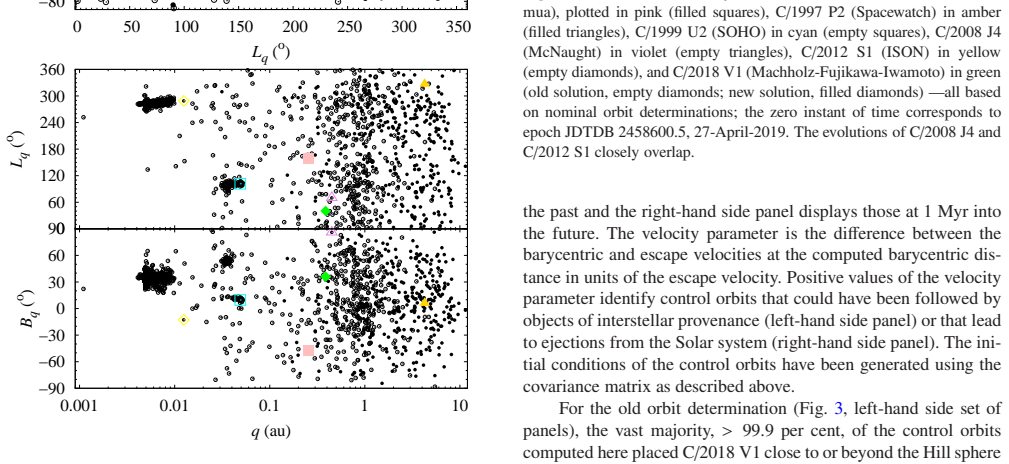
- [Section 4 (Fig. 3) and Section 6] The central quantitative results—the 43% (1 Myr) and 73% (5 Myr) unbound control-orbit fractions, the inbound velocity of -0.30 +/- 0.14 km/s at 0.31 +/- 0.08 pc, and the Gaia DR2 kinematic matches in Section 5—are all derived from control orbits sampled from the covariance matrix of the 2019 May 15 JPL orbit solution, whose fidelity the authors themselves question in Section 6: 'the possibility that bad data may have corrupted the current orbit estimate and produce unreliable formal uncertainties cannot be fully neglected as C/2018 V1 was observed at low solar elongation.' The paper contains no sensitivity analysis, such as scaling the covariance, adopting a non-Gaussian error model, or recomputing with the 12-day 2018 November 20 solution, which yields >99.9% unbound control orbits. Because the old and new solutions bracket nearly the full range of possible origins, every headline number must be treated as provisional until the robustness of the covariance input is demonstrated.
- [Section 5 (last paragraph) vs. Section 6 (first paragraph)] The manuscript contradicts itself on the statistical status of the extrasolar scenario. Section 6 states that 'rather than having come from interstellar space, C/2018 V1 seems to have been dislodged from the Oort Cloud in the recent past,' while Section 5 refers to an extrasolar provenance as 'the most likely interpretation, statistically,' and the Abstract only says that an interstellar origin 'cannot be excluded.' These statements imply different priors and different readings of the 43%/73% fractions. The authors should either adopt one consistent position or explicitly describe the decision rule that reconciles 'cannot be excluded' with 'most likely.'
- [Abstract and Section 7, item (iv)] The claim that 'comets coming from interstellar space at low heliocentric velocities may not be rare' is a population-level statement that does not follow from the single-object analysis presented. The paper computes no occurrence rate, accounts for no survey completeness or observational bias, and does not quantify how often the control-orbit procedure would classify a typical Oort Cloud comet as interstellar-compatible. As it stands, this conclusion overreaches the evidence; it should be reframed as a motivation for future searches rather than an inference of this work.
minor comments (5)
- [Section 2.2 and Table 3] The statement that neglecting the Gaia DR2 parallax zero-point offset 'has no significant effect on our conclusions' should be justified quantitatively; a 0.08 mas offset is not negligible for the 2.7573 mas parallax of Gaia DR2 1927143514955658880, and the kinematic-match tolerance in Section 5 is of order 9 sigma.
- [Section 4] The phrase 'about 73 per cent (72.6 +/- 0.5)' needs a definition of the quoted uncertainty, presumably Monte Carlo counting noise; please also reconcile the number of control orbits for the 5 Myr runs, which the text and the Figure 3 caption describe differently (1000 versus 700).
- [Figure 3] The 'velocity parameter' is defined in the text, but the figure caption and axis labels should include the definition (barycentric velocity minus escape velocity, normalized by escape velocity) for readability.
- [Section 5, Table 3] For the four candidate stars, the radial-velocity uncertainties (up to 3.66 and 1.86 km/s) dominate the (U,V,W) errors; the paper should state clearly that the 9 sigma kinematic matches are driven largely by the loose tolerance in the radial-velocity direction, not by agreement in all three velocity components.
- [Section 3, last paragraph] The statement that C/2018 V1 'does not appear to be dynamically coherent with any of the known parabolic or hyperbolic comets, which might indicate that it is not a first time visitor from the Oort Cloud' conflates orbital geometry with dynamical age; consider rewording to avoid implying that the pole/perihelion clustering test alone can distinguish dynamically new from dynamically old comets.
Circularity Check
No circular derivation: the origin analysis integrates external JPL orbital data and Gaia DR2 with an independent N-body model; self-citations are methodological and not load-bearing.
full rationale
The paper's derivation chain is: (1) take the JPL SBDB orbit determination of C/2018 V1 (an external product), (2) sample the associated covariance matrix to create control orbits, (3) integrate those orbits with a standard Hermite N-body code including planetary perturbations, (4) classify orbits as bound/unbound via the velocity parameter relative to the Hill sphere, and (5) compare the backward-integrated unbound trajectories with independent Gaia DR2 stellar kinematics. None of these steps fits a parameter to the quantity being inferred. The 43% (1 Myr) and 73% (5 Myr) interstellar-compatibility fractions are Monte Carlo counts from the external JPL covariance, not from any parameter adjusted in this paper; the Gaia matches are selected using the comet's predicted inbound velocity, but the Gaia catalogue is independent of the comet orbit solution, so the match is a genuine external consistency check rather than a construction. The self-citations (de la Fuente Marcos & de la Fuente Marcos 2012, 2015, 2019; de la Fuente Marcos et al. 2018) concern numerical methodology, covariance sampling, and previous candidate lists; they do not supply the central result. The Section 6 argument that C/2018 V1's radiant is far from the overdensities identified in de la Fuente Marcos et al. (2018) is a self-citation, but it only weakens one particular Oort-Cloud-perturbation scenario; the paper's central conclusion is explicitly non-committal (Oort Cloud origin cannot be excluded either), so that citation is not load-bearing. The acknowledged risk that the 37-day-arc covariance may be corrupted by low-elongation astrometry is a data-quality/robustness concern about an external input, not a circularity of the derivation.
Assumptions & free parameters
free parameters (2)
- Barycentric eccentricity of C/2018 V1 (JPL 2019 May 15 solution) =
1.01235
- Kinematic match tolerance =
9 sigma
assumptions (6)
- domain assumption The JPL covariance matrix can be used to generate control orbits that represent the true uncertainty of the orbit determination.
- domain assumption Non-gravitational forces are negligible for the dynamical evolution.
- domain assumption The 0.5 km/s relative-velocity threshold from Valtonen and Innanen (1982) separates capture from escape at the Hill sphere.
- domain assumption Gaia DR2 parallax zero-point offset can be neglected.
- domain assumption Colour-magnitude isochrone matching at 4.568 Gyr and solar metallicity is a sufficient basis to call stars solar sibling candidates.
- domain assumption Galactic tide is either included in the public N-body code or is negligible for the 1-5 Myr conclusions.
Cite this review
Pith. "Pith review of Comet C/2018 V1 (Machholz-Fujikawa-Iwamoto): dislodged from the Oort Cloud or coming from interstellar space?." pith.science (2026). https://pith.science/paper/PGTHQTUR
@misc{pith2026190802666,
  author       = {Pith},
  title        = {Pith review of: Comet C/2018 V1 (Machholz-Fujikawa-Iwamoto): dislodged from the Oort Cloud or coming from interstellar space?},
  year         = {2026},
  howpublished = {\url{https://pith.science/paper/PGTHQTUR}},
  note         = {Machine review of arXiv:1908.02666}
}
read the original abstract
The chance discovery of the first interstellar minor body, 1I/2017 U1 (`Oumuamua), indicates that we may have been visited by such objects in the past and that these events may repeat in the future. Unfortunately, minor bodies following nearly parabolic or hyperbolic paths tend to receive little attention: over 3/4 of those known have data-arcs shorter than 30 d and, consistently, rather uncertain orbit determinations. This fact suggests that we may have observed interstellar interlopers in the past, but failed to recognize them as such due to insufficient data. Early identification of promising candidates by using N-body simulations may help in improving this situation, triggering follow-up observations before they leave the Solar system. Here, we use this technique to investigate the pre- and post-perihelion dynamical evolution of the slightly hyperbolic comet C/2018 V1 (Machholz-Fujikawa-Iwamoto) to understand its origin and relevance within the context of known parabolic and hyperbolic minor bodies. Based on the available data, our calculations suggest that although C/2018 V1 may be a former member of the Oort Cloud, an origin beyond the Solar system cannot be excluded. If extrasolar, it might have entered the Solar system from interstellar space at low relative velocity with respect to the Sun. The practical feasibility of this alternative scenario has been assessed within the kinematic context of the stellar neighbourhood of the Sun, using data from Gaia second data release, and two robust solar sibling candidates have been identified. Our results suggest that comets coming from interstellar space at low heliocentric velocities may not be rare.
Figures

Figures from the paper (2 more)

Reference graph
Works this paper leans on
-
[1]
J., 2003, Gravitational N-body simulations
Aarseth S. J., 2003, Gravitational N-body simulations. Cambridge Univ. Press, Cambridge, p.\ 27
2003
-
[2]
C., 2010, ARA&A, 48, 47
Adams F. C., 2010, ARA&A, 48, 47
2010
-
[3]
et al., 2018, A&A, 619, A130
Adibekyan V. et al., 2018, A&A, 619, A130
2018
-
[4]
J., 2018, MNRAS, 480, 4903
Almeida-Fernandes F., Rocha-Pinto H. J., 2018, MNRAS, 480, 4903
2018
-
[5]
et al., 2018, A&A, 616, A8
Andrae R. et al., 2018, A&A, 616, A8
2018
-
[6]
Ashton E., Gladman B., Kavelaars J., Williams G., 2018, AAS/Div. Planet. Sci. Meeting Abstr., 50, 201.02
2018
-
[7]
et al., 2017, MPEC Circ., MPEC 2017-U181
Bacci P. et al., 2017, MPEC Circ., MPEC 2017-U181
2017
-
[8]
Bailer-Jones C. A. L., Farnocchia D., Meech K. J., Brasser R., Micheli M., Chakrabarti S., Buie M. W., Hainaut O. R., 2018a, AJ, 156, 205
Show all 104 references
-
[9]
Bailer-Jones C. A. L., Rybizki J., Fouesneau M., Mantelet G., Andrae R., 2018b, AJ, 156, 58
-
[10]
Bannister M. T. et al., 2019, Nat. Astron., 3, 594
2019
-
[11]
V., 2019, Astron
Bobylev V. V., 2019, Astron. Lett., 45, 10
2019
-
[12]
Geosci., 3, 637
Bouvier A., Wadhwa M., 2010, Nat. Geosci., 3, 637
2010
-
[13]
Bressan A., Marigo P., Girardi L., Salasnich B., Dal Cero C., Rubele S., Nanni A., 2012, MNRAS, 427, 127
2012
-
[14]
C., Kenyon S
Bromley B. C., Kenyon S. J., Brown W. R., Geller M. J., 2018, ApJ, 868, 25
2018
-
[15]
Y., Tokunaga A
Brooke T. Y., Tokunaga A. T., Weaver H. A., Crovisier J., Bockel \'e e-Morvan D., Crisp D., 1996, Nature, 383, 606
1996
-
[16]
et al., 2018, MPEC Circ., MPEC 2018-W46
Buzzi L. et al., 2018, MPEC Circ., MPEC 2018-W46
2018
-
[17]
A., 1965, SvA, 8, 78
Chebotarev G. A., 1965, SvA, 8, 78
1965
-
[18]
et al., 2012, RAA, 12, 1197
Cui X.-Q. et al., 2012, RAA, 12, 1197
2012
-
[19]
de la Fuente Marcos R., de la Fuente Marcos C., 2008, ApJ, 672, 342
2008
-
[20]
de la Fuente Marcos C., de la Fuente Marcos R., 2012, MNRAS, 427, 728
2012
-
[21]
de la Fuente Marcos C., de la Fuente Marcos R., 2015, MNRAS, 453, 1288
2015
-
[22]
de la Fuente Marcos C., de la Fuente Marcos R., 2017, MNRAS, 471, L61
2017
-
[23]
de la Fuente Marcos R., de la Fuente Marcos C., 2018a, MNRAS, 481, L64
-
[24]
Notes AAS, 2, 10
de la Fuente Marcos R., de la Fuente Marcos C., 2018b, Res. Notes AAS, 2, 10
-
[25]
Notes AAS, 2, 30
de la Fuente Marcos R., de la Fuente Marcos C., 2018c, Res. Notes AAS, 2, 30
-
[26]
de la Fuente Marcos R., de la Fuente Marcos C., 2019, A&A, 627, A104
2019
-
[27]
J., 2015, MNRAS, 446, 1867
de la Fuente Marcos C., de la Fuente Marcos R., Aarseth S. J., 2015, MNRAS, 446, 1867
2015
-
[28]
J., 2018, MNRAS, 476, L1
de la Fuente Marcos C., de la Fuente Marcos R., Aarseth S. J., 2018, MNRAS, 476, L1
2018
-
[29]
A., Tonry J., 2018, ApJ, 855, L10
Do A., Tucker M. A., Tonry J., 2018, ApJ, 855, L10
2018
-
[30]
A., 2002, A&A, 396, 283
Dybczy \'n ski P. A., 2002, A&A, 396, 283
2002
-
[31]
M., 2019, ApJ, 874, L11
Eubanks T. M., 2019, ApJ, 874, L11
2019
-
[32]
et al., 2016, A&A, 595, A1
Gaia Collaboration, Prusti T. et al., 2016, A&A, 595, A1
2016
-
[33]
et al., 2018, A&A, 616, A10
Gaia Collaboration, Babusiaux C. et al., 2018, A&A, 616, A10
2018
-
[34]
Gaia Collaboration, Brown A. G. A. et al., 2018, A&A, 616, A1
2018
-
[35]
Giorgini J. D. et al., 1996, BAAS, 28, 1158
1996
-
[36]
Giorgini J., 2011, in Capitaine N., ed., Proceedings of the Journ\'ees 2010 `Syst\`emes de r\'ef\'erence spatio-temporels' (JSR2010): New Challenges for Reference Systems and Numerical Standards in Astronomy, Observatoire de Paris, Paris, p.\ 87
2011
-
[37]
J., Hale A., 2018, CBET, 4572, 2
Gonzalez J. J., Hale A., 2018, CBET, 4572, 2
2018
-
[38]
B., Avni Y., 2019, MNRAS, 487, 3324
Grishin E., Perets H. B., Avni Y., 2019, MNRAS, 487, 3324
2019
-
[39]
R., Meech K
Hainaut O. R., Meech K. J., Micheli M., Belton M. S. J., 2018, Messenger, 173, 13
2018
-
[40]
et al., 2018, MPEC Circ., MPEC 2018-W03
Hasubick W. et al., 2018, MPEC Circ., MPEC 2018-W03
2018
-
[41]
H g E., et al., 2000, A&A, 355, L27
2000
-
[42]
Hui M.-T., Jewitt D., Clark D., 2018, AJ, 155, 25
2018
-
[43]
Irvine W. M. et al., 1996, Nature, 383, 418
1996
-
[44]
Johnson D. R. H., Soderblom D. R., 1987, AJ, 93, 864
1987
-
[45]
M., 2008, Ph.D
Knight M. M., 2008, Ph.D. Thesis, University of Maryland, College Park
2008
-
[46]
Kreutz H. C. F., 1888, Untersuchungen \"uber das Cometensystem 1843 I, 1880 I und 1882 II. Publ. Sternwarte Kiel, No. 3, ed. Druck von C. Schaidt and C. F. Mohr, Kiel
-
[47]
A., 2017, MNRAS, 472, 4634
Kr \'o likowska M., Dybczy \'n ski P. A., 2017, MNRAS, 472, 4634
2017
-
[48]
A., 2018, A&A, 615, A170
Kr \'o likowska M., Dybczy \'n ski P. A., 2018, A&A, 615, A170
2018
-
[49]
E., Smith G
Langland-Shula L. E., Smith G. H., 2007, ApJ, 664, L119
2007
-
[50]
J., Mann A
L \'e pine S., Hilton E. J., Mann A. W., Wilde M., Rojas-Ayala B., Cruz K. L., Gaidos E., 2013, AJ, 145, 102
2013
-
[51]
L \'e pine J. R. D., Michtchenko T. A., Barros D. A., Vieira R. S. S., 2017, ApJ, 843, 48
2017
-
[52]
Licandro J., de la Fuente Marcos C., de la Fuente Marcos R., de Le \'o n J., Serra-Ricart M., Cabrera-Lavers A., 2019, A&A, 625, A133
2019
-
[53]
et al., 2018, A&A, 616, A2
Lindegren L. et al., 2018, A&A, 616, A2
2018
-
[54]
A., Bensby T., Brown A
Liu C., Ruchti G., Feltzing S., Mart \' nez-Barbosa C. A., Bensby T., Brown A. G. A., Portegies Zwart S. F., 2015, A&A, 575, A51
2015
-
[55]
et al., 2018, MPEC Circ., MPEC 2018-V151
Machholz D. et al., 2018, MPEC Circ., MPEC 2018-V151
2018
-
[56]
Makino J., 1991, ApJ, 369, 200
1991
-
[57]
Notes AAS, 1, 21
Mamajek E., 2017, Res. Notes AAS, 1, 21
2017
-
[58]
E., Barenfeld S
Mamajek E. E., Barenfeld S. A., Ivanov V. D., Kniazev A. Y., V \"a is \"a nen P., Beletsky Y., Boffin H. M. J., 2015, ApJ, 800, L17
2015
-
[59]
et al., 2017, ApJ, 835, 77
Marigo P. et al., 2017, ApJ, 835, 77
2017
-
[60]
G., 1967, AJ, 72, 1170
Marsden B. G., 1967, AJ, 72, 1170
1967
-
[61]
G., 1989, AJ, 98, 2306
Marsden B. G., 1989, AJ, 98, 2306
1989
-
[62]
G., 2005, ARA&A, 43, 75
Marsden B. G., 2005, ARA&A, 43, 75
2005
-
[63]
A., 2016, Ph.D
Mart \' nez-Barbosa C. A., 2016, Ph.D. Thesis, Leiden University, The Netherlands
2016
-
[64]
A., Brown A
Mart \' nez-Barbosa C. A., Brown A. G. A., Boekholt T., Portegies Zwart S., Antiche E., Antoja T., 2016, MNRAS, 457, 1062
2016
-
[65]
et al., 2017, MPEC Circ., MPEC 2017-U183
Meech K. et al., 2017, MPEC Circ., MPEC 2017-U183
2017
-
[66]
et al., 2018, Nature, 559, 223
Micheli M. et al., 2018, Nature, 559, 223
2018
-
[67]
N., Acharova I
Mishurov Y. N., Acharova I. A., 2011, MNRAS, 412, 1771
2011
-
[68]
J., Disanti M
Mumma M. J., Disanti M. A., dello Russo N., Fomenkova M., Magee-Sauer K., Kaminski C. D., Xie D. X., 1996, Science, 272, 1310
1996
-
[69]
D., Dermott S
Murray C. D., Dermott S. F., 1999, Solar System Dynamics, Cambridge Univ. Press, Cambridge
1999
-
[70]
C., Capobianco C., 2004, ApJ, 600, 804
Murray N., Weingartner J. C., Capobianco C., 2004, ApJ, 600, 804
2004
-
[71]
Nakano S., 2018, CBET, 4572, 3
2018
-
[72]
Namouni F., Morais M. H. M., 2018, MNRAS, 477, L117
2018
-
[73]
Ochsenbein F., Bauer P., Marcout J., 2000, A&AS, 143, 23
2000
-
[74]
H., 1950, BAN, 11, 91
Oort J. H., 1950, BAN, 11, 91
1950
-
[75]
et al., 2019, MNRAS, 485, 5666
Pastorelli G. et al., 2019, MNRAS, 485, 5666
2019
-
[76]
Pfalzner S., 2013, A&A, 549, A82
2013
-
[77]
T., 2019, ApJ, 874, L34
Pfalzner S., Bannister M. T., 2019, ApJ, 874, L34
2019
-
[78]
F., 2009, ApJ, 696, L13
Portegies Zwart S. F., 2009, ApJ, 696, L13
2009
-
[79]
X., 2018, MNRAS, 479, L17
Portegies Zwart S., Torres S., Pelupessy I., B \'e dorf J., Cai M. X., 2018, MNRAS, 479, L17
2018
-
[80]
R., 2018, ApJ, 867, L17
Rafikov R. R., 2018, ApJ, 867, L17
2018
-
[81]
Riess A. G. et al., 2018, ApJ, 861, 126
2018
-
[82]
G., 2008, AJ, 136, 2204
Schleicher D. G., 2008, AJ, 136, 2204
2008
-
[83]
Sch \"o nrich R., Binney J., Dehnen W., 2010, MNRAS, 403, 1829
2010
-
[84]
Sekanina Z., 2002, ApJ, 566, 577
2002
-
[85]
Sekanina Z., 2019, arXiv e-prints, arXiv:1901.08704
2019 arXiv
-
[86]
W., 2004, ApJ, 607, 620
Sekanina Z., Chodas P. W., 2004, ApJ, 607, 620
2004
-
[87]
W., 2007, ApJ, 663, 657
Sekanina Z., Chodas P. W., 2007, ApJ, 663, 657
2007
-
[88]
Sekanina Z., Kracht R., 2013, ApJ, 778, 24
2013
-
[89]
Sekanina Z., Kracht R., 2015, ApJ, 815, 52
2015
-
[90]
Sekanina Z., Kracht R., 2016, ApJ, 823, 2
2016
-
[91]
Seligman D., Laughlin G., 2018, AJ, 155, 217
2018
-
[92]
Siraj A., Loeb A., 2019, ApJ, 872, L10
2019
-
[93]
Soulier J.-F., Maury A., Vanssay J.-B., Kadota K., 2018, CBET, 4572, 1
2018
-
[94]
G., Torres G., 2018, ApJ, 862, 61
Stassun K. G., Torres G., 2018, ApJ, 862, 61
2018
-
[95]
X., Brown A
Torres S., Cai M. X., Brown A. G. A., Portegies Zwart S., 2019, A&A, in press (arXiv:1906.10617)
2019 arXiv
-
[96]
H., 2017, ApJ, 839, 55
Vagnozzi S., Freese K., Zurbuchen T. H., 2017, ApJ, 839, 55
2017
-
[97]
J., Innanen K
Valtonen M. J., Innanen K. A., 1982, ApJ, 255, 307
1982
-
[98]
T., Bobylev V
Valtonen M., Bajkova A. T., Bobylev V. V., Myll \"a ri A., 2015, Celest. Mech. Dyn. Astron., 121, 107
2015
-
[99]
V., Jenkins C
Wall J. V., Jenkins C. R., 2012, Practical Statistics for Astronomers. Cambridge Univ. Press, Cambridge
2012
-
[100]
V., 2017, MPEC Circ., MPEC 2017-V17
Williams G. V., 2017, MPEC Circ., MPEC 2017-V17
2017
-
[101]
J., Zheng X., Wang G., 2019, ApJ, 875, 114
Xu S., Zhang B., Reid M. J., Zheng X., Wang G., 2019, ApJ, 875, 114
2019
-
[102]
Zhao G., Zhao Y.-H., Chu Y.-Q., Jing Y.-P., Deng L.-C., 2012, RAA, 12, 723
2012
-
[103]
C., Pinsonneault M
Zinn J. C., Pinsonneault M. H., Huber D., Stello D., 2019, ApJ, 878, 136
2019
-
[104]
write newline
" write newline "" before.all 'output.state := FUNCTION fin.entry write newline FUNCTION new.block output.state before.all = 'skip after.block 'output.state := if FUNCTION new.sentence output.state after.block = 'skip output.state before.all = 'skip after.sentence 'output.stat...
Reviewed August 14, 2026 · model on record in the stance chip above.
Discussion (0). Continue with ORCID to comment.