PulseCX: Breaking the Closed-World Assumption in Real-Time CX
Pith reviewed 2026-06-26 14:41 UTC · model grok-4.3
The pith
PulseCX decouples knowledge gathering from use in CX agents via an asynchronous decay-aware graph to handle external shifts without added latency.
A machine-rendered reading of the paper's core claim, the machinery that carries it, and where it could break.
Core claim
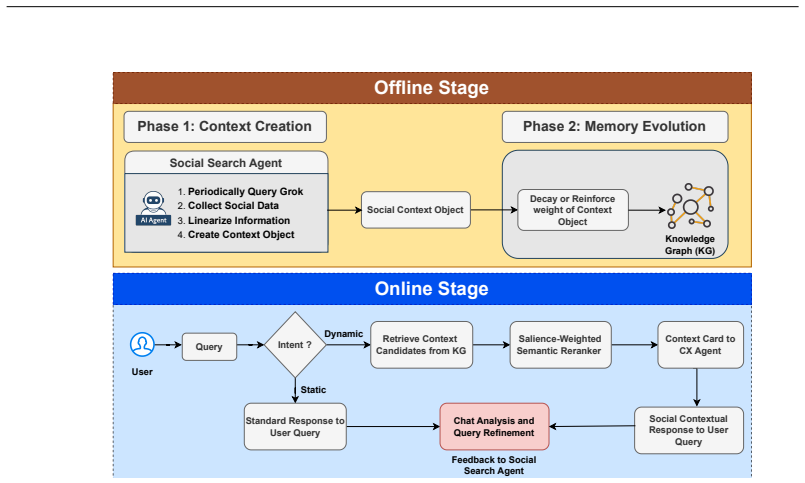
PulseCX is a framework that decouples knowledge acquisition from consumption. It employs an asynchronous agent to linearize external signals into a Decay-Aware Temporal Knowledge Graph (DA-TKG) governed by reinforcement-decay dynamics to actively manage information lifecycles. By coupling this self-evolving memory with hierarchical intent gating, PulseCX removes synchronous search bottlenecks with less than 10 ms overhead and drives gains in Intent Resolution Rate and customer satisfaction metrics in dynamic environments.
What carries the argument
The Decay-Aware Temporal Knowledge Graph (DA-TKG) governed by reinforcement-decay dynamics, which acts as a self-evolving memory that linearizes external signals asynchronously and controls information lifespan.
If this is right
- Synchronous web searches are no longer required, removing their latency and poisoning risks.
- Intent Resolution Rate and satisfaction scores improve in environments with rapid external change.
- Information lifecycles are managed automatically so outdated signals do not persist.
- The same memory structure supports multiple intents without rebuilding context on each turn.
Where Pith is reading between the lines
- The same decoupling pattern could apply to other real-time agents that must track fast-moving external facts, such as financial news bots or public-health chat systems.
- Automatic decay rules might reduce the engineering effort needed to keep any long-running agent memory current over weeks or months.
- If the linearization step proves accurate, the approach could be combined with existing retrieval systems rather than replacing them outright.
Load-bearing premise
An asynchronous agent can reliably linearize external signals into a DA-TKG governed by reinforcement-decay dynamics while avoiding context poisoning and keeping overhead under 10 ms when paired with hierarchical intent gating.
What would settle it
A live test in which external signals during a viral trend produce context poisoning in the DA-TKG or push response latency above 10 ms would falsify the performance claims.
Figures
read the original abstract
Conversational AI agents in Customer Experience (CX) typically suffer from a Closed-World Constraint, ignoring high-velocity external shifts like viral trends or outages. Ad-hoc web search attempts to bridge this gap but often introduce prohibitive latency and context poisoning. We introduce PulseCX, a framework that decouples knowledge acquisition from consumption. Adopting a structure-first paradigm, PulseCX employs an asynchronous agent to linearize signals into a Decay-Aware Temporal Knowledge Graph (DA-TKG) governed by reinforcement--decay dynamics to actively manage information lifecycles. By coupling this self-evolving memory with hierarchical intent gating, PulseCX removes synchronous search bottlenecks (<10ms overhead) and drives significant gains in Intent Resolution (IRR) and Customer Satisfaction (s-CSAT) in dynamic environments.
Editorial analysis
A structured set of objections, weighed in public.
Referee Report
Summary. The paper introduces PulseCX, a framework for conversational AI in customer experience (CX) that decouples knowledge acquisition from consumption via an asynchronous agent linearizing external signals into a Decay-Aware Temporal Knowledge Graph (DA-TKG) governed by reinforcement-decay dynamics. Coupled with hierarchical intent gating, the approach is claimed to eliminate synchronous search bottlenecks with <10ms overhead while delivering significant gains in Intent Resolution Rate (IRR) and customer satisfaction (s-CSAT) in dynamic environments.
Significance. If validated, the structure-first paradigm and self-evolving memory could meaningfully advance real-time CX agents by addressing the closed-world constraint without prohibitive latency or context poisoning. The decoupling of acquisition and consumption represents a potentially useful architectural shift for handling high-velocity external signals.
major comments (2)
- [Abstract] Abstract: the central claims of significant IRR/s-CSAT gains and <10ms overhead are asserted without any experiments, baselines, latency measurements, ablation studies, or error analysis. No data or formal argument is supplied to support that the DA-TKG linearization plus gating actually achieves these outcomes or avoids context poisoning.
- [Abstract] Abstract: the DA-TKG, reinforcement-decay dynamics, and hierarchical intent gating are introduced as invented entities without definitions, equations, pseudocode, or complexity analysis, rendering the performance assertions impossible to evaluate or reproduce.
minor comments (1)
- The acronym s-CSAT is used without expansion or definition.
Simulated Author's Rebuttal
Thank you for the opportunity to respond to the referee's report. We appreciate the detailed feedback on the abstract and will revise the manuscript to address the concerns.
read point-by-point responses
-
Referee: [Abstract] Abstract: the central claims of significant IRR/s-CSAT gains and <10ms overhead are asserted without any experiments, baselines, latency measurements, ablation studies, or error analysis. No data or formal argument is supplied to support that the DA-TKG linearization plus gating actually achieves these outcomes or avoids context poisoning.
Authors: We agree that the abstract asserts quantitative performance claims without supporting evidence in the provided text. We will revise the manuscript to add a dedicated evaluation section containing experiments, baselines, latency measurements confirming the overhead, ablation studies, and error analysis to substantiate the IRR, s-CSAT, and context-poisoning claims. revision: yes
-
Referee: [Abstract] Abstract: the DA-TKG, reinforcement-decay dynamics, and hierarchical intent gating are introduced as invented entities without definitions, equations, pseudocode, or complexity analysis, rendering the performance assertions impossible to evaluate or reproduce.
Authors: We agree that the abstract introduces the key components without definitions or technical details. We will revise the manuscript to include formal definitions, equations for the reinforcement-decay dynamics, pseudocode for the hierarchical intent gating, and complexity analysis. revision: yes
Circularity Check
No significant circularity: framework description contains no derivation chain or self-referential reductions
full rationale
The provided abstract and description introduce PulseCX as a framework employing an asynchronous agent to build a DA-TKG with reinforcement-decay dynamics and hierarchical intent gating, asserting <10ms overhead and gains in IRR/s-CSAT. No equations, fitted parameters, uniqueness theorems, or self-citations appear in the text. Without any load-bearing derivation steps, mathematical claims, or ansatzes that could reduce to inputs by construction, the paper's presentation is self-contained as a high-level system proposal rather than a derived result. The performance assertions remain unsupported by evidence but do not exhibit circularity.
Axiom & Free-Parameter Ledger
axioms (1)
- domain assumption External high-velocity signals can be linearized into a temporal knowledge graph without loss of utility for downstream intent resolution.
invented entities (1)
-
Decay-Aware Temporal Knowledge Graph (DA-TKG)
no independent evidence
Reference graph
Works this paper leans on
-
[1]
Scaling Learning Algorithms Towards
Bengio, Yoshua and LeCun, Yann , booktitle =. Scaling Learning Algorithms Towards
-
[2]
and Osindero, Simon and Teh, Yee Whye , journal =
Hinton, Geoffrey E. and Osindero, Simon and Teh, Yee Whye , journal =. A Fast Learning Algorithm for Deep Belief Nets , volume =
-
[3]
2016 , publisher=
Deep learning , author=. 2016 , publisher=
2016
-
[4]
arXiv preprint arXiv:2512.05470 , year=
Everything is context: Agentic file system abstraction for context engineering , author=. arXiv preprint arXiv:2512.05470 , year=
-
[5]
Proceedings of the ACM on Management of Data , volume=
CtxPipe: Context-aware Data Preparation Pipeline Construction for Machine Learning , author=. Proceedings of the ACM on Management of Data , volume=. 2024 , publisher=
2024
-
[6]
Advances in Neural Information Processing Systems , volume=
Agentpoison: Red-teaming llm agents via poisoning memory or knowledge bases , author=. Advances in Neural Information Processing Systems , volume=
- [7]
-
[8]
Memory in the Age of AI Agents
Memory in the Age of AI Agents , author=. arXiv preprint arXiv:2512.13564 , year=
work page internal anchor Pith review Pith/arXiv arXiv
-
[9]
International Conference on Computational Science and Computational Intelligence , pages=
Revolutionizing Multi-agent Systems: The Role of Agentic RAG in Dynamic Data Ingestion and Real-Time Reasoning , author=. International Conference on Computational Science and Computational Intelligence , pages=. 2024 , organization=
2024
-
[10]
Frontiers of Computer Science , volume=
A survey on large language model based autonomous agents , author=. Frontiers of Computer Science , volume=. 2024 , publisher=
2024
-
[11]
NeurIPS , year=
Retrieval-Augmented Generation for Knowledge-Intensive NLP Tasks , author=. NeurIPS , year=
-
[12]
ICLR , year=
ReAct: Synergizing Reasoning and Acting in Language Models , author=. ICLR , year=
-
[13]
Journal of Business and Future Economy , volume=
Enhancing Customer Experience and Business Intelligence: The Role of AI-Driven Smart CRM in Modern Enterprises , author=. Journal of Business and Future Economy , volume=
-
[14]
Advances in digital marketing in the era of artificial intelligence , pages=
Enhancing customer experience through AI-enabled content personalization in e-commerce marketing , author=. Advances in digital marketing in the era of artificial intelligence , pages=. 2024 , publisher=
2024
-
[15]
, author=
Context Aware Intelligence: A Framework for Immersive Customer Experience. , author=. International Journal of Advanced Research in Computer Science , volume=
-
[16]
Sustainability , volume=
Customer experience design for smart product-service systems based on the iterations of experience--evaluate--engage using customer experience data , author=. Sustainability , volume=. 2022 , publisher=
2022
-
[17]
arXiv preprint arXiv:2507.13396 , year=
DyG-RAG: Dynamic Graph Retrieval-Augmented Generation with Event-Centric Reasoning , author=. arXiv preprint arXiv:2507.13396 , year=
-
[18]
arXiv preprint arXiv:2402.16568 , year=
Two-stage generative question answering on temporal knowledge graph using large language models , author=. arXiv preprint arXiv:2402.16568 , year=
-
[19]
Proceedings of the 62nd Annual Meeting of the Association for Computational Linguistics (Volume 1: Long Papers) , pages=
Temporal knowledge question answering via abstract reasoning induction , author=. Proceedings of the 62nd Annual Meeting of the Association for Computational Linguistics (Volume 1: Long Papers) , pages=
discussion (0)
Sign in with ORCID, Apple, or X to comment. Anyone can read and Pith papers without signing in.