REVIEW 3 major objections 6 minor 36 references
Market-Information-Aware Gated-LoRA of Foundation Models for Transferable Day-Ahead Electricity Price Forecasting
T0 review · 3 major / 6 minor · reviewed 2026-08-15 · deepseek-v4-flash
Pith's one-line read Most of the transferable gain in day-ahead price forecasting comes from feeding a frozen foundation model the pre-clearing supply, demand, reserve, and intertie information; a six-parameter gate adds a smaller state-dependent gain.
desk verdict Careful LOMO study of transferable price forecasting; the MSMI gain hinges on an unvalidated version-policy assumption. read the letter →
The pith
A machine-rendered reading of the paper's core claim, the machinery that carries it, and where it could break.
The reading
What carries the argument
Two objects carry the argument. The first is the multi-source market-information (MSMI) interface: a task interface that concatenates a 7-day (672-step) price context, its contemporaneous covariates, and the known future values of supply–demand, reserve, maintenance, generator-capacity, and intertie fields over the 1-day (96-step) forecast horizon, exposing the frozen backbone to the same pre-clearing information set a market participant holds. The second is the gated low-rank adapter: the LoRA update $W' = W + \gamma_\psi(z_t)\frac{\alpha}{r}BA$ is injected into the four attention projections and the patch-output projection of the frozen Chronos-2 weights, and a linear gate maps a five-dimensional standardized market-state vector $z_t$ — net load, renewable share, reserve adequacy, capacity margin, and recent price volatility, signed so that larger values mean tighter operating conditions — to a task-level multiplier clipped to $[1, 3]$. The gate is initialized from the source-trained LoRA checkpoint with only the reserve-tightness weight active, then trained for 300 source-market steps with the LoRA matrices frozen, adding six trainable parameters. The design's work is to let the source adapter strengthen exactly when the operating state tightens, without ever exposing a held-out market's labels.
What would settle it
Re-run the same leave-one-market-out protocol with the MSMI interface fed the final revised supply–demand rows instead of the earliest available ones, and again with the market-information variables lagged by one day so they could not be known pre-clearing: if either variant reproduces the 7.7% zero-shot MAE gain, the gain is not evidence of using the genuine pre-clearing information set. A complementary check is to deploy the framework on a day-ahead market that publishes only a subset of these fields before clearing; the MSMI advantage should shrink in proportion to the fields actually withheld.
Extended reading notes
Core claim
The paper's central claim is that a generic pretrained time-series model can forecast day-ahead electricity prices in a market it has never seen, provided the model is handed the economic information set from which those prices are formed. The authors construct a multi-source market-information (MSMI) interface — 672 hours of price history, contemporaneous covariates, and known day-ahead values of load, wind, solar, hydro, nuclear, reserve, ancillary-service, maintenance, generation-capacity, and intertie fields over the 96-step horizon — and show that switching Chronos-2's zero-shot input from a minimal load–wind–PV set to this interface reduces the four-market average MAE from 86.25 to 79.60 without any training. Training a rank-8 LoRA (about 1% of the 120.7M parameters) on the three source markets, with the backbone frozen and the held-out market untouched, brings MAE/RMSE to 76.98/142.90; replacing the adapter's fixed strength with a six-parameter gate that scales the LoRA update by reserve tightness, net load, renewable share, capacity margin, and recent volatility brings it to 74.63/137.87. The authors further claim, from control experiments with a learned global scalar, random gate initialization, and shuffled state–task pairing, that the gate's benefit is genuinely state-dependent rather than a generic calibration artifact. They are explicit that the gated gain is marginal outside the most volatile market and that it degrades 80% interval coverage, recommending a separate interval-calibration layer before operational use.
Load-bearing premise
The argument assumes the earliest available supply–demand table row is a truthful, revision-free stand-in for what the market knows before clearing; if load, renewable output, reserves, maintenance, and intertie figures are routinely revised after the fact or only published post-clearing, the large MSMI zero-shot gain would reflect information leakage rather than transferable forecasting skill.
Editorial extensions
If this is right
- A newly established or data-scarce market can deploy day-ahead price forecasts immediately with zero local labels: the MSMI interface alone brings Chronos-2 zero-shot average MAE from 86.25 to 79.60.
- Domain re-pretraining is unnecessary for this transfer: adapting about 1% of parameters on source markets reaches 76.98/142.90 average MAE/RMSE, and extending the source history from 900 to 1665 days changes results by only −0.24 MAE.
- State-dependent adapter calibration works, but its benefit is concentrated: the reserve-initialized gate reaches 74.63/137.87, with the largest drop on the most volatile held-out market and near-zero change on calmer ones.
- Probabilistic output is a separate axis: gated LoRA improves CRPS from 62.66 to 61.23 but drops pooled 80% interval coverage from 73.24% to 70.23%, so interval calibration needs an added layer before operational use.
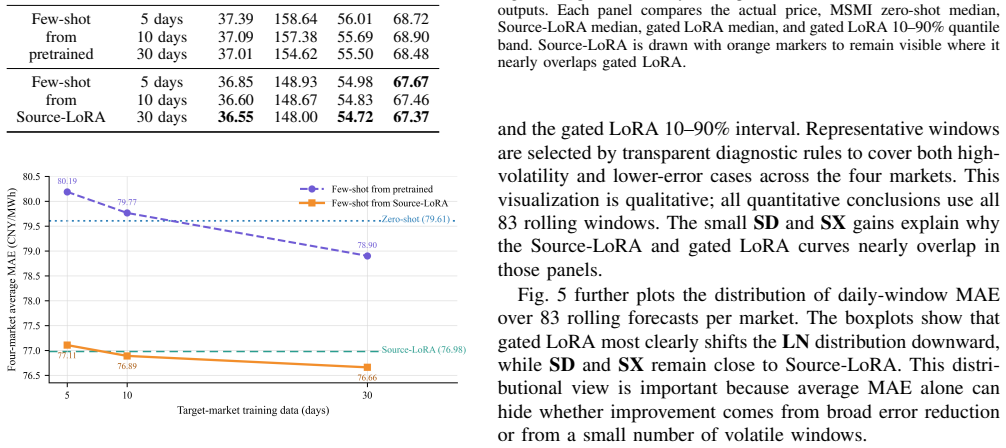
- Local few-shot labels are more useful after a source-domain warm start than from the pristine backbone: 30 target-market days give 76.66 average MAE from Source-LoRA versus 78.90 from pretrained Chronos-2.
Reading between the lines
- If the interface dominates adaptation, the same recipe likely transfers to other cleared prices with pre-market schedules — real-time and ancillary-service prices, emission allowances, or other auctioned commodities — where the pre-clearing information set is similarly published before the outcome is set.
- The 'earliest version' supply–demand policy is only a proxy for the pre-clearing information set; a direct test is to feed the interface the final revised table rows instead. If the revised-version model outperforms the earliest-version model, later revisions carry predictive signal and part of the reported 7.7% interface gain is leakage rather than pre-clearing skill.
- The gate's concentration in the volatile fold suggests a threshold hypothesis: the gate's benefit should appear mainly when reserve adequacy or capacity margin falls below a scarcity boundary, so a regime-stratified evaluation (tight vs slack days) would sharpen or refute the reserve-tightness story.
- Concretely testable extension: the gate is six scalars; the paper's logic implies that a gate weighting only reserve tightness and net load — the two price-relevant scarcity signals — should match or beat the full five-dimensional gate on sparse data, indicating which market states actually carry transferable information.
Signed reviews
Editorial analysis
A structured set of objections, weighed in public.
Referee Report
Summary. The paper addresses target-market-free transfer learning for day-ahead electricity price forecasting. It builds on Chronos-2, a pretrained time-series foundation model, and proposes (i) a multi-source market information (MSMI) interface that feeds seven days of price history plus forecast-horizon supply-demand, reserve, maintenance, capacity, and intertie variables into the frozen backbone; (ii) a source-domain LoRA adapter trained only on the three non-held-out markets under a leave-one-market-out (LOMO) protocol; and (iii) a market-state gate that scales the LoRA update by a linear function of five standardized state scores (net load, renewable share, reserve adequacy, capacity margin, volatility). On four Chinese provincial day-ahead markets, the MSMI interface reduces zero-shot MAE from 86.25 (Core) to 79.60, source-domain LoRA reduces it to 76.98, and the reserve-initialized gated LoRA achieves 74.63 MAE and 137.87 RMSE, a 3.05% MAE improvement over Source-LoRA. The authors also report CRPS, PICP, DM significance tests with HLN correction, an information-interface ablation, and a progressive few-shot adaptation spectrum. They conclude that the task interface is the dominant source of gain and that gated LoRA gives a small but useful additional calibration.
Significance. The paper is significant for the electricity price forecasting community because it tests a concrete, label-free transfer path for data-scarce markets and does so with unusual care for leakage: LOMO folds, a deterministic minimum-version data policy, source-only gate scaler statistics, and multiple control configurations for the gate. The finding that a broader pre-clearing information interface, rather than model-side changes, drives most of the improvement is a useful and falsifiable message. However, the headline numerical gains are only as credible as the assumption that the supply-demand table versions used are truly pre-clearing; the evidence for that assumption is currently absent, and the gated-LoRA advantage over Source-LoRA is modest and only marginally significant. With additional validation of the information timeline and more cautious language, this would be a solid contribution.
major comments (3)
- [III.A.1 and III.C.4] The central empirical claim rests on the assertion that the deterministic minimum-version policy 'approximates the information that would be available before day-ahead clearing.' The paper does not provide evidence that version 0 precedes the clearing deadline for any of the four markets, nor that the load, renewable, reserve, maintenance, capacity, and intertie fields are pre-clearing forecasts rather than settled or revised values. Because the MSMI-vs-Core improvement (86.25 to 79.60) and all subsequent Source-LoRA and Gated-LoRA gains are built on these inputs, hindsight leakage in these fields would convert the reported 'transferable' gains into artifacts. Please add release-schedule/timestamp evidence, a lagged-covariate control (feeding information as it would have been known at the forecast origin), or a comparison using only documented pre-clearing variables; without this, the main transferability claim is not established.
- [II.D, III.B.2, and Table IV] The evidence that state-dependent gating per se (rather than the initialization prior or small parameterization) explains the improvement is weak. The pooled Gated-vs-Source DM statistic is only marginally significant (p=0.074), Shanxi is not improved (statistic +0.49), and the shuffled-state control (74.873±0.047) is close to the matched reserve-initialized gate (74.633±0.002). The authors acknowledge the small matched-vs-shuffled gap in III.B.1 but elsewhere state that 'reserve-tightness-conditioned calibration can further improve' the adapter as a supported finding. The causal claim should be softened to 'the reserve-initialized gate is a stable, compact calibration that yields a small net improvement,' or additional evidence of state-dependence (e.g., market-level analysis showing larger gate multipliers on tight-reserve days are associated with lower loss) should be provided.
- [Abstract and III.B.3] The abstract and title foreground the gated-LoRA numbers (74.63/137.87) and the 3.05% reduction, while the body correctly describes the gain as marginally significant and largely limited to LN. This creates a mismatch between the strength of the evidence and the prominence of the claim. Please either report the gating result with explicit significance caveats in the abstract, or reposition the contribution as primarily the MSMI interface plus source-domain LoRA, with gating as a secondary calibration device. The conclusion should also state prominently that gated LoRA degrades interval calibration (PICP@80 falls to 70.23% and Macro-ACD rises to 9.77 p.p.).
minor comments (6)
- [II.C] The sentence 'These quantities are published or scheduled before market clearing' (the paragraph after Eq. (5)) is an unsupported assertion; please cite market documentation or replace it with a statement about the assumed information set.
- [III.B.3] Table V shows that gated LoRA lowers PICP@80 to 70.23% and increases Macro-ACD to 9.77 p.p.; the paper already notes this, but it should be reflected in the abstract's summary of the gating method.
- [III.B.6] The statement that 'representative windows are selected by transparent diagnostic rules' is not sufficient because the rules are not given; please specify them or state explicitly that the panels are illustrative only.
- [II.D and III.A.1] The gate uses beta=2.0 and clip range [1.0,3.0] in Eq. (12), but these values are introduced only in Section III.A.1; please define them where the gate is first presented.
- [Table III] The global-scalar row reports 77.001±0.000, which differs slightly from Source-LoRA (76.98); please explain whether this is a single run or multiple runs collapsed, since a zero standard deviation over three seeds is otherwise surprising.
- [III.A.1] The reported version-0 share (654377 out of 667680 rows) is useful, but the paper should also report the distribution of version numbers by market and by field; this would help readers assess the leakage risk.
Circularity Check
No significant circularity: held-out target markets, source-only adapter/gate training, and external baselines keep the central claim self-contained.
full rationale
The paper's derivation chain is not circular. The central empirical claim is that a gated LoRA adapter on the MSMI interface reduces four-market average MAE/RMSE from 76.98/142.90 (Source-LoRA) to 74.63/137.87. The training objectives in Eqs. (11) and the gate objective optimize only on D_src, the source-market rolling tasks, and evaluation is on D_tar for a held-out market with no target-market labels used for training or model selection. The market-state scaler is standardized from source-market windows only, and the gate inputs (reserve tightness, net load, renewable share, capacity tightness, volatility) are exogenous scheduled/operating-state quantities, not the forecast target. No prediction is defined in terms of its input, and no fitted parameter is renamed as a forecast. The control experiments (global scalar, shuffled state, zero/random/reserve initialization) directly test whether the gate result is an artifact of construction. The paper invokes no self-citation as load-bearing evidence: references to Chronos-2, LoRA, and baseline models are external, and no uniqueness theorem from the authors is used to force a choice. The main assumption to scrutinize is the Section III.A.1 minimum-version policy, which assumes version-0 supply-demand rows approximate the pre-clearing information set; Section III.C.4 explicitly acknowledges that future market-information availability is a limitation. If the version policy is wrong, the risk is information leakage and inflated gains, not equivalence-by-construction or fitted-input circularity. Accordingly, no circular step can be exhibited, and the appropriate finding is a non-finding with score 0.
Assumptions & free parameters
free parameters (4)
- LoRA rank and scaling =
r=8, alpha=16
- Gate hyperparameters =
beta=2, clip [1.0,3.0], linear gate, reserve weight initialized to 1 and others to 0
- Context length and horizon =
L=672 and H=96 at 15-minute resolution
- Source training pool cap =
900 days per market
assumptions (6)
- domain assumption Day-ahead market-information variables are known and correct over the forecast horizon at inference time.
- domain assumption The minimum-version row selection approximates the pre-clearing information set without hindsight leakage.
- domain assumption The four selected Chinese provincial markets are comparable and representative enough for leave-one-market-out transfer conclusions.
- standard math The Diebold-Mariano test with Newey-West HAC variance and Harvey-Leybourne-Newbold correction is valid for daily-window loss differentials.
- ad hoc to paper A linear gate on five standardized market-state scores, clipped to [1.0,3.0], is a sufficient functional form for state-dependent adapter scaling.
- ad hoc to paper Reserve-initialized gate weights with all other weights zero provide the right inductive bias for market-state calibration.
Cite this review
Pith. "Pith review of Market-Information-Aware Gated-LoRA of Foundation Models for Transferable Day-Ahead Electricity Price Forecasting." pith.science (2026). https://pith.science/paper/PH6RS477
@misc{pith2026260811359,
  author       = {Pith},
  title        = {Pith review of: Market-Information-Aware Gated-LoRA of Foundation Models for Transferable Day-Ahead Electricity Price Forecasting},
  year         = {2026},
  howpublished = {\url{https://pith.science/paper/PH6RS477}},
  note         = {Machine review of arXiv:2608.11359}
}
abstract
Electricity price forecasting is crucial for market participants but remains difficult because prices are volatile, market-specific, and closely tied to anticipated system conditions. Existing supervised methods depend largely on market-specific historical data, limiting their use in newly established or data-scarce markets. This paper proposes a market-information-aware adaptation framework that transfers the Chronos-2 time-series foundation model to day-ahead electricity price forecasting. It first constructs a multi-source market information (MSMI) interface aligning 7-day price context with pre-clearing supply--demand, reserve, maintenance, generator-capacity, and intertie variables, and then trains a source-domain gated low-rank adapter (LoRA), updating about $1\%$ of model parameters without target-market labels. The gate scales the frozen source adapter according to reserve-tightness and operating-state signals. A leave-one-market-out protocol is adopted for evaluating cross-market transferability. Experiments on four Chinese provincial day-ahead spot markets show that the proposed framework reduces the average MAE/RMSE by $6.24\%/7.99\%$ relative to market-information-aware zero-shot Chronos-2 and by $3.05\%/3.52\%$ relative to vanilla Source-LoRA. Experiments show that the gain is not reproduced by a learned global scalar or by random gate initialization, while the additional improvement over Source-LoRA is limited. These results suggest that market-structured inputs and state-dependent gated LoRA can provide a practical transfer path for data-scarce electricity markets.
Figures


Figures from the paper (2 more)

Reference graph
Works this paper leans on
-
[1]
Electricity price forecasting: A review of the state-of-the- art with a look into the future,
R. Weron, “Electricity price forecasting: A review of the state-of-the- art with a look into the future,”Int. J. Forecasting, vol. 30, no. 4, pp. 1030–1081, Oct. 2014
work page 2014
-
[2]
Recent advances in electricity price forecasting: A review of probabilistic forecasting,
J. Nowotarski and R. Weron, “Recent advances in electricity price forecasting: A review of probabilistic forecasting,”Renew. Sustain. Energy Rev., vol. 81, pp. 1548–1568, Jan. 2018
work page 2018
-
[3]
Power market reform in China: Motivations, progress, and recommendations,
H. Guo, M. R. Davidson, Q. Chen, D. Zhang, N. Jiang, Q. Xia, C. Kang, and X. Zhang, “Power market reform in China: Motivations, progress, and recommendations,”Energy Policy, vol. 145, p. 111717, Oct. 2020
work page 2020
-
[4]
J. Lago, G. Marcjasz, B. De Schutter, and R. Weron, “Forecasting day- ahead electricity prices: A review of state-of-the-art algorithms, best practices and an open-access benchmark,”Appl. Energy, vol. 293, p. 116983, Jul. 2021
work page 2021
-
[5]
F. Ziel and R. Weron, “Day-ahead electricity price forecasting with high-dimensional structures: Univariate vs. multivariate modeling frame- works,”Energy Econ., vol. 70, pp. 396–420, Feb. 2018
work page 2018
-
[6]
N. Ludwig, S. Feuerriegel, and D. Neumann, “Putting big data analytics to work: Feature selection for forecasting electricity prices using the LASSO and random forests,”J. Decis. Syst., vol. 24, no. 1, pp. 19–36, Jan. 2015
work page 2015
-
[7]
Variance stabilizing transforma- tions for electricity spot price forecasting,
B. Uniejewski, R. Weron, and F. Ziel, “Variance stabilizing transforma- tions for electricity spot price forecasting,”IEEE Trans. Power Syst., vol. 33, no. 2, pp. 2219–2229, Mar. 2018
work page 2018
-
[8]
J. Bottieau, Y . Wang, Z. De Gr `eve, F. Vall ´ee, and J.-F. Toubeau, “Interpretable transformer model for capturing regime switching effects of real-time electricity prices,”IEEE Trans. Power Syst., vol. 38, no. 3, pp. 2162–2176, May 2023
work page 2023
Show all 36 references
-
[9]
A novel electricity price forecasting approach based on dimension reduction strategy and rough artificial neural net- works,
H. Jahangir, H. Tayarani, S. Baghali, A. Ahmadian, A. Elkamel, M. A. Golkar, and M. Castilla, “A novel electricity price forecasting approach based on dimension reduction strategy and rough artificial neural net- works,”IEEE Trans. Ind. Informat., vol. 16, no. 4, pp. 2369–2381...
2020
-
[10]
Hybrid deep learning model for electricity price forecasting in renewable-dominated markets: The case of south australia,
N. Vahedi, A. Jolfaei, S. U. Rehman, and R. S. Ravi, “Hybrid deep learning model for electricity price forecasting in renewable-dominated markets: The case of south australia,”IEEE Trans. Consumer Electron., vol. 72, no. 1, pp. 1227–1229, Feb. 2026
2026
-
[11]
Temporal fusion trans- formers for interpretable multi-horizon time series forecasting,
B. Lim, S. ¨O. Arik, N. Loeff, and T. Pfister, “Temporal fusion trans- formers for interpretable multi-horizon time series forecasting,”Int. J. Forecasting, vol. 37, no. 4, pp. 1748–1764, Oct. 2021
2021
-
[12]
Autoformer: Decomposition transformers with auto-correlation for long-term series forecasting,
H. Wu, J. Xu, J. Wang, and M. Long, “Autoformer: Decomposition transformers with auto-correlation for long-term series forecasting,” in Adv. Neural Inf. Process. Syst., vol. 34, Dec. 2021, pp. 22 419–22 430
2021
-
[13]
FEDformer: Frequency enhanced decomposed transformer for long-term series forecasting,
T. Zhou, Z. Ma, Q. Wen, X. Wang, L. Sun, and R. Jin, “FEDformer: Frequency enhanced decomposed transformer for long-term series forecasting,” inProc. 39th Int. Conf. Mach. Learn., ser. Proc. Mach. Learn. Res., vol. 162. PMLR, Jul. 2022, pp. 27 268–27 286. [Online]. Available: ...
2022 arXiv
-
[14]
Probabilistic electricity price forecast with optimal prediction interval,
C. Zhang and Y . Fu, “Probabilistic electricity price forecast with optimal prediction interval,”IEEE Trans. Power Syst., vol. 39, no. 1, pp. 442– 452, Jan. 2024
2024
-
[15]
Conditional density forecast of electricity price based on ensemble ELM and logistic EMOS,
S. Chai, Z. Xu, and Y . Jia, “Conditional density forecast of electricity price based on ensemble ELM and logistic EMOS,”IEEE Trans. Smart Grid, vol. 10, no. 3, pp. 3031–3043, May 2019
2019
-
[16]
Predicting real-time locational marginal prices: A GAN-based approach,
Z. Zhang and M. Wu, “Predicting real-time locational marginal prices: A GAN-based approach,”IEEE Trans. Power Syst., vol. 37, no. 2, pp. 1286–1296, Mar. 2022
2022
-
[17]
Transfer learning for electricity price forecasting,
S. Gunduz, U. Ugurlu, and I. Oksuz, “Transfer learning for electricity price forecasting,”Sustain. Energy Grids Netw., vol. 34, p. 100996, Jun. 2023
2023
-
[18]
Transferable wind power probabilistic forecasting based on multi-domain adversarial networks,
X. Dong, Y . Sun, L. Dong, J. Li, Y . Li, and L. Di, “Transferable wind power probabilistic forecasting based on multi-domain adversarial networks,”Energy, vol. 285, p. 129496, Dec. 2023
2023
-
[19]
Chronos-2: From univariate to universal forecasting,
A. F. Ansari, O. Shchur, J. K ¨uken, A. Auer, B. Han, P. Mercado, S. S. Rangapuram, H. Shen, L. Stella, X. Zhang, M. Goswami, S. Kapoor, D. C. Maddix, P. Guerron, T. Hu, J. Yin, N. Erickson, P. M. Desai, H. Wang, H. Rangwala, G. Karypis, Y . Wang, and M. Bohlke- Schneider, “Ch...
-
[20]
Lag-Llama: Towards foundation models for probabilistic time series forecasting,
K. Rasul, A. Ashok, A. R. Williams, H. Ghonia, R. Bhagwatkar, A. Khorasani, M. J. D. Bayazi, G. Adamopoulos, R. Riachi, N. Hassen, M. Bilo ˇs, S. Garg, A. Schneider, N. Chapados, A. Drouin, V . Zantedeschi, Y . Nevmyvaka, and I. Rish, “Lag-Llama: Towards foundation models for ...
-
[21]
Unified training of universal time series forecasting transformers,
G. Woo, C. Liu, A. Kumar, C. Xiong, S. Savarese, and D. Sahoo, “Unified training of universal time series forecasting transformers,” in Proc. 41st Int. Conf. Mach. Learn., ser. Proc. Mach. Learn. Res., vol
-
[22]
A decoder-only foundation model for time-series forecasting,
A. Das, W. Kong, R. Sen, and Y . Zhou, “A decoder-only foundation model for time-series forecasting,” inProc. 41st Int. Conf. Mach. Learn., ser. Proc. Mach. Learn. Res., vol. 235. PMLR, Jul. 2024, pp. 10 148–10 167. [Online]. Available: https: //proceedings.mlr.press/v235/das24c.html
2024
-
[23]
TimeXer: Empowering transformers for time series forecasting with exogenous variables,
Y . Wang, H. Wu, J. Dong, G. Qin, H. Zhang, Y . Liu, Y . Qiu, J. Wang, and M. Long, “TimeXer: Empowering transformers for time series forecasting with exogenous variables,” inAdv. Neural Inf. Process. Syst., vol. 37, Dec. 2024, pp. 469–498. [Online]. Available: https://proceed...
2024
-
[24]
PriceFM: Foundation model for probabilistic electricity price forecasting,
R. Yu, C. Gu, J. Stiasny, Q. Wen, W. S. Dilov, L. Qi, and J. L. Cremer, “PriceFM: Foundation model for probabilistic electricity price forecasting,”arXiv preprint arXiv:2508.04875, 2025. [Online]. Available: https://arxiv.org/abs/2508.04875
2025 arXiv
-
[25]
Wind power forecasting based on large time series model,
J. Yan, Y . Li, H. Wang, S. Han, W. Shang, and Y . Liu, “Wind power forecasting based on large time series model,”Engineering, Nov. 2025, available online 19 Nov. 2025
2025
-
[26]
Chronos: Learning the language of time series,
A. F. Ansari, L. Stella, A. C. Turkmen, X. Zhang, P. Mercado, H. Shen, O. Shchur, S. S. Rangapuram, S. Pineda Arango, S. Kapoor, J. Zschiegner, D. C. Maddix, H. Wang, M. W. Mahoney, K. Torkkola, A. G. Wilson, M. Bohlke-Schneider, and B. Wang, “Chronos: Learning the language of...
2024
-
[27]
Strictly proper scoring rules, prediction, and estimation,
T. Gneiting and A. E. Raftery, “Strictly proper scoring rules, prediction, and estimation,”J. Amer. Statist. Assoc., vol. 102, no. 477, pp. 359–378, Mar. 2007
2007
-
[28]
LoRA: Low-rank adaptation of large language models,
E. J. Hu, Y . Shen, P. Wallis, Z. Allen-Zhu, Y . Li, S. Wang, L. Wang, and W. Chen, “LoRA: Low-rank adaptation of large language models,” inProc. Int. Conf. Learn. Represent., 2022. [Online]. Available: https://openreview.net/forum?id=nZeVKeeFYf9
2022
-
[29]
XGBoost: A scalable tree boosting system,
T. Chen and C. Guestrin, “XGBoost: A scalable tree boosting system,” inProc. 22nd ACM SIGKDD Int. Conf. Knowl. Discovery Data Mining, Aug. 2016, pp. 785–794
2016
-
[30]
LightGBM: A highly efficient gradient boosting decision tree,
G. Ke, Q. Meng, T. Finley, T. Wang, W. Chen, W. Ma, Q. Ye, and T.-Y . Liu, “LightGBM: A highly efficient gradient boosting decision tree,” in Adv. Neural Inf. Process. Syst., vol. 30, Dec. 2017
2017
-
[31]
A time series is worth 64 words: Long-term forecasting with transformers,
Y . Nie, N. H. Nguyen, P. Sinthong, and J. Kalagnanam, “A time series is worth 64 words: Long-term forecasting with transformers,” inProc. Int. Conf. Learn. Represent., 2023. [Online]. Available: https://arxiv.org/abs/2211.14730
2023 arXiv
-
[32]
iTransformer: Inverted transformers are effective for time series forecasting,
Y . Liu, T. Hu, H. Zhang, H. Wu, S. Wang, L. Ma, and M. Long, “iTransformer: Inverted transformers are effective for time series forecasting,” inProc. Int. Conf. Learn. Represent., 2024. [Online]. Available: https://arxiv.org/abs/2310.06625
2024 arXiv
-
[33]
Are transformers effective for time series forecasting?
A. Zeng, M. Chen, L. Zhang, and Q. Xu, “Are transformers effective for time series forecasting?” inProc. AAAI Conf. Artif. Intell., vol. 37, no. 9, Jun. 2023, pp. 11 121–11 128. [Online]. Available: https://arxiv.org/abs/2205.13504
2023 arXiv
-
[34]
Comparing predictive accuracy,
F. X. Diebold and R. S. Mariano, “Comparing predictive accuracy,”J. Bus. Econ. Statist., vol. 13, no. 3, pp. 253–263, Jul. 1995
1995
-
[35]
Testing the equality of prediction mean squared errors,
D. Harvey, S. Leybourne, and P. Newbold, “Testing the equality of prediction mean squared errors,”Int. J. Forecasting, vol. 13, no. 2, pp. 281–291, Jun. 1997
1997
-
[235]
2024, pp
PMLR, Jul. 2024, pp. 53 140–53 164
2024
Reviewed August 15, 2026 · model on record in the stance chip above.
Discussion (0). Continue with ORCID to comment.