REVIEW 2 major objections 5 minor 31 references
Addressing degeneracies in latent interpolation for diffusion models
T0 review · 2 major / 5 minor · reviewed 2026-08-15 · deepseek-v4-flash
Pith's one-line read A small bias in diffusion latents is amplified by sqrt(N) and makes centroid interpolation degenerate; the paper proposes a channel-wise mean adjustment that fixes it.
desk verdict A clean diagnosis of a real failure mode in many-input latent interpolation, with a simple fix that mostly works; the main soft spots are in the evaluation, not the theory. read the letter →
The pith
A machine-rendered reading of the paper's core claim, the machinery that carries it, and where it could break.
The reading
What carries the argument
The load-bearing object is the amplification identity $z'\approx\sqrt{N}\,d + e'$ for the normalized centroid of $N$ latents, derived in Section 4.2. It works through the sharply concentrated norm of an average of independent Gaussian variables, $\lVert \frac{1}{N}\sum_n e_n\rVert\approx\sqrt{L/N}$, which makes the normalization factor $\alpha$ grow like $\sqrt{N}$. That identity identifies channel-wise mean bias, not low norm alone, as the cause of degeneration, and it dictates the repair: remove the estimated per-channel means before norm-adjusting the residual, then reinsert the blended means.
What would settle it
Take latents with exactly zero channel-wise bias by drawing pure independent Gaussian noise, then compute normalized centroids for $N=2,8,\dots,96$ and generate images from them: if those images still degenerate, Eq. (9) is not the cause. In the opposite direction, add a known constant $d$ to each channel before normalization and check whether the image degeneration scales with $d\sqrt{N}$.
Extended reading notes
Core claim
Concretely, the paper claims that if inverted latents obey $z_n = d + e_n$ with $d$ a small common deterministic bias and $e_n$ independent Gaussian noise, then the normalized centroid satisfies $z' \approx \sqrt{N}\,d + e'$. The normalization factor is boosted because the average of the noise terms has norm of order $\sqrt{L/N}$, so scaling the centroid back to the nominal norm $\sqrt{L}$ multiplies everything by about $\sqrt{N}$. The deterministic trace left in latents by imperfect schedulers and denoisers is therefore no longer negligible: it dominates the interpolated latent as $N$ grows, producing washed-out and degenerate images even though the norm is correct. The proposed fix decomposes each latent into a per-channel mean part $d$ and a residual $e$, interpolates the residuals with the norm-preserving schemes $f_{FIX}$ or $f_{NIN}$, and adds back linearly interpolated means; this preserves the input-reproduction property when $f_{NIN}$ is used.
Load-bearing premise
The load-bearing premise is that the amplified term is a common per-channel bias shared across latents and constant across spatial positions; if the bias varies from image to image or across space, the channel-wise mean fix stops removing the part that normalization amplifies.
Editorial extensions
If this is right
- Centroid-based augmentation and multi-image morphing pipelines should expect normalized averages of many inverted latents to drift away from valid image latents as $N$ grows, even when every individual latent looks normal.
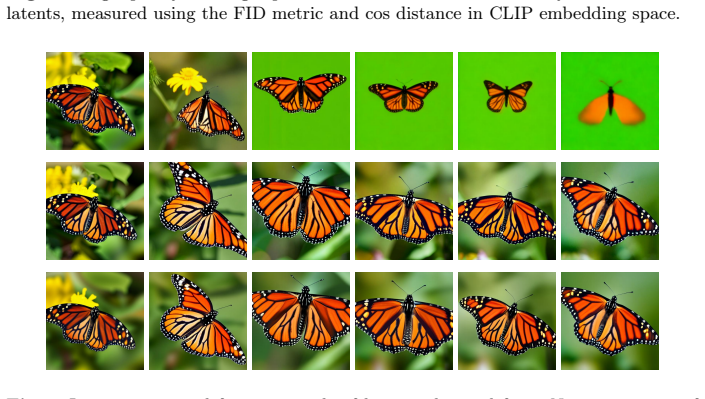
- Quality metrics such as FID and CLIP distance degrade with $N$ before degeneration is visually obvious, so latent interpolation methods should be evaluated at several $N$ values rather than by inspecting a few images.
- Using channel-wise mean adjustment is claimed to improve FID and CLIP distance even at small $N$, so it can serve as a drop-in replacement for plain fixed normalization or normalization to interpolated norms.
- The input-reproduction property survives the fix when residual interpolation uses $f_{NIN}$, because a one-hot weight vector returns the original latent exactly.
Reading between the lines
- If the same bias-plus-noise model describes any normalized averaging of features whose mean differs from zero, the $\sqrt{N}$ amplification may appear in other generative latent spaces, not only diffusion models; the remedy of per-dimension mean subtraction would then generalize to GAN inversion or embedding-space centroiding.
- A low-pass-filtered estimate of $d$, which the paper lists as future work, should handle biases that vary across spatial positions; if spatial variation is strong, the channel-wise fix alone would still show residual quality loss at large $N$.
- The paper's observation that $f_{FIX}$ slightly beats $f_{NIN}$ suggests the correct normalization target for far-from-input centroids is closer to the nominal $\sqrt{L}$ than to interpolated input norms; a closed-form norm schedule interpolating between the two regimes could combine both advantages without optimization.
Signed reviews
Editorial analysis
A structured set of objections, weighed in public.
Referee Report
Summary. The paper studies degeneracies in latent-space interpolation for diffusion models when computing centroids of N inverted latents. It observes that even with norm normalization (fFIX or fNIN), the generated images degenerate as N grows, and it attributes this to a small deterministic bias d in the latents that is amplified by roughly sqrt(N) during normalization. The central theoretical statement is Eq. (9), derived in Section 4.2 for a toy model z_n = d + e_n with i.i.d. Gaussian e_n. The paper then proposes a channel-wise mean adjustment (chm): subtract each channel's mean from each latent, interpolate the residuals with norm normalization, and add back the interpolated means. Experiments on ImageNet classes with Stable Diffusion 1.5 and 3.5 measure FID and CLIP distance for N up to 64 and show that chm improves quality relative to the baselines. The authors also discuss the non-zero terminal SNR issue and alternative inversion procedures, and they explicitly leave spatially structured bias models (e.g., low-pass-filtered d) to future work.
Significance. If the diagnosis and remedy hold, the work is practically valuable for image morphing and data augmentation, where multi-input latent interpolation is increasingly common. The theoretical derivation in Section 4.2 is clean, parameter-free, and consistent with the measured channel-wise mean growth in Figure 4. The paper is also honest about the limitations of FID and about the restricted bias model it considers. The main strengths are the simplicity of the proposed fix and the breadth of the empirical evaluation across two model families and several inversion procedures. However, the significance of the claimed remedy is conditional on the assumption that the bias is dominated by per-channel constants, which the paper acknowledges but does not directly verify in the experiments.
major comments (2)
- [Section 4.2 and Section 5] The derivation in Eq. (9) models the latents as z_n = d + e_n with a common deterministic bias d, and the proposed channel-wise mean adjustment in Section 5 removes only the per-channel spatial mean of d. If d also has a spatially varying component, or if the class-consistent part of the bias varies across examples as suggested by the terminal-SNR term sqrt(alpha_T) z_0 in Section 4.3, then that component survives the chm subtraction and is still amplified by the same sqrt(N) mechanism. The paper itself lists low-pass-filtered d as a possible decomposition in Section 5, indicating that a per-channel constant d is not guaranteed to capture the true bias. The experiments in Section 6 do not measure the residual bias after chm (e.g., the norm of the spatially varying part of the average latent), so the empirical support for the remedy is only established for biases that are approximately per-channel constant. To justify the broad claim that the method 'significantly reduces the degeneration effect', the authors should either directly measure the residual non-constant component or explicitly restrict the claim to the tested setting.
- [Section 6, Figure 7] The primary quantitative evidence consists of FID and CLIP distance curves without error bars or per-class spread, despite being averaged over only 10 randomly drawn ImageNet classes. At moderate N, the differences between the chm methods and the baselines, and between fix/chm and nin/chm, may be within the natural variation across classes. Reporting only point estimates makes it difficult to assess whether the reported improvements are statistically significant, especially since the paper claims a 'significant' reduction in degeneration. Please report standard errors, confidence intervals, or per-class curves, and state in the caption or text that the curves are averages over 10 classes.
minor comments (5)
- [Section 3.2] The notation 'Pwn = 1' should be typeset with a summation symbol and limits; currently it appears as an ambiguous 'P' rather than a sum.
- [Section 3.3, Eq. (2)] The expression for fFIX(Z,{1,0,0,...}) has a missing delimiter; it should read sqrt(L)/||z1|| * z1 to avoid ambiguity.
- [Section 4.1] The sentence 'we can conclude that inverted latents do not in general follow the statistics of random samples drawn from a normal distribution' is a strong conclusion drawn from a few qualitative examples; a more cautious phrasing would be appropriate.
- [Section 6, Figure 7 caption] The caption says 'centroids of N noisy diffusion model latents' but does not specify that these latents come from inverting real ImageNet images (as described in Appendix A); please clarify.
- [Section 4.4] The qualitative offset experiment in Figure 6 applies a constant offset only to the top quarter of one channel, which is a useful illustration but not a quantitative measurement of the spatial structure of the bias; a brief note acknowledging this limitation would strengthen the presentation.
Circularity Check
No significant circularity: Eq. (9) follows from an explicit additive-bias model and the remedy is validated by external ImageNet metrics, not by construction.
full rationale
Eq. (9) is not circular: it is obtained by substituting the explicit decomposition z_n = d + e_n into fFIX and algebraically expanding the normalization factor alpha, with no constants fitted to the data being predicted. The observed sqrt(N) growth of channel-wise means in Fig. 4 is an independent test of that derivation. Section 5's channel-wise mean adjustment is a remedy targeted at the per-channel constant component of d; its usefulness is established by ImageNet FID/CLIP experiments, not by assumption. The paper's one self-citation ([12], for fNIN) is not load-bearing: fNIN is defined in Eq. (4), the bias-amplification derivation is performed for fFIX, and the fNIN variant is a baseline/option whose properties are analyzed in-paper. Section 5 also lists low-pass-filtered d as future work, so the paper does not claim its model covers all bias structures. No fitted parameter is renamed as a prediction and no uniqueness theorem or prior work is invoked to force the choice. Verdict: no significant circularity.
Assumptions & free parameters
assumptions (4)
- standard math In high dimensions, the norm of the averaged iid Gaussian noise, ||(1/N) sum e_n||, concentrates at sqrt(L/N).
- domain assumption Inverted latents can be written as z_n = d + e_n, where d is a small common deterministic bias and e_n are iid Gaussian noise.
- ad hoc to paper The deterministic bias d is well approximated by a per-channel mean value that is constant across spatial dimensions.
- domain assumption The target norm sqrt(L) is the appropriate normalization level for latent centroids.
Cite this review
Pith. "Pith review of Addressing degeneracies in latent interpolation for diffusion models." pith.science (2026). https://pith.science/paper/PHHP7ARA
@misc{pith2026250507481,
  author       = {Pith},
  title        = {Pith review of: Addressing degeneracies in latent interpolation for diffusion models},
  year         = {2026},
  howpublished = {\url{https://pith.science/paper/PHHP7ARA}},
  note         = {Machine review of arXiv:2505.07481}
}
read the original abstract
There is an increasing interest in using image-generating diffusion models for deep data augmentation and image morphing. In this context, it is useful to interpolate between latents produced by inverting a set of input images, in order to generate new images representing some mixture of the inputs. We observe that such interpolation can easily lead to degenerate results when the number of inputs is large. We analyze the cause of this effect theoretically and experimentally, and suggest a suitable remedy. The suggested approach is a relatively simple normalization scheme that is easy to use whenever interpolation between latents is needed. We measure image quality using FID and CLIP embedding distance and show experimentally that baseline interpolation methods lead to a drop in quality metrics long before the degeneration issue is clearly visible. In contrast, our method significantly reduces the degeneration effect and leads to improved quality metrics also in non-degenerate situations.
Figures


Figures from the paper (10 more)




Reference graph
Works this paper leans on
-
[1]
arXiv preprint arXiv:2304.08466 (2023)
Azizi, S., Kornblith, S., Saharia, C., Norouzi, M., Fleet, D.J.: Synthetic data from diffusion models improves imagenet classification. arXiv preprint arXiv:2304.08466 (2023)
arXiv 2023
-
[2]
arXiv preprint arXiv:2211.01324 (2022)
Balaji, Y., Nah, S., Huang, X., Vahdat, A., Song, J., Kreis, K., Aittala, M., Aila, T., Laine, S., Catanzaro, B., et al.: ediffi: Text-to-image diffusion models with an ensemble of expert denoisers. arXiv preprint arXiv:2211.01324 (2022)
arXiv 2022
-
[3]
ACM Transactions on Graphics (TOG)20(2), 95–126 (2001)
Buss, S.R., Fillmore, J.P.: Spherical averages and applications to spherical splines and interpolation. ACM Transactions on Graphics (TOG)20(2), 95–126 (2001)
work page 2001
-
[4]
In: Proceedings of the IEEE/CVF conference on computer vision and pattern recognition
Chong, M.J., Forsyth, D.: Effectively unbiased fid and inception score and where to find them. In: Proceedings of the IEEE/CVF conference on computer vision and pattern recognition. pp. 6070–6079 (2020)
work page 2020
-
[5]
In: Forty-first International Conference on Machine Learning (2024)
Esser, P., Kulal, S., Blattmann, A., Entezari, R., Müller, J., Saini, H., Levi, Y., Lorenz, D., Sauer, A., Boesel, F., et al.: Scaling rectified flow transformers for high- resolution image synthesis. In: Forty-first International Conference on Machine Learning (2024)
2024
-
[6]
arXiv preprint arXiv:2208.01618 (2022)
Gal, R., Alaluf, Y., Atzmon, Y., Patashnik, O., Bermano, A.H., Chechik, G., Cohen-Or, D.: An image is worth one word: Personalizing text-to-image gener- ation using textual inversion. arXiv preprint arXiv:2208.01618 (2022)
arXiv 2022
-
[7]
arXiv preprint arXiv:2403.14602 (2024)
Garibi, D., Patashnik, O., Voynov, A., Averbuch-Elor, H., Cohen-Or, D.: Renoise: Real image inversion through iterative noising. arXiv preprint arXiv:2403.14602 (2024)
arXiv 2024
-
[8]
Advances in neural information processing systems30 (2017)
Heusel,M.,Ramsauer,H.,Unterthiner,T.,Nessler,B.,Hochreiter,S.:Ganstrained by a two time-scale update rule converge to a local nash equilibrium. Advances in neural information processing systems30 (2017)
2017
Show all 31 references
-
[9]
Advances in neural information processing systems33, 6840–6851 (2020)
Ho, J., Jain, A., Abbeel, P.: Denoising diffusion probabilistic models. Advances in neural information processing systems33, 6840–6851 (2020)
2020
-
[10]
In: Proceedings of the IEEE/CVF Conference on Computer Vision and Pattern Recog- nition
Jayasumana, S., Ramalingam, S., Veit, A., Glasner, D., Chakrabarti, A., Kumar, S.: Rethinking fid: Towards a better evaluation metric for image generation. In: Proceedings of the IEEE/CVF Conference on Computer Vision and Pattern Recog- nition. pp. 9307–9315 (2024)
2024
-
[11]
In: The Twelfth International Conference on Learning Representations (2023)
Khanna, S., Liu, P., Zhou, L., Meng, C., Rombach, R., Burke, M., Lobell, D.B., Ermon, S.: Diffusionsat: A generative foundation model for satellite imagery. In: The Twelfth International Conference on Learning Representations (2023)
2023
-
[12]
arXiv preprint arXiv:2406.03146 (2024)
Landolsi, E., Kahl, F.: Tiny models from tiny data: Textual and null-text inversion for few-shot distillation. arXiv preprint arXiv:2406.03146 (2024)
2024 arXiv
-
[13]
arXiv preprint arXiv:2305.08891 (2023)
Lin, S., Liu, B., Li, J., Yang, X.: Common diffusion noise schedules and sample steps are flawed. arXiv preprint arXiv:2305.08891 (2023)
2023 arXiv
-
[14]
arXiv preprint arXiv:2209.03003 (2022)
Liu, X., Gong, C., Liu, Q.: Flow straight and fast: Learning to generate and transfer data with rectified flow. arXiv preprint arXiv:2209.03003 (2022)
2022 arXiv
-
[15]
arXiv preprint arXiv:2312.12540 (2023)
Meiri, B., Samuel, D., Darshan, N., Chechik, G., Avidan, S., Ben-Ari, R.: Fixed- point inversion for text-to-image diffusion models. arXiv preprint arXiv:2312.12540 (2023)
2023 arXiv
-
[16]
arXiv preprint arXiv:2305.16807 (2023)
Miyake, D., Iohara, A., Saito, Y., Tanaka, T.: Negative-prompt inversion: Fast image inversion for editing with text-guided diffusion models. arXiv preprint arXiv:2305.16807 (2023)
2023 arXiv
-
[17]
In: Proceedings of the IEEE/CVF Conference on Computer Vision and Pattern Recognition
Mokady, R., Hertz, A., Aberman, K., Pritch, Y., Cohen-Or, D.: Null-text inver- sion for editing real images using guided diffusion models. In: Proceedings of the IEEE/CVF Conference on Computer Vision and Pattern Recognition. pp. 6038– 6047 (2023) 14 E. Landolsi and F. Kahl
2023
-
[18]
In: Proceedings of the IEEE/CVF International Conference on Computer Vision
Pan, Z., Gherardi, R., Xie, X., Huang, S.: Effective real image editing with acceler- ated iterative diffusion inversion. In: Proceedings of the IEEE/CVF International Conference on Computer Vision. pp. 15912–15921 (2023)
2023
-
[19]
In: International conference on machine learning
Radford, A., Kim, J.W., Hallacy, C., Ramesh, A., Goh, G., Agarwal, S., Sastry, G., Askell, A., Mishkin, P., Clark, J., et al.: Learning transferable visual models from natural language supervision. In: International conference on machine learning. pp. 8748–8763. PMLR (2021)
2021
-
[20]
arXiv preprint arXiv:2204.06125 (2022)
Ramesh, A., Dhariwal, P., Nichol, A., Chu, C., Chen, M.: Hierarchical text- conditional image generation with clip latents. arXiv preprint arXiv:2204.06125 (2022)
2022 arXiv
-
[21]
In: Proceedings of the IEEE/CVF conference on computer vision and pattern recognition
Rombach, R., Blattmann, A., Lorenz, D., Esser, P., Ommer, B.: High-resolution image synthesis with latent diffusion models. In: Proceedings of the IEEE/CVF conference on computer vision and pattern recognition. pp. 10684–10695 (2022)
2022
-
[22]
In: Medical Image Computing and Computer-Assisted Intervention–MICCAI 2015: 18th International Conference, Munich, Germany, Oc- tober 5-9, 2015, Proceedings, Part III 18
Ronneberger, O., Fischer, P., Brox, T.: U-net: Convolutional networks for biomed- ical image segmentation. In: Medical Image Computing and Computer-Assisted Intervention–MICCAI 2015: 18th International Conference, Munich, Germany, Oc- tober 5-9, 2015, Proceedings, Part III 18....
2015
-
[23]
Advances in Neural Information Processing Systems35, 36479–36494 (2022)
Saharia, C., Chan, W., Saxena, S., Li, L., Whang, J., Denton, E.L., Ghasemipour, K., Gontijo Lopes, R., Karagol Ayan, B., Salimans, T., et al.: Photorealistic text- to-image diffusion models with deep language understanding. Advances in Neural Information Processing Systems35,...
2022
-
[24]
Advances in Neural Information Processing Systems 36 (2024)
Samuel, D., Ben-Ari, R., Darshan, N., Maron, H., Chechik, G.: Norm-guided latent space exploration for text-to-image generation. Advances in Neural Information Processing Systems 36 (2024)
2024
-
[25]
In: Proceed- ings of the IEEE/CVF Conference on Computer Vision and Pattern Recognition
Sarıyıldız, M.B., Alahari, K., Larlus, D., Kalantidis, Y.: Fake it till you make it: Learning transferable representations from synthetic imagenet clones. In: Proceed- ings of the IEEE/CVF Conference on Computer Vision and Pattern Recognition. pp. 8011–8021 (2023)
2023
-
[26]
In: Proceedings of the 12th annual conference on Computer graphics and interactive techniques
Shoemake, K.: Animating rotation with quaternion curves. In: Proceedings of the 12th annual conference on Computer graphics and interactive techniques. pp. 245– 254 (1985)
1985
-
[27]
arXiv preprint arXiv:2010.02502 (2020)
Song, J., Meng, C., Ermon, S.: Denoising diffusion implicit models. arXiv preprint arXiv:2010.02502 (2020)
2020 arXiv
-
[28]
In: Proceedings of the International Conference of Learning Representations (2024)
Trabucco, B., Doherty, K., Gurinas, M., Salakhutdinov, R.: Effective data aug- mentation with diffusion models. In: Proceedings of the International Conference of Learning Representations (2024)
2024
-
[29]
In: International Conference on Machine Learning
Wang, Y., Schiff, Y., Gokaslan, A., Pan, W., Wang, F., De Sa, C., Kuleshov, V.: Infodiffusion:Representationlearningusinginformationmaximizingdiffusionmod- els. In: International Conference on Machine Learning. pp. 36336–36354. PMLR (2023)
2023
-
[30]
arXiv preprint arXiv:2311.06792 (2023)
Yang, Z., Yu, Z., Xu, Z., Singh, J., Zhang, J., Campbell, D., Tu, P., Hartley, R.: Impus: Image morphing with perceptually-uniform sampling using diffusion models. arXiv preprint arXiv:2311.06792 (2023)
2023 arXiv
-
[31]
goldfish
Zhang, K., Zhou, Y., Xu, X., Dai, B., Pan, X.: Diffmorpher: Unleashing the capa- bility of diffusion models for image morphing. In: Proceedings of the IEEE/CVF Conference on Computer Vision and Pattern Recognition. pp. 7912–7921 (2024) Addressing degeneracies in latent interpo...
2024
Reviewed August 15, 2026 · model on record in the stance chip above.
Discussion (0). Continue with ORCID to comment.