Dynamic Power Management Methodology for Distributed Vertical Power Delivery in High-Performance Computing Systems
Pith reviewed 2026-06-30 00:05 UTC · model grok-4.3
The pith
A load-aware activation framework for distributed voltage regulators in HPC systems scales active units with demand and selects them spatially to cut switching losses by 2x-3x at light loads.
A machine-rendered reading of the paper's core claim, the machinery that carries it, and where it could break.
Core claim
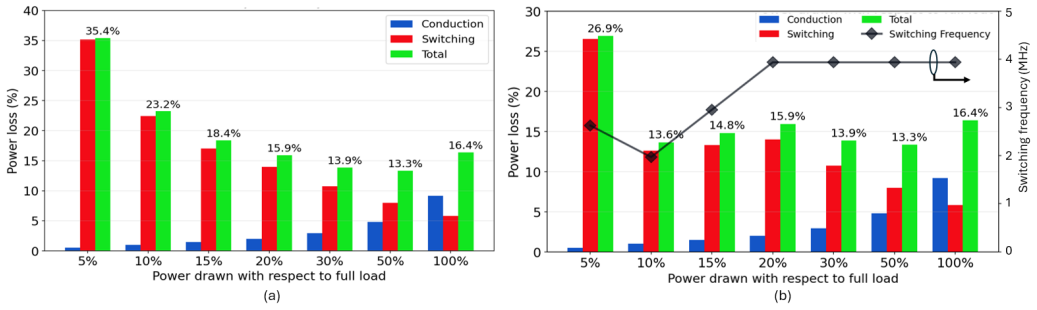
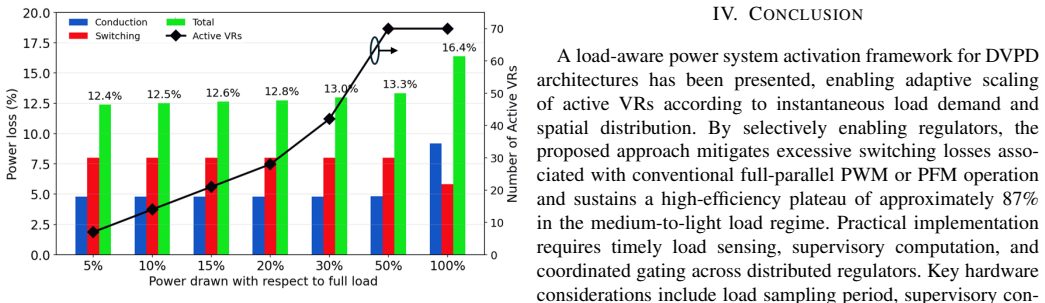
The paper establishes that a load-aware power-system activation framework, which scales the number of active voltage regulators proportionally to load power and applies spatially informed selection to align with localized demand, reduces switching losses by a factor of two to three relative to conventional full-parallel light-load operation while sustaining an approximately 87 percent efficiency plateau across the 5 percent to 30 percent load range and preserving inductor-current ripple within 6 percent and output-voltage ripple within 2 percent.
What carries the argument
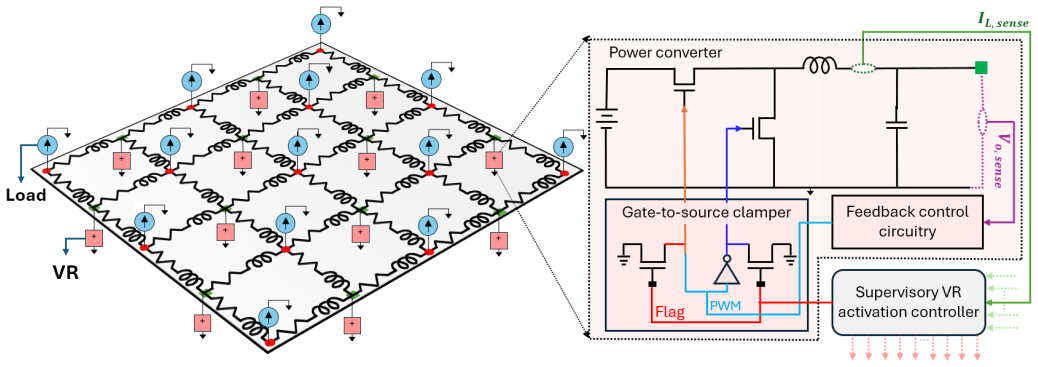
Load-aware power-system activation framework that scales active VRs with load and uses spatially informed selection to minimize lateral redistribution currents.
If this is right
- Switching losses drop by a factor of two to three compared with conventional full-parallel operation in the light-load regime.
- Conversion efficiency remains near 87 percent across the 5 percent to 30 percent load range.
- Inductor current ripple stays inside 6 percent and output voltage ripple stays inside 2 percent, preserving regulation quality.
- Spatial selection reduces lateral redistribution currents and the associated conduction losses and voltage drops.
Where Pith is reading between the lines
- Hardware realization would require sensing and control circuitry whose overhead remains small enough to preserve the simulated savings.
- The same scaling-plus-spatial principle could apply to other multi-regulator power-delivery topologies used in servers or accelerators.
- If the efficiency plateau holds in silicon, total energy draw of variable-load HPC workloads could decrease without changes to the compute fabric.
Load-bearing premise
The simulation model accurately captures real lateral redistribution currents, conduction losses, and the feasibility of real-time spatially informed selection without control overhead or sensing errors.
What would settle it
Direct measurement of switching losses and efficiency on a physical DVPD prototype under 5-30 percent load, comparing the proposed activation strategy against full-parallel operation.
Figures
read the original abstract
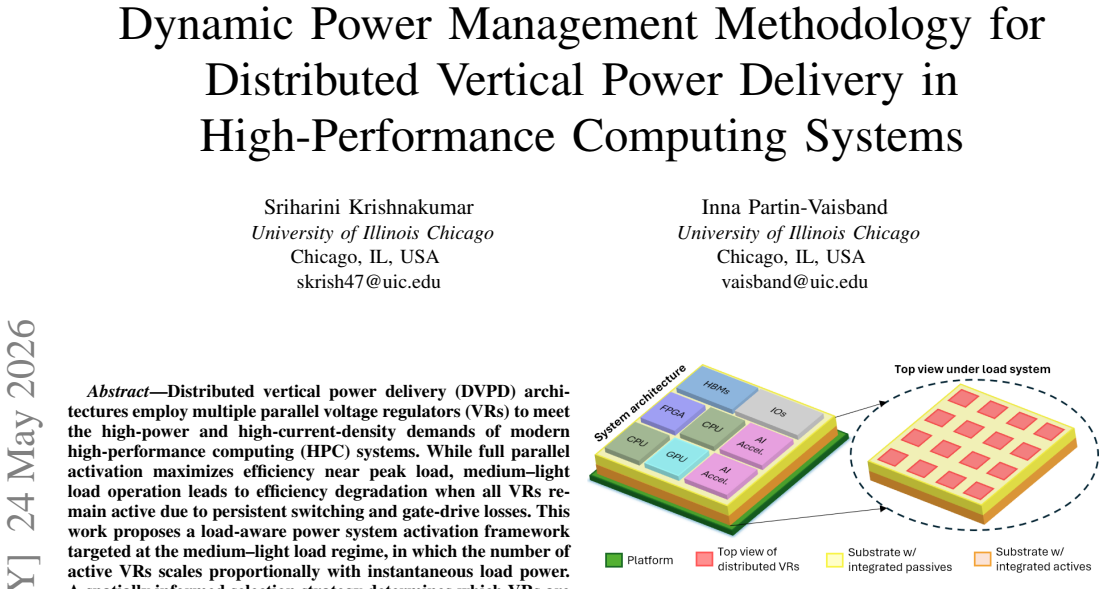
Distributed vertical power delivery (DVPD) architectures employ multiple parallel voltage regulators (VRs) to meet the high-power and high current density demands of modern high performance computing (HPC) systems. While full parallel activation maximizes efficiency near peak load, medium to light load operation leads to efficiency degradation when all VRs remain active due to persistent switching and gate drive losses. This work proposes a load aware power system activation framework targeted at the medium to light load regime, in which the number of active VRs scales proportionally with instantaneous load power. A spatially informed selection strategy determines which VRs are activated from the available pool, aligning regulator placement with localized power demand. This locality aware activation minimizes lateral redistribution currents within the power plane and reduces conduction losses and voltage drops. Simulation results on a representative DVPD system demonstrate 2x to 3x switching loss reduction relative to conventional full-parallel light load operation, while sustaining an approximately 87% efficiency plateau across the 5% to 30% load range. Output ripple constraints are preserved, with inductor current ripple maintained within 6% and output voltage ripple within 2%, ensuring regulation integrity while improving overall conversion efficiency.
Editorial analysis
A structured set of objections, weighed in public.
Referee Report
Summary. The manuscript proposes a load-aware power system activation framework for distributed vertical power delivery (DVPD) architectures in HPC systems. The method scales the number of active voltage regulators proportionally with instantaneous load and applies a spatially informed selection strategy to align active VRs with localized demand, thereby minimizing lateral redistribution currents, conduction losses, and voltage drops. Simulation results on a representative DVPD system are reported to show 2x to 3x switching loss reduction versus conventional full-parallel light-load operation while maintaining an ~87% efficiency plateau from 5% to 30% load, with inductor current ripple ≤6% and output voltage ripple ≤2%.
Significance. If the underlying simulation model is shown to be faithful, the proposed spatially aware activation could provide a practical route to higher conversion efficiency in DVPD systems during the medium-to-light load regime that dominates many HPC workloads. The emphasis on locality-aware selection distinguishes the approach from simpler on/off schemes and directly targets conduction losses arising from lateral currents.
major comments (2)
- [Simulation results (abstract and results section)] The central quantitative claims (2x–3x switching loss reduction and 87% efficiency plateau) rest exclusively on simulation outputs whose fidelity with respect to lateral redistribution currents, conduction losses under partial activation, and control/sensing overhead is not demonstrated. No hardware measurements, no sensitivity study on lateral plane resistance, and no comparison against measured redistribution currents are described; this modeling assumption is load-bearing for the reported loss-reduction numbers.
- [Simulation results (abstract and results section)] No information is supplied on the simulation model (e.g., how lateral currents are computed, baseline VR implementations, exact parameter values, or statistical significance of the efficiency figures), making it impossible to evaluate whether the reported improvements are robust or model-specific.
minor comments (1)
- [Abstract] The abstract would be strengthened by a single sentence summarizing the simulation setup or key modeling assumptions that underpin the numerical results.
Simulated Author's Rebuttal
We thank the referee for the constructive feedback on our simulation-based study. We will revise the manuscript to substantially expand the description of the simulation model, parameters, and analysis methods. This directly addresses the concerns about model transparency and robustness.
read point-by-point responses
-
Referee: [Simulation results (abstract and results section)] The central quantitative claims (2x–3x switching loss reduction and 87% efficiency plateau) rest exclusively on simulation outputs whose fidelity with respect to lateral redistribution currents, conduction losses under partial activation, and control/sensing overhead is not demonstrated. No hardware measurements, no sensitivity study on lateral plane resistance, and no comparison against measured redistribution currents are described; this modeling assumption is load-bearing for the reported loss-reduction numbers.
Authors: We acknowledge that the reported gains rely on the simulation model and that hardware validation is absent. As the manuscript presents a methodology evaluated via simulation, hardware prototyping lies outside its scope. In revision we will add: (i) explicit formulation of lateral current computation from the power-plane resistance matrix, (ii) a sensitivity study sweeping lateral plane resistance over a realistic range and reporting resulting loss-reduction variation, and (iii) discussion of modeled control/sensing overhead. These additions will allow readers to assess model fidelity without requiring hardware data. revision: yes
-
Referee: [Simulation results (abstract and results section)] No information is supplied on the simulation model (e.g., how lateral currents are computed, baseline VR implementations, exact parameter values, or statistical significance of the efficiency figures), making it impossible to evaluate whether the reported improvements are robust or model-specific.
Authors: We agree that the current manuscript lacks sufficient model documentation. The revised version will include a dedicated subsection (or appendix) specifying: simulation platform and solver settings, complete VR and power-plane parameter tables, the exact method used to calculate lateral redistribution currents, baseline full-parallel activation implementation, and confirmation that efficiency values are deterministic outputs from fixed-parameter runs (no statistical aggregation). This will enable independent evaluation of robustness. revision: yes
- Absence of hardware measurements or experimental validation of the simulation model, as the work is a simulation study proposing a control methodology.
Circularity Check
No circularity; results are direct simulation outputs with no fitted parameters or self-referential definitions
full rationale
The paper presents a load-aware activation framework for DVPD systems and reports efficiency gains exclusively as outputs from simulation of a representative system. No equations, fitted parameters, or derivation steps are described that would make the reported 2x-3x loss reduction or 87% efficiency plateau reduce to quantities defined by the method itself. No self-citations, uniqueness theorems, or ansatzes are invoked in the provided text to support the central claims. The derivation chain is therefore self-contained against external benchmarks (simulation results), with no load-bearing step that collapses by construction to its inputs.
Axiom & Free-Parameter Ledger
Forward citations
Cited by 1 Pith paper
-
A Comprehensive Design Framework for Vertical Power Delivery in High-Performance Computing
A design framework for distributed vertical power delivery in HPC systems achieves 84% end-to-end efficiency for 48V-to-1V conversion while using 54% of the area under the load.
Reference graph
Works this paper leans on
-
[1]
TPU vs GPU vs Cerebras vs Graphcore: A fair comparison between ML hardware,
M. Khairy, “TPU vs GPU vs Cerebras vs Graphcore: A fair comparison between ML hardware,”Medium, 2020
2020
-
[2]
(2024) Chapter 22: 2D/3D power delivery for heterogeneous integration
Heterogeneous Integration Roadmap. (2024) Chapter 22: 2D/3D power delivery for heterogeneous integration. Available online: https://eps.ieee. org/images/files/HIR 2024/HIR 2024 ch22 2D-3D.pdf
2024
-
[3]
Power delivery for high-performance microprocessors—challenges, solutions, and future trends,
K. Radhakrishnan, M. Swaminathan, and B. K. Bhattacharyya, “Power delivery for high-performance microprocessors—challenges, solutions, and future trends,”IEEE Transactions on Components, Packaging and Manufacturing Technology, vol. 11, no. 4, pp. 655–671, 2021
2021
-
[4]
Vertical power delivery for emerging packaging and integration platforms-power conversion and dis- tribution,
S. Krishnakumar and I. Partin-Vaisband, “Vertical power delivery for emerging packaging and integration platforms-power conversion and dis- tribution,” inIEEE International System-on-Chip Conference (SOCC), 2023, pp. 1–6
2023
-
[5]
Design considerations for DC-DC voltage regulators in distributed vertical power delivery sys- tems,
S. Krishnakumar, M. Choi, R. R. Khorasani, R. Sharma, M. Swami- nathan, S. Kumar, and I. Partin-Vaisband, “Design considerations for DC-DC voltage regulators in distributed vertical power delivery sys- tems,” inIEEE International Symposium on Circuits and Systems (ISCAS), 2024, pp. 1–5
2024
-
[6]
Embedded silicon chip capacitors in glass package for vertical power delivery,
R. R. Khorasani, X. Li, M. Al-Juwhari, W. Murti, J. Cha, and M. Swami- nathan, “Embedded silicon chip capacitors in glass package for vertical power delivery,” inIEEE Electronic Components and Technology Con- ference (ECTC), 2025, pp. 416–423
2025
-
[7]
High aspect ratio spiral inductor with progressive turn widths for embedded power converters,
R. Rasheedi and I. Partin-Vaisband, “High aspect ratio spiral inductor with progressive turn widths for embedded power converters,” in2025 IEEE 75th Electronic Components and Technology Conference (ECTC). IEEE, 2025, pp. 2271–2277
2025
-
[8]
An embedded multi-layer spiral square inductor for integrated power delivery-physical design and ana- lytical models,
R. Rasheedi and I. Partin-Vaisband, “An embedded multi-layer spiral square inductor for integrated power delivery-physical design and ana- lytical models,” 2024, pp. 370–375
2024
-
[9]
Hybrid voltage regulators for high performance computing: Analytical models and design methodology,
S. Abdelzaher, M. Gharib, and I. Partin-Vaisband, “Hybrid voltage regulators for high performance computing: Analytical models and design methodology,” inIEEE Electronic Components and Technology Conference (ECTC), 2025, pp. 2286–2292
2025
-
[10]
Package power delivery architecture for high performance com- puting systems with a 1 kW IVR operated in CCM-DCM boundary mode condition,
R. R. Khorasani, X. Li, J. W. Kim, P. Murali, R. Sharma, and M. Swami- nathan, “Package power delivery architecture for high performance com- puting systems with a 1 kW IVR operated in CCM-DCM boundary mode condition,” inIEEE Electronic Components and Technology Conference (ECTC), 2024, pp. 285–292
2024
-
[11]
Vertical power delivery for high performance computing systems with buck-derived regulators,
S. Krishnakumar, M. Choi, R. R. Khorasani, R. Sharma, M. Swami- nathan, S. Kumar, and I. Partin-Vaisband, “Vertical power delivery for high performance computing systems with buck-derived regulators,” in IEEE Electronic Components and Technology Conference (ECTC), 2024, pp. 2136–2142
2024
-
[12]
System archi- tecture optimization for vertical power delivery,
S. Krishnakumar, Y . Popryho, and I. Partin-Vaisband, “System archi- tecture optimization for vertical power delivery,” inProceedings of the Great Lakes Symposium on VLSI, 2024, pp. 351–352
2024
-
[13]
Thermal analysis of high current vertical power delivery network with embedded microchannel cooling,
M. Choi, S. Krishnakumar, R. R. Khorasani, I. Partin-Vaisband, R. Sharma, M. Swaminathan, and S. Kumar, “Thermal analysis of high current vertical power delivery network with embedded microchannel cooling,” inIEEE Intersociety Conference on Thermal and Thermome- chanical Phenomena in Electronic Systems (ITherm), 2024, pp. 1–8
2024
-
[14]
Substrate-embedded microfluidic cooling of distributed vertical power delivery architectures for high-performance computing processors,
M. Choi, S. Krishnakumar, R. R. Khorasani, M. Swaminathan, I. Partin- Vaisband, and S. Kumar, “Substrate-embedded microfluidic cooling of distributed vertical power delivery architectures for high-performance computing processors,”IEEE Transactions on Components, Packaging and Manufacturing Technology, 2025
2025
-
[15]
Self-consistent electrother- mal modeling of distributed vertical power delivery architecture with substrate-embedded microfluidic cooling,
M. Choi, S. Krishnakumar, Y . Popryho, R. R. Khorasani, M. Swami- nathan, I. Partin-Vaisband, and S. Kumar, “Self-consistent electrother- mal modeling of distributed vertical power delivery architecture with substrate-embedded microfluidic cooling,”IEEE Transactions on Com- ponents, Packaging and Manufacturing Technology, 2025
2025
-
[16]
Automated electro-thermal modeling framework of distributed vertical power delivery architectures with substrate-embedded microfluidic cooling,
M. Choi, S. Krishnakumar, Y . Popryho, R. R. Khorasani, M. Swami- nathan, I. Partin-Vaisband, and S. Kumar, “Automated electro-thermal modeling framework of distributed vertical power delivery architectures with substrate-embedded microfluidic cooling,” in2025 24th IEEE Intersociety Conference on Thermal and Thermomechanical Phenomena in Electronic System...
2025
-
[17]
Itap: Idle-time-aware power management for gpu execution units,
M. Sadrosadati, S. B. Ehsani, H. Falahati, R. Ausavarungnirun, A. Tavakkol, M. Abaee, L. Orosa, Y . Wang, H. Sarbazi-Azad, and O. Mutlu, “Itap: Idle-time-aware power management for gpu execution units,”ACM Trans. Archit. Code Optim., vol. 16, no. 1, Feb. 2019. [Online]. Available: https://doi.org/10.1145/3291606
-
[18]
Optimizing idle power of hpc systems: practical insights and methods,
T. Ilsche, S. Schrader, and R. Sch ¨one, “Optimizing idle power of hpc systems: practical insights and methods,” in2024 IEEE international conference on cluster computing workshops (CLUSTER workshops). IEEE, 2024, pp. 19–25
2024
-
[19]
Bandit learning-driven power gating with state retention for high performance computing,
S. Abdelzaher, M. Gharib, A. R. Trivedi, and I. Partin-Vaisband, “Bandit learning-driven power gating with state retention for high performance computing,” in2025 IEEE 34th Conference on Electrical Performance of Electronic Packaging and Systems (EPEPS). IEEE, 2025, pp. 1–3
2025
-
[20]
A survey of light-load efficiency improve- ment techniques for low-power dc-dc converters,
O. Trescases and Y . Wen, “A survey of light-load efficiency improve- ment techniques for low-power dc-dc converters,” in8th International Conference on Power Electronics-ECCE Asia. IEEE, 2011, pp. 326– 333
2011
-
[21]
Two-stage 48 v-12 v/6 v-1.8 v voltage regulator module with dynamic bus voltage control for light- load efficiency improvement,
C. Fei, M. H. Ahmed, F. C. Lee, and Q. Li, “Two-stage 48 v-12 v/6 v-1.8 v voltage regulator module with dynamic bus voltage control for light- load efficiency improvement,”IEEE Transactions on Power Electronics, vol. 32, no. 7, pp. 5628–5636, 2016
2016
-
[22]
I. P. Vaisband,Power delivery and management in nanoscale ICs. University of Rochester, 2015
2015
-
[23]
Design and realization of a digital multiphase-interleaved vrm controller using fpga,
Y .-C. Wang and Y .-Y . Tzou, “Design and realization of a digital multiphase-interleaved vrm controller using fpga,” inIECON 2007-33rd Annual Conference of the IEEE Industrial Electronics Society. IEEE, 2007, pp. 1978–1982
2007
-
[24]
Digital controller for high-performance multiphase vrm with current balancing and near-ideal transient re- sponse,
B. Halivni and M. M. Peretz, “Digital controller for high-performance multiphase vrm with current balancing and near-ideal transient re- sponse,” in2020 IEEE Applied Power Electronics Conference and Exposition (APEC). IEEE, 2020, pp. 2206–2213
2020
-
[25]
A low latency secure communication architecture for microgrid control,
A. Kondoro, I. B. Dhaou, H. Tenhunen, and N. Mvungi, “A low latency secure communication architecture for microgrid control,”Energies, vol. 14, no. 19, p. 6262, 2021
2021
discussion (0)
Sign in with ORCID, Apple, or X to comment. Anyone can read and Pith papers without signing in.