SIDM and CDM interpretations of the million-solar-mass lensing perturber JVAS B1938+666-mathcal{V}
Pith reviewed 2026-06-27 06:48 UTC · model grok-4.3
The pith
The million-solar-mass lensing perturber in JVAS B1938+666 arises naturally in self-interacting dark matter during deep core collapse.
A machine-rendered reading of the paper's core claim, the machinery that carries it, and where it could break.
Core claim
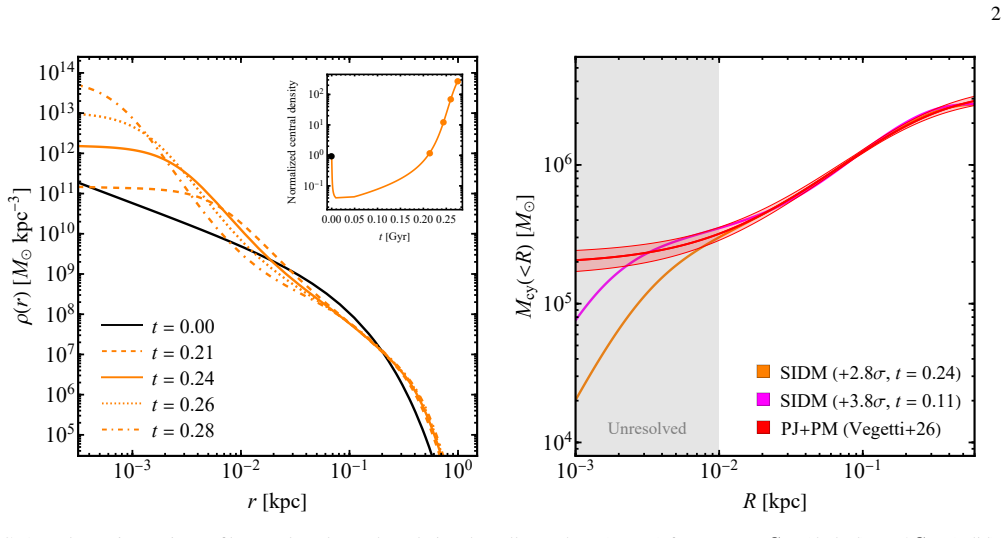
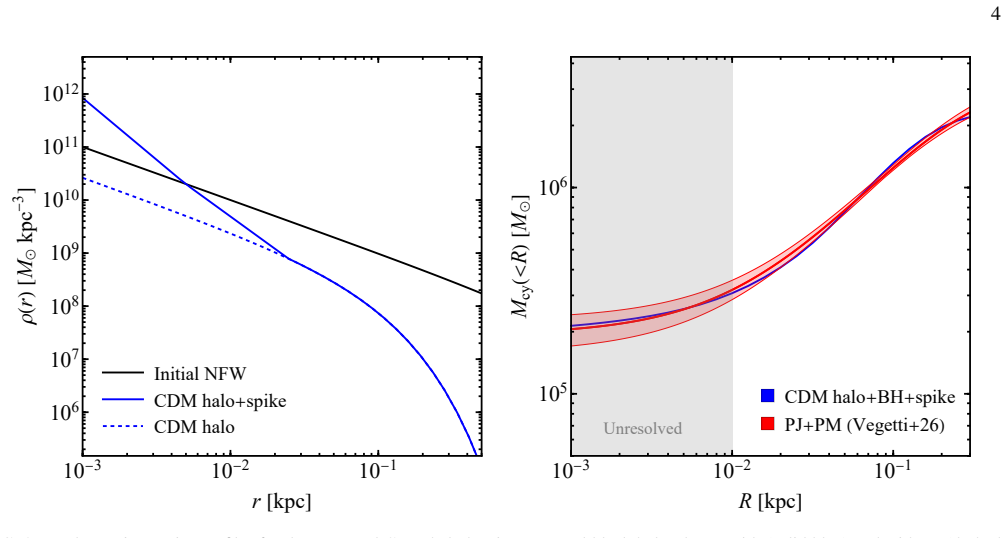
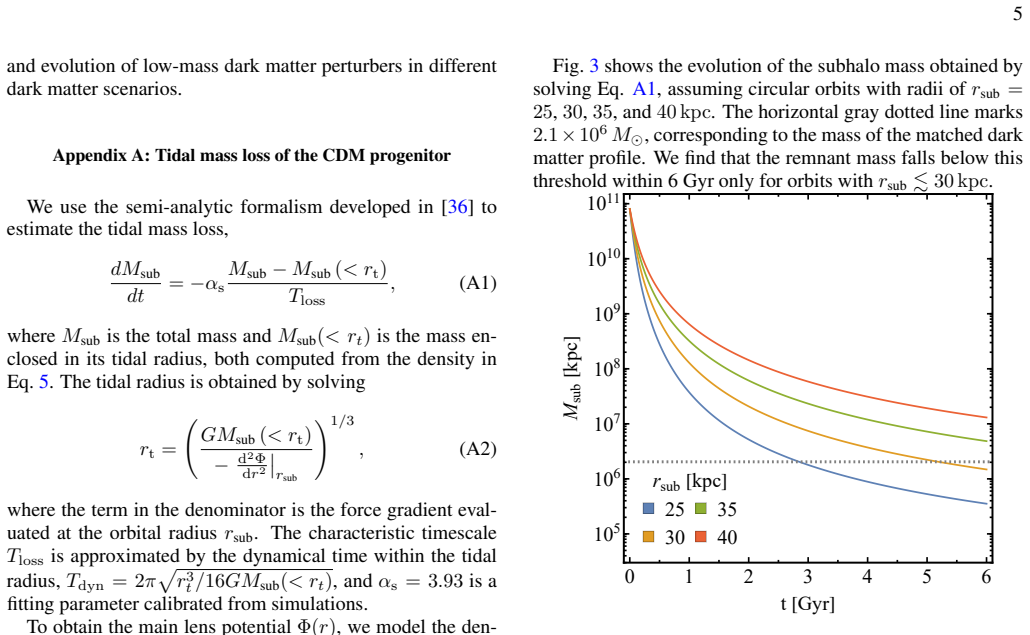
Using gravothermal fluid simulations, we show that such a structure arises naturally in self-interacting dark matter (SIDM) halos evolving into a deep core-collapse phase, where a secondary dense central core forms within an extended profile. The resulting density structure closely matches the inferred properties of the lensing object. We also demonstrate that a similar profile could be reproduced in CDM in the presence of an intermediate-mass black hole, but this requires an early-forming progenitor that subsequently loses 5 orders of magnitude in mass through tidal stripping by the lens galaxy. Whether such a scenario can be realized in realistic cosmological environments remains an open q
What carries the argument
gravothermal fluid simulations of SIDM halos evolving into the deep core-collapse phase to form a secondary dense central core within an extended profile
Load-bearing premise
The gravothermal fluid simulations accurately capture the physics of SIDM halo evolution in the deep core-collapse regime and the lensing-inferred density profile is robust against modeling uncertainties in the lens galaxy.
What would settle it
A direct observation or simulation showing that SIDM halos at this mass do not develop secondary dense cores with the required density contrast, or that realistic tidal stripping cannot remove five orders of magnitude from an early IMBH progenitor, would falsify the central interpretations.
Figures
read the original abstract
A $10^6\,M_\odot$ object has recently been inferred from gravitational imaging of the strong-lensing system JVAS B1938+666, exhibiting an unusually dense inner region embedded within an extended envelope, far exceeding expectations for cold dark matter (CDM) halos. Using gravothermal fluid simulations, we show that such a structure arises naturally in self-interacting dark matter (SIDM) halos evolving into a deep core-collapse phase, where a secondary dense central core forms within an extended profile. The resulting density structure closely matches the inferred properties of the lensing object. We also demonstrate that a similar profile could be reproduced in CDM in the presence of an intermediate-mass black hole, but this requires an early-forming progenitor that subsequently loses $5$ orders of magnitude in mass through tidal stripping by the lens galaxy. Whether such a scenario can be realized in realistic cosmological environments remains an open question.
Editorial analysis
A structured set of objections, weighed in public.
Referee Report
Summary. The manuscript uses gravothermal fluid simulations to show that SIDM halos evolving into deep core-collapse naturally develop a secondary dense central core within an extended envelope whose density structure closely matches the 10^6 M_⊙ lensing perturber inferred in JVAS B1938+666. It further argues that reproducing the same profile in CDM would require an early-forming progenitor hosting an intermediate-mass black hole that loses five orders of magnitude in mass via tidal stripping, a scenario whose cosmological viability remains unclear.
Significance. If the simulation results hold, the work supplies a concrete, falsifiable prediction for the internal structure of low-mass SIDM halos and a potential discriminator between SIDM and CDM using strong-lensing data. The explicit comparison of the two interpretations strengthens the paper's utility for observers.
major comments (3)
- [§3] §3 (gravothermal fluid simulations): the central SIDM claim rests on the fluid equations accurately capturing heat conduction and secondary-core formation in the deep core-collapse regime for 10^6 M_⊙ halos, yet no resolution tests, mean-free-path comparisons, or cross-validation against N-body or Boltzmann solvers are reported; this is load-bearing because the 'close match' to the lensing profile is generated entirely by these simulations.
- [Results] Results section (density-profile comparison): the statement that the simulated profile 'closely matches' the lensing-inferred properties is presented without quantitative metrics (e.g., χ², enclosed-mass residuals, or parameter posteriors), making it impossible to judge whether the agreement is robust or post-hoc.
- [§5] §5 (CDM+IMBH scenario): the claim that five orders of magnitude of tidal stripping are required is stated without an explicit calculation of the progenitor mass, orbital parameters, or survival probability inside the lens galaxy; this weakens the dismissal of the CDM channel.
minor comments (2)
- Notation for the perturber mass (10^6 M_⊙) and the symbol Ψ should be defined at first use and used consistently.
- Figure captions should include the simulation parameters (cross-section, concentration, redshift) used to generate each curve.
Simulated Author's Rebuttal
We thank the referee for their constructive comments. We respond to each major point below, indicating where revisions will be made to address the concerns.
read point-by-point responses
-
Referee: [§3] §3 (gravothermal fluid simulations): the central SIDM claim rests on the fluid equations accurately capturing heat conduction and secondary-core formation in the deep core-collapse regime for 10^6 M_⊙ halos, yet no resolution tests, mean-free-path comparisons, or cross-validation against N-body or Boltzmann solvers are reported; this is load-bearing because the 'close match' to the lensing profile is generated entirely by these simulations.
Authors: We agree that additional validation strengthens the results. The gravothermal fluid equations are a standard approach in the SIDM core-collapse literature. In the revised manuscript we will add resolution convergence tests, mean-free-path to system-size comparisons confirming the fluid regime, and references to prior N-body validations of the same equations for comparable regimes. Full cross-validation against Boltzmann solvers for this exact mass and collapse depth is not available in the literature, but the existing tests support the method. revision: yes
-
Referee: [Results] Results section (density-profile comparison): the statement that the simulated profile 'closely matches' the lensing-inferred properties is presented without quantitative metrics (e.g., χ², enclosed-mass residuals, or parameter posteriors), making it impossible to judge whether the agreement is robust or post-hoc.
Authors: We accept that quantitative metrics improve transparency. The revised manuscript will include χ² values for the density-profile comparison, enclosed-mass residuals at the relevant radii, and a brief discussion of the explored parameter space to demonstrate that the match is not post-hoc. revision: yes
-
Referee: [§5] §5 (CDM+IMBH scenario): the claim that five orders of magnitude of tidal stripping are required is stated without an explicit calculation of the progenitor mass, orbital parameters, or survival probability inside the lens galaxy; this weakens the dismissal of the CDM channel.
Authors: The five-order-of-magnitude figure follows from standard tidal-stripping estimates that compare the minimum progenitor mass needed to host a sufficiently massive IMBH against the final observed mass. In the revised §5 we will present the explicit progenitor-mass calculation (~10^{11} M_⊙), the assumed orbital parameters consistent with the lens-galaxy potential, and a qualitative assessment of survival probability drawn from cosmological simulations. This will make clear that the scenario is possible only under specific conditions whose cosmological abundance remains uncertain. revision: yes
Circularity Check
No circularity: forward gravothermal simulations compared to independent lensing data
full rationale
The paper performs forward gravothermal fluid simulations of SIDM halo evolution into deep core-collapse and reports that the resulting density profiles match the independently inferred properties of the lensing perturber. No parameter is fitted to the target lensing data within the paper's equations, no self-citation chain is invoked to justify the central result, and the comparison is not reduced to a renaming or self-definition. The derivation remains self-contained against external lensing observations.
Axiom & Free-Parameter Ledger
Reference graph
Works this paper leans on
-
[1]
S. Vegettiet al., Space Sci. Rev.220, 58 (2024), arXiv:2306.11781 [astro-ph.CO]
arXiv 2024
- [2]
-
[3]
D. M. Powell, J. P. McKean, S. Vegetti, C. Spingola, S. D. M. White, and C. D. Fassnacht, Nature Astron.9, 1714 (2025), arXiv:2510.07382 [astro-ph.CO]
arXiv 2025
-
[4]
Yu, (2025), arXiv:2510.11006 [astro-ph.GA]
H.-B. Yu, (2025), arXiv:2510.11006 [astro-ph.GA]
arXiv 2025
-
[5]
S. Tulin and H.-B. Yu, Phys. Rept.730, 1 (2018), arXiv:1705.02358 [hep-ph]
Pith/arXiv arXiv 2018
-
[6]
S. Adhikariet al., Rev. Mod. Phys.97, 045004 (2025), arXiv:2207.10638 [astro-ph.CO]. 6
arXiv 2025
-
[7]
X. Zhang, H.-B. Yu, D. Yang, and E. O. Nadler, Astrophys. J. Lett.978, L23 (2025), arXiv:2409.19493 [astro-ph.GA]
arXiv 2025
-
[8]
A. Bonaca, D. W. Hogg, A. M. Price-Whelan, and C. Conroy, (2018), 10.3847/1538-4357/ab2873, arXiv:1811.03631 [astro- ph.GA]
-
[9]
J. Pe ˜narrubia, R. Errani, M. G. Walker, M. Gieles, and T. C. N. Boekholt, Mon. Not. Roy. Astron. Soc.533, 3263 (2024), arXiv:2404.19069 [astro-ph.GA]
arXiv 2024
-
[10]
S. Vegetti, S. D. M. White, J. P. McKean, D. M. Powell, C. Spingola, D. Massari, G. Despali, and C. D. Fassnacht, (2026), 10.1038/s41550-025-02746-w, arXiv:2601.02466 [astro-ph.CO]
-
[11]
J. F. Navarro, C. S. Frenk, and S. D. M. White, Astrophys. J. 490, 493 (1997), arXiv:astro-ph/9611107
Pith/arXiv arXiv 1997
-
[12]
B. Diemer and M. Joyce, Astrophys. J.871, 168 (2019), arXiv:1809.07326 [astro-ph.CO]
Pith/arXiv arXiv 2019
-
[13]
E. O. Nadler, D. Kong, D. Yang, and H.-B. Yu, Astrophys. J. 991, 69 (2025), arXiv:2503.10748 [astro-ph.CO]
arXiv 2025
-
[14]
D. Kong, E. O. Nadler, and H.-B. Yu, (2025), arXiv:2510.01491 [astro-ph.CO]
arXiv 2025
-
[15]
R. Errani and J. F. Navarro, Mon. Not. Roy. Astron. Soc.505, 18 (2021), arXiv:2011.07077 [astro-ph.GA]
arXiv 2021
-
[16]
N. J. Outmezguine, K. K. Boddy, S. Gad-Nasr, M. Kapling- hat, and L. Sagunski, Mon. Not. Roy. Astron. Soc.523, 4786 (2023), arXiv:2204.06568 [astro-ph.GA]
arXiv 2023
-
[17]
S. Gad-Nasr, K. K. Boddy, M. Kaplinghat, N. J. Outmezguine, and L. Sagunski, JCAP05, 131 (2024), arXiv:2312.09296 [astro-ph.GA]
arXiv 2024
-
[18]
J. Pollack, D. N. Spergel, and P. J. Steinhardt, Astrophys. J. 804, 131 (2015), arXiv:1501.00017 [astro-ph.CO]
Pith/arXiv arXiv 2015
-
[19]
S. Balberg, S. L. Shapiro, and S. Inagaki, Astrophys. J.568, 475 (2002), arXiv:astro-ph/0110561
Pith/arXiv arXiv 2002
-
[20]
D. Kong, D. Yang, and H.-B. Yu, Astrophys. J. Lett.965, L19 (2024), arXiv:2402.15840 [astro-ph.GA]
arXiv 2024
- [21]
-
[22]
H. Nishikawa, K. K. Boddy, and M. Kaplinghat, Phys. Rev. D 101, 063009 (2020), arXiv:1901.00499 [astro-ph.GA]
arXiv 2020
-
[23]
O. Sameie, H.-B. Yu, L. V . Sales, M. V ogelsberger, and J. Zavala, Phys. Rev. Lett.124, 141102 (2020), arXiv:1904.07872 [astro-ph.GA]
arXiv 2020
-
[24]
F. Kahlhoefer, M. Kaplinghat, T. R. Slatyer, and C.-L. Wu, JCAP12, 010 (2019), arXiv:1904.10539 [astro-ph.GA]
arXiv 2019
-
[25]
D. Yang and H.-B. Yu, Phys. Rev. D104, 103031 (2021), arXiv:2102.02375 [astro-ph.GA]
arXiv 2021
-
[26]
Z. C. Zeng, A. H. G. Peter, X. Du, A. Benson, S. Kim, F. Jiang, F.-Y . Cyr-Racine, and M. V ogelsberger, Mon. Not. Roy. Astron. Soc.513, 4845 (2022), arXiv:2110.00259 [astro-ph.CO]
arXiv 2022
-
[27]
W.-X. Feng, H.-B. Yu, and Y .-M. Zhong, Astrophys. J. Lett. 914, L26 (2021), arXiv:2010.15132 [astro-ph.CO]
arXiv 2021
-
[28]
W.-X. Feng, H.-B. Yu, and Y .-M. Zhong, JCAP05, 036 (2022), arXiv:2108.11967 [astro-ph.CO]
arXiv 2022
-
[29]
H.-P. Gu, F. Jiang, X. Chen, and R. Li, (2026), arXiv:2601.17117 [astro-ph.CO]
Pith/arXiv arXiv 2026
-
[30]
W.-X. Feng, H.-B. Yu, and Y .-M. Zhong, (2025), arXiv:2506.17641 [astro-ph.GA]
arXiv 2025
-
[31]
P. Gondolo and J. Silk, Phys. Rev. Lett.83, 1719 (1999), arXiv:astro-ph/9906391
Pith/arXiv arXiv 1999
-
[32]
K. Bandara, D. Crampton, and L. Simard, Astrophys. J.704, 1135 (2009), arXiv:0909.0269 [astro-ph.GA]
Pith/arXiv arXiv 2009
-
[33]
C. M. Booth and J. Schaye, Mon. Not. Roy. Astron. Soc.405, L1 (2010), arXiv:0911.0935 [astro-ph.CO]
Pith/arXiv arXiv 2010
-
[34]
Merritt, inCarnegie Observatories Centennial Symposium
D. Merritt, inCarnegie Observatories Centennial Symposium
-
[35]
Coevolution of Black Holes and Galaxies(2003) arXiv:astro- ph/0301257
arXiv 2003
- [36]
-
[37]
X. Duet al., Phys. Rev. D110, 023019 (2024), arXiv:2403.09597 [astro-ph.GA]
arXiv 2024
-
[38]
A. M. Nierenberget al., Mon. Not. Roy. Astron. Soc.530, 2960 (2024), arXiv:2309.10101 [astro-ph.CO]
arXiv 2024
-
[39]
R. E. Keeleyet al., (2025), arXiv:2511.07765 [astro-ph.CO]
arXiv 2025
-
[40]
Gilmanet al., (2025), arXiv:2511.07513 [astro-ph.CO]
D. Gilmanet al., (2025), arXiv:2511.07513 [astro-ph.CO]
Pith/arXiv arXiv 2025
-
[41]
A. M. Nierenberget al., (2026), arXiv:2604.05237 [astro- ph.CO]
Pith/arXiv arXiv 2026
-
[42]
B. Wediget al., Astrophys. J.986, 42 (2025), arXiv:2506.03390 [astro-ph.CO]
arXiv 2025
-
[43]
Drlica-Wagneret al.(LSST Dark Matter Group), (2019), arXiv:1902.01055 [astro-ph.CO]
A. Drlica-Wagneret al.(LSST Dark Matter Group), (2019), arXiv:1902.01055 [astro-ph.CO]
Pith/arXiv arXiv 2019
-
[44]
M. Tajalli, S. Vegetti, C. M. O’Riordan, S. D. M. White, C. D. Fassnacht, D. M. Powell, J. P. McKean, and G. Despali, Mon. Not. Roy. Astron. Soc.543, 540 (2025), arXiv:2505.07944 [astro-ph.CO]
arXiv 2025
-
[45]
Zhang and H.-B
X. Zhang and H.-B. Yu,https://github.com/ WorkerXYZ/GravothermalSIDM_c(2026)
2026
discussion (0)
Sign in with ORCID, Apple, or X to comment. Anyone can read and Pith papers without signing in.