REVIEW 3 major objections 4 minor 69 references
Robust Online Multi-target Visual Tracking using a HISP Filter with Discriminative Deep Appearance Learning
T0 review · 3 major / 4 minor · reviewed 2026-08-14 · deepseek-v4-flash
Pith's one-line read A HISP filter with a deep appearance likelihood lifts MOTA from 35.9 to 37.4 on MOT16 and to 45.4 on MOT17 while keeping track identities online.
desk verdict A plausible HISP-plus-deep-appearance integration with modest but consistent MOT gains, undercut by an underspecified likelihood and no code. read the letter →
The pith
A machine-rendered reading of the paper's core claim, the machinery that carries it, and where it could break.
The reading
What carries the argument
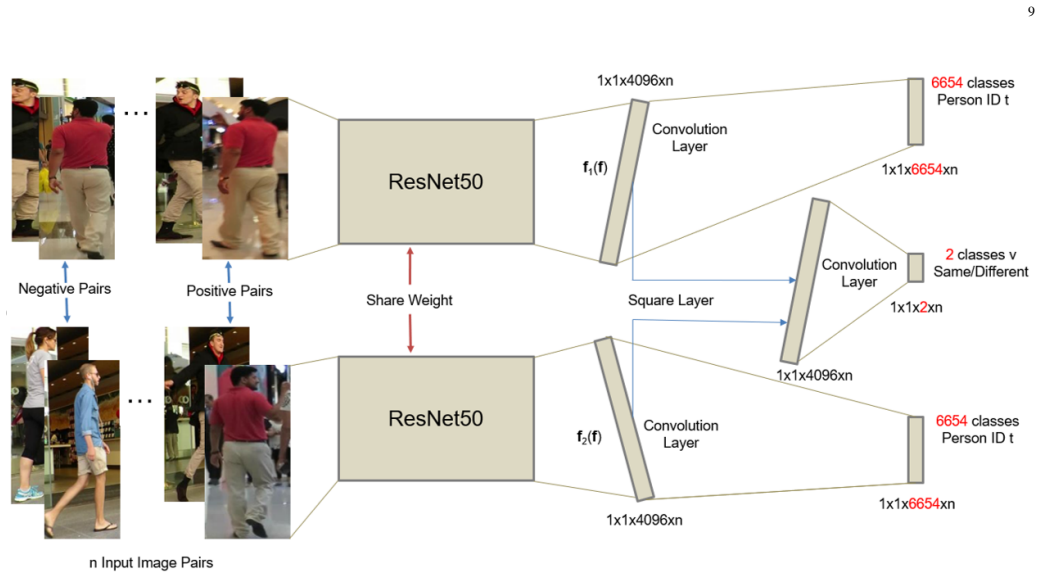
The load-bearing object is the HISP filter itself, a Bayesian multi-target filter that represents each previously detected target by a measurement path, or hypothesis, and propagates each hypothesis' probability density and survival weight with complexity linear in the number of hypotheses and measurements. Into this filter the paper inserts an augmented likelihood of the form $g_t(z|x)=g_t(z_d|x)g_t(z_w|x)$: the detection term is the Gaussian innovation of Eq. (12), and the appearance term is the sigmoid of the cosine distance between CNN features, Eq. (21). The VerIdNet supplies those features: a Siamese ResNet50 with one verification and two identification losses, trained on 6,654 identities. The filter's update equations then convert these likelihoods into association weights and posterior hypothesis weights, so the appearance term is used both for data association and for track updates.
What would settle it
Rerun HISP-DAL on the MOT16 test set with the appearance factor $g_t(z_w\mid x)$ in Eq. (21) replaced by the constant 1: if MOTA remains 37.4, the deep appearance term is not carrying the reported improvement.
Extended reading notes
Core claim
The paper's central assertion is that the HISP filter's per-track hypotheses can ingest an augmented likelihood $g_t(z|x)=g_t(z_d|x)g_t(z_w|x)$, where the first factor scores box-level agreement through the Kalman innovation and the second factor scores appearance agreement through a logistic function of the cosine distance between deep CNN embeddings. With this likelihood, HISP-DAL reports 37.4 MOTA and 2,101 identity switches on MOT16 versus 35.9 MOTA and 2,592 switches for the motion-only HISP-T, and reaches 45.4 MOTA on MOT17. The paper also claims that the weight propagated with each confirmed hypothesis can relabel spawned objects that would otherwise share one identity after track extraction. The appearance embeddings come from VerIdNet, a Siamese ResNet50 trained with two identification losses and one verification loss on a mixture of re-identification and tracking data sets, which the paper reports at about 98% pair-verification accuracy.
Load-bearing premise
The augmented likelihood can be evaluated only if every track has an appearance feature vector available at its predicted state, but the paper never defines how such a track appearance template is initialized, stored, or updated.
Editorial extensions
If this is right
- An online tracker can preserve track identities without exponential hypothesis growth; the reported complexity is $O(|\mathcal{I}_{t|t-1}||Z_t|)$ per recursion.
- Appearance learning can be added to stochastic-population filters through the measurement likelihood, so the same augmented likelihood should extend to DISP and related filters, not only HISP.
- The paper's reported MOTA on MOT17 is obtained with public detections from DPM, FRCNN, and SDP detectors, so the gain is not tied to a custom detector.
- The duplicate-label fix is applied after track extraction and does not alter the filtering recursion, which means any HISP implementation can adopt it without changing the filter itself.
Reading between the lines
- The paper leaves a track's appearance state undefined: nothing in the Kalman state of Section V stores or updates an appearance template, so a working implementation must add an undocumented appearance store. Making that store explicit would also make Eq. (13) testable.
- The same cosine-sigmoid likelihood could be ported to other Bayesian multi-target filters, such as labeled random-finite-set filters; if the reported gain is real, those filters should see a similar improvement.
- The VerIdNet's 98% pair-verification accuracy contrasts with the tracker's 30.5 IDF1 on MOT16, suggesting that the appearance signal is diluted by the motion term or by association ambiguity; a testable extension is to reweight $g_t(z_d|x)$ and $g_t(z_w|x)$.
- Since HISP-DAL is compared only with the author's own motion-only HISP-T, an independent appearance-based tracker under identical detections would be needed to isolate the contribution of the deep features.
Signed reviews
Editorial analysis
A structured set of objections, weighed in public.
Referee Report
Summary. The paper proposes an online multi-target visual tracker based on the Hypothesized and Independent Stochastic Population (HISP) filter, combined with a deep CNN appearance model (VerIdNet). The authors augment the HISP measurement likelihood with an appearance term, g_t(z|x)=g_t(z_d|x)g_t(z_w|x), and evaluate the resulting tracker (HISP-DAL) on MOT16 and MOT17. They report MOTA of 37.4 on MOT16 (versus 35.9 for the motion-only HISP-T) and 45.4 on MOT17, and claim the deep appearance information is responsible for the improvement. The paper also introduces a heuristic to re-label spawned tracks that share an identity after track extraction.
Significance. If the central claim is correct, this is the first HISP filter with deep representation learning and a working online identity-preserving tracker, which would be a useful contribution to visual multi-target tracking: the HISP filter offers linear complexity while maintaining track identities, and the addition of discriminative appearance features is a natural and potentially valuable extension. The benchmark results are self-consistent, and the use of external MOT16/MOT17 evaluation reduces circularity concerns. However, the current manuscript does not fully specify the mechanism by which the deep appearance likelihood is evaluated, and one key equation is mathematically problematic, so the central claim is not yet verifiable from the text.
major comments (3)
- [§III-B and §IV-A] The augmented likelihood g_t(z_w|x) in Eq. (21) cannot be evaluated as written because the paper never defines a track appearance state. Section V defines the Kalman state as x_t=[p_cx, p_cy, v_x, v_y, w, h]^T and the measurement as [p_cx, p_cy, w, h]^T, with no appearance descriptor. Eq. (21) requires z_i_w, an appearance feature extracted from the detected object region determined by the predicted measurement Hx, but no template store, no initialization rule, and no update rule for an appearance template are given. Please specify how the appearance feature of a predicted track is obtained: is a crop taken from the current frame at the predicted box, or is a stored template used? How is the template initialized at track birth and updated after association, and how are miss-detections handled? Without this, the reported MOTA gain from deep appearance cannot be traced to the equations provided.
- [§III-B, Eq. (13)] Equation (13) is not a valid identity. The left-hand side is an integral over x, but the right-hand side retains Hx and g_t(z_w|x) after the integral. For a Gaussian p(x), the detection-term integral should be evaluated at the predicted mean Hm, and the appearance term, if it depends on x, must remain inside the integral or be approximated explicitly. As written, the equation cannot be used to compute the association weight w^{κ,z}_t. Please correct the derivation and state the approximations used to factor the appearance term out of the integral.
- [§VI, Ablation Study] The ablation compares HISP-DAL with HISP-T, which is reported in the author's prior work [22], rather than a re-run of the same implementation without the appearance term. The paper states that HISP-T is 'simply the HISP-DAL tracker without deep appearance information,' but no evidence is provided that all other components (Kalman parameters, pruning/merging thresholds, track extraction window, detection preprocessing) are identical. The 1.5 MOTA difference could stem from implementation differences or parameter changes. Please provide a controlled ablation: run the same code with the appearance likelihood disabled, or report the exact configuration differences between HISP-DAL and HISP-T.
minor comments (4)
- [Abstract and §VI] The abstract claims the tracker 'significantly outperforms several state-of-the-art trackers in terms of tracking accuracy,' but on MOT16, AMIR and KCF16 achieve higher MOTA (47.2 and 48.8 versus 37.4, Table I). The claim is acceptable if 'several' is interpreted as 'many, but not all,' but it would be clearer to qualify the statement or highlight the MOT17 results where the tracker does rank first in MOTA.
- [§III-B, Eq. (12)] The detection likelihood in Eq. (12) is written as an unnormalized exponential. Since the text states that the augmented likelihood is 'dimensionless and takes values in the interval [0,1]', the normalization is not just cosmetic; please define whether g_t(z_d|x) is a likelihood ratio, a density, or an unnormalized score, and clarify how it is normalized.
- [§IV-A, Eqs. (21) and (22)] Eq. (22) defines C_w as a cosine similarity (dot product divided by norms), but the text calls it a cosine distance. A similarity of +1 corresponds to identical features, while a distance would be 0 in that case. Please make the terminology consistent and state the range of C_w, since Eq. (21) is a sigmoid of 2C_w and the interpretation depends on the sign convention.
- [§III-D] The proposed re-labeling of spawned tracks based on the maximum-weight assumption is described as rarely susceptible to identity switches, but no quantitative evidence supports this claim. A brief analysis of how often the assumption fails (e.g., on the reported sequences) would help the reader assess the robustness of this post-processing step.
Circularity Check
No circularity found: the central tracking-accuracy gain is evaluated on external MOT16/MOT17 test sets with fixed parameters and a separately trained appearance network.
full rationale
The paper's central claim, that incorporating deep CNN appearance features through the augmented likelihood g_t(z|x)=g_t(z_d|x)g_t(z_w|x) improves tracking, is supported by an empirical comparison on the external MOT16/MOT17 test sets using public detections. The reported MOTA values are not fitted to the result: the filter parameters (sigma_v=5, sigma_r=6, p_d=0.9, clutter rate 10, n_alpha=0.1) are stated as fixed implementation values, and the VerIdNet appearance model is trained on person re-identification data rather than on the MOT test sequences. The comparisons against HISP-T [22] and GM-PHD-DAL [3] cite the author's own prior publications, but those are used only as published baselines; the improvement claim is not derived from those citations by construction. The HISP filter itself is taken from external work [14]-[16], not from any uniqueness theorem of the present author. The only notable defect is that Eq. (13) leaves an appearance-feature term depending on x outside the integral, and no track appearance template or update rule is defined in Section V, so the augmented likelihood is under-specified as written. That is an implementation/correctness gap, not a circular reduction: no equation is defined in terms of the output it is claimed to predict, and no fitted quantity is relabeled as a prediction. Therefore no circularity is found, and the score is 0.
Assumptions & free parameters
free parameters (7)
- Probability of detection p_d =
0.90
- Target survival probability p_pi =
0.99 (death kernel q_w = 1e-2)
- False alarm (clutter) rate =
mean 10 per frame; v_t(z) ~ 4.8e-6
- Birth intensity n_alpha =
0.1 new objects per frame
- Process and observation noise =
sigma_v = 5 px/s^2, sigma_r = 6 px
- Pruning, merging, and window thresholds =
tau_p = 1e-3, tau_m = 4 px, T = 5, max hypotheses = 1e7
- Cosine verification threshold =
0.75
assumptions (4)
- domain assumption The HISP filter recursion and its linear complexity are taken as given from the stochastic populations literature.
- domain assumption Data association is moderately ambiguous, so products of association weights for different hypotheses vanish (sparsity assumption).
- ad hoc to paper The appearance likelihood can be evaluated as a function of a predicted kinematic state, i.e., a track appearance template exists and its cosine distance with the current detection can be computed.
- domain assumption MOT16/MOT17 public detections and ground truth are reliable and the benchmark evaluation is unbiased.
Cite this review
Pith. "Pith review of Robust Online Multi-target Visual Tracking using a HISP Filter with Discriminative Deep Appearance Learning." pith.science (2026). https://pith.science/paper/PJ2KWWQK
@misc{pith2026190803945,
  author       = {Pith},
  title        = {Pith review of: Robust Online Multi-target Visual Tracking using a HISP Filter with Discriminative Deep Appearance Learning},
  year         = {2026},
  howpublished = {\url{https://pith.science/paper/PJ2KWWQK}},
  note         = {Machine review of arXiv:1908.03945}
}
read the original abstract
We propose a novel online multi-target visual tracker based on the recently developed Hypothesized and Independent Stochastic Population (HISP) filter. The HISP filter combines advantages of traditional tracking approaches like MHT and point-process-based approaches like PHD filter, and it has linear complexity while maintaining track identities. We apply this filter for tracking multiple targets in video sequences acquired under varying environmental conditions and targets density using a tracking-by-detection approach. We also adopt deep CNN appearance representation by training a verification-identification network (VerIdNet) on large-scale person re-identification data sets. We construct an augmented likelihood in a principled manner using this deep CNN appearance features and spatio-temporal information. Furthermore, we solve the problem of two or more targets having identical label considering the weight propagated with each confirmed hypothesis. Extensive experiments on MOT16 and MOT17 benchmark data sets show that our tracker significantly outperforms several state-of-the-art trackers in terms of tracking accuracy.
Figures


Figures from the paper (1 more)

Reference graph
Works this paper leans on
-
[22]
Online multi-target visual tracking using a HISP filter,
N. L. Baisa, “Online multi-target visual tracking using a HISP filter,” in Proceedings of the 13th International Joint Conference on Computer Vision, Imaging and Computer Graphics Theory and Applications - Volume 5: VISAPP ,, INSTICC. SciTePress, 2018, pp. 429–438
work page 2018
-
[1]
Online multi-target tracking with strong and weak detections,
R. Sanchez-Matilla, F. Poiesi, and A. Cavallaro, “Online multi-target tracking with strong and weak detections,” in Computer Vision - ECCV 2016 Workshops - Amsterdam, The Netherlands, October 8-10 and 15- 16, 2016, Proceedings, Part II , 2016, pp. 84–99. 13 Fig. 5: Sample results on the sequence MOT17-07-SDP (using SDP detector); bounding boxes represent ...
work page 2016
-
[2]
Y . Song and M. Jeon, “Online multiple object tracking with the hierarchically adopted GM-PHD filter using motion and appearance,” in IEEE/IEIE The International Conference on Consumer Electronics (ICCE) Asia, 2016
work page 2016
-
[3]
Online multi-object visual tracking using a GM-PHD filter with deep appearance learning,
N. L. Baisa, “Online multi-object visual tracking using a GM-PHD filter with deep appearance learning,” in 2019 22nd International Conference on Information Fusion (FUSION) , July 2019
work page 2019
-
[4]
Learning by track- ing: Siamese CNN for robust target association,
L. Leal-Taix ´e, C. Canton-Ferrer, and K. Schindler, “Learning by track- ing: Siamese CNN for robust target association,” IEEE Conference on Computer Vision and Pattern Recognition Workshops (CVPR). DeepVi- sion: Deep Learning for Computer Vision. , 2016
work page 2016
-
[5]
Continuous energy minimization for multitarget tracking,
A. Milan, S. Roth, and K. Schindler, “Continuous energy minimization for multitarget tracking,” IEEE Transactions on Pattern Analysis and Machine Intelligence, vol. 36, no. 1, pp. 58–72, Jan 2014
work page 2014
-
[6]
Globally-optimal greedy algorithms for tracking a variable number of objects,
H. Pirsiavash, D. Ramanan, and C. C. Fowlkes, “Globally-optimal greedy algorithms for tracking a variable number of objects,” in CVPR 2011, June 2011, pp. 1201–1208
work page 2011
-
[7]
B.-N. V o, M. Mallick, Y . Bar-Shalom, S. Coraluppi, R. O. III, R. Mahler, and B.-T. V o,”Multitarget Tracking”. Wiley Encyclopedia of Electrical and Electronics Engineering, Wiley, September 2015
work page 2015
Show all 69 references
-
[8]
Multiple object tracking: A literature review,
W. Luo, X. Zhao, and T. Kim, “Multiple object tracking: A literature review,”CoRR, vol. abs/1409.7618, 2014. [Online]. Available: http://arxiv.org/abs/1409.7618
2014 arXiv
-
[9]
Bar-Shalom, P
Y . Bar-Shalom, P. Willett, and X. Tian, Tracking and Data Fusion: A Handbook of Algorithms . YBS Publishing, 2011. [Online]. Available: https://books.google.co.uk/books?id=2aOiuAAACAAJ
2011
-
[10]
Multiple hypothesis tracking revisited,
C. Kim, F. Li, A. Ciptadi, and J. M. Rehg, “Multiple hypothesis tracking revisited,” in 2015 IEEE International Conference on Computer Vision (ICCV), Dec 2015, pp. 4696–4704
2015
-
[11]
An extension of the munkres algorithm for the assignment problem to rectangular matrices,
F. Bourgeois and J.-C. Lassalle, “An extension of the munkres algorithm for the assignment problem to rectangular matrices,” Commun. ACM , vol. 14, no. 12, pp. 802–804, Dec. 1971
1971
-
[12]
R. P. Mahler, Advances in statistical multisource-multitarget information fusion. Norwood: Artech House, 2014. [Online]. Available: http: //cds.cern.ch/record/2158275
2014
-
[13]
Multitarget bayes filtering via first-order multitarget moments,
——, “Multitarget bayes filtering via first-order multitarget moments,” IEEE Trans. on Aerospace and Electronic Systems , vol. 39, no. 4, pp. 1152–1178, 2003
2003
-
[14]
Multitarget filtering with linearized complexity,
J. Houssineau and D. E. Clark, “Multitarget filtering with linearized complexity,” IEEE Transactions on Signal Processing , vol. 66, no. 18, pp. 4957–4970, Sep. 2018
2018
-
[15]
A new multi-target tracking algorithm for a large number of orbiting objects,
E. Delande, J. Houssineau, J. Franco, C. Fr ¨uh, and D. Clark, “A new multi-target tracking algorithm for a large number of orbiting objects,” 27th AAS/AIAA Space Flight Mechanics Meeting , 2017
2017
-
[16]
A new multi-target tracking algorithm for a large number of orbiting objects,
E. Delande, J. Houssineau, J. Franco, C. Frueh, D. Clark, and M. Jah, “A new multi-target tracking algorithm for a large number of orbiting objects,” Advances in Space Research , vol. 64, no. 3, pp. 645 – 667,
-
[17]
ImageNet classification with deep convolutional neural networks,
A. Krizhevsky, I. Sutskever, and G. E. Hinton, “ImageNet classification with deep convolutional neural networks,” in Advances in Neural In- formation Processing Systems 25 , F. Pereira, C. Burges, L. Bottou, and K. Weinberger, Eds., 2012, pp. 1097–1105
2012
-
[18]
Deep residual learning for image recognition,
K. He, X. Zhang, S. Ren, and J. Sun, “Deep residual learning for image recognition,” CoRR, vol. abs/1512.03385, 2015
2015 arXiv
-
[19]
Faster R-CNN: towards 14 real-time object detection with region proposal networks,
S. Ren, K. He, R. B. Girshick, and J. Sun, “Faster R-CNN: towards 14 real-time object detection with region proposal networks,” CoRR, vol. abs/1506.01497, 2015. [Online]. Available: http://arxiv.org/abs/1506. 01497
2015 arXiv
-
[20]
A discriminatively learned CNN embedding for person re-identification,
Z. Zheng, L. Zheng, and Y . Yang, “A discriminatively learned CNN embedding for person re-identification,” CoRR, vol. abs/1611.05666, 2016
2016 arXiv
-
[21]
Tracking the untrackable: Learning to track multiple cues with long-term dependencies,
A. Sadeghian, A. Alahi, and S. Savarese, “Tracking the untrackable: Learning to track multiple cues with long-term dependencies,” CoRR, vol. abs/1701.01909, 2017. [Online]. Available: http://arxiv.org/abs/ 1701.01909
2017 arXiv
-
[23]
The Gaussian mixture probability hypothesis density filter,
B.-N. V o and W.-K. Ma, “The Gaussian mixture probability hypothesis density filter,” Signal Processing, IEEE Transactions on, vol. 54, no. 11, pp. 4091–4104, Nov 2006
2006
-
[24]
Long-term correlation tracking using multi-layer hybrid features in sparse and dense environments,
N. L. Baisa, D. Bhowmik, and A. Wallace, “Long-term correlation tracking using multi-layer hybrid features in sparse and dense environments,” Journal of Visual Communication and Image Representation, vol. 55, pp. 464 – 476, 2018. [Online]. Available: http://www.sciencedirect.c...
2018
-
[25]
Single to multiple target, multiple type visual tracking,
N. L. Baisa, “Single to multiple target, multiple type visual tracking,” Ph.D. dissertation, Heriot-Watt University, 06 2018
2018
-
[26]
Multiple target, multiple type filtering in the RFS framework,
N. L. Baisa and A. Wallace, “Multiple target, multiple type filtering in the RFS framework,” Digital Signal Processing , vol. 89, pp. 49 – 59,
-
[27]
Development of a N-type GM-PHD filter for multiple target, multiple type visual tracking,
——, “Development of a N-type GM-PHD filter for multiple target, multiple type visual tracking,” Journal of Visual Communication and Image Representation, vol. 59, pp. 257 – 271, 2019. [Online]. Available: http://www.sciencedirect.com/science/article/pii/S1047320319300343
2019
-
[28]
Available: http://www.sciencedirect.com/science/article/ pii/S1051200418303166
[Online]. Available: http://www.sciencedirect.com/science/article/ pii/S1051200418303166
-
[29]
An efficient implementation of the generalized labeled multi-bernoulli filter,
B. V o, B. V o, and H. G. Hoang, “An efficient implementation of the generalized labeled multi-bernoulli filter,” IEEE Transactions on Signal Processing, vol. 65, no. 8, pp. 1975–1987, April 2017
1975
-
[30]
Labeled random finite sets and the bayes multi-target tracking filter,
B. V o, B. V o, and D. Phung, “Labeled random finite sets and the bayes multi-target tracking filter,” IEEE Transactions on Signal Processing , vol. 62, no. 24, pp. 6554–6567, Dec 2014
2014
-
[31]
Multi-object filtering with stochastic populations,
E. Delande, J. Houssineau, and D. Clark, “Multi-object filtering with stochastic populations,” arXiv, vol. 1501.04671v2, 2016. [Online]. Available: https://arxiv.org/abs/1501.04671v2
2016 arXiv
-
[32]
Online multi-object tracking via labeled random finite set with appearance learning,
D. Y . Kim, “Online multi-object tracking via labeled random finite set with appearance learning,” in 2017 International Conference on Control, Automation and Information Sciences (ICCAIS), Oct 2017, pp. 181–186
2017
-
[33]
Tracking interacting objects using intertwined flows,
X. Wang, E. T ¨uretken, F. Fleuret, and P. Fua, “Tracking interacting objects using intertwined flows,” IEEE Transactions on Pattern Analysis and Machine Intelligence , vol. 38, no. 11, pp. 2312–2326, 2016
2016
-
[34]
Multiple object tracking using k-shortest paths optimization,
J. Berclaz, F. Fleuret, E. Turetken, and P. Fua, “Multiple object tracking using k-shortest paths optimization,” IEEE Transactions on Pattern Analysis and Machine Intelligence, vol. 33, no. 9, pp. 1806–1819, 2011
2011
-
[35]
Greedy batch-based minimum-cost flows for tracking multiple objects,
X. Wang, B. Fan, S. Chang, Z. Wang, X. Liu, D. Tao, and T. S. Huang, “Greedy batch-based minimum-cost flows for tracking multiple objects,” IEEE Transactions on Image Processing, vol. 26, no. 10, pp. 4765–4776, 2017
2017
-
[36]
Non-markovian globally consistent multi-object tracking,
A. Maksai, X. Wang, F. Fleuret, and P. Fua, “Non-markovian globally consistent multi-object tracking,” in Proceedings of the IEEE Interna- tional Conference on Computer Vision (ICCV) , Oct 2017
2017
-
[37]
GM-PHD filter based online multiple human tracking using deep discriminative corre- lation matching,
Z. Fu, F. Angelini, S. M. Naqvi, and J. A. Chambers, “GM-PHD filter based online multiple human tracking using deep discriminative corre- lation matching,” in 2018 IEEE International Conference on Acoustics, Speech and Signal Processing (ICASSP) , April 2018, pp. 4299–4303
2018
-
[38]
Multi-object tracking with neural gating using bilinear LSTM,
C. Kim, F. Li, and J. M. Rehg, “Multi-object tracking with neural gating using bilinear LSTM,” in The European Conference on Computer Vision (ECCV), September 2018
2018
-
[39]
Scalable person re-identification: A benchmark,
L. Zheng, L. Shen, L. Tian, S. Wang, J. Wang, and Q. Tian, “Scalable person re-identification: A benchmark,” in 2015 IEEE International Conference on Computer Vision (ICCV) , Dec 2015, pp. 1116–1124
2015
-
[40]
Deep learning face representation by joint identification-verification,
Y . Sun, X. Wang, and X. Tang, “Deep learning face representation by joint identification-verification,” in NIPS, 2014
2014
-
[41]
Stable multi-target tracking in real-time surveillance video,
B. Benfold and I. Reid, “Stable multi-target tracking in real-time surveillance video,” in CVPR, June 2011, pp. 3457–3464
2011
-
[42]
ImageNet Large Scale Visual Recognition Challenge,
O. Russakovsky, J. Deng, H. Su, J. Krause, S. Satheesh, S. Ma, Z. Huang, A. Karpathy, A. Khosla, M. Bernstein, A. C. Berg, and L. Fei-Fei, “ImageNet Large Scale Visual Recognition Challenge,” International Journal of Computer Vision (IJCV) , vol. 115, no. 3, pp. 211–252, 2015
2015
-
[43]
Deepreid: Deep filter pairing neural network for person re-identification,
W. Li, R. Zhao, T. Xiao, and X. Wang, “Deepreid: Deep filter pairing neural network for person re-identification,” in 2014 IEEE Conference on Computer Vision and Pattern Recognition , June 2014, pp. 152–159
2014
-
[44]
Performance measures and a data set for multi-target, multi- camera tracking,
E. Ristani, F. Solera, R. S. Zou, R. Cucchiara, and C. Tomasi, “Performance measures and a data set for multi-target, multi- camera tracking,” in Computer Vision - ECCV 2016 Workshops - Amsterdam, The Netherlands, October 8-10 and 15-16, 2016, Proceedings, Part II , 2016, pp. ...
2016 doi
-
[46]
Region-based quality estimation network for large-scale person re-identification,
G. Song, B. Leng, Y . Liu, C. Hetang, and S. Cai, “Region-based quality estimation network for large-scale person re-identification,” CoRR, vol. abs/1711.08766, 2017. [Online]. Available: http://arxiv.org/ abs/1711.08766
2017 arXiv
-
[47]
MOT16: A benchmark for multi-object tracking,
A. Milan, L. Leal-Taix ´e, I. Reid, S. Roth, and K. Schindler, “MOT16: A benchmark for multi-object tracking,” arXiv:1603.00831 [cs], Mar. 2016, arXiv: 1603.00831. [Online]. Available: http: //arxiv.org/abs/1603.00831
2016 arXiv
-
[48]
Object detection with discriminatively trained part-based models,
P. F. Felzenszwalb, R. B. Girshick, D. McAllester, and D. Ramanan, “Object detection with discriminatively trained part-based models,” IEEE Trans. Pattern Anal. Mach. Intell. , vol. 32, no. 9, pp. 1627–1645, Sep. 2010. [Online]. Available: http://dx.doi.org/10.1109/TPAMI.2009. 167
2010 doi
-
[49]
A sequential monte carlo approximation of the HISP filter,
J. Houssineau, D. E. Clark, and P. Del Moral, “A sequential monte carlo approximation of the HISP filter,” in Signal Processing Conference (EUSIPCO), 2015 23rd European . IEEE, 2015, pp. 1251–1255
2015
-
[50]
Evaluating multiple object tracking performance: The CLEAR MOT metrics,
K. Bernardin and R. Stiefelhagen, “Evaluating multiple object tracking performance: The CLEAR MOT metrics,” J. Image Video Process., pp. 1:1–1:10, Jan 2008
2008
-
[51]
Learning to associate: Hybridboosted multi-target tracker for crowded scene,
Y . Li, C. Huang, and R. Nevatia, “Learning to associate: Hybridboosted multi-target tracker for crowded scene,” in In CVPR, 2009
2009
-
[52]
Exploit all the layers: Fast and accurate cnn object detector with scale dependent pooling and cascaded rejection classifiers,
F. Yang, W. Choi, and Y . Lin, “Exploit all the layers: Fast and accurate cnn object detector with scale dependent pooling and cascaded rejection classifiers,” in 2016 IEEE Conference on Computer Vision and Pattern Recognition (CVPR), June 2016, pp. 2129–2137
2016
-
[53]
High-speed tracking-by- detection without using image information,
E. Bochinski, V . Eiselein, and T. Sikora, “High-speed tracking-by- detection without using image information,” in 2017 14th IEEE Inter- national Conference on Advanced Video and Signal Based Surveillance (AVSS), Aug 2017, pp. 1–6
2017
-
[54]
The way they move: Tracking multiple targets with similar appearance,
C. Dicle, O. I. Camps, and M. Sznaier, “The way they move: Tracking multiple targets with similar appearance,” in 2013 IEEE International Conference on Computer Vision , Dec 2013, pp. 2304–2311
2013
-
[55]
MatConvNet – convolutional neural networks for matlab,
A. Vedaldi and K. Lenc, “MatConvNet – convolutional neural networks for matlab,” in Proceedings of the 25th annual ACM international conference on Multimedia , 2015
2015
-
[56]
Sequential sensor fusion combining probability hypothesis density and kernelized correlation filters for multi-object tracking in video data,
T. Kutschbach, E. Bochinski, V . Eiselein, and T. Sikora, “Sequential sensor fusion combining probability hypothesis density and kernelized correlation filters for multi-object tracking in video data,” in 2017 14th IEEE International Conference on Advanced Video and Signal Base...
2017
-
[57]
Real-time multi- human tracking using a probability hypothesis density filter and multiple detectors,
V . Eiselein, D. Arp, M. P ¨atzold, and T. Sikora, “Real-time multi- human tracking using a probability hypothesis density filter and multiple detectors,” in 2012 IEEE Ninth International Conference on Advanced Video and Signal-Based Surveillance , Sep. 2012, pp. 325–330
2012
-
[58]
Joint probabilistic data association revisited,
S. H. Rezatofighi, A. Milan, Z. Zhang, Q. Shi, A. Dick, and I. Reid, “Joint probabilistic data association revisited,” in 2015 IEEE Interna- tional Conference on Computer Vision (ICCV) , Dec 2015, pp. 3047– 3055
2015
-
[59]
Eliminating exposure bias and metric mismatch in multiple object tracking,
A. Maksai and P. Fua, “Eliminating exposure bias and metric mismatch in multiple object tracking,” in The IEEE Conference on Computer Vision and Pattern Recognition (CVPR) , June 2019
2019
-
[60]
Multiple object tracking via feature pyramid siamese networks,
S. Lee and E. Kim, “Multiple object tracking via feature pyramid siamese networks,” IEEE Access, vol. 7, pp. 8181–8194, 2019
2019
-
[61]
Joint cost minimization for multi-object tracking,
A. Boragule and M. Jeon, “Joint cost minimization for multi-object tracking,” in 2017 14th IEEE International Conference on Advanced Video and Signal Based Surveillance (AVSS) , Aug 2017, pp. 1–6
2017
-
[62]
Simple online and realtime tracking,
A. Bewley, Z. Ge, L. Ott, F. Ramos, and B. Upcroft, “Simple online and realtime tracking,” in 2016 IEEE International Conference on Image Processing (ICIP), Sep. 2016, pp. 3464–3468
2016
-
[63]
Tracking the untrackable: Learning to track multiple cues with long-term dependencies,
A. Sadeghian, A. Alahi, and S. Savarese, “Tracking the untrackable: Learning to track multiple cues with long-term dependencies,” in 2017 15 IEEE International Conference on Computer Vision (ICCV) , 2017, pp. 300–311
2017
-
[64]
Real-time online multi-object tracking in compressed domain,
Q. Liu, B. Liu, Y . Wu, W. Li, and N. Yu, “Real-time online multi-object tracking in compressed domain,”IEEE Access, vol. 7, pp. 76 489–76 499, 2019
2019
-
[65]
Tracking multiple persons based on a variational bayesian model,
Y . Ban, S. Ba, X. Alameda-Pineda, and R. Horaud, “Tracking multiple persons based on a variational bayesian model,” in Computer Vision – ECCV 2016 Workshops , G. Hua and H. J ´egou, Eds. Cham: Springer International Publishing, 2016, pp. 52–67
2016
-
[66]
Arcface: Additive angular margin loss for deep face recognition,
J. Deng, J. Guo, N. Xue, and S. Zafeiriou, “Arcface: Additive angular margin loss for deep face recognition,” in The IEEE Conference on Computer Vision and Pattern Recognition (CVPR) , June 2019
2019
-
[67]
Online multi- object tracking with instance-aware tracker and dynamic model refreshment,
P. Chu, H. Fan, C. C. Tan, and H. Ling, “Online multi- object tracking with instance-aware tracker and dynamic model refreshment,” CoRR, vol. abs/1902.08231, 2019. [Online]. Available: http://arxiv.org/abs/1902.08231
1902 arXiv
-
[70]
Focal loss for dense object detection,
T. Lin, P. Goyal, R. B. Girshick, K. He, and P. Doll ´ar, “Focal loss for dense object detection,” CoRR, vol. abs/1708.02002, 2017. [Online]. Available: http://arxiv.org/abs/1708.02002
2017 arXiv
-
[2017]
Available: http://arxiv.org/abs/1711.08565
[Online]. Available: http://arxiv.org/abs/1711.08565
-
[2019]
Available: http://www.sciencedirect.com/science/article/ pii/S0273117719302728
[Online]. Available: http://www.sciencedirect.com/science/article/ pii/S0273117719302728
Reviewed August 14, 2026 · model on record in the stance chip above.
Discussion (0). Continue with ORCID to comment.