REVIEW 3 major objections 4 minor 40 references
Fusion of Sensors Data in Automotive Radar Systems: A Spectral Estimation Approach
T0 review · 3 major / 4 minor · reviewed 2026-08-14 · deepseek-v4-flash
Pith's one-line read The paper claims that fusing two automotive radar receiver arrays through the squared magnitude of their cross-spectrum improves estimates of target range, velocity, and angle.
desk verdict A clean, modest simulation study showing cross-spectrum magnitude helps two-ULA radar frequency estimation, but the advantage rests on uncorrelated channel noise and would vanish under full correlation. read the letter →
The pith
A machine-rendered reading of the paper's core claim, the machinery that carries it, and where it could break.
The reading
What carries the argument
The load-bearing object is the multidimensional multivariate windowed periodogram (the Blackman-Tukey estimate), $\hat\Phi(\omega)=\sum_{k\in\Lambda} w(k)\hat\Sigma_k e^{-i\langle k,\omega\rangle}$, built from sample covariance lags $\hat\Sigma_k$ of the two-channel data array; $w$ is a rectangular or Bartlett window with support $\Lambda$. Because it returns a $2\times2$ Hermitian matrix at each frequency, it makes the cross-spectrum $\hat\Phi_{12}$ available as an explicit term in the peak-search objective, and the rank-one structure of the true spectral mass $\Phi(\omega)=2\pi a^2\delta(\omega-\theta)R+\tilde\sigma^2 I_2$ explains why the squared cross-spectrum magnitude carries the target signal. The Frobenius-norm objective (12) is the mechanism that converts that matrix-valued estimate into a single scalar whose maximum gives the target frequency vector.
What would settle it
Repeat the paper's Monte Carlo experiment while injecting a small controlled correlation between the two channel noises, for example a common interference component added before sampling, and compare the Frobenius-norm estimator with the independent estimator; if the advantage persists, noise correlation is not the mechanism, and if it shrinks, the claim is limited to the uncorrelated-noise idealization.
Extended reading notes
Core claim
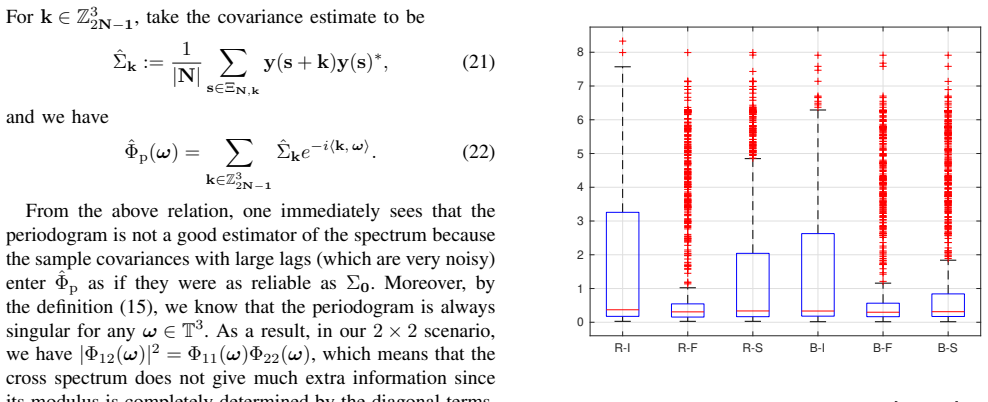
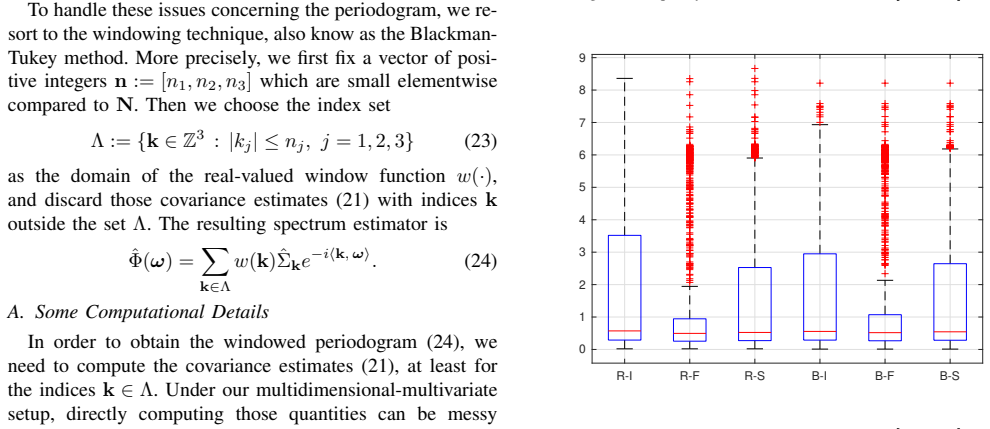
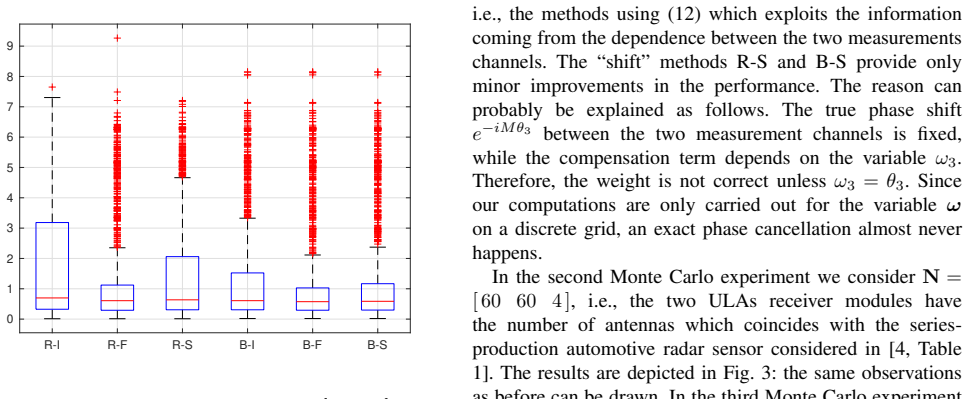
The paper's central claim is that, under the model (6) with uncorrelated equal-variance channel noises, the estimator $\hat\theta_F = \arg\max_{\omega\in\mathbb{T}^3} \|\hat\Phi(\omega)\|_F^2$ -- where $\|\hat\Phi\|_F^2 = |\hat\Phi_{11}|^2 + |\hat\Phi_{22}|^2 + 2|\hat\Phi_{12}|^2$ and $\hat\Phi$ is the windowed periodogram (24) -- yields smaller frequency-estimation error than the independent-channel estimator (10). Monte Carlo runs with 1000 trials at data-array sizes $N=[40,40,7]$, $N=[60,60,4]$, and $N=[70,70,3]$, with unit signal amplitude and noise standard deviation $\tilde\sigma=20$, show the Frobenius-norm estimator giving the best results with both rectangular and Bartlett windows. The paper also reports that the phase-shift-compensated estimator (11) improves only marginally, because its compensating weight $e^{iM\omega_3}$ cancels the true phase $e^{-iM\theta_3}$ only when the search grid happens to contain $\omega_3=\theta_3$.
Load-bearing premise
The two receiver channels are assumed to have uncorrelated noises with equal variance, so the squared cross-spectrum magnitude is a clean target signal; if real hardware has correlated channel noises, that term is contaminated and the reported advantage may vanish.
Editorial extensions
If this is right
- The squared cross-spectrum magnitude is itself a usable target signal, so the fusion happens at the spectrum-estimation level rather than by averaging separate detections.
- The Frobenius-norm peak search does not require knowing the inter-array phase shift, so it works without calibrating the distance $d$ between the two arrays.
- For $m$ aligned receiver modules, the same objective generalizes by summing all $m^2$ entries of the estimated matrix spectrum, at a computational cost that grows like $m^2$.
- In the small-antenna, low-SNR regime tested, including $N=[70,70,3]$ with three antennas per array, the fusion advantage persists.
- The phase-compensated estimator (11) improves on independent processing only marginally because exact phase cancellation requires $\omega_3=\theta_3$ on a discrete grid.
Reading between the lines
- If real hardware has correlated channel noises, for example through mutual coupling or a shared local oscillator, the $|\hat\Phi_{12}|^2$ term gains a spurious contribution; a natural experiment would inject controlled correlation and check whether the Frobenius advantage degrades.
- The comparison between the shifted and Frobenius estimators may depend on grid resolution, since the shifted estimator's weakness is partly a grid artifact; an off-grid optimizer could reduce that gap.
- The same spectral formulation could be combined with high-resolution multivariate moment estimators, keeping the Frobenius peak rule while replacing the windowed periodogram with a sharper spectrum estimate.
- For multiple targets, the doubled weight on coherent target energy in the cross-spectrum may help separate closely spaced targets, but peak picking will need a greedy method such as the paper's suggested pursuit or RELAX step.
Signed reviews
Editorial analysis
A structured set of objections, weighed in public.
Referee Report
Summary. The paper considers an automotive radar setup with two uniform linear arrays sharing a common transmitter. It models the post-mixing sampled measurements as a two-channel, three-dimensional complex sinusoid in noise, with target range, velocity, and angle encoded in a frequency vector θ (eqs. (1)-(6)). The authors propose a windowed (Blackman-Tukey) multivariate periodogram as an estimate of the 2×2 matrix spectrum (24), and compare three peak-search objectives: independent processing of the auto-spectra (10), a phase-shift-compensated cross-spectrum objective (11), and a Frobenius-norm objective using the magnitude of the cross-spectrum (12). Monte Carlo experiments with 1000 trials, one target, a=1, σ=20, three array sizes, and rectangular and Bartlett windows show that the Frobenius objective consistently yields the lowest frequency estimation error, while the phase-compensated objective gives only marginal improvement. The paper concludes that cross-spectral information can improve single-target range, velocity, and angle estimates in the simulated low-SNR regime.
Significance. If the result holds, the paper provides a simple and computationally cheap sensor-fusion rule: compute the multivariate windowed periodogram and maximize its Frobenius norm rather than summing only the diagonal auto-spectral terms. The reported improvement is consistent across three array sizes and two window types, and the computational details in Section III are explicit enough for reproduction. The modeling framework is a reasonable first step toward applying multivariate multidimensional spectral estimation to automotive radar. The significance is tempered by two limitations: all experiments use only one target, and the central advantage depends on an uncorrelated-noise assumption that is neither challenged experimentally nor theoretically analyzed for realistic automotive hardware.
major comments (3)
- [Section II (eq. (6)) and Section IV] The claim that Frobenius objective (12) outperforms independent processing (10) rests on the assumption that the two channel noises are uncorrelated with equal variance. For off-peak frequencies, with noise correlation coefficient ρ, one has E|Φ̂11|² = 2σ⁴ and E|Φ̂12|² = (1+|ρ|²)σ⁴, so the peak-to-floor contrast advantage of (12) over (10) degrades as |ρ| grows and disappears at |ρ|=1. Since real automotive radar modules share a transmitter and commonly share clock/LO paths, this assumption is load-bearing. Please add an analysis or simulations for ρ>0, or explicitly restrict the conclusion to hardware with independent channel noises.
- [Section IV, window width selection] The window widths n=[8,8,2] and [12,12,3] are chosen empirically so that the single-channel periodograms exhibit good performance, and no sensitivity analysis is reported. The comparison is fair because the same windows are used for all estimators, but the claimed superiority of the Frobenius method could depend on windows tuned to the simulated settings and array sizes. I ask for a sensitivity study over the window widths (or at least a few alternatives) to demonstrate that the ordering B-F/R-F versus B-I/R-I is robust.
- [Section IV and Section II] All Monte Carlo experiments use exactly one target, whereas the motivating application and the abstract refer to multiple surrounding cars. The extension to n targets in (13) is stated but not simulated, and the behavior of Frobenius peak selection with multiple peaks, sidelobes, and the outliers mentioned in the conclusions is unknown. Please add at least a two-target experiment, or explicitly label the present claim as a single-target proof-of-concept.
minor comments (4)
- [Section IV] The results are reported only as boxplots; no numerical medians, quartiles, or statistical significance tests are given. Reporting median errors and, for example, a paired test across the 1000 trials would make the claim 'outperforms' more precise.
- [Section II, after eq. (6)] The paper draws θ3 uniformly from [-π,π] in the simulations, but the physical relation θ3=c3 sinα with α∈[-π/2,π/2] restricts θ3 to [-c3,c3]. The manuscript should clarify whether this discrepancy is intentional and how it affects the angular part of the simulation.
- [Section III] The statement that the periodogram 'is always singular' should be phrased as a property of the rank-one sample periodogram (14)-(15), not of the true covariance spectrum; the following equation |Φ12|²=Φ11Φ22 is also specific to the rank-one sample periodogram.
- [Section II, eq. (11)] The factor 2 and the use of the squared real part in the shifted objective (11) are not derived. A sentence explaining the rationale would help readers understand why this is a natural candidate objective.
Circularity Check
No circularity: the cross-spectrum advantage is an empirical Monte Carlo outcome, not a quantity forced by construction or by load-bearing self-citation.
full rationale
The central claim is that the Frobenius-norm objective (12) outperforms the independent-channel objective (10) in Monte Carlo simulations. This is an empirical outcome, not a derived prediction. The estimator is defined from the windowed periodogram (24), which is computed from data generated by the assumed model (6); the target frequencies are drawn randomly in each trial and are not used to build or tune the estimator. The only tuned quantities, the window widths, are explicitly chosen to make single-channel periodograms work well, not to favor the cross-spectrum method, so the comparison is not fitted into existence. The uncorrelated-noise assumption introduced after (6) is a stated modeling assumption that makes the cross-spectrum informative, but the paper does not conceal it, and the reported improvement remains a measured result; sensitivity to correlated channel noise would be a robustness or correctness concern, not a circularity. Minor self-citations appear, notably [34] for the standard asymptotic unbiasedness of periodograms and [27]-[28] as background, but they are not load-bearing: the windowed periodogram and its basic properties are standard textbook material, and the paper's own simulations determine the conclusion. No step in the derivation reduces by definition to its own input, and no fitted parameter is renamed as a prediction.
Assumptions & free parameters
free parameters (2)
- Window width n (rectangular) =
[8, 8, 2]
- Window width n (Bartlett) =
[12, 12, 3]
assumptions (5)
- domain assumption Two ULA receiver modules share a common transmitter, are placed on the same line, and the far-field assumption holds so target parameters differ only in range by d sin(alpha).
- domain assumption Noises in the two receiver channels are uncorrelated and have equal variance sigma_tilde^2.
- domain assumption Initial phase phi is uniformly distributed in [-pi, pi] and independent of the noise; for multiple targets the phases are independent.
- standard math The windowed periodogram is an asymptotically unbiased estimator of the true spectrum (eq. (16)).
- domain assumption For the continuous-spectrum extension (eq. (26)), the phase function phi(theta) is independent across frequencies theta.
Cite this review
Pith. "Pith review of Fusion of Sensors Data in Automotive Radar Systems: A Spectral Estimation Approach." pith.science (2026). https://pith.science/paper/PJ3EXYLY
@misc{pith2026190802504,
  author       = {Pith},
  title        = {Pith review of: Fusion of Sensors Data in Automotive Radar Systems: A Spectral Estimation Approach},
  year         = {2026},
  howpublished = {\url{https://pith.science/paper/PJ3EXYLY}},
  note         = {Machine review of arXiv:1908.02504}
}
read the original abstract
To accurately estimate locations and velocities of surrounding targets (cars) is crucial for advanced driver assistance systems based on radar sensors. In this paper we derive methods for fusing data from multiple radar sensors in order to improve the accuracy and robustness of such estimates. First we pose the target estimation problem as a multivariate multidimensional spectral estimation problem. The problem is multivariate since each radar sensor gives rise to a measurement channel. Then we investigate how the use of the cross-spectra affects target estimates. We see that the use of the magnitude of the cross-spectrum significantly improves the accuracy of the target estimates, whereas an attempt to compensate the phase lag of the cross-spectrum only gives marginal improvement. This paper may be viewed as a first step towards applying high-resolution methods that builds on multidimensional multivariate spectral estimation for sensor fusion.
Figures

Figures from the paper (1 more)
Reference graph
Works this paper leans on
-
[1]
Eskandarian, Handbook of Intelligent Vehicles
A. Eskandarian, Handbook of Intelligent Vehicles . Springer, 2012, vol. 2
work page 2012
-
[2]
F. Gini, A. De Maio, and L. Patton, Eds., Waveform Design and Diversity for Advanced Radar Systems . Institution of engineering and technology London, 2012
work page 2012
-
[3]
Radar system with improved angle formation,
M. Wintermantel, “Radar system with improved angle formation,” Mar. 4 2014, US Patent 8,665,137
work page 2014
-
[4]
F. Engels, P. Heidenreich, A. M. Zoubir, F. K. Jondral, and M. Win- termantel, “Advances in automotive radar: A framework on computa- tionally efficient high-resolution frequency estimation,” IEEE Signal Process. Magazine, vol. 34, no. 2, pp. 36–46, 2017
work page 2017
-
[5]
Target shape estimation using an automotive radar,
F. Engels, “Target shape estimation using an automotive radar,” in Smart Mobile In-Vehicle Systems: Next Generation Advancements . Springer Science+Business Media, 2014, ch. 16, pp. 271–290
work page 2014
-
[6]
Integration of multiple automotive radar modules based on fiber-wireless network,
J.-J. Lin, “Integration of multiple automotive radar modules based on fiber-wireless network,” in 24th Wireless and Optical Communication Conference (WOCC). IEEE, 2015, pp. 36–39
work page 2015
-
[7]
Next generation short range radar (SRR) for automotive applications,
M. Murad, J. Nickolaou, G. Raz, J. S. Colburn, and K. Geary, “Next generation short range radar (SRR) for automotive applications,” in IEEE Radar Conference . IEEE, 2012, pp. 0214–0219
work page 2012
-
[8]
Relative entropy and the multivariable multidimen- sional moment problem,
T. T. Georgiou, “Relative entropy and the multivariable multidimen- sional moment problem,” IEEE Trans. Inform. Theory , vol. 52, no. 3, pp. 1052–1066, 2006
work page 2006
Show all 40 references
-
[9]
Multidimensional MEM spectral estima- tion,
S. Lang and J. McClellan, “Multidimensional MEM spectral estima- tion,” IEEE Trans. Acoust. Speech Signal Process. , vol. 30, no. 6, pp. 880–887, 1982
1982
-
[10]
Solution of the general moment problem via a one- parameter imbedding,
T. T. Georgiou, “Solution of the general moment problem via a one- parameter imbedding,” IEEE Trans. Automat. Control , vol. 50, no. 6, pp. 811–826, 2005
2005
-
[11]
Multidimensional rational covariance extension with applications to spectral estimation and image compression,
A. Ringh, J. Karlsson, and A. Lindquist, “Multidimensional rational covariance extension with applications to spectral estimation and image compression,” SIAM J. Control Optim., vol. 54, no. 4, pp. 1950– 1982, 2016
1950
-
[12]
Multidimensional rational covariance extension with approxi- mate covariance matching,
——, “Multidimensional rational covariance extension with approxi- mate covariance matching,” SIAM J. Control Optim. , vol. 56, no. 2, pp. 913–944, 2018
2018
-
[13]
On the geometry of maximum entropy problems,
M. Pavon and A. Ferrante, “On the geometry of maximum entropy problems,” SIAM Rev., vol. 55, no. 3, pp. 415–439, 2013
2013
-
[14]
An interpretation of the dual problem of the THREE-like approaches,
M. Zorzi, “An interpretation of the dual problem of the THREE-like approaches,” Automatica J. IFAC, vol. 62, pp. 87 – 92, 2015
2015
-
[15]
Spectral moment problems: Generalizations, implemen- tation and tuning,
E. Avventi, “Spectral moment problems: Generalizations, implemen- tation and tuning,” Ph.D. dissertation, KTH Royal Institute of Tech- nology, Stockholm, 2011. 1Notice that the assumption of independence may be questionable as one naturally wants to require the function ϕ(θ) t...
2011
-
[16]
Matrix-valued Nevanlinna–Pick interpolation with complexity constraint: An opti- mization approach,
A. Blomqvist, A. Lindquist, and R. Nagamune, “Matrix-valued Nevanlinna–Pick interpolation with complexity constraint: An opti- mization approach,” IEEE Trans. Automat. Control , vol. 48, no. 12, pp. 2172–2190, 2003
2003
-
[17]
A globally convergent matricial algorithm for multivariate spectral estimation,
F. Ramponi, A. Ferrante, and M. Pavon, “A globally convergent matricial algorithm for multivariate spectral estimation,” IEEE Trans. Automat. Control, vol. 54, no. 10, pp. 2376–2388, 2009
2009
-
[18]
On the well-posedness of multivariate spectrum approxima- tion and convergence of high-resolution spectral estimators,
——, “On the well-posedness of multivariate spectrum approxima- tion and convergence of high-resolution spectral estimators,” Systems Control Lett., vol. 59, no. 3, pp. 167–172, 2010
2010
-
[19]
Hellinger versus Kullback– Leibler multivariable spectrum approximation,
A. Ferrante, M. Pavon, and F. Ramponi, “Hellinger versus Kullback– Leibler multivariable spectrum approximation,” IEEE Trans. Automat. Control, vol. 53, no. 4, pp. 954–967, 2008
2008
-
[20]
Time and spectral domain relative entropy: A new approach to multivariate spectral estimation,
A. Ferrante, C. Masiero, and M. Pavon, “Time and spectral domain relative entropy: A new approach to multivariate spectral estimation,” IEEE Trans. Automat. Control, vol. 57, no. 10, pp. 2561–2575, 2012
2012
-
[21]
A new family of high-resolution multivariate spectral estimators,
M. Zorzi, “A new family of high-resolution multivariate spectral estimators,” IEEE Trans. Automat. Control , vol. 59, no. 4, pp. 892– 904, 2014
2014
-
[22]
Multivariate spectral estimation based on the concept of optimal prediction,
——, “Multivariate spectral estimation based on the concept of optimal prediction,” IEEE Trans. Automat. Control , vol. 60, no. 6, pp. 1647–1652, 2015
2015
-
[23]
Likelihood analysis of power spectra and generalized moment problems,
T. T. Georgiou and A. Lindquist, “Likelihood analysis of power spectra and generalized moment problems,” IEEE Trans. Automat. Control , vol. 62, no. 9, pp. 4580–4592, 2017
2017
-
[24]
On the existence of a solution to a spectral estimation problem `a la Byrnes-Georgiou-Lindquist,
B. Zhu and G. Baggio, “On the existence of a solution to a spectral estimation problem `a la Byrnes-Georgiou-Lindquist,” IEEE Trans. Automat. Control, vol. 64, no. 2, pp. 820–825, 2019
2019
-
[25]
Spectral analysis based on the state covariance: the maximum entropy spectrum and linear fractional parametrization,
T. T. Georgiou, “Spectral analysis based on the state covariance: the maximum entropy spectrum and linear fractional parametrization,” IEEE Trans. Automat. Control, vol. 47, no. 11, pp. 1811–1823, 2002
2002
-
[26]
A maximum entropy solution of the covariance extension problem for reciprocal processes,
F. P. Carli, A. Ferrante, M. Pavon, and G. Picci, “A maximum entropy solution of the covariance extension problem for reciprocal processes,” IEEE Trans. Automat. Control , vol. 56, no. 9, pp. 1999–2012, 2011
1999
-
[27]
On the well-posedness of a parametric spectral estimation problem and its numerical solution,
B. Zhu, “On the well-posedness of a parametric spectral estimation problem and its numerical solution,” To appear in IEEE Trans. Automat. Control, arXiv e-print: 1802.09330, 2018
2018 arXiv
-
[28]
On the uniqueness result of Theorem 6 in “Relative Entropy and the Multivariable Multidimensional Moment Problem
——, “On the uniqueness result of Theorem 6 in “Relative Entropy and the Multivariable Multidimensional Moment Problem”,” IEEE Trans. Inform. Theory , vol. 65, no. 7, pp. 4634–4639, 2019
2019
-
[29]
Stoica and R
P. Stoica and R. Moses, Spectral Analysis of Signals . Upper Saddle River, NJ: Pearson Prentice Hall, 2005
2005
-
[30]
Continuous waveforms for automotive radar systems,
H. Rohling and M. Kronauge, “Continuous waveforms for automotive radar systems,” inWaveform Design and Diversity for Advanced Radar Systems, ser. IET Radar, Sonar and Navigation Series, F. Gini, A. D. Maio, and L. Patton, Eds. IET, 2012, vol. 22, ch. 7, pp. 173–205
2012
-
[31]
From sparse solutions of systems of equations to sparse modeling of signals and images,
A. M. Bruckstein, D. L. Donoho, and M. Elad, “From sparse solutions of systems of equations to sparse modeling of signals and images,” SIAM Rev., vol. 51, no. 1, pp. 34–81, 2009
2009
-
[32]
Efficient mixed-spectrum estimation with applica- tions to target feature extraction,
J. Li and P. Stoica, “Efficient mixed-spectrum estimation with applica- tions to target feature extraction,”IEEE Trans. Signal Process., vol. 44, no. 2, pp. 281–295, 1996
1996
-
[33]
P. J. Brockwell, R. A. Davis, and S. E. Fienberg, Time Series: Theory and Methods. Springer Science & Business Media, 1991
1991
-
[34]
M 2-spectral estima- tion: A relative entropy approach,
B. Zhu, A. Ferrante, J. Karlsson, and M. Zorzi, “M 2-spectral estima- tion: A relative entropy approach,” Submitted to IEEE Trans. Automat. Control, 2019
2019
-
[35]
Spectral estimation via selective harmonic amplifica- tion,
T. T. Georgiou, “Spectral estimation via selective harmonic amplifica- tion,” IEEE Trans. Automat. Control, vol. 46, no. 1, pp. 29–42, 2001
2001
-
[36]
MIMO radar with colocated antennas,
J. Li and P. Stoica, “MIMO radar with colocated antennas,” IEEE Signal Process. Magazine , vol. 24, no. 5, pp. 106–114, 2007
2007
-
[37]
A new approach to spectral estimation: A tunable high-resolution spectral estimator,
C. Byrnes, T. Georgiou, and A. Lindquist, “A new approach to spectral estimation: A tunable high-resolution spectral estimator,” IEEE Trans. Signal Process., vol. 48, no. 11, pp. 3189–3205, 2000
2000
-
[38]
AR identification of latent-variable graphical models,
M. Zorzi and R. Sepulchre, “AR identification of latent-variable graphical models,” IEEE Trans. Automat. Control , vol. 61, no. 9, pp. 2327–2340, Sept 2016
2016
-
[39]
Kullback-leibler approximation of spectral density functions,
T. Georgiou and A. Lindquist, “Kullback-leibler approximation of spectral density functions,” IEEE Trans. Inform. Theory , vol. 49, pp. 2910 – 2917, 12 2003
2003
-
[40]
Identifiability and well- posedness of shaping filter parametrizations: A global analysis ap- proach,
C. I. Byrnes, P. Enqvist, and A. Lindquist, “Identifiability and well- posedness of shaping filter parametrizations: A global analysis ap- proach,” SIAM J. Control Optim. , vol. 41, no. 1, pp. 23–59, 2002
2002
Reviewed August 14, 2026 · model on record in the stance chip above.
Discussion (0). Continue with ORCID to comment.