REVIEW 3 major objections 4 minor 81 references
What is the role of memorization in Continual Learning?
T0 review · 3 major / 4 minor · reviewed 2026-08-07 · deepseek-v4-flash
Pith's one-line read In continual learning, high-memorization samples are forgotten fastest, yet memorization becomes valuable as the memory buffer grows. The paper shows that the right replay policy depends on the buffer size.
desk verdict Useful buffer-policy proxy, but the headline forgetting claim overreaches: offline memorization scores are shown by the paper itself not to identify incremental memorization. read the letter →
The pith
A machine-rendered reading of the paper's core claim, the machinery that carries it, and where it could break.
The reading
What carries the argument
The load-bearing object is the memorization score, defined as the difference between the probability a trained model assigns to a sample's correct label when that sample is in the training set and the probability when it is removed. Because exact leave-one-out scores are expensive, the paper relies on a leave-k-out estimator with a variance bound, and on an incremental proxy: the first training iteration after which a sample is continuously classified correctly. The proxy drives a family of buffer policies (top-k, middle-k, and bottom-k by proxy score) built on reservoir sampling. A second mechanism is the linear probe, a linear classifier trained on frozen representations from other tasks to test whether offline high-memorization samples are actually memorized during incremental training.
What would settle it
Train a class-incremental stream, then hold out one sample from an early task and retrain only the later tasks on the remaining data; if the accuracy of held-out high-memorization samples does not drop more than that of regular samples, the claim that high-memorization examples are forgotten faster would be refuted. A cheaper check: on a fixed large buffer, if top-proxy-memorization selection never outperforms bottom-proxy selection across several datasets and seeds, the buffer-size dependence claim would collapse.
Extended reading notes
Core claim
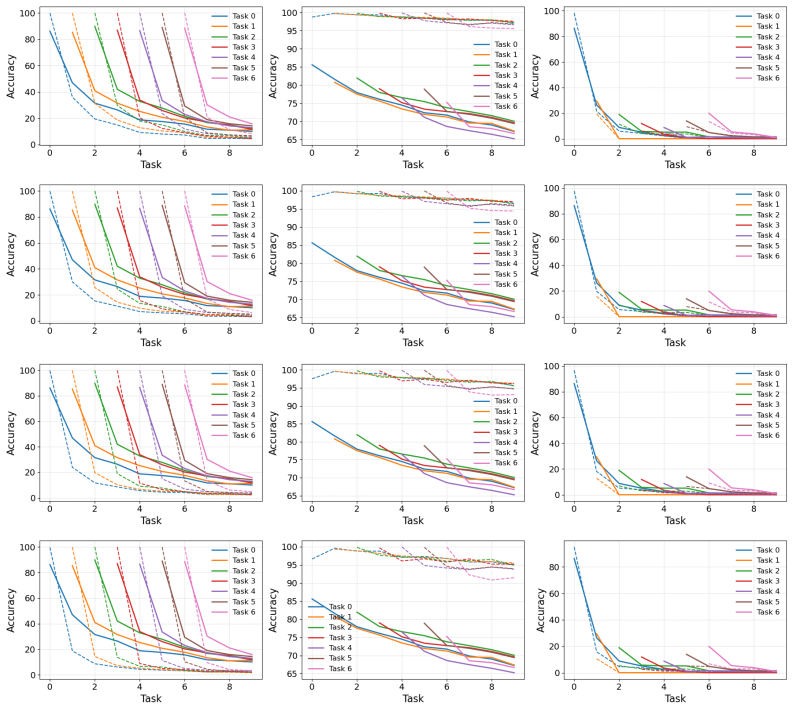
The paper's central claim is that memorization and forgetting prevention are not the same phenomenon, and that the two have a size-dependent relationship in class-incremental learning. Tracking samples that carry high memorization scores, as estimated offline by a leave-k-out influence estimator, across incremental training shows their classification accuracy collapses after the first distribution shift, while regular test accuracy declines more slowly. With full access to past data, memorized samples stay accurate, indicating that memorization is necessary for the best performance; with a small buffer, performance is dominated by forgetting of typical samples; with larger buffers, high-memorization samples become increasingly worth keeping. The paper's buffer-policy experiments confirm this: selecting samples with low proxy memorization scores beats random and coreset baselines at buffer size 500, while adding a 10% quota of high-proxy samples helps only when the buffer is large.
Load-bearing premise
The load-bearing premise is that memorization scores computed from stationary, full-dataset training identify the same samples that are actually memorized during incremental training; the paper's own linear-probe experiment shows this correspondence is imperfect.
Editorial extensions
If this is right
- Rehearsal buffers with small memory budgets should be filled with typical, easy-to-represent samples rather than memorized ones, since forgetting regular data is the dominant failure mode in that regime.
- At larger buffer sizes, buffer policies should reserve a share of slots for high-memorization samples, because those samples become necessary to approach the accuracy of training with full access to past data.
- Increasing the number of classes in a task increases the fraction of high-memorization samples, so benchmarks that vary classes-per-task are testing different memorization loads, not just different amounts of forgetting.
- The proposed training-iteration proxy can be attached to rehearsal-based continual learning with negligible overhead and improves accuracy over reservoir sampling on standard image benchmarks.
- Exemplar-free or heavily regularized methods lose accuracy on memorized samples quickly, so methods that claim to prevent forgetting should separately report performance on memorized data.
Reading between the lines
- If the paper's picture is right, small-buffer and large-buffer continual learning should be treated as different algorithmic regimes: methods optimized for one may not transfer to the other, and evaluation suites should vary buffer size as a first-class axis.
- A direct test of the paper's main claim would compute leave-one-out style memorization scores within the incremental stream itself, rather than from stationary training, and check whether the same samples are forgotten fastest; the paper's linear-probe results suggest this score could differ substantially from the offline one.
- The proxy's moderate correlation with the memorization estimator suggests that a sharper proxy, built from prediction-confidence trajectories or forgetting counts, might strengthen the large-buffer effect that is currently small relative to its standard deviation.
- Buffer policies that mix typical and memorized samples by a size-dependent ratio could be tuned automatically, with the paper's results providing the qualitative shape of the optimal mixing curve.
Editorial analysis
A structured set of objections, weighed in public.
Referee Report
Summary. This paper investigates the role of memorization in class-incremental continual learning. The authors compute Feldman memorization scores offline for CIFAR and Tiny ImageNet datasets, study how these scores vary with the number of classes, dataset size, and model architecture, and then track the test accuracy of high-memorization samples during incremental training. They also introduce a training-iteration based proxy for the memorization score and use it to design rehearsal buffer policies, reporting that policies favoring low- or mid-proxy samples perform well with small buffers, while the relative value of high-proxy samples grows with buffer size. The paper releases code and detailed experimental logs.
Significance. If the central claims held, this work would provide useful guidance for buffer construction in class-incremental learning and extend the study of memorization to non-stationary settings. The paper has clear strengths: it is transparent about limitations, releases code and MLFlow logs, provides detailed hyperparameters and compute-reporting, and adopts a variance-bounded Feldman estimator. However, the headline claim that "high-memorization-score examples are forgotten faster than regular samples" is not supported by the paper's own evidence in Section 3.4, which shows that offline high-memorization samples are often not actually memorized in incremental training. This reduces the conceptual contribution substantially, although the buffer-policy findings may remain useful as empirical observations about training-iteration-based selection.
major comments (3)
- [Abstract, §3.3, §3.4] The central claim that examples with high memorization scores are forgotten faster depends on treating the offline Feldman estimator (Eq. 2) as a proxy for what is memorized during incremental training. Section 3.4's linear-probe experiment shows that data with high offline scores can often be classified from representations learned on other tasks, and the authors explicitly state that "data with high memorization scores computed offline doesn't necessarily correspond to data that is actually memorized in incremental training." The Limitations section reiterates this. Consequently, Fig. 3 may be measuring sample atypicality or difficulty rather than memorization per se, and the abstract, introduction, and conclusion overclaim the finding. Please reframe the claims to be about offline memorization scores, or add a direct validation that the proxy tracks incremental memorization.
- [Fig. 3, Table 3] The two main quantitative claims lack adequate statistical support. Fig. 3, which underlies the "forgotten faster" claim, has no error bars and is averaged over only five runs, as the checklist acknowledges. In Table 3, the improvements from adding 10% top-k samples are within one standard deviation for nearly every buffer size (e.g., +0.36 ± 0.64 at buffer 20000, +0.10 ± 0.68 at buffer 10000, +0.25 ± 0.64 for mid-k at 5000), so the statement that "the importance of a high-memorization score sample rises with an increase in the buffer size" is not supported by the reported numbers. Please provide error bars or confidence intervals for the key trend plots and re-evaluate the buffer-size trend with statistical tests or more runs.
- [§3.5, Appendix B] The proposed proxy (Eq. 3) is validated only against the Feldman estimator, not against the actual incremental memorization behavior it is used to approximate. The reported correlations are moderate (Pearson r = 0.594 with original memorization scores in Fig. 5; Pearson r = 0.808 with Feldman estimates on 150 samples in Fig. 8), and the Feldman estimator itself inherits the validity gap noted in Section 3.4. Since the buffer-policy results are interpreted as evidence about memorization, the proxy validation should include a check in the incremental setting, or the paper should limit its interpretation to a "training-iteration proxy" rather than a memorization proxy.
minor comments (4)
- [Fig. 1 caption] There is a typo: "depepence" should be "dependence."
- [Tables 1 and 3, §4] There are typos in the tables and text: "memsocres" should be "memscores," and "ballanced" should be "balanced."
- [§3.5, Eq. (3)] In Eq. (3), the notation f_j is not fully defined; please state explicitly that f_j is the model before the j-th gradient update, and clarify how samples that are never correctly classified (v_i = ∞, mentioned in Appendix G) are handled in the definition.
- [Appendix B, §5.1] The proxy validation in Appendix B is based on only 150 samples and a single network per excluded sample; this should be stated in the main text when describing the proxy's accuracy, since the main text currently reports only the correlation values.
Circularity Check
No significant circularity: buffer-policy results are evaluated on held-out test accuracy, and the proxy is validated against an external estimator; the offline-to-incremental memorization gap is an acknowledged validity limitation, not a circular reduction.
full rationale
The paper's derivation chain is empirical rather than definitional. Section 3.3 labels training examples by the external Feldman estimator (Eq. 2) at threshold 0.25 and then measures how those samples' accuracy evolves during incremental training; the 'forgotten faster' claim is a measured correlation, not an identity. The proxy in Eq. 3 is used to choose buffer contents, but the reported Acc/FM values in Tables 1-3 and Fig. 6 are computed on held-out test sets, so the policy's success is not forced by the proxy definition. Appendix B validates the proxy only against the Feldman estimator and original memorization scores; validating against an intermediate quantity rather than the final target is a construct-validity concern, not a circular reduction. The authors explicitly flag the weak link: 'data with high memorization scores computed offline doesn't necessarily correspond to data that is actually memorized in incremental training' (Sec. 3.4), and the Limitations section states they do not solve incremental memorization determination. Such acknowledged invalidity is a correctness risk, not circularity. There are no load-bearing self-citations: the estimator, threshold, and long-tail results are attributed to external prior work (Feldman 2021; Feldman & Zhang 2020; Arpit et al. 2017), and no uniqueness claim is imported from the authors' own prior papers. Given no equation reduces to its input and no fitted parameter is renamed as a prediction, the appropriate score is 0.
Assumptions & free parameters
free parameters (1)
- memorized-sample threshold =
0.25
assumptions (3)
- domain assumption Feldman's memorization score (Eq. 1) and its estimator (Eq. 2) correctly quantify sample-level memorization for the networks used here.
- domain assumption The premise that simple patterns are learned early in training and memorization occurs later is valid for the proxy (Eq. 3).
- domain assumption CIFAR-10, CIFAR-100, and Tiny ImageNet with the given splits are representative enough for general continual-learning conclusions.
Cite this review
Pith. "Pith review of What is the role of memorization in Continual Learning?." pith.science (2026). https://pith.science/paper/PJ5QJZNX
@misc{pith2026250517664,
  author       = {Pith},
  title        = {Pith review of: What is the role of memorization in Continual Learning?},
  year         = {2026},
  howpublished = {\url{https://pith.science/paper/PJ5QJZNX}},
  note         = {Machine review of arXiv:2505.17664}
}
read the original abstract
Memorization impacts the performance of deep learning algorithms. Prior works have studied memorization primarily in the context of generalization and privacy. This work studies the memorization effect on incremental learning scenarios. Forgetting prevention and memorization seem similar. However, one should discuss their differences. We designed extensive experiments to evaluate the impact of memorization on continual learning. We clarified that learning examples with high memorization scores are forgotten faster than regular samples. Our findings also indicated that memorization is necessary to achieve the highest performance. However, at low memory regimes, forgetting regular samples is more important. We showed that the importance of a high-memorization score sample rises with an increase in the buffer size. We introduced a memorization proxy and employed it in the buffer policy problem to showcase how memorization could be used during incremental training. We demonstrated that including samples with a higher proxy memorization score is beneficial when the buffer size is large.
Figures


Figures from the paper (10 more)


Reference graph
Works this paper leans on
-
[1]
Curran Associates Inc., Red Hook, NY , USA, 2019
Rahaf Aljundi, Min Lin, Baptiste Goujaud, and Yoshua Bengio.Gradient based sample selection for online continual learning . Curran Associates Inc., Red Hook, NY , USA, 2019
2019
-
[2]
The curious case of benign memorization
Sotiris Anagnostidis, Gregor Bachmann, Lorenzo Noci, and Thomas Hofmann. The curious case of benign memorization. In The Eleventh International Conference on Learning Representations,
-
[3]
Kanwal, Tegan Maharaj, Asja Fischer, Aaron Courville, Yoshua Bengio, and Simon Lacoste-Julien
Devansh Arpit, Stanisław Jastrzebski, Nicolas Ballas, David Krueger, Emmanuel Bengio, Maxinder S. Kanwal, Tegan Maharaj, Asja Fischer, Aaron Courville, Yoshua Bengio, and Simon Lacoste-Julien. A closer look at memorization in deep networks. In Proceedings of the 34th International Conference on Machine Learning - V olume 70 , ICML’17, page 233–242. JMLR.org, 2017
work page 2017
-
[5]
Class-incremental continual learning into the extended der-verse
Matteo Boschini, Lorenzo Bonicelli, Pietro Buzzega, Angelo Porrello, and Simone Calderara. Class-incremental continual learning into the extended der-verse. IEEE Transactions on Pat- tern Analysis and Machine Intelligence , 45(5):5497–5512, 2023. doi: 10.1109/TPAMI.2022. 3206549
-
[6]
Dark experience for general continual learning: a strong, simple baseline
Pietro Buzzega, Matteo Boschini, Angelo Porrello, Davide Abati, and Simone Calderara. Dark experience for general continual learning: a strong, simple baseline. In H. Larochelle, M. Ranzato, R. Hadsell, M. F. Balcan, and H. Lin, editors, Advances in Neural Information Processing Systems, volume 33, pages 15920–15930. Curran Associates, Inc., 2020
work page 2020
-
[7]
Rethinking Experience Replay: a Bag of Tricks for Continual Learning
Pietro Buzzega, Matteo Boschini, Angelo Porrello, and Simone Calderara. Rethinking ex- perience replay: a bag of tricks for continual learning. CoRR, abs/2010.05595, 2020. URL https://arxiv.org/abs/2010.05595
work page Pith review arXiv 2010
-
[8]
New insights on reducing abrupt representation change in online continual learning
Lucas Caccia, Rahaf Aljundi, Nader Asadi, Tinne Tuytelaars, Joelle Pineau, and Eugene Belilovsky. New insights on reducing abrupt representation change in online continual learning. In The Tenth International Conference on Learning Representations, ICLR 2022, Virtual Event, April 25-29, 2022. OpenReview.net, 2022
work page 2022
-
[9]
Towards Evaluating the Robustness of Neural Networks
Nicholas Carlini and David Wagner. Towards Evaluating the Robustness of Neural Networks . In 2017 IEEE Symposium on Security and Privacy (SP) , pages 39–57, Los Alamitos, CA, USA, May 2017. IEEE Computer Society. doi: 10.1109/SP.2017.49. URL https://doi. ieeecomputersociety.org/10.1109/SP.2017.49. 10
Show all 81 references
-
[10]
The secret sharer: evaluating and testing unintended memorization in neural networks
Nicholas Carlini, Chang Liu, Úlfar Erlingsson, Jernej Kos, and Dawn Song. The secret sharer: evaluating and testing unintended memorization in neural networks. In Proceedings of the 28th USENIX Conference on Security Symposium , SEC’19, page 267–284, USA, 2019. USENIX Associat...
2019
-
[11]
Dokania, Thalaiyasingam Ajanthan, and Philip H
Arslan Chaudhry, Puneet K. Dokania, Thalaiyasingam Ajanthan, and Philip H. S. Torr. Rieman- nian walk for incremental learning: Understanding forgetting and intransigence. In Proceedings of the European Conference on Computer Vision (ECCV) , September 2018
2018
-
[12]
Efficient lifelong learning with a-GEM
Arslan Chaudhry, Marc’Aurelio Ranzato, Marcus Rohrbach, and Mohamed Elhoseiny. Efficient lifelong learning with a-GEM. In International Conference on Learning Representations , 2019. URL https://openreview.net/forum?id=Hkf2_sC5FX
2019
-
[13]
Dokania, Philip H
Arslan Chaudhry, Marcus Rohrbach, Mohamed Elhoseiny, Thalaiyasingam Ajanthan, Puneet K. Dokania, Philip H. S. Torr, and Marc’Aurelio Ranzato. On tiny episodic memories in continual learning, 2019. URL https://arxiv.org/abs/1902.10486
2019 arXiv
-
[14]
Developments in mlflow: A system to accelerate the machine learning life- cycle
Andrew Chen, Andy Chow, Aaron Davidson, Arjun DCunha, Ali Ghodsi, Sue Ann Hong, Andy Konwinski, Clemens Mewald, Siddharth Murching, Tomas Nykodym, Paul Ogilvie, Mani Parkhe, Avesh Singh, Fen Xie, Matei Zaharia, Richard Zang, Juntai Zheng, and Corey Zumar. Developments in mlflo...
2020
-
[15]
Lifelong Machine Learning
Zhiyuan Chen, Bing Liu, Ronald Brachman, Peter Stone, and Francesca Rossi. Lifelong Machine Learning. Morgan & Claypool Publishers, 2nd edition, 2018. ISBN 1681733021
2018
-
[16]
Online bias correction for task-free continual learning
Aristotelis Chrysakis and Marie-Francine Moens. Online bias correction for task-free continual learning. In The Eleventh International Conference on Learning Representations , 2023. URL https://openreview.net/forum?id=18XzeuYZh_
2023
-
[17]
Pradnya Desai, Phung Lai, NhatHai Phan, and My T. Thai. Continual learning with differential privacy, 2021. URL https://arxiv.org/abs/2110.05223
2021 arXiv
-
[18]
Does learning require memorization? a short tale about a long tail, 2021
Vitaly Feldman. Does learning require memorization? a short tale about a long tail, 2021. URL https://arxiv.org/abs/1906.05271
2021 arXiv
-
[19]
What neural networks memorize and why: Discovering the long tail via influence estimation, 2020
Vitaly Feldman and Chiyuan Zhang. What neural networks memorize and why: Discovering the long tail via influence estimation, 2020. URL https://arxiv.org/abs/2008.03703
2020 arXiv
-
[20]
Catastrophic forgetting in connectionist networks
Robert French. Catastrophic forgetting in connectionist networks. Trends in cognitive sciences, 3:128–135, 05 1999. doi: 10.1016/S1364-6613(99)01294-2
1999 doi
-
[21]
On the diminishing returns of width for continual learning
Etash Guha and Vihan Lakshman. On the diminishing returns of width for continual learning. In Proceedings of the 41st International Conference on Machine Learning , ICML’24. JMLR.org, 2024
2024
-
[22]
Forgetting order of continual learning: Examples that are learned first are forgotten last, 2024
Guy Hacohen and Tinne Tuytelaars. Forgetting order of continual learning: Examples that are learned first are forgotten last, 2024. URL https://arxiv.org/abs/2406.09935
2024 arXiv
-
[23]
Bilevel coreset selection in continual learning: A new formulation and algorithm
Jie Hao, Kaiyi Ji, and Mingrui Liu. Bilevel coreset selection in continual learning: A new formulation and algorithm. In Thirty-seventh Conference on Neural Information Processing Systems, 2023. URL https://openreview.net/forum?id=2dtU9ZbgSN
2023
-
[24]
Grasp: A rehearsal policy for efficient online continual learning, 2024
Md Yousuf Harun, Jhair Gallardo, Junyu Chen, and Christopher Kanan. Grasp: A rehearsal policy for efficient online continual learning, 2024. URL https://arxiv.org/abs/2308. 13646
2024
-
[25]
What variables affect out-of-distribution generalization in pretrained models? In The Thirty- eighth Annual Conference on Neural Information Processing Systems , 2024
Md Yousuf Harun, Kyungbok Lee, Jhair Gallardo, Giri Prashanth, and Christopher Kanan. What variables affect out-of-distribution generalization in pretrained models? In The Thirty- eighth Annual Conference on Neural Information Processing Systems , 2024. URL https: //openreview...
2024
-
[26]
Deep residual learning for image recognition
Kaiming He, Xiangyu Zhang, Shaoqing Ren, and Jian Sun. Deep residual learning for image recognition. In 2016 IEEE Conference on Computer Vision and Pattern Recognition (CVPR) , pages 770–778, 2016. doi: 10.1109/CVPR.2016.90
2016 doi
-
[27]
Knowledge accumulation in continually learned representations and the issue of feature forgetting
Timm Hess, Eli Verwimp, Gido M van de Ven, and Tinne Tuytelaars. Knowledge accumulation in continually learned representations and the issue of feature forgetting. Transactions on Machine Learning Research , 2024. ISSN 2835-8856. URL https://openreview.net/ forum?id=aHtZuZfHcf
2024
-
[28]
Measuring forgetting of memorized training examples
Matthew Jagielski, Om Thakkar, Florian Tramer, Daphne Ippolito, Katherine Lee, Nicholas Carlini, Eric Wallace, Shuang Song, Abhradeep Guha Thakurta, Nicolas Papernot, and Chiyuan Zhang. Measuring forgetting of memorized training examples. In The Eleventh International Conferen...
2023
-
[29]
Rabinowitz, Joel Veness, Guillaume Des- jardins, Andrei A
James Kirkpatrick, Razvan Pascanu, Neil C. Rabinowitz, Joel Veness, Guillaume Des- jardins, Andrei A. Rusu, Kieran Milan, John Quan, Tiago Ramalho, Agnieszka Grabska- Barwinska, Demis Hassabis, Claudia Clopath, Dharshan Kumaran, and Raia Hadsell. Over- coming catastrophic forg...
2016 arXiv
-
[30]
Optimal continual learning has perfect memory and is np-hard
Jeremias Knoblauch, Hisham Husain, and Tom Diethe. Optimal continual learning has perfect memory and is np-hard. In Proceedings of the 37th International Conference on Machine Learning, ICML’20. JMLR.org, 2020
2020
-
[31]
Learning multiple layers of features from tiny images
Alex Krizhevsky. Learning multiple layers of features from tiny images. Technical report, 2009
2009
-
[32]
On the privacy effect of data enhancement via the lens of memorization
Xiao Li, Qiongxiu Li, Zhanhao Hu, and Xiaolin Hu. On the privacy effect of data enhancement via the lens of memorization. Trans. Info. F or . Sec., 19:4686–4699, January 2024. ISSN 1556-
2024
-
[33]
Learning without forgetting
Zhizhong Li and Derek Hoiem. Learning without forgetting. IEEE Trans. Pattern Anal. Mach. Intell., 40(12):2935–2947, December 2018. ISSN 0162-8828. doi: 10.1109/TPAMI.2017. 2773081. URL https://doi.org/10.1109/TPAMI.2017.2773081
2018
-
[34]
Benchmarking continual learning from cognitive perspectives, 2023
Xiaoqian Liu, Junge Zhang, Mingyi Zhang, and Peipei Yang. Benchmarking continual learning from cognitive perspectives, 2023. URL https://arxiv.org/abs/2312.03309
2023 arXiv
-
[35]
Gradient episodic memory for continual learning
David Lopez-Paz and Marc' Aurelio Ranzato. Gradient episodic memory for continual learning. In I. Guyon, U. V on Luxburg, S. Bengio, H. Wallach, R. Fergus, S. Vishwanathan, and R. Garnett, editors, Advances in Neural Information Processing Systems , volume 30. Curran Associate...
2017
-
[36]
Decoupled weight decay regularization
Ilya Loshchilov and Frank Hutter. Decoupled weight decay regularization. In International Conference on Learning Representations , 2019. URL https://openreview.net/forum? id=Bkg6RiCqY7
2019
-
[37]
Bagdanov
Simone Magistri, Tomaso Trinci, Albin Soutif-Cormerais, Joost van de Weijer, and Andrew D. Bagdanov. Elastic feature consolidation for cold start exemplar-free incremental learning. In ICLR, 2024. URL https://openreview.net/forum?id=7D9X2cFnt1
2024
-
[38]
Lipton, and J
Pratyush Maini, Saurabh Garg, Zachary C. Lipton, and J. Zico Kolter. Characterizing datapoints via second-split forgetting, 2022. URL https://arxiv.org/abs/2210.15031
2022 arXiv
-
[39]
Mozer, Hanie Sedghi, Zachary C
Pratyush Maini, Michael C. Mozer, Hanie Sedghi, Zachary C. Lipton, J. Zico Kolter, and Chiyuan Zhang. Can neural network memorization be localized? In Proceedings of the 40th International Conference on Machine Learning , ICML’23. JMLR.org, 2023
2023
-
[40]
Bagdanov, and Joost van de Weijer
Marc Masana, Xialei Liu, Bartlomiej Twardowski, Mikel Menta, Andrew D. Bagdanov, and Joost van de Weijer. Class-incremental learning: survey and performance evaluation on image classification, 2022. URL https://arxiv.org/abs/2010.15277. 12
2022 arXiv
-
[41]
Wide neural networks forget less catastrophically
Seyed Iman Mirzadeh, Arslan Chaudhry, Dong Yin, Huiyi Hu, Razvan Pascanu, Dilan Gorur, and Mehrdad Farajtabar. Wide neural networks forget less catastrophically. In Kamalika Chaudhuri, Stefanie Jegelka, Le Song, Csaba Szepesvari, Gang Niu, and Sivan Sabato, editors, Proceeding...
2022
-
[42]
Privacy-aware lifelong learning
Ozan Ozdenizci, Elmar Rueckert, and Robert Legenstein. Privacy-aware lifelong learning. In The Thirteenth International Conference on Learning Representations , 2025. URL https: //openreview.net/forum?id=UstOpZCESc
2025
-
[43]
Semi- supervised knowledge transfer for deep learning from private training data
Nicolas Papernot, Martín Abadi, Úlfar Erlingsson, Ian Goodfellow, and Kunal Talwar. Semi- supervised knowledge transfer for deep learning from private training data. In International Conference on Learning Representations , 2017. URL https://openreview.net/forum? id=HkwoSDPgg
2017
-
[44]
Memory bounds for continual learning
Binghui Peng, Xi Chen, and Christos Papadimitriou. Memory bounds for continual learning. In NeurIPS 2022 Workshop on Distribution Shifts: Connecting Methods and Applications , 2022. URL https://openreview.net/forum?id=2RVRDlmzLN
2022
-
[45]
FeTrIL: Feature Translation for Exemplar-Free Class-Incremental Learning
Gregoire Petit, Adrian Popescu, Hugo Schindler, David Picard, and Bertrand Delezoide. FeTrIL: Feature Translation for Exemplar-Free Class-Incremental Learning . In 2023 IEEE/CVF Winter Conference on Applications of Computer Vision (WACV), pages 3900–3909, Los Alamitos, CA, USA...
2023
-
[46]
Rusu, Neil C
Andrei A. Rusu, Neil C. Rabinowitz, Guillaume Desjardins, Hubert Soyer, James Kirkpatrick, Koray Kavukcuoglu, Razvan Pascanu, and Raia Hadsell. Progressive neural networks. CoRR, abs/1606.04671, 2016. URL http://arxiv.org/abs/1606.04671
2016 arXiv
-
[47]
Markosyan, Luke Zettlemoyer, and Armen Aghajanyan
Kushal Tirumala, Aram H. Markosyan, Luke Zettlemoyer, and Armen Aghajanyan. Memo- rization without overfitting: Analyzing the training dynamics of large language models. In Alice H. Oh, Alekh Agarwal, Danielle Belgrave, and Kyunghyun Cho, editors, Advances in Neural Informatio...
2022
-
[48]
Markosyan, Luke Zettlemoyer, and Armen Aghajanyan
Kushal Tirumala, Aram H. Markosyan, Luke Zettlemoyer, and Armen Aghajanyan. Memoriza- tion without overfitting: Analyzing the training dynamics of large language models, 2022. URL https://arxiv.org/abs/2205.10770
2022 arXiv
-
[49]
GCR: Gradient Coreset based Replay Buffer Selection for Continual Learning
Rishabh Tiwari, Krishnateja Killamsetty, Rishabh Iyer, and Pradeep Shenoy. GCR: Gradient Coreset based Replay Buffer Selection for Continual Learning . In 2022 IEEE/CVF Conference on Computer Vision and Pattern Recognition (CVPR) , pages 99–108, Los Alamitos, CA, USA, June 202...
2022
-
[50]
How to combine differential privacy and continual learning, 2025
Marlon Tobaben, Talal Alrawajfeh, Marcus Klasson, Mikko Heikkilä, Arno Solin, and Antti Honkela. How to combine differential privacy and continual learning, 2025. URL https: //arxiv.org/abs/2411.04680
2025 arXiv
-
[51]
Coreset selection via reducible loss in continual learning
Ruilin Tong, Yuhang Liu, Javen Qinfeng Shi, and Dong Gong. Coreset selection via reducible loss in continual learning. In The Thirteenth International Conference on Learning Representa- tions, 2025. URL https://openreview.net/forum?id=mAztx8QO3B
2025
-
[52]
van de Ven and Andreas S
Gido M. van de Ven and Andreas S. Tolias. Three scenarios for continual learning, 2019. URL https://arxiv.org/abs/1904.07734
2019 arXiv
-
[53]
Memorization in deep learning: A survey, 2024
Jiaheng Wei, Yanjun Zhang, Leo Yu Zhang, Ming Ding, Chao Chen, Kok-Leong Ong, Jun Zhang, and Yang Xiang. Memorization in deep learning: A survey, 2024. URL https: //arxiv.org/abs/2406.03880
2024 arXiv
-
[54]
Tiny imagenet challenge
Jiayu Wu. Tiny imagenet challenge. 2017. URL https://api.semanticscholar.org/ CorpusID:212697711. 13
2017
-
[55]
Der: Dynamically expandable representation for class incremental learning
Shipeng Yan, Jiangwei Xie, and Xuming He. Der: Dynamically expandable representation for class incremental learning. In 2021 IEEE/CVF Conference on Computer Vision and Pattern Recognition (CVPR), pages 3013–3022, 2021. doi: 10.1109/CVPR46437.2021.00303
2021
-
[56]
Lifelong learning with dynamically expandable networks
Jaehong Yoon, Eunho Yang, Jeongtae Lee, and Sung Ju Hwang. Lifelong learning with dynamically expandable networks. In International Conference on Learning Representations,
-
[57]
Understanding deep learning requires rethinking generalization, 2017
Chiyuan Zhang, Samy Bengio, Moritz Hardt, Benjamin Recht, and Oriol Vinyals. Understanding deep learning requires rethinking generalization, 2017. URL https://arxiv.org/abs/1611. 03530
2017
-
[58]
Counterfactual memorization in neural language models
Chiyuan Zhang, Daphne Ippolito, Katherine Lee, Matthew Jagielski, Florian Tramèr, and Nicholas Carlini. Counterfactual memorization in neural language models. In Proceedings of the 37th International Conference on Neural Information Processing Systems , NIPS ’23, Red Hook, NY ...
2023
-
[59]
Proba- bilistic bilevel coreset selection
Xiao Zhou, Renjie Pi, Weizhong Zhang, Yong Lin, Zonghao Chen, and Tong Zhang. Proba- bilistic bilevel coreset selection. In Kamalika Chaudhuri, Stefanie Jegelka, Le Song, Csaba Szepesvari, Gang Niu, and Sivan Sabato, editors, Proceedings of the 39th International Confer- ence ...
2022
-
[63]
Random Horizontal Flip with probability 0.5
-
[64]
Random Crop with size of the original image (32 for CIFAR datasets, and 64 for TinyIma- geNet) and padding of 4
-
[65]
Transformation to tensor - that normalizes image pixels into [0,1] interval
-
[66]
This is a standard set of augmentations that is available in Torchvision library
Normalization with channel-wise mean and standard deviation computed for each dataset separately. This is a standard set of augmentations that is available in Torchvision library. D Additional memorization score results For completeness, we provide the histogram of memorizatio...
-
[67]
Guidelines: • The answer NA means that the abstract and introduction do not include the claims made in the paper
Claims Question: Do the main claims made in the abstract and introduction accurately reflect the paper’s contributions and scope? Answer: [Yes] Justification: We belive that claims made in the abstract and introduction reflect well the content of the paper and result of our ex...
-
[68]
Limitations
Limitations Question: Does the paper discuss the limitations of the work performed by the authors? Answer: [Yes] Justification: We added separate section for discussing limitations of our findings. Guidelines: • The answer NA means that the paper has no limitation while the an...
-
[69]
Guidelines: • The answer NA means that the paper does not include theoretical results
Theory assumptions and proofs Question: For each theoretical result, does the paper provide the full set of assumptions and a complete (and correct) proof? Answer: [NA] 23 Justification: the paper does not include theoretical results. Guidelines: • The answer NA means that the...
-
[70]
We provide information about implementation of the proposed algorithm in Appendix G with listing containing pseudocode
Experimental result reproducibility Question: Does the paper fully disclose all the information needed to reproduce the main ex- perimental results of the paper to the extent that it affects the main claims and/or conclusions of the paper (regardless of whether the code and da...
-
[71]
We will also provide .zip package with repository to our submission
Open access to data and code Question: Does the paper provide open access to the data and code, with sufficient instruc- tions to faithfully reproduce the main experimental results, as described in supplemental material? Answer: [Yes] Justification: We provide code in the form...
-
[72]
Guidelines: • The answer NA means that the paper does not include experiments
Experimental setting/details Question: Does the paper specify all the training and test details (e.g., data splits, hyper- parameters, how they were chosen, type of optimizer, etc.) necessary to understand the results? Answer: [Yes] Justification: We provide information about ...
-
[73]
We do not provide error bars for plots with with task accuracy for test data and samples with memorization score above some threshold
Experiment statistical significance Question: Does the paper report error bars suitably and correctly defined or other appropriate information about the statistical significance of the experiments? Answer: [Yes] Justification: We provide error bars on plots and standard deviat...
-
[74]
Guidelines: • The answer NA means that the paper does not include experiments
Experiments compute resources Question: For each experiment, does the paper provide sufficient information on the com- puter resources (type of compute workers, memory, time of execution) needed to reproduce the experiments? Answer: [Yes] Justification: We provide that informa...
-
[75]
Guidelines: • The answer NA means that the authors have not reviewed the NeurIPS Code of Ethics
Code of ethics Question: Does the research conducted in the paper conform, in every respect, with the NeurIPS Code of Ethics https://neurips.cc/public/EthicsGuidelines? Answer: [Yes] Justification: We have carefully reviewed Code of Ethics and we believe that our work is compl...
-
[76]
Guidelines: • The answer NA means that there is no societal impact of the work performed
Broader impacts Question: Does the paper discuss both potential positive societal impacts and negative societal impacts of the work performed? Answer: [Yes] Justification: We provide broader impact discussion in appendix. Guidelines: • The answer NA means that there is no soci...
-
[77]
Guidelines: • The answer NA means that the paper poses no such risks
Safeguards Question: Does the paper describe safeguards that have been put in place for responsible release of data or models that have a high risk for misuse (e.g., pretrained language models, image generators, or scraped datasets)? Answer: [NA] Justification: Our work does n...
-
[78]
We provide versions of libraries used in environment specification in our repository
Licenses for existing assets Question: Are the creators or original owners of assets (e.g., code, data, models), used in the paper, properly credited and are the license and terms of use explicitly mentioned and properly respected? Answer: [Yes] 27 Justification: We credit lib...
-
[79]
We only provide code with our experiments implementation, but we do not consider it an assets, as it not a library or framework
New assets Question: Are new assets introduced in the paper well documented and is the documentation provided alongside the assets? Answer: [NA] Justification: We do not publish any assets in this paper. We only provide code with our experiments implementation, but we do not c...
-
[80]
Guidelines: • The answer NA means that the paper does not involve crowdsourcing nor research with human subjects
Crowdsourcing and research with human subjects Question: For crowdsourcing experiments and research with human subjects, does the paper include the full text of instructions given to participants and screenshots, if applicable, as well as details about compensation (if any)? A...
-
[81]
Guidelines: • The answer NA means that the paper does not involve crowdsourcing nor research with human subjects
Institutional review board (IRB) approvals or equivalent for research with human subjects 28 Question: Does the paper describe potential risks incurred by study participants, whether such risks were disclosed to the subjects, and whether Institutional Review Board (IRB) approv...
-
[82]
Answer: [NA] Justification: Our work does not involve LLMs
Declaration of LLM usage Question: Does the paper describe the usage of LLMs if it is an important, original, or non-standard component of the core methods in this research? Note that if the LLM is used only for writing, editing, or formatting purposes and does not impact the ...
2025
-
[2018]
URL https://openreview.net/forum?id=Sk7KsfW0-
-
[2023]
URL https://openreview.net/forum?id=4C8ChYvMYBn
-
[6013]
URL https://doi.org/10.1109/TIFS.2024
doi: 10.1109/TIFS.2024.3381477. URL https://doi.org/10.1109/TIFS.2024. 3381477
2024
Reviewed August 7, 2026 · model on record in the stance chip above.
Discussion (0). Sign in to comment.