REVIEW 3 major objections 4 minor 53 references
Plasmon enhanced second harmonic generation by periodic arrays of triangular nanoholes coupled to quantum emitters
T0 review · 3 major / 4 minor · reviewed 2026-08-14 · deepseek-v4-flash
Pith's one-line read This paper claims that pumping triangular nanohole arrays at the localized plasmon resonance gives the strongest second harmonic signal, and that strong molecular coupling splits the harmonic into three peaks whose spacing matches the…
desk verdict Solid nonlinear FDTD study with a genuinely new three-peak SH signature, but the LSPR strong-coupling claim is undercut by the paper's own linewidths and the abstract's 'efficiency' language oversells what is actually computed. read the letter →
The pith
A machine-rendered reading of the paper's core claim, the machinery that carries it, and where it could break.
The reading
What carries the argument
The central object is the nonlinear hydrodynamic Drude model, Eq. (3), which describes the motion of the conduction electron fluid through a macroscopic polarization field $\mathbf{P}$ coupled to Maxwell's equations. The equation includes the Coulomb interaction term $\nabla(\nabla\cdot\mathbf{P})$ and the convective term $\mathbf{P}\times(\nabla\times\mathbf{P})-\mathbf{P}(\nabla\cdot\mathbf{P})$, which are found to dominate the nonlinear response, while the magnetic Lorentz term is negligible. The molecular emitters are governed by Maxwell-Bloch equations, Eq. (6), and the full set is integrated in three dimensions using the finite-difference time-domain method.
What would settle it
A direct measurement of the second harmonic spectrum from a triangular hole array pumped at 1.99 eV with a molecular density of 4e25 per cubic meter would need to show three peaks with a splitting of 78 meV; if the splitting differs significantly, the hydrodynamic model's quantitative accuracy is in doubt.
Extended reading notes
Core claim
The paper's central claim is that for a silver film with a square array of triangular nanoholes, the strongest second harmonic generation occurs when the pump is tuned to the localized surface plasmon resonance at 1.99 eV. The linear spectrum also contains a first-order Bragg plasmon near 2.54 eV and a waveguide mode near 2.71 eV, and pumping at those resonances produces weaker or absent third harmonics. When two-level molecular emitters inside a polyvinyl alcohol cap are resonant with a plasmon mode and concentrated enough to reach strong coupling, the second harmonic power spectrum exhibits three peaks: the second harmonic of the lower polariton, the bare localized plasmon, and the second harmonic of the upper polariton. The spacing between the outer peaks, 78 meV for the LSPR case and 135 meV for the Bragg case, exactly matches the Rabi splitting extracted from linear absorption, showing that the nonlinear signal carries quantitative information about the exciton-plasmon hybridization.
Load-bearing premise
The central assumption is that the nonlinear hydrodynamic Drude model gives a quantitatively accurate description of silver's second and third harmonic response in the studied spectral range, from 1.99 eV pumps up to about 8 eV third harmonics, although the paper notes the model is valid only in a limited spectral range and neglects core-electron and phonon contributions.
Editorial extensions
If this is right
- Pumping a triangular nanohole array at the localized plasmon resonance is the most efficient route to second harmonic generation among the modes studied.
- A clear third harmonic appears only for the LSPR pump, which could serve as a signature of the dominant nonlinear mechanism.
- The equality of the Rabi splitting measured in the second harmonic and in linear absorption provides a nonlinear readout of strong coupling that could work when linear features are obscured.
- The second harmonic is emitted directionally, with the vertical component preferentially toward the upper corner of the triangular hole, indicating that the hole acts as a nonlinear antenna.
- The observed blue shift of the central absorption peak with increasing molecular concentration is a direct consequence of strong coupling, not a refractive-index change, and should be testable in experiments.
Reading between the lines
- The same model, extended with Lorentz oscillators, could predict which nonlinear term dominates for other hole shapes or pump frequencies.
- The three-peak second harmonic spectrum could be used to measure coupling strength in systems where the linear polariton peaks are too weak to resolve.
- The directional second harmonic emission could be engineered into a compact, geometry-controlled frequency doubler.
- The circular-hole control case shows that even harmonics appear even for symmetric shapes, so symmetry breaking along the propagation direction alone is sufficient to generate even harmonics.
Signed reviews
Editorial analysis
A structured set of objections, weighed in public.
Referee Report
Summary. The paper studies the linear and nonlinear optical response of periodic arrays of triangular nanoholes in a silver film, using a fully vectorial FDTD approach that couples Maxwell's equations to the hydrodynamic Drude model for the metal and to Bloch equations for molecular emitters. The authors identify three low-energy modes: a localized surface plasmon resonance (LSPR) at 1.99 eV, a first-order Bragg plasmon at 2.54 eV, and a waveguide mode in the PVA overlayer at 2.71 eV. They analyze the relative contributions of the Coulomb and convective nonlinear terms, finding that the Coulomb term and the convective term contribute comparably to second and third harmonic generation. They report that the second harmonic signal is strongest when pumping the LSPR, that adding molecules resonant with the LSPR produces three peaks in the second harmonic spectrum which they attribute to the lower polariton, the LSPR, and the upper polariton with a Rabi splitting of 78 meV, and that a larger Rabi splitting of 135 meV is found for molecules resonant with the Bragg plasmon. The supplemental material provides avoided-crossing data, field maps, and a comparison to circular-hole arrays.
Significance. If the central claims hold, the paper would be a useful contribution to nonlinear plasmonics: it demonstrates a fully self-consistent numerical treatment of metal nonlinearity and molecular response on equal footing, provides a term-by-term analysis of the hydrodynamic nonlinearities, and proposes second harmonic lineshape as a probe of exciton-plasmon hybridization. The strengths of the manuscript include the direct numerical integration without fitting to the target output, the stated convergence parameters, and the inclusion of both Coulomb and convective nonlinear terms. However, the headline result for molecules coupled to the LSPR depends on the system being in the strong-coupling regime, and the paper's own numbers appear to violate the standard strong-coupling criterion; this is an internal inconsistency that must be resolved before the three-peak interpretation can be accepted.
major comments (3)
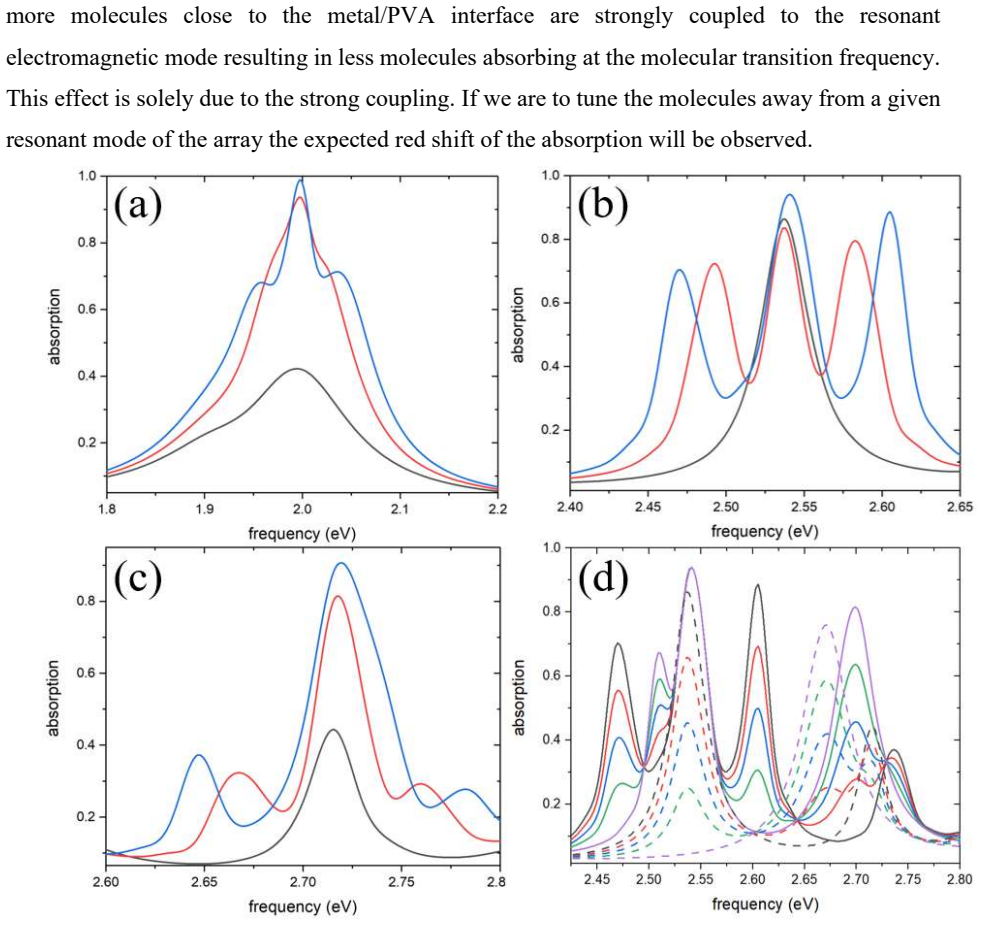
- [§3, Fig. 2a and Fig. 3c] The LSPR-molecule system is not in the strong-coupling regime according to the parameters reported in the paper itself. The LSPR at 1.99 eV has Q = 12, giving a FWHM of approximately 1.99/12 eV = 166 meV, and the molecular transition has a FWHM of 40 meV. The conventional strong-coupling criterion, Omega_R > (gamma_LSPR + gamma_mol)/2, gives a threshold of about 103 meV. The reported Rabi splitting of 78 meV is below this threshold, and even if one used the less stringent criterion of splitting larger than the broader linewidth, 78 meV < 166 meV. Therefore the assignment of the three peaks in Fig. 3c to the lower polariton, the LSPR, and the upper polariton is not justified by the data shown. Please either provide a clear strong-coupling criterion and show that it is satisfied, increase the molecular density or coupling strength so that the criterion is met, or reinterpret the three-peak structure without invoking polariton formation.
- [Abstract and Fig. 3b] The abstract states that the energy conversion efficiency in the second harmonic process is highest when the system is pumped at the LSPR, but no absolute efficiency is computed anywhere in the paper. Figure 3b shows normalized power spectra, not a conversion efficiency such as the ratio of second harmonic power to incident pump power. The relative comparison of normalized spectra may support the statement that the second harmonic signal is largest for LSPR pumping, but the term 'energy conversion efficiency' has a quantitative meaning that requires an absolute calculation. Please either compute and report the absolute second harmonic conversion efficiency for the compared pump frequencies or rephrase the claim to refer to relative second harmonic signal strength.
- [§3, paragraph after Fig. 3b] The third harmonic results are affected by the acknowledged limited spectral validity of the hydrodynamic Drude model. The authors state that the model is valid only in a limited spectral range and neglects core-electron contributions, yet the third harmonic from the 2.71 eV pump reaches approximately 8.1 eV, well above silver's interband transition threshold. The quantitative comparison of third harmonic intensities, including the factor of 36 attributed to the convective term, is therefore a correctness risk. The second harmonic claims near 4 eV are closer to the model's applicability, but even there the second harmonic from the 1.99 eV pump lies at 3.98 eV, near the interband edge. Please add an explicit discussion of how the limited model validity affects each harmonic, and consider marking the third harmonic results as indicative rather than quantitative.
minor comments (4)
- [Abstract] The sentence 'lineshapes of the second harmonic signal exhibits three peaks' has a subject-verb agreement error; it should be either 'the lineshape ... exhibits' or 'the lineshapes ... exhibit'.
- [Fig. 3 caption] The caption reads 'combined the transmitted and reflected energy'; the word 'combined' should be 'combining'.
- [Throughout, e.g., Fig. S1] The abbreviation 'LSRP' appears in the supplemental material and in one place in the main text; it should be 'LSPR' for consistency.
- [§3, Fig. 2 discussion] The blue shift of the central absorption peak at high molecular concentration is attributed to strong coupling and a decreasing effective refractive index; this explanation is not developed quantitatively and would benefit from a reference or a supporting calculation.
Circularity Check
No circular derivation: SHG and polariton three-peak claims come from direct FDTD integration of Maxwell–Bloch–hydrodynamic equations; the only self-citation (ref. 20) is illustrative, not load-bearing.
full rationale
The derivation chain is numerical: Eqs. (1), (3), and (6) are integrated directly, with literature silver parameters and fixed molecular parameters. The SH spectra in Fig. 3 are outputs of this integration, not fits to a model. The three-peak SH structure is read directly from the simulated power spectrum, and the statement 'The value calculated from Fig. 3c is 78 meV corresponds exactly to that obtained from linear absorption simulations' is a consistency check between two simulation outputs, not a fitted input renamed as a prediction. The only arguably self-citational moment is the sentence 'This observation is supported by the simple analytical model, which we recently proposed elsewhere.20'; this model is invoked to interpret the lineshape, but the observation itself is already established by the numerical simulation, so the citation is not load-bearing. The paper's caveat that the nonlinear Drude model 'is valid only in a limited spectral range' is an acknowledged validity limitation, not a circular step. The skeptic's concern that the LSPR Rabi splitting (78 meV) is below the strong-coupling threshold estimated from the paper's own linewidths is a physical-consistency/correctness issue, outside the circularity definition. No equation is defined in terms of the predicted observable, and no parameter is fitted to the target spectra.
Assumptions & free parameters
assumptions (3)
- domain assumption The nonlinear hydrodynamic Drude model (Eq. 3) accurately describes the second and third harmonic response of silver in the pump and harmonic frequency ranges used (1.99-2.71 eV pumps, up to about 8 eV harmonics).
- domain assumption Two-level Bloch equations (Eq. 6) with the stated dipole and decay parameters adequately model molecular emitters and their strong coupling to the array modes.
- domain assumption The FDTD discretization with 1.5 nm spatial resolution and 0.0025 fs time step yields numerically converged results for both linear and nonlinear spectra.
Cite this review
Pith. "Pith review of Plasmon enhanced second harmonic generation by periodic arrays of triangular nanoholes coupled to quantum emitters." pith.science (2026). https://pith.science/paper/PJG6N634
@misc{pith2026190801077,
  author       = {Pith},
  title        = {Pith review of: Plasmon enhanced second harmonic generation by periodic arrays of triangular nanoholes coupled to quantum emitters},
  year         = {2026},
  howpublished = {\url{https://pith.science/paper/PJG6N634}},
  note         = {Machine review of arXiv:1908.01077}
}
read the original abstract
Optical properties of periodic arrays of nanoholes of a triangular shape with experimentally realizable parameters are examined in both linear and nonlinear regimes. Utilizing fully vectorial three-dimensional approach based on the nonlinear hydrodynamic Drude model describing metal coupled to Maxwells equations and Bloch equations for molecular emitters we analyze linear transmission, reflection, and nonlinear power spectra. Rigorous numerical calculations demonstrating second and third harmonic generation by the triangular hole arrays are performed. It is shown that both the Coulomb interaction of conduction electrons and the convective term contribute on equal footing to the nonlinear response of metal. It is demonstrated that the energy conversion efficiency in the second harmonic process is the highest when the system is pumped at the localized surface plasmon resonance. When molecular emitters are placed on a surface of the hole array lineshapes of the second harmonic signal exhibits three peaks corresponding to second harmonics of the localized surface plasmon mode and upper and lower polaritonic states.
Figures


Figures from the paper (1 more)

Reference graph
Works this paper leans on
-
[1]
Barnes, W. L.; Murray, W. A., Plasmonic materials. Adv Mater 2007, 19 (22), 3771- 3782
work page 2007
-
[2]
Ebbesen, T. W.; Genet, C.; Bozhevolnyi, S. I., Surface-plasmon circuitry. Phys Today 2008, 61 (5), 44-50
work page 2008
-
[3]
Gramotnev, D. K.; Bozhevolnyi, S. I., Plasmonics beyond the diffraction limit. Nat Photonics 2010, 4 (2), 83-91
work page 2010
-
[4]
Schuller, J. A.; Barnard, E. S.; Cai, W. S.; Jun, Y. C.; White, J. S.; Brongersma, M. L., Plasmonics for extreme light concentration and manipulation. Nat Mater 2010, 9 (3), 193-204
work page 2010
-
[5]
I., Nanoplasmonics: past, present, and glimpse into future
Stockman, M. I., Nanoplasmonics: past, present, and glimpse into future. Opt Express 2011, 19 (22), 22029-22106
work page 2011
-
[6]
Martin-Moreno, L., Plasmonic circuits: Detecting unseen light. Nat Phys 2009, 5 (7), 457-458
work page 2009
-
[7]
Kauranen, M.; Zayats, A. V., Nonlinear plasmonics. Nat Photon 2012, 6 (11), 737-748
work page 2012
-
[8]
Butet, J.; Brevet, P.-F.; Martin, O. J. F., Optical Second Harmonic Generation in Plasmonic Nanostructures: From Fundamental Principles to Advanced Applications. Acs Nano 2015, 9 (11), 10545-10562
work page 2015
Show all 53 references
-
[9]
I.; Bergman, D
Stockman, M. I.; Bergman, D. J.; Anceau, C.; Brasselet, S.; Zyss, J., Enhanced Second- Harmonic Generation by Metal Surfaces with Nanoscale Roughness: Nanoscale Dephasing, Depolarization, and Correlations. Phys Rev Lett 2004, 92 (5), 057402. 17
2004
-
[10]
The Journal of Physical Chemistry C 2013, 117 (43), 22377-22382
Salomon, A.; Zielinski, M.; Kolkowski, R.; Zyss, J.; Prior, Y., Size and Shape Resonances in Second Harmonic Generation from Silver Nanocavities. The Journal of Physical Chemistry C 2013, 117 (43), 22377-22382
2013
-
[11]
J Opt-Uk 2014, 16 (11), 114012
Salomon, A.; Prior, Y.; Fedoruk, M.; Feldmann, J.; Kolkowski, R.; Zyss, J., Plasmonic coupling between metallic nanocavities. J Opt-Uk 2014, 16 (11), 114012
2014
-
[12]
Light: Science & Applications 2018, 7 (1), 49
Galanty, M.; Shavit, O.; Weissman, A.; Aharon, H.; Gachet, D.; Segal, E.; Salomon, A., Second harmonic generation hotspot on a centrosymmetric smooth silver surface. Light: Science & Applications 2018, 7 (1), 49
2018
-
[13]
Opt Express 2014, 22 (25), 30592-30606
Kolkowski, R.; Szeszko, J.; Dwir, B.; Kapon, E.; Zyss, J., Effects of surface plasmon polariton-mediated interactions on second harmonic generation from assemblies of pyramidal metallic nano-cavities. Opt Express 2014, 22 (25), 30592-30606
2014
-
[14]
L., Strong coupling between surface plasmon polaritons and emitters: a review
Törmä, P.; Barnes, W. L., Strong coupling between surface plasmon polaritons and emitters: a review. Reports on Progress in Physics 2015, 78 (1), 013901
2015
-
[15]
Journal of Physics: Condensed Matter 2017, 29 (44), 443003
Sukharev, M.; Nitzan, A., Optics of exciton-plasmon nanomaterials. Journal of Physics: Condensed Matter 2017, 29 (44), 443003
2017
-
[16]
J.; Lal, S.; Chang, W.-S.; Link, S.; Nordlander, P., Plasmons in Strongly Coupled Metallic Nanostructures
Halas, N. J.; Lal, S.; Chang, W.-S.; Link, S.; Nordlander, P., Plasmons in Strongly Coupled Metallic Nanostructures. Chem Rev 2011, 111 (6), 3913-3961
2011
-
[17]
J.; Salomon, A.; Prior, Y., Ultrafast energy transfer between molecular assemblies and surface plasmons in the strong coupling regime
Sukharev, M.; Seideman, T.; Gordon, R. J.; Salomon, A.; Prior, Y., Ultrafast energy transfer between molecular assemblies and surface plasmons in the strong coupling regime. Acs Nano 2014, 8 (1), 807-17
2014
-
[18]
M.; Tsakmakidis, K
Pusch, A.; Wuestner, S.; Hamm, J. M.; Tsakmakidis, K. L.; Hess, O., Coherent Amplification and Noise in Gain-Enhanced Nanoplasmonic Metamaterials: A Maxwell-Bloch Langevin Approach. Acs Nano 2012, 6 (3), 2420-2431
2012
-
[19]
M., Lasing in metamaterial nanostructures
Fang, A.; Koschny, T.; Soukoulis, C. M., Lasing in metamaterial nanostructures. J Opt- Uk 2010, 12 (2), 024013
2010
-
[20]
The Journal of Physical Chemistry C 2019, 123 (11), 6898-6904
Drobnyh, E.; Pachter, R.; Sukharev, M., Harmonic Generation by Metal Nanostructures Optically Coupled to Two-Dimensional Transition-Metal Dichalcogenide. The Journal of Physical Chemistry C 2019, 123 (11), 6898-6904
2019
-
[21]
N.; Pachter, R., Optical Response of Hybrid Plasmon–Exciton Nanomaterials in the Presence of Overlapping Resonances
Sukharev, M.; Day, P. N.; Pachter, R., Optical Response of Hybrid Plasmon–Exciton Nanomaterials in the Presence of Overlapping Resonances. ACS Photonics 2015, 2 (7), 935-941
2015
-
[22]
The Journal of Chemical Physics 2018, 148 (9), 094701
Sukharev, M.; Pachter, R., Effects of exciton-plasmon strong coupling on third harmonic generation by two-dimensional WS2 at periodic plasmonic interfaces. The Journal of Chemical Physics 2018, 148 (9), 094701
2018
-
[23]
K.; Kujalal, S.; Jefimovs, K.; Vallius, T.; Turunen, J.; Kauranen, M., Polarization effects in the linear and nonlinear optical responses of gold nanoparticle arrays
Canfield, B. K.; Kujalal, S.; Jefimovs, K.; Vallius, T.; Turunen, J.; Kauranen, M., Polarization effects in the linear and nonlinear optical responses of gold nanoparticle arrays. Journal of Optics A - Pure and Applied Optics 2005, 7 (2), S110-S117
2005
-
[24]
K.; Kauranen, M.; Svirko, Y.; Turunen, J., Multipolar analysis of second-harmonic radiation from gold nanoparticles
Kujala, S.; Canfield, B. K.; Kauranen, M.; Svirko, Y.; Turunen, J., Multipolar analysis of second-harmonic radiation from gold nanoparticles. Opt Express 2008, 16 (22), 17196-17208
2008
-
[25]
L., Hydrodynamic-model calculation of second-harmonic generation at a metal surface
Corvi, M.; Schaich, W. L., Hydrodynamic-model calculation of second-harmonic generation at a metal surface. Phys Rev B 1986, 33 (6), 3688-3695
1986
-
[26]
J.; Koch, S
Zeng, Y.; Hoyer, W.; Liu, J. J.; Koch, S. W.; Moloney, J. V., Classical theory for second-harmonic generation from metallic nanoparticles. Phys Rev B 2009, 79 (23), 235109
2009
-
[27]
R.; Hoyer, W.; Koch, S
Liu, J.; Brio, M.; Zeng, Y.; Zakharian, A. R.; Hoyer, W.; Koch, S. W.; Moloney, J. V., Generalization of the FDTD algorithm for simulations of hydrodynamic nonlinear Drude model. J Comput Phys 2010, 229 (17), 5921-5932. 18
2010
-
[28]
A.; de Ceglia, D.; Roppo, V.; Centini, M.; Akozbek, N.; Bloemer, M
Scalora, M.; Vincenti, M. A.; de Ceglia, D.; Roppo, V.; Centini, M.; Akozbek, N.; Bloemer, M. J., Second- and third-harmonic generation in metal-based structures. Phys Rev A 2010, 82 (4), 043828
2010
-
[29]
B.; Smith, D
Ciracì, C.; Pendry, J. B.; Smith, D. R., Hydrodynamic Model for Plasmonics: A Macroscopic Approach to a Microscopic Problem. ChemPhysChem 2013, 14 (6), 1109-1116
2013
-
[30]
Photonics 2015, 2 (2), 459
Zhao, Y.; Liu, J., FDTD for Hydrodynamic Electron Fluid Maxwell Equations. Photonics 2015, 2 (2), 459
2015
-
[31]
M.; Busch, K., Second Harmonic Generation from Metal Nano-Particle Resonators: Numerical Analysis On the Basis of the Hydrodynamic Drude Model
Hille, A.; Moeferdt, M.; Wolff, C.; Matyssek, C.; Rodríguez-Oliveros, R.; Prohm, C.; Niegemann, J.; Grafström, S.; Eng, L. M.; Busch, K., Second Harmonic Generation from Metal Nano-Particle Resonators: Numerical Analysis On the Basis of the Hydrodynamic Drude Model. The Journa...
2016
-
[32]
E.; So, V
Sipe, J. E.; So, V. C. Y.; Fukui, M.; Stegeman, G. I., Analysis of second-harmonic generation at metal surfaces. Phys Rev B 1980, 21 (10), 4389-4402
1980
-
[33]
Springer: Berlin ; New York, 1995; p xx, 532 p
Kreibig, U.; Vollmer, M., Optical properties of metal clusters. Springer: Berlin ; New York, 1995; p xx, 532 p
1995
-
[34]
Phys Rev B 2017, 95 (11), 115406
Sukharev, M.; Charron, E., Molecular plasmonics: The role of rovibrational molecular states in exciton-plasmon materials under strong-coupling conditions. Phys Rev B 2017, 95 (11), 115406
2017
-
[35]
M., Self-consistent calculation of metamaterials with gain
Fang, A.; Koschny, T.; Wegener, M.; Soukoulis, C. M., Self-consistent calculation of metamaterials with gain. Phys Rev B 2009, 79 (24), 241104
2009
-
[36]
A., Stimulated Raman adiabatic passage as a route to achieving optical control in plasmonics
Sukharev, M.; Malinovskaya, S. A., Stimulated Raman adiabatic passage as a route to achieving optical control in plasmonics. Phys. Rev. A 2012, 86 (4), 043406
2012
-
[37]
C., Computational electrodynamics : the finite-difference time- domain method
Taflove, A.; Hagness, S. C., Computational electrodynamics : the finite-difference time- domain method. 3rd ed.; Artech House: Boston, 2005
2005
-
[38]
A.; Gedney, S
Roden, J. A.; Gedney, S. D., Convolution PML (CPML): An efficient FDTD implementation of the CFS-PML for arbitrary media. Microwave and Optical Technology Letters 2000, 27 (5), 334-339
2000
-
[39]
Phys Rev A 2011, 84 (4), 043802
Sukharev, M.; Nitzan, A., Numerical studies of the interaction of an atomic sample with the electromagnetic field in two dimensions. Phys Rev A 2011, 84 (4), 043802
2011
-
[40]
F.; Mathew, T
Chan, T. F.; Mathew, T. P., Domain decomposition algorithms. Acta Numerica 1994, 3, 61-143
1994
-
[41]
L.; Murray, W
Barnes, W. L.; Murray, W. A.; Dintinger, J.; Devaux, E.; Ebbesen, T. W., Surface Plasmon Polaritons and Their Role in the Enhanced Transmission of Light through Periodic Arrays of Subwavelength Holes in a Metal Film. Phys Rev Lett 2004, 92 (10), 107401
2004
-
[42]
A.; Genet, C.; Ebbesen, T
Salomon, A.; Wang, S.; Hutchison, J. A.; Genet, C.; Ebbesen, T. W., Strong Light- Molecule Coupling on Plasmonic Arrays of Different Symmetry. ChemPhysChem 2013, 14 (9), 1882-1886
2013
-
[43]
ACS Applied Nano Materials 2019, 2 (3), 1285-1293
Segal, E.; Haleva, E.; Salomon, A., Ultrasensitive Plasmonic Sensor for Detecting Sub- PPB Levels of Alachlor. ACS Applied Nano Materials 2019, 2 (3), 1285-1293
2019
-
[44]
A., Plasmonics : fundamentals and applications
Maier, S. A., Plasmonics : fundamentals and applications. Springer, /: New York, 2007; p xxiv, 223 p
2007
-
[45]
J Phys B-at Mol Opt 2007, 40 (11), S283-S298
Sukharev, M.; Seideman, T., Coherent control of light propagation via nanoparticle arrays. J Phys B-at Mol Opt 2007, 40 (11), S283-S298
2007
-
[46]
G.; Seideman, T., Optical properties of metal nanoparticles with no center of inversion symmetry: Observation of volume plasmons
Sukharev, M.; Sung, J.; Spears, K. G.; Seideman, T., Optical properties of metal nanoparticles with no center of inversion symmetry: Observation of volume plasmons. Phys Rev B 2007, 76 (18), -. 19
2007
-
[47]
F.; Thio, T.; Grupp, D
Ghaemi, H. F.; Thio, T.; Grupp, D. E.; Ebbesen, T. W.; Lezec, H. J., Surface plasmons enhance optical transmission through subwavelength holes. Phys Rev B 1998, 58 (11), 6779- 6782
1998
-
[48]
J., Colloquium: Light scattering by particle and hole arrays
Garcia de Abajo, F. J., Colloquium: Light scattering by particle and hole arrays. Rev Mod Phys 2007, 79 (4), 1267. S1 Supplementary Material: Plasmon enhanced second harmonic generation by periodic arrays of triangular nanoholes coupled to quantum emitters Elena Drobnyh1 and M...
2007
-
[49]
Avoided crossing for molecules coupled to the LSPR mode. Fig. S1 shows resonant frequencies of the uppe r and lower polaritons near the LSPR mode (1.99 eV). Calculations are performed by sweeping molecular transition frequency through the LSPR, corresponding resonant frequenci...
-
[50]
Local EM field spatial distributions for the LSR, the Bragg plasmon, and the guiding mode. Fig. S2 shows EM field com ponents and the corresponding intensity as functions of X and Y distributions 20 nm above the input side of the array. Calculations are performed to obtain ste...
-
[51]
Nonlinear fields in the triangular hole arrays Having direct access to local electromagnetic field components we can examine spatial distributions of the second harmonic fields as well. Figs. S5, S6, S7 show steady-state distributions of the electromagnetic field and local int...
-
[52]
S8 shows angular distribut ions of the horizontally and vertically polar ized second harmonic signal for the Bragg plasmon mode and the guiding mode (see Fig
Angular properties of the second harmonic signal Fig. S8 shows angular distribut ions of the horizontally and vertically polar ized second harmonic signal for the Bragg plasmon mode and the guiding mode (see Fig. 4 in the paper for the LSPR distribution and details of calculat...
-
[53]
Thus we can in principle observe even harmonics at symmetric systems such as arrays of circular holes
Nonlinear fields in the circle hole arrays Since our approach is based on direct integr ation of Maxwell’s equations coupled to the equation on the macroscopic polarization, it accounts for a symmetry breaking in the direction of the incident field propagation. Thus we can in ...
Reviewed August 14, 2026 · model on record in the stance chip above.
Discussion (0). Continue with ORCID to comment.