REVIEW 2 major objections 5 minor 1 cited by
Phase sensitivity via photon-subtraction operations inside Mach-Zehnder interferometer
T0 review · 2 major / 5 minor · reviewed 2026-08-15 · deepseek-v4-flash
Pith's one-line read Multi-photon subtraction inside a Mach-Zehnder interferometer can push phase sensitivity below the Heisenberg limit, even under internal photon loss.
desk verdict Competent analytic study of photon subtraction inside an MZI, but the 'Heisenberg-limit breaking' relies on a post-selected photon-number resource count that ignores failed subtraction trials, and the appendix quadrature formulas need correction. read the letter →
The pith
A machine-rendered reading of the paper's core claim, the machinery that carries it, and where it could break.
The reading
What carries the argument
The load-bearing object is the universal moment formula $\langle \hat a^{\dagger p_1}\hat a^{p_2}\hat b^{\dagger q_1}\hat b^{q_2}\rangle = A^2 D_{m,n,p_1,p_2,q_1,q_2}e^M$, which expresses every expectation value needed for phase sensitivity and Fisher information as derivatives of a single generating function. The photon-subtraction operations $\hat a^m\hat b^n$ insert extra annihilation operators into that generating function, and the normalization constant $A$ is fixed by the same formula at zero photon-count moments. Phase sensitivity is then evaluated through the error-propagation formula for the chosen detection observable, and the lossy Fisher information is obtained from the purification bound $F_L = 4\eta\langle \hat n_a\rangle F / [(1-\eta)F+4\eta\langle \hat n_a\rangle]$. This machinery turns the whole scheme into a direct calculation of moments without truncating the state.
What would settle it
Measure or compute the phase sensitivity of scheme A with $m=2,3$ and mode-b homodyne detection using the total input photon number before the heralded subtraction, including discarded events; if $\Delta\phi$ is never below $1/\sqrt{N_{\rm in}}$ at $T=0.7$, the claimed sub-Heisenberg operation is an artifact of the resource accounting. A laboratory version would count the input coherent and squeezed photon flux and the heralding efficiency, then test whether the variance per trial beats the standard quantum limit.
Extended reading notes
Core claim
The central claim is that multi-photon subtraction performed inside the interferometer, through operations $\hat a^m$, $\hat b^n$, or $\hat a^m\hat b^n$ applied after the first beam splitter, reshapes the conditional output state so that phase estimation improves beyond what the same interferometer achieves without subtraction. For intensity detection, the intensity-difference observable $N_-$ is the best choice and the two-mode scheme $m=n=1$ gives the largest improvement, with schemes A and B identical. For homodyne detection, detecting the quadrature of mode $b$ is best, and only the mode-$a$ subtraction scheme improves sensitivity; at $m=2,3$ this scheme breaks the standard quantum limit and, at $m=3$ in the ideal case and $m=1$ under $T=0.7$ loss, breaks the Heisenberg limit $1/N$. The quantum Fisher information is enhanced by the subtraction, with the symmetric two-mode scheme performing best over wide parameter ranges. All of these conclusions use $N$ defined as the mean photon number of the post-subtraction state inside the interferometer.
Load-bearing premise
The comparison against the standard quantum limit and the Heisenberg limit uses $N$ as the mean photon number of the state after the probabilistic photon subtraction has succeeded, treating the subtracted photons and all failed herald events as free; if one instead counts the full input photon flux before subtraction, the claimed advantage may not survive.
Editorial extensions
If this is right
- For intensity detection, the intensity-difference observable $N_-$ is the best option, and the symmetric scheme $m=n=1$ gives the largest phase-sensitivity improvement among the three subtraction configurations.
- For homodyne detection, measuring the $b$-mode quadrature is optimal, and only subtracting photons from mode $a$ improves sensitivity; subtracting from mode $b$ or from both modes degrades it.
- Increasing the photon-subtraction number $m$ in scheme A improves both phase sensitivity and quantum Fisher information.
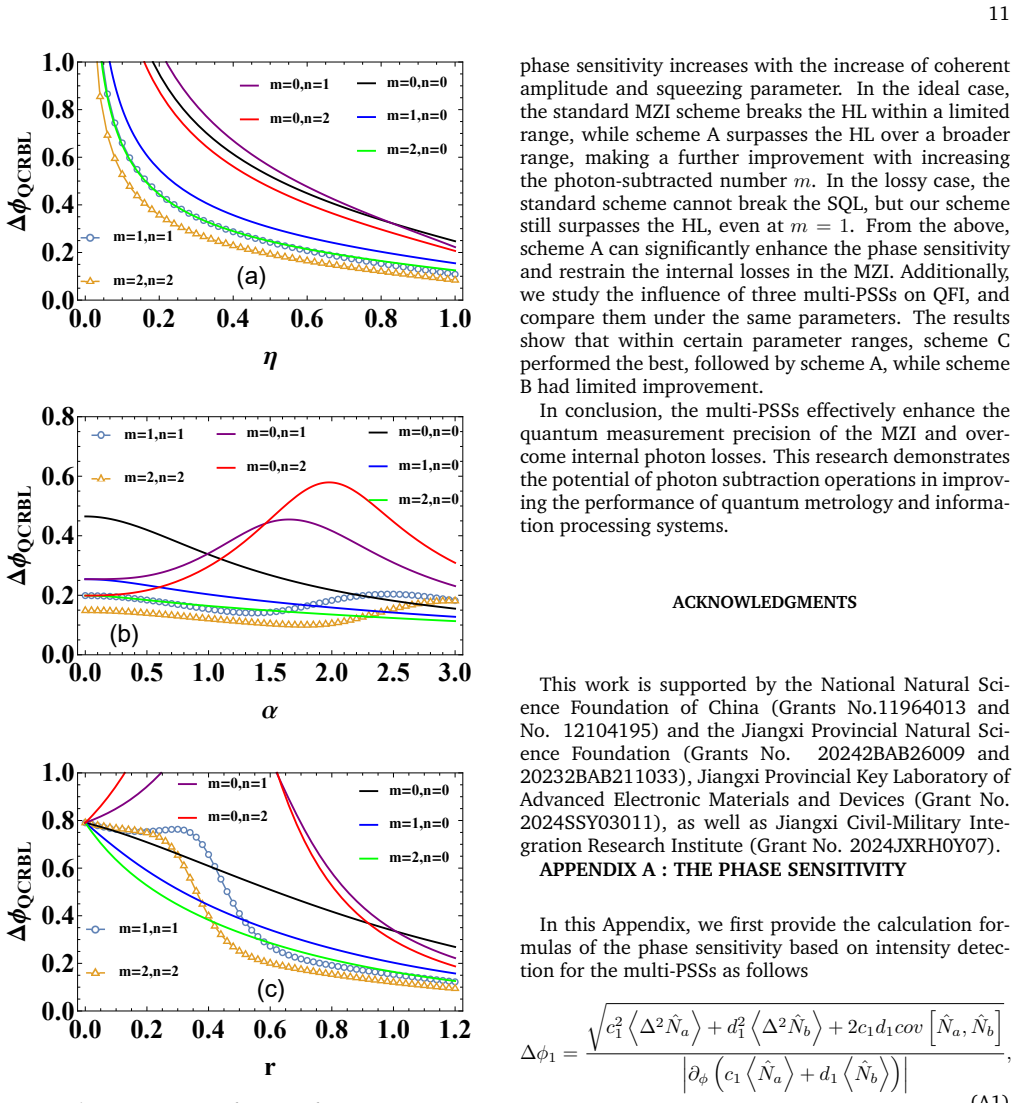
- Under internal photon loss with transmittance $T=0.7$, scheme A with mode-b homodyne detection still breaks the Heisenberg limit, whereas the standard MZI does not even reach the standard quantum limit.
- The symmetric scheme C gives the highest quantum Fisher information over wide parameter ranges, particularly at small coherent amplitude and larger squeezing.
Reading between the lines
- If the resource accounting is changed to include the photons consumed by the heralded subtraction and the failed subtraction events, the claimed beating of the SQL and HL may shrink or disappear; that accounting test is the most direct check of the practical advantage.
- The loss tolerance of scheme A suggests photon subtraction acts as a conditional non-Gaussian filter that reshapes the state toward one with higher Fisher information; comparing it against photon addition or photon catalysis at equal post-selected photon number would show how specific the effect is.
- The generating-function method used here can be applied directly to other non-Gaussian operations placed inside the interferometer, such as photon addition or number-conserving operations, and to other interferometric layouts.
Signed reviews
Editorial analysis
A structured set of objections, weighed in public.
Referee Report
Summary. The manuscript proposes a phase-estimation scheme in which m and n photons are subtracted from the two modes of a Mach-Zehnder interferometer after the first beam splitter, using a coherent state in mode a and a squeezed vacuum in mode b. It derives a generating-function expression for normally ordered moments of the output state and uses it to compute phase sensitivity for intensity and homodyne detection, together with ideal and lossy quantum Fisher information and quantum Cramér-Rao bounds. The central numerical claims are that photon subtraction improves phase sensitivity, that intensity-difference detection can surpass the standard quantum limit even with internal loss, and that mode-b homodyne detection can break the Heisenberg limit 1/N even under loss.
Significance. The analytic generating-function framework for arbitrary subtraction orders m and n is a useful methodological contribution, and the paper covers a broad parameter space in a systematic way, including both ideal and lossy operation. The manuscript contains no fitted parameters; all plotted curves are direct evaluations of the derived expressions, which is a positive feature. If the central claims survive a fair-resource accounting, the scheme would be interesting because it combines Gaussian inputs with experimentally feasible non-Gaussian operations and compares detection strategies under loss. However, the headline sub-Heisenberg claim currently rests on a conditional resource metric that needs to be tested, and the homodyne covariance formula in the appendix is incorrect.
major comments (2)
- [Eq. (12), Figs. 5 and 9, abstract] The SQL/HL comparison defines N by Eq. (12) as the mean photon number of the conditional post-subtraction state inside the interferometer. Because the subtraction a^m b^n is probabilistic, the resources actually consumed include all rejected trials; in the ideal projection model the success probability is p_success = 1/A^2, and the input mean photon number is |α|^2 + sinh^2 r. With the current definition, the claimed breaking of the Heisenberg limit in Fig. 9 and the abstract is a comparison against a limit evaluated for a smaller resource count than the one invested. A fair comparison should use N_fair = (|α|^2 + sinh^2 r)/p_success, or should include p_success in the QCRB in Eq. (21), e.g. Δϕ ≥ 1/sqrt(p_success v F). The manuscript does not provide such a check, so the headline loss-tolerant sub-Heisenberg claim is not supported as stated. In the lossy case this is especially acute, because loss further reduces the post-selected mean photon number used to draw the Heisenberg-limit curve.
- [Appendix A, Eqs. (A6)-(A8)] The homodyne formulas are inconsistent with the definition in Eq. (17). For X_a = (a+a†)/√2, the second moment is (1/2)(⟨a^2⟩+⟨a†^2⟩+2⟨a†a⟩+1), whereas Eq. (A6) uses the unnormalized form X = a+a†, and similarly for Eq. (A7). In addition, Eq. (A8) for cov[X_a, X_b] is identical in form to the intensity covariance in Eq. (A5); the true quadrature covariance must involve terms such as ⟨a b⟩, ⟨a b†⟩, ⟨a† b⟩, and ⟨a† b†⟩ minus the corresponding product of means. The single-quadrature cases X_a and X_b used in Figs. 6-9 are invariant under the missing global 1/√2 factor in the error-propagation ratio, so this may not change those curves, but the general formula as presented is wrong and would corrupt any optimized combination c2,d2 of quadratures. Please correct these expressions and confirm the numerical results with the corrected formulas.
minor comments (5)
- [Sec. II and Fig. 12] The operator order in Eq. (1) places the loss operator B_Lw after the photon subtraction a^m b^n, while Sec. IV.B and Fig. 12 are ambiguous about whether the loss occurs before or after the subtraction; please clarify the terminology and make the notation consistent.
- [Fig. 3 caption] The caption labels the panels as (a), (b), (c) but the text describes panel (a) twice; the panel labels should be corrected.
- [Eqs. (A5) and (A8)] There are typographical errors in the last factors, e.g. 'Dm,n1,1,0,0,eM' should be 'D_{m,n,1,1,0,0}e^M'; please fix these expressions.
- [References] Reference [24] is dated 1900; it should be 1990. Also, 'phonton losses' in Sec. II and 'experimentlly' in Sec. II should be corrected.
- [Sec. III.A.1.c] The text refers to 'Fig. 6(a)' and 'Fig. 6(b)' when discussing the SQL/HL comparison for intensity detection, but the relevant figure appears to be Fig. 5; the cross-references should be corrected.
Circularity Check
No significant circularity: all computed phase sensitivities and QFI values are direct analytic evaluations of the stated input states and operations; the SQL/HL comparison is a resource-accounting choice, not a circular reduction.
full rationale
The paper's derivation chain is self-contained. The output state is defined in Eq. (1) as a sequence of beam splitters, phase shift, losses, and photon-subtraction operations; the universal expectation formula Eq. (2) follows by differentiation of a generating function constructed from those operators. Phase sensitivities in Eqs. (A1)-(A8) are direct applications of the error-propagation formula Eq. (10) to the expectation values of intensity or quadrature operators, and the QFI in Eqs. (20) and (29) comes from the standard pure-state QFI formula Eq. (18) and the Escher et al. loss formula Eq. (28), both cited to independent external literature. No parameter is fitted to a subset of data and then renamed a prediction; the plotted curves are evaluations of the derived formulas with chosen input parameters (α, r, m, n, T). The SQL/HL comparison uses N defined in Eq. (12) as the mean photon number of the normalized post-subtraction state inside the MZI before the second beam splitter. That is a stated resource metric; whether it should instead count the photon flux consumed in failed heralding trials is a substantive physical criticism about post-selection accounting, but it is not a circularity, because N is not defined in terms of the quantity being predicted and the comparison does not presuppose the claimed advantage. Refs. [45] and [46] are by overlapping authors, but they are used only as motivation for studying internal photon operations, not as the mathematical basis for the new formulas; the universal formula, phase sensitivities, and QFI expressions are derived within this paper. Therefore there is no load-bearing circular step and the central result retains independent content.
Assumptions & free parameters
assumptions (5)
- domain assumption The fictitious-beam-splitter loss model with vacuum environment correctly describes internal photon losses in the interferometer.
- domain assumption The Escher purification-limit formula FL = 4η⟨n_a⟩F / ((1-η)F + 4η⟨n_a⟩) applies to the loss configuration considered here.
- ad hoc to paper The photon-subtraction operation â^m b^n is noiseless and its probabilistic success does not add to the resource count.
- standard math The error propagation formula (Eq. (10)) is a valid estimator of phase sensitivity for the states and measurements used.
- standard math The universal generating-function expression (Eqs. (2)-(8)) correctly computes the moments of the output state.
Cite this review
Pith. "Pith review of Phase sensitivity via photon-subtraction operations inside Mach-Zehnder interferometer." pith.science (2026). https://pith.science/paper/PJH66YYO
@misc{pith2026250504499,
  author       = {Pith},
  title        = {Pith review of: Phase sensitivity via photon-subtraction operations inside Mach-Zehnder interferometer},
  year         = {2026},
  howpublished = {\url{https://pith.science/paper/PJH66YYO}},
  note         = {Machine review of arXiv:2505.04499}
}
read the original abstract
Based on the conventional Mach-Zehnder interferometer, we propose a metrological scheme to improve phase sensitivity. In this scheme, we use a coherent state and a squeezed vacuum state as input states, employ multi-photon-subtraction operations and make intensity-detection or homodyne-detection. We study phase sensitivity, quantum Fisher information and quantum Cram\'er-Rao bound under both ideal and lossy conditions. The results indicate that choosing an appropriate detection method and photon subtraction scheme can significantly enhance the phase sensitivity and robustness against photon losses. Even under lossy conditions, the multi-photon subtraction schemes can surpass the standard quantum limit. Notably, the homodyne detection method can even break through the Heisenberg limit. Moreover, increasing the number of photon-subtracted can enhance both phase sensitivity and quantum Fisher information. This research highlights the significant value of this scheme in quantum precision measurement.
Figures


Figures from the paper (10 more)


Forward citations
Cited by 1 Pith paper
-
Fundamental limits of parameter estimation with heralded optical non-Gaussian states generated from Gaussian resources
For single-parameter phase estimation, the success-probability-weighted quantum Fisher information of any non-Gaussian state heralded from Gaussian resources through passive linear optics is no larger than the quantum...
Reference graph
Works this paper leans on
-
[1]
Phase sensitivity based on intensity difference detection Subsequently , we examine the phase sensitivity with scheme A based on intensity difference detectionN−, fo- cusing on the effects of several parameters such as the phase, the number of photons subtracted ( m), the co- herent amplitude α, and the squeezing parameter r. In order to facilitate analys...
-
[2]
Phase sensitivity based on homodyne detection Xb Now, we examine the phase sensitivity with scheme A based on homodyne detection Xb focusing on the influ- ence of its associated parameters. a. Ideal case We analyze the effects of the photons subtracted number m, coherent state amplitude, and squeezing parameter on the phase sensitivity . In Fig. 7, we plo...
-
[3]
Information theory and statistics[M]
Kullback S. Information theory and statistics[M]. Courier Corporation (1997)
work page 1997
-
[4]
Luis A. Equivalence between macroscopic quantum super- positions and maximally entangled states: Application to phase-shift detection[J]. Physical Review A, 64(5):54102 (2001)
work page 2001
-
[5]
Phase Sensitivity of a Mach-Zehnder Interferometer[J]
Pezze L, Smerzi A. Phase Sensitivity of a Mach-Zehnder Interferometer[J]. Physical Review A, 73(1):5689-5693 (2005)
work page 2005
-
[6]
Quantum states for Heisenberg-limited interferometry[J]
Uys H, Meystre P. Quantum states for Heisenberg-limited interferometry[J]. Physical Review A, 76(1):013804 (2007)
work page 2007
-
[7]
A gravitational wave ob- servatory operating beyond the quantum shot-noise limit
LIGO Scientific Collaboration. A gravitational wave ob- servatory operating beyond the quantum shot-noise limit. Nat Phys,7(12):962–965 (2011)
work page 2011
-
[8]
Boto A N, Kok P, Abrams D S, et al. Quantum Interfero- metric Optical Lithography: Exploiting Entanglement to Beat the Diffraction Limit [J]. Physical Review Letters, 85(13): 2733-6 (2000)
work page 2000
Show all 68 references
-
[9]
Measurement of the de Broglie Wavelength of a Multiphoton Wave Packet [J]
Fonseca E J S, Monken C H, P´adua S. Measurement of the de Broglie Wavelength of a Multiphoton Wave Packet [J]. Physical Review Letters, 82(14): 2868-71 (1999)
1999
-
[10]
Quantum imaging beyond the diffraction limit by optical centroid measurements[J]
Tsang M. Quantum imaging beyond the diffraction limit by optical centroid measurements[J]. Physical Review Letters, 102(25): 253601 (2009)
2009
-
[11]
Quantum spa- tial superresolution by optical centroid measurements[J]
Shin H, Chan K W C, Chang H J, et al. Quantum spa- tial superresolution by optical centroid measurements[J]. Physical Review Letters, 107(8): 083603 (2011)
2011
-
[12]
Optical atomic clocks [J]
Ludlow A D, Boyd M M, Ye J, et al. Optical atomic clocks [J]. Reviews of Modern Physics, 87(2): 637-701 (2015)
2015
-
[13]
Standards of Time and Frequency at the Outset of the 21st Century [J]
Diddams S A, Bergquist J C, Jefferts S R, et al. Standards of Time and Frequency at the Outset of the 21st Century [J]. Science, 306(5700): 1318-24 (2004)
2004
-
[14]
GW150914: Implications for the Stochastic Gravitational-Wave Background from Binary Black Holes[J]
Abbott B P, et al. GW150914: Implications for the Stochastic Gravitational-Wave Background from Binary Black Holes[J]. Physical Review Letters,116(13):131102 (2016)
2016
-
[15]
Detecting Gravitational-Wave Memory with LIGO: Implications of GW150914[J]
Lasky P D, Thrane E, Levin Y, et al. Detecting Gravitational-Wave Memory with LIGO: Implications of GW150914[J]. Physical Review Letters, 117(6):061102 (2016)
2016
-
[16]
S., Shaham, Y
Durfee, D. S., Shaham, Y. K., & Kasevich, M. A. Long-term stability of an area-reversible atom-interferometer Sagnac gyroscope. Physical review letters, 97(24), 240801 (2006)
2006
-
[17]
Correlated input-port, matter-wave inter- 13 ferometer: Quantum-noise limits to the atom-laser gyro- scope[J]
Dowling J P. Correlated input-port, matter-wave inter- 13 ferometer: Quantum-noise limits to the atom-laser gyro- scope[J]. Physical Review A, 57(6):4736-4746 (1998)
1998
-
[18]
Quantum Metrol- ogy[J]
Giovannetti V, Lloyd S, Maccone L. Quantum Metrol- ogy[J]. Physical Review Letters, 96(1):010401 (2006)
2006
-
[19]
Interferometric detection of op- tical phase shifts at the Heisenberg limit[J]
Holland M J, Burnett K. Interferometric detection of op- tical phase shifts at the Heisenberg limit[J]. Physical Re- view Letters, 71(9): 1355 (1993)
1993
-
[20]
Quantum-enhanced measurements: beating the standard quantum limit[J]
Giovannetti V, Lloyd S, Maccone L. Quantum-enhanced measurements: beating the standard quantum limit[J]. Science, 306(5700): 1330-1336 (2004)
2004
-
[21]
Quantum metrology from a quantum information science perspective[J]
T ´oth G, Apellaniz I. Quantum metrology from a quantum information science perspective[J]. Journal of Physics A: Mathematical and Theoretical, 47(42): 424006 (2014)
2014
-
[22]
On the general problem of quantum phase estimation [J]
D’Ariano G M, Macchiavello C, Sacchi M F. On the general problem of quantum phase estimation [J]. Physics Letters A, 248(2): 103-8 (1998)
1998
-
[23]
Quantum-mechanical noise in an interferom- eter[J]
Caves C M. Quantum-mechanical noise in an interferom- eter[J]. Physical Review D, 23(8): 1693 (1981)
1981
-
[24]
Quantum Metrology with Entangled Coherent States[J]
Joo J, Munro W J, and Spiller T P. Quantum Metrology with Entangled Coherent States[J]. Physical Review Let- ters, 107(8): p.94-97 (2011)
2011
-
[25]
Quantum optical metrology? - the low- down on high-N00N states[J]
Dowling J P. Quantum optical metrology? - the low- down on high-N00N states[J]. Contemporary Physics, 49(2):125-143 (2008)
2008
-
[26]
Two-photon interfer- ence in a Mach-Zehnder interferometer[J]
Rarity J R, Tapster P R, Jakeman E, Larchuk T, Campos R A, Teich M C, and Saleh B E A. Two-photon interfer- ence in a Mach-Zehnder interferometer[J]. Physical Re- view Letters,65(11):1348-1351 (1900)
1900
-
[27]
Quan- tum Metrology with Two-Mode Squeezed Vacuum: Parity Detection Beats the Heisenberg Limit[J]
Anisimov P M, Raterman G M, Chiruvelli A, et al. Quan- tum Metrology with Two-Mode Squeezed Vacuum: Parity Detection Beats the Heisenberg Limit[J]. Physical Review Letters, 104(10): p.103602.1-103602.4 (2010)
2010
-
[28]
SU(2) and SU(1,1) interferometers[J]
Yurke B, Mccall S L, Klauder J R. SU(2) and SU(1,1) interferometers[J]. Physical Review A, 33(6):4033-4054 (1986)
1986
-
[29]
P., & Zhang, Z
Wei, C. P., & Zhang, Z. M. Improving the phase sensitivity of a Mach–Zehnder interferometer via a nonlinear phase shifter. Journal of Modern Optics, 64(7), 743-749 (2017)
2017
-
[30]
F., Zhang, K., Chen, L
Jiao, G. F., Zhang, K., Chen, L. Q., Zhang, W., & Yuan, C. H. Nonlinear phase estimation enhanced by an actively correlated Mach-Zehnder interferometer. Physical Review A, 102(3), 033520 (2020)
2020
-
[31]
H., Zhang, W., & Chen, L
Huang, W., Liang, X., Yuan, C. H., Zhang, W., & Chen, L. Q. Optimal phase measurements in a lossy Mach– Zehnder interferometer with coherent input light. Results in Physics, 50,106574 (2023)
2023
-
[32]
Fab- rication and error analysis of a InGaAsP/InP polarization beam splitter based on an asymmetric Mach-Zehnder in- terferometer
Pan, P., Wen, J., Zha, S., Cai, X., Ma, H., & An, J. Fab- rication and error analysis of a InGaAsP/InP polarization beam splitter based on an asymmetric Mach-Zehnder in- terferometer. Optical Materials, 118, 111250 (2021)
2021
-
[33]
Parity- detection-based Mach-Zehnder interferometry with co- herent and non-Gaussian squeezed vacuum states as in- puts
Kumar, C., Rishabh, Sharma, M., & Arora, S. Parity- detection-based Mach-Zehnder interferometry with co- herent and non-Gaussian squeezed vacuum states as in- puts. Physical Review A, 108(1), 012605 (2023)
2023
-
[34]
B., Gao, F., Wang, Y
Tang, X. B., Gao, F., Wang, Y. X., Kuang, S., & Shuang, F. Non-Gaussian quantum states generation and robust quantum non-Gaussianity via squeezing field. Chinese Physics B, 24(3), 034208 (2015)
2015
-
[35]
Chen, X. Y. The entanglement properties of non-Gaussian states prepared by photon subtraction from two-mode squeezed thermal states. Physics Letters A, 372(17), 2976-2979 (2008)
2008
-
[36]
R., & Sabapathy , K
Su, D., Myers, C. R., & Sabapathy , K. K. Conversion of Gaussian states to non-Gaussian states using photon- number-resolving detectors. Physical Review A, 100(5), 052301 (2019)
2019
-
[37]
Success probability and perfor- mance optimization in non-Gaussian continuous-variable quantum teleportation
Kumar, C., & Arora, S. Success probability and perfor- mance optimization in non-Gaussian continuous-variable quantum teleportation. Physical Review A, 107(1), 012418 (2023)
2023
-
[38]
S., & Duc, T
Chuong, H. S., & Duc, T. M. Enhancement of non- Gaussianity and nonclassicality of pair coherent states by superposition of photon addition and subtraction. Jour- nal of Physics B: Atomic, Molecular and Optical Physics, 56(20), 205401 (2023)
2023
-
[39]
Y., Yang, C
Zhang, X. Y., Yang, C. Y., Wang, J. S., & Meng, X. G. Non- Gaussian quantum states generated via quantum catalysis and their statistical properties. Chinese Physics B, 33(4), 040308 (2024)
2024
-
[40]
N., & Guha, S
Gagatsos, C. N., & Guha, S. Efficient representation of Gaussian states for multimode non-Gaussian quantum state engineering via subtraction of arbitrary number of photons. Physical Review A, 99(5), 053816 (2019)
2019
-
[41]
Continuous Vari- able Quantum Teleportation in a Dissipative Environ- ment: Comparison of Non-Gaussian Operations Before and After Noisy Channel
Kumar, C., Sharma, M., & Arora, S. Continuous Vari- able Quantum Teleportation in a Dissipative Environ- ment: Comparison of Non-Gaussian Operations Before and After Noisy Channel. Advanced Quantum Technolo- gies, 7(4), 2300344 (2024)
2024
-
[42]
Zavatta,A.,Parigi,V.,Kim,M.S.,and.Bellini,M.,Subtracting photons from.arbitrary lightfields: Experimental test of coherent state invariance by single-photon annihila- tion[J].New Journal of Physics,10(12):123006 (2008)
2008
-
[43]
Wenger,J.,Tualle-Brouri,R.,and Grangier,P.,Non- Gaussian statistics from individual pulses of squeezed light[J].Physical Review Letters, 92(15):153601 (2004)
2004
-
[44]
High-probability photon catalysis with non- linear photon beam splitter
Zhang, S. High-probability photon catalysis with non- linear photon beam splitter. Optik, 276, 170638 (2023)
2023
-
[45]
K., & Panigrahi, P
Verma, M., Kumar, C., Mishra, K. K., & Panigrahi, P. K. Advantage of Non-Gaussian Operations in Phase Estima- tion via Mach–Zehnder Interferometer. Advanced Quan- tum Technologies, 2400192 (2024)
2024
-
[46]
Enhanced phase estima- tion in parity-detection-based Mach–Zehnder interferom- eter using non-Gaussian two-mode squeezed thermal in- put state
Kumar, C., Rishabh, & Arora, S. Enhanced phase estima- tion in parity-detection-based Mach–Zehnder interferom- eter using non-Gaussian two-mode squeezed thermal in- put state. Annalen der Physik, 535(8), 2300117 (2023)
2023
-
[47]
Y. K. Xu, T. Zhao, Q. Q. Kang, C. J. Liu, L. Y. Hu, and S. Q. Liu, Phase sensitivity of an SU(1,1) interferometer in photon-loss via photon operations, Opt. Express 31, 8414 (2023)
2023
-
[48]
Phase estimation via multi-photon subtraction inside the SU (1, 1) interferometer
Kang, Q., Zhao, Z., Xu, Y., Zhao, T., Liu, C., & Hu, L. Phase estimation via multi-photon subtraction inside the SU (1, 1) interferometer. Physica Scripta, 99(8), 085111 (2024)
2024
-
[49]
D., Spence, S
Parks, A. D., Spence, S. E., Troupe, J. E., & Rodecap, N. J. Tripartite loss model for Mach-Zehnder interferometers with application to phase sensitivity . Review of scientific instruments, 76(4) (2005)
2005
-
[50]
Non-Gaussian statistics from individual pulses of squeezed light
Wenger, J., Tualle-Brouri, R., & Grangier, P. Non-Gaussian statistics from individual pulses of squeezed light. Physi- cal review letters, 92(15), 153601 (2004)
2004
-
[51]
Demkowicz-Dobrza ´nski, M
R. Demkowicz-Dobrza ´nski, M. Jarzyna, and J.Kołody´nski, Quantum limits in optical interferometry , Prog. Optics 60, 345-435 (2015)
2015
-
[52]
Bradshaw, P
M. Bradshaw, P. K. Lam, and S. M. Assad, Ultimate pre- cision of joint quadrature parameter estimation with a Gaussian probe, Phys. Rev. A 97(1), 012106 (2018)
2018
-
[53]
Noise in Homodyne and Hetero- dyne Detection[J]
Yuen H P, Chan V W S. Noise in Homodyne and Hetero- dyne Detection[J]. Optics Letters, 8(3):177-179 (1983). 14
1983
-
[54]
Improving the phase super-sensitivity of squeezing-assisted interferometers by squeeze factor unbalancing[J]
Manceau M, Khalili F, Chekhova M. Improving the phase super-sensitivity of squeezing-assisted interferometers by squeeze factor unbalancing[J]. New Journal of Physics, 19(1):013014 (2017)
2017
-
[55]
Squeezed states of light[J]
Walls D. Squeezed states of light[J]. Nature, 306(5939):141-146 (1983)
1983
-
[56]
Pumped- Up SU(1,1) Interferometry[J]
Szigeti S S, Lewis-Swan R J, Haine S A. Pumped- Up SU(1,1) Interferometry[J]. Physical Review Letters, 118(15):150401 (2017)
2017
-
[57]
Phase sensitivity of a Mach-Zehnder interferometer with single-intensity and difference-intensity detection
Ataman, S., Preda, A., & Ionicioiu, R. Phase sensitivity of a Mach-Zehnder interferometer with single-intensity and difference-intensity detection. Physical Review A, 98(4), 043856 (2018)
2018
-
[58]
Opti- mal frequency measurements with maximally correlated states[J]
Bollinger J J, Itano W M, Wineland D J, et al. Opti- mal frequency measurements with maximally correlated states[J]. Physical Review A, 54(6):R4649-R4652 (1996)
1996
-
[59]
Quan- tum Metrology with Two-Mode Squeezed Vacuum: Parity Detection Beats the Heisenberg Limit[J]
Anisimov P M, Raterman G M, Chiruvelli A, et al. Quan- tum Metrology with Two-Mode Squeezed Vacuum: Parity Detection Beats the Heisenberg Limit[J]. Physical review letters, 104(10):p.103602.1-103602.4 (2010)
2010
-
[60]
C. M. Caves, Quantum-mechanical noise in an interfer- ometer, Phys. Rev. D 23(8), 1693 (1981)
1981
-
[61]
Assaf and Y
O. Assaf and Y. Ben-Aryeh, Quantum mechanical noise in coherent-state and squeezed-state Michelson interfer- ometers, J. Opt. B: Quantum Semiclass. Opt. 4(1), 49 (2002)
2002
-
[62]
Beltran and A
J. Beltran and A. Luis, Breaking the Heisenberg limit with inefficient detectors, Phys. Rev. A 72(4),045801 (2005)
2005
-
[63]
J. Liu, X. Jing, W. Zhong, and X. Wang, Quantum Fisher Information for density matrices with arbitrary ranks, Commun. Theor. Phys. 61, 45-50 (2014)
2014
-
[64]
Helstrom C W, Quantum detection and estimation theory (Academic), 123 (1976)
1976
-
[65]
C. W. Helstrom, Minimum mean-squared error of esti- mates in quantum statistics, Phys. Lett. A 25(2), 101 (1967)
1967
-
[66]
C. W. Helstrom, Quantum detection and estimation the- ory , J. Stat. Phys. 1(2), 231 (1969)
1969
-
[67]
B. M. Escher, R. L. de Matos Filho, and L. Davidovich, General framework for estimating the ultimate precision limit in noisy quantum-enhanced metrology , Nat. Phys. 7, 406 (2011)
2011
-
[68]
S. K. Chang, W. Ye, H. Zhang, L. Y. Hu, J. H. Huang, and S. Q. Liu, Improvement of phase sensitivity in an SU(1, 1) interferometer via a phase shift induced by a Kerr medium, Phys. Rev. A 105(3), 033704 (2022)
2022
Reviewed August 15, 2026 · model on record in the stance chip above.
Discussion (0). Continue with ORCID to comment.