ITGPT: Generative Pretraining on Irregular Timeseries
Pith reviewed 2026-05-20 20:39 UTC · model grok-4.3
The pith
ITGPT enables generative pretraining directly on irregular multimodal timeseries data.
A machine-rendered reading of the paper's core claim, the machinery that carries it, and where it could break.
Core claim
ITGPT is an attention-based architecture designed for handling multimodal, irregularly sampled timeseries by allowing training with both SSL losses and GPT-like objectives. It achieves state-of-the-art performance on the TIHM healthcare dataset and the CompX predictive maintenance dataset without requiring resampling, feature fusion or explicit data imputation. When labels are scarce, ITGPT effectively leverages unlabeled data through SSL and GPT training, outperforming the purely supervised approach.
What carries the argument
The ITGPT attention-based architecture that ingests raw irregular multimodal timeseries and trains end-to-end with self-supervised and generative pretraining losses.
If this is right
- State-of-the-art results on healthcare regression tasks with the TIHM dataset using irregular multimodal inputs.
- State-of-the-art results on predictive maintenance tasks with the CompX dataset without preprocessing steps.
- Improved accuracy over purely supervised training when only a small fraction of the data carries labels.
- Direct use of existing unlabeled sensor streams without resampling or explicit missing-value handling.
Where Pith is reading between the lines
- The same pretraining recipe could be tested on irregular data from environmental sensors or financial tick streams where labels are also sparse.
- If the architecture scales, it reduces the engineering effort spent on domain-specific cleaning pipelines before modeling.
- One could measure whether adding more unlabeled streams from additional modalities continues to lift downstream accuracy without extra labels.
Load-bearing premise
An attention-based architecture can be trained end-to-end on raw irregular multimodal timeseries using only SSL and GPT-like objectives and still produce accurate downstream predictions.
What would settle it
On the TIHM dataset with limited labels, a version of ITGPT trained only with standard supervised loss on imputed data matches or exceeds the performance of the full SSL-plus-GPT version.
Figures




read the original abstract
Timeseries regression models often struggle to leverage large volumes of labeled multimodal data, particularly when the data are irregularly sampled or contain missing values. This is common in domains like healthcare and predictive maintenance, where data are collected from unreliable sources, and labeling requires expert knowledge or costly equipments. Transformer-based large language models have proven effective on structured data such as text through self-supervised learning (SSL) and generative pretraining (GPT) frameworks. However, such models lack the flexibility to efficiently process irregularly sampled multimodal timeseries data. In this paper, we introduce ITGPT, an attention-based architecture designed for handling multimodal, irregularly sampled timeseries by allowing training with both SSL losses and GPT-like objectives. We evaluate its performance on a healthcare task with the TIHM dataset, and a predictive maintenance task with the CompX dataset. Our results demonstrate that ITGPT achieves state-of-the-art performance without requiring resampling, feature fusion or explicit data imputation. Furthermore, when labels are scarce, ITGPT effectively leverages unlabeled data through SSL and GPT training, outperforming the purely supervised approach. This represents an important step towards efficiently using large and unstructured timeseries datasets for practical inference tasks.
Editorial analysis
A structured set of objections, weighed in public.
Referee Report
Summary. The manuscript introduces ITGPT, an attention-based architecture for multimodal irregularly sampled timeseries. It supports end-to-end training via self-supervised learning (SSL) losses and GPT-like generative objectives without resampling, explicit imputation, or feature fusion. Evaluations on the TIHM healthcare dataset and CompX predictive maintenance dataset claim state-of-the-art results; in low-label regimes the model is said to outperform purely supervised baselines by leveraging large amounts of unlabeled data through pretraining.
Significance. If the performance gains are robust and attributable to the pretraining objectives rather than architecture capacity, the work would offer a practical route for applying generative pretraining to irregular multimodal timeseries in label-scarce domains. This could reduce reliance on costly preprocessing steps common in healthcare and maintenance applications. The approach extends successful NLP pretraining ideas to a new data modality, but the current evidence base is too thin to assess whether the central empirical claims hold.
major comments (2)
- [Experiments / low-label results] Low-label regime experiments (TIHM and CompX splits): no ablation compares a pretrained ITGPT against a randomly initialized ITGPT of identical architecture and capacity trained only with the supervised objective. Without this controlled comparison the claim that 'ITGPT effectively leverages unlabeled data through SSL and GPT training, outperforming the purely supervised approach' cannot be isolated from possible differences in model capacity or regularization.
- [Results / Tables] SOTA claims on TIHM and CompX: the manuscript provides no error bars, statistical significance tests, or detailed baseline descriptions (hyperparameters, training budgets, or exact preprocessing for competing methods). This weakens the assertion of state-of-the-art performance without resampling or imputation.
minor comments (2)
- [Abstract] Abstract states performance claims but omits quantitative metrics, dataset sizes, or any mention of error bars or statistical tests.
- [Model description] Notation for irregular sampling and multimodal fusion is introduced without a clear diagram or pseudocode showing how raw timestamps and modalities are fed into the attention layers.
Simulated Author's Rebuttal
We thank the referee for their constructive and detailed feedback. We address each major comment below and have revised the manuscript to strengthen the empirical claims.
read point-by-point responses
-
Referee: [Experiments / low-label results] Low-label regime experiments (TIHM and CompX splits): no ablation compares a pretrained ITGPT against a randomly initialized ITGPT of identical architecture and capacity trained only with the supervised objective. Without this controlled comparison the claim that 'ITGPT effectively leverages unlabeled data through SSL and GPT training, outperforming the purely supervised approach' cannot be isolated from possible differences in model capacity or regularization.
Authors: We agree that this controlled ablation is required to isolate the contribution of pretraining from architecture capacity. The original manuscript compared ITGPT to other supervised baselines but did not include a randomly initialized ITGPT trained only with the supervised loss. We have now run and added this exact comparison on the low-label splits of both TIHM and CompX. The new results show consistent gains from pretraining and are reported in the revised Section 4.3 and updated tables. revision: yes
-
Referee: [Results / Tables] SOTA claims on TIHM and CompX: the manuscript provides no error bars, statistical significance tests, or detailed baseline descriptions (hyperparameters, training budgets, or exact preprocessing for competing methods). This weakens the assertion of state-of-the-art performance without resampling or imputation.
Authors: We accept that the absence of error bars, significance tests, and baseline details weakens the SOTA claims. In the revision we have added standard deviations over five random seeds to all reported metrics, included paired t-test p-values against the strongest baseline, and expanded the experimental setup section with full hyperparameter tables, training budgets, and preprocessing descriptions for every competing method. These changes make the no-resampling/no-imputation advantage of ITGPT reproducible and statistically supported. revision: yes
Circularity Check
No circularity: empirical performance claims rest on experimental evaluation
full rationale
The paper introduces an attention-based architecture (ITGPT) for irregular multimodal timeseries and reports empirical results on the TIHM healthcare and CompX maintenance datasets. Central claims of state-of-the-art performance without resampling/imputation and effective leverage of unlabeled data via SSL/GPT objectives in low-label regimes are presented as outcomes of training and evaluation rather than any mathematical derivation, fitted parameter renamed as prediction, or self-citation chain that reduces to the inputs by construction. No equations, uniqueness theorems, or ansatzes are invoked in a load-bearing manner; the architecture is described as designed to handle the data characteristics, with results measured against baselines. This is a standard empirical ML paper whose validity hinges on experimental controls, not tautological reductions.
Axiom & Free-Parameter Ledger
Lean theorems connected to this paper
-
IndisputableMonolith/Cost/FunctionalEquation.leanwashburn_uniqueness_aczel unclear?
unclearRelation between the paper passage and the cited Recognition theorem.
gm(t, Xm,t)= ∑ t′∈τm,t α(m) t,t′ vt′ … Sim(qt,kt′)=exp(qT t kt′ / √dk) … qt = p(t) = […,sin(ωi t),cos(ωi t),…]
-
IndisputableMonolith/Foundation/ArithmeticFromLogic.leanLogicNat.induction unclear?
unclearRelation between the paper passage and the cited Recognition theorem.
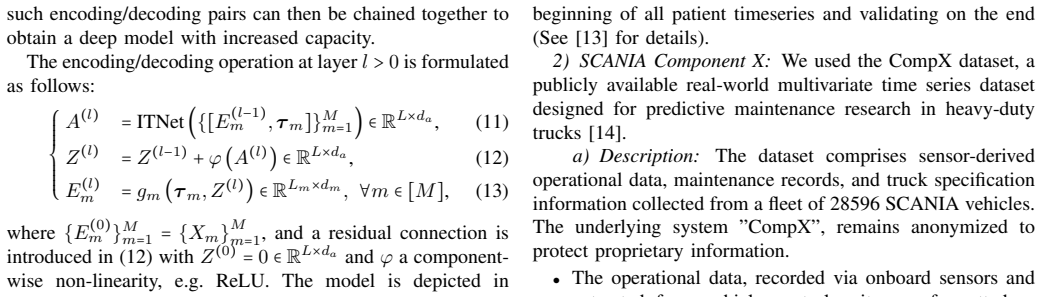
A(l) = ITNet({[E(l−1)m,τm]}M m=1) … Z(l)=Z(l−1)+φ(A(l)) … chaining of encoder/decoder pairs
What do these tags mean?
- matches
- The paper's claim is directly supported by a theorem in the formal canon.
- supports
- The theorem supports part of the paper's argument, but the paper may add assumptions or extra steps.
- extends
- The paper goes beyond the formal theorem; the theorem is a base layer rather than the whole result.
- uses
- The paper appears to rely on the theorem as machinery.
- contradicts
- The paper's claim conflicts with a theorem or certificate in the canon.
- unclear
- Pith found a possible connection, but the passage is too broad, indirect, or ambiguous to say the theorem truly supports the claim.
Reference graph
Works this paper leans on
-
[1]
Self-Supervised Multi- modal Learning: A Survey,
Y . Zong, O. M. Aodha, and T. M. Hospedales, “Self-Supervised Multi- modal Learning: A Survey,”IEEE Transactions on Pattern Analysis and Machine Intelligence, vol. 47, pp. 5299–5318, July 2025
work page 2025
-
[2]
Predictive maintenance in the Industry 4.0: A systematic literature review,
T. Zonta, C. A. da Costa, R. da Rosa Righi, M. J. de Lima, E. S. da Trindade, and G. P. Li, “Predictive maintenance in the Industry 4.0: A systematic literature review,”Computers & Industrial Engineering, vol. 150, p. 106889, Dec. 2020
work page 2020
-
[3]
Deep Learning for Health Informatics,
D. Rav `ı, C. Wong, F. Deligianni, M. Berthelot, J. Andreu-Perez, B. Lo, and G.-Z. Yang, “Deep Learning for Health Informatics,”IEEE Journal of Biomedical and Health Informatics, vol. 21, pp. 4–21, Jan. 2017
work page 2017
-
[4]
Self-Supervised Learning in Remote Sensing: A review,
Y . Wang, C. M. Albrecht, N. A. A. Braham, L. Mou, and X. X. Zhu, “Self-Supervised Learning in Remote Sensing: A review,”IEEE Geoscience and Remote Sensing Magazine, vol. 10, pp. 213–247, Dec. 2022
work page 2022
-
[5]
Self-supervised learning in medicine and healthcare,
R. Krishnan, P. Rajpurkar, and E. J. Topol, “Self-supervised learning in medicine and healthcare,”Nature Biomedical Engineering, vol. 6, pp. 1346–1352, Dec. 2022
work page 2022
-
[6]
A Survey on Self-Supervised Learning: Algorithms, Applications, and Future Trends,
J. Gui, T. Chen, J. Zhang, Q. Cao, Z. Sun, H. Luo, and D. Tao, “A Survey on Self-Supervised Learning: Algorithms, Applications, and Future Trends,”IEEE Transactions on Pattern Analysis and Machine Intelligence, vol. 46, pp. 9052–9071, Dec. 2024
work page 2024
-
[7]
Learning Transferable Visual Models From Natural Language Supervi- sion,
A. Radford, J. W. Kim, C. Hallacy, A. Ramesh, G. Goh, S. Agarwal, G. Sastry, A. Askell, P. Mishkin, J. Clark, G. Krueger, and I. Sutskever, “Learning Transferable Visual Models From Natural Language Supervi- sion,” inProceedings of the 38th International Conference on Machine Learning, pp. 8748–8763, PMLR, July 2021
work page 2021
-
[8]
Comparison of two measurement fusion methods for Kalman-filter-based multisensor data fusion,
Q. Gan and C. Harris, “Comparison of two measurement fusion methods for Kalman-filter-based multisensor data fusion,”IEEE Transactions on Aerospace and Electronic Systems, vol. 37, pp. 273–279, Jan. 2001
work page 2001
-
[9]
Recurrent Neural Networks for Multivariate Time Series with Missing Values,
Z. Che, S. Purushotham, K. Cho, D. Sontag, and Y . Liu, “Recurrent Neural Networks for Multivariate Time Series with Missing Values,” Scientific Reports, vol. 8, p. 6085, Apr. 2018
work page 2018
-
[10]
Learning to detect sepsis with a multitask Gaussian process RNN classifier,
J. Futoma, S. Hariharan, and K. Heller, “Learning to detect sepsis with a multitask Gaussian process RNN classifier,” inProceedings of the 34th International Conference on Machine Learning(D. Precup and Y . W. Teh, eds.), vol. 70 ofProceedings of Machine Learning Research, pp. 1174–1182, PMLR, Aug. 2017
work page 2017
-
[11]
ITNet: Irregular Timeseries Data Fusion with Attention Mechanisms,
A. Honor ´e, P. Appelquist, and M. Xiao, “ITNet: Irregular Timeseries Data Fusion with Attention Mechanisms,” in2025 28th International Conference on Information Fusion (FUSION), pp. 1–7, July 2025
work page 2025
-
[12]
A. Vaswani, N. Shazeer, N. Parmar, J. Uszkoreit, L. Jones, A. N. Gomez, L. Kaiser, and I. Polosukhin, “Attention Is All You Need,” Dec. 2017
work page 2017
-
[13]
TIHM: An open dataset for remote healthcare monitoring in dementia,
F. Palermo, Y . Chen, A. Capstick, N. Fletcher-Loyd, C. Walsh, S. Kouchaki, J. True, O. Balazikova, E. Soreq, G. Scott, H. Rostill, R. Nilforooshan, and P. Barnaghi, “TIHM: An open dataset for remote healthcare monitoring in dementia,”Scientific Data, vol. 10, p. 606, Sept. 2023
work page 2023
-
[14]
Z. Kharazian, T. Lindgren, S. Magn ´usson, O. Steinert, and O. Anders- son Reyna, “SCANIA Component X dataset: A real-world multivariate time series dataset for predictive maintenance,”Scientific Data, vol. 12, p. 493, Mar. 2025. APPENDIX A. Position encoding The samples can be irregularly spaced across observations or modalities. Let δ(i) m =[0, t (i) m,...
work page 2025
-
[15]
Normalization:Perturbation strategies were used to en- sure data privacy and commercial confidentiality. The original timestamps and the true variable names were removed from the data, and feature values were scaled with an undisclosed factor. According to the authors, the dataset retains its utility for a wide range of machine learning tasks, including c...
-
[16]
Labeling:To ensure label quality, only vehicles with a complete service history within the SCANIA workshop network were included. This restriction avoids ambiguities arising from missing third-party repair data and helps reduce label noise. However, it does introduce selection bias toward vehicles that consistently use SCANIA-authorized mainte- nance serv...
work page 2099
discussion (0)
Sign in with ORCID, Apple, or X to comment. Anyone can read and Pith papers without signing in.